

What do you think?

The Tyrant Philosophers #3
Days of Shattered Faith
Welcome to Alkhalend, Jewel of the Waters, capital of Usmai, greatest of the Successor States, inheritor to the necromantic dominion that was the Moeribandi Empire and tomorrow's frontline in the Palleseen's relentless march to bring Perfection and Correctness to an imperfect world.
Loret is fresh off the boat, and just in time.
As Cohort-Invigilator of Correct Appreciation, Outreach department, she's here as aide to the Palleseen Resident, Sage-Invigilator Angilly. And Sage-Invigilator Angilly – Gil to her friends – needs a second in the spectacularly illegal, culturally offensive and diplomatically inadvisable duel she must fight at midnight.
Outreach, that part of the Pal machine that has to work within the imperfection of the rest of the world, has a lot of room for the illegal, the unconventional, the unorthodox. But just how much unorthodoxy can Gil and Loret get away with?
As a succession crisis looms, as a long-forgotten feat of necromantic engineering nears fruition, as pirate kings, lizard armies and demons gather, as old gods wane and new gods wax, sooner or later Gil and Loret will have to settle their ledger.
Just as well they are both very, very good with a blade…
THE TYRANT PHILOSOPHERS SERIES
'Endlessly creative . . . so much invention peeking around every corner - Patrick Ness
'Dense, dark, ingenious, ironic, complex, often funny, and always smart' Locus
'A master at the height of his powers. This is epic symphonic fantasy, weaving a breakneck plot through a sumptuously dangerous world' Ian Green
Loret is fresh off the boat, and just in time.
As Cohort-Invigilator of Correct Appreciation, Outreach department, she's here as aide to the Palleseen Resident, Sage-Invigilator Angilly. And Sage-Invigilator Angilly – Gil to her friends – needs a second in the spectacularly illegal, culturally offensive and diplomatically inadvisable duel she must fight at midnight.
Outreach, that part of the Pal machine that has to work within the imperfection of the rest of the world, has a lot of room for the illegal, the unconventional, the unorthodox. But just how much unorthodoxy can Gil and Loret get away with?
As a succession crisis looms, as a long-forgotten feat of necromantic engineering nears fruition, as pirate kings, lizard armies and demons gather, as old gods wane and new gods wax, sooner or later Gil and Loret will have to settle their ledger.
Just as well they are both very, very good with a blade…
THE TYRANT PHILOSOPHERS SERIES
'Endlessly creative . . . so much invention peeking around every corner - Patrick Ness
'Dense, dark, ingenious, ironic, complex, often funny, and always smart' Locus
'A master at the height of his powers. This is epic symphonic fantasy, weaving a breakneck plot through a sumptuously dangerous world' Ian Green
582 pages, Kindle Edition
First published December 5, 2024
About the author
Adrian Tchaikovsky
198 books20.1k followersADRIAN TCHAIKOVSKY was born in Lincolnshire and studied zoology and psychology at Reading, before practising law in Leeds. He is a keen live role-player and occasional amateur actor and is trained in stage-fighting. His literary influences include Gene Wolfe, Mervyn Peake, China Miéville, Mary Gently, Steven Erikson, Naomi Novak, Scott Lynch and Alan Campbell.
Ratings & Reviews
Friends & Following
Create a free account to discover what your friends think of this book!
Community Reviews
Displaying 1 - 30 of 369 reviews

March 2, 2025
There’s a reason Adrian Tchaikovsky is one of my all-time favorite writers. And that reason is the consistent quality of his books that stay good and interesting and thought-out without insulting his readers’ intelligence.
Despite being the third book in this series, Days of Shattered Faith can completely stand on its own since each story has its own setting and set of characters (although having read the first two helps appreciate some seemingly small details - but you don’t have to read them to understand this one).
Again we are in the world where the ever-expansionist state of Pallesand has set its sights on takeover of another country, with little difference between “peaceful” takeover and “liberation” via invasion. Pallesand is a country built on “perfection”, with seeming goal of bringing the culture of rationality to the others, together with bureaucratically precise censorship and desire to squeeze out all the resources while turning other countries into heavily dependent colonies and slowly decaying into authoritarianism. But the places Pallesand takes over are also hard to root for, with corruption of the monarchies and superstitions and their own bloodlust and expansionist desires, and their own bloody battles for power rife to be exploited by others.
And if it uncomfortably sounds like so many things in our modern world, then you’ve been paying attention to the world.
By setting every book of this series in a different place of this world, Tchaikovsky never gets to skate by just on the worldbulding that has been done but rather starts anew in each place— and I suspect he does this precisely because he’s so good with his incredible imagination and ability to set up a sense of place and culture quickly that he just has fun with it. (And yes, it wouldn’t be Tchaikovsky without including at least a few insectoid characters, of course!). He plays with the narrative style, effortlessly switching between mosaic-style omniscient narration and limited point-of-view perspective, from zeroing in on the minute battle details to the eagle-eye overview of time and place.
The theme that stood out to me in Days of Shattered Faith is loyalty and the pain it can bring. Loyalties that are divided and clash and yet all are important - to friends and loved ones and countries and faiths and the allures of the past and the promises and threats of the future. All these loyalties compete and pull you in different directions, and the choices between those are rarely clear-cut. Inevitably there will be betrayal and heartbreak and pain and the absence of artificially happy reader-pleasing resolutions.
(And of course there are those whose loyalties lie just along the lines of power or money and the dilemma of right and wrong never troubles their callously calculating sociopathic selves. Also just like in our world, of course.)
I usually prefer Tchaikovsky’s science fiction works to his fantasy works, but with this series I’m starting to like them equally. The guy is a master of his craft, and I am so happy that he seems to never get tired of writing, since I’m so here for everything he chooses to write next.
5 stars.
——————
Also posted on my blog.
——————
Thanks to NetGalley and Bloomsbury USA | Head of Zeus -- an AdAstra Book for providing me with a digital ARC in exchange for an honest review.
Despite being the third book in this series, Days of Shattered Faith can completely stand on its own since each story has its own setting and set of characters (although having read the first two helps appreciate some seemingly small details - but you don’t have to read them to understand this one).
“And all too often freedom hurts far more than the safe close walls of obedience, and so much the better for that.”
Again we are in the world where the ever-expansionist state of Pallesand has set its sights on takeover of another country, with little difference between “peaceful” takeover and “liberation” via invasion. Pallesand is a country built on “perfection”, with seeming goal of bringing the culture of rationality to the others, together with bureaucratically precise censorship and desire to squeeze out all the resources while turning other countries into heavily dependent colonies and slowly decaying into authoritarianism. But the places Pallesand takes over are also hard to root for, with corruption of the monarchies and superstitions and their own bloodlust and expansionist desires, and their own bloody battles for power rife to be exploited by others.
And if it uncomfortably sounds like so many things in our modern world, then you’ve been paying attention to the world.
By setting every book of this series in a different place of this world, Tchaikovsky never gets to skate by just on the worldbulding that has been done but rather starts anew in each place— and I suspect he does this precisely because he’s so good with his incredible imagination and ability to set up a sense of place and culture quickly that he just has fun with it. (And yes, it wouldn’t be Tchaikovsky without including at least a few insectoid characters, of course!). He plays with the narrative style, effortlessly switching between mosaic-style omniscient narration and limited point-of-view perspective, from zeroing in on the minute battle details to the eagle-eye overview of time and place.
“And Loret made a sound, a squeak really. It probably sounded like fear or laughter, but it was empathy. She read, in those horrors, a single unified plea, and it was one she knew. Don’t send me back. They had been prisoners. They had been locked in skulls and jars, buried for centuries. They had known cruelty, these things that had been shaped for cruel deeds by cruel masters. The uniform wasn’t freedom but it was better than the alternative.”
The theme that stood out to me in Days of Shattered Faith is loyalty and the pain it can bring. Loyalties that are divided and clash and yet all are important - to friends and loved ones and countries and faiths and the allures of the past and the promises and threats of the future. All these loyalties compete and pull you in different directions, and the choices between those are rarely clear-cut. Inevitably there will be betrayal and heartbreak and pain and the absence of artificially happy reader-pleasing resolutions.
(And of course there are those whose loyalties lie just along the lines of power or money and the dilemma of right and wrong never troubles their callously calculating sociopathic selves. Also just like in our world, of course.)
I usually prefer Tchaikovsky’s science fiction works to his fantasy works, but with this series I’m starting to like them equally. The guy is a master of his craft, and I am so happy that he seems to never get tired of writing, since I’m so here for everything he chooses to write next.
5 stars.
——————
Also posted on my blog.
——————
Thanks to NetGalley and Bloomsbury USA | Head of Zeus -- an AdAstra Book for providing me with a digital ARC in exchange for an honest review.

December 28, 2024
Tyrant Philosophers is a tremendous series that should be more widely read and, you know, maybe it would be if *I* didn't like it so much.
This one is even more contained than HOUSE which was more contained than CITY, but Tchaikovsky's prose continues to impress and his ability to get us to care about the 'bad guys', the conquerors and imperialists, even as they do conquest and imperial things is mind-boggling. Sometimes while reading this, I thought to myself, 'you know, these guys need some Perfection a la Palaseen Sway because I personally can't stand them'. These books, more than any others I've read by Tchaikovsky, always keep you guessing at how they'll turn out and the 'good guys' do not, in fact, always win.
This book, even more than HOUSE and CITY discusses the destruction of culture, the coexistance of diametrically opposed (foes) societies, warring ideologies, and that the right thing is often not the best thing, which is something that gives me the heebidy-jeebidies. Stellar military action, crushing heartbreak, and discussions on belief, duty, and where our loyalties truly lie.
5 stars, but is probably my least favorite of the three but only just. I felt a little adrift at times, wondering where we were all headed, especially in the last third, one POV in particular, but that doesn't alter the fact that this is one of the great series of our times.
Thanks to the author, Head of Zeus, and Netgalley for the ARC!
This one is even more contained than HOUSE which was more contained than CITY, but Tchaikovsky's prose continues to impress and his ability to get us to care about the 'bad guys', the conquerors and imperialists, even as they do conquest and imperial things is mind-boggling. Sometimes while reading this, I thought to myself, 'you know, these guys need some Perfection a la Palaseen Sway because I personally can't stand them'. These books, more than any others I've read by Tchaikovsky, always keep you guessing at how they'll turn out and the 'good guys' do not, in fact, always win.
This book, even more than HOUSE and CITY discusses the destruction of culture, the coexistance of diametrically opposed (foes) societies, warring ideologies, and that the right thing is often not the best thing, which is something that gives me the heebidy-jeebidies. Stellar military action, crushing heartbreak, and discussions on belief, duty, and where our loyalties truly lie.
5 stars, but is probably my least favorite of the three but only just. I felt a little adrift at times, wondering where we were all headed, especially in the last third, one POV in particular, but that doesn't alter the fact that this is one of the great series of our times.
Thanks to the author, Head of Zeus, and Netgalley for the ARC!

March 13, 2025
Reread 3/26. Another excellent installment and graced with awesome cover art.
I found each book in this series better than the last, and City of Last Chances, the first, I rated a bold 4 stars. Whew, Tchaikovsky really nailed it with this series and I hope to see more volumes in the future. While we have a few characters from previous novels in the series here, Days of Shattered Faith Tchaikovsky set this tale in a different place from the previous two volumes (this seems to be a trademark of the series), a kingdom on the Successor Coast.
The backdrop remains the same, however. The Palleseen continue their relentless march to 'perfect' the rest of the world, stamping out gods, religion and other 'imperfect' stuff, all the while transforming the magic of the world into basically batteries and ammo for their weapons. Alkhalend, the capitol city of Usmai, where most of this tale takes place, has entered relations with the Palleseen, the first step to eventual conquest as the Palleseen Sway continues. Hard to point to a main protagonist with this wide cast, but Sage-Invigilator 'Gil' Angilly, the Palleseen 'Resident' in Usmai comes the closest. The book start with her receiving her new Aide Loret just as she is heading out to a duel. This definitely starts with a bang!
The Usmiat royal family has been in power for generations but the current 'Tranquility' Oparan is very old, blind, and one of his sons will sit on the throne soon. The eldest, Gorbudan, the 'warrior prince', earned enough disfavor with his father that he had him exiled, leaving the second son, Dekamran, next in line. Gil and Dekamran are close, perhaps too close for the Pal rulebook. When Gil first came to Usmia, Dekamran was just the quite, scholarly type, destined to be overshadowed by his older brother. The Palleseen in Usmia were on the fringes as well; word gets around regarding what they do when they get their hooks in a nation! Nonetheless, with Gorbudan out and Dekamran in, the Pals rise in favor as well...
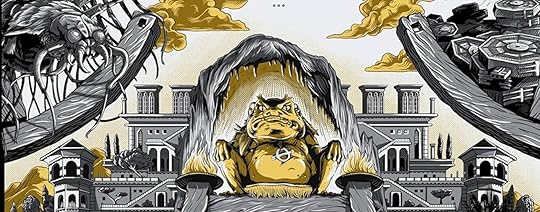
Tchaikovsky weaves together here a brilliant cast of characters into a complex, intriguing plot with many different levels. The deepest level concerns the expansionist Palleseen, a theme in all three books in the series. Here, the juggernaut Palleseen may be showing some cracks, but I will skip this to avoid spoilers. We also have the subtext critique of war, another theme in the series. Does might make right? The Palleseen think so. We also have the complex relationship between religion and gods (the main god of Usmia is a giant frog!) and the population at large. Riding on top of all this Tchaikovsky tells a tale of classic feudal intrigue regarding the throne of Usmia, the sneakiness of the Palleseen as they make steady inroads into Usmia and the surrounding states, and finally, the complex dynamics among the broad cast.
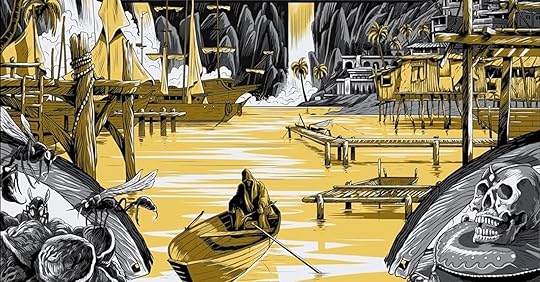
I rarely give out 5 stars, but this one earned it. Great stuff! I really hope he continues with this series as it is one of his best for sure. Oh, did I mention the amazing cover art by Joe Wilson?
I found each book in this series better than the last, and City of Last Chances, the first, I rated a bold 4 stars. Whew, Tchaikovsky really nailed it with this series and I hope to see more volumes in the future. While we have a few characters from previous novels in the series here, Days of Shattered Faith Tchaikovsky set this tale in a different place from the previous two volumes (this seems to be a trademark of the series), a kingdom on the Successor Coast.
The backdrop remains the same, however. The Palleseen continue their relentless march to 'perfect' the rest of the world, stamping out gods, religion and other 'imperfect' stuff, all the while transforming the magic of the world into basically batteries and ammo for their weapons. Alkhalend, the capitol city of Usmai, where most of this tale takes place, has entered relations with the Palleseen, the first step to eventual conquest as the Palleseen Sway continues. Hard to point to a main protagonist with this wide cast, but Sage-Invigilator 'Gil' Angilly, the Palleseen 'Resident' in Usmai comes the closest. The book start with her receiving her new Aide Loret just as she is heading out to a duel. This definitely starts with a bang!
The Usmiat royal family has been in power for generations but the current 'Tranquility' Oparan is very old, blind, and one of his sons will sit on the throne soon. The eldest, Gorbudan, the 'warrior prince', earned enough disfavor with his father that he had him exiled, leaving the second son, Dekamran, next in line. Gil and Dekamran are close, perhaps too close for the Pal rulebook. When Gil first came to Usmia, Dekamran was just the quite, scholarly type, destined to be overshadowed by his older brother. The Palleseen in Usmia were on the fringes as well; word gets around regarding what they do when they get their hooks in a nation! Nonetheless, with Gorbudan out and Dekamran in, the Pals rise in favor as well...
Tchaikovsky weaves together here a brilliant cast of characters into a complex, intriguing plot with many different levels. The deepest level concerns the expansionist Palleseen, a theme in all three books in the series. Here, the juggernaut Palleseen may be showing some cracks, but I will skip this to avoid spoilers. We also have the subtext critique of war, another theme in the series. Does might make right? The Palleseen think so. We also have the complex relationship between religion and gods (the main god of Usmia is a giant frog!) and the population at large. Riding on top of all this Tchaikovsky tells a tale of classic feudal intrigue regarding the throne of Usmia, the sneakiness of the Palleseen as they make steady inroads into Usmia and the surrounding states, and finally, the complex dynamics among the broad cast.
I rarely give out 5 stars, but this one earned it. Great stuff! I really hope he continues with this series as it is one of his best for sure. Oh, did I mention the amazing cover art by Joe Wilson?

December 16, 2024
Once could have been a fluke, twice a coincidence. Three times? No, it's time to say it: The Tyrant Philosophers is swiftly becoming one of my favourite ongoing series.
- Spoiler Free Review -
The previous two books in the series, City of Last Chances and House of Open Wounds, were, essentially, standalone novels set in the same world and with one or two recurring characters. Days of Shattered Faith follows a similar format, but does start to feel a little more dependent on the previous book(s) than the others.
Could you read it as a standalone? Yes, I believe you could. There are, however, a number of characters whose backgrounds will not be explored in this book, but if you've read the previous two then you'll know who they are and their decisions and actions will be much more meaningful. I also think the Palleseen Sway comes across a bit differently, especially in the first half of the book, if you've read the previous books. So, while I think you could just pick this up and read it if you want to, I'd recommend reading the previous two books first.
What's it about?
In City of Last Chances, we saw what happened after the Palleseen Sway occupied a conquered city. In House of Open Wounds we watched them fighting a war of conquest. In Days of Shattered Faith, we see the Palleseen Sway just beginning to slide its hooks into an independent kingdom with the aim of 'perfecting' it - a kingdom which is mired in its own political problems and power struggles.
We mostly follow Gil - or Palleseen Resident Sage-Invigilator Angilly, to give her her full title. She is, essentially, the Palleseen ambassador to the kingdom of Usmai, and her brief is to further Palleseen interests there. We also follow Loret, her new and rather hapless aide, and a selection of other characters, powerful and humble, who reside in the Usmai capital of Alkhalend.
What makes this book so good?
I think I mention this every time I read a Tchaikovsky book, but his prose really is outstanding! He shines, no matter whether he's writing action, emotion, description, dialogue, a character's inner thoughts, or some combination of all of the above. He also weaves a subtle, dry humour through many of his scenes that never feels distracting (like he's setting up punchlines or sacrificing atmosphere for a cheap laugh) but will leave you grinning and chuckling at the absurdity of the situations these characters have found themselves in. It's honestly just a pleasure to read Tchaikovsky's prose!
The characters are another highlight. Gil, in particular, feels like a character that (especially if you've read the previous two books, and know how the Pals tend to operate) shouldn't be easy to like. And yet... She gives the Palleseen Sway a human face, and it's a surprisingly sympathetic one. A large part of her character arc involves the difficulty in balancing her personal feelings against the duty she has as a Pal in an 'imperfect' nation, and this is a really interesting angle to explore. Most of the other high-ranking Pals we've met in the series have been zealouts, it's nice to meet one who understands the meaning of nuance and compromise.
The children of the Alkhaland deserve a mention too - all four were very memorable in their own way and made an impact whenever they were on the page.
A real standout of this book, and of this series as a whole, however, is the way that Tchaikovsky tackles themes. In this book, he tackles colonialism, politics and cultural subversion (among other things) and manages to do so in a way that never feels preachy, but still prompts the reader to think about the questions he raises.
I would say that a major theme of this book is the question of whether two cultures, with opposing values, can ever manage to live side-by-side, or is it inevitable that one will subsume the other. He explores this through the character relationships (can characters from different 'sides' of the conflict be allies? friends? More than friends?) and also through watching the political manoeuvres of the different factions, and the factions within the factions.
Honestly, writing that out makes this book sound like it's going to be a really heavy, dense read with a moral message at the end. It's none of those things - and that's the beauty of Tchaikovsky's writing! The book is incredibly compelling and hard to put down - and while it does prompt you to think, I never felt like Tchaikovsky was using it as a way to push an agenda or grind an axe.
Are there any negatives?
I would say that this is probably the weakest of the Tyrant Philosopher series so far. However, it's still a five star book for me, and easily one of the best of the year - so that isn't much of a negative. It also doesn't stand alone quite as strongly as the previous two, but that's only a negative if you were planning to read them out of order.
So, all in all, I don't really have much negative to say at all. I love this series and I hope Tchaikovsky continues to write more in this world - I'll be a day one reader if he does!
Overall, I'd recommend this to anyone who enjoyed the first two books, but I'd advise a new reader to finish those before trying it. I think fans of the previous books will be very happy with Days of Shattered Faith and hungry for the next installment in the series!
- Spoiler Free Review -
The previous two books in the series, City of Last Chances and House of Open Wounds, were, essentially, standalone novels set in the same world and with one or two recurring characters. Days of Shattered Faith follows a similar format, but does start to feel a little more dependent on the previous book(s) than the others.
Could you read it as a standalone? Yes, I believe you could. There are, however, a number of characters whose backgrounds will not be explored in this book, but if you've read the previous two then you'll know who they are and their decisions and actions will be much more meaningful. I also think the Palleseen Sway comes across a bit differently, especially in the first half of the book, if you've read the previous books. So, while I think you could just pick this up and read it if you want to, I'd recommend reading the previous two books first.
What's it about?
In City of Last Chances, we saw what happened after the Palleseen Sway occupied a conquered city. In House of Open Wounds we watched them fighting a war of conquest. In Days of Shattered Faith, we see the Palleseen Sway just beginning to slide its hooks into an independent kingdom with the aim of 'perfecting' it - a kingdom which is mired in its own political problems and power struggles.
We mostly follow Gil - or Palleseen Resident Sage-Invigilator Angilly, to give her her full title. She is, essentially, the Palleseen ambassador to the kingdom of Usmai, and her brief is to further Palleseen interests there. We also follow Loret, her new and rather hapless aide, and a selection of other characters, powerful and humble, who reside in the Usmai capital of Alkhalend.
What makes this book so good?
I think I mention this every time I read a Tchaikovsky book, but his prose really is outstanding! He shines, no matter whether he's writing action, emotion, description, dialogue, a character's inner thoughts, or some combination of all of the above. He also weaves a subtle, dry humour through many of his scenes that never feels distracting (like he's setting up punchlines or sacrificing atmosphere for a cheap laugh) but will leave you grinning and chuckling at the absurdity of the situations these characters have found themselves in. It's honestly just a pleasure to read Tchaikovsky's prose!
The characters are another highlight. Gil, in particular, feels like a character that (especially if you've read the previous two books, and know how the Pals tend to operate) shouldn't be easy to like. And yet... She gives the Palleseen Sway a human face, and it's a surprisingly sympathetic one. A large part of her character arc involves the difficulty in balancing her personal feelings against the duty she has as a Pal in an 'imperfect' nation, and this is a really interesting angle to explore. Most of the other high-ranking Pals we've met in the series have been zealouts, it's nice to meet one who understands the meaning of nuance and compromise.
The children of the Alkhaland deserve a mention too - all four were very memorable in their own way and made an impact whenever they were on the page.
A real standout of this book, and of this series as a whole, however, is the way that Tchaikovsky tackles themes. In this book, he tackles colonialism, politics and cultural subversion (among other things) and manages to do so in a way that never feels preachy, but still prompts the reader to think about the questions he raises.
I would say that a major theme of this book is the question of whether two cultures, with opposing values, can ever manage to live side-by-side, or is it inevitable that one will subsume the other. He explores this through the character relationships (can characters from different 'sides' of the conflict be allies? friends? More than friends?) and also through watching the political manoeuvres of the different factions, and the factions within the factions.
Honestly, writing that out makes this book sound like it's going to be a really heavy, dense read with a moral message at the end. It's none of those things - and that's the beauty of Tchaikovsky's writing! The book is incredibly compelling and hard to put down - and while it does prompt you to think, I never felt like Tchaikovsky was using it as a way to push an agenda or grind an axe.
Are there any negatives?
I would say that this is probably the weakest of the Tyrant Philosopher series so far. However, it's still a five star book for me, and easily one of the best of the year - so that isn't much of a negative. It also doesn't stand alone quite as strongly as the previous two, but that's only a negative if you were planning to read them out of order.
So, all in all, I don't really have much negative to say at all. I love this series and I hope Tchaikovsky continues to write more in this world - I'll be a day one reader if he does!
Overall, I'd recommend this to anyone who enjoyed the first two books, but I'd advise a new reader to finish those before trying it. I think fans of the previous books will be very happy with Days of Shattered Faith and hungry for the next installment in the series!

January 27, 2025
Ah damn, I finished another one. These Tyrant Philosopher books are WAY too short. Damnit!
This is by FAR my favourite series by Tchaikovsky. It's not his best or deepest or anything but it suites my brain hole the best. There's such a lovely similarity (in my opinion) to the last few Pratchett books, esp The Night Watch and Jingo. The social commentary feels so on point.
I'll admit that it took me a lot longer to get into this book compared to 1 and 2, but it really paid off. So many incredible Big concepts being played with. so much subtle humour. It feels like he had more fun writing these books than any of the others he's done, i don't know why i say this but it just feels so playful.
This is by FAR my favourite series by Tchaikovsky. It's not his best or deepest or anything but it suites my brain hole the best. There's such a lovely similarity (in my opinion) to the last few Pratchett books, esp The Night Watch and Jingo. The social commentary feels so on point.
I'll admit that it took me a lot longer to get into this book compared to 1 and 2, but it really paid off. So many incredible Big concepts being played with. so much subtle humour. It feels like he had more fun writing these books than any of the others he's done, i don't know why i say this but it just feels so playful.

February 7, 2025
Tchaikovsky took all of the most successful elements in the first two books and turned them all the way up in this third (and final?) entry in the Tyrant Philosophers series. On its own it is excellent, and as the continuation of the series it is even better. The first book in the series had a staggering number of POVs and was exploring what resistance against authoritarian control looked like. The second book narrowed the POVs to mostly a single regiment of unorthodox medics in a Pal army battalion, but in narrowing the POVs opened the world to a larger war-in-action, with the remnants of battle scenes just bleeding past the pages. In this novel he has opened up the world even more by moving to yet another country, Usmai, one that is not (yet) under the Palleseen Sway, but the country is looking at a contested change of rule and the Pals know what the iron is hot. And yet amazingly this book feels almost more intimate, with two POVs being the most prominent for the first half of the book. The way that these stories get bigger and bigger, almost showing Pal perfection in reverse (first longstanding occupation, then ongoing battle, then the initial diplomacy that transforms into something else) while the stories get more and more intimate.
The writing is incredible, as usual, full of heart and dry wit. Every character feels completely well-rounded and genuine, there is nothing stock about anyone. Eventually a lot more characters emerge, and all of them are compelling and exciting. Every character you want to spend more time with (even if it is just because you want to see them lose their share of blood!). The writing ties the characters together so well, moving across the country and the different groups as we move from chapter to chapter always kept me turning the pages, always anxious to find out what happened next. It never felt like being strung along, though, because all of the small stories felt meaningful and was easy to invest in. The plotting was a little more expansive than in the first two books, peaking and then settling only to find a new peak later on, but that worked for this story, it pulled you into the experiences of the characters we cared about. The small storylines all slotted together perfectly, weaving a complicated, messy, emotional story.
As I mentioned, everything was turned up. There were multiple action and battle scenes that were really well-written, giving a great sense of geography and stakes each time. The magic, the demons, the religions and cults, the allure of the Woods, the emotions, the political machinations, the hypocrisies of Perfection—everything was turned up and made for an overload of an experience. It could have been too much, but it was all juggled perfectly, balancing meaningful character inner-journeys with court intrigue and a fleet of giant war dinosaurs (and if you thought seeing one of them in action in the last book was exciting, just wait!). Maybe just as important this story had important ideas. The first novel did a great job looking at resistance movements, the importance of solidarity, and the ultimate fragility of authoritarian rule. The second novel forged a found family of outcasts in the most hellish of situations and exemplified what it meant to develop meaningful human connection. Here we have ideas about the roles tradition and faith play in maintaining power, exploring what it means to be in a place but not of that place, and how divided loyalties will always break in one direction or another. Succession and power aren’t only wielded through the sword, but when you see your nation’s identity slipping away before your eyes what types of response are appropriate? Are forgivable?
This entry continues to introduce new characters and ideas, increases the tension, the stakes, and the action, and never loses its heart. It has callbacks to both the other novels, tying all three together neatly, highlighting that just because battles are fought in numerous, seemingly disconnected theatres doesn’t mean they aren’t interconnected. I had an absolute blast with this novel, and if you enjoyed the others then you will find a lot to love here, too.
I want to thank the author, the publisher Bloomsbury USA | Head of Zeus, and NetGalley, who provided a complimentary eARC for review. I am leaving this review voluntarily.
The writing is incredible, as usual, full of heart and dry wit. Every character feels completely well-rounded and genuine, there is nothing stock about anyone. Eventually a lot more characters emerge, and all of them are compelling and exciting. Every character you want to spend more time with (even if it is just because you want to see them lose their share of blood!). The writing ties the characters together so well, moving across the country and the different groups as we move from chapter to chapter always kept me turning the pages, always anxious to find out what happened next. It never felt like being strung along, though, because all of the small stories felt meaningful and was easy to invest in. The plotting was a little more expansive than in the first two books, peaking and then settling only to find a new peak later on, but that worked for this story, it pulled you into the experiences of the characters we cared about. The small storylines all slotted together perfectly, weaving a complicated, messy, emotional story.
As I mentioned, everything was turned up. There were multiple action and battle scenes that were really well-written, giving a great sense of geography and stakes each time. The magic, the demons, the religions and cults, the allure of the Woods, the emotions, the political machinations, the hypocrisies of Perfection—everything was turned up and made for an overload of an experience. It could have been too much, but it was all juggled perfectly, balancing meaningful character inner-journeys with court intrigue and a fleet of giant war dinosaurs (and if you thought seeing one of them in action in the last book was exciting, just wait!). Maybe just as important this story had important ideas. The first novel did a great job looking at resistance movements, the importance of solidarity, and the ultimate fragility of authoritarian rule. The second novel forged a found family of outcasts in the most hellish of situations and exemplified what it meant to develop meaningful human connection. Here we have ideas about the roles tradition and faith play in maintaining power, exploring what it means to be in a place but not of that place, and how divided loyalties will always break in one direction or another. Succession and power aren’t only wielded through the sword, but when you see your nation’s identity slipping away before your eyes what types of response are appropriate? Are forgivable?
This entry continues to introduce new characters and ideas, increases the tension, the stakes, and the action, and never loses its heart. It has callbacks to both the other novels, tying all three together neatly, highlighting that just because battles are fought in numerous, seemingly disconnected theatres doesn’t mean they aren’t interconnected. I had an absolute blast with this novel, and if you enjoyed the others then you will find a lot to love here, too.
I want to thank the author, the publisher Bloomsbury USA | Head of Zeus, and NetGalley, who provided a complimentary eARC for review. I am leaving this review voluntarily.

January 15, 2025
Just amazing. I can't decide yet if I will remember this one as fondly as I will House of Open Wounds, but it is an astounding read and I would say the most impactful of the series so far. If book two was a comedy, and I could argue that it was, then I would say that book 3 is closer to a tragedy. The themes are heavier and the story is more serious in tone.
That isn't to say that it's not just as colorfully bonkers as the other two. In some cases, it's actually more so. The world of The Tyrant Philosophers only gets more complicated and more busy in this novel as we learn more about the pals, the nations they are conquering and the denizens of the Worlds beyond the Grove. Not only that, but the politics, particularly among the pals, are getting more complicated and the consequences of the actions from the first 2 books are really starting to show.
And Tchaikovsky said he spent time listening to history podcasts and reading books on historical rebellions and it shows. There is a lot of similarity in Shattered Faith to many instances of Western colonial takeovers of eastern nations.
This one has a great cast of new characters along with some returning faces that I was delighted to see.
I am absolutely in love with this series. My fantasy nerd and my history nerd get to meet in this series and both be happy. I hope he writes 10 of these things.
5/5
That isn't to say that it's not just as colorfully bonkers as the other two. In some cases, it's actually more so. The world of The Tyrant Philosophers only gets more complicated and more busy in this novel as we learn more about the pals, the nations they are conquering and the denizens of the Worlds beyond the Grove. Not only that, but the politics, particularly among the pals, are getting more complicated and the consequences of the actions from the first 2 books are really starting to show.
And Tchaikovsky said he spent time listening to history podcasts and reading books on historical rebellions and it shows. There is a lot of similarity in Shattered Faith to many instances of Western colonial takeovers of eastern nations.
This one has a great cast of new characters along with some returning faces that I was delighted to see.
I am absolutely in love with this series. My fantasy nerd and my history nerd get to meet in this series and both be happy. I hope he writes 10 of these things.
5/5

October 19, 2024
I received a free review copy of this book from the publisher.
CHARACTERS
🔲 mary-sue party
🔲 mostly 2D
🔲 great main cast, forgettable side characters
🔲 well-written
✅ complex and fascinating
🔲 hard to believe they are fictional
PLOT
🔲 you've already heard this exact story a thousand times
🔲 nothing memorable
✅ gripping
🔲 exceptional
🔲 mind=blown
WORLDBUILDING
🔲 takes place in our world
🔲 incoherent
🔲 OK
🔲 nicely detailed
🔲 meticulous
✅ even the last tree in the forest has its own story
ATMOSPHERE
🔲 nonexistent
🔲 fine
🔲 immersive
✅ you forget you are reading a book
PACING
🔲 dragging
✅ inconsistent
🔲 picks up with time
🔲 page-turner
🔲 impossible to put down
It took me so long to finish this but now that it's over I'm sad :c
CHARACTERS
🔲 mary-sue party
🔲 mostly 2D
🔲 great main cast, forgettable side characters
🔲 well-written
✅ complex and fascinating
🔲 hard to believe they are fictional
PLOT
🔲 you've already heard this exact story a thousand times
🔲 nothing memorable
✅ gripping
🔲 exceptional
🔲 mind=blown
WORLDBUILDING
🔲 takes place in our world
🔲 incoherent
🔲 OK
🔲 nicely detailed
🔲 meticulous
✅ even the last tree in the forest has its own story
ATMOSPHERE
🔲 nonexistent
🔲 fine
🔲 immersive
✅ you forget you are reading a book
PACING
🔲 dragging
✅ inconsistent
🔲 picks up with time
🔲 page-turner
🔲 impossible to put down
It took me so long to finish this but now that it's over I'm sad :c

August 29, 2025
4.5⭐️ Każda książka w tej serii jest lepsza od poprzedniej. Tchaikovsky ma coś takiego w stylu pisania, co mnie absolutnie pochłania.
Choć wciąż nie są to książki, które byłyby stuprocentowo moimi, to uważam, że jest to fantastyka na bardzo wysokim poziomie.
Choć wciąż nie są to książki, które byłyby stuprocentowo moimi, to uważam, że jest to fantastyka na bardzo wysokim poziomie.
October 9, 2024
Come for a deftly worked tour of the moral compromises of merchant imperialism (with East India Company vibes straight out of a really fraught game of John Company), stay for Tchaikovsky’s compelling worldbuilding and character beats, but pine for the tension and searing clarity of House of Open Wounds.
——————
After two brilliant but nearly stand-alone predecessors, Days of Shattered Faith marks The Tyrant Philosophers' transition to a proper series, for good and for ill. Where House of Open Wounds (barely) followed a single POV from City of Last Chances into a new setting, Shattered Faith recycles a whole host of characters from the earlier books, to mixed effect. Some of the returnees are enriched by interesting continuations of their arcs, some are there mostly for the ‘memberberries, and a couple have shown up because of the Rule of Cool, plausibility and seemingly-final sendoffs be damned.
Which is a pity, because focusing on the rear-view mirror makes Tchaikovsky’s world look smaller than it should, and dilutes some intriguing new elements. The first half of Days spins up the sprawling, South Asian-inflected kingdom of Usmai and its (too-)well-meaning heir apparent; a disarmingly sympathetic Pal ambassador; and Palleseen versions of Doctor Aphra, Flashman, and the whole East India Company besides. Yet Tchaikovsky seems to lack full conviction in these fresh creations, shifting the narrative’s focus towards his old guard exactly when the new characters’ story should be building to a head, partially fizzling the cathartic spell he wove so well before.
Days’ broad scope has upside too, of course, and I particularly enjoyed its suggestion that the past books have not just been isolated narratives, but events that are already reshaping the stories' broader world. And while Days’ parallels to the real-world history of British colonialism in India are obvious, they’re presented intelligently, with Tchaikovsky winkling out ambiguities and ironies on both sides of the imperialist game that a heavier-handed treatment would iron out or ignore. The book also sets up unexpectedly clear signposts towards follow-up novels, right down to a Marvel-style stinger in the final pages, breadcrumbs which will hopefully make any future continuity feel more organic.
I’m not sure I want the Tyrant Philosophers to turn into another long-running series (with inevitably diminishing returns), but if it has to, Days is a perfectly cromulent way to start.
——————
After two brilliant but nearly stand-alone predecessors, Days of Shattered Faith marks The Tyrant Philosophers' transition to a proper series, for good and for ill. Where House of Open Wounds (barely) followed a single POV from City of Last Chances into a new setting, Shattered Faith recycles a whole host of characters from the earlier books, to mixed effect. Some of the returnees are enriched by interesting continuations of their arcs, some are there mostly for the ‘memberberries, and a couple have shown up because of the Rule of Cool, plausibility and seemingly-final sendoffs be damned.
Which is a pity, because focusing on the rear-view mirror makes Tchaikovsky’s world look smaller than it should, and dilutes some intriguing new elements. The first half of Days spins up the sprawling, South Asian-inflected kingdom of Usmai and its (too-)well-meaning heir apparent; a disarmingly sympathetic Pal ambassador; and Palleseen versions of Doctor Aphra, Flashman, and the whole East India Company besides. Yet Tchaikovsky seems to lack full conviction in these fresh creations, shifting the narrative’s focus towards his old guard exactly when the new characters’ story should be building to a head, partially fizzling the cathartic spell he wove so well before.
Days’ broad scope has upside too, of course, and I particularly enjoyed its suggestion that the past books have not just been isolated narratives, but events that are already reshaping the stories' broader world. And while Days’ parallels to the real-world history of British colonialism in India are obvious, they’re presented intelligently, with Tchaikovsky winkling out ambiguities and ironies on both sides of the imperialist game that a heavier-handed treatment would iron out or ignore. The book also sets up unexpectedly clear signposts towards follow-up novels, right down to a Marvel-style stinger in the final pages, breadcrumbs which will hopefully make any future continuity feel more organic.
I’m not sure I want the Tyrant Philosophers to turn into another long-running series (with inevitably diminishing returns), but if it has to, Days is a perfectly cromulent way to start.

December 8, 2024
Review originally on JamReads
Days of Shattered Faith is the third novel (they can be read as standalones) in the science fantasy series Tyrant Philosophers, written by Adrian Tchaikovsky, and published by Head of Zeus. In this third novel, Tchaikovsky continues describing how the Palleseen are trying to shape the world, painting a choral story about Alkhalend's changes with the Pal influence, showing his skill to create a fully detailed part of the world, and to weave a story about colonialism and religion.
An instalment that also shows a different way of colonization, portraying the Palleseen taking advantage after offering their help to one of the parts of a succession conflict; and as a consequence, we become spectators of how, using that excuse, the Palleseen try to impose their "rational" way to see the world, creating another source of conflict over an Alkhalend, that, effectively, is shattering.
The cast of characters is wide, but Tchaikovsky manages to richly endow most of them, and with an especial attention to those non-humanoid characters, which tend to be overlooked in the genre. Each one has their own storyline that clashes at moments with the own historical moment happening over Alkhalend, a reflection of how the history doesn't stop for the individuals; but even in this situation, Tchaikovsky manages to make us connect with them.
My attention was fully caught by Tchaikovsky's full of detail descriptions, painting a vivid portrait of Alkhalend and their people; a place that has its own past and religion (which is deeply explored), and that will be changed by the foreign influence. Despite this is a relatively long book, I practically devoured it, as the pacing and the jumps between POVs greatly situated, making you crave for more.
Days of Shattered Faith is an excellent novel, a story that analyzes colonialism in a fantasy setting while giving its own set of individual stories; if you like science fantasy and history, this is the perfect pick. I can't wait to see how the Tyrant Philosophers series continues in the next instalments, but right now, it's shaping to be one of my favourites in the genre.
Days of Shattered Faith is the third novel (they can be read as standalones) in the science fantasy series Tyrant Philosophers, written by Adrian Tchaikovsky, and published by Head of Zeus. In this third novel, Tchaikovsky continues describing how the Palleseen are trying to shape the world, painting a choral story about Alkhalend's changes with the Pal influence, showing his skill to create a fully detailed part of the world, and to weave a story about colonialism and religion.
An instalment that also shows a different way of colonization, portraying the Palleseen taking advantage after offering their help to one of the parts of a succession conflict; and as a consequence, we become spectators of how, using that excuse, the Palleseen try to impose their "rational" way to see the world, creating another source of conflict over an Alkhalend, that, effectively, is shattering.
The cast of characters is wide, but Tchaikovsky manages to richly endow most of them, and with an especial attention to those non-humanoid characters, which tend to be overlooked in the genre. Each one has their own storyline that clashes at moments with the own historical moment happening over Alkhalend, a reflection of how the history doesn't stop for the individuals; but even in this situation, Tchaikovsky manages to make us connect with them.
My attention was fully caught by Tchaikovsky's full of detail descriptions, painting a vivid portrait of Alkhalend and their people; a place that has its own past and religion (which is deeply explored), and that will be changed by the foreign influence. Despite this is a relatively long book, I practically devoured it, as the pacing and the jumps between POVs greatly situated, making you crave for more.
Days of Shattered Faith is an excellent novel, a story that analyzes colonialism in a fantasy setting while giving its own set of individual stories; if you like science fantasy and history, this is the perfect pick. I can't wait to see how the Tyrant Philosophers series continues in the next instalments, but right now, it's shaping to be one of my favourites in the genre.
August 3, 2025
Another incredible entry in what is, now without doubt, my favorite series by Tchaikovsky.
In this installment, we get to see the Palleseen Sway at the earliest stages of occupation of a new land. Our main character is Gil - part spy, part diplomat - as she ‘softens’ the edges of the tropical (and highly religious) nation of Usmai for future Pal conquest.
And, as is often the case, she learns she might actually want to switch sides.
Along the way, we meet tons of other amazing characters (some new, some established in the previous novels), and world-building unmatched by any series outside of Malazan.
In addition, readers get to enjoy Tchaikovsky’s sharpest prose as he crafts a story about colonialism that feels like it was pulled out of our real-world history.
Book 2 (House of Open Wounds) still probably remains my favorite entry in this series, because it was so perfectly paced (and this one started pretty slow), but otherwise this was an EASY Five Stars.
Tchaikovsky has never written a bad book, but Tyrant Philosophers is his masterpiece.
In this installment, we get to see the Palleseen Sway at the earliest stages of occupation of a new land. Our main character is Gil - part spy, part diplomat - as she ‘softens’ the edges of the tropical (and highly religious) nation of Usmai for future Pal conquest.
And, as is often the case, she learns she might actually want to switch sides.
Along the way, we meet tons of other amazing characters (some new, some established in the previous novels), and world-building unmatched by any series outside of Malazan.
In addition, readers get to enjoy Tchaikovsky’s sharpest prose as he crafts a story about colonialism that feels like it was pulled out of our real-world history.
Book 2 (House of Open Wounds) still probably remains my favorite entry in this series, because it was so perfectly paced (and this one started pretty slow), but otherwise this was an EASY Five Stars.
Tchaikovsky has never written a bad book, but Tyrant Philosophers is his masterpiece.

July 16, 2026
This book is not a perfect piece of work. It’s messy and uneven. But Tchaikovsky succeeded in making the emotional heart of it penetrate past those issues. I don’t know that I can say that I loved it, but I can say that it made me feel things deeply. It made me angry. It made me sad. It made me grieve. It forced me to sit on both sides of the fence, to reckon with the realities of idealism and the universal unfairness of war. It was an uncomfortable experience, but it provoked thought. I will take that over an easy, comfortable read any day of the week.

January 16, 2025
⇝
4.5 stars

January 2, 2025
Tchaikovsky does it again in this third entertaining Tyrant Philosophers story. He opens this novel with an illegal duel and pirates, and shows a country under pressure: an elderly Alkhand (king) whose heart isn’t in ruling anymore, the peaceful son named heir and the martial one biding his time, the Pals approaching after their takeover of Lorithi (in book two), and simmering political and religious tensions.
This time he takes us to Usmai, a kingdom with an ailing, blind king who rules a nation of various faiths including one with a frog god, lizard people known as Ibaleth, and terrifying warrior priests known as Louse Monks by the Usmai but who are Tesemer from another world. The Alkhand Oparan is neutral in his support and attitude to the Pallaseen. He has three sons and a daughter:
-the eldest Gorbudan is a warrior who loathes the Pallaseen; Oparan has banished him for being a little too violent in his approach to the Pals
-the second eldest Dekamran, educated by the Pals, and who feels diplomacy with the wider world is important and necessary
-the two younger siblings are Palmath, who worships the death god and wants to join an order, and
-Elshiri, the princess, destined for a marriage of alliance, but who is eager to not just buck tradition but to knife it then kick it out a window.
Other important players this time around are
-the Pallaseen Resident Angilly ("Gil"), the head of diplomatic office in Usmai. Gil is also a highly skilled duelist and canny politician
-Gil's new aide Loret, who is mostly naïve and untrained for her role, and mouse-like until she’s reveals how terrifyingly dangerous she can be, and
-a small contingent of the healers we waded through blood and gore with in book two; they’re deserters from the Pallaseen army, and are in Usmai under assumed names: Ollery now Oathan, Jack now Happy Jack, Tallifer now Tally and Alv as the Reckoner, Caeleen now the Viper, and Kilbery, Ollery's adopted son. They live in the Sand Lanes, a rough, poor and dangerous area of the city, but they are safe as they treat all who enter the Fever Lodge.
Tchaikovsky brings all these people together in Alkhalend, main city of Usmai, and turns the political temperature up: the Pals are softening up Usmai through the Resident’s office and efforts, and are determined to perfect this nation’s gods and traditions entirely away.
Oparan is ailing and melancholic, pining for his wife who left him years before for a religious order. Gorbudan and Dekamran have philosophical differences, which cannot be glossed over any longer when Gorbudan grabs a chance to rule, upsetting many different groups' plans in Usmai. There is much violence, political intrigue, plotting, betrayals, and tragedy over the course of this intense story about political and religious ideologies, assassinations, conquest, civil war, grief and love.
Though there are characters from book two here, this could be read as a standalone. I think, however, that one would more deeply appreciate the more sympathetic way Tchaikovsky presents the Pals for the first half of the book in the form of Gil, before pulling the curtain back and saying, "Nah, fooled you!" Gil is the Pal ambassador in Usmai, and has in some sense gone soft on the customs and traditions of the country, particularly as she has fallen into a relationship with Dekamran. Her adaptability and willingness to compromise is a stark contrast to her fellow Pals, who gradually move into the country with all the upheaval, seeing this as the perfect opportunity to extend the Pallaseen Sway into this messy country.
Tchaikovsky again deals with colonial attitudes and asks us to think about whether powerful countries with distinct cultures and traditions can live peacefully together, especially when one intends on gobbling up everyone else.
I thoroughly enjoyed this third book in this series, and though long, it never dragged. I love this author's work, and hope there are more stories in this world.
Thank you to Netgalley and to Bloomsbury USA for this ARC in exchange for my review.
This time he takes us to Usmai, a kingdom with an ailing, blind king who rules a nation of various faiths including one with a frog god, lizard people known as Ibaleth, and terrifying warrior priests known as Louse Monks by the Usmai but who are Tesemer from another world. The Alkhand Oparan is neutral in his support and attitude to the Pallaseen. He has three sons and a daughter:
-the eldest Gorbudan is a warrior who loathes the Pallaseen; Oparan has banished him for being a little too violent in his approach to the Pals
-the second eldest Dekamran, educated by the Pals, and who feels diplomacy with the wider world is important and necessary
-the two younger siblings are Palmath, who worships the death god and wants to join an order, and
-Elshiri, the princess, destined for a marriage of alliance, but who is eager to not just buck tradition but to knife it then kick it out a window.
Other important players this time around are
-the Pallaseen Resident Angilly ("Gil"), the head of diplomatic office in Usmai. Gil is also a highly skilled duelist and canny politician
-Gil's new aide Loret, who is mostly naïve and untrained for her role, and mouse-like until she’s reveals how terrifyingly dangerous she can be, and
-a small contingent of the healers we waded through blood and gore with in book two; they’re deserters from the Pallaseen army, and are in Usmai under assumed names: Ollery now Oathan, Jack now Happy Jack, Tallifer now Tally and Alv as the Reckoner, Caeleen now the Viper, and Kilbery, Ollery's adopted son. They live in the Sand Lanes, a rough, poor and dangerous area of the city, but they are safe as they treat all who enter the Fever Lodge.
Tchaikovsky brings all these people together in Alkhalend, main city of Usmai, and turns the political temperature up: the Pals are softening up Usmai through the Resident’s office and efforts, and are determined to perfect this nation’s gods and traditions entirely away.
Oparan is ailing and melancholic, pining for his wife who left him years before for a religious order. Gorbudan and Dekamran have philosophical differences, which cannot be glossed over any longer when Gorbudan grabs a chance to rule, upsetting many different groups' plans in Usmai. There is much violence, political intrigue, plotting, betrayals, and tragedy over the course of this intense story about political and religious ideologies, assassinations, conquest, civil war, grief and love.
Though there are characters from book two here, this could be read as a standalone. I think, however, that one would more deeply appreciate the more sympathetic way Tchaikovsky presents the Pals for the first half of the book in the form of Gil, before pulling the curtain back and saying, "Nah, fooled you!" Gil is the Pal ambassador in Usmai, and has in some sense gone soft on the customs and traditions of the country, particularly as she has fallen into a relationship with Dekamran. Her adaptability and willingness to compromise is a stark contrast to her fellow Pals, who gradually move into the country with all the upheaval, seeing this as the perfect opportunity to extend the Pallaseen Sway into this messy country.
Tchaikovsky again deals with colonial attitudes and asks us to think about whether powerful countries with distinct cultures and traditions can live peacefully together, especially when one intends on gobbling up everyone else.
I thoroughly enjoyed this third book in this series, and though long, it never dragged. I love this author's work, and hope there are more stories in this world.
Thank you to Netgalley and to Bloomsbury USA for this ARC in exchange for my review.

Read
November 30, 2024A difficult one to discuss without spoilers, this. Even if I say that Tchaikovsky's two previous novels about the Palleseen Sway showed first an occupied city, then a war, and that now he's looking at the other way an empire can get its claws in, offering to assist one party in some petty local dispute that ends up giving away the whole country...well, that already takes us halfway through the book. And apart from watching the whole horrific pratfall that's been playing out on our own world for at least two millennia go down somewhere else, much of the fascination here is in the details of who and why and how that goes for them, which are heartwrenching in the reading, but where a summary would be at once importunate and next to meaningless. So. Let's say that, if you know the basic set-up of the series, with the Pals determined to rationalise and 'perfect' a fantasy world, and you look at that title, and then you consider the locale for this book is the monk-heavy kingdom of Usmai...well, conclusions can be drawn. There are the terrifying Louse Monks who guard the throne, the death cult of the old empire, the jolly monks of the city's most noticeable god (who is essentially a very large frog), and it's a fair guess that some or all of them are going to have a bad time of it. But there are so many other sorts of faith that can shatter, aren't there? Faith in one's mission, one's nation, one's friends, oneself. The sense of everything fraying, the unprecedented fast becoming all too precedented, is a familiar one nowadays, and particularly when charismatic characters more concerned with grand notions than rules suddenly find themselves running out of road, it's easy to infer recent real world parallels. But underlying all of it is the reductionism of the Palleseen world-view, in which gods, magic, relics would all be better rendered down into raw energy to power lamps and factories. I don't know Tchaikovsky's own views on religion, but he's clearly on the left-liberal side politically, and in these books I detect something similar to Pratchett's later re-evaluation of faith, that maybe on reflection there were worse things for people to get zealous about. Certainly, reading this while people who define themselves as anti-capitalist have been poking fun at protesting farmers, asking why anyone who's asset rich but cash poor doesn't just sell up, as though there couldn't really be any other applicable metric than monetary value, even though they're the side who supposedly don't weigh the world that way, I've seen uncomfortable parallels.
When I read City Of Last Chances, I thought it was a stand-alone novel; House Of Open Wounds retained one character. Now, though, we're definitely in series territory, and this doesn't read like the end of a trilogy, either. I've read a lot of other Tchaikovsky, but never his other epic fantasy, because when it started I wasn't aware of anything to elevate it beyond a hundred others, and by the time I knew Tchaikovsky was always worth a look, his incredible work-rate made it unlikely I would find space to catch up with an earlier 10+ book series on top of reading the new ones. As such, I can't compare the two, but I do find it interesting how this not only manages to reformat the old genre standby of an evil empire (the Sway doesn't cackle; its representatives sound concerned, insist they're there to help, and some of them even mean it) but to feel unusually bottom-up. Which is a particular feat when the main characters include princes and ambassadors. As a whole I'm not sure it's quite up there with Open Wounds, but few can evoke a city, a moment, or a mindset this well, never mind the poor sods caught up in it.
(Netgalley ARC)
When I read City Of Last Chances, I thought it was a stand-alone novel; House Of Open Wounds retained one character. Now, though, we're definitely in series territory, and this doesn't read like the end of a trilogy, either. I've read a lot of other Tchaikovsky, but never his other epic fantasy, because when it started I wasn't aware of anything to elevate it beyond a hundred others, and by the time I knew Tchaikovsky was always worth a look, his incredible work-rate made it unlikely I would find space to catch up with an earlier 10+ book series on top of reading the new ones. As such, I can't compare the two, but I do find it interesting how this not only manages to reformat the old genre standby of an evil empire (the Sway doesn't cackle; its representatives sound concerned, insist they're there to help, and some of them even mean it) but to feel unusually bottom-up. Which is a particular feat when the main characters include princes and ambassadors. As a whole I'm not sure it's quite up there with Open Wounds, but few can evoke a city, a moment, or a mindset this well, never mind the poor sods caught up in it.
(Netgalley ARC)

November 29, 2025
Days of Shattered Faith by Adrian Tchaikovsky is a sprawling epic of political intrigue, faith, and shifting loyalties set in a richly imagined world where an empire’s drive for “perfection” collides with a city built on ancient gods, moral decay, and impossible choices.
The novel follows the arrival of Loret, a newcomer assigned as aide to Sage-Invigilator Angilly in the imperial bureaucracy, just as the city of Alkhalend, capital of the Usmai successor state teeters on the brink of a succession crisis, while cults, demons, and supernatural threats stir unrest across the streets, the courts, and the shadows.
From the first pages I felt carried away by the layers of ambition, fear, and belief that Tchaikovsky builds with surgical care. I was struck by how the novel explores the collision between doctrine and humanity, especially through the relationship between Angilly (“Gil”) and the heir-apparent Dekamran. Their bond is fraught with politics and danger, yet tender and frail as it struggles against societal expectations and spiritual fervor. The worldbuilding is lush and vivid: demons roam freely, necromantic conspiracies surface, and lizard armies, pirate kings, and monk-cultists blur the lines between myth and menace.
What moved me most was the way Tchaikovsky does not hand out easy answers. Faith and reason, cruelty and compassion, tradition and change, all these forces intersect in painful, often heartbreaking ways. Sometimes I felt overwhelmed by the density of politics and spiritual conflict, but that weight made each moment of hope or vulnerability shine all the brighter. I admired how flawed, desperate, and human the characters feel even when they hold great power.
If there is a gentle reservation, it is that the sheer number of plotlines and moral grey zones can feel dizzying. On occasion the pace falters under the weight of world-building and scheming. For a reader seeking comfort or simplicity, this might be a hard journey.
Rating: 4 / 5. Days of Shattered Faith is a compelling, ambitious fantasy that refuses to pretend morality is simple. Its scope, its heart, and its willingness to wrestle with uncomfortable truths left a deep impression on me.
The novel follows the arrival of Loret, a newcomer assigned as aide to Sage-Invigilator Angilly in the imperial bureaucracy, just as the city of Alkhalend, capital of the Usmai successor state teeters on the brink of a succession crisis, while cults, demons, and supernatural threats stir unrest across the streets, the courts, and the shadows.
From the first pages I felt carried away by the layers of ambition, fear, and belief that Tchaikovsky builds with surgical care. I was struck by how the novel explores the collision between doctrine and humanity, especially through the relationship between Angilly (“Gil”) and the heir-apparent Dekamran. Their bond is fraught with politics and danger, yet tender and frail as it struggles against societal expectations and spiritual fervor. The worldbuilding is lush and vivid: demons roam freely, necromantic conspiracies surface, and lizard armies, pirate kings, and monk-cultists blur the lines between myth and menace.
What moved me most was the way Tchaikovsky does not hand out easy answers. Faith and reason, cruelty and compassion, tradition and change, all these forces intersect in painful, often heartbreaking ways. Sometimes I felt overwhelmed by the density of politics and spiritual conflict, but that weight made each moment of hope or vulnerability shine all the brighter. I admired how flawed, desperate, and human the characters feel even when they hold great power.
If there is a gentle reservation, it is that the sheer number of plotlines and moral grey zones can feel dizzying. On occasion the pace falters under the weight of world-building and scheming. For a reader seeking comfort or simplicity, this might be a hard journey.
Rating: 4 / 5. Days of Shattered Faith is a compelling, ambitious fantasy that refuses to pretend morality is simple. Its scope, its heart, and its willingness to wrestle with uncomfortable truths left a deep impression on me.

January 31, 2026
A generous 3.
For me, this was an unceasingly elaborate tale, too long, too hard to follow. Sometimes I had to skim. I wanted to find out what happened, Tchaikovsky has a bottomless imagination, and even quite a few good characters. But to really know what's going on, one has to read closely - and I just wasn't interested enough to give the book the concentration.
For those who read it, yes Gil and Dekamran were good characters. I especially liked Loret, though I couldn't figure her out, even at the end when some of the mystery was unwound. But honestly, too many characters, none of which were easy to understand, demons, ghosts, aliens, apparations from otherwhere, pirates with other religions - all of which appear in great skirmishes, die in little mean duels and in national wars. I just wasn't committed.
If you are into some real weirdness that's not fully explained, this might float your boat.
For me, this was an unceasingly elaborate tale, too long, too hard to follow. Sometimes I had to skim. I wanted to find out what happened, Tchaikovsky has a bottomless imagination, and even quite a few good characters. But to really know what's going on, one has to read closely - and I just wasn't interested enough to give the book the concentration.
For those who read it, yes Gil and Dekamran were good characters. I especially liked Loret, though I couldn't figure her out, even at the end when some of the mystery was unwound. But honestly, too many characters, none of which were easy to understand, demons, ghosts, aliens, apparations from otherwhere, pirates with other religions - all of which appear in great skirmishes, die in little mean duels and in national wars. I just wasn't committed.
If you are into some real weirdness that's not fully explained, this might float your boat.

April 27, 2025
The Fisher King: Fish and Fisher, after all, existing at opposite ends of ideology. Except it was all the same ocean. All the blood shed for either cult ran into it and mingled and mixed, along with every other horrible sect that howled to the moon and tides and held holy some kraken or leviathan, some set of jaws or pincers or tentacles from the lightless depths. And so, even though she was probably their enemy and their rival, she who had had the Fisher King’s consecration poured into her was yet holy to them.

January 22, 2025
Listened to on audio book while processing samples. Towards the end, I deliberately started switching to music in the evenings because I just didn't want to be done with this book! Tchaikovsky has built an amazingly rich world with this series, and I was not ready to leave it behind, despite how dark it is at times. I feel like people often forget that audio book narrators deserve a little praise too, David Thorpe does an excellent job with reading these audio books and absolutely has contributed to my enjoyment of these stories.
Days of Shattered Faith is a lovely culmination of the previous two books, bringing back characters the reader is familiar with from The House of Open Wounds and The City of Last Chances, as well as introducing new characters and another new setting. Alkhallend is just as full of life, magic, mystery, misery, and conflict as Ilmar and the Pallaseen Hospital Tent from previous books. The plot has a very good balance of personal problems and national problems, blending them in ways that twisted my heart alongside the characters own feelings. It all builds into a tragedy that was inevitable from the very beginning, but doesn't leave the reader feeling empty, cheated, or like things were laid out too obviously. The foreshadowing and build up is all done very well, the characters are interesting and full of voice, the world feels fantastical and down to earth at the same time, and Tchaikovsky's writing style is magnetic. I really really hope that we get more from this series, since I want to meet more new characters, see new places, and of course, see what kind of trouble Jack will end up in next.
Days of Shattered Faith is a lovely culmination of the previous two books, bringing back characters the reader is familiar with from The House of Open Wounds and The City of Last Chances, as well as introducing new characters and another new setting. Alkhallend is just as full of life, magic, mystery, misery, and conflict as Ilmar and the Pallaseen Hospital Tent from previous books. The plot has a very good balance of personal problems and national problems, blending them in ways that twisted my heart alongside the characters own feelings. It all builds into a tragedy that was inevitable from the very beginning, but doesn't leave the reader feeling empty, cheated, or like things were laid out too obviously. The foreshadowing and build up is all done very well, the characters are interesting and full of voice, the world feels fantastical and down to earth at the same time, and Tchaikovsky's writing style is magnetic. I really really hope that we get more from this series, since I want to meet more new characters, see new places, and of course, see what kind of trouble Jack will end up in next.
December 13, 2024
I hope there is a next installment, the way this ended was just another (awfully intriguing) beginning!
rtc
rtc

December 3, 2024
The third of the Tyrant Philosophers series and loved loved loved it. Objectively it's the weakest so far and definitely felt like the middle book in the series but I loved it all the same. The characters were deeply engaging, the cultures and peoples absorbing and the development of the overarching story and world is top notch. Hope it ramps up for the next one however as The City of Last Chances was definitely the best and each instalment since has been progressively, albiet marginally, lesser than the one before it. Can't wait for the next one all the same though. One of my favourite series of all time.
December 6, 2024
I don't fucking know how Tchaikovsky keeps building on this world the way he does but my god is he a master and I am fucking here for the whole of whatever this becomes. We get to see the Palleseen actually taking over a nation in real time in this one, complete with the slaughter of a god, and we get lead in from last book too (characters and plot threads) in the best kind of way. Tchaikovsky is a master at threading his plot across all these POV characters, and winding them all up and watching them go. It sounds like we might be getting more of this (fingers crossed), and I am so here for it. Highly recommended series.

September 11, 2025
Days of Shattered Faith is set in Alkhalend, the capital city of Usmai; the Palleseen are focused on bringing Usmai into the Sway, and Sage-Invigilator Angilly of the Outreach Department has been sent to Usmai to ease the takeover. The book opens with Angilly and her newly arrived (and apparently not very competent) aide Loret going to illegally duel Tarcomir, a diplomat from a rival nation seeking to build ties with Usmai.
The core of the narrative centers on Agilly’s approach to Usmai: Outreach is expected to go outside the box from Palleseen ways to some extent in order to increase the likelihood of a Pal takeover involving less bloodshed. Pal officials in areas like Usmai, where the Pal have not yet brought their version of perfection, will take liberties with how they wear their uniform, how they engage with local religious customs, and more, but Angilly’s actions and relationships veer into too unconventional and unacceptable even for this context. The results test Angilly’s commitment to Pal ideology, to her duties, to her career, and to ‘perfection’ itself.
I love this series and this installment contains all the aspects that make it great: morally complicated characters of a diverse cast of species and types of entities (there are demons!), excitement and action, political manoeuvring, major twists, and complex themes explored in compelling ways. There is a lot going on – this is a book with a city at its heard and Tchaikovsky excels at bringing the disparate elements of the city – from the elites currying favour with the ruler to the religious strata to the pirates docked in harbour – to life on the page. I am really really glad he’s continuing the series and will definitely pick up the next. This might’ve been my favourite instalment so far.
Note: The novella Lives of Bitter Rain is installment 2.5 in this series, while this novel is installment 3; you could read Lives before or after this one though (it was published after, but is chronologically before the action in this book). I read it before and am happy that I did, but I also don’t think it is vital – it does give more context to Gil’s motivations and personality.
Content warnings: violence, war, murder, death, colonization, animal cruelty, animal death, medical content, forcible confinement
Thank you to Head of Zeus / Bloomsbury USA, the author, and NetGalley for providing me an ARC to review.
The core of the narrative centers on Agilly’s approach to Usmai: Outreach is expected to go outside the box from Palleseen ways to some extent in order to increase the likelihood of a Pal takeover involving less bloodshed. Pal officials in areas like Usmai, where the Pal have not yet brought their version of perfection, will take liberties with how they wear their uniform, how they engage with local religious customs, and more, but Angilly’s actions and relationships veer into too unconventional and unacceptable even for this context. The results test Angilly’s commitment to Pal ideology, to her duties, to her career, and to ‘perfection’ itself.
I love this series and this installment contains all the aspects that make it great: morally complicated characters of a diverse cast of species and types of entities (there are demons!), excitement and action, political manoeuvring, major twists, and complex themes explored in compelling ways. There is a lot going on – this is a book with a city at its heard and Tchaikovsky excels at bringing the disparate elements of the city – from the elites currying favour with the ruler to the religious strata to the pirates docked in harbour – to life on the page. I am really really glad he’s continuing the series and will definitely pick up the next. This might’ve been my favourite instalment so far.
Note: The novella Lives of Bitter Rain is installment 2.5 in this series, while this novel is installment 3; you could read Lives before or after this one though (it was published after, but is chronologically before the action in this book). I read it before and am happy that I did, but I also don’t think it is vital – it does give more context to Gil’s motivations and personality.
Content warnings: violence, war, murder, death, colonization, animal cruelty, animal death, medical content, forcible confinement
Thank you to Head of Zeus / Bloomsbury USA, the author, and NetGalley for providing me an ARC to review.

December 7, 2024
Another great addition to the Tyrant Philosphers series, where Tchaikovsky is working to fill part of the hole Terry Pratchett left. Alas, without really having Pratchett's sense of humor, but the same business of following a collection of mostly "small" people:
Since one of the sources Tchaikovsky thanks for Days of Shattered Faith is The Anarchy: The Relentless Rise of the East India Company, you can expect the story to be (in part) about how personal and institutional greed intersect. But there are a *lot* of threads at play, and the overall story *is* about shattered faith: in gods, in institutions, in people. And what you can do after your faith is shattered.
Another one for my Hugo nomination long list. Warning: as is frequently the case with Tchaikovsky, body horror, insects & other bio horror. Violence, gore, medical procedures. No explicit sexual content, no sexual trauma.
Behind every grand history, the dates of battles and the names of kings, there are a hundred small stories. The people that the scholars will never know and the bards never sing of. People just doing their best with the hand life dealt them. Their entrances onto the stage as unnoticed as their exits.As you can tell, Tchaikovsky doesn't have Pratchett's scalpel-like way with words, it's more the sensibility: that the little people *matter*, that the bosses are mostly idiots or at best just muddling through like the rest of us.
Since one of the sources Tchaikovsky thanks for Days of Shattered Faith is The Anarchy: The Relentless Rise of the East India Company, you can expect the story to be (in part) about how personal and institutional greed intersect. But there are a *lot* of threads at play, and the overall story *is* about shattered faith: in gods, in institutions, in people. And what you can do after your faith is shattered.
Another one for my Hugo nomination long list. Warning: as is frequently the case with Tchaikovsky, body horror, insects & other bio horror. Violence, gore, medical procedures. No explicit sexual content, no sexual trauma.

February 19, 2025
Another strong entry in this series, which starts spectacularly well, and then descends into the expected political, moral and physical chaos that one expects from these books. Leans a little heavier on the last two books than the second one did, and so is really not the potential standalone that the first two were.
The juxtaposition of the revolutionary logical zeal of the Pals and the more messy, organic faith and lifestyle of the other nations is again a fantastic backdrop to everything that occurs. Once again things are set in motion that cannot be undone, and you begin to sense a wider story being told, beyond the simpler contained plots of the first two novels. Interesting times indeed.
The juxtaposition of the revolutionary logical zeal of the Pals and the more messy, organic faith and lifestyle of the other nations is again a fantastic backdrop to everything that occurs. Once again things are set in motion that cannot be undone, and you begin to sense a wider story being told, beyond the simpler contained plots of the first two novels. Interesting times indeed.

February 3, 2025
This was of the absolute highest quality. Excellent. Rtc
September 12, 2025
If Adrian Tchaikovsky ever snitches on the mafia, we can all start calling him Adriana Tchaikovsky.

November 5, 2025
3.5 rounded up. A solid entry into this series of standalones within the same world.

April 20, 2026
I loved it maybe the sliiightest bit less than the first two but I still got really caught up in it. "Difficult Wives Club" cracked me up every single time. We may as well add Kama to it, in a very different way lmao
Displaying 1 - 30 of 369 reviews