

What do you think?

The Lore of Scotland: A guide to Scottish legends
Scotland's rich past and varied landscape have inspired an extraordinary array of legends and beliefs, and in The Lore of Scotland Jennifer Westwood and Sophia Kingshill bring together many of the finest and most stories of heroes and bloody feuds, tales of giants, fairies, and witches, and accounts of local customs and traditions. Their range extends right across the country, from the Borders with their haunting ballads, via Glasgow, site of St Mungo's miracles, to the fateful battlefield of Culloden, and finally to the Shetlands, home of the seal-people. More than simply retelling these stories, The Lore of Scotland explores their origins, showing how and when they arose and investigating what basis - if any - they have in historical fact. In the process, it uncovers the events that inspired Shakespeare's Macbeth, probes the claim that Mary King's Close is the most haunted street in Edinburgh, and examines the surprising truth behind the fame of the MacCrimmons, Skye's unsurpassed bagpipers. Moreover, it reveals how generations of Picts, Vikings, Celtic saints and Presbyterian reformers shaped the myriad tales that still circulate, and, from across the country, it gathers together legends of such renowned figures as Sir William Wallace, St Columba, and the great warrior Fingal. The result is a thrilling journey through Scotland's legendary past and an endlessly fascinating account of the traditions and beliefs that play such an important role in its heritage.
635 pages, Kindle Edition
First published October 1, 2009
Ratings & Reviews
Friends & Following
Create a free account to discover what your friends think of this book!
Community Reviews
Displaying 1 - 25 of 25 reviews

August 25, 2020
"And he aalways minded that tune, and when that boy grew up he could play that tune, and that tune's been handed doon to this day."
I'm an American who, to my great sadness, has never set foot outside the 50 states; but the weird thing about being an American is that the majority of us—indigenous peoples, of course, excepted—haven't actually been here very long in the scheme of things. For my part I'm mostly the descendant of Scottish settlers and German immigrants, some of them more recently-arrived than others but none of them native to the land they eventually called home. Personally I've never been particularly interested in German history or culture (apologies to any Germans reading this!), but the language, landscapes, and lore of Scotland have enchanted me as long I can remember.
I know that native Europeans find it puzzling, even distasteful, when white Americans try to claim the heritage of their distant countries of origin. I've never lived in or even visited the British Isles, so of course I can make no meaningful claim to being "from" them. Even worse, because of America's longstanding policy of cultural assimilation, most of us haven't even held on to whatever traditions and customs our ancestors may have originally carried over with them. What does it mean for someone to be "Irish-American" when their conception of Ireland is made entirely of stereotypes and they can barely point the place out on a map?
Yet we've been given very little, aside from a general anti-culture of white supremacy and American exceptionalism, to replace these erased traditions with. White Americans have made a bargain with the Devil (a motif which, incidentally, pops up quite a bit in this book): we've gobbled up power and material wealth but forfeited our souls in the process. Our history is a 400-year cycle of violent conquest and brutal oppression, our traditions a placating mixture of lies about racial superiority, religious domination, and contentment through consumption.
That's a heavy way to start a review of a collection of Scottish folktales, but it's important background for why this book interests me so much right now. I've long since given up the Christianity I was raised in—and good riddance, too—nor was I ever particularly patriotic, but there is a sort of spiritual appeal to connecting with the ancient, to seeking communion with a tradition you haven't (outright) stolen and can taken a measure of pride in, however tenuous or secondhand. These stories aren't my stories, exactly, but they're stories my great-great-great-grandparents may have heard and told, and anyway they're a hell of a lot more interesting than Johnny Appleseed or George Washington and the Cherry Tree or most of whatever else passes for a legend—as opposed to simple pop culture—among my people now.
I've had The Lore of Scotland on my bedside table for the better part of a year now, dipping in whenever my other reading gets dull or I'm having trouble falling asleep, picking passages to read pretty much at random. This is a thick book chock-full of tiny text, so that's the best and probably the only practical way to read it. And it's been an incredibly fun ride so far.
Like most folk traditions, the Scottish one is funny, dark, and weird (oh so weird), but also like most folk traditions it does all the funny and dark and weird stuff in its own highly distinctive way. There's a pretty standard cast list of human and divine players—the ancient warrior Fingal, the defenders against English invasion William Wallace and Robert the Bruce, the medieval sorcerer Michael Scot (no, not that Michael Scott), a handful of kings, any number of saints and witches, a veritable army of farmers, tradesmen, old widows, and ghosts, the Devil in various guises (though God and his angels are conspicuously absent)—but it's the non-humans that really steal the show. I love all the tales of kelpies, selkies, mermaids, brownies, trows, dragons, and sea serpents (these latter being a lifelong source of fascination for me, though the famous lake monster is revealed here to be an almost entirely modern invention and therefore unworthy of much attention), but to my surprise the stories that have most captured my imagination are the ones about fairies.
I wasn't totally ignorant about the Fair Folk before—I knew at least that in their original form they bore more of a resemblance to Tolkien's elves than the flittering Tinkerbells we picture today—but this was my first sustained exposure to the deep, bizarre, and frequently disturbing body of lore surrounding these fundamentally unknowable entities. The most interesting facet of this mythology is, I think, its inconsistency: do fairies share our conception of morality, and if so are they mainly good or mainly wicked? Do they like humans and want to help us, or are we mere toys, even annoyances, to them? What powers do they actually possess, and where are these derived from? Are they immortal, and if not how does their mortality manifest? Are they diminished Celtic gods? Fallen angels? Something else entirely? Fairy lore is inherently ambiguous in a way you really don't get outside of a longstanding folk tradition, and you can see why they've proven so enchanting to so many, myself now included. Forget Tolkien's elves, the better comparison is his Tom Bombadil! (The Folk also have a tendency to, uh, discourage those who reveal too many of their secrets, so let's leave off there.)
I've made a few allusion to religion, and that's an interesting component here too. Scotland has, of course, been at least a nominally Christian land since the sixth century or so, and since most of these tales were first written down a millennium or more after that they inevitably reflect a broadly Christian worldview (Catholic in the earlier stories, Protestant in the later). But that worldview is truly only broadly Christian because, as I said above, God is a scarce presence here, even when his human ministers or devilish foes take center stage. There's a lingering pagan sensibility to these legends, a sense of the world as a place of deep and mysterious natural magic where Christian prayers and creeds are only a few more—and rarely the most effective—forms of spell-work, and of course if we could trace them back far enough we'd probably find that most of the tales are in fact pre-Christian in origin. (Some even have a Norse inflection, owing to periodic Viking raids and migrations.) I wish it were easier to find original or objective sources on ancient paganism in Scotland and elsewhere, but the barely-disguised survival of these narrative traditions and folk beliefs within a framework designed quash them out is fascinating and encouraging in its own way. (See Keith Thomas's Religion and the Decline of Magic for a more academic analysis of the same trend in England.) I should also note that, to the compilers' credit, they do try to trace their tales' deeper lineages or connect them to broader folkloric traditions whenever there's evidence enough to do so.
Speaking of the compilers: the stories themselves are great, of course, but what I really love about this book specifically is the way it's written. Some reviewers have complained about Lore's dryness or its encyclopedic layout—it's done geographically, the legends grouped by region and place-name—but for me personally the approach is ideal. Westwood, Kingshill and co. always start by naming their source(s), follow with a summary of the tale in question with excerpts from the original text for flavor, and conclude with relevant commentary, notes, parallels, or explanatory info. The entries rarely exceed a page, albeit a double-columned one, and personally I don't think the style is dull at all—the writing is clear and concise, the tales told engagingly, the commentary personable and often funny. ("Though from pictures the hills look dauntingly steep, they are not as difficult as those of many hill-forts—it is possible to get up and as importantly down with a leg in a cast, as proved by one of the writers of this book.") It's maybe not the same kind of immersive experience you'd have hearing the tale before a campfire or from the pen of a dedicated storyteller like Neil Gaiman, but I really appreciate Lore's usefulness as an all-around resource and I find the stories no less fun for all the authors' rigor. Even the maps and other illustrations—some in color—are clear and informative, and there are occasional standalone spreads to cover the most significant or universal components of Scottish lore.
I could say plenty more, but there's really no need to. I'm sure this book will stay at my bedside for a very long time to come, and it's already inspired further searches into the myths, folktales, beliefs, and history of Scotland and beyond—to say nothing of the personal, if cautious, attachment I feel to the subject matter.
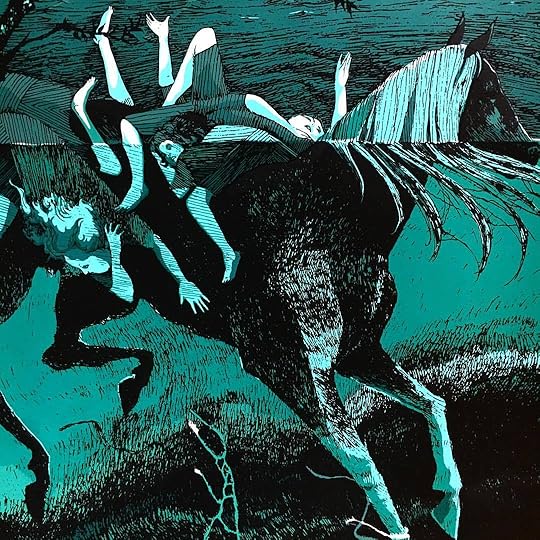
Here's some cool art of a kelpie from Landland studio which currently hangs (the art, not the kelpie) above my writing desk at home. As so many Scottish legends teach us, it's always advisable to just stay away from the water:
I'm an American who, to my great sadness, has never set foot outside the 50 states; but the weird thing about being an American is that the majority of us—indigenous peoples, of course, excepted—haven't actually been here very long in the scheme of things. For my part I'm mostly the descendant of Scottish settlers and German immigrants, some of them more recently-arrived than others but none of them native to the land they eventually called home. Personally I've never been particularly interested in German history or culture (apologies to any Germans reading this!), but the language, landscapes, and lore of Scotland have enchanted me as long I can remember.
I know that native Europeans find it puzzling, even distasteful, when white Americans try to claim the heritage of their distant countries of origin. I've never lived in or even visited the British Isles, so of course I can make no meaningful claim to being "from" them. Even worse, because of America's longstanding policy of cultural assimilation, most of us haven't even held on to whatever traditions and customs our ancestors may have originally carried over with them. What does it mean for someone to be "Irish-American" when their conception of Ireland is made entirely of stereotypes and they can barely point the place out on a map?
Yet we've been given very little, aside from a general anti-culture of white supremacy and American exceptionalism, to replace these erased traditions with. White Americans have made a bargain with the Devil (a motif which, incidentally, pops up quite a bit in this book): we've gobbled up power and material wealth but forfeited our souls in the process. Our history is a 400-year cycle of violent conquest and brutal oppression, our traditions a placating mixture of lies about racial superiority, religious domination, and contentment through consumption.
That's a heavy way to start a review of a collection of Scottish folktales, but it's important background for why this book interests me so much right now. I've long since given up the Christianity I was raised in—and good riddance, too—nor was I ever particularly patriotic, but there is a sort of spiritual appeal to connecting with the ancient, to seeking communion with a tradition you haven't (outright) stolen and can taken a measure of pride in, however tenuous or secondhand. These stories aren't my stories, exactly, but they're stories my great-great-great-grandparents may have heard and told, and anyway they're a hell of a lot more interesting than Johnny Appleseed or George Washington and the Cherry Tree or most of whatever else passes for a legend—as opposed to simple pop culture—among my people now.
I've had The Lore of Scotland on my bedside table for the better part of a year now, dipping in whenever my other reading gets dull or I'm having trouble falling asleep, picking passages to read pretty much at random. This is a thick book chock-full of tiny text, so that's the best and probably the only practical way to read it. And it's been an incredibly fun ride so far.
Like most folk traditions, the Scottish one is funny, dark, and weird (oh so weird), but also like most folk traditions it does all the funny and dark and weird stuff in its own highly distinctive way. There's a pretty standard cast list of human and divine players—the ancient warrior Fingal, the defenders against English invasion William Wallace and Robert the Bruce, the medieval sorcerer Michael Scot (no, not that Michael Scott), a handful of kings, any number of saints and witches, a veritable army of farmers, tradesmen, old widows, and ghosts, the Devil in various guises (though God and his angels are conspicuously absent)—but it's the non-humans that really steal the show. I love all the tales of kelpies, selkies, mermaids, brownies, trows, dragons, and sea serpents (these latter being a lifelong source of fascination for me, though the famous lake monster is revealed here to be an almost entirely modern invention and therefore unworthy of much attention), but to my surprise the stories that have most captured my imagination are the ones about fairies.
I wasn't totally ignorant about the Fair Folk before—I knew at least that in their original form they bore more of a resemblance to Tolkien's elves than the flittering Tinkerbells we picture today—but this was my first sustained exposure to the deep, bizarre, and frequently disturbing body of lore surrounding these fundamentally unknowable entities. The most interesting facet of this mythology is, I think, its inconsistency: do fairies share our conception of morality, and if so are they mainly good or mainly wicked? Do they like humans and want to help us, or are we mere toys, even annoyances, to them? What powers do they actually possess, and where are these derived from? Are they immortal, and if not how does their mortality manifest? Are they diminished Celtic gods? Fallen angels? Something else entirely? Fairy lore is inherently ambiguous in a way you really don't get outside of a longstanding folk tradition, and you can see why they've proven so enchanting to so many, myself now included. Forget Tolkien's elves, the better comparison is his Tom Bombadil! (The Folk also have a tendency to, uh, discourage those who reveal too many of their secrets, so let's leave off there.)
I've made a few allusion to religion, and that's an interesting component here too. Scotland has, of course, been at least a nominally Christian land since the sixth century or so, and since most of these tales were first written down a millennium or more after that they inevitably reflect a broadly Christian worldview (Catholic in the earlier stories, Protestant in the later). But that worldview is truly only broadly Christian because, as I said above, God is a scarce presence here, even when his human ministers or devilish foes take center stage. There's a lingering pagan sensibility to these legends, a sense of the world as a place of deep and mysterious natural magic where Christian prayers and creeds are only a few more—and rarely the most effective—forms of spell-work, and of course if we could trace them back far enough we'd probably find that most of the tales are in fact pre-Christian in origin. (Some even have a Norse inflection, owing to periodic Viking raids and migrations.) I wish it were easier to find original or objective sources on ancient paganism in Scotland and elsewhere, but the barely-disguised survival of these narrative traditions and folk beliefs within a framework designed quash them out is fascinating and encouraging in its own way. (See Keith Thomas's Religion and the Decline of Magic for a more academic analysis of the same trend in England.) I should also note that, to the compilers' credit, they do try to trace their tales' deeper lineages or connect them to broader folkloric traditions whenever there's evidence enough to do so.
Speaking of the compilers: the stories themselves are great, of course, but what I really love about this book specifically is the way it's written. Some reviewers have complained about Lore's dryness or its encyclopedic layout—it's done geographically, the legends grouped by region and place-name—but for me personally the approach is ideal. Westwood, Kingshill and co. always start by naming their source(s), follow with a summary of the tale in question with excerpts from the original text for flavor, and conclude with relevant commentary, notes, parallels, or explanatory info. The entries rarely exceed a page, albeit a double-columned one, and personally I don't think the style is dull at all—the writing is clear and concise, the tales told engagingly, the commentary personable and often funny. ("Though from pictures the hills look dauntingly steep, they are not as difficult as those of many hill-forts—it is possible to get up and as importantly down with a leg in a cast, as proved by one of the writers of this book.") It's maybe not the same kind of immersive experience you'd have hearing the tale before a campfire or from the pen of a dedicated storyteller like Neil Gaiman, but I really appreciate Lore's usefulness as an all-around resource and I find the stories no less fun for all the authors' rigor. Even the maps and other illustrations—some in color—are clear and informative, and there are occasional standalone spreads to cover the most significant or universal components of Scottish lore.
I could say plenty more, but there's really no need to. I'm sure this book will stay at my bedside for a very long time to come, and it's already inspired further searches into the myths, folktales, beliefs, and history of Scotland and beyond—to say nothing of the personal, if cautious, attachment I feel to the subject matter.
Here's some cool art of a kelpie from Landland studio which currently hangs (the art, not the kelpie) above my writing desk at home. As so many Scottish legends teach us, it's always advisable to just stay away from the water:
March 29, 2016
I'll be honest: I haven't actually finished this book and I doubt I ever will. Not because it is a bad book, not at all, but because it is simply not the kind of book you would read from cover to cover. It is incredibly dense, which makes it hard to remember everything if you try to read large chunks of it in one go. As a reference book, however, it is very good. The stories are arranged per area of Scotland, which gives them more context. The writing style is a bit dry, but the massive amount of information is still presented in a clear and concise way. And there is also extra information included on the more interesting tales and phenomena, like kelpies or the traveller people, in case you'd like to know more about that.
To me it was mostly interesting to look up the folklore from places I have visited or lived in, because that gave the stories more context. The book doesn't have a lot of pictures, so it was nice that I'd been to some of the locations mentioned and could picture them in my head, which helped with my understanding of the text. I'm not sure I'd recommend this book to someone who has never been to Scotland. It will still be an interesting read, but it won't make as much sense. For someone who is familiar with Scotland, however, this book will be very enjoyable.
To me it was mostly interesting to look up the folklore from places I have visited or lived in, because that gave the stories more context. The book doesn't have a lot of pictures, so it was nice that I'd been to some of the locations mentioned and could picture them in my head, which helped with my understanding of the text. I'm not sure I'd recommend this book to someone who has never been to Scotland. It will still be an interesting read, but it won't make as much sense. For someone who is familiar with Scotland, however, this book will be very enjoyable.

February 15, 2015
It would be a fib to say I'm finished, because this is one of those dip in and out books, and there's loads left I haven't read. But it's fab. Thank you so much to Alison, who gave me it, it's given me so many ideas it made my head spin. Arranged by region, and absolutely packed full (with very small type) of legends and myths, comparing different regional variations, giving possible origins and a million other bits of information. As I said, perfect for dipping in and out, perfect for research, loads of little titbits to fling into books as asides, and some ghosts and ghouls too.
November 3, 2024
I've been dipping into this one for months now, it's not the sort of thing I can just read pages and pages of in one go, but it is very thorough and would be great for future reference if I'm looking up something specific. There are maps for each area, with a nicely illustrated key (or legend!) showing the different types of stories.
As well as the stories themselves you get a good idea of the nature of folklore: how the tales are passed down and change through the centuries, and how they have come to us today through the work of folklorists and antiquaries.
As well as the stories themselves you get a good idea of the nature of folklore: how the tales are passed down and change through the centuries, and how they have come to us today through the work of folklorists and antiquaries.

January 3, 2019
Such a dry, dense, boring read. I was looking forward to this book very much. But it just gives you stories but it doesn’t feel like you get the whole story. I say that because of how short it all is. I think you’re getting the entire tale but you don’t feel like you are. Also, I did not feel the author’s passion in this book & I would have loved to learn the history behind the stories.
May 19, 2013
This is a good guide to myths and legends about Scotland, arranged by area of the country. As it's laid out in this way it's more of a reference book than something you can sit down and read from cover to cover.
I enjoyed reading the various entries and it was interesting to see how similar legends sprang up in different parts of Scotland. I found the style quite dry, however, and the two-columns per page set up makes it seem unnecessarily dense. I would have liked some photographs so I could get a better idea of the look and atmosphere of some of the locations described.
A good reference book, but slightly too far towards the academic for general readers.
I enjoyed reading the various entries and it was interesting to see how similar legends sprang up in different parts of Scotland. I found the style quite dry, however, and the two-columns per page set up makes it seem unnecessarily dense. I would have liked some photographs so I could get a better idea of the look and atmosphere of some of the locations described.
A good reference book, but slightly too far towards the academic for general readers.
October 25, 2011
A good book to take with you on a tour of Scotland. It could be vastly improved with photographs of the actual places for those of us who are arm chair travellers. The print is small and arranged in 2 columns on the page which makes reading very slow. The counties are arranged in alphabetical order and after that the sites by alphabetical order.
As you can imagine there is a lot of repetition of type of myth but each is re-told as accurately as possible. Only rarely are explanations are given.
As you can imagine there is a lot of repetition of type of myth but each is re-told as accurately as possible. Only rarely are explanations are given.

February 29, 2012
Very accurate and clear. The book is broken up into sections of the country as well. So packed full, I could barely read the first pages. Which is good. Some of the tales are pretty crazy, who knew people were that imaginative?
July 20, 2025
I absolutely adore this collection of strange lore mixed with history dating back to the 1100s (!!). Always have had a deep love for mysteries, occult, ghost and witchy stories. Everything strange and spooky in general. So this book is perfect to keep on my nightstand for when I can't sleep. The stories are short and the book has enough pages for me to randomly open that I don't believe I will ever read all of them (not for sure at least).
Went to many of the places mentioned on my vacation to Scotland. Just really wonder why the Devil's Pulpit (or really Finnich Glen) is not mentioned at all, since the location is beautifully strange and spooky with its blood red water running through the moss-covered sandstone gorge. It has local legends of satan using one of the rockformations as a pulpit which turned the water blood-red and of witches and druïds having gatherings there. This place is way too interesting to be left out. Especially in comparison to other stories I came across that barely had anything to tell (there are not many boring stories trust me!).
There is a page (after 269 called Witch-Hunts) where a devil's pulpit is mentioned but there is no reference at all which is kinda dissapointing. I find it to be a hidden gem in Stirlingshire and this makes me wonder what other places and lore has been left out.
Besides this minor downer I would recommend this book to anyone interested in folklore or mythology and wants to visit Scotland. Every area has it's own legend and map and the index is perfectly done so everything is easy to find.
Went to many of the places mentioned on my vacation to Scotland. Just really wonder why the Devil's Pulpit (or really Finnich Glen) is not mentioned at all, since the location is beautifully strange and spooky with its blood red water running through the moss-covered sandstone gorge. It has local legends of satan using one of the rockformations as a pulpit which turned the water blood-red and of witches and druïds having gatherings there. This place is way too interesting to be left out. Especially in comparison to other stories I came across that barely had anything to tell (there are not many boring stories trust me!).
There is a page (after 269 called Witch-Hunts) where a devil's pulpit is mentioned but there is no reference at all which is kinda dissapointing. I find it to be a hidden gem in Stirlingshire and this makes me wonder what other places and lore has been left out.
Besides this minor downer I would recommend this book to anyone interested in folklore or mythology and wants to visit Scotland. Every area has it's own legend and map and the index is perfectly done so everything is easy to find.

October 30, 2025
This book is a very mixed bag. Published in 2009, it feels more like the kind of folklore books which were being published in the 19th century. Items are organised roughly geographically, rather than by subject, using the traditional Scottish counties, which, nostalgic as that might be, is a bit silly for a modern book.
As a reference book among other reference books, it may be useful as "another place I could look" when doing research, but the book's poor organisation and lack of interpretive help would make it a poor introduction to Scottish folklore. When I looked at some of the more complex topics that I have done research on in the past, it was apparent that the authors didn't pay much attention to the quality of their sources - just sweeping up whatever was handy and dumping it into the entry.
The system of citation is also unnecessarily arcane and labourious to follow.
The cover blurb doesn't really make clear that this is not a book of folk-tales, in the sense of stories with a beginning, middle, and end. So, if you're looking for that, this isn't for you.
As a reference book among other reference books, it may be useful as "another place I could look" when doing research, but the book's poor organisation and lack of interpretive help would make it a poor introduction to Scottish folklore. When I looked at some of the more complex topics that I have done research on in the past, it was apparent that the authors didn't pay much attention to the quality of their sources - just sweeping up whatever was handy and dumping it into the entry.
The system of citation is also unnecessarily arcane and labourious to follow.
The cover blurb doesn't really make clear that this is not a book of folk-tales, in the sense of stories with a beginning, middle, and end. So, if you're looking for that, this isn't for you.
February 11, 2017
Not gonna to lie - this is a book that you never really finish. More like a dictionary of Scottish Folk Lore, it's packed with tales of witches and fairies and of course, Auld Nick. Great reference guide and makes you recall all the bits of folk lore and tales you may have heard about your own area that may not be included in the book. Terry Pratchett was bang on the money with his endorsement (which is why I picked this one over many others.)

October 28, 2017
Indeed, this is an encyclopedic reference work.
It took much longer for me to read than I first thought it would. There are so many nuggets to be cherished and cross referenced. One of the ones I most enjoyed was the story behind one of my favourite pieces of music: Felix Mendelssohn's The Hebrides (Fingal's Cave) Overture. There are so many places I now want to see in the context of this book. However, I am curious as to why there is no story about Beira and her link to Ben Nevis.
It took much longer for me to read than I first thought it would. There are so many nuggets to be cherished and cross referenced. One of the ones I most enjoyed was the story behind one of my favourite pieces of music: Felix Mendelssohn's The Hebrides (Fingal's Cave) Overture. There are so many places I now want to see in the context of this book. However, I am curious as to why there is no story about Beira and her link to Ben Nevis.

March 20, 2018
While this is a great reference book about the myths and legends of Scotland, I do not recommend that you read it cover to cover as I did. I recommend that it be used as a reference to investigate subjects of particular interest - fairies, witches giants, kelpies etc. The other option would be to use it to investigate particular areas of Scotland.
It is very well researched and is so full of information that I am quite certain I won't remember half.
It is very well researched and is so full of information that I am quite certain I won't remember half.
May 12, 2026
Despite enormous amount of reaserch and work that for sure was put into that book i must say, that i have no idea who the target audience is. The fact that it has encyclopedia like format and lacks narrative makes it hard to read, stores are merging into one big mix in your head. Its not a book to just open and read. Perhaps for academics? Good point to start reaserch, but doesnt really get in depth.

November 6, 2023
Un compendio ben strutturato, diviso in macro-aree geografiche e corredato da approfondimenti, delle leggende del folklore scozzese.
La raccolta vanta una bibliografia corposa e, nonostante le dimensioni corpose, è stata una lettura estremamente interessante, resa ancora più interessante dall'aver letto il libro durante un viaggio in Scozia.
La raccolta vanta una bibliografia corposa e, nonostante le dimensioni corpose, è stata una lettura estremamente interessante, resa ancora più interessante dall'aver letto il libro durante un viaggio in Scozia.

September 5, 2019
Myths, Legends and Folklore are all in this amazing book, great to dip into and while away the hours.

February 4, 2021
Recomend dipping in and out of this one.

January 6, 2022
Interesting snippets and information.

May 3, 2022
Brilliant: so dippable

January 14, 2023
The book covers each area of Scotland and the Legends/folklore that can be found there. This is a wonderful book!! Highly recommend, especially if you plan to travel Scotland.
February 11, 2023
Essential

June 11, 2023
The most mind-numbingly boring book that ever attacked a fascinating topic. I regret I bought it. Hard pass.
December 16, 2015
A wonderful collection of stories. Perfect to be picked up at anytime and nibble here and there.
Some stories are really creepy. I love Scottish folklore!
Some stories are really creepy. I love Scottish folklore!
May 19, 2022
Another good book by Jennifer Westwood.

September 17, 2014
Lots of interesting folklore--and history--from all around Scotland.
Displaying 1 - 25 of 25 reviews