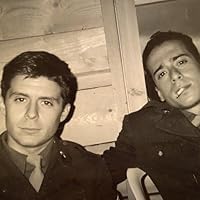
Paratrooper David Kenyon Webster jumped into the chaos of occupied Europe on D-Day, fighting his way through Holland and finally capturing Hitler’s Eagle’s Nest. He was the only member of Easy Company to write down his experiences as soon as he came home from war.Webster records with visceral and sometimes brutal detail what it is like to take a bullet in the leg, to fight pitched battles capturing enemy towns, and to endure long periods of boredom punctuated by sudden moments of terror. But most of all, Parachute Infantry shows how a group of comrades entered the furnace of war and came out brothers.
Born June 2, 1922 in New York, New York 1937-1940, Attended the Taft School, Watertown, Connecticut 1940-1942, Attended Harvard College, Cambridge, Massachusetts 1942-1945, Rifleman, 101st Airborne Division 1945-1961, Journalist (reporter with Wall Street Journal, L.A. Daily News), writer, public relations (North American Aviation, Systems Development Corporation, Pacific Ocean Park), sales Interests: Writing, surfing, skin diving, sailing, social justice September 9, 1961, lost at sea while shark fishing off the coast of Santa Monica, California, leaving a wife and three children
Band of Brothers ... before Ambrose and Hollywood Intervened ..., December 22, 2010
Ever since HBO glorified this group of men, I have made it a point ... well, now it's a mission, to read any/all of the books associated with Easy Company. Reading Ambrose's book prior to the release of the HBO miniseries served as an appetizer to the main course (the 10 part series), but there was still plenty of room left for desert as I was hungry for more information about these men, their upbringing, their bond, their deeds and their lives after their service. My mission has been blessed with a virtual avalanche of books that have contributed to satisfying my craving for "all things Easy Company", but they are all products of the Band of Brother's cash cow and perhaps a scant indulgent. Ironically, it was actually the debut of HBO's "The Pacific" which led me to David Kenyon Webster's book. Just like E.B. Sledge's "With the Old Breed" and Robert Leckie's "Helmet for My Pillow" provided the foundation for "the Pacific", "Parachute Infantry" serves as the raw material needed for "Band of Brothers". In his book, Webster authors a genuine, personal and detailed look at Easy Company almost four decades before Ambrose gave these men a global introduction. The pleasant surprise with this book is that it provides so much more than the miniseries could have hoped to deliver.
What makes Webster's book a worthy read is that he wrote it decades before Ambrose even considered writing about a company from the 506 Division (it was actually Ambrose who initiated the memoir actually being published) ... in other words, "Parachute Infantry" is arguably the original manuscript for the Band of Brothers book and miniseries. And Webster delivers a wonderfully detailed account of his wartime experience, the military life he absolutely hated and a war that left an indelible imprint on his life. A constant theme throughout the memoir is the author's utter disdain for the military and all of its pettiness and ineptitude. Additionally, Webster displays a similar distaste toward the French, their arrogance and unappreciative, elitist nature. It becomes obvious from the beginning of the book that David Webster clearly viewed military life beneath him. Webster articulates his experiences and opinions in a dry, witty manner and illustrates them with great detail. The reader never experiences moments where more information is desired.
One of the more surprising aspects of "Parachute Infantry" is that the individuals made popular by Ambrose and the HBO miniseries are, for the most part, absent. Most of the individuals close to Webster are mostly fringe characters in the miniseries. But, it is obvious, that he felt a kinship to many of the men who shared his experience. If anything, Webster's book is reminiscent of Robert Leckie's "Helmet for My Pillow" in that the focus of the book is more of personal reflection of military life, bonding and the deep impact of what is being witnessed rather than a pure combat memoir. It is not that Webster didn't see combat (he was wounded in Holland and earned a Bronze Star), but his focus is less on the actual battles as it is on the indelible affect their aftermath had on him.
"Parachute Infantry" starts out slow and can be somewhat verbose initially, creating a somewhat tedious read. However, as the book progresses, Webster's attention to detail becomes more appreciated and enjoyable to read. His keen eye for specifics is evident as the reader is immersed in a lush and colorful environment on each point of Webster's journey through Europe; this attention to minutia adds to the reader's experience. In my opinion, one of the best segments of the miniseries is the final episode when the war draws to a close and the men of Easy Company take Hitler's Eagle's Nest in Berchtesgaden, Germany and eventually report to Austria. This particular episode is where I believe "Parachute Infantry" really shines and it becomes clear that the miniseries drew heavily from Webster's account as the description he provides of these two locales is just as breathtaking to read about as it is viewed on television. His recollection of spending the end of the war in Austria reads a lot like a military version of a Jack Kerouac adventure.
It is a shame that David Webster was never able to see the impact or importance of his book. After reading his work, though, it becomes obvious that military service was only a small (but significant) facet of the man's life; maybe even a necessary interruption. And, like many gifted writers, he chose to view his experience as an adventure. Rather than leaning on his family's wealth to garner favoritism and avoid hazardous duty, David Webster opted to enter the military as private to see this adventure from the ground up as a low level enlisted man. The perspective he provides the reader of the Band of Brothers is both eloquent and unique.
Great book about the daily life in E Company, 506 PIR during World War 2. The book came before "Band of Brothers" and was written shortly after the war which separates it from all the other E Company memoirs. Webster was not a "gung-ho" soldier and did not volunteer for assignments, but reading the book you can see he was still a good, duty bound soldier that survived the War, and the Army. He does not make war glamourous and there is not a lot of description of the actions he was involved in, but just takes you into the mind of the average soldier. Great book and highly recommended to all E Company followers.
Aah, Webster, how I love thee and thine writing style. If you want to clean your head from the Spanks cheesy American kitsch about perfect hero soldiers, Parachute Infantry is the right book for you. Webster's eye misses nothing and his writing shies away from no cock up, no chicken shit behavior and no silly soldierly mischief. It's a wonderful introduction to David K. Webster and his wonderful style of writing as well as a personal testimony of an American paratrooper in the second world war.
When I watched and later read Band of Brothers, Webster was one of my favorite characters, because he was deeply thoughtful and generally more relatable than the others. I loved all of them. I loved Dick Winters especially, but I couldn't relate to him, because he was like a Superman figure. Webster gives an honest, authentic look at the experience of a soldier in WWII and that's highly valuable to me. To quote the back cover:
"David Kenyon Webster worked as a reporter and writer after the war. The Saturday Evening Post published a portion of his memoir, but book publishers rejected his manuscript, seeking sensationalized novels of the war rather than authentic memoirs. He died in 1961 in a boating accident while shark fishing."
You'll probably enjoy this book a lot more if you've seen Band of Brothers (the best WWII series ever imho), but it's worth checking out either way!
“I wished that I had not come, that I had not joined the army and volunteered for the paratroops and gotten to know so many men who had died and so many others who might die later.”
sooo happy I finally got to websters book!! I loved that he wrote this shortly after the war so everything was still fresh in his mind. the long chapters threw me off a lil but it was worth it!!
his beef with peacock will always be hilarious to me though lol.
This is an absolute treasure of a book. If you are interested in WWII's European theater, this book will be for you. If you enjoyed the HBO Series *Band of Brothers* you will be familiar with the character "Webster" who is the author of this book. It is clever, witty, well written, and absolutely full of amazing vignettes about his experience in the war.
It was evident that Webster did not enjoy being in the army. Far too often the accounts we read come from those who take naturally to military service. In this case, Webster bristled at nearly every part of his experience in training, combat, and even the nonsense of the military after the fighting stopped. He couldn't wait to get home. His keen eye of observation creates rich descriptions of inter-personal interactions, combat, and the overarching political understanding that is so often lacking in the "boots on the ground" discussions of war.
The book has a section at the end of primary source letters from the author to various people at home. It's a treasure trove itself. The connections made between moments in his life with the letters works really well. This is like having a conversation with an incredibly intelligent veteran who has the memories fresh in his mind. It is unbelievable.
I would definitely recommend this book to anyone interested in WWII soldiers. I would consider assigning this for a WWII class, certainly, but also maybe a US military history course. It should be required reading for anyone interested in American paratroopers, particularly at the graduate or military professional school level.
From one of the heroic soldiers of E Company, subsequently featured in the miniseries Band of Brothers. I've read, I think, four memoirs from E Company members who jumped on D-Day. This one is by far the most eloquent, but it's not my favorite. I don't care to get into the reasons why here, just know that this is quite good and includes some of the best descriptions of active duty army life during WWII.
A brilliant and honest memoir. Webster has an easy going writing style and remembers events with incredible detail. He’s also a likeable guy, who doesn’t hold back with his criticism of the army. Band of Brothers did his memoirs proud, but there is a lot more detail in this book (naturally). If you loved this book then read With The Old Breed, for Eugene Sledge’s incredible accounts from the Pacific.
I listened to the audio book and it's on the long side, between 17 and 18 hours. I moved the speed from 1.25 to 1.50x because even at 1.25x it was too slow for me.
This book is made up of the notes of David Kenyon Webster who parachuted into Germany on D-Day and fought in several battles throughout Europe included Germany, France, The Netherlands and Belgium to name a few countries.
Webster proclaimed that he never volunteered for anything which I found interesting and he did not care for the French people compared to the Dutch or even the Germans including their soldiers which is interesting too.
The book is part combat and part what soldiers do when behind the front lines in reserve or in the hospital recuperating from being wounded on the battlefield.
Of great interest is that Webster and his 506th Regiment were at Berchtesgaden for that liberation which was pretty cool.
I recommend this book and please keep in mind it's on the long side.
This was a very interesting, boots on the ground, type book. Web is cynical and doesn't pull any punches about his feelings about the army. He's a good writer, and you will see many recognizable names and characters from Band of Brothers, but there are also a lot of holes filled in that the show just couldn't cover. You will also see how each of the characters in the show served more as an archtype than stuck point for point with their real life character. I wonder what Web would have thought of the show. One of the interesting parts was reading the letters he wrote to his family that are included at the end of the book. They showed that he wasn't as cynical towards the army as he was in the book, that the tone came towards the middle to the end of the war, and understandably. Going from the semi freedom of the war to the more strict marching orders of peace time accupation would grate on guys who had risked their lives, and watched their friends die. I do recommend this book for any WW2 buff and Band of Brothers buff. Enjoy. Rated: PG-13: realities of young men at war.
"What a fate: to gasp your life out all alone in the mud of a dirty little creek, helpless to hold off the slow death that is inside you and the quicker death that is walking up on you on the other side of the water. A death without love, a death without hope. God, who invented war?"
Probably the only English literature major among the enlisted ranks of the parachute infantry during the last, arduous years of the War, the author drives flawlessly between a sarcastic view of the war, with the usual griping about the "chickenshit" ways of the Army, a dutiful sense of selflessness and camaraderie only found in battle, then coupled with a very understandable lack of "heroics", with an endless anxiety for self preservation.
The snappy, witty, smart-ass sense of humor, the rather biased and acidic judging of humans in a world unraveled by war, the description of images, and some really good one-liners, have made this my favorite war book at this moment, with the also-sarcastic author of Helmet for My Pillow, and the thoughtful author of With the Old Breed, close behind.
Some of the quotes that I think are really cool: 1. "I have always been glad that I could not look into the future." 2. "...spread out for miles on the moonlit sea, were scores and scores of landing barges, destroyers, cruisers, and attack transports. They were bearing the infantry slowly east, like a flood of lava,..." 3. "He called the roll in a loud, clear voice and paused between each name, so that every man would be remembered." 4. "The trucks seemed as tired and dirty and battered as the men now gathering around them." 5. "That strongpoint, riding the open field like a brig on a tidal wave." 6. "In the light of a sun that glared without warmth, ..."
And to sum the author's view of the Army: "This Army would be the greatest show on earth if it wasn't for the tragic undertones."
Sometimes cynical, sometimes company man, Webster pens quite a report on his experiences as one of the Band of Brothers. I have read a lot of these books, memoirs, and stories from 101st Airborne men from WWII. I have the utmost respect for them and their experiences. Most of the stories are inspiring, amazing, saddening, etc. I can not even begin to understand what these men went through.
Websters account takes away all of the bravado, all of the praise, and all of the fluff. He tells a real story from his point of view, and does not hesitate to offer his opinion of fellow soldiers, squad leaders, platoon leaders, generals, German soldiers, German citizens, France, Frenchmen and women, etc etc etc. The movie portrayal of Webster in the classic series leaves the viewer with a mixed feeling. You wonder if he was a part of the group or not. You wonder if he had the same dedication to the group or not. This account answers those questions for me.
There are stories here not included in the mini series and not included in other books I have read. More names of fellow soldiers that have been left out of the other tales. A different perspective to many of the events already described. All coupled with a written recollection of the inner voice of Webster himself. Almost like he was journaling the entire time.
The fact that Webster went out sailing and never was heard from again seems a fitting end to this hero's life. I don't mean that as disrespectful, but more like something that he planned out and happened just the way he wanted it to. And I love that he loved sharks. Not that I love sharks, but the obscure interest from a soldier of WWII just seems to go right along with the mysterious person that Webster makes himself out to be.
This was a first-hand account of World War Two written by one of the men featured in the book and movie 'Band of Brothers'. He died long before that book was written, disappearing along with his boat in the Pacific in the early 1960s. However, his account has some unique qualities about it. He was cynical, Harvard educated, and very intelligent. And yet, he was one of those tough paratroopers who landed at D-Day. Its a very good account if you are a student of World War II. I strongly recommend it if you can get past the contrived conversations that are in all of these first-hand accounts for we know that the details of conversations are not always remembered as they happened and memories are not 100% accurate. Its important, though, in reading these memoirs, as I have read several, to get the feel and the emotions of war on the citizen-soldier, the one who leaves civilian life to do something heroic and then returns if still alive.
you go out of the world the way you came in: surrounded by people and utterly alone.
if i could quote this entire book here i would. instead have the moments david k. webster actually broke my heart-
god, it's quiet... what a lousy way to leave the world. nobody to say goodbye. nobody who loves you waving from the door... how quiet it is - and godforsaken lonely.
i don't want to hurt anybody, i would say. all i ask of the world is to be left alone.
was there any meaning to life or to war, that two men should sit together and jump within seconds of each other and yet never meet on the ground below?
we were ready to go again, because we could only go forward, never back.
a death without love, a death without hope. god, who invented war?
life isn't worth living if you don't try to make the most of every minute of it. i don't mean being virtuous or successful necessarily, but happy.
Though I had seen it before, in 2019, in a burst of patriotic fervor, I decided to watch the entire BAND OF BROTHERS series again. The early episodes are a bit confusing--a lot of characters, and they are hard to tell apart when they're all wearing identical jump suits and helmets. So when I had finished the series, I watched it again, mostly to appreciate the growth of the many different characters.
I was taken by Webster (David Kenyon Webster), who became a writer after the war. His book, PARACHUTE INFANTRY was not published in his short lifetime, but his wife saw that it was published after his death. I delighed to discover scenes and events in the book that were also in the TV series. Very well written, with little details that would prove useful for anyone writing about World War II and paratroopers.
All in all, I was moved by the stories of these brave men and the sacrifices they made for their country. I wish they'd been a little more noble after the war (drinking, looting, and having sex out of boredom--ugh), but after the war, I'm sure they wanted to celebrate the fact that they made it through alive.
If you like true war stories, this one is for you.
A memoir researched and written by letters sent home from the author. It is very well written with detail that really puts you in the head and heart of Webster in combat during his time in the 506th. If you were a fan of Stephen Ambrose's Band of Brothers, I would highly recommend this book. A superb addition to Easy Company's history and legacy.
A world war 2 memoir from paratrooper David Webster who was part of the group of soldiers in Band of brothers. This is a really good supplement to that, giving a soldiers account which in some cases was raw. It was interesting to see his fears exposed as well as his dislike of the army, of British tanks and the French generally. His biggest dislike, though, was war itself - something he never wanted but like many others did his duty.
This is a must-read for Band of Brother fans. David Webster is actually one of the main true-life characters featured in the HBO WW2 series. Since it's a memoir, at times it gets a little laborious to read (skipped several parts because of this), but the perspective he shares is so unique and authentic, I still really enjoyed this book. You can see many of the scenes depicted in the series as you read.
I pulled this off of my shelves as a part of a current paratrooper focused reading effort without recalling any of the details. The author was actually featured in Band of Brothers, you may remember Private Webster who moved around in several companies in the 506th's 2nd Battalion including Easy Company. Stephen Ambrose wrote the introduction to this paperback edition though Webster was not one of the individuals he had interviewed for the Band of Brothers book. Webster died in a boating accident while shark fishing (and researching another book that he wrote on sharks, published after his death). I'm not sure I would have liked Webster much as a squad or platoon mate, though I probably wouldn't have disliked him too much either. A self-confessed goldbrick and almost always late for formation, etc., Webster apparently joined the Army already having the soul of a veteran. Even during World War Two, the aspiring writer who joined the Army intending to later write about the experience was already a cliche featured in numerous Hollywood movies of the day, and that was Harvard-graduate Webster. He tried to sell this book to a publisher in the late 1950s but never was able to clinch the deal, allegedly because the publishers wanted a different kind of story about the war. Webster's story is a pretty unvarnished look from the ranks of the war, the US Army, its British and French allies, its German foes, and the paratroopers. This may have put off a publisher looking for a best seller. Clearly, interest became greater with the success of the Band of Brothers book and mini-series, and with the backing of Stephen Ambrose the book is finally in print. This edition includes a number of Webster's wartime letters home to family and friends which are great addition to the volume. With his cynicism slightly in check, his observations remain as realistic as anything that made it into the book itself but with the immediacy of time versus the slightly edited words of the finished book. I do recommend it if you are interested in the complete story of World War II and especially the paratroopers and the Band of Brothers of Easy Company.
Interesting book. Offers a different view on the story of the famous paratroopers that are best known as the Band of Brothers. Webster wrote his story between the war and his death in 1961 so he never got any part of the fame the HBO series earned him and his fellow soldiers. Having read other novels about Easy Company men and seen the tv series several times (thanks to my hubby who is an avid fan), I have to say that Webster's novel is the most realistic one; a very rough, down to earth tale of one man and his role in a huge chain of events on the European front. Naturally this book was written without the influence of BoB and that only adds to the value of it.
Webster focuses on the everyday life of a soldier; the chickenshit, the constant hurry to wait etc. His depiction of actual battle events is realistic and thus very different than those from Hollywood. He emphasizes the fact that high morale and idealism aren't very much valued during war. He has mixed feelings about German soldiers as well as civilians he encounters; while they're the enemy and partly all responsible for horrible war crimes, he still sees them as people too, and feels (momentarily) bad for making them suffer when following orders. His hate for the army and love for his comrades is evident and present throughout the novel.
Included are some of his letters home, which make an interesting addition to the novel and add to the authenticity of it all.
This memories have a great importance over years. If only we could learn and understood the messages from them maybe we wouldn't repeat the same mistakes over and over.
This is the WWII memoir of David Webster, who served with the 101st Airborne (with the famous Easy Company; he was a major character in the TV series "Band of Brothers").
It is a very different memoir than you usually see from veterans. Webster hated the army. He loved his unit, and served well, but he loathed most officers, hated saluting, and though that dug down into a ditch was the best way to spend your time under fire. In short, this is a memoir by someone who was willing to say what I imagine most of his comrades were thinking.
If you're familiar with "Band of Brothers," you will easily be able to place plot points. It's nothing ground-breaking, but very well written, and he has a unique tone (frankly, he comes off as a whiny prick in some of his stories). A good read, especially for anyone interested in a new perspective on Easy Company.
One of the largest supplements to Stephen Ambrose's book Band of Brothers is this hidden gem. It was relatively unknown before Ambrose published his book, but is now getting well deserved publicity. It is the personal war narrative of David Webster from boot camp all the way through to the occupation of Austria. A well read and educated soldier, he attended Harvard before the war but dropped out to serve. Webster goes through all the events in detail and gives a rare 1st person accounts of the war, making no secret about his disdain for all things military and warlike along the way. Unfortunately Webster died a few years after the war, robbing the man of a bright future and the world of an excellent body of work.
This book had such potential. I remember thinking to myself during the first half of the book that this gentleman can really write! Then it left the thoughtful, imperiled U.S. European WWII combat soldier and degenerated into the thievery, constantly complaining, constantly drunken occupation force. The publisher complains that no one wanted to publish the book because it didn't have enough sensationalism. The publishers were wise enough to realize no one wanted to read about the degenerate occupation force described in the last half of the book.
I think what I liked most about this book is that it was written so soon after the war (compared to the others who wrote theirs late in life) that it seems more honest. I think a lot can be lost over several decades after the war and Webster captured some of what’s missing in the others’ memoirs.
Seemingly "just another book" in the BofB series, this book manages to add value for anyone who is a fan of the show or reader of the other BofB books out there. This one was written well before the series and used by Ambrose as inspiration.
Compared to some others in the series, this book was written almost right after the war (though remained unpublished for some time), so it is certainly much more vivid in terms of imagery and recollections, as well as personal thoughts.
Stephen Ambrose wrote the intro to the book, and while he admits never having met Webster, he writes that he admired him anyway as one who contributed to help win the war, thought of him as a good soldier, and more pertinent to this review, that he found him to be a "wonderful" writer.
If you can get used to Webster's writing style in the first 10 to 20 pages, you should sail through this interesting book which is really well written and pulls the reader along very nicely with lots of imagery and vivid descriptions. Out of the few others I've read so far (Malarkey and Winters), this book comes across as much more of a first person account than a story/recollection 40+ years after the fact.
The book really adds tremendous detail to events and locations which others have skimmed over or missed entirely. I personally really enjoyed his descriptions of the flight over the English channel on D-Day, his time in Holland, the time he spent in Hagenau (his return to the unit from hospital seemed much less harsh by his recollection than depicted in the show), and finally, their move into Germany and Austria, especially the pages describing the raiding of wine cellars, his time at a checkpoint and the unit's eventual departure. He missed Bastogne altogether and only skims over the liberation of the concentration camp(s), but the other parts were interesting reading and more than make up for these absences. In short, the paperback price was well worth it.
A warning to those who may be overly sensitive to issues relating to patriotism and how one (even veterans) speak of the military after leaving: Webster clearly did not like the military or it's bureaucracy. Putting this into perspective, as with any other job, some like it and some don't, Webster simply makes it very clear throughout his book that while he volunteered to fight and believed in his greater patriotic purpose, he thought the Army... and its quirky ways... sucked!! His resultant rebellious nature (including his self-admitted work avoidance) seeps through to the reader more and more as the story progresses, which may be potentially displeasing to some, though quite understandable for others. If you're a vet (as I) and left uniformed service with mixed emotions (jaded, but with fond memories and lifelong friends), you'll probably find parts of the book quite funny.
In the end, I found the book to be much more realistic in that it didn't unnecessarily wrap itself in the flag or paint an overly idealistic picture of life in the military. Webster just tells it the way he saw it, no holds barred.
On the book itself (mass market paperback): Amazon lists it as 464 pages, but the story only goes to 393. An annex with his letters home to family and siblings runs from pages 397 to 441. The pages are typical mass market paperback (slightly see-through), the print is relatively clear and of good size causing minimal eye strain. There are a few typos in the book but nothing bothersome; there are little to no margins though.
See my other reviews in the BofB series to compare.
In 1942, the author was attending Harvard University with a declared major in English literature when he dropped out and enlisted in the Army. After finishing jump school with the 101st Airborne Division, he was transferred to the European theater of World War 2. He and his division parachuted into France on D-Day, where they landed off-course in a flooded field a few miles inland from Utah Beach. A few days later he was injured by a mortar round and sent back to England to recuperate.
After returning to duty, he parachuted into The Netherlands in October 1944 as part of Operation Market Garden. He was wounded again and spent the next several months convalescing in England. After rejoining his unit in January 1945, he and his fellow soldiers were instrumental in the victory over the German forces on their home turf. After V-E Day, Webster and his fellow soldiers had a thrilling few months in Austria living in appropriated homes, driving confiscated vehicles including ambulances and fire trucks, and drinking all the liquor they could find in wine cellars and other hidden caches. The ensuing bacchanalian debauchery was legendary.
After the war, Webster moved to California and found work as a journalist. He wrote a book about his wartime experiences but could not find a publisher. In 1961, he disappeared at sea on a solo fishing trip. With the help of author Stephen Ambrose, his widow published his memoirs posthumously in 1994.
The Army Airborne soldiers seem to have spent as much time scrounging for food, liquor and cigarettes as they did fighting the enemy. They milked cows in the fields, pilfered eggs from henhouses, and broke into abandoned houses and barns looking for victuals, valuables and souvenirs. Every liberated town was another opportunity to steal foodstuffs. Every dead German soldier offered another chance to search pockets for money and spare cigarettes.
Best description of a meal: “Heroes for the day, we posed for snapshots, signed our autographs, drank cognac and wine that had been hidden away to celebrate the liberation. A Dutchman…served us a splendid meal of vegetable broth, roast veal, Brussels sprouts, boiled potatoes, applesauce, and fresh milk.”
German field rations were described as “stone-hard biscuits, tasty canned meat, and little tubes of Limburger cheese,” while British field rations were “somewhat on the heavy side, the food consisted of cans of sausage meat, beef stew, meat and vegetable stew, beefsteak and kidney stew, and a rich fruit pudding. Biscuits and dehydrated tea rounded out the menu.”
webster’s account is so unique and provides such a poignant and beautiful anti-war perspective to the band of brothers story that i gained a lot from. it’s so important to have stories like this from people who are no longer with us, his death was so tragic.
here are some of my favorite quotes which really resonated with me.
“If you have to die, you have to die—and what a way this is! If you have to jump, you have to jump. A man’s life and death are decided by forces that he cannot fight. He can only question them and rebel against them, but in the end, he has to go with them.”
“A flash of light came in the window, and I glanced outside and saw wisps of cloud streaking by. Now and then a pale, full moon, mocking in its serenity, appeared briefly among the long, thin, scudding black clouds. This is a night for murder, I thought. God must have planned it that way.”
“Somebody wants to kill me, I thought. So this is what war is really like? I couldn’t believe that somebody wanted to kill me. What had I done to them? I wanted to go up to them and tell them that I didn’t want to kill anybody, that I thought the whole war was a lot of malarkey. I don’t want to hurt anybody, I would say. All I ask of the world is to be left alone.”
“I had grown up with Republicans and gone to school and college with them, and sickened by their selfishness, their cold avarice and lofty contempt for the common people, had early sworn to vote for the Democrats, who, for all their rotten political faults, were more concerned with the welfare of the country as a whole.”
“What a fate: to gasp your life out all alone in the mud of a dirty little creek, helpless to hold off the slow death that is inside you and the quicker death that is walking up on you on the other side of the water. A death without love, a death without hope. God, who invented war?”
“I continued to stare at Janovec. I wanted to bend over and shake him back to life, to curse him for sleeping so soundly… I looked at Janovec again, hoping that he would move or cry out, but the blanket was still. Grant shot and Janovec dead and the war over: It made no sense. The Army was death.”