In the tradition of Station Eleven, a literary thriller set partly on the roof of New York’s Museum of Natural History in a flooded future.
All the Water in the World is told in the voice of a girl gifted with a deep feeling for water. In the years after the glaciers melt, Nonie, her older sister and her parents and their researcher friends have stayed behind in an almost deserted New York City, creating a settlement on the roof of the American Museum of Natural History. The rule: Take from the exhibits only in dire need. They hunt and grow their food in Central Park as they work to save the collections of human history and science. When a superstorm breaches the city’s flood walls, Nonie and her family must escape north on the Hudson. They carry with them a book that holds their records of the lost collections. Racing on the swollen river towards what may be safety, they encounter communities that have adapted in very different and sometimes frightening ways to the new reality. But they are determined to find a way to make a new world that honors all they've saved.
Inspired by the stories of the curators in Iraq and Leningrad who worked to protect their collections from war, All the Water in the World is both a meditation on what we save from collapse and an adventure story—with danger, storms, and a fight for survival. In the spirit of From the Mixed-Up Files of Mrs. Basil E. Frankweiler and Parable of the Sower, this wild journey offers the hope that what matters most – love and work, community and knowledge – will survive.
Eiren Caffall is a writer and musician based in Chicago. Her writing on loss and nature, oceans and extinction has appeared in Guernica, The Los Angeles Review of Books, Literary Hub, Al Jazeera, The Rumpus, and the anthology Elementals: Volume IV. Fire forthcoming in 2024 from The Center for Humans and Nature. She received a 2023 Whiting Award in Creative Nonfiction, a Social Justice News Nexus fellowship, and residencies at the Banff Centre, Millay Colony, MacDowell Colony (waitlisted), Hedgebrook, and Ragdale. Her memoir The Mourner’s Bestiary is forthcoming from Row House Publishing in 2024 and her novel All the Water in the World is forthcoming from St. Martin’s Press in early 2025.
All the Water in the World is told in the voice of a girl gifted with a deep feeling for water. In the years after the glaciers melt, Nonie, her older sister and her parents and their researcher friends have stayed behind in an almost deserted New York City, creating a settlement on the roof of the American Museum of Natural History. The rule: Take from the exhibits only in dire need. They hunt and grow their food in Central Park as they work to save the collections of human history and science. When a superstorm breaches the city’s flood walls, Nonie and her family must escape north on the Hudson. They carry with them a book that holds their records of the lost collections. Racing on the swollen river towards what may be safety, they encounter communities that have adapted in very different and sometimes frightening ways to the new reality. But they are determined to find a way to make a new world that honors all they've saved.
This one was a big disappointment for me. I love dystopian books. I love how my heart pounds when I read them and love all the emotions that you get. But I didn't get the heart pounding feeling and I didn't feel any emotions.
I didn't have a strong connection to the characters. Nonie's voice tells the story and she didn't show any emotions. Since I didn't have this connection, I didn't care what happened to the characters. Nonie is a girl that is gifted with a deep feeling for water.
This book is very slow. I was really bored. I struggle with a book that is slow like this. Once I put the book down I had a hard time picking it back up again. I also found it to be repetitive in parts.
This book is about survival and a hurricane and climate change. I would think that I would have received a lot of emotions but it was more depressing than anything. There are a lot of readers who loved this book so make sure you check out their reviews.
Available Now
2.5 stars rounded up.
I want to thank St. Martin's Press and Netgalley for the copy of this book in exchange for an honest review.
Nonie Mayo can sense, throughout her body, when a storm is coming. This is very fortunate because the world as she and her family know it is now at the mercy of hypercanes, irreversible climate changes, food shortages, lawlessness and looting.
As I read this story, I was reminded of the apocalyptic TV series: The Walking Dead: there was so much violence and destruction, both by Nature and by the people who had survived the first wave of catastrophic storms and flooding.
Nonie, Bix, their father and their friend Keller were forced to leave their rooftop sanctuary on the AMNH building in New York by a vicious "hypercane" - a hurricane so powerful and far reaching that entire cities were wiped out.
That harrowing journey by birch bark canoe to the girls' family farm in Massachusetts held me spellbound. Needless to say, it was very difficult to put this book down.
The author kept the atmosphere of dread and fear at fever pitch during the post-flood sections of the story. This intrepid group of survivors overcame one horrifying obstacle after another.
The flashbacks in this story to a quieter, gentler time were a welcome respite from all that high emotion and devastating action.
One GR reviewer suggested that Nonie is probably autistic. I agree that Nonie appears to have some form of emotional or developmental issues: she has been known to be non-responsive in certain difficult situations, to the point that she stopped communicating altogether. Nonie also confesses at one point that she often does not know how to react to certain catastrophic or stressful situations (despite her obvious intelligence.)
I highly recommend this fast-paced apocalyptic novel, but take note: there are no Zombies or Alien Invaders to overcome. The disasters that befall these characters are the result of climate changes brought on by humanity's wanton abuse of the earth's bounty. A very timely message indeed!
My thanks to the author, publisher and NetGalley for an ARC of this novel in exchange for an honest review. This was a definite page turner, and I am rating it 5 out of 5 well-deserved stars.
After the glaciers have melted, Nonie, her family, and a group of researchers stayed behind living in a settlement on top of the American Museum of Natural History in New York City. Survival is the name of the game for them. They learn to be self-reliant but when a superstorm hits, Nonie and her family flee, taking with them a book that holds their records. Along the way they encounter civilizations that have been created, they suffer, experience loss, experience community, and do their best to survive.
This book was very slow going and I struggled with that while reading. This book was also dark and dreary as one would expect the world to be after the effects of climate change changes the world. Nonie is an interesting character and has a connection to the water. It is all she has ever known. She can't recall a time when there wasn't water everywhere.
This book provided a lot of food for thought concerning climate change, survival, choices, moving on, and formed communities. I so wanted to love this book, but it was so slow moving that I put this book down and turned to other books. One positive is I listened to the audiobook, and I thought the narrator did a fantastic job. I also thought the author did a good job creating the dystopian world.
Much too slow for my tastes but others are enjoying this book, so please read their reviews as well.
2.75 for me rounded up to 3 stars.
*This was a buddy read with Mary Beth and Carolyn. Please read their reviews as well to see their thoughts on All the Water in the World.
Thank you to Macmillan Audio and NetGalley who provided me with a copy of this book in exchange for an honest review. All the thoughts and opinions are my own.
Thank you so much, St. Martin's Press, for providing me with this ARC and a chance to read this book pre-release. As always, all thoughts are my own. ✨
I had such high expectations for this book, but sadly it didn't resonate with me. The dystopian and post-apocalyptic themes initially caught my attention and intrigued me. However, as I delved deeper into the story, the plot seemed to drag on and felt somewhat repetitive and redundant.
In terms of writing style and structure, I will certainly give credit where credit is due. The author undoubtedly possesses skill, and I can understand why some readers might fall in love with the writing style of the author.
Despite its unique premise, it reminded me of "All the Light We Cannot See" in that it was filled with a pervasive sense of doom but lacked a compelling plot to drive the narrative forward.
If you appreciate slow-paced, monotone adventures and are interested in discussions about climate change, this book might be right up your alley. Personally, though, this is a big no thank you for me.
The expected publication date is January 07, 2025.
"Greed and Hope are twins grabbing for the same thing- one in fear and one in faith."- from All the Water in the World.
I listened to the audiobook which was well narrated by Eunice Wong.
This post-apocalyptic climate disaster story follows Nonie and her family as they escape from a submerged NYC to a farm to the north (possibly Massachusetts?). Much of the story covers flashbacks of disasters that befell the world and family leading to their present circumstances.
I love post- apocalyptic fiction (as a genre) and climate change seems to be replacing zombies as the method of choice for burning it all down. I've read a few really good ones in this subgenre- The Light Pirate by Lily Brooks Dalton- is my favorite so far. I had high hopes for this one, I really did, but they were dashed upon the newly carved shores of upstate New York.
So what went wrong? In a nutshell, everything seemed to be building towards a story that never actually materialized. For example: Nonie is described as a "human dowsing" rod. She can sense water everywhere- ground to sky. This isn't framed as a magical ability exactly, more like Nonie has an uncanny affinity for water. She is autistic and I got the impression her sense with water might be a savant skill, but it is never explained. Anyway, that ability plays a very small role in the story, and could have been left out entirely. If a character is given a unique and unusual skill do something with it! Frustrating that that plot element was squandered.
Another potentially interesting plotline was the family's guardianship of "AMNH" (The American Museum of Natural History in NYC, pronounced "Amen" in the audiobook). Nonie's parents and co-workers turned found family were scientists and made good use of the museum's exhibits for their survival, but prioritized cataloguing and preserving the surviving exhibits and artifacts for the benefit of humankind in the future. Much is made of the logbooks- which contain the records of all that remains- as well as Nonie's "water log books" where she comes up with new descriptions for, and understandings of, water that are going to be integral for turning things around one day. Or so we are told. However, this whole aspect of the story, which frames the lives of our survivors for most of the book, just disappears mid-story leaving me with no idea how Nonie's intuitive understanding of water will go on to change the world. Seems a big detail to leave out.
Finally, towards the end of the novel, a bunch of new communities and characters are introduced. We spend the whole book developing a small handful of characters (who, by the way, were likable enough, but made no lasting impression at all) and then about a dozen more are tacked on at the end to propel the story along. Some of those might have become interesting if they had more time and story invested into them, but as things were, I had difficulty telling some of them apart. I briefly wondered if maybe this was a book 1 and these characters stories might develop over future books, but it doesn't seem like it. I couldn't find any information about this being the beginning of a series and, at the end, several character's stories are kind of "flash- forwarded" so we know who wound up with who, who had babies (neither of which were questions the story made me care about the answers to), how the settlements developed, etc...
This book's write up compares it to Station Eleven- Emily St. John Mandel. I didn't like this one nearly as much as Station Eleven, however I see where the comparison comes in. Towards the end of "All the Water in the World" there is this quote, "... you are allowed to hope for something that doesn't just save- something that builds." Station Eleven has the traveling theater troupe, All the Water... has a (submerged) museum and people who understand that the best parts of the past should be salvaged and preserved for humanity's sake- not for our survival- but to remind us who we were and could become again. Life can't just be about survival, there needs to be inspiration, joy, love, community, culture, or what's it all for? All the Water in the World muddles the message that Station Eleven delivers so gracefully, but the message is there.
Weak characterization, unsteady pacing, a muddled message, disappointing storyline, interesting characters and plot points that go nowhere, all add up to a book that could have been so much better than it was. If you have an itch for climate disaster stories, there are better ones out there, but I wouldn't give up on this author- there was nothing terrible about this book and part of the reason it was so disappointing is because she really had the makings there for something amazing. She has another book The Mourner’s Bestiary which sounds really good and I plan to give that a go at some point. But I would only recommend this one to readers who hate to miss a chance to see the world burn down (or sink beneath the waves as the case may be). ⭐⭐⭐
A sad and lyrical elegy for the lost world that is coming.
I’m starting to feel like I can’t read climate fiction anymore. It’s not the writing, it’s the fact that it seems less fictional every day and it’s also sad and scary. The writing in this is lovely, but it’s also such a frightening story, because it’s so likely. Is the ending also likely? I’m going to choose to believe it is.
“Hell, it was happening, I saw it happening. But I couldn’t picture it, you know? I couldn’t picture how we’d lose the seasons, how it would be tropical heat in November, but still have blizzards that melted into heat waves. I couldn’t picture the way the storms come and then come back. Not the polar cold fronts in the south. Not the new hurricanes, the hot winters, the king tides, the typhoons going east then west then east again. It should have been easy to see. It was in the data.” …
”There is the weather and there is death. You can’t control them, and you can’t fool yourself that your name is the only one they know. They have everyone’s names in their mouths.”
I received a free copy of, All the Water in the world, by Eiren Caffall, from the publisher and Netgalley in exchange for an honest review. Nonie has a connection with water., she is living on the roof of The American Museum of Natural History, in New York. There is a storm coming that will change them forever. This was a n interesting and enjoyable read.
4.0 Stars I have a fascination with climate fiction so this literary science fiction novel was right up my alley. It was interesting, slow and contemplative. I liked so many aspects yet I actually felt a touch disappointed since this one never reached the five star potential the plot had. I wish this one had a bit harder with a punchier story. I liked it but I found it's message a bit soft.
Disclaimer I received a copy of this book from the publisher.
I love a good apocalypse book and this one did not disappoint! In this book, as is happening currently in the real world, the sea levels have risen drastically and climate change has thrown the world into chaos. Our group of characters have found sanctuary in NYC's Museum of Natural History (mostly on its roof). A mega storm rolls through, destroying their sanctuary and forcing them to seek higher ground, so they head north for a family farm inland. The book follows their trek. It's dark and difficult. Society has absolutely devolved. It's awful and entirely believable—especially when we see so many men embracing brutal, violent behavior simply because they are no longer constrained by societal norms and rules. As I said, entirely believable. What saves the book from being too dark is the young narrator, Nonie. She leads us through horrors while holding to hope, and I really enjoyed her special connection to water. The conclusion is excellent. This book is well worth the read!
«Gostei mesmo muito do livro: estava entusiasmada com a premissa quando o descobri e, para mim, a execução não desiludiu. Fiquei muito presa a todos os pensamentos sobre como se chegou ao ponto em que os glaciares derreteram completamente, ao facto de as pessoas acharem que ainda iria demorar muito e afinal demorou menos do que se esperava. Pareceu-me uma tentativa bem executada de imaginar o que poderá acontecer quando o planeta chegar a essa situação, e assustou-me muito porque sei que estamos mais perto dessa realidade do que gostaríamos.»
This was an absolute snoozefest and I feel so bad for hating it. It just made absolutely no sense to me. I liked the main character and her way of seeing the world, however if I could have also understood the world that would have been great.
I really struggled to understand how the world was so flooded that they had to use canoes and boats but some people seemed to leave in houses and also being able to read gravestones was mentioned. The descriptions of the environments confused me to no end.
Initially, and with the blurb, I thought this was going to be a story about preserving knowledge, the knowledge of the museum that they're carefully collecting especially. I thought they'd meet other people and share/gain more knowledge but the reality was that there was a big storm and then they just wandered to a new camp in a boat and that was it really.
Such an intriguing story of what could be. Very dystopian and a future "what if" scenario! Such heartbreak but also such amazing character growth from Biz and Nonie. I absolutely devoured this book as I had to know how it was going to play out for both of them. I also really loved Mary and Esther! Just such a good read and intriguing to think "what if", like if the world flooded and if all this would happen. Nonie and Bix were truly survivors and fought their hardest! Brilliant writing and amazing characters!
I received this ARC from NetGalley and St. Martin's Press to read/review. All of the statements above are my true opinions after fully reading this book.
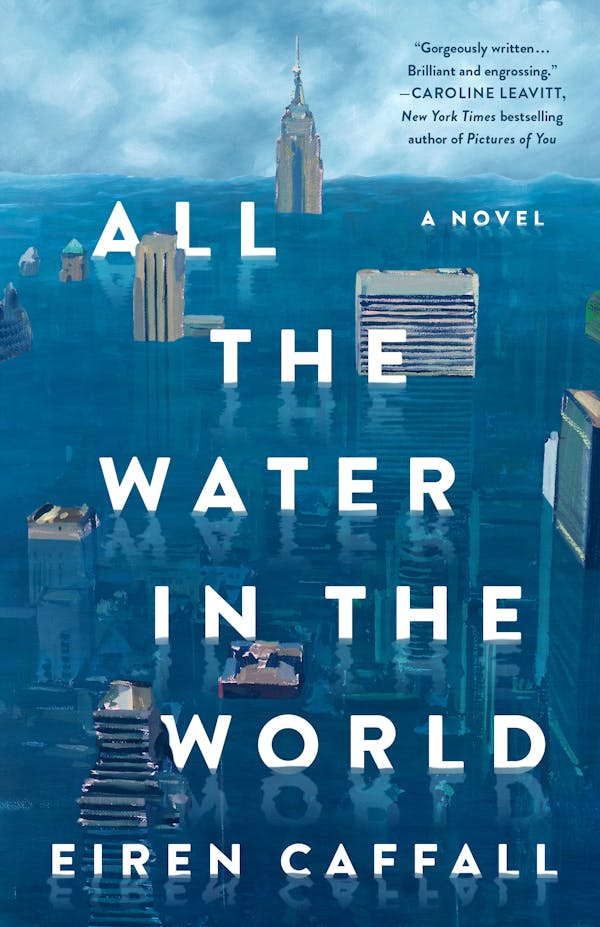
The cover art of All The Water in the World immediately grabbed my attention. It shows famous landmarks of New York City (e.g., The Empire State Building) mostly submerged in water. And when I read the publisher’s blurb, I knew I had to read it.
Set in an unknown number of years in the future (but not too far in the future, I think), the story is told by a young teen girl, Nonie. She has a special relationship with water, can feel storms coming, for example. As the story opens, she and her older sister, Bix, and their father are living on the roof of what used to be the American Museum of Natural History (AMNH) in Manhattan. They have a small community, living in a longhouse structure on the roof but able to go inside the former museum for shelter. They call it AMEN, sort of an abbreviation of the museum’s abbreviation. The people of Amen have tried to save important things from the museum. They recall how the people in Leningrad and France and Italy and Iraq tried to save art and other priceless items, and also the monks of the Middle Ages, who transcribed ancient texts, to preserve them for the future. They tend a garden and hunt deer in Central Park. Their former home on 10th Street, downtown, is gone, completely under water. (Miami is gone, among other coastal places.) Their mother has died of a disease that once was treatable, but medicines are extremely scarce, along with many other things we all take for granted. Then a humongous storm upends even their current “normal” lives - it’s so big, it’s called a hypercane! NYC had built flood walls, but those were now overtaken by the storm. Water rises and rises. The rest of the story is how this small family plus a friend, Keller, handle their perilous new reality. Interspersed with their adventure/journey, are lots of flashbacks and entries from Nonie’s “water log.”
While I really loved the story, I found it to be a bit slow-paced, making it seem much longer than its 304 pages/8 hours and 12 minutes of audio. It was very reflective in nature, with it being told by Nonie. The whole thing was disturbing, discombobulating, as it covers so many landscapes and places that I know so well in “the world as it was,” as Nonie calls what we think of as present day.
I mainly listened to the audiobook version of All The Water in The World. It was beautifully narrated by a new-to-me narrator, Eunice Wong.
Thank you to St. Martin’s Press and NetGalley for the opportunity to read a review copy of this book and to Macmillan Audio and NetGalley for the opportunity to listen to a review copy of the audiobook. All opinions are my own.
یکی از بدترین تجربههای مطالعاتیم در سالهای اخیر. کتابی که با نثر متظاهرانه و استعارههای بیشازحد، سعی میکنه خودش رو عمیق و شاعرانه نشون بده، ولی در واقع چیزی جز تودهای از خاطرات پراکنده، فضای گرفته، و خالی از هرگونه داستان، گره یا کشش نیست. کتاب رو با زحمت خوندم، منتظر یک نقطهی اوج، یک پیچش، یک معنای تازه — اما هیچی. نه شخصیتها رشد میکنن، نه روایت جلو میره، نه دنیایی که توصیف میکنه قانعکنندهست. فقط تکرار و تکرار و تکرارِ توصیفهای آب و بارون و مرگ و «یادش بخیر». انگار یک دفترچهی خاطرات افسردهی پساآخرالزمانی رو بیهیچ ویرایشی چاپ کرده باشن. اگر میخواید اعصابتون خرد بشه، انرژیتون تخلیه بشه، و احساس کنید وقتتون رو به بدترین شکل هدر دادید، حتماً این کتاب رو بخونید.
در غیر این صورت، دورش رو خط بکشید.
تنها چیزی که این کتاب رو برای لحظهای جذاب کرد، این بود که اسمش آدم رو یاد فیلم ریدلی اسکات میندازه — فقط همین. چون خود کتاب، یه سیل خستهکننده از هیچ بود.
I went into this one blind, and have since discovered a wonderful post-apocalyptic novel about a young girl coming of age in a world turned to water and all its perils. A few themes and tropes that I enjoy make appearances here as well, like coming of age, mothers and daughters, water as metaphor, and the definition of home.
Final Review
Mother taught me how to love the water.... I have more of that than any of them.p 40
I finished this book a couple weeks ago. It must not have made an impression at me, because my recollection of this read is vague. I remember that I loved the main character, a seven year old trying to survive the end of the world in a small group of people. Her perspective on this story
Reading Notes
Three (or more) things I loved:
1. Mother taught me how to love the water... I had more of that than any of them. I had to give Father and Keller and Bix the water love Mother gave me, put them into the bathysphere with me... p40 At first, I found the perspective jarring, as the narrating character is only about seven years old. Most often, I find inauthentic, overly adult tone, diction, and syntactical complexity ascribed to a very young narrating character. Here, the style strives for simplicity and focuses on describing things phenotypically, like "bathysphere" in place of bathosphere.
2. The antagonist in this book is water, an ocean-like deluge that covers most of the world, as a natural force the characters must grapple with and survive. One of the things that makes this book unique is how much the protagonist, a child survivor, empathizes with this water, her literary nemesis.
3. Bodies of people we love die, we leave them. Something of them remains in us, something we have to keep like we would a fossil, a story no one remembers, .... I knew that a place is just a body, no longer alive without the people that ensoul it, but it still hurt to go. p58 This book takes on some wonderful themes, like the definition of home or the definition of the body.
4. I like numerous short chapters, which is how this is written. More organization is better than less, in many cases.
Three (or less) things I didn't love:
This section isn't only for criticisms. It's merely for items that I felt something for other than "love" or some interpretation thereof.
1. This is kind of a dry read. It has to do with a few style choices, namely the narrative voice, fashioned as coming from a child. The sentences are all simple and similar to each other in form.
2. I really struggled to connect with this book. I think it's because the story developes into multiple directions at once– the long past, the recent past, many directions in the present, and possible futures for the characters. The pace is almost leisurely, but the plot still manages to be convoluted. There needs to be more than just survival in the story; the story needs a point, a primary conflict.
Rating: 🌊🌊🌊🌊 Yes, for fans of more literary novels Finished: Dec 23 '24 Format: Digital Arc, NetGalley Read this book if you like: 🌊 water, lots of it! 🏚 distopian settings 👧🏽 girl's coming of age 🔥 slow burn plot
Thank you to the author Eirin Caffall, publishers St. Martin's Press, and NetGalley for an advance digital copy of ALL THE WATER IN THE WORLD. All views are mine. ---------------
Compelling climate-themed apocolapyic fiction that also manages to be a coming-of-age story too. In a flooded world replete with sickness and dangerous humans known as "The Lost," a small community of family and found family members struggles to survive while maintaining their memories of things long gone as well as their decency. The hopefulness of the ending was beautiful.
Thank you, St. Martin's Press, for the gifted ARC. I'll happily read any future work by this author.
3.5stars A slow-burn literary thriller story of survival, found community and preservation of humanity.
Set in the years after all the glaciers melt, our protagonist, her family and other researcher friends create a settlement in an almost-abandoned New York City, as they work to save the collections of humanity history and science.
Thank you Net Galley and Publishers for letting me read an arc of this book in return for an honest review.
Wow, all I have to say is wow. This was a heartbreakingly beautiful book. I wanted to cry so many times during it. It's intense and sad and so powerful. I can't believe this is her first book ever, it's just so good. I wanted to read something different than I usually read and this was a great one. Each chapter is short and hard to put down. I loved that the intense and sad chapters were broken up with past memories, happier ones. This book raises alot of questions and what if's of today. What would you do if all the glaciers melted and the world was suddenly under water? That's what these people had to learn to live with. So much heart break and loss but also hope and life. The character development was great and I felt like I really got to know these people. All of the good and the bad. My heart breaks with this book.
i tried so hard to love this and understand it, but it’s just so confusing😭 i had no idea what was going on in this one. it had so much potential to be great, and it was just not unfortunately. this just fell completely flat. i was so looking forward to it and it was just disappointing from the start :/
if you like sci-fi / end of the world books, then you might like this, but i personally would not recommend it.
I had looked forward to this book. But I absolutely could not get into it. It felt like it was written by an elementary aged child. Sentences within the same paragraph had no connection. There was no foundation at all - it was just rambling from one thing to another. People were introduced then left behind. References were made, then forgotten. It was billed as "In the tradition of Station Eleven" a book I also thought was a waste of ink and paper, so guess I was forewarned. Quit at 50 pages and that was 49 pages too many!
All the Water in the World by Eiren Caffall was both riveting and thought provoking. It was well written and well plotted. The characters balanced each other and yet maintained their own identities. All the Water in the World began in New York City’s Museum of Natural History on its roof. Before that, for a short period of time, it revolved around a family who had lived on Tenth Street, a family that consisted of a mother, father and two little girls. The first born daughter was named Beatrice but everyone called her Bix and the younger daughter was named Norah but everyone called her Nonie. That family had made their home on the roof of the American Museum of Natural History when storm after storm, some far worse than one before it, struck and made their home on Tenth Street unsafe, dangerous and uninhabitable. Nonie had been told that before she was even born, storms had already begun to affect “coastlines, glaciers, reefs, whole islands and cities”. It was a slow process but it had begun. The night the storm tide flooded the city was the night this family managed to get to the AMNH, the safest place that would become their home. Their plan to meet Aunt Clare and get to her farm was abandoned for then.
Nonie loved the water, much like her mother, but Bix was terrified of it ever since they escaped from Tenth Street. Bix and Nonie’s mother was dying. She had an inherited kidney disease with no cure. Things at AMNH had gone as well as they could have hoped for a number of years. Of course there was the Mosquito Borne that took many lives, hurricanes, tornadoes and N’oreasters. Sadly, their mother died. Then there was the hypercane, “the biggest kind of hurricane there could be.” This occurred when Bix was sixteen and Nonie was thirteen. With a canoe taken from AMNH, Bix, Nonie, their father and Keller, another researcher that had lived at AMNH with them, made their way to their Mother’s and Aunt Clare’s farm, Tyringham, their safe place if AMNH was ever compromised, north along the uncharted waters of the Hudson River. The only thing that they saved from AMNH was a logbook that documented their “records of lost collections”. What would they encounter as they maneuvered north along the Hudson River? Would they be able to reach the farm where their mother lived as a young girl? Could it become their new “safe place”?
All the Water in the World was an eye opening look at what the remnants of climate change, like melted glaciers, extensive flooding, more and more strong hurricanes and wildfires, could do to life as we knew it if left untouched. We are all guilty of feeling bad when natural disasters occur, but things are cleaned up, mended and replaced and life goes on without any real change. Not that the things that happened in All the Water in the World were an exact match to what we could expect someday but what if they were? More serious attention and action must be allocated to climate change and now!
All the Water in the World was told from Nonie’s POV. The chapters were short and therefore encouraged me to read more than I might have. It was hard to put this book down. I really enjoyed the characters in this book especially Nonie. How sad that this was the only world that she could remember. She had no recollection of how the world was before. I listened to the audiobook that was narrated by Eunice Wong and also read along in the book that I won in a goodreads giveaway.
Thank you to Macmillan Audio for allowing me to listen to the audiobook of All the Water in the World by Eiren Caffall through Netgalley and St. Martin’s Press through Goodreads in exchange for an honest review. All opinions expressed in this review are completely my own.
Okay, so this book, it has a really poetic vibe and deep emotions, which I totally respect. The way connects grief, climate change, and water is super creative and thoughtful. There were parts that hit hard and made me stop and think.
That being said, I felt like some sections dragged a bit or got too abstract for my taste. I kept wanting to connect more, but it just didn't fully land for me. Maybe it's one of those books you need to be in the right headspace for. If you love poetic reflections and don’t mind a slower pace, it’s worth checking out—but it wasn't quite my cup of tea.
*4+ stars. As someone who has lived through two floods, this post-apocalyptic scenario would be my worst nightmare. The plot: The polar ice caps have melted, flooding all the coastal regions of the world and creating chaos. Nonie, the young girl narrating this story, is part of a family of scientists who are now amongst others living inside the American Museum of Natural History. That is until a 'hypercane' destroys the rest of the building and four survivors escape in a birchbark canoe.
The story is well told, with flashbacks to 'before.' Nonie is a terrific character--smart and brave. If anyone can survive this, she will. Believe me, you will be totally immersed (pun intended) in this novel. I read most of it in one sitting. Highly recommend.
Many thanks to the author and publisher for providing me with an arc of this new novel via NetGalley for a voluntary review. Opinions expressed are my own.
This book made absolutely no sense to me. It’s a total snooze fest and I was trying very hard to stay focused. I thought the idea of a post apocalyptic literally work set in completely flooded NYC was going to be a massive hit but it ended up putting me to sleep. There was no background story of how the “floods” began, no connectivity between the characters, and all the flashback scenes were about nothing at all. All the glaciers have melted away and you’re just rowing, rowing, rowing..
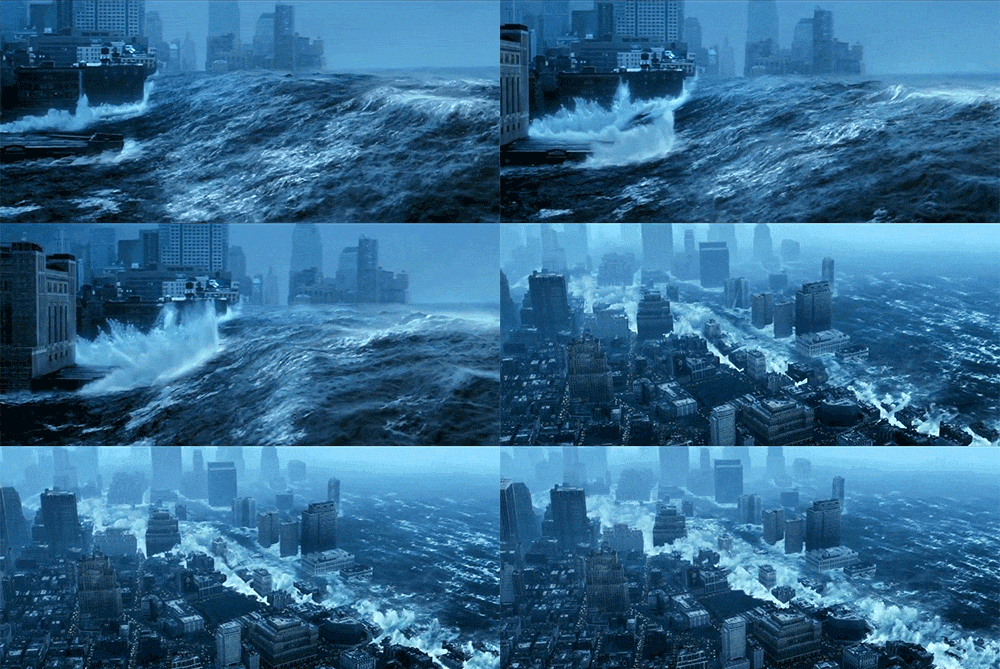
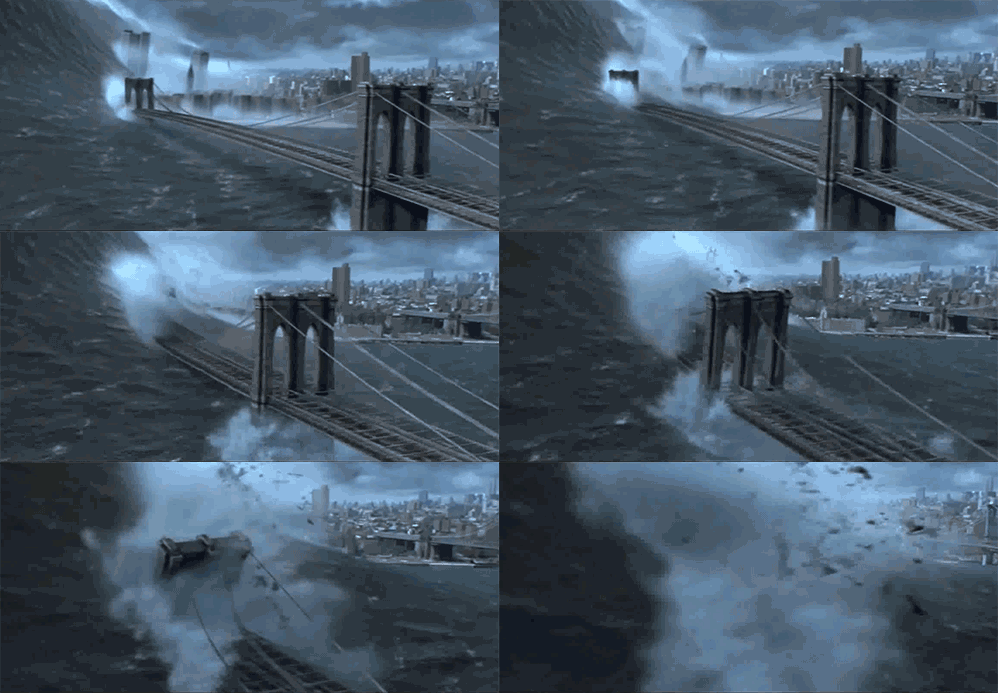
It’s a climate disaster novel that touches on survival & isolation, new found family and preservation of humanity & spirit. Initially it gave me such strong “Day After Tomorrow” movie vibes (probably one of my favorite movies sci-fi movies of early 2000s)—but for a heavy topic, it didn’t do it any justice. I don’t mean to be mean… but…it’s honestly 1⭐️
I'm just going to make a list why this book didn't work for me because it's Christmas and I don't want to be eloquent.
- Nothing happened until 50% - Our main character has a special ability that is never explored/doesn't affect the story - We don't get a lot of background into the advent of the flood - A lot of characters that we are supposed to feel something for, but we don't get to establish a connection - Flashback scenes completely jar the story and bring it to a halt
There was nothing wrong with the writing but I just really didn't enjoy this and I finished it by sheer force of will!
⭐⭐
Available January 7, 2024
Thank you to Netgalley and St Martin's Press for an advance review copy of this book in exchange for my honest review.
Weird to see this compared with Station Eleven, it kind of has more of the energy of the quieter moments of the Parable of the Sower duology? But without as much social commentary.
i’ve never been a fan of climate fiction (cli-fi), considering it’s not ever been a fictional concept and the looming threat contradicts my desire of escapism…
all the water in the world is most likely my first cli-fi novel, and i found the concept of our fmc nonie having the ability to be hyper-aware of when the next disaster would occur rather interesting.