Jump to ratings and reviews
Rate this book

Geronimo: The Man, His Time, His Place (The Civilization of the American Indian Series Book 142)

Rate this book
On 5 September 1886, America rejoiced as the news flashed from the Southwest that the Apache war leader Geronimo had surrendered to Brigadier General Nelson A. Miles. With Geronimo, at the time of his surrender, were Chief Naiche - son of the great Cochise - sixteen other warriors, fourteen women and six children. It had taken a force of 5,000 regular army troops and a series of false promises to capture the band.

Here is an enthralling narrative of revenge and raids, of escape, pursuit and uneasy peace. It is also a powerful and sympathetic portrait of Geronimo - one of the greatest, most feared and most elusive of Indian leaders - a man who became known as 'the tiger of the human race'.

533 pages, Kindle Edition

First published January 1, 1976

18 people are currently reading
163 people want to read

About the author

Angie Debo

42 books24 followers

Born in Beattie, Kansas, where her parents, Edward P. and Lina Cooper Debo, were homesteaders, Angle Debo liked to observe that her birth date coincided with the closing of the American frontier. She spent a lifetime examining the historical implications of that settlement for Native American Indians…

Debo was the author of numerous books and essays; salient works in addition to those listed in the text include her MA thesis, "The Historical Background of the American Policy of Isolation," Smith College Studies in History 9 (April-July 1924), pp. 71-165; The Five Civilized Tribes: Report on Social and Economic Conditions (1951); Geronimo: The Man, His Time, His Place (1976); and Oklahoma: A Guide to the Sooner State (1941), edited with John M. Oskison.

References

Fitzpatrick, E. (2004). DEBO, Angie Elbertha. Notable American Women, A Biographical Dictionary: Completing The Twentieth Century (Vol.5), 158.

Ratings & Reviews

What do you think?
Rate this book

Friends & Following

Create a free account to discover what your friends think of this book!

Community Reviews

5 stars
30 (34%)
4 stars
32 (36%)
3 stars
18 (20%)
2 stars
5 (5%)
1 star
2 (2%)
Displaying 1 - 11 of 11 reviews
Profile Image for Mikey B..
1,141 reviews487 followers
March 6, 2016


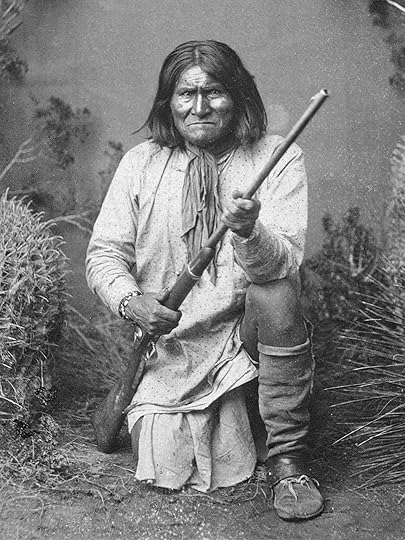
Geronimo 1884


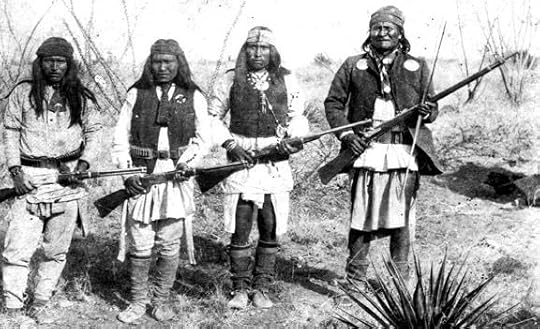
Yahnozha, Chappo, Fun and Geronimo 1886

This book is also a history of the Apache people during the time of Geronimo. It is an excellent and a sad chronicle. The Apaches lived in an area currently in Mexico (states of Sonora and Chihuahua) and the U.S. (states of New Mexico and Arizona). They were not more than a few thousand people and were persecuted by Mexico and the United States – meaning government agents, soldiers, and settlers. All sides (meaning Mexico, U.S. and Apaches) could be very ruthless.

It was a war that the Apaches could never win; they were simply outnumbered by armies that could be replenished and by an ever-increasing influx of settlers. Geronimo to his dying day hated Mexicans, because his wife, children and other relations had been massacred by Mexican soldiers. He re-married and had other wives after.

Large numbers of U.S. and Mexican soldiers chased small numbers of Apaches across a very rugged landscape. The Apaches (sometimes under Geronimo) gave as good as they got – rampaging, killing and stealing horses, guns, ammunition, food... on both sides of the border. Settlers feared the Apaches and grew increasingly irritated that the government armies could never subdue them.

The Apaches were caught a number of times, but always managed to escape. Finally they gave up to the U.S. army in Mexico (generally Mexico allowed U.S. troops to enter when pursuing Apaches). The Apaches were simply tired of constantly fighting and hiding – and were realizing the futility of their struggle. It should also be pointed out that they were only found because the U.S. army used Apache scouts to track them! The author emphasizes that the Apache people were strongly individualistic and were not subservient to Geronimo or any other leader. Some did not want to fight.


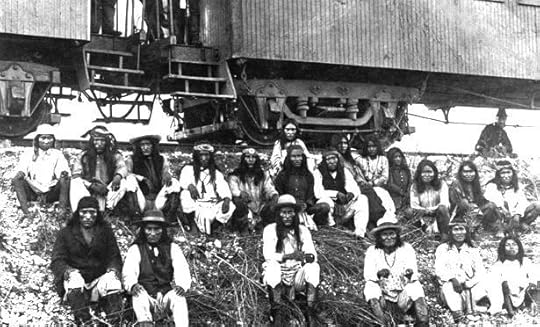
a rest stop on the way to San Antonio 1887


Throughout, the author always presents well the Apache point of view – giving us many of their spokes-people. They were moved from the southwest U.S. to Florida. It is harder to think of a landscape that is entirely different from their original land (from canyon, mountain, dry-desert to hot, humid and flat). Many in Florida died of diseases like tuberculosis and pneumonia.

But not Geronimo, who lived, it is estimated, into his early 90’s (he died in 1909). He was always in strong physical condition, riding horses until his dying day. He died in Fort Sill, Oklahoma after his people were moved there from Florida.

This book is engaging and captures well the spirit of these people who lived long ago.
Profile Image for Rena Jane.
268 reviews12 followers
November 22, 2014
A beautiful, fair and dignified biography of one of the most famous of Indian chiefs.

Must read for lovers of southwestern history.
3,198 reviews26 followers
December 8, 2018
Who was Geronimo? A Man of the Apache. Geronimo was not one to sit on a fence and watch the white man take away from the Apache. He fought with unbridled passion. He realized the white man was taking everything away from the Apache. The white man is the one who started the scalping program. The United States was paying $50 dollars a scalp and the Mexicans slightly more. The once proud Apache nation fell to the wayside in the White expansion. The Indians believed that Mother Earth should be taken care of and they stated so, but we are seeing the results of white ignorance in the destruction of the climate. Chief Joseph of the Nez Perce was an Indian leader who led his people out of harms way. He led them to Canada. This is an excellent read for the genre.....DEHS
Profile Image for Krysia Meráki Stories .
154 reviews3 followers
December 14, 2025
Tenía gran esperanza de conocer una decente memoria de Gerónimo, y solo me encuentro capítulo a capítulo, una visión sesgada contra la herencia española en México y Nuevo México.

La autora utiliza vocabulario propio de las atrocidades realizadas por su propio país, 'Esclavo', 'Vasallo', etc. Y las pone a los españoles.

Así de primeras, quita de un plumazo la herencia española en la tribu de Gerónimo, para dar espacio solamente al reciente Estados Unidos y los apaches. Ojo, con muy poca mención al pueblo mexicano.

Espero reerlo, pero me ha decepcionado para continuarlo.
Profile Image for Willie Kirschner.
453 reviews1 follower
October 25, 2021
I inherited this book, and thought it would be more interesting than I thought it was. It is a very sad story in the history of America’s genocide of the natives of this country. This was a brave man who fought against all odds to preserve his family and his people. America never treated him fairly, and had the chutzpah to label him a savage. It is a shame we cannot treat Native people better.
Profile Image for Jas.
292 reviews
May 19, 2021
Really enjoyed this history of the Apaches and Geronimo in 1800s and later. Lots of detail, but very readable. Really changes your view of his general reputation. Family was key to him.
Profile Image for Emmanuel Gustin.
413 reviews26 followers
July 8, 2012
By necessity, this is not just a history of the war leader and medicine man who was called Geronimo, but also of his people, a cluster of Apache tribes who lived on the border of Arizona and Mexico. Debo is grimly realistic about the bloody conflict that was sometimes as much an internal tribal war, as a war of the native Americans against the intruding Mexicans and Anglo-Americans. Her biography is that of a man who was hardy, intelligent, ruthless, charismatic, superstitious and at times paranoid. He lived by his own standards and values, which remained mysterious to the white soldiers who fought him and later held him captive.


Profile Image for Nick.
678 reviews33 followers
March 11, 2010
Larry McMurtry considers this book a classic, and he has pretty good taste. It is not only a biography of Geronimo but a history of the encounter between the U.S.A.'s westward expansion and the Apache people through the life of one of its great leaders.
Profile Image for Troy.
72 reviews4 followers
April 28, 2008
The sad thing is that the Apache's were pushed onto reservations because the goverment was doing so in the name of big business - the Mining Corporations.
4 reviews
November 13, 2008
This book demonstrates the dignity of the American Indian and Geronimo in particular. It clearly shows how the American Government has screwed with the Indians over and over and over again....
Displaying 1 - 11 of 11 reviews

Can't find what you're looking for?

Get help and learn more about the design.