Have you ever watched the TV programme "The Addams Family"? A strange way to start a book review, perhaps, but bear with me and all will become clear.
Charles Addams was an American cartoonist and comic strip artist known for his black humour and macabre characters. His work regularly appeared in The New Yorker, where according to a biographer, he was "drawing with a happy vengeance". Ray Bradbury is a master story-teller, a science-fiction writer whose works are without fail extraordinary flights of the imagination. They met in 1946, and the rest, as they say, is history.
In his twenties Ray Bradbury wrote a short story entitled "Homecoming". It was to be the first in a series of tales chronicling a family named the Elliotts. But this was no ordinary family. Yes, they were loyal and loving, with great hearts and compassion, as families should be. But they were a strange outlandish family, comprised of ghosts and unnamed supernatural creatures, who all lived in Illinois, in the Mid-Western United States.
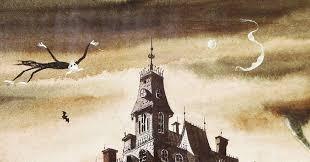
Charles Addams painted a two-page spread to illustrate "Homecoming", which was published in the October 1946 issue of "Mademoiselle" magazine. Although "Homecoming" had been rejected several times, this time the editors enthusiastically decided to change the magazine to fit the story, and based the whole issue around it. The pair, Bradbury and Addams, became friends and planned to collaborate on a book of the Elliott Family's complete history with Bradbury writing and Addams providing the illustrations, but it never materialized.
From then on, their two paths diverged. In an interview, Bradbury stated that Addams,
"went his way and created the Addams Family and I went my own way and created my family in this book."
"The Addams Family" became a huge success, both on television and films, and in cartoon and book form. However, it is a very different beast from Bradbury's. Addams heightened the humour and populist treatment; Bradbury's stories about the Elliott family kept the wry macabre humour, but were by turns lyrical, wistful, poignant, and chilling.
"From the Dust Returned" then, is Bradbury's created novel from 2001, about the immortal family. The author developed six of his short stories written over a fifty-five year period. All of the stories had appeared in magazines, and some also in previous anthologies, so the reader may well have a feeling of deja-vu whilst reading this novel. If anything this adds to the dreamlike feel characteristic of all Bradbury's writing.
The cover illustration to the book is the original one by Charles Addams, created to accompany the first story. Sadly Addams never saw this novel; he died in 1988. Interspersed in the text are small line drawings of spiders, cats, tombs, skeletons and suchlike, to enhance the mood. The previously published six stories are interwoven with newer chapters and lyrical prose passages, connecting to make a unique atmospheric patchwork of a most peculiar clan.
"They hollowed, they lingered, they roared down and wafted up... the shapeless and invisible winds... carrying the semblance of their old weather with them. And if they had names at all it was monsoon or sirocco or santana... hurricanes flung hopeless... or flurried south with freezing breaths to meet the breaths of fire that moved intemperately across the Gulf."
Bradbury says that his initial inspiration for the Elliott family dates back to his childhood, and the Halloweens he spent at his grandmother's house. This resulted in the first short story, "Homecoming." He then published five further stories about the Elliotts.
They have lived for centuries in a house of legend and mystery. Nobody except the family know where it is, and they preserve its secret location ferociously. Rarely encountered in daylight hours, the family's children are strange and wild; all supernatural creatures of the night save one - Timothy - the human foundling son they feel sorry for and adopt. He is considered to be abnormal by them as his face reflects in a mirror; a perfect example of Bradbury's trademark ghoulish wit. Ironically it is Timothy who is the poignant character in this weird tale, for it is he who carries the burden of time on his shoulders. The family are right; he is strange. He is unique. For unlike them, one day he must age and die.
This series of interconnected stories, uses a device Bradbury has used before, notably in "The Illustrated Man". In this case the linking character is A Thousand Times Great Grandmère, the family matriarch. She is the mother of Nefertiti, and she and Grandfather have survived since before the Sphinx in Egypt. She speaks pronouncements; lyrical passages from deep within her mummified wrappings. She speaks about the old ones, and of millennia gone by,
"a captive of time, her eyes slits of deep blue lapis lazuli behind thread-sewn lids, a glitter of remembrance as her mouth, with a shriveled tongue wormed in it, whistled and sighed and whispered to recall every hour of every lost night four thousand years back"
The main character is Cecy, "the one who dreams," a young girl yearning for love who can experience the world only through the travels of her mind as she flies high in the consciousness of bird, or bat... or human. There is Uncle Einar, a fun-loving, proud-winged vampire who loses his ability to fly. There is Tom, a farm boy whom Cecy "meets" and falls in love with one night during one of her spirit-borne journeys.
Throughout the stories, there is growing tension as the house is being got ready for the gala homecoming that will gather together the farflung branches of the family, whether shapeshifter, telepath, somnambulist or vampire. But in the midst of eager anticipation, there is a sense of doom. For the world is changing. And it is Timothy who must find a way to resolve it. The ending... well it is unexpected. Afterwards the reader has a great sense of loss, but also a sense of inevitability.
This novel shows Ray Bradbury's powerful vision and imagination, with just one single human representative of the Elliott family. It is very different in feel to the Addams family of the television series, or indeed, the cartoons. But then from the initial conception has developed something touching, wistful and strange, at times reading like liquid poetry.
A critic once stated, "Ray Bradbury is Edgar Allan Poe for optimists." A good description of this book, perhaps? Here's a taste,
"And what are you, or we, or us? Can it be named?...Are we kin to Autumn rains? Do we rise in mists from wetland moors? Do twilight fogs seem similar? Do we prowl or run or lope? Are we shadows on a ruined wall?...Do we hover or fly or writhe...? Are we footsteps heard to waken us and bump our skulls on nailed-shut lids? Are we batwing heartbeats held in claw or hand or teeth?...Do we abide in walls as mortuary beetles telling time?...Do we sleep by day and swarm-glide the splendid night? When Autumn leaves shower bullions are we that Midas stuff, a leaf-fall that sounds the air in crisp syllables? What, what, oh what are we?"