

What do you think?
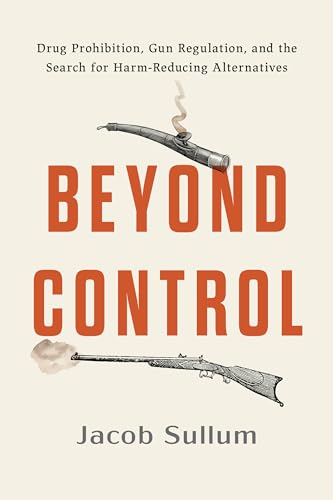
Beyond Control: Drug Prohibition, Gun Regulation, and the Search for Sensible Alternatives
In this incisive book, Reason editor Jacob Sullum untangles America’s twin crusades against guns and drugs, suggesting better-tailored alternatives that do more good while causing less harm.
Does gun control work? What about drug prohibition? In this cogent examination of two of America’s most enduring challenges, Reason Senior Editor Jacob Sullum traces the evolution of gun and drug laws from their dubious beginnings to today’s divisive rhetoric. Based on data-driven analysis and compassionate consideration of the human costs imposed by the twin crusades against guns and drugs, Sullum recommends an alternative approach that focuses on reducing harm, including the harm caused by misguided policies.
Sullum exposes the racist roots of gun control and drug control, noting that both policies continue to have a racially disproportionate impact. Even leaving aside the legacy of that dark history, he argues, both policies are unjust because they punish people for conduct that violates no one’s rights. They are also dangerous to civil liberties because they encourage the expansion of government power at the expense of individual freedom.
The burdens imposed by gun control and drug control reinforce each other, since gun possession increases penalties for drug offenses and drug offenses disqualify people from legally possessing guns. Yet there is little logic to these legal regimes, which penalize people for behavior that is not inherently criminal.
Decades of research have produced scant evidence that popular gun control prescriptions such as assault weapon bans, universal background checks, restrictions on ownership, and red flag laws work as advertised. Research on the impact of the war on drugs likewise provides little reason to believe that its doubtful benefits outweigh its myriad costs. In both cases, the burdens often fall on peaceful individuals who pose no threat to public safety, and the policies seem ill-designed to reduce the problems they aim to address.
Sullum notes that critics of gun control and critics of the war on drugs make similar points, complaining that these policies are unfair, invasive, poorly targeted, and ineffective. But because these two sets of critics tend to come from opposing political camps, they usually overlook their common ground. Beyond Control surveys that territory, showing that conservatives and progressive share concerns about overcriminalization, overzealous law enforcement, draconian penalties, and the erosion of civil liberties.
Substance abuse, violence, and suicide are complex problems that cannot be solved by targeting inanimate objects or by arresting and incarcerating people who possess them. Beyond Control urges better-tailored alternatives that would do more good while causing less harm.
Does gun control work? What about drug prohibition? In this cogent examination of two of America’s most enduring challenges, Reason Senior Editor Jacob Sullum traces the evolution of gun and drug laws from their dubious beginnings to today’s divisive rhetoric. Based on data-driven analysis and compassionate consideration of the human costs imposed by the twin crusades against guns and drugs, Sullum recommends an alternative approach that focuses on reducing harm, including the harm caused by misguided policies.
Sullum exposes the racist roots of gun control and drug control, noting that both policies continue to have a racially disproportionate impact. Even leaving aside the legacy of that dark history, he argues, both policies are unjust because they punish people for conduct that violates no one’s rights. They are also dangerous to civil liberties because they encourage the expansion of government power at the expense of individual freedom.
The burdens imposed by gun control and drug control reinforce each other, since gun possession increases penalties for drug offenses and drug offenses disqualify people from legally possessing guns. Yet there is little logic to these legal regimes, which penalize people for behavior that is not inherently criminal.
Decades of research have produced scant evidence that popular gun control prescriptions such as assault weapon bans, universal background checks, restrictions on ownership, and red flag laws work as advertised. Research on the impact of the war on drugs likewise provides little reason to believe that its doubtful benefits outweigh its myriad costs. In both cases, the burdens often fall on peaceful individuals who pose no threat to public safety, and the policies seem ill-designed to reduce the problems they aim to address.
Sullum notes that critics of gun control and critics of the war on drugs make similar points, complaining that these policies are unfair, invasive, poorly targeted, and ineffective. But because these two sets of critics tend to come from opposing political camps, they usually overlook their common ground. Beyond Control surveys that territory, showing that conservatives and progressive share concerns about overcriminalization, overzealous law enforcement, draconian penalties, and the erosion of civil liberties.
Substance abuse, violence, and suicide are complex problems that cannot be solved by targeting inanimate objects or by arresting and incarcerating people who possess them. Beyond Control urges better-tailored alternatives that would do more good while causing less harm.
- GenresPolitics
295 pages, Kindle Edition
Published September 2, 2025
About the author
Jacob Sullum
21 books7 followersJacob Z. Sullum (B.A., Cornell University) is an award-winning journalist who has covered drug policy, public health, gun control, civil liberties, and criminal justice for more than three decades and currently serves as senior editor at Reason. His syndicated weekly column is carried by newspapers across the United States, including the New York Post and Chicago Sun-Times.
In 1988 Sullum won the Keystone Press Award for investigative reporting, and in 1991 he received First Prize in the Felix Morley Memorial Journalism Competition.
In 1988 Sullum won the Keystone Press Award for investigative reporting, and in 1991 he received First Prize in the Felix Morley Memorial Journalism Competition.
Ratings & Reviews
Friends & Following
Create a free account to discover what your friends think of this book!
Community Reviews
Displaying 1 - 6 of 6 reviews

December 4, 2025
Definitely an original work that does a good job summarizing the history and current status of drug and gun prohibition in a way that’s accessible for those new to either subject. The book is formatted in a way that reviews drugs and guns mostly separately so the reader can see the comparisons of prohibition and harm reduction for each. My only criticism is I wish more space was dedicated to how drug laws and gun control intersect, not merely their similarities. A solid book otherwise.

June 5, 2025
Book Review: Beyond Control: Drug Prohibition, Gun Regulation, and the Search for Sensible Alternatives by Jacob Sullum - A Public Health Practitioner’s Perspective
Jacob Sullum’s Beyond Control is a provocative critique of America’s twin crusades against drugs and guns, challenging readers to reconsider punitive approaches through a lens of harm reduction and personal autonomy. As a public health practitioner, I found myself both intellectually stimulated and emotionally conflicted by Sullum’s arguments—applauding his indictment of carceral systems while wrestling with the gendered implications of his libertarian framework.
Emotional Resonance: Between Agreement and Unease
Reading this book evoked a tension between professional principles and personal convictions. Sullum’s dismantling of prohibitionist policies resonated deeply—particularly his exposure of how the war on drugs has disproportionately criminalized Black and Brown communities, a reality public health has long fought against. Yet his near-absolutist stance on individual liberty left me unsettled when applied to gun regulation. As someone who works with survivors of intimate partner violence (where firearms escalate lethality risks), I struggled to reconcile his skepticism of gun laws with the lived reality that some forms of control do protect marginalized lives. The book’s libertarian core often felt at odds with feminist collectivism, sparking both admiration for its boldness and frustration at its blind spots.
Key Insights for Public Health
-The Failure of Punitive Systems: Sullum’s analysis of drug prohibition as a public health disaster aligns with feminist critiques of carceral “solutions” to social problems. His evidence that criminalization worsens outcomes (e.g., overdose deaths, mass incarceration) reinforces our field’s push for decriminalization and safe-use programs.
-The Paradox of “Protection”: The book’s exploration of how gun regulations often fail to prevent violence while infringing on rights mirrors feminist debates about paternalistic policies (e.g., mandatory waiting periods for abortion). This tension—between safety and autonomy—demands nuanced discussion.
-Alternatives as Radical Praxis: Sullum’s proposals for market-based and community-led alternatives (e.g., drug legalization, voluntary risk-reduction tools) offer provocative parallels to feminist mutual-aid models, though they risk underestimating structural barriers.
Constructive Criticism
-Gendered Analysis Missing: While Sullum critiques systemic racism, the book largely ignores how drug and gun policies specifically harm women—particularly survivors of violence, pregnant people targeted by punitive drug laws, or trans women of color facing armed policing. A feminist lens would deepen this critique.
-Structural Myopia: The libertarian focus on individual choice overlooks how systemic inequities (poverty, misogyny, racism) constrain “voluntary” alternatives. Public health thrives on balancing autonomy with collective responsibility—a tension needing more acknowledgment.
Final Thoughts
Beyond Control is a vital but flawed contribution to policy debates. Sullum’s sharp critique of prohibitionist dogma is essential reading, even as his framework demands feminist revision. The book left me galvanized to advocate for truly sensible alternatives—ones that center both liberty and the marginalized communities most harmed by false binaries of control vs. chaos.
Rating: ★★★½ (3.5/5) – A thought-provoking starting point, not a final word.
Gratitude: Thank you to the publisher and Edelweiss for the review copy. In a polarized landscape, this book challenges all sides to think beyond dogma—a rare and needed provocation.
Jacob Sullum’s Beyond Control is a provocative critique of America’s twin crusades against drugs and guns, challenging readers to reconsider punitive approaches through a lens of harm reduction and personal autonomy. As a public health practitioner, I found myself both intellectually stimulated and emotionally conflicted by Sullum’s arguments—applauding his indictment of carceral systems while wrestling with the gendered implications of his libertarian framework.
Emotional Resonance: Between Agreement and Unease
Reading this book evoked a tension between professional principles and personal convictions. Sullum’s dismantling of prohibitionist policies resonated deeply—particularly his exposure of how the war on drugs has disproportionately criminalized Black and Brown communities, a reality public health has long fought against. Yet his near-absolutist stance on individual liberty left me unsettled when applied to gun regulation. As someone who works with survivors of intimate partner violence (where firearms escalate lethality risks), I struggled to reconcile his skepticism of gun laws with the lived reality that some forms of control do protect marginalized lives. The book’s libertarian core often felt at odds with feminist collectivism, sparking both admiration for its boldness and frustration at its blind spots.
Key Insights for Public Health
-The Failure of Punitive Systems: Sullum’s analysis of drug prohibition as a public health disaster aligns with feminist critiques of carceral “solutions” to social problems. His evidence that criminalization worsens outcomes (e.g., overdose deaths, mass incarceration) reinforces our field’s push for decriminalization and safe-use programs.
-The Paradox of “Protection”: The book’s exploration of how gun regulations often fail to prevent violence while infringing on rights mirrors feminist debates about paternalistic policies (e.g., mandatory waiting periods for abortion). This tension—between safety and autonomy—demands nuanced discussion.
-Alternatives as Radical Praxis: Sullum’s proposals for market-based and community-led alternatives (e.g., drug legalization, voluntary risk-reduction tools) offer provocative parallels to feminist mutual-aid models, though they risk underestimating structural barriers.
Constructive Criticism
-Gendered Analysis Missing: While Sullum critiques systemic racism, the book largely ignores how drug and gun policies specifically harm women—particularly survivors of violence, pregnant people targeted by punitive drug laws, or trans women of color facing armed policing. A feminist lens would deepen this critique.
-Structural Myopia: The libertarian focus on individual choice overlooks how systemic inequities (poverty, misogyny, racism) constrain “voluntary” alternatives. Public health thrives on balancing autonomy with collective responsibility—a tension needing more acknowledgment.
Final Thoughts
Beyond Control is a vital but flawed contribution to policy debates. Sullum’s sharp critique of prohibitionist dogma is essential reading, even as his framework demands feminist revision. The book left me galvanized to advocate for truly sensible alternatives—ones that center both liberty and the marginalized communities most harmed by false binaries of control vs. chaos.
Rating: ★★★½ (3.5/5) – A thought-provoking starting point, not a final word.
Gratitude: Thank you to the publisher and Edelweiss for the review copy. In a polarized landscape, this book challenges all sides to think beyond dogma—a rare and needed provocation.

July 31, 2025
Strong Refutation of Gun and Drug Laws. At least in American politics, the political right loves to demand total freedom re: guns (and has a particularly strong textual Constitutional case for exactly that) yet also demand exceedingly harsh punishments for even minor issues wherein a person is using, possessing, or even being anywhere near some substance the government has decided it doesn't like. In American politics, the political left is the opposite - demanding near total freedom re: substances (despite, to be clear, a clear Constitutional case protecting access there) while demanding ever more draconian punishments for any issue they don't like involving certain tools they don't like.
In this text, reasonably well researched with a bibliography clocking in at around 23% of the overall text, Reason Magazine editor Jacob Sullum finally writes a book about the two issues he has spent a career writing for the magazine about: gun control and drug control, and how both have remarkably similar histories and even current arguments.
Sullum shows how both ultimately come from racist and classist origins and actively have racist and classist causes and effects even in today's society. He quotes the oft-cited Michelle Alexander's New Jim Crow, while pointing to some of its shortcomings. He cites others across the ideological spectrum, showing the strengths and weaknesses of several different ideas through the course of both early American history up through history as recent as 2024.
Ultimately, this is not even that arguably the strongest take down of both regulatory schemes I've yet encountered in book form - and the fact that Sullum did it with *two* topics (and shows how closely they are linked, despite "both" American Political Parties handling each very differently) at once shows just how much of a master logician he is. I mean, I consider myself reasonably well versed in various forms of debate, but here Sullum may as well be Neo upon discovering that he really is The One, effortlessly slicing through counter arguments as if they were no more substantive than the hot air coming out both sides of Joe Biden's mouth. (And yes, yet again another libertarian-based book, and another book were former US Senator and now former President Joe Biden is cited - and showing how wrong he was - seemingly more often than any other US President, including the current one as I write this review just over a month before publication of this book. The other similar book being Radley Balko's excellent 2013 book Rise Of The Warrior Cop.)
If you're at all interested in gun control or drug legalization in the US, from any position and any angle... you need to read this book. Even if just for opposition research. Because even if I didn't agree with Sullum's positions (and I don't... maybe 5% of the time here ;) ) this truly is a very solidly reasoned and examined argument against government regulation of either object, at least as regulations of either currently stand or are largely even thought of at all, and even if you are 100% opposed to Sullum's stances here, you'll do yourself a favor by examining his arguments if only to try to find a way to counter them.
Truly well done, truly well organized narratively, and absolutely...
Very much recommended.
In this text, reasonably well researched with a bibliography clocking in at around 23% of the overall text, Reason Magazine editor Jacob Sullum finally writes a book about the two issues he has spent a career writing for the magazine about: gun control and drug control, and how both have remarkably similar histories and even current arguments.
Sullum shows how both ultimately come from racist and classist origins and actively have racist and classist causes and effects even in today's society. He quotes the oft-cited Michelle Alexander's New Jim Crow, while pointing to some of its shortcomings. He cites others across the ideological spectrum, showing the strengths and weaknesses of several different ideas through the course of both early American history up through history as recent as 2024.
Ultimately, this is not even that arguably the strongest take down of both regulatory schemes I've yet encountered in book form - and the fact that Sullum did it with *two* topics (and shows how closely they are linked, despite "both" American Political Parties handling each very differently) at once shows just how much of a master logician he is. I mean, I consider myself reasonably well versed in various forms of debate, but here Sullum may as well be Neo upon discovering that he really is The One, effortlessly slicing through counter arguments as if they were no more substantive than the hot air coming out both sides of Joe Biden's mouth. (And yes, yet again another libertarian-based book, and another book were former US Senator and now former President Joe Biden is cited - and showing how wrong he was - seemingly more often than any other US President, including the current one as I write this review just over a month before publication of this book. The other similar book being Radley Balko's excellent 2013 book Rise Of The Warrior Cop.)
If you're at all interested in gun control or drug legalization in the US, from any position and any angle... you need to read this book. Even if just for opposition research. Because even if I didn't agree with Sullum's positions (and I don't... maybe 5% of the time here ;) ) this truly is a very solidly reasoned and examined argument against government regulation of either object, at least as regulations of either currently stand or are largely even thought of at all, and even if you are 100% opposed to Sullum's stances here, you'll do yourself a favor by examining his arguments if only to try to find a way to counter them.
Truly well done, truly well organized narratively, and absolutely...
Very much recommended.
November 3, 2025
In Beyond Control, the journalist Jacob Sullum argues persuasively that critics of the drug war (typically progressives) and critics of gun control (typically conservatives) are essentially making the same arguments. Conversely, you could swap words Mad Libs-style in the speeches of drug prohibitionists and gun prohibitionists. Both are making bad arguments. When it comes to guns or drugs, prohibition doesn’t work.
I was familiar with the racist roots of drug laws, but the chapter on the racist roots of gun laws had information that was mostly new to me. “A Winchester rifle should have a place of honor in every black home,” wrote the great Civil Rights activist Ida B. Wells, making the case that guns were an effective deterrent to lynching. Frederick Douglass and Martin Luther King, Jr. also recognized that guns could provide some degree of protection when the law failed. It’s no mystery why racist Southern whites sought to strip blacks of their rifles. In Chapter 4, Sullum convincingly argues that, while the rhetoric has changed, gun restrictions continue to punish blacks disproportionately.
I love reading Sullum’s prose (both here and in the pages of Reason magazine) because his paragraphs are like impenetrable fortresses of logical argument. Beyond Control is also beautifully crafted and filled with personal stories that make it a joy to read. I hope this provocative book will be read closely by drug warriors and gun prohibitionists alike.
I was familiar with the racist roots of drug laws, but the chapter on the racist roots of gun laws had information that was mostly new to me. “A Winchester rifle should have a place of honor in every black home,” wrote the great Civil Rights activist Ida B. Wells, making the case that guns were an effective deterrent to lynching. Frederick Douglass and Martin Luther King, Jr. also recognized that guns could provide some degree of protection when the law failed. It’s no mystery why racist Southern whites sought to strip blacks of their rifles. In Chapter 4, Sullum convincingly argues that, while the rhetoric has changed, gun restrictions continue to punish blacks disproportionately.
I love reading Sullum’s prose (both here and in the pages of Reason magazine) because his paragraphs are like impenetrable fortresses of logical argument. Beyond Control is also beautifully crafted and filled with personal stories that make it a joy to read. I hope this provocative book will be read closely by drug warriors and gun prohibitionists alike.

August 15, 2026
I’m torn. A significant portion of this book, particularly the drug sections, was excellent. But some parts felt starkly disingenuous.
A few statements really stuck out and rubbed me the wrong way (ignoring that Beyond Control never got into mass shootings and didn’t start to address gun crimes until nearly 200 pages in). In some instances, they felt like a side effect of the author’s lack of clarity. For example, readers could be mislead into the incorrect assumption that Biden pardoned his son, Hunter, for drug crimes. He did not. He did so because the president succeeding him threatened the entire
Biden family with imprisonment multiple times.
In other instances, it seems to be an outright obstruction of information. For example, Ross Ulbricht did not receive a life sentence for “creating a website.” Sullum is a seasoned and celebrated journalist. I left wanting more.
A few statements really stuck out and rubbed me the wrong way (ignoring that Beyond Control never got into mass shootings and didn’t start to address gun crimes until nearly 200 pages in). In some instances, they felt like a side effect of the author’s lack of clarity. For example, readers could be mislead into the incorrect assumption that Biden pardoned his son, Hunter, for drug crimes. He did not. He did so because the president succeeding him threatened the entire
Biden family with imprisonment multiple times.
In other instances, it seems to be an outright obstruction of information. For example, Ross Ulbricht did not receive a life sentence for “creating a website.” Sullum is a seasoned and celebrated journalist. I left wanting more.

November 7, 2025
This book clearly demonstrates the link between gun control drug prohibition, and racism to the point of being repetitive. The author encourages a focus on harm reduction as a solution, which is good. However, his solutions are too general. I would have appreciated more specific policy proposals. #endthedrugwar
Displaying 1 - 6 of 6 reviews