

What do you think?

Redrawing the Western: A History of American Comics and the Mythic West
A history of American Western genre comics and how they interacted with contemporaneous political and popular culture.
Redrawing the Western charts a history of the Western genre in American comics from the late 1800s through the 1970s and beyond. Encompassing the core years in which the genre was forged and prospered in a range of popular media, Grady engages with several key historical timeframes, from the origins of the Western in the nineteenth-century illustrated press; fin de siècle anxieties with the closing of the frontier; and the centrality of cowboy adventure across the interwar, postwar, and high Cold War years, to the revisions of the genre in the wake of the Vietnam War and the Western’s continued vitality in contemporary comics storytelling.
In its study of stories about vengeance, conquest, and justice on the contested frontier, Redrawing the Western highlights how the “simplistic” conflicts common in Western adventure comics could disguise highly political undercurrents, providing young readers with new ways to think about the contemporaneous social and political milieu. Besides tracing the history, forms, and politics of American Western comics in and around the twentieth century, William Grady offers an original reassessment of the important role of comics in the development of the Western genre, ranking them alongside popular fiction and film in the process.
Redrawing the Western charts a history of the Western genre in American comics from the late 1800s through the 1970s and beyond. Encompassing the core years in which the genre was forged and prospered in a range of popular media, Grady engages with several key historical timeframes, from the origins of the Western in the nineteenth-century illustrated press; fin de siècle anxieties with the closing of the frontier; and the centrality of cowboy adventure across the interwar, postwar, and high Cold War years, to the revisions of the genre in the wake of the Vietnam War and the Western’s continued vitality in contemporary comics storytelling.
In its study of stories about vengeance, conquest, and justice on the contested frontier, Redrawing the Western highlights how the “simplistic” conflicts common in Western adventure comics could disguise highly political undercurrents, providing young readers with new ways to think about the contemporaneous social and political milieu. Besides tracing the history, forms, and politics of American Western comics in and around the twentieth century, William Grady offers an original reassessment of the important role of comics in the development of the Western genre, ranking them alongside popular fiction and film in the process.
310 pages, Kindle Edition
Published November 12, 2024
Ratings & Reviews
Friends & Following
Create a free account to discover what your friends think of this book!
Community Reviews
Displaying 1 - 1 of 1 review

June 17, 2026
An academic study (drawn from the author's PhD research) of the development of comics with a "Wild West" setting. The author demonstrates how mercurial (and resilient) the genre is, reflecting changing times, melding with other genres and being easy to parody. The book traces antecedents of the Western comics in dime novels, newspaper cartoons, silent films and vaudeville shows (which provides a good overview of the origins of the genre as a whole). It then continues chronologically, including discussions of censorship, Western romance comics, patriotic Cold War allegories (including some featuring a cartoon John Wayne), and 1970s underground comics.
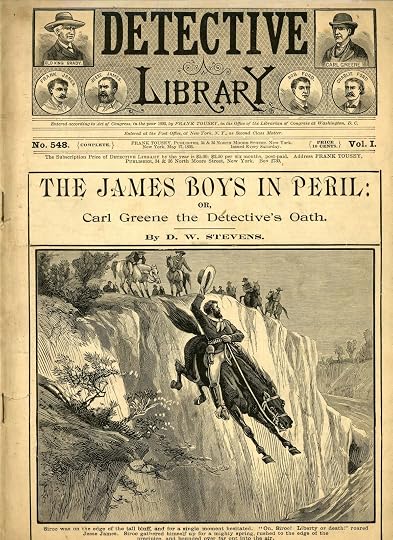
A dime novel cover which is an illustration in the book: "Siroc was on the edge of the tall bluff" from D.W. Stevens, "The James Boys in Peril," New York Detective Library #548, new York: Frank Tousey, 1893
There is an interesting discussion of a paradoxical (perverse?) nostalgia at the heart of the genre (in its older forms at least): glorifying a time of westward expansion, and simultaneously nostalgic for the world that existed before that colonisation was complete. The book considers more subversive and revisionist takes on the genre as well. The strongest analysis is of a 1976 comic book story 'Nits Make Lice' by John Jackson, which has no nostalgia for the Old West at all, and is unflinching in its portrayal of genocide.
A dime novel cover which is an illustration in the book: "Siroc was on the edge of the tall bluff" from D.W. Stevens, "The James Boys in Peril," New York Detective Library #548, new York: Frank Tousey, 1893
There is an interesting discussion of a paradoxical (perverse?) nostalgia at the heart of the genre (in its older forms at least): glorifying a time of westward expansion, and simultaneously nostalgic for the world that existed before that colonisation was complete. The book considers more subversive and revisionist takes on the genre as well. The strongest analysis is of a 1976 comic book story 'Nits Make Lice' by John Jackson, which has no nostalgia for the Old West at all, and is unflinching in its portrayal of genocide.
Displaying 1 - 1 of 1 review