An expansive and revelatory historical exploration of the multicultural, water-seeking, land-destroying settlers of the most arid corner of North America, arguing that in order to know where the United States is going in the era of mass migration and climate crisis we must understand where the Southwest has already been
“A lively, thoughtful tour.”—The Los Angeles Times • “Elegant.”—The New Yorker
“Essential reading for understanding the forces shaping the modern Southwest—and, possibly, the planet’s future.”—New Mexico Magazine
Albuquerque. Phoenix. Tucson. El Paso. Las Vegas. Iconic American cities of glass and steel surrounded by desert and rust. Decadent metropolises that seem to exist independently of the inhospitable landscape around them, belying the rich insight they offer into American stories of migration, industry, bloodshed, and rebirth.
Acclaimed journalist Kyle Paoletta charts a geographic and historical path through America's uncompromising deserts, mapping the past and future of these cities and other beachheads of civilization—from rural pueblos to sprawling exurbs—that make up the region known as the American Southwest. Weaving together the stories of immigrants and indigenous populations, American Oasis pulls back layers of settlement, sediment, habit, and effect that successive empires have left on the region, from the O'odham, Diné, Tewa, Apache, and Comanche, to the Spanish, Mexican, and, finally, American.
As Paoletta’s journey into the Southwest’s history becomes inextricably linked to an exploration of its dependency on water, he begins to Where, ultimately, will cities like Las Vegas and Phoenix find themselves once the Colorado River and its branches dry up? What, ultimately, will become of the entire nation if we don't look back in order to see ahead? Richly reported and sweeping in its history, American Oasis is the story of what one dynamic region’s past can tell us about our shared future.
While the book was okay and I’m glad to have read it, I don’t think the premise of the book held up. The author profiled a few cities in the southwest looking mainly at: Phoenix, Las Vegas, El Paso and Albuquerque, with a few other cities being mentioned. All of these places are hot desert climates, having water issues and in the last several decades huge growth. Some history about these cities were discussed.
Yet, the author described many personal stories of individuals or families that seemingly had nothing to do with the topic, other than they live in that city. The opening described the author’s upbringing in New Mexico. While one story was about a man who lost his hands in 1946 as a boy while playing with explosives. Dealing with his disability ended up giving him some fame. First a newspaper article then later working in movies. Okay, but how does this relate to that particular city and the future? (not to mention this man had moved to another state.) There are many digressions and stories like this. Interesting characters, but not all that relevant.
The last part of the book seemed to regain focus and keep on topic. Water issues are a problem and will be more so in the future. Looking at these desert and drought-prone areas is a good idea for finding solutions for the future. One interesting piece of information was that despite all the growth in Las Vegas, through their water policies the amount of water consumed has stayed at the same level. I just wish the narrative had kept this at the forefront for most of the book.
Book rating: 2.75 stars
Thanks to Knopf, Pantheon, Vintage, and Anchor/Pantheon and NetGalley for an uncorrected electronic advance review copy of this book. However, I read and listened to a published copy of the book.
Obsessed! If you are from the southwest or just interested in learning about it, definitely read this book. It has everything - ABQ fangirling, local history that is interesting to those who grew up there (who knew that erna furgason was franz hunings granddaughter?), fun facts about other states that actually made me appreciate Arizona a lil bit, and good commentary on how we still have a lot of growing to do as a state and society. 100/5 stars!
Only qualm I have is that the audiobook is not narrated by the author and instead by someone who isn’t from New Mexico and there a few glaringly obvious times, but that’s my NM bias (like when he says bosque like a Bosc pear?)
In American Oasis, journalist and Albuquerque, New Mexico native Kyle Paoletta writes tangentially about several American Southwestern cities (including Albuquerque, Las Vegas, Phoenix, Tucson, and El Paso) largely through the lens of various historical and modern day residents.
In a rare nonfiction experience for me, these stories unfortunately didn't hold my attention (or, conversely, the vignette would end as soon as I became interested), and I decided to abandon this book at the 58% mark after several stops and starts. I can see how this book would be successful for other audiences, though.
This book is written with a beautiful narrative tying together complex histories and environmental issues of the South West to illuminate lessons for our generation to find balance between modernity and environmentalism.
I loved this book! Very engrossing & lyrical for a nonfiction book. The southwest is such a special place! I felt that from the moment I got here, which sounds cliche but must be true given how long I stayed when I had no real reason to. I love the desert so much and I loved learning more about its history & its possibilities for the future. Unfortunate timing to read this as I consider leaving Phoenix; I am feeling incredibly emo and sentimental now.
3.5. But rounded up. The content of the book was amazing and everything was so well researched. I also loved the story telling and the narrative was captivating. However, the organization of the book made it hard for me to stay focused and it felt like it jumped around a lot in time, location, and focus of the story. With so much to cover, I’m not surprised this book had to move around so much, but it was something that made it challenging to check back into the material as I was reading.
I liked the way he used storytelling/narrative but this book is only making enemies to his cause. Glad I read it to be up to date on a little environmental history I guess.
Wonderfully written and observant. The second half or 2/3rds ish of the book resonated for me more. All the chapters/sections on Vegas resonated with me far more than expected. Also enjoyed the Phoenix sections too.
I wanted to like this way more than I did. While a lot of reporting and research went into this and I learned new things here and there, the organization of the book left much to be desired. There were too many cities over too many centuries to only write 260 pages. It should have been organized thematically with the different cities used as supporting case studies. The author clearly had some interesting arguments to make but never quite brought them home. For a book that has future in it’s subtitle, a surprisingly little amount was offered in terms of thoughts on the future of the southwest other than “it’s getting hot, this seems bad, uh oh.” The last chapter on water struggles was well done, I would have read that in book length.
The desert has always been a place of projection. To those who arrive from outside, it is empty, hostile, a canvas upon which dreams of conquest or abundance can be painted. To those who live within it, the desert is layered with history, alive with memory, full of the residue of struggle and survival. In American Oasis, Kyle Paoletta excavates these overlapping visions with a patient but restless energy, showing how the Southwest, long dismissed as peripheral, has always been central to America’s story, and may well be its forecast.
Paoletta writes not as a neutral observer but as someone bound to the land by childhood and estrangement. His Albuquerque upbringing gives him the kind of double-vision that animates the strongest passages in the book: at once intimate and analytical, affectionate and critical. He sees the city of his youth as both marrow and myth, built on layers of conquest and erasure, carrying within it traces of Indigenous resistance, Spanish brutality, Mexican persistence, and Anglo boosterism. The streets of Albuquerque are never just streets; they are palimpsests of histories we too easily forget.
The first part of American Oasis moves through centuries with a sweep that is both historical and elegiac. In “Marrow,” we encounter Estevánico, Coronado, and Oñate — figures whose names haunt the region, not because they succeeded in making it theirs, but because they revealed the patterns that would follow: conquest, dispossession, violence. Paoletta recounts the Acoma massacre with unsparing clarity, then pivots to his own adolescent awareness that Albuquerque was fractured along racial and economic lines. The juxtaposition works: history does not live in the past; it persists in the neighborhoods we inherit.
In Destiny,” the focus is the Pueblo Revolt of 1680 — not only as a story of Indigenous defiance but as a disruption of the very notion of destiny itself. By showing that Pueblo peoples could coordinate across vast distances and disparate languages to expel the Spanish, Paoletta insists that empire was never inevitable, that conquest could be reversed, even if temporarily. This reframing — resistance as destiny, not submission — is one of the book’s most powerful interventions.
“Recalcitrance” and “Chimera” move the narrative into Mexican and early American eras, revealing how the myth of harmony (“three cultures living side by side”) masked deeper inequities, and how boosters turned deserts into Edens through the sleight-of-hand of irrigation projects and promotional rhetoric. Here the prose sharpens into critique: what we call sprawl and speculation today is simply the latest form of this chimera, a dazzling illusion that growth is permanent, that the land will yield indefinitely to human desire.
The second part of the book shifts from deep history to modern upheaval, and here Paoletta’s journalistic training becomes most visible. In “Defiance,” we enter the world of Chicano activists, Indigenous water rights campaigns, labor strikes, and student protests. The through-line is continuity: the refusal of the marginalized to accept erasure. What the Pueblo peoples began in the 17th century is echoed in the walkouts of Tucson high schools, in the picket lines of copper miners, in the murals and poems of barrio artists.
“Combustion” carries this momentum into the late 20th century, when rapid urban growth collided with ecological limits and border militarization. Paoletta describes Phoenix and Las Vegas as engines of spectacle, dazzling in their scale but precarious in their foundations. The Colorado River is stretched to its breaking point; migrants die in the desert even as cities lure millions with the promise of cheap housing and perpetual sunshine. The metaphor of combustion works: the region is tinder, ignited by heat and inequity, erupting into protest, unrest, and ecological disaster.
In the third part, the book pivots toward prognosis. “Viability” asks whether desert cities can survive in an age of climate crisis. The answer is uncertain. Lake Mead and Lake Powell drop, revealing white scars of absence. Groundwater is pumped faster than it can be replenished. Air conditioners hum endlessly, consuming energy that fuels the very warming they try to relieve. Paoletta does not sensationalize; he simply lays bare the arithmetic of limits.
“Mutualism” offers a counterpoint. Instead of conquest, cooperation. Instead of sprawl, solidarity. The acequia communities of New Mexico are not relics but living systems of governance and reciprocity. The Mission Garden of Tucson embodies centuries of multiethnic foodways, cultivated side by side. Grassroots coalitions revive older wisdom: water is life, and life must be shared. This chapter is the book’s most hopeful, and perhaps its most necessary.
But “Sprawl” returns us to the stark reality. Phoenix spreads outward into the desert with no clear boundary; Las Vegas builds new subdivisions even as Lake Mead shrinks. Albuquerque and Tucson replicate the pattern, each in their own ways. Sprawl is not just a set of cul-de-sacs and highways; it is an ethos that refuses to acknowledge limits, a cultural insistence that growth is always good, that the future will look like the past. Paoletta’s warning is clear: this illusion cannot hold. When sprawl collapses, it may not be one city that fails, but an entire model of urban life.
The Afterword returns us to Paoletta himself. He admits his ambivalence toward his homeland: a place of beauty and violence, of resilience and illusion. What once seemed marginal is now central. The Southwest is not an exception to America but its preview. The future will be hotter, drier, more unequal, more migratory. What has long been true in Albuquerque or Phoenix will soon be true in Atlanta, Chicago, New York.
Here the prose is quiet but urgent. The desert, Paoletta insists, was never empty. It has always held stories of survival, ingenuity, and struggle. If America wishes to endure, it must learn from these stories. Mutualism, humility, recognition of limits — these are not optional virtues but necessary conditions of survival. The book ends as both elegy and prophecy: elegy for the illusions of endless abundance, prophecy of the reckonings to come.
What makes American Oasis compelling is its ability to weave personal memoir, historical narrative, and ecological journalism into a single fabric. Paoletta’s eye for detail is sharp: the knots of yucca cord that signaled the Pueblo Revolt, the white “bathtub rings” of Lake Mead, the cul-de-sacs curling outward from Phoenix like tendrils of denial. His sentences are elegant, but rarely ornamental; they carry the clarity of a reporter and the cadence of a storyteller.
Yet there are moments where the book strains under its ambition. Some readers may wish for deeper engagement with policy debates — how exactly should water be reallocated, how might cities redesign themselves for resilience? Others may find the historical sweep occasionally compresses complexity: Coronado and Oñate receive vivid attention, but the nuances of Mexican sovereignty and the intricacies of 20th-century federal water law can blur in the larger narrative. The book is strongest when Paoletta moves between the panoramic and the personal; it is weaker when it tries to cover too much ground at once.
Still, these shortcomings do not diminish the book’s achievement. It is rare to encounter a work that feels both regionally specific and nationally urgent, both elegiac and pragmatic. *American Oasis* belongs in conversation with books like God Save Texas, Forget the Alamo, and Where the Water Goes, but it also stands on its own as a definitive account of the Southwest at a crossroads.
To read American Oasis is to confront both the beauty and the precarity of the desert. The mountains, mesas, and arroyos hold memories of conquest and revolt, boosterism and collapse. The cities — Albuquerque, Phoenix, Tucson, El Paso, Las Vegas — shimmer as testaments to human ingenuity and denial. The future of America can be glimpsed here: fragile, contested, combustible.
Paoletta does not offer easy hope, but he does suggest paths forward. Mutualism, reciprocity, humility — these are not abstract ideals but practices rooted in centuries of survival. Whether America will heed these lessons remains uncertain. What is clear is that the Southwest, long imagined as marginal, is in fact central. To ignore its history and its warnings is to risk repeating its mistakes on a continental scale.
I close the book with admiration for its sweep, appreciation for its clarity, and awareness of its limitations. My reception of American Oasis is 75 out of 100 — a score that reflects its power, its urgency, and its occasional unevenness. It is not a flawless book, but it is an essential one, and its warnings are not to be taken lightly.
Reading this made me appreciate the Southwest a lot more. It isn’t that cities like Phoenix and Las Vegas are simply monuments to the hubris of man and should be left to the desert like I’d previously assumed. People have lived in these places for millennia happily and sustainably. Rather, they are feeling more acutely than anywhere else in the US the consequences of the same overconsumption of resources that exist throughout the country. The difference is that in the desert, the margins are so much thinner.
Instead of learning from those native to the desert on how to live in harmony with it, we instead sought to conquer and transform the desert to fit a lifestyle imported from far more hospitable regions. We planted water thirsty crops, trees, and grasses, subdivided acres upon acres lots for single-family homes designed to be reliant on air conditioning, and paved huge swaths of asphalt for parking lots and roads that trap heat down close to the city. All of this under the assumption that human ingenuity would build us out of any scarcity problems that arose.
And for the first 100 or so years, that largely remained true. We captured the water from the Colorado River via the Hoover Dam and sent it hundreds of miles across the desert. Cheap energy also provided by the dam allowed unchecked use of AC in every home and building. The cities grew by factors of 1000’s. But now the bill is coming due. The river is running out of water. Climate change is perpetuating drought conditions while simultaneously increasing temperatures and therefore reliance on AC. The cities of the Southwest are learning they will need to adapt and live within their means in order to survive.
Though it is being felt first and most urgently here, other cities in the US and around the world are not off the hook. The same culture of overconsumption that exists in Phoenix, LA, and Las Vegas also exists in cities like Chicago, New York, and Boston. The bill will come due in these places as well. The question is can we learn from and adapt like the southwest will have to? Or will we ignore the problem, try and innovate our way out of it, or ship the consequences off elsewhere? There is a way for humans to exist and thrive while still living within the means given to us by our planet, regardless of where we live. We’re products of this planet, and we can either learn to live within it, or destroy it and ourselves fighting against it.
I learned so much about Albuquerque, Phoenix, El Paso, and Las Vegas (and more) that I didn’t know! I actually wish it had been longer, because there was a lot more room to talk about specific policies in specific cities. Going into it, I was expecting it to be mostly focused on the climate crisis, but I was pleasantly surprised that there was even more to it. The book is about cities in the southwest as models for the future of America, not just as cities adapted to dry climates, but cities also built around different cultures.
Interesting historical overview of the centuries of human habitation in the desert southwest areas that are now Albuquerque, Phoenix, Tucson, El Paso, and Las Vegas. We can learn how to live into future in these arid climes by looking to how humans have successfully done it in the past.
Lots of interesting individuals stories and urban histories. I enjoyed the mix in focus between Albuquerque, El Paso, & Phoenix. The second half felt more future focused on how the southwest will continue to develop and survive in the coming decades, which felt more engaging to me.
Would have liked it more if I hadn't known so much of it already. Clearly created from a number of magazine feature articles, without too much in the way of solutions.
Do not listen to the audiobook unless you wanna be enraged by the narrators pronunciation of words lmao luckily I was able to get the physical book from the library.
Very informative of the history of Southwestern cities and I found it so interesting as someone living in Albuquerque and who has spent time in El Paso, Tucson, and Phoenix. Just have to make it to Las Vegas sometime!
WHY IT’S READWORTHY: “Shimmering and revelatory… I couldn’t put it down” (The Atlantic) Touches on immigration, urban settlement, the climate crisis, and more “Peppered with fascinating historical tidbits” (Publishers Weekly)
This book is definitely one-of-a-kind. I've been actively searching and it's terribly hard to find late 20th century histories of the southwest, particularly Albuquerque, that are actually interesting, thoughtful, and engaging. We had a lively discussion in my Albuquerque-based history book club.
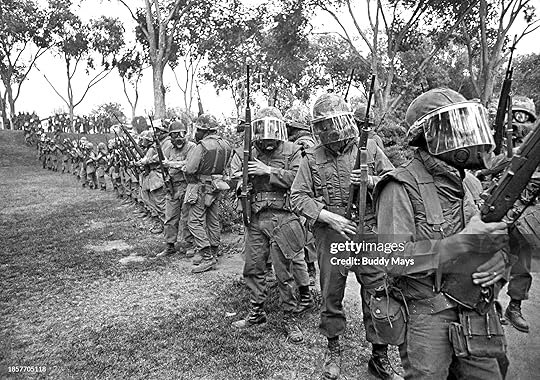
(Coincidentally, right after finishing this book, I had a friend message me to ask if I'd ever heard of the riots in the 70s in Roosevelt Park. I was like... YOU GOT ME STARTED. I had been aware the National Guard bayoneting UNM students for protesting Kent State the year before and had even seen historic pictures of the bloody scene on campus, but I hadn't read much on the Roosevelt Park riots of 1971 prior to this book.)
He frames a lot of local history of various time periods within by describing the lives of particular local citizens - for instance, 1970s Albuquerque is framed within the lens of the life of Jimmy Santiago Baca, a well known local poet. We learn about 1980/90s El Paso after delving into the life of Jay J. Armes, a PI known for his prosthetic hands and action figures made in his likeness. We're introduced to The Kim Sisters before we enter the corrupt world of 50s/60s Las Vegas.
Really, this is more of a series of loosely connected articles than a book, and many of the chapters were previously published as essays in other journals and papers. Together, they paint a kaleidoscopic picture of the major cities of the southwest with a mix of crushing cynicism and guarded hope for the future. We had a couple of newcomers in book club who said this was their first ever southwest history book - I thought this was particularly perfect for newcomers to southwest history as it gives a wide-ranging tasting menu of the ancient/current history of our city and our closest neighbors.
It's a LOT of information in one book. I'd love to see him do one just on Albuquerque. I wished we had maps and images in this one.
(Audiobook reader was distractingly bad at pronouncing certain words - I would have thought he could have looked up how to pronounce unfamiliar words. Glad I also purchased the physical book.)
I read this ahead of a roadtrip through the American Southwest. The book explores the history of this region — its development, its culture — and what we can learn from the adaptability and resilience of those who have chosen to live here, especially in a climate-changed world.
It explores themes of fantasy and reality, grandeur and pleasure, all within the oh so true reality of having to live within one’s means while also pushing nature to its limits.
Paoletta organizes the books by themes and cities/regions, dividing chapters by diving into each city’s history, some that span back as far as Indigenous population then Spanish settlement strongholds, to the much more recent development of Phoenix.
We hear of the somewhat unique mix of peoples in New Mexico, and how the state is often overlooked, a bare plain compared to the glitz and glamour of its neighbors in Las Vegas or Phoenix. Most interestingly, we get the origin stories of each of these major cities that dot the region.
Phoenix is one of hubris — a river to be tamed in support of agricultural bounty — Santa Fe a trading hub, used by Spanish explorers and colonizers, Tuscon an outpost used to defend Spanish from Apache raids, and Vegas a gambler’s paradise that was originally shaped by the silver rush.
In each case, there are plenty of stories that color each city’s narratives: El Paso has as much vice as Vegas, but with a lot of industry as well; Vegas was a hub or organized crime until gambling became legalized.
Sprawl, immigration, development, tourism, and profit come to define many of these cities over time, a marketing problem that turned into an opportunity — a parched landscape that still tries to drive people there for the sunshine, regardless of how hot it is: “The desert gives little, no matter how much we ask.”
The story of the Southwest is a story of America, of all the things that make us unique, and all the challenges we must face day in and day out. But it doesn't mean that these challenges are insurmountable.
This book offers a fantastic history into this region, while shaping it with universal themes of humanity and patriotism, arguing always for humility and grace, even when we have a history of dominance and control.
An interesting—albeit irredeemably biased—account of Southwestern history coupled with what amounts to a call for degrowth. Stylistically clunky, as if the author was trying their hardest to flex their writing ability. Nonetheless, a worthwhile effort to capture the complexity of the region.
An example of choosing a book by its cover. My first stop at the library is usually the new nonfiction book shelf, just in case I missed something. Normally nothing catches my eye and noting my reading patterns of late, I gravitate toward classics and books from twenty to thirty years ago that I have might have missed. The new book section is not a place where I find most of my reading material. The library put this eye catching book front and center, the colors of the southwestern sky sure to the catch the attention of someone. It worked for me this time around, especially as we enter the month of May and the weather warms up here in the midwest. It was this time last year when my reading gravitated to the south and west and the endless stories that comprise those regions of the country. My husband teases me that I already have one foot in Florida, and that I might be better suited for Phoenix or Las Vegas with all of my allergies and upper respiratory issues. My counter is that there is no beach unless you drive to San Diego. Still, western Texas and it’s open skies sound enticing, and Las Vegas is getting a baseball team in a few years and Phoenix already has one plus all that spring training. If he wants to entice me to move to a landlocked area, the best I can do is read up on its history, so American Oasis is more than choosing a book by its cover.
Kyle Paoletta grew up in Albuquerque, New Mexico, a place that fascinates me due to the history of conversos in that state. He has lived in the Boston area for the last twenty years, but he is still a Burqueño. American Oasis is Paoletta’s debut book after writing in magazines for a number of years. His thesis is how the cities of Albuquerque, El Paso, Las Vegas, and Phoenix demonstrate how the rest of the United States can adapt to 21st century living. He splits the book into three sections, including the history of each city dating back to precolombian times, more modern history of each city, and how the expansion of population and its water usage serve as a warning of what to do and not to do in order to be sustainable going forward. Clearly, Paoletta only wanted to write a book on climate change and water rights laws, yet, he saw that he did not have enough information on the subject to construct an entire book. This was a red flag for me: I am not a fan of authors of all stripes inserting politics into their books, and climate change/water rights is a hot button issue. Had I known that the book was primarily about these issues, I probably would not have selected it. Books are my escape and I don’t want politics encroaching on my reading, which they have done with increased frequency as of late. News to authors- unless your subject is politics, please leave them out; I am not interested on your views of immigration, climate change, etc., which usually spoils an otherwise good book for me.
Paoletta won back points from me in describing the history of each city. I do read a lot, including my Larry McMurtry kick last year, so I know a fair amount about the history of El Paso and Phoenix. It also helps that I still savor a comprehensive biography of Sandra Day O’Connor six years later, and these were two cities that comprised large portions of her life. The other two cities, Albuquerque and Las Vegas, not so much. Paoletta writes this book as a survey, each chapter serving as a vignette rather than segueing to the next one. There are so many names and dates in each section that most readers would have to take notes to remember everyone. The long history of battles between settlers and the Apache and Comanche, those I know well so I glossed over them. Las Vegas being more than a tourist town for gamblers did interest me because it is a city my husband shows interest in. The city is supposed to be a major league city and family. It is home to a melting pot of cultures and offers among other things Asian studies in its public schools. Yes, the key industry is gambling and always will be, but this newer city is being to rival Phoenix as a top city and relocation destination in the region. As a result it is overpopulated although the county commission recycles water. If this is a congested metropolis without public transportation, I don’t think Vegas vaults itself to the top for me unless it undergoes more iterations to make itself sustainable going forward.
With all the names and dates to remember, the most fascinating portions of this book were Paoletta’s exploration of the arts and culture. Judith Chafee was a top architect of her generation and built gorgeous homes for retirees, but she never won a top job to expand her portfolio because of her gender. News flash, a name to look into for next year’s women’s history month. Paoletta also cites Frank Lloyd Wright and the winter home he built in Tucson, which has become a museum. If I ever get to the area, it is going on the list. Tucson is also home to a botanical gardens overlooking the city which sound luscious. This is not a city I would live in because it does snow and I’d like to get away from that. Back in his hometown of Albuquerque, Paoletta does provide the most information as this is his home. The narrative is more captivating and reads more like a memoir. He could have stressed Albuquerque and left out other cities and the book would have been more interesting. For instance, the racial tensions between Hispanics and white and those passing for white. He interviewed author Jimmy Santiago Baca to stress this point, and I found Baca’s life story to be fascinating. He cites former governor and cabinet member Bill Richardson in making New Mexico into a sustainable place to live, yet leaves out the hot air balloon festival and the state’s history of converso Jews because he was pressed for space in the New Mexico section of the book. Sometimes less is more.
The sections about immigration politics and water usage rights not withstanding, I found American Oasis to be constructed as a survey book that stands out as a debut. In the interim sections between each chapter, Paoletta writes about his travels as he moves from one city to the next down the highway. While I would have loved to know more about how his Italian and Jewish family ended up in Albuquerque, I could have done with less information about suburban sprawl and water rights laws designed for the year 2100. Yes we are closer to 2100 believe it or not than to the construction of the Hoover Dam in 1925, but we are not there yet. I chose American Oasis as a history book to discover more about the cities of Albuquerque, El Paso, Las Vegas, and Phoenix. I did not choose this books to hear the author’s views on immigration and water. Still, he does present a decent argument for sustainability in the desert, a landscape that societies have learned to live in for millennia. I look forward to see what Kyle Paoletta writes next. I would be intrigued to read a full length memoir about his family history as a melting pot of cultures in its own right. He is a promising nonfiction writer, and now his name is on my radar as a western voice. In the meantime, American Oasis remains an example of choosing a book for its cover.
I was excited about this book because I am from the southwest. In the introduction the author postulates we should look to the large cities of the southwest to address the looming threat of climate change to other cities in the east and north, but in the text the author is really focused on social inequalities, cultural, and economic drivers within a southwestern culture.
Low key obsessed with this book. The only thing I didn’t like was the audio book narrator clearly doesn’t know how to pronounce words in Spanish which was incredibly distracting. Poor choice of an audio book narrator I thought the book was great. Growing up in southern NM, working in AZ and Las Vegas so much of this spoke to my experiences, feelings, and deep love for the southwest 🧡
There is probably no part of the United States less conducive to support human life than the American Southwest. The states of western Texas, Arizona, New Mexico, and Southern Nevada are the driest, hottest, and most hostile environments in existence.
They make up the bulk of the Mojave and Chihuahuan deserts. They have little to no natural sources of water. They punishing summers that can spend the bulk of that time in the triple digits. However, despite these reasons for life in general and definitely no civilization to exist in this environment it does.
Phoenix, Arizona is the fifth most populous city in the United States. Las Vegas is a large Mecca for tourism and hedonism. Tucson, El Paso, and Albuquerque have long and storied histories that date back centuries. These are prominent cities whose continued existence comes from investments of billions of dollars in hydrological and civil engineering.
Kyle Paoletta explores this anomaly in his book American Oasis. He provides the history of these cities and how they reached the point they are at now. He explores the complicated racial background of these cities and how they often reflect these issues in the history of the greater United States.
Paoletta then explores the present and the issues these cities are facing. He explores that the racial strife has never totally gone away. It has just reimagined itself into economic segregation where people of color have been disadvantaged and disenfranchised for so long they can’t join the communities of their richer, whiter neighbors.
The greatest threat to them in the modern era is the same as the greatest threat to the rest of the world: climate change. Climate change has manifested itself in both racial strife and hydrology.
Climate change has caused most of its problems in the developing world of the global south. This has led many residents kf these countries to be displaced and search for a better life in more climatically livable places, like the US. The U.S. has responded to this with greater and greater anger toward immigrants. Many even call their seeking of survival to be an “invasion.”
Additionally, these cities are experiencing a greater and greater concern from loss of water. The Colorado River; which is so important as a source of water for Colorado, Utah, Wyoming, Nevada, Arizona, and California; is losing its water levels. Aridification has gripped the American west, and it is felt no place more than in the Southwest.
Paoletta brings this up as the greatest concern for these cities and their city leaders. Paoletta then brings up the biggest issue that prevents these places from being able to progress and prepare for an uncertain and difficult future. It is the same aspect that generated so much civil strife in these cities and imposed so much racial and ethnic segregation within them: rich anglos.
As white people entered these cities, or, in the case of Las Vegas and Phoenix, built the cities from the ground up they brought their money and comfortable lifestyle. These people enjoyed the Southwest and its mild winters. After the advent of air conditioning these cities became tolerable in the summer and their populations flourished. However, these people brought many demands, and the largest is that they do not want to abandon their previous lifestyle, which they found so convenient.
They love watering their lawns to have it nice and green. They love washing their cars in their driveway. They love consuming their water intensive foods. They don’t want to share this land or water with immigrants. There is a future for these cities, but they need to adjust to the new reality climate change is causing. They cannot do that as long as rich, white people expect to enjoy the wasteful water use they previously enjoyed.
If changes don’t come soon enough, the cities will remain, but a sprawling mega-metropolis like Phoenix may never exist again.
As someone who has lived in the American Southwest for over thirty-five years, Kyle Paoletta's "American Oasis" resonated deeply with me. Paoletta understands that the region is not just geography but a stratified story of ambition, neglect, resilience, and contradiction. This is neither a celebratory survey nor a nostalgic lament, but an unflinching excavation of the histories, myths, and engineered illusions that have shaped the desert's cities. And it arrives at a time when such histories are increasingly under siege.
Paoletta, raised in Albuquerque and now writing from San Diego, crafts a narrative that is both expansive in scope and deeply rooted in place. His subject is the urban Southwest—Phoenix, Tucson, Albuquerque, El Paso, and Las Vegas—but his lens is historical, ecological, and unavoidably political. What interests him isn't just how these cities were built, but whom they displaced, what resources they consumed, and what stories were erased in the process.
What most impressed me about this book, beyond the familiar landscapes and city names, is how Paoletta confronts the historical oppression of marginalized communities. He dismantles the long-peddled fiction of racial harmony in places like New Mexico, exposing the structural segregation that urban renewal projects inflicted on Mexican American, Indigenous, Black, and Asian communities. These chapters don't merely recover hidden histories; they indict the very processes that made particular histories "forgettable" in the first place. Through compelling individual stories—from poet Jimmy Santiago Baca's journey from illiteracy in prison to literary acclaim, to welfare rights activist Ruby Duncan's organizing of Las Vegas's poorest families—Paoletta transforms abstract historical forces into vivid human experiences.
But "American Oasis" isn't just about the past; it's about the future already arriving. Having lived in the Southwest since 1988, I've witnessed the current decades-long drought persist, temperatures rise, and lakes and rivers become drier. Paoletta traces this arc of scarcity through centuries of adaptation and exploitation, from Indigenous irrigation systems to the overpromises of 20th-century reclamation. He challenges the romance of "mastering" the desert, instead suggesting that survival now demands humility, density, and cooperation, less an engineering marvel and more mutual care. The Southwest, he argues, offers crucial lessons for a nation that will soon face similar challenges: extreme heat, water scarcity, rapid demographic change, and the need to adapt existing infrastructure to environmental limits.
At a time when book bans and legislative efforts seek to erase the uncomfortable parts of American history, "American Oasis" makes a compelling case: the histories of those on the margins—whether Genízaros, Chicano activists, or families displaced by "slum clearance"—are not side stories. They are the story. And if we fail to reckon with that history, we do so at our peril—not just morally, but practically, in how we build and sustain life in a hotter, more strained world.
"American Oasis" is a necessary book, unsentimental yet deeply felt. Paoletta's most significant achievement may be showing that the cities so often dismissed as "bland" or "artificial" are, in fact, sites of historical struggle and imaginative possibility. If the rest of the country wants to understand what lies ahead, it would do well to start here, or as Paoletta so aptly concludes, "In order to see where America is going, we have to look at where the Southwest has already been."
First..a rant: I attempted to listen to this one but I gave up when saguaro was pronounced with a "g" you can hear instead of the correct silent "g". If you're going to narrate a book about the Southwest, including the Sonoran Desert, PLEASE do some research to get pronunciations correct. It is suh-waa-row, replace the "gu" with a "w" sound and you're golden (you will see it spelled sahuaro occasionally so people will pronounce it correctly). It is wild that no one corrected the narrator on this—the author is apparently FROM the Southwest. I realize that the desert surrounding Albuquerque doesn't have naturally growing saguaro cactus so maybe he didn't know how to pronounce it either which does make me question what kind of authority he has to write THIS book about how the Southwest can be a guide for future cities trying to survive with less water (which isn't even really what I got from this book).
This book presents the history of Albuquerque, Phoenix, Tucson, El Paso, and Las Vegas beginning with the disruption and destruction of indigenous communities by early Spanish settlers in New Mexico. Given that I did not grow up in the Southwest, I have a huge knowledge gap about the settling of the Southwest.
While I knew there were peoples living near Phoenix, I didn't realize that they had already left this part of the desert because of drought (and significant population loss brought by Europeans). That bit of history helped me understand why Phoenix always feels removed from the desert while Tucson feels more connected to the desert. Primarily because white folks created Phoenix, started farming, didn't try to learn anything from the people already living here, and were surprised when the rain stopped. While Tucson has a much older history and mix of peoples—Tohono O'odham, Mexican, Spanish, Anglo—of course, it also has its racism. Can't seem to escape that anywhere in America.
Fun fact: Arizona Highways was created to promote the Sonoran desert and convince people to visit -- rich business men were always trying to convince others to move here by creating golf tournaments and building tract homes (nothing has changed!).
There is a section about sprawl (Maryvale, Buckeye) and water rights (and lack of), but the last 52% of the ebook is bibliography so it ended much earlier than I expected. It was very interesting to learn about the changes Phoenix has made, mainly the improvements in water usage over the last decade. I liked the book, I would have liked a couple more chapters.
CW: racism, violence, murder (domestic violence), child abandonment, torture of children, war, etc.
Okay I’m rounding up on this one because I really enjoyed the chapters on Albuquerque—but this book missed my expectations.
The premise of the book is that as we navigate climate change we should look to the lessons learned in the American southwest—ABQ, Pheonix, Las Vegas, and El Paso.
My main issue with the book is it primarily focuses on the history and sociology of the region and very little on the ecology and urban design aspects of climate change. And I completely agree that the history and sociology—considering both race and immigration —are critical for navigating the climate crisis.
The ecological thread that connected the book was the focus on water, but I wanted more.
In one of the last chapters the author talks about Las Vegas as an example of a city that is a shining example in the southwest of recycling and using much less water than other cities. I wanted to learn way more about how the lessons from Las Vegas can be implemented in places like Salt Lake and Denver. Basically I wanted way more information around environmental urban design, because I thought that was what I was going to be reading about.
I did really enjoyed reading the history of the region and I thought Paoletta did an excellent job weaving in histories of individuals who made an impact on the region. One individual history that will stick with me was Jimmy Santiago Baca as he was abandoned by his mother, survived a boarding school, was illiterate, and went on to become a Poet. I’m definitely interested in reading Baca’s books after reading.
(4.5 stars—If you go in expecting a history of the SW region I think you’ll enjoy this one. )