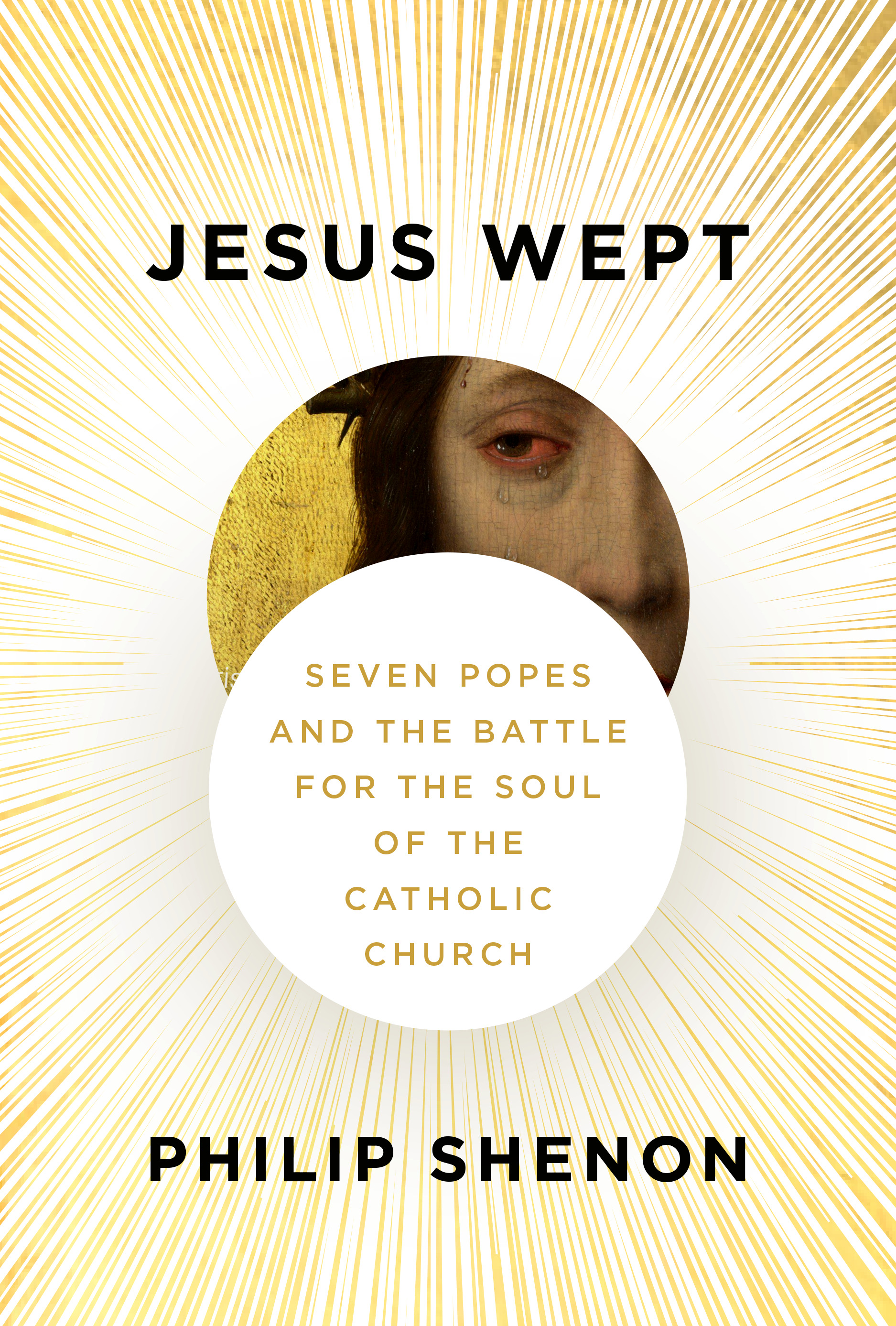
From a former New York Times investigative reporter, a revelatory look at the struggles inside the modern Catholic Church, told through the lives of the last seven popesWhen the jolly Italian peasant-turned-cardinal Angelo Giuseppe Roncalli of Venice was elected Pope John XXIII in 1958, change was in the air. The Church, many said, had refused to enter the 20th century. In response, Pope John launched Vatican II, an “ecumenical council” that summoned hundreds of church leaders to Rome. It marked one of the most progressive turns the Church had taken in “medicine of mercy,” as Pope John called it. Yet, not everyone in the Church was prepared to accept this modernization. The battle lines were drawn. In Jesus Wept, Philip Shenon takes us inside the Holy See to reveal its intricacies, hypocrisies, and hidden maneuverings, bringing all the momentous disputes vividly to priestly celibacy, birth control, homosexuality, restoring ties with other Christians and Jews, shameful sex abuse crimes, the role of women in the Church. In his rich portrayals of the popes from John to Francis, Shenon draws on research across four continents, including hundreds of interviews and the exhaustive use of archives. He also brings to light other key figures in the Church, such as Cardinal Ottaviani, the incredibly powerful, conservative, and staunchly anti-communist director of the Holy Office under Pius XII, who lived proudly by the motto Semper Idem—“Always the Same.” A consummate, vibrant history of the modern Church.
By extraordinary coincidence, I put this book down last night when I reached its final section covering Pope Francis I’s papacy. I felt strongly compelled to finish it today after learning he died last night. My experience with Jesus Wept was more personal than any work of nonfiction I’ve read. Reading the political history of the Vatican provided context and explanation for perplexing Catholic beliefs I was raised with. I began writing this review when I reached history that touched the living memory of my parents. I was overwhelmed by information that felt intimately relevant to my own life, and writing it down helped me process what I learned about Catholicism, the Vatican, the community I was raised in, my family, and myself
The idea of a “political” history of the papacy is probably blasphemous to believers. To steel-man a devout Catholic’s argument against the relevance of a political history of the Vatican, I would say God speaks through the aggregate actions of his church’s hierarchy over time and with attention to which policies are best for the church at any given moment. Because the ultimate actions of the hierarchy over time are an accurate representation of God’s will, it doesn’t matter if a given Vatican policy was overwhelmingly disagreed with by the world’s bishops, theologians, and laypeople, or if the policy is apparently inconsistent with the teachings of Jesus, theological research, or other existing policies. God speaks through the product of the Vatican’s politics, and sometimes the word of God is incomprehensible to humans. Therefore, the political activity that ultimately produces the word of God is irrelevant, because God is refining his final decrees through that political process. It doesn’t matter if political actors within the Vatican nearly succeeded in pushing for very different stances on birth control, divorce, papal infallibility, or homosexuality. The final word of the Vatican, and therefore the final word of God, is the only opinion that matters
That’s the strongest argument I can mount against analyzing the Vatican as a political or historical subject. As someone raised Catholic, I don’t think the argument is worth picking apart. Growing up Catholic in a conservative part of the US taught me that the Judeo-Christian faith is stubborn in its rigid, self-reinforcing logic. More importantly, I don’t think lay Catholics, or even most ordained members of the global Catholic hierarchy, give much thought to the Vatican or its policies
I went to Catholic school through ninth grade, competed in “diocesan” youth sports leagues, went to church twice a week, and played with other Catholic kids on Monday nights while my mom hosted a prayer group. Viewed from a Midwestern town of about 100 thousand, the Vatican was as rarified and nebulous as Ancient Rome or the biblical characters whose stories I was constantly told. I doubt anyone I knew, probably not even the priests, read translations of the Vatican’s edicts on morality, doctrine, or proper behavior for the world’s faithful. I didn’t even conceive of the Vatican as a political or legalistic governing body until reading this book. To the extent I thought of the Vatican at all I thought of it as a monastery where churchmen and nuns constantly prayed or attended mass surrounded by opulence. Where I grew up, most people had a personal and community-based relationship with their faith, and were willing to pick and choose which elements of doctrine were sensible in their own lives. Folks knew Catholicism did not approve of homosexuality, birth control of any kind, divorce, or meat on Fridays during Lent, but no one cared to understand why, just as most people don’t care to understand the legacy of the Cold War or reconstruction in the American south. If the Catholic church’s preferences didn’t fit your own life, you could still retain your faith and membership in the community without being perfect. I’ve heard this referred to as being a “cafeteria Catholic” by the self-consciously less devout, the same folks that might call themselves “Chreasters”, meaning they only go to church on Christmas and Easter. This practical relationship with the faith couldn’t be further from the theological, legalistic battles between opposing Vatican coalitions and theologians in Catholic universities. Both experiences of the faith are able to exist in distant parallel, and mostly oblivious of the other
I tried to imagine my mom or dad reading Jesus Wept, but I think they would reject it as a biased hit piece. My mom especially is extremely devout, but it’s difficult to imagine even a practical Catholic getting through this book. To understand the political history of the Vatican is to realize the church’s “preferences” on homosexuality, birth control, divorce, etc, are, in fact, the sacred and unequivocal word of God from the perspective of the world’s most powerful churchmen. In other words, there is no such thing as a cafeteria Catholic, because to deny any component of Catholicism is to directly deny the will of the Vatican bureaucracy, which in turn means denying the will of God. The credibility of that perspective is dubious and can’t stand up to serious, even-minded scrutiny, which is precisely why everyday lay people don’t scrutinize it. The most devout practicing Catholics go to church every weekend, and maybe do their best to say a rosary or work through a prayer book throughout the week, just as they might go to the gym or jog. The Vatican’s legalistic theological debates and decrees are as relevant to these practical Catholics as are the US Congress’s obscure procedures to average US citizens. To become better acquainted with the details of the Vatican’s operations is to realize it is an extraordinarily troubled and hypocritical institution, which I imagine would cause even the firmest believers to develop a far more individualistic relationship with their faith, if not move away from Catholicism entirely
The similarities between the Vatican’s political machinations and nation-state politics were the most compelling part of reading this book. The Vatican is not directly relevant to the increasingly secular world we occupy, but learning its political history offers an opportunity to check your priors at the cathedral door and observe leadership and politics in a neutral context. There is much to learn from the reactionary Vatican bureaucrats who believed it was imperative to fiercely cling to the oldest precedents set by the church, and doggedly undermine any precedents set in their living memory, all while refusing to attempt to understand the changing world they were scandalized by. There is also much to learn from the progressive theologians who were insensitive to Vatican politics, and in their scholarly conviction lost their influence within the church. Their pathways for effecting change on an authoritarian, reactionary institution were limited, but their struggle is a reminder that being smarter and better researched is not a political strategy. Finally, even though I do not personally care if the Catholic Church declares without evidence that St Peter irrefutably died in Rome and is buried beneath St Peter’s basilica, or that Mary’s living earthly body spontaneously floated up into heaven, I can recognize the same political expediency and anti-intellectualism that pervades the politics of today’s nation-states. Observing these political behaviors in a neutral context, where I have no interest in the outcome, sharpened my understanding of reactionary and progressive politics. It seems to me that a feature of progressive ideology is political weakness, and, although it sounds hyperbolic, the stubborn vitriol of reactionary politics is sociopathic, or perhaps even deserving of its own classification of psychiatric disorder
In the case of the Vatican, reactionary politics is necessary and self-preserving. If the Vatican were to strictly adopt the teachings of Jesus, you would expect the Vatican to abandon its strange medieval opulence and commit itself to the world as an institution dedicated to alleviating human suffering and poverty. But of course it never will. The Vatican is an institution staffed by institutionalists. It is like any authoritarian government in that its purpose is to perpetuate and strengthen its own existence. If the Vatican were to dissolve its wealth, yield power to local diocese, and commit itself and the broader Catholic Church to the service of humanity, it would necessarily destroy itself, and perhaps the centralized Catholic Church as well. To be a Vatican institutionalist is to necessarily be a reactionary, to balk at reasonable suggestions for change, and to double down on existing doctrine, otherwise the internal inconsistencies will collapse on themselves. Living memory is a vital concern for the credibility of the Catholic Church. If you claim to speak for God, who really is infallible, you cannot afford to contradict or retract your own speech. Retractions and contradictions can only be smoothed out and forgotten across generations. The pope cannot declare the use of condoms a grave sin, and then suddenly during the AIDS crisis reverse himself and declare condoms an acceptable precaution, even within a heterosexual Catholic marriage. Unwillingness to change with the facts is patently unreasonable, but for the Vatican it is politically essential. The institution preserves itself above all else, reason and the good of humanity be damned
Assuming an institutionalist’s reasoning, the optimal papal strategy to maximize power is to balance commitment to existing doctrine with maintenance or growth of the global practicing Catholic population. Consistency on existing doctrine maintains Vatican credibility, but exclusionary doctrine, such as discrimination against divorced Catholics, threatens the global growth of practicing Catholics. Among the most recent popes, Benedict XVI and John Paul II clearly went too far in their commitment to existing doctrine, but Francis I went too far in his contradictions. A strategically optimal pope would identify the most exclusionary doctrine and remain silent on those topics. The next generation can then work from a blank living memory, and credibly reverse doctrine that threatens the growth of the church. Francis I seemed to embrace this strategy prior to Benedict XVI’s death, but after Benedict XVI’s death he was more open to breaking precedent. Francis I’s contradictions, such as allowing priests to simply “bless” gay marriages, may seem cautious and almost negligible to a secular, liberal-minded observer, but to the faithful they represented deviations from doctrine firmly established in living memory by Francis I’s predecessors. Francis I should have focused less on reform under his own papacy, and instead reshaped the Cardinal college to ensure a progressive successor who could credibly implement change as the living memory of Benedict XVI and John Paul II faded. Although they were explicitly unconcerned with even maintaining the global population of practicing Catholics, Benedict XVI and John Paul II arguably employed a rational strategy. Similarly to Vladimir Putin’s Russia, Benedict XVI and John Paul II took steps to reduce their dissenting population by coercing them to leave the faith. In their consistent reiteration of the most exclusionary Catholic doctrine and rigorous exercise of the Curia’s investigative powers, they were able to alienate and evict progressive theologians, churchmen, and lay people from the church. The effect was a more reactionary church hierarchy and lay population that was supportive of centralized power in a strong Vatican
I am immensely grateful Jesus Wept was written. The scope of the book is perfectly selected. Everyone knows medieval popes were bastards, but they ruled the church so long ago, were so blatantly political, and the world was so primitive, it almost doesn’t matter what they did. It’s almost as if man wrested control of the Vatican from God, and the actions of the medieval Vatican can be excused as temporarily unrelated to the modern or ancient church. Perhaps there are lessons from that line of thinking that can help the church recover from its deeply troubled recent history. Throughout Jesus Wept I often thought of my parents, and this book has added so much context to the things I heard and experienced as a child. About one-third of the books in my parents’ house are Catholic texts of the sort referenced throughout Jesus Wept. I’ve considered flipping through some of them out of curiosity when home, particularly those written by John Paul II, and especially those related to ‘The Theology of the Body’ a text constantly referenced by my mom. John Paul II looms large for devout Catholics like my mom. He sat at the head of the Vatican for so long, it seems impossible for lay Catholics today to disentangle the beliefs of John Paul II from the doctrine of the church itself. I was raised to believe (without success) that condoms and other forms of birth control simply don’t work and shouldn’t be used. It was impressed on me that there was something fundamentally unnatural and vaguely grotesque about children I knew that were conceived from IVF. Homosexuality was sinful, and even a courthouse homosexual marriage was a perversion of a sacred religious institution. Divorce was sinful and divorced people were corrupt. The local gynecologist that implanted IUDs and had a child in my brother’s class at Catholic school would have to answer to God for her sins, and on and on. I won’t even try to unpack the things I was told about human sexuality, primarily because I didn’t even begin to understand how strange my relationship with sex was until I was in my mid-twenties. Jesus Wept has given me the context I needed to eventually review some of those texts on my parents’ bookshelves, and better identify and explore the hidden corners of my mind that remain influenced by Italy’s most regally dressed septuagenarians. Based on my experiences growing up in Catholicism, I had written the institution off as hopelessly lost, beyond repair, and maybe even evil. To my surprise, Jesus Wept has replaced my dismay with hopefulness and even tepid optimism for successful reform in the global Catholic hierarchy
I described the Vatican as an institution irrelevant to the increasingly secular world, but that’s not necessarily true to my own experience. The Vatican was probably the single most influential institution on the first 15 or 16 years of my life, and it’s only striking me now, as I am writing this, how strange and tragic that is. Strange because it’s quite a shock to realize, at 28 years old, you were raised in a household that was far more ideologically severe than a vast majority of Catholic families (based on Pew Research Center polls on Catholic attitudes toward birth control, for example). Strange because elderly men in Italy without families of their own were apparently so interested in and effective at shaping the terms on which my family and community raised my brother and I on the other side of the world. Tragic because those same elderly men could’ve directed their resources and energy away from my community’s family and sex lives, and toward alleviating human suffering around the world, or at least the suffering of the youngest and most vulnerable Catholics abused in their own parishes. It is impossible to imagine Jesus of the New Testament speaking and writing through those men. Instead he probably weeps, but maybe Francis I’s successor will stop the tears
“The church is a whore but she is my Mother.” - St. Augustine.
This is a brutal, infuriating read. Someone smarter than me wrote that the best way to avoid disillusionment is to refuse to entertain illusions in the first place.
A part of me will always be Catholic, but I no longer practice Catholicism, and have not passed the tradition on to my children. I think I'll just leave it at that.
Anybody can be Pope; the proof of this is that I have become one.
I’m not religious, but I found this book fascinating and, at times, infuriating. On the surface, it’s hundreds of pages of Vatican politics: meetings, debates, backroom dealings, positioning. But that’s the point. Those regular political dealings ended up shaping the lives of millions of people who believe in contraception, women’s ordination, homosexuality, celibacy, and more.
The story is told through the lives of the seven popes from Pius XII to Francis. The history of those eighty years reveals the struggle between more conservative members of the Church and those leaning more liberal and progressive. The structure of the book is satisfying, given its beginning and ending.
I didn't know a lot about the popes, so the book gave a lot of texture to figures like John Paul II and Francis. During my childhood, I heard that John Paul II was incredible. Yet, this book made me understand that he used travelling and public visibility to raise his popularity, while failing to achieve anything in his job as the top manager of the Vatican. And, in some ways, Francis is the product of a long arc of compromise, resistance, and power struggles that preceded him.
The sections on Vatican II especially stuck with me. You see how close the Church came to real reform, and then how decades of manoeuvring slowly strangled that progress. There's a painful cost to this failure. Most painfully, in failing to change priestly celibacy, as the direct costs are thousands of abused children each year.
It’s not an easy read, but it’s one worth sitting with - even, maybe especially, if you’re not religious.
A very well written and deeply researched book that looks at the lives of the last seven pontiffs. A book that will truly challenge your Catholic faith. This book draws back the curtains to reveal a church ultimately run by men with honor, ambition, jealousy, hate, ignorance, and at times misguided faith.
Why would someone want to read 600+ pages of play-by-play of the upper echelons of the postwar Catholic Church, most of which could be described as "meetings about meeting" and "debates about how to debate"?
You would think most of this would be inherently uninteresting, but it is the exact kind of boring that I have a soft spot for - bureaucratic procedures that end up being enormously consequential. At the end of the day, the choices the Catholic Church made in the last century -- namely, to continue to exclude women from the priesthood, and to refuse to modernize on sexuality (birth control, homosexuality, celibacy... you know, just little things) -- ended up impacting hundreds of millions of people. These decisions trickled down and became what we were taught in Catholic schools and Sunday schools all over the world, and they created a dissonance between what seemed common-sense-true and what the church was saying that drove hundreds of millions of people away from the church.
So - I did quite enjoy the play by play of the convening of Vatican II and the machinations over the subsequent decades to then undermine the reforms that were trying to emerge during Vatican II. This is how shit happens sometimes! This is how history is written. We should learn it if we want to enact change. It's also maddening to think about just how different everything might have been if reform / progressivism had won just a few more victories.
What else...
The church interacted with regimes of all kinds over the last ~100 years, and stands nearly alone as an institution of enormous influence, wealth, and power that is not a state.
The evolution of Francis in particular is really surprising - something you really can't quite capture the texture of without a long, long immersive text.
Wouldn’t it be nice if the Vatican would gate-keep pedophiles from children the way they gate-keep the teachings of the bible and Jesus’ love from people that yearn for it? :)
This book covers more than just the countless sexual assault scandals that (for me at least) were the first thing I thought of when I read the title. And as a primer on the last 70 years of the papacy and the church, it's great for understanding the big picture, general movements, and the handful of big players who helped shape those things. That being said, finishing this book (where the last 1/3 is primarily about the coverups of rampant sexual abuse of children) this week (when the Epstein list is still fighting to be one of the prominent news stories, among so much other disturbing noise, and against the wishes of so many people who are clearly dead set on never letting it be seen) I found this all very heavy and bleak. Bleaker, I'm sure, that an institution reportedly for the spread of God's love was used to such horrifying ends than that a billionaire thought he could get away with similarly horrifying behavior. I don't know why I'm making this all about Epstein, I guess it's just that reading this when I did I was even less inclined to be like "but what about the ways the church has done good in people's lives." Which is funny because the author reports, and I believe him, that he didn't write this with a mind to attack the church. It's just pretty damning all the same.
This is a book every Catholic should read. A very difficult read, this piece of nonfiction dives deep into the past seven popes, up to and including Francis, using soooo much research to present background on these men and then details of their papacy — the good, the bad, and the ugly. There is lots of ugly. One can only hope that these issues will be taken care of and that current and future popes will not fail the Church in ways these seven have. Presented without commentary by a NY Times reporter who spent decades studying and writing.
This was a magnificent read!! I’m a big fan of the writing style and the pacing, and all in all so informative about Vatican II and the successes and struggles of the past 7 popes. So cool that the book goes up to nearly the end of 2024.
Would suggest to anyone! It is rather thick - 510 pages of just text before the 1300 footnotes. Very well sourced.
Imagine being 550 pages into a 700 page book on recent papal history when the pope dies. Educational, gut-wrenching, inspiring, devastating. SO much better than Conclave, when will people learn that truth is stranger than fiction.
A well researched account of the Catholic Church during the times of the last seven popes. It proved to be exceptionally interesting as Pope Francis was ill and has subsequently died recently. I fast forwarded through the many accountings of child abuse.
I’m going to come out and say it: If you liked ‘Conclave’ (the movie; I haven’t read the book, so I can’t speak to that), you will like this book. It’s full of the intrigue and controversy and conniving and gossip that made the movie so entertaining. And it’s nonfiction, too. Cue the smoking cardinals.
Let’s see. There was Pius XII, who was pope during World War II. Problem was, he really loved Germany. And, because we were still in the era where Christians viewed Jews as Christ killers, he didn’t exactly try too hard to stand in their way, claiming Vatican neutrality. He played scandal close to his chest, aware of abuse but unafraid to rock the very boat of which he was the captain. Feels like ancient history, doesn’t it? As you will see, it was par for the course in the land of St. Peter.
Then there was ‘The Good Pope’ John XXIII, best known for kicking off Vatican II. He was as open and ecumenical as his predecessor was stern and ecclesiastical. He was pretty old to begin with, but he went a long way in mending fences and making the Church more relatable—having Mass in the vernacular, embracing non-Catholics, acknowledging women, etc. Shockingly progressive! He even called Mrs. Kennedy ‘Jackie!’ on their first meeting. He seemed pretty lovable, but then he died. (As kids in Catholic school, we sang this peppy song about how he had a dream.)
And—oh wow—Pope John XXIII kind of reminded us what Jesus was about. It’s easy to get lost and forget that in this book. Remember the title.
Paul VI initially was seen as an ideological successor to John, but he fell under the influence of some powerful members of the Curia and rationalized that to make changes would be to admit that the Church had been wrong for centuries. He defied the bishops and cardinals and the vast majority of Catholics, doubling down on their wish to permit contraception, insisting that sex was for procreation only. (Sorry, sterile or older couples.) He boomeranged in the completely opposite direction, more or less slamming shut all the doors John had cracked open. (Even as a small child, I still was steeped in the attitude that associating with Protestants—or worse!—was heretical in itself. I still remember the lone Lutheran in my elementary school and how the staff, well, crucified her.) Didn’t like non-Catholics, didn’t like women. Except Mother Teresa. Semi related, he really looked the other way regarding abuse accusations. Speculation swirled that he had skeletons in his own closet—perhaps not involving sexual abuse, but he was known to keep constant company with handsome Italian actors and such. In the last several years of his life, he was consumed with paranoia and saw the devil around every corner.
Next up for a minute was John Paul I (get it?), the William Henry Harrison of popes. He takes up three pages, as he didn��t live very long. (I understand that his first order of business was to look into the financial mess Paul had left behind, hence the rumors surrounding his unexpected demise.)
As you might have guessed, fiftysomething John Paul II was next. Initially perceived to be another moderate in the mold of John XXIII, he quickly showed his true colors, replete with a light-year-wide streak of conservatism. He self-flagellated, gave most favored nation status (for lack of a better term) to Opus Dei, ruthlessly condemned liberation theology (to be fair, he had grown up in the Eastern Bloc and had no patience for anything Marxist adjacent), and doubled down on what constituted Christian marriage. He stressed political neutrality but was only too happy to get involved in politics in his native Poland. He mercilessly silenced critics, made nuns wear habits again, took over the Jesuits to shut them up, and embraced known abusers because they were, you know, priests. Or Americans, who were decadent anyway. Blame the gays! And oh, speaking of which, he wasn’t terribly compassionate to AIDS patients…
Frankly, he was there much too long. His part of the book is 150 pages long, for Christ’s sake! (Still longer than this review, at least.)
Benedict XVI, the scary-looking German guy, was next. (I imagine him as the George H.W. Bush to JP2’s Reagan.) But his ascendancy to the throne of Peter was not the beginning; to the contrary, he is already present throughout the book, a reformer in the vein of John XXIII (well, not quite, but hopefully in that direction). Unfortunately, that was then: Some years earlier he had fallen prey to what we Catholics call scrupulosity, albeit with other people’s sins. In other words, he became obsessed with other people’s sex lives. And in Benedict’s view, it was all sin. (Except that involving children and clergy. At worst, he figured, it was a statistical inevitability to have that going on in an institution the size of the Roman Catholic Church…not that HE knew of it personally, mind you.) He denounced his earlier statements, cut off old friends (see: Hans Küng), and declared other religions ‘gravely deficient’. And this was all before he became pope! Get this—as Cardinal Joseph Ratzinger, he briefly considered taking the name John Paul III in honor of the pope from Krakow whose star he’d hitched his wagon so firmly to. It worked… But then he ticked off the Muslims, continued to cover up priestly sex abuse cases (even as American dioceses went bankrupt), and became known for his stylish footwear and personal lodgings. A real let-them-eat-torta kind of guy, he continued to insult everyone he met—Jews, Protestants, indigenous peoples, nuns—all the while saying there was a ‘huge propaganda campaign’ out to smear him.
As you may recall, Benedict—having stepped on his last rake—gave up the popehood for Lent in 2013 and was succeeded by his rival (and previous papal runner-up) Jorge Bergoglio, who had considered the name John XXIV but instead settled on Francis. (Just Francis.) But this is not the first time we hear of him, either: The book also traces his ascendancy through previous papacies, even to his adolescence. It’s not terribly flattering. Similar to Pius, when surrounded by war (in this case, the Dirty War that claimed the lives of close friends and untold others, often after unspeakable torture), he quietly moved out of the way—in this instance, to preserve his own fellow priests. It is impossible to know how any of us would have acted in that situation, but the torment of it led him to seek therapy and regret his silence, later apologizing and truly repenting. He may or may not have done the same in his later years, but for the first time it at least looked as though some of John XXIII’s forward thought had returned to Rome. (He even supported liberation theology in all but name!) But that didn’t get to happen, either; he anticipated the next pope—whom he referred to as John XXIV—would do that.
Throughout all of this, we learn not only of the popes’ formative years prior to them becoming household names, but we also meet some of the era’s most daring and influential theologians and learn how they fell in and out of favor with whomever was in charge. Hans Küng, for one, was betrayed by the very Church he had served for decades, learning of his career ending while skiing on his Christmas holiday. (How very corporate of the Vatican.) In his last days, he likened his old friend Benedict to Vladimir Putin. As for the Curia, they are masters of office politics and make the people at the DMV look downright pleasant.
This book came out shortly before Francis‘ death, and I have to say that I am intrigued by Leo XIV (not John XXIV)—a big part because he is an American and also loves the White Sox. Who would have thought? As glacially slow as the Church’s evolution may be, it still manages to surprise us every few generations. Greatest story ever told, indeed.
This book was recommended by my sister, who is an historian and knows good books; this definitely is a good book as well as an exceptional one. As a Catholic of sorts (I grew up Catholic, experienced 12 years of Catholic schooling and attended church regularly up until COVID), I have lived under all the popes profiled in this book (Pius XII through Francis) so I’m so sadly if not terribly shocked by what is documented in this book. This is a stunning indictment of the Catholic Church: of a bunch of unmarried men choking the life out of Jesus’s teachings for power and greed all under hypocritical guises (covering rampant pedophilia) - no different than what we are experiencing today under 47 as he chokes the life out of democracy. Indeed, Jesus wept and is still weeping over these men with feet of clay.
The conservatism of the Catholic Church is sad. I remember like a lot of people being excited by Vatican II - at least we got the Mass in English (or the country’s language) - but John XXXIII died it was business as usual. Back to being preached about the sins of sex, birth control and other things that went against the grain of the Sermon on The Mount. But during those years of Paul VI and early John Paul II, I wasn’t focused on church politics until it became clearer in the later years of John II and Benedict that we were entering back into medieval thinking and tightening control of thought. Francis gave me hope (as does Leo XIV). But as I read Shenon’s book, the conservative hold on Jesus’s message of love and mercy was very little to be found and stifled when it was like in the case of Hans Küng.
The Church has had pedophiles among its priestly ranks since its beginning (as an example in The Pope and Mussolini by David Kertzer he points out a notorious Italian cardinal who in the 30s was allowed to continue but to keep it quiet). The covering up of these heinous acts is unforgivable. While preaching the sanctity of life and being against abortions, the Church like 47 and his ilk are happy to see the living abased and abused! The Church has a problem with sex: it makes it a sin for married people unless used for procreation and turns its back on the need to recognize that celibacy is a task many priests fail at - let them marry if you won’t let women be priests.
Jesus Wept is an informative but ultimately mixed bag. The book is clearly written with an agenda, which isn’t necessarily disqualifying, but as a non-Catholic author, his celebration of the Roman Catholic Church breaking with its own long-held teachings feels odd at times. Again and again, he falls into the dull trap of equating “liberal = good” and “conservative = bad,” which oversimplifies both the history and the real debates within Catholicism. There are also some basic factual mistakes—something outlets like the National Catholic Reporter have pointed out. That said, the strongest—and saddest—portion of the book is his chronicling of the sex abuse crisis. It is sobering and weighty. Just devastating and far-reaching this tragedy has been. Overall, worthwhile for background and perspective, but not without frustration.
In my opinion, this is the most exciting book on the Catholic Church since Hans Küng‘s „Church & Council“. If you are Catholic and/or interested in the Catholic faith, get a copy now.
I‘m very grateful to Philip Shendon for writing this book and I believe it will influence my thinking for years to come. And I hope that there‘ll be a German translation. What really got me: How - in my memory - I somehow convinced myself that popes John Paul II and Benedict XVI weren‘t all that bad. This book helped me to remember all the inhumane and outright stupid decisions the two made.
Well researched, if sometimes slanted, accounting of the past seven popes. Extremely timely with Francis’ health issues. It is especially focused on the Vatican’s blind eye and coverups of the sexual abuses of priests, bishops, and cardinals. Excellent examination of how human the Vatican is, no better than any other human institution, especially those that are exclusively male directed.
I have thoughts.....lots and lots of thoughts but I hate reading long reviews so I will keep mine brief-ish....
Before reading this book, I'd call myself a non-practicing Catholic. I went to Catholic school, did all the Catholic things. After reading this book, when people ask, I'll say that I was baptized Catholic but that I no longer follow the teaching of the Church. I did, at one time, attend mass, but I always felt like a hypocrite sitting there because I could not in good faith follow a church doctrine that hid the molestation of children, that was rooted in deep anti-Semitism, that had so little regard for woman and all that this entails (from birth control to their role in the church). I can go on and on. All this to say that as I sat there in a pew, it was very seldom with a happy heart.
In brief, this book is about the rot of the Church. It's about greed and money and hiding things so that they can make more money. It's about power....and it's not about love, the poor, charity and being a good person.
One thing I gathered throughout the book is that the church feared communism more than anything.....well that and of course they were masters at hiding sexual abuse. Plus XII loved to ex-communicate communists, but the 'good old' Catholic nazis, they were as good as gold. The level of anti-Semitism from Pius XI all the way to Benedict is atrocious! One last thing I'm going to say about this because I need to write about the sexual abuse is this. If you really want to know where the church stood on this issue, look no further than Benedict. The guy was part of the Hitler youth. He said " he was forced to join".....but all the same! Read the friggin' room catholics! Don't elect a Pope that had ANYTHING TO DO WITH THAT SHIT! The Church is still filled with these monsters.
On to the other matter at hand. I will never forgive the church for what they have done to children. The Church is filled with sick f&$+# and the fact that they just hid and still hide that evil should never be forgotten. Oh! the stories in this book will make your toes curl! I sometimes had to turn off the audiobook and breathe in deeply to calm myself. None of the 7 last Popes should be forgiven for their part in this. Not one ( well maybe JP XXIII - cuz he wasn't there long enough) is blameless. If you believe in heaven and hell, none of these men are in heaven.
I first picked up this audiobook because of an interview I saw on the author. I was curious because of this last Conclave. All in all, I don't hold much hope for Leo. I think he'll be just like the rest. It's been this way since the very start. the Church is rotten.
One petty thing about this audiobook.....I didn't like the narrator. Don't get me wrong ...I love me a good British narrator. They are my favorites but this guy sounded like he had a potato in his mouth. Plus, the author is American ....so why not an American narrator? Weird...
*so much for a "brief" review..... :/
Note: we just had a sexual abuse case here in San Antonio at a Catholic school. A VERY bad case of hazing/sexual abuse on the boys soccer team where one boy repeatedly molested a Freshman. Want to know what the Archdiocese said about this?
"As Central Catholic is a private Catholic high school, any comments should be addressed to the school or the Marianist Province of the USA which founded the school and still administers it."
Make note that the Archdiocese is in charge of the curriculum and all that this entails, so once again, the Church is not addressing anything that has to do with sexual abuse. Cowards. Does not bode well for any type of change. I am so upset. Still just passing the buck.
i bought this as Pope Francis' health was failing when i saw it on a goodreads' booklist & just got around to reading it now after Pope Leo has been chosen. the book was incredibly informing and eye-opening for me, especially as i have always been a staunch defender & appreciator of Vatican II. it was written by a non-Catholic, which makes it strictly factual. my main complaint, which was the same complaint i had about news coverage on the recent conclave, was that they're missing the mystical nature of the Holy Spirit that surrounds the Church. they try to apply the rules & dynamics of the secular world to the Holy See & it completely removes a dimension of the politics that this book so explicitly lays out. the author is deliciously gossipy, which of course keeps me hooked, but makes it slightly sacrilegious in removing the religiousness from the workings of the religion. all in all, i thought it was an extremely insightful look into the history behind different aspects of the Church i have always grown up with & appreciated. much to pray about & definitely interested in reading his other books.
Jesus Wept is a powerful and absorbing account of the modern papacy, told through the lens of a journalist who approaches the subject with both curiosity and concern. Philip Shenon traces the lives and legacies of seven popes, centering his narrative on the reforms of Vatican II and the challenges that have followed. The book is especially focused on how each pontiff responded to the rapidly changing world around them, including the moral crisis posed by the clerical abuse scandal.
Shenon writes from an outside perspective, but his research is thorough and his respect for the weight of the Church’s history is evident. What makes this book so compelling is not just its scope, but its attention to the human element — the visionaries, the skeptics, the faithful reformers. For readers interested in Church history, Vatican diplomacy, or the ongoing legacy of the Second Vatican Council, this is a well-written and thought-provoking read.
I recommend this book to any cradle Catholic whose favorite religion class was Church history and/or who remember spending class time watching the new pope to get elected OR anyone who cites The Da Vinci code as a non-fiction source (this Venn Diagram may be a circle)
This book wastes no flattery in its examination of the Catholic Church’s seven most recent popes, and it’s all the better for it…it is DEFINITELY not a light read nor one I even completely recommend to a general audience, but it’s one I believe will find the right demographic
My biggest appreciation of this book is that, while it doesn’t shy away from criticizing more commonly disgraced religious figureheads like Pope Benedict XVI, it also forces the reader to reconcile the shortcomings of more venerated ones, such as Pope John Paul II and even Pope Francis
Split my reading between audio and ebook and honestly recommend the ebook to account for the multitude of footnotes and citations
fascinating and interesting look at the post Vatican 2 Catholic church - it started with Pope Pius XII during world war 2, moved on to John and Vatican 2, Paul VI and grappling with the legacy of Vatican 2, John Paul II in the Cold War, and the modern Benedict/Francis handoff. I knew a decent bit about Benedict and Francis, but the rest was quite new to me! As a non-Catholic, it was interesting to dig into the history of the past 100 years.
The book was well written, but the author’s thesis was pretty simplistic: conservative popes = bad, progressive popes = good, with very little nuance by what he meant by that. He dealt with key issues of the last 100 years: responses to war, contraception debates, debates on Latin mass, clergy sex abuse, papal power, etc. Because the author wasn’t a Believer, I felt his argument was hampered at times by ways he took shots at key Christian doctrines that he seemed not to fully understand.
Overall helpful survey of the 20th century Catholic Church.
Wow I see why Jesus wept. If you were raised Catholic like me it is impossible not to be biased one way or the other so I appreciate that the author was not Catholic and he humanized these holy men. I especially liked learning about the progressive priests. Less so the many coverups and silence on atrocities. What is it with the cults of pediophiles on this planet?
My favorite Pope Francis quotes:
“who am I to judge?”
“It’s hypocrisy to call yourself a Christian and chase away a refugee.”
“The sin is to refuse to encounter the other… the different… when this is in fact a privileged opportunity to encounter the Lord.”
The book discusses the history of the church, particularly Vatican II. It follows seven popes, particularly focusing on the last three, and traces how the Vatican not only navigated but often orchestrated the currents of history, from when Hitler was in power, the Cold War, to the political turmoil of South America, even to public clashes between President Trump and Pope Francis.
It’s an excellent source on the infamous sexual abuse of children that has tragically become synonymous with the 2000-year-old institution. It also thoughtfully examines the ongoing debates around birth control and clerical celibacy, which show Catholicism’s tense relationship with modernity.
The book exposes the Vatican’s deep political bureaucracy, a system that has married itself to the Church’s religious mission, yet repeatedly overpowers and undermines true reformers like Hans Küng. One scary takeaway from Jesus Wept is how even the most well-intentioned popes, someone as revolutionary as John XXIII, or the so-called "Francis revolution," ultimately fail. A revolution in leadership is not enough; the institution itself needs transformation. The system is designed to outlast reformers and popes, survive each new wave of sexual abuse and financial scandals without altering its course.
My favorite thing about the book is that it doesn’t settle for easy villains out of the popes (unlike other books I've read, I will say, though, that Pope Benedict, imo, is by far the worst modern pope.) It calls out the people who protected predators, like republican and democratic presidents, but more chillingly, it reveals an institutional structure that fosters secrecy, shields itself with the language of tradition, and survives by being too big to morally fail.
This book is so good - it pulled me in in ways that I haven’t been pulled in by a book in a long time. I was reading this every free moment I got because it’s so fascinating; and with Bergoglio’s recent death and the appointment of a new pope, the timing was perfect. I learned so much, and the book is very readable, despite its length; it never felt dense.
My small gripe is that the last two sections, on Ratzinger and Bergoglio, felt a little short; I would have liked about 20 more pages of analysis of their actual papacies in each section. I think the fact that it’s missing from the Bergoglio section makes sense, given that the book was written and released before his death, but I honestly could have read at least 100 more pages in the last section.
Regardless, this book is truly incredible - I will be looking for books that give me a similar feeling for a while. Highly recommend
A stunning look inside the Catholic Church since WWII. The relentless efforts by John Paul II, Pope Benedict, and conservative bishops to crush the initiatives from Vatican II to modernize the church are depressing. Even worse are the coverups by all church leadership, to include Pope Francis, of the sex scandals and rampant pedophilia among the clergy. It’s disheartening. A must read for all Catholics.
Comprehensive, interesting, and pretty fairly written. If you want a history of the most recent popes, the battles on the teachings of the Catholic Church, Vatican politics, corruption, and the abuse scandals that have defined the church for at least three decades now, this is a good place to get it.
If you are considering reading this book, I recommend purchasing at least two boxes of tissues. That way, you can throw one box across the room every time a Pope overrides popular opinion to push his agenda and you can use the other box to clean up the inevitable tears. It’s a very difficult read, but it’s a story you can’t turn away from once you start.