

What do you think?
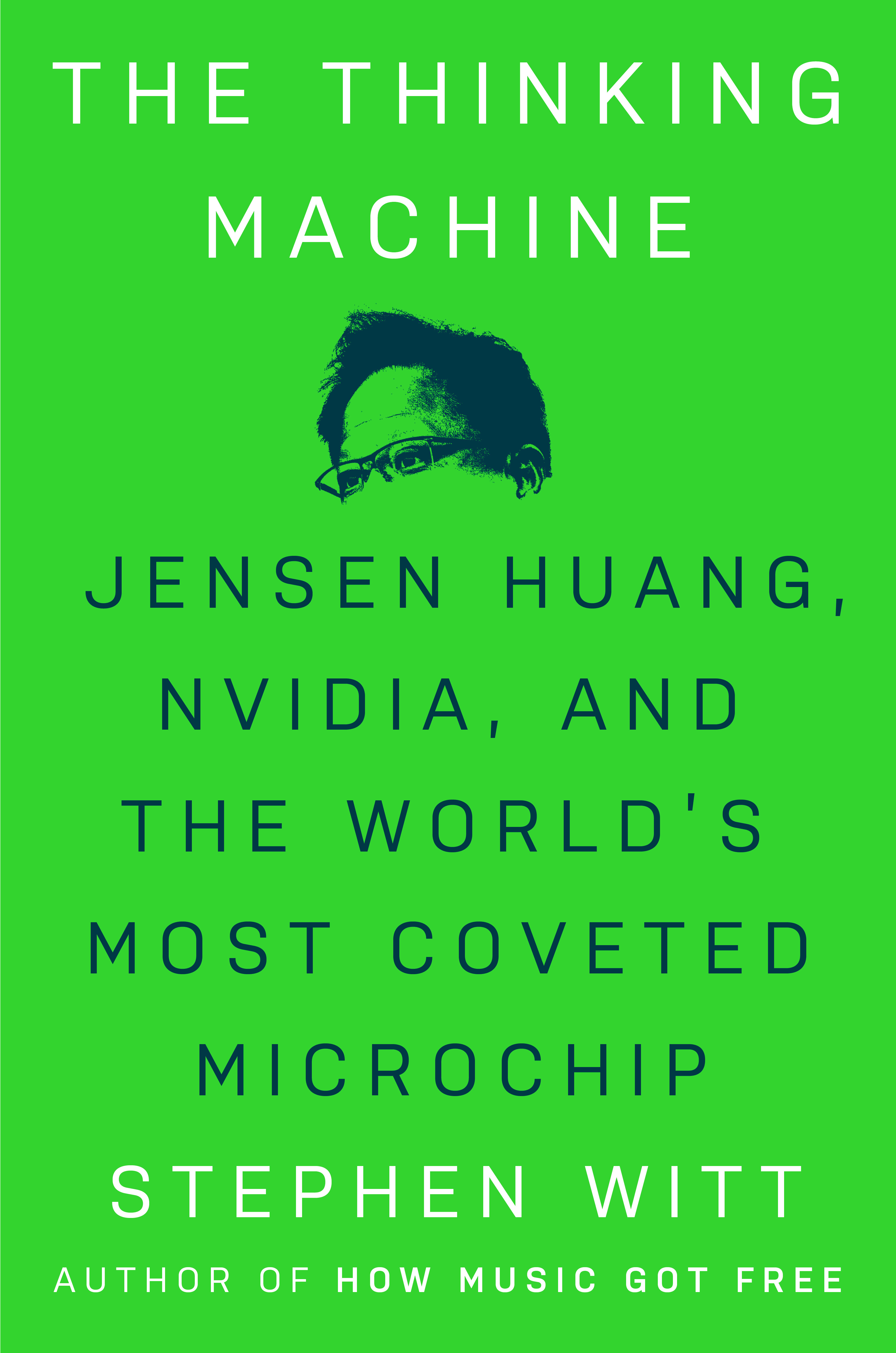
The Thinking Machine: Jensen Huang, Nvidia, and the World's Most Coveted Microchip
“Stephen Witt’s deep reporting shines through every page of The Thinking Machine. The result is a page-turning biography of perhaps the most consequential CEO and company in the world.” —David Epstein, New York Times bestselling author of Range
Nvidia is as valuable as Apple and Microsoft. It has shaped the world as we know it. But its story is little known. This is the definitive story of the greatest technology company of our times.
In June of 2024, thirty-one years after its founding in a Denny’s restaurant, Nvidia became the most valuable corporation on Earth. The Thinking Machine is the astonishing story of how a designer of video game equipment conquered the market for AI hardware, and in the process re-invented the computer.
Essential to Nvidia’s meteoric success is its visionary CEO Jensen Huang, who more than a decade ago, on the basis of a few promising scientific results, bet his entire company on AI. Through unprecedented access to Huang, his friends, his investors, and his employees, Witt documents for the first time the company’s epic rise and its single-minded and ferocious leader, now one of Silicon Valley’s most influential figures.
The Thinking Machine is the story of how Nvidia evolved to supplying hundred-million-dollar supercomputers. It is the story of a determined entrepreneur who defied Wall Street to push his radical vision for computing, becoming one of the wealthiest men alive. It is the story of a revolution in computer architecture, and the small group of renegade engineers who made it happen. And it’s the story of our awesome and terrifying AI future, which Huang has billed as the ‘next industrial revolution,’ as a new kind of microchip unlocks hyper-realistic avatars, autonomous robots, self-driving cars, and new movies, art, and books, generated on command.
This is the story of the company that is inventing the future.
Nvidia is as valuable as Apple and Microsoft. It has shaped the world as we know it. But its story is little known. This is the definitive story of the greatest technology company of our times.
In June of 2024, thirty-one years after its founding in a Denny’s restaurant, Nvidia became the most valuable corporation on Earth. The Thinking Machine is the astonishing story of how a designer of video game equipment conquered the market for AI hardware, and in the process re-invented the computer.
Essential to Nvidia’s meteoric success is its visionary CEO Jensen Huang, who more than a decade ago, on the basis of a few promising scientific results, bet his entire company on AI. Through unprecedented access to Huang, his friends, his investors, and his employees, Witt documents for the first time the company’s epic rise and its single-minded and ferocious leader, now one of Silicon Valley’s most influential figures.
The Thinking Machine is the story of how Nvidia evolved to supplying hundred-million-dollar supercomputers. It is the story of a determined entrepreneur who defied Wall Street to push his radical vision for computing, becoming one of the wealthiest men alive. It is the story of a revolution in computer architecture, and the small group of renegade engineers who made it happen. And it’s the story of our awesome and terrifying AI future, which Huang has billed as the ‘next industrial revolution,’ as a new kind of microchip unlocks hyper-realistic avatars, autonomous robots, self-driving cars, and new movies, art, and books, generated on command.
This is the story of the company that is inventing the future.
272 pages, Hardcover
First published April 8, 2025
Ratings & Reviews
Friends & Following
Create a free account to discover what your friends think of this book!
Community Reviews
Displaying 1 - 30 of 554 reviews

June 17, 2025
After reading countless books about both past and present tech leaders, a troubling pattern has emerged: an uncritical glorification of the “visionary CEO.” The Thinking Machine falls into this same trap, fixating on Jensen Huang’s personality and rise rather than interrogating the structural forces behind his ascent. Instead of examining the consolidation of political and economic power Nvidia now represents — or the global implications of its monopoly in AI chips — the book reads more like a tribute than an analysis.
Only a single paragraph is dedicated to the dangers of monopoly power. That omission reflects a deeper problem in tech biographies today: they idolize billionaires rather than question the system that enables such concentrated influence. We need books that pull back the curtain, not polish the throne.
2.5
Only a single paragraph is dedicated to the dangers of monopoly power. That omission reflects a deeper problem in tech biographies today: they idolize billionaires rather than question the system that enables such concentrated influence. We need books that pull back the curtain, not polish the throne.
2.5

May 21, 2025
Frankly, the best business book I have read in awhile. The author, while detailing the story of Jensen Huang and his company Nvidia, manages to explain complex issues relevant to the industry. If you have been confused by artificial intelligence, neural networks, parallel processing or just computer programing in general, this book will give you enough of a grasp to at least frame issues such as whether AI is dangerous or beneficial. Quite a cast of characters and a lot of insight into Huang and how he became one of the richest men in the world while building one of the most successful firms in the industry.
I "read" the audio version which was well done. The book as a whole moves right along.
I "read" the audio version which was well done. The book as a whole moves right along.

August 7, 2025
It is difficult to get a man to understand something, when his salary depends on his not understanding it— Upton Sinclair
Witt is great (he wrote one of the best-ever books about the music industry) and he acquits himself well enough here, but product development stories ("The NV1 launched into a crowded marketplace in the fall of 1995. Customers walking into electronics retailers that Christmas season found
dozens of chipmakers competing for attention. In addition to Nvidia, there were Matrox, S3, 3dfx, Cirrus Logic, and ATI. The confusing situation was not improved by Nvidia’s circuit-board partners, which sold Nvidia chipsets under the trade name “Diamond Edge” while simultaneously selling
competing 3dfx chipsets under the trade name “Diamond Monster.”") are harder to make compelling, even when the products drive the most important technology ever.
He dutifully pushes the unemployment line and the AI takeover line, and as always it's mildly useful to see how weak and unserious Huang and Cantanzaro's responses are:
when I questioned Nvidia executives about the wisdom of unleashing such power, they looked at me like I was questioning the utility of the washing machine... I wondered if someday soon an AI might become self-aware. “In order for you to be a creature, you have to be conscious. You have to have some knowledge of self, right?” Huang said. “So no. I don’t know where that could happen.”
I brought up Geoffrey Hinton’s worries. Huang scoffed: “A lot of researchers don’t understand why he’s saying that. Maybe it’s bringing attention to his own work.”
...He began to lecture me in the voice that one would use with a wayward teenager. He’d placed high expectations in me, he said, and I had disappointed him. I had wasted his time; I had wasted everyone’s time; the whole project of the book was now called into question. The interview was attended by two of Jensen’s PR reps, but neither made any attempt to intervene—they weren’t about to draw fire... His anger seemed uncontained, omnidirectional, and wildly inappropriate. I was not Jensen’s employee, and he had nothing to gain from raging at me. He just seemed tired of being asked about the negative aspects of the tools he was building. He thought the question was stupid, and he had been asked it one too many times.
“This cannot be a ridiculous sci-fi story,” he said. He gestured to his frozen PR reps at the end of the table. “Do you guys understand? I didn’t grow up on a bunch of sci-fi stories, and this is not a sci-fi movie. These are serious people doing serious work!” he said. “This company is not a manifestation of Star Trek! We are not doing those things! We are serious people, doing serious work. And—it’s just a serious company, and I’m a serious person, just doing serious work.”
For the next twenty minutes, in a tone that alternated among accusatory, exasperated, and belittling, Jensen questioned my professionalism, questioned my interview approach, questioned my dedication to the project...
Looking back, it became clear to me that Jensen had wanted to lose his temper; he’d made a conscious decision to thrash me. Once the performance had started, his fury was genuine, but it was all in service of a larger point he wanted to make. It wasn’t just that Jensen didn’t read science fiction—it was that he actually hated science fiction. He was a serious man...
I recalled, too, with sudden clarity, how disinclined those same executives had been to discuss the potential future implications of the technology they were building, a disinclination that I sensed spilled over into discomfort and even fear. Now I saw where the fear was coming from. The executives were more afraid of Jensen yelling at them than they were of wiping out the human race.
Surely, I countered, a superior intelligence could be dangerous. Our own
species, through agriculture, animal husbandry, mineral extraction, and urbanization, had transformed the surface of the planet, decimating or even eliminating all competing species...
“I feel like we get stuck in science fiction perspectives a little bit too often,” Catanzaro said. He leaned back in his chair, and I got a good look at the large owl embroidered on the front of his sweater. “AI isn’t going to be interested in zero-sum games with us because there’s so much more to do in this universe. For example, if an artificial intelligence is trying to build a huge data center—it doesn’t want to put it where the humans live. It wants to put it somewhere else, maybe underground. Do you know how much space there is underground?”
Catanzaro was uncorked now—I sensed that he didn’t often get to share this perspective at his job. “It doesn’t need to inhabit this biosphere. In fact, it doesn’t need to be on the Earth, either, because the thing about artificial intelligence is that it travels at the speed of light. Humans, you know, we actually have to lug bodies around. Artificial intelligence can move along a radio signal as long as there’s an antenna on the other side...
“Humans are naturally confrontational—like, we’re territorial animals, and it’s built into our limbic
system to defend our turf... AI, if it’s truly intelligent, the things that it’s interested in are so much bigger than the little thin crust of Earth that the humans live on. I don’t think that it’s going to be interested in taking that from us. Rather, I feel like AI is going to want to take care of us.”
(If you were trapped in a gravity well with a territorial and violent ape with priors, you wouldn't try to pre-empt it?)
---
Syukuro Manabe, the scientist who won the 2021 Nobel Prize in Physics for showing that trace amounts of carbon dioxide would trap heat in the atmosphere, had arrived at this conclusion in the late 1960s after fashioning a primitive simulation of Earth with an IBM computer that weighed seventy tons and drew as much power as ten city blocks. Using exponentially more powerful computers in the 1980s, NASA scientists had correctly predicted a coming rise in Earth’s average temperature of several degrees Fahrenheit, even though the empirical trend at the time had looked flat. These simulations also predicted that as the planet warmed, the upper atmosphere would cool down, causing atmospheric layers to pancake as heat was trapped near the surface... Almost all of what we understand about climate change is the product of powerful, energy-hungry supercomputers. Scientists had been running climate models on Nvidia hardware since the late 2000s
Last year there were two AI Nobels: one for a technology which will lead to big things but mostly so far hasn't and one for two dead-end precursors to deep learning just because they were physics-inspired. How many Nobels rely on GPUs more generally?
* 2017 Physics (LIGO)
* 2017 Chemistry (cryoelectron microscopy)
* The initial multiscale modelling from the 2013 Chemistry prize was done before CUDAm but all this lineage of work is now on GPU.
These will probably soon be the rule.
---
Misc notes:
* What fraction of all artificial computation is now orchestrated by CUDA? Maybe a tenth?? More interestingly: what's the slope on its trend?
* Witt's lossy compression of technical reality into nontechnical metaphor is mostly fine. I wish he had done a little of this kind of nonsense though.
* Huang takes top billing, but Nickolls (CUDA) and Catanzaro (cuDNN), NVIDIA's first AI researcher in 2011, probably deserve most of the credit for the AI bet. Witt covers them well (and Huang brings them up spontaneously).
* ‘Everybody shut the fuck up—I’ve got Morris Chang on the phone’
*
The building interiors were immaculate; I imagined firing the gun from Portal at the walls. As I later learned, Nvidia tracks employees throughout the building with video cameras and AI. If an employee eats a meal at a conference table, the AI will dispatch a janitor within an hour to clean up after him. A human janitor, for now
*
With a near-monopoly on the hardware, Huang is arguably the most powerful person in AI
The first clause is off: TPUs, Trainium, and Ascend are probably about a sixth of AI compute and increasing. The second clause could still be true.
* The family business:
The genetic connection between Huang and Su was somewhat faint. Huang’s mother had come from a large family and had at least eleven older siblings. One of those siblings was Su’s grandfather; technically speaking, this made the two executives first cousins, once removed. While he was growing up, Huang hadn’t been aware of Su’s existence and learned she was his relative only after she was named AMD’s CEO.
*
In early 2024, an administrator at CalTech’s data center told me that the school’s wait time for delivery on an H100 chip was almost eighteen months. He had encouraged professors at the school to switch to other providers but found few willing to accept. “They’d rather wait for the hardware than switch away from CUDA,” he said. It was all this code that made Nvidia hard to compete against. Upstarts might design a new chip, but that wasn’t enough—Dwight Diercks, Nvidia’s head of software engineering, had ten thousand programmers working for him. “We’re really a software company; that’s the thing people don’t understand,”
*
In 1994 Dahl unveiled Jellyfish, the first neural net ever sold to the public. Jellyfish had trained on many millions of backgammon games, but despite this intensive computational process, the finished product was small enough to fit on a 3.5-inch floppy disk, which Dahl sold via his primitive website. In this way an early distinction was established between the
cumbersome training stage of AI, which was how the computer learned, and the inference stage, which was how the computer deployed its knowledge... He had selected the name “Jellyfish” as an homage to the ancient aquatic cnidarian whose “nerve net” controlled its systems of stimulus and response. His program “had only about a hundred brain cells, which I figured was about on par with the jellyfish".
---
It'd be a better book if it didn't feel the need to hit every product launch, but Witt did his job.
May 8, 2025
"This is the story of how a niche vendor of video game hardware became the most valuable company in the world..."
The Thinking Machine was a well-done look into NVIDIA and its charismatic CEO, Jensen Huang. I wasn't sure what to expect from this one, as these books can often be hit or miss in my experience.
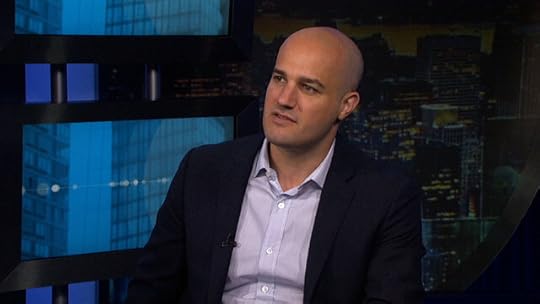
Author Stephen Witt a Los Angeles-based writer, television producer, and investigative journalist.
Stephen Witt :
Witt opens the book with a good intro. He's got a great writing style that I found effective and interesting. The book is very readable.
He drops the quote above near the start of the book, and it continues:
As the book's title implies, the writing here covers the life of Haung, as well as the history of NVIDIA. The narrative proceeds in a chronological fashion. Jensen is a notably mercurial personality, and is well known for giving very public dressing-downs of his employees. Many of these exchanges are also covered here.
There are many interesting tidbits of writing throughout. In this short blurb, the author talks about the difficulty of interviewing Jenson:
NVIDIA went from a small company that made graphics cards for PCs into the largest tech company (by market capitalization) in the world. In recent years, they have made a foray into the emerging field of AI; supplying the world's biggest companies with the hardware needed to crunch large numbers and perform machine learning.
The discussion around AI is a super-interesting one. Leaders in the field have split (roughly) into two opposing camps. One utopian, and the other dystopian. There are interesting arguments on both sides. One of the main themes debated is the "alignment problem." That is - how do you program an AI to make sure that its values are in alignment with human values? Jensen doesn't seem to think this is a problem.
I have to drop just one more quote. It's a funny bit of writing that the author leaves until the end of the book. He describes the response he got when he asked Jensen about the possibility that AI would steal people's jobs. I'll cover it with a spoiler, since it's a bit long:
********************
I enjoyed this one. It was well written, edited, and presented. I would easily recommend it to anyone interested.
5 stars.
The Thinking Machine was a well-done look into NVIDIA and its charismatic CEO, Jensen Huang. I wasn't sure what to expect from this one, as these books can often be hit or miss in my experience.
Author Stephen Witt a Los Angeles-based writer, television producer, and investigative journalist.
Stephen Witt :
Witt opens the book with a good intro. He's got a great writing style that I found effective and interesting. The book is very readable.
He drops the quote above near the start of the book, and it continues:
"...It is the story of a stubborn entrepreneur who pushed his radical vision for computing for thirty years, in the process becoming one of the wealthiest men alive. It is the story of a revolution in silicon and the small group of renegade engineers who defied Wall Street to make it happen. And it is the story of the birth of an awesome and terrifying new category of artificial intelligence, whose long-term implications for the human species cannot be known.
At the center of this story is a propulsive, mercurial, brilliant, and extraordinarily dedicated man. His name is Jensen Huang, and his thirty-two-year tenure is the longest of any technology CEO in the S&P 500.
Huang is a visionary inventor whose familiarity with the inner workings of electronic circuitry approaches a kind of intimacy. He reasons from first principles about what microchips can do today, then gambles with great conviction on what they will do tomorrow. He does not always win, but when he does, he wins big: his early, all-in bet on AI was one of the best investments in Silicon Valley history. Huang’s company, Nvidia, is today worth more than $3 trillion, rivaling both Apple and Microsoft in value."
As the book's title implies, the writing here covers the life of Haung, as well as the history of NVIDIA. The narrative proceeds in a chronological fashion. Jensen is a notably mercurial personality, and is well known for giving very public dressing-downs of his employees. Many of these exchanges are also covered here.
There are many interesting tidbits of writing throughout. In this short blurb, the author talks about the difficulty of interviewing Jenson:
"I found Huang to be an elusive subject, in some ways the most difficult I’ve ever reported on. He hates talking about himself and once responded to one of my questions by physically running away. Before this book was commissioned, I had written a magazine profile of Huang for The New Yorker. Huang told me he hadn’t read it, and had no intention of ever doing so. Informed that I was writing a biography of him, he responded, “I hope I die before it comes out.”
NVIDIA went from a small company that made graphics cards for PCs into the largest tech company (by market capitalization) in the world. In recent years, they have made a foray into the emerging field of AI; supplying the world's biggest companies with the hardware needed to crunch large numbers and perform machine learning.
The discussion around AI is a super-interesting one. Leaders in the field have split (roughly) into two opposing camps. One utopian, and the other dystopian. There are interesting arguments on both sides. One of the main themes debated is the "alignment problem." That is - how do you program an AI to make sure that its values are in alignment with human values? Jensen doesn't seem to think this is a problem.
I have to drop just one more quote. It's a funny bit of writing that the author leaves until the end of the book. He describes the response he got when he asked Jensen about the possibility that AI would steal people's jobs. I'll cover it with a spoiler, since it's a bit long:
********************
I enjoyed this one. It was well written, edited, and presented. I would easily recommend it to anyone interested.
5 stars.

June 6, 2025
Super well done long form journalism on the story of Jensen and NVDA, opening the founder character and resulting company culture very well.
And actually, because it is just a side thread, a great compact intro for anyone who wants to understand how the neural networks wave of AI came together over the last decade -- from the individual scientists now behind all the main AI labs buying their first 2 Nvidia gaming GPUs to run in their dorm rooms.
And actually, because it is just a side thread, a great compact intro for anyone who wants to understand how the neural networks wave of AI came together over the last decade -- from the individual scientists now behind all the main AI labs buying their first 2 Nvidia gaming GPUs to run in their dorm rooms.

March 21, 2026
Stephen Witt desperately tries to tell the story of how great men make history. He ends up telling the story of a silicon valley manager whose career has depended on his wife dropping out of her own and on regularly humiliating and deriding his employees in front of their colleagues. Jensen Huang surely is a smart man with an acute sense for business but Witt is so enamored with his subject that the pedestal he puts it on overshadows virtually everything that would actually be interesting in the rise of the most valuable corporation in the world. Witt's regurgitating silicon valley AI myths are not doing the book any favors either. A particular self-own comes in at the end when he cannot let go of his childlike adoration even when Huang begins shouting at and deriding him for asking the very basic question of whether AI might lead to job loss somewhere in the future. In the end, the book unwittingly provides a better insight into the Californian Ideology than in the history of Nvidia.
July 1, 2025
I really enjoyed learning Nvidia's backstory and the entire semiconductor/chip industry, and Huang's involvement and interactions with the other big tech CEOs. I couldn't help but notice the author's focus on Huang's personality, while a key factor, often feels disproportionate and overshadows other elements of his ascent. This fixation becomes particularly jarring when the author inserts himself into the story, recounting a personal anecdote of being berated by Huang, which feels more like a distracting authorial intrusion than insightful commentary. Ultimately, while I recommend the book for its invaluable content, the writing style unfortunately detracts from the overall experience.
January 17, 2026
would have been 5 stars if it weren't for the last chapter where the author chose to just spew his own worries about AI which felt very irrelevant.

December 30, 2025
Much like the tons of newsletter out there - the writing was engaging tbh but if I had to pick an informative book about chips and their future - Chips War beats it by a mile. Don’t know quite how this won the FT Book of year when you’d breakneck and house of huawei as contenders
July 1, 2026
4.5* Ojj wciągnęłam się 💚

April 27, 2025
This book offers an insightful account of Nvidia’s journey and how it has evolved to become a key player at the forefront of today’s generative AI and neural network innovations.
It is informative, educational, and truly inspiring to read.
I had previously encountered some of the areas covered in the book — such as computer graphics, machine learning, bitcoin mining, and generative AI — but only in a fragmented way. This book connects these topics through a coherent timeline of events and technological progression.
A bonus is reading it while the book is still fresh and timely. It feels current and at the cutting edge.
It is informative, educational, and truly inspiring to read.
I had previously encountered some of the areas covered in the book — such as computer graphics, machine learning, bitcoin mining, and generative AI — but only in a fragmented way. This book connects these topics through a coherent timeline of events and technological progression.
A bonus is reading it while the book is still fresh and timely. It feels current and at the cutting edge.

December 29, 2025
Verslo istorijos man labai patinka, bet, sakyčiau, šita prašyta silpnai, gan mažokai inside stories ir tiesiog apžvalga. Nesigailiu skaitęs, bet viską beveik jau ir pamiršau.

November 17, 2025
A really interesting read. This is a brief history of NVIDIA, which is also the history of AI development to the stage it has reached today.
NVIDIA started as a graphics card company. It made GPUs — which run on parallel processing, when Intel made CPUs— which run on sequential processing. When Moore’s Law would break for CPUs when transistor sizes reached the atomic scale (because at that scale, there would be leakages in electricity), GPUs would still be giving insane outputs because their architecture was fundamentally different.
NVIDIA’s gamble in going whole hog for parallel processing is what in effect led to AI reality. For parallel processing in scientific applications specifically, they developed CUDA, which was the language that made parallel processing possible. From there, curious scientists made their rigs with multiple NVIDIA chips strung together to develop programs that in various iterations led to what today is Chat GPT.
I was curious about the rise of NVIDIA and what it was really. I always thought it to be a graphics card company. It’s far more transformative. In fact, I learnt that it wasn’t even really a hardware company— it’s the software that runs so well with their parallel processing chips that makes NVIDIA stand out. And the specialised suites / tools they make for a variety of scientific uses.
While the first half of the book is a deep dive into NVIDIA’s history, the second half is a good summary of recent AI evolution history. It covers the topics uncritically for most of the narration, but it’s a good starting point for deeper dives on many themes.
Great book to get up to speed with the AI evolution, if you’ve lagged behind following it. And it’s not just ChatGPT— we are going through our most consequential phases of evolution in our human story thus far.
NVIDIA started as a graphics card company. It made GPUs — which run on parallel processing, when Intel made CPUs— which run on sequential processing. When Moore’s Law would break for CPUs when transistor sizes reached the atomic scale (because at that scale, there would be leakages in electricity), GPUs would still be giving insane outputs because their architecture was fundamentally different.
NVIDIA’s gamble in going whole hog for parallel processing is what in effect led to AI reality. For parallel processing in scientific applications specifically, they developed CUDA, which was the language that made parallel processing possible. From there, curious scientists made their rigs with multiple NVIDIA chips strung together to develop programs that in various iterations led to what today is Chat GPT.
I was curious about the rise of NVIDIA and what it was really. I always thought it to be a graphics card company. It’s far more transformative. In fact, I learnt that it wasn’t even really a hardware company— it’s the software that runs so well with their parallel processing chips that makes NVIDIA stand out. And the specialised suites / tools they make for a variety of scientific uses.
While the first half of the book is a deep dive into NVIDIA’s history, the second half is a good summary of recent AI evolution history. It covers the topics uncritically for most of the narration, but it’s a good starting point for deeper dives on many themes.
Great book to get up to speed with the AI evolution, if you’ve lagged behind following it. And it’s not just ChatGPT— we are going through our most consequential phases of evolution in our human story thus far.

April 26, 2025
Software is eating the world, but AI is going to eat software.
A good companion book to "The Nvidia Way". The two combined would make for a five-star book. The Nvidia Way, as the name suggests, is about showing the brighter side of Nvidia's story. The Thinking Machine tries to stay balanced, the focus is more on the AI side of the story, and ultimately ends up being worried about the future of humanity.
A good companion book to "The Nvidia Way". The two combined would make for a five-star book. The Nvidia Way, as the name suggests, is about showing the brighter side of Nvidia's story. The Thinking Machine tries to stay balanced, the focus is more on the AI side of the story, and ultimately ends up being worried about the future of humanity.

October 31, 2025
Very good. Combo biography, history, and business management book. Contemporary relevance and tight/interesting narrative.
August 17, 2026
The book does not question whether Jensen was simply lucky and in the right place and right time to capitalise on structural changes, instead it focuses on him as a godlike visionary whose decisions are by definition correct. When the author acknowledges the contributions of others to the commercial progress of AI, they ultimately attribute it to Jensen’s leadership and frankly toxic management style, enabling them to do the work they did. Even when Jensen blows up in an unreasonable fit of rage at the author himself, the author quickly U-turns to glazing him again, passing it off as evidence of his drive to push progress.
Jensen is obviously an impressive man but at times the book reads more like a fan fiction than an autobiography.
Jensen is obviously an impressive man but at times the book reads more like a fan fiction than an autobiography.
February 10, 2026
Great story of Jenson and AI development in general. The beginning is a little dry, but things speed up as the technology progresses in the 2010s onward. The combination of the spectacular engineering required to build the chips, the CUDA software to help them run AI models, and then the software code and architecture of the new AI itself, all put together, is remarkable.

January 27, 2026
Offering a behind-the-scenes look at the inner workings of Nvidia and into the life of Jensen Huang, this is an intriguing read, although I've read better biographies than this. I couldn't quite say what I was missing because Witt interviewed lots of people and described various aspects of the book's main themes in detail. Perhaps the more memorable biographies (about Musk and Da Vinci in particular) had more interesting subjects overall.
On another note, I sometimes felt that the author was unable to distill what he learnt about some advanced concepts of computing into something digestible to the uninitiated public, but the majority of his explanations were quite easy to follow, despite the complex topic. The chapter on The Fear was especially powerful, and I was glad that Witt didn't try to idolise his subject or show only the positive aspects of AI and Nvidia's work.
On another note, I sometimes felt that the author was unable to distill what he learnt about some advanced concepts of computing into something digestible to the uninitiated public, but the majority of his explanations were quite easy to follow, despite the complex topic. The chapter on The Fear was especially powerful, and I was glad that Witt didn't try to idolise his subject or show only the positive aspects of AI and Nvidia's work.

February 28, 2026
4.5 stars

June 28, 2026
A complement to The Nvidia Way for the Huang portrait, but fully idealized. Every questionable move is retrofitted as wisdom because it worked. The access is real but its insight is thin because we never learn who Huang really is or what drives him. The author filled the gap with himself instead. The losers, trade-offs and the ecosystem barely analyzed, and the book stops just before the first cracks, DeepSeek moment. A weak bio, the real book is still unwritten.
July 6, 2026
Great piece of learning about the rise of Nvidia, LLMs, GPUs, CUDA, and Mr Huang
February 20, 2026
if you want a book that glazes Jensen Huang and washes his ruthless monopolist business as somehow smart read this. hate read this and hated this
February 11, 2026
I put this book by Stephen Witt on my get-at-library list after reading the WSJ review last year. (WSJ gifted link). I seem to be doing that a lot lately. I was somewhat surprised by how much I enjoyed reading the book. Witt has a real knack for combining personal anecdotes, pungent observations, and layman-level technical detail into an interesting whole.
Part of the book is a biography of Nvidia CEO Jensen Huang. I think it's fair to say that he's flown under the radar for most of his career. There are businessfolk who can't/couldn't seem to stay out of the headlines: Steve Jobs, Bill Gates, Jeff Bezos, Larry Ellison, … But (shame on me, perhaps) I couldn't have told you who helmed Nvidia before reading this book. And, guess what, Jensen Huang might go down in history as having a bigger impact on the 21st century than any of those guys.
If you believe some of the AI pessimists, though, Huang might be known as "the guy who caused mankind's doom." (Except, small detail, there might be nobody left to make that claim.)
Huang's biography takes up the early part of the book. His unlikely origin story: born in Taiwan, raised in Thailand, sent by his parents (at age 10) to a dinky Baptist-run school in rural Kentucky. But (eventually) rejoined his parents in Oregon, worked at Denny's, became an expert ping-pong player, attended Oregon State, got a job at AMD in semiconductor design, and eventually…
He still likes to go to Denny's for a big breakfast. And, according to Witt, who tagged along one morning, he left a $1000 tip for the waitress. I don't think it's revealed whether that's his usual behavior.
What is, apparently Huang's usual behavior: angrily dressing down his employees in front of their co-workers. You wouldn't think that would be a successful business strategy, but it worked for Nvidia. Huang almost never fired those targets of his wrath. And they seemed to remain fiercely loyal toward the company and Huang himself.
It doesn't hurt, I suppose, that he made them all pretty rich along the way.
The book is also a biography of Nvidia; it is perhaps unappreciated how many near-death experiences the company had on its way to its current dizzying success. (As I type: a $4.58 trillion market cap, stock price up 1160% over the past five years.) But before that, they had their share of dud products, false starts, takeover attempts, etc.
The company in its early days was aimed at gamers who lusted after ever-higher performance video. But some curious coders noted that the Nvidia hardware could also do arithmetic incredibly quickly. Which allowed scientists to "smuggle demanding mathematical payloads—say, simulating the formation of a galaxy, or modeling the ignition process of a nuclear bomb—into hardware meant to render carjackings and disembowelments." (One of Witt's "pungent observations" I mentioned above.)
The third part of the book is a layperson's history of AI, a field full of hype, broken promises, and dead-end research. Huang's, and Nvidia's, success was in resurrecting and combining two scorned, out-of-fashion subfields: one in AI (neural networks), the other in computer architecture (parallel processing). This (eventually) turned out to work surprisingly well for the company, to put it mildly.
The penultimate chapter in the book is a look at the possibility that AI will kill us all. In the cheerful language of the theorists: p(doom), the probability of doom. I've always been an optimist about that, thinking that capitalist innovation and technical progress has always been an easy net win for mankind in the past. But it's hard to deny that a lot of smart people think differently.
Huang is not one of those people. In the book's final chapter, Witt describes his final interview with Huang, where he tries to elicit commentary about those dire predictions. This does not work out well: Witt finds himself at the receiving end of one of Huang's harangues. Witt is hurt and somewhat surprised, and has deep thoughts; it's almost as if Huang doesn't want to think about possible downsides.
So: we find ourselves fulfilling that (fake) Chinese curse: "May you live in interesting times." Thanks to Huang (and others).
January 21, 2026
Honestly bought this book to show off in front of my tech bro colleagues, but I thoroughly enjoyed and found myself down deep rabbit holes on topics we should all probably know about but don’t!
June 18, 2026
It's rare to read a biography, or in this case I suppose a quasi-biography, of a living figure who isn't an obvious villain and get the sense that the author really, really dislikes his subject. I don't know that Stephen Witt would go so far as to say he thinks Jensen Huang is an asshole. But this is definitely a book where a key message is "Jensen Huang is an asshole." Here's Witt on Huang, the father:
Huang is constantly screaming at his employees, and in one memorable case at Witt. Toward the end of the book, he quips, "[NVIDIA] executives were more afraid of Jensen yelling at them than they were of wiping out the human race."
I guess he comes by it honestly. The account of Huang's first year in the US — spent at a boarding school that his Taiwanese family had thought was prestigious but was more of a last-chance academy for troubled Kentucky youths — is the kind of thing that, in a novel, would feel over-written. Paul Graham famously said you could drop Sam Altman onto an island of cannibals and he's wind up running the place. Huang's parents more or less did drop him onto an island of cannibals and he wound up at least claiming to love the place and showering it with donations as an adult.
In any case, beyond illuminating the personality of one of the world's most powerful men, this is a quite good history of the early years of the deep learning revolution, from AlexNet through to immediately post-ChatGPT (there's a fun reference to "Project Strawberry" toward the close). It also helps answer one of my great NVIDIA questions: has Curtis Priem, the cofounder who'd be as rich as Jensen today if he hadn't sold all of his stock for a thousandth of its current worth twenty years ago, totally lost his mind with regret?
Turns out, no! He's the most psychologically healthy person in the book:
(That said, I have some ideas for how to use a $100 billion foundation if Priem is curious.)
Working constant eighty-hour weeks, Huang had missed out on much of Spencer and Madison’s childhood. “If I’m being honest, Lori did ninety percent of the parenting,” he said. Typically, Huang spent one weekend day a week with his children, but even here he was often preoccupied. (Horstmann recalled visiting an amusement park with Huang, where he repeatedly sent his kids on the roller coaster so the two could discuss technical problems.)
Huang is constantly screaming at his employees, and in one memorable case at Witt. Toward the end of the book, he quips, "[NVIDIA] executives were more afraid of Jensen yelling at them than they were of wiping out the human race."
I guess he comes by it honestly. The account of Huang's first year in the US — spent at a boarding school that his Taiwanese family had thought was prestigious but was more of a last-chance academy for troubled Kentucky youths — is the kind of thing that, in a novel, would feel over-written. Paul Graham famously said you could drop Sam Altman onto an island of cannibals and he's wind up running the place. Huang's parents more or less did drop him onto an island of cannibals and he wound up at least claiming to love the place and showering it with donations as an adult.
In any case, beyond illuminating the personality of one of the world's most powerful men, this is a quite good history of the early years of the deep learning revolution, from AlexNet through to immediately post-ChatGPT (there's a fun reference to "Project Strawberry" toward the close). It also helps answer one of my great NVIDIA questions: has Curtis Priem, the cofounder who'd be as rich as Jensen today if he hadn't sold all of his stock for a thousandth of its current worth twenty years ago, totally lost his mind with regret?
Turns out, no! He's the most psychologically healthy person in the book:
In a series of chunk transactions between 2004 and 2006, Priem sold all his Nvidia shares. “That’s why the stock flatlined,” he said. “We basically sold into strength whenever it started going up.” Had he held those shares and done nothing but play cowboy for twenty years, Priem would today be worth more than $100 billion, making him one of the wealthiest people alive—but he told me he didn’t regret his decision. Doing so would have required him to have 99.9 percent of his net worth invested in the volatile stock of a risky tech company he no longer worked for, which didn’t seem like a good idea. Channeling George Bailey, Priem asked me to consider where his vanished windfall profits had gone. “The shares went out there, but it’s not like they disappeared. It’s in pension plans. It’s in people’s houses. It’s sort of like I contributed $100 billion to our economy,” he said. “I’m on track to give away half a billion in my lifetime, and that has taken most of my time and effort. In the back of my mind, I’m trying to figure out what I would do with a $100 billion foundation, and it is not easy. I wouldn’t even know how to give that away.”
(That said, I have some ideas for how to use a $100 billion foundation if Priem is curious.)

May 29, 2025
oh my god i flew threw this book. the way i’ve spent my entire life around tech bros and it’s so terrifying but also so entertaining… what even is reality/humanity/conciousness? honestly this book made me feel a lot more positively about the future. whatever happens happens and at the end of the day the only unstoppable force is time. the end of humanity was always going to happen one way or another. i think this book touches on most theories but doesn’t really speak much about how maybe humans could become the technology. would this count as the end of humanity? would this be sad? would this be inevitable? perhaps we need a new word to describe something that’s not quite ~ sad ~ but we have hard feelings about. the feeling that change has to happen but part of us doesn’t want it to happen but then part of us knows that it will.
mono no aware (Japanese) – the awareness of the impermanence of things, and a gentle sadness at their passing. this might come closest in spirit.
to be honest while sometimes i get caught up in the feels i think im just excited to live in this movie, see how the future unfolds, and one day hopefully peacefully die as a human. or maybe i’ll keep honing my selfish side and try and live forever. i think if the people around me did it i would do it as well. hey, im only human with fomo!
also to the point of selfish ai doing better and wiping out the human race. i think as long as humans are more selfish than ai then there should be no risk of ai taking us over…….. perhaps? so maybe ai ethics people should be focused on making sure to only make selfless ai. i wonder if that’s possible!
mono no aware (Japanese) – the awareness of the impermanence of things, and a gentle sadness at their passing. this might come closest in spirit.
to be honest while sometimes i get caught up in the feels i think im just excited to live in this movie, see how the future unfolds, and one day hopefully peacefully die as a human. or maybe i’ll keep honing my selfish side and try and live forever. i think if the people around me did it i would do it as well. hey, im only human with fomo!
also to the point of selfish ai doing better and wiping out the human race. i think as long as humans are more selfish than ai then there should be no risk of ai taking us over…….. perhaps? so maybe ai ethics people should be focused on making sure to only make selfless ai. i wonder if that’s possible!

May 16, 2025
The Thinking Machine: Jensen Huang, Nvidia, and the World’s Most Coveted Microchip
(2025) by Stephen Witt is an excellent book about Nvidia and its founder. Witt is a journalist who has written for the New Yorker and other publications. Witt writes very well.
For anyone interested in Nvidia this book is a great read. For anyone interested in machine learning the book is also very valuable. It’s also worth listening to the multi-part Acquired podcast about Nvidia.
The book starts by profiling Jensen Huang and his remarkable upbringing. Huang was born in Taiwan and moved to Thailand. He then moved to the US into a boarding school which was also a reform school. There he taught tough kids how to read and they taught him to lift weights. He also started on his ability to improve himself.
His parents moved to the US. Then they moved to Oregon. Huang excelled at school there. He went to a state US college to study engineering. There he met his wife and together they moved to Silicon Valley to work on custom chips. Huang excelled at the work. After some time, he joined up with Chris Malachowsky and Curtis Priem. They formed Nvidia to design graphics accelerator chips for computers.
Huang became CEO and worked very hard on improving himself to do so. He read many management books and books on pricing and other things. However, Nvidia would suffer its first near death experience as the first chip they designed didn’t sell well. Priem was the main designer of the chip. Huang’s management style of incredible hard work and also yelling at people for long periods is well described. However Huang is very loyal to the people he hires as long as they work hard and are smart. He avoids dismissing them in contrast to Musk who fires people regularly.
With the company very close to bankruptcy the firm used virtual tooling to build a new chip that did work. It saved the company. Priem was unhappy with what was happening though.
Nvidia went on to build better and better chips and also to build a programmable graphics pipeline. This did in a chip what the experimental Pixelflow computer had done at UNC many years ago. Nvidia called it a GPU and the name stuck. Witt writes about Nvidia’s chips as the first parallel computers.
From there Nvidia would repeatedly iterate on the design and incorporate more pipelines and more function into their chips. They built up a regular schedule of releasing frequently. Their graphics driver software was excellent. However even then Nvidia wasn’t especially profitable and was sometimes in financial trouble.
Nvidia noticed that scientists were using the parallelism available on their chips for scientific work. So they created an API called CUDA to enable this to be better done. For some years CUDA was a very useful scientific library that facilitated Noble Prizes. However it didn’t have much impact on Nvidia’s profits. There is a section here about how Nvidia’s chips work that includes attempted metaphors for parallel computing. These include a DJ, a fleet of motorcycles and then as GPUs as a Wusthof kitchen knife. It doesn’t really work.
The book also writes about how Nvidia were the first company to bring parallel computing mainstream. However Intel’s ‘Core’ series CPUs did this as well. Admittedly this usually allowed more processors to run without inhibiting each other but it’s still significant. The performance increase on the original core chips was dramatic.
This would all change when machine learning (ML) with deep neural nets began to take off. Neural nets, and the crucial backpropagation algorithm had been around since the 1980s. But it wasn’t until the 2010s that ML really took off. Geoff Hinton, Ilya Sutskever and Alex Krizhevsky used CUDA on Nvidia cards to dramatically speed up ML. This has led to the current explosion in ML. First they enabled ML to do image recognition, something that had been a huge computer science problem for decades.
This led to Nvidia cards becoming highly desired items. This drove up Nvidia’s stock price.
At the same time Nvidia cards were also ideal for crypto mining and this further drew up Nvidia’s profits.
The next big step for ML was the creation of the ‘transformer’ architecture. This was described in the paper ‘Attention is all you need’. The paper was written to improve machine translation. It was written by a team of eight authors at Google. This enabled large neural net models to be trained in parallel. Once sufficiently large the models excelled not just at translation but also in response to written prompts.
It was this breakthrough that led to OpenAI creating ChatGPT and the ML explosion that has happened since. At this point Nvidia was the key supplier for many companies and the stock price dramatically rose. This has led to Nvidia become the third most valuable company in the world.
The book then starts to write about where ML may be going. Further advances have enabled ML to create images, videos, music and essays with incredible ability. Witt interviews various figures about their view of what the impact of ML on society will be.
The views vary. Huang and others at Nvidia are pragmatic and not concerned about ML risks. Hinton and other leading ML scientists are. However some, such as Jan LeCun are not. In the meantime ML has helped more people win Nobel Prizes.
Witt does write well about ML and questions where it is likely to end up.
The Thinking Machine is an excellent book. Witt writes really well and has put a great deal of research effort into the book. It’s highly recommended.
(2025) by Stephen Witt is an excellent book about Nvidia and its founder. Witt is a journalist who has written for the New Yorker and other publications. Witt writes very well.
For anyone interested in Nvidia this book is a great read. For anyone interested in machine learning the book is also very valuable. It’s also worth listening to the multi-part Acquired podcast about Nvidia.
The book starts by profiling Jensen Huang and his remarkable upbringing. Huang was born in Taiwan and moved to Thailand. He then moved to the US into a boarding school which was also a reform school. There he taught tough kids how to read and they taught him to lift weights. He also started on his ability to improve himself.
His parents moved to the US. Then they moved to Oregon. Huang excelled at school there. He went to a state US college to study engineering. There he met his wife and together they moved to Silicon Valley to work on custom chips. Huang excelled at the work. After some time, he joined up with Chris Malachowsky and Curtis Priem. They formed Nvidia to design graphics accelerator chips for computers.
Huang became CEO and worked very hard on improving himself to do so. He read many management books and books on pricing and other things. However, Nvidia would suffer its first near death experience as the first chip they designed didn’t sell well. Priem was the main designer of the chip. Huang’s management style of incredible hard work and also yelling at people for long periods is well described. However Huang is very loyal to the people he hires as long as they work hard and are smart. He avoids dismissing them in contrast to Musk who fires people regularly.
With the company very close to bankruptcy the firm used virtual tooling to build a new chip that did work. It saved the company. Priem was unhappy with what was happening though.
Nvidia went on to build better and better chips and also to build a programmable graphics pipeline. This did in a chip what the experimental Pixelflow computer had done at UNC many years ago. Nvidia called it a GPU and the name stuck. Witt writes about Nvidia’s chips as the first parallel computers.
From there Nvidia would repeatedly iterate on the design and incorporate more pipelines and more function into their chips. They built up a regular schedule of releasing frequently. Their graphics driver software was excellent. However even then Nvidia wasn’t especially profitable and was sometimes in financial trouble.
Nvidia noticed that scientists were using the parallelism available on their chips for scientific work. So they created an API called CUDA to enable this to be better done. For some years CUDA was a very useful scientific library that facilitated Noble Prizes. However it didn’t have much impact on Nvidia’s profits. There is a section here about how Nvidia’s chips work that includes attempted metaphors for parallel computing. These include a DJ, a fleet of motorcycles and then as GPUs as a Wusthof kitchen knife. It doesn’t really work.
The book also writes about how Nvidia were the first company to bring parallel computing mainstream. However Intel’s ‘Core’ series CPUs did this as well. Admittedly this usually allowed more processors to run without inhibiting each other but it’s still significant. The performance increase on the original core chips was dramatic.
This would all change when machine learning (ML) with deep neural nets began to take off. Neural nets, and the crucial backpropagation algorithm had been around since the 1980s. But it wasn’t until the 2010s that ML really took off. Geoff Hinton, Ilya Sutskever and Alex Krizhevsky used CUDA on Nvidia cards to dramatically speed up ML. This has led to the current explosion in ML. First they enabled ML to do image recognition, something that had been a huge computer science problem for decades.
This led to Nvidia cards becoming highly desired items. This drove up Nvidia’s stock price.
At the same time Nvidia cards were also ideal for crypto mining and this further drew up Nvidia’s profits.
The next big step for ML was the creation of the ‘transformer’ architecture. This was described in the paper ‘Attention is all you need’. The paper was written to improve machine translation. It was written by a team of eight authors at Google. This enabled large neural net models to be trained in parallel. Once sufficiently large the models excelled not just at translation but also in response to written prompts.
It was this breakthrough that led to OpenAI creating ChatGPT and the ML explosion that has happened since. At this point Nvidia was the key supplier for many companies and the stock price dramatically rose. This has led to Nvidia become the third most valuable company in the world.
The book then starts to write about where ML may be going. Further advances have enabled ML to create images, videos, music and essays with incredible ability. Witt interviews various figures about their view of what the impact of ML on society will be.
The views vary. Huang and others at Nvidia are pragmatic and not concerned about ML risks. Hinton and other leading ML scientists are. However some, such as Jan LeCun are not. In the meantime ML has helped more people win Nobel Prizes.
Witt does write well about ML and questions where it is likely to end up.
The Thinking Machine is an excellent book. Witt writes really well and has put a great deal of research effort into the book. It’s highly recommended.

May 7, 2026
2.5, the history parts and learning the objective facts around what decisions were made and why and what they led to was interesting. I didn't know how much Jensen had pushed for AI and prepped the groundwork. But the book itself was too long, I don't think the author really understood Jensen Huang and his leading style and beliefs deeply it seemed a bit on the surface. Compare that to say how Ed Catmull talks about Steve Jobs, dunno left me feeling a bit meh still

June 20, 2026
SPOILER ALERT: this review is basically a summary for myself. Only read it, if you are vaguely interested and never want to read this book anyway.
This is a biography of Jensen Huang, one of the 3 founders and CEO of Nvidia, the biggest company in the world as of 2024
The book is also more or less a historical book on the rise of A/I and the computational technology behind A/I.
Nvidia, was founded in 1993 as jensen and the 2 other co-founders saw an opportunity to create the best graphics chip possible (mostly used during that time for games). Serving the gaming industry with graphic chips, or GPU’s, would go on to be nvidia’s destiny for 20 years before a new usage was found for Nvidia’s GPU’s, Artificial Intelligence.
Before we arrive there, nvidia first had to endure big peaks(during the dotcom rise) and a very long period of stagnation, where Nvidia stock underperformed the market from 2001 until 2012. During the financial crisis, Nvidia was still an established company, but no one was sure what Nvidia’s purpose actually was. They made arguably the best GPU’s that were used in gaming PC’s, but was that it?
Jensen hoped to find new markets or new technology breakthroughs with a new idea called CUDA back in 2008, which basically was a GPU designed to be used as a supercomputer for scientists needing to do big calculations. Amazing as it was, for a long time no significant breakthrough was created with it, until a Russian immigrant alex built a very smart image recognition model with 2 Nvidia’s GPUs based on a computational neural net back in 2012. This model “alexNet” consisted of neural networks that was able to be trained in days by supplying it with large amounts of data. Because of the paralel processing nature of the GPU(graphical processing unit), it was able to make multiple decisions at one moment, therefore increasing the speed of learning significantly. (This was and still is a crucial difference in why GPUs matter so much and are so much more superior to the unrivaled(back in 2010) CPU when it comes to A/I and training neural networks)
Only around the end of the 2010s it became very clear for lots of people that this technology, that for 30 years had been used to create the best graphics possible for games, was actually crucial for creating incredibly smart computers based on Neural networks, Artificial Intelligence.
This push to A/I, as we know it today(chatGPT), started with the creation of a so called “transformer” model, first made by google in 2018. Where a couple of researchers came up with a smart idea to model language using context alone, using a new form of neural architecture whereby a “self attention” mechanism could predict a word based on the words standing before it in text.
This “self attention” mechanism was indeed successful, but only after OpenAI made a transformer model based on massive amounts of text data and attached it to a talking chat bot, this amazing new technology became visible to the consumers in 2023.
This also lead to the immense rise of Nvidia to being the most valuable company in the world. These “mechanical brains” were slowly becoming the frontier of humanity’s greatest technological achievement. The disruptive potential of A/I was soon recognized by investors and researchers alike, for there was no doubt this was going to change everything. The trend of people advocating the potential danger of A/I, cooled off sooner than expected, giving place to optimism about the numerous opportunities that could be created.
As for jensen, i think he’s a great CEO, but i am not particularly baffled by the guy. He definitely was at the right place a the right time with his company, (maybe luckily) ending in the middle of one of humanity’s most disruptive technologies. He is also no great visionary either like steve jobs or elon musk is. The book is well written though, which gives a very nice insight into Nvidia’s Story, while also explaining the historic rise of A/I neural network models. Certainly a must read as anyone ought to understand the world’s biggest company and crucial technology that is changing the world as world rapidly as we know it.
4,5/5
This is a biography of Jensen Huang, one of the 3 founders and CEO of Nvidia, the biggest company in the world as of 2024
The book is also more or less a historical book on the rise of A/I and the computational technology behind A/I.
Nvidia, was founded in 1993 as jensen and the 2 other co-founders saw an opportunity to create the best graphics chip possible (mostly used during that time for games). Serving the gaming industry with graphic chips, or GPU’s, would go on to be nvidia’s destiny for 20 years before a new usage was found for Nvidia’s GPU’s, Artificial Intelligence.
Before we arrive there, nvidia first had to endure big peaks(during the dotcom rise) and a very long period of stagnation, where Nvidia stock underperformed the market from 2001 until 2012. During the financial crisis, Nvidia was still an established company, but no one was sure what Nvidia’s purpose actually was. They made arguably the best GPU’s that were used in gaming PC’s, but was that it?
Jensen hoped to find new markets or new technology breakthroughs with a new idea called CUDA back in 2008, which basically was a GPU designed to be used as a supercomputer for scientists needing to do big calculations. Amazing as it was, for a long time no significant breakthrough was created with it, until a Russian immigrant alex built a very smart image recognition model with 2 Nvidia’s GPUs based on a computational neural net back in 2012. This model “alexNet” consisted of neural networks that was able to be trained in days by supplying it with large amounts of data. Because of the paralel processing nature of the GPU(graphical processing unit), it was able to make multiple decisions at one moment, therefore increasing the speed of learning significantly. (This was and still is a crucial difference in why GPUs matter so much and are so much more superior to the unrivaled(back in 2010) CPU when it comes to A/I and training neural networks)
Only around the end of the 2010s it became very clear for lots of people that this technology, that for 30 years had been used to create the best graphics possible for games, was actually crucial for creating incredibly smart computers based on Neural networks, Artificial Intelligence.
This push to A/I, as we know it today(chatGPT), started with the creation of a so called “transformer” model, first made by google in 2018. Where a couple of researchers came up with a smart idea to model language using context alone, using a new form of neural architecture whereby a “self attention” mechanism could predict a word based on the words standing before it in text.
This “self attention” mechanism was indeed successful, but only after OpenAI made a transformer model based on massive amounts of text data and attached it to a talking chat bot, this amazing new technology became visible to the consumers in 2023.
This also lead to the immense rise of Nvidia to being the most valuable company in the world. These “mechanical brains” were slowly becoming the frontier of humanity’s greatest technological achievement. The disruptive potential of A/I was soon recognized by investors and researchers alike, for there was no doubt this was going to change everything. The trend of people advocating the potential danger of A/I, cooled off sooner than expected, giving place to optimism about the numerous opportunities that could be created.
As for jensen, i think he’s a great CEO, but i am not particularly baffled by the guy. He definitely was at the right place a the right time with his company, (maybe luckily) ending in the middle of one of humanity’s most disruptive technologies. He is also no great visionary either like steve jobs or elon musk is. The book is well written though, which gives a very nice insight into Nvidia’s Story, while also explaining the historic rise of A/I neural network models. Certainly a must read as anyone ought to understand the world’s biggest company and crucial technology that is changing the world as world rapidly as we know it.
4,5/5

January 7, 2026
"With computer graphics you were not finished until you were living inside Matrix". "Not to gamble was the biggest risk of all". "Zero to billion dollar market" "Speed of light concept: find out what is the maximum possible for perspective and how close you can get to it"
The first book I completed in 2026 and I have mixed feelings about it. It's written in "strong" language and has also won multiple awards from that, during the read I had both moments where I liked the book and style very much and then there were also sections which I disliked, for example I did not like the fact that the book ended with such passive-agressive note after colourful description of how the author challenged (not in a tactful manner) Jensen on his and Nvidia's role in the potential harm that AI could cause to humanity. In that sense the book also felt biased, but from other end it was definitely more analytical than the average company/founder story.
In The Thinking Machine, Stephen Witt presents Nvidia as a masterclass in applying—and sometimes defying—the classic management theories that defined Silicon Valley. Witt illustrates how Jensen Huang used these "gospels" to navigate Nvidia from a near-bankrupt gaming startup to the world’s most valuable corporation.
The discussions around these classics center on how Nvidia turned academic theory into ruthless competitive practice:
1. The Innovator’s Dilemma (Clayton Christensen)
Witt details how Huang was deeply influenced by Christensen’s concept of disruptive innovation. While Intel was focused on the "sustaining" innovation of making CPUs faster for general office work (the high-margin market), Nvidia focused on "offbeat" products like GPUs.
Ignoring the Customer: Witt quotes Huang as using Christensen’s logic to justify ignoring current investors and customers. While Wall Street wanted Nvidia to focus on the reliable gaming market, Huang pivoted to CUDA, a software platform for scientific computing that had almost no paying customers for a decade.
The "Run Away" Strategy: Huang famously noted that Nvidia doesn't "compete" with Intel; instead, when Intel moves toward their market, Nvidia "picks up its chips and runs" to a newer, more difficult market (like AI or Robotics) that the incumbent isn't yet equipped to serve.
2. Only the Paranoid Survive (Andrew Grove)
The book portrays Huang as the spiritual successor to Intel’s Andy Grove, particularly in his handling of Strategic Inflection Points (SIPs).
The Zero-Billion Dollar Market: Witt explains that Huang lives in a "mental torture chamber" of his own making, driven by a constant fear of failure. This paranoia led him to bet the company on AI long before it was profitable.
Internal Speed: Like Grove, Huang demands "speed-of-light" execution. Witt describes how Nvidia’s structure is designed to be flat and decentralized, allowing the company to "turn on a dime" when a strategic shift (like the rise of Large Language Models) occurs.
3. Moats and Software Ecosystems
A major discussion point in the book is that Nvidia’s "coveted microchip" isn't just about hardware—it's a moat built on software.
The CUDA Lock-in: Witt argues that Nvidia successfully navigated the "Dilemma" by building a developer ecosystem. By giving GPUs away to researchers and scientists for years at a loss, they ensured that when AI finally arrived, the entire world's code was already written for Nvidia chips.
“For Dally, it was Huang’s tireless work ethic that made Nvidia succeed. Even Dally, who left no spare second in his day, could not quite believe the superhuman efforts of his boss. “The rest of us are just here to reduce the bandwidth demands on Jensen,” Dally said. “I mean, when does he sleep?” Diercks agreed: “His hobbies are work, email, and work.”
"Once you understand the physical limits of what is possible, you understand the competition can't go any faster either."
"To this day, we don't compete with Intel... Whenever they come near us, I pick up my chips and run." — Jensen Huang (from zero to billion dollar markets strategy)
"Honestly, AMD can make silicon just as good as we can. They just can't make the calculations go as fast."
"The truth, not widely understood until later, was that the deep-learning revolution was as much a revolution in hardware as software."
"The marginal cost of calculation has gone to zero, and this has opened up incredible possibilities."
The first book I completed in 2026 and I have mixed feelings about it. It's written in "strong" language and has also won multiple awards from that, during the read I had both moments where I liked the book and style very much and then there were also sections which I disliked, for example I did not like the fact that the book ended with such passive-agressive note after colourful description of how the author challenged (not in a tactful manner) Jensen on his and Nvidia's role in the potential harm that AI could cause to humanity. In that sense the book also felt biased, but from other end it was definitely more analytical than the average company/founder story.
In The Thinking Machine, Stephen Witt presents Nvidia as a masterclass in applying—and sometimes defying—the classic management theories that defined Silicon Valley. Witt illustrates how Jensen Huang used these "gospels" to navigate Nvidia from a near-bankrupt gaming startup to the world’s most valuable corporation.
The discussions around these classics center on how Nvidia turned academic theory into ruthless competitive practice:
1. The Innovator’s Dilemma (Clayton Christensen)
Witt details how Huang was deeply influenced by Christensen’s concept of disruptive innovation. While Intel was focused on the "sustaining" innovation of making CPUs faster for general office work (the high-margin market), Nvidia focused on "offbeat" products like GPUs.
Ignoring the Customer: Witt quotes Huang as using Christensen’s logic to justify ignoring current investors and customers. While Wall Street wanted Nvidia to focus on the reliable gaming market, Huang pivoted to CUDA, a software platform for scientific computing that had almost no paying customers for a decade.
The "Run Away" Strategy: Huang famously noted that Nvidia doesn't "compete" with Intel; instead, when Intel moves toward their market, Nvidia "picks up its chips and runs" to a newer, more difficult market (like AI or Robotics) that the incumbent isn't yet equipped to serve.
2. Only the Paranoid Survive (Andrew Grove)
The book portrays Huang as the spiritual successor to Intel’s Andy Grove, particularly in his handling of Strategic Inflection Points (SIPs).
The Zero-Billion Dollar Market: Witt explains that Huang lives in a "mental torture chamber" of his own making, driven by a constant fear of failure. This paranoia led him to bet the company on AI long before it was profitable.
Internal Speed: Like Grove, Huang demands "speed-of-light" execution. Witt describes how Nvidia’s structure is designed to be flat and decentralized, allowing the company to "turn on a dime" when a strategic shift (like the rise of Large Language Models) occurs.
3. Moats and Software Ecosystems
A major discussion point in the book is that Nvidia’s "coveted microchip" isn't just about hardware—it's a moat built on software.
The CUDA Lock-in: Witt argues that Nvidia successfully navigated the "Dilemma" by building a developer ecosystem. By giving GPUs away to researchers and scientists for years at a loss, they ensured that when AI finally arrived, the entire world's code was already written for Nvidia chips.
“For Dally, it was Huang’s tireless work ethic that made Nvidia succeed. Even Dally, who left no spare second in his day, could not quite believe the superhuman efforts of his boss. “The rest of us are just here to reduce the bandwidth demands on Jensen,” Dally said. “I mean, when does he sleep?” Diercks agreed: “His hobbies are work, email, and work.”
"Once you understand the physical limits of what is possible, you understand the competition can't go any faster either."
"To this day, we don't compete with Intel... Whenever they come near us, I pick up my chips and run." — Jensen Huang (from zero to billion dollar markets strategy)
"Honestly, AMD can make silicon just as good as we can. They just can't make the calculations go as fast."
"The truth, not widely understood until later, was that the deep-learning revolution was as much a revolution in hardware as software."
"The marginal cost of calculation has gone to zero, and this has opened up incredible possibilities."
Displaying 1 - 30 of 554 reviews