

What do you think?
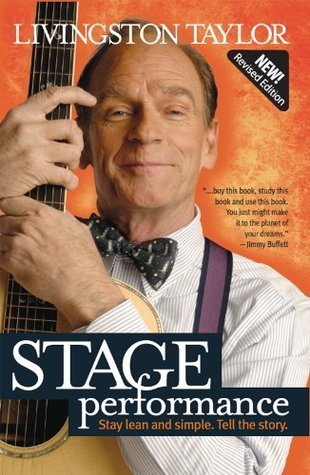
Stage Performance
In his Stage Performance class at Berklee College of Music, Livingston Taylor has taught thousands of young musicians how to take the stage without fear and deliver a performance that is rewarding for both the performer and the audience. Stage Performance will help you discover the conversation of performance, the right way to begin and end your appearance, how to understand and conquer stage fright, as well as many other helpful tips. With a natural humor, real-life anecdotes, and 10,000 performance critiques under his belt, Livingston gives you the tools to successfully deliver your message to an audience and to elevate the level of your performance to professional standards.
- GenresNonfictionWriting
148 pages, Kindle Edition
First published March 1, 2000
Ratings & Reviews
Friends & Following
Create a free account to discover what your friends think of this book!
Community Reviews
Displaying 1 - 9 of 9 reviews

January 21, 2021
I’m not sure why I read this, especially considering that I won’t be performing anytime soon bc of covid, but I rly don’t regret it. Beside the 2/3 chapters on media exposure, contracts, and touring advice, I would recommend this to anybody, bc Livingston ties up stage advice w some invaluable life advice
Here are a few of the points / quotes that stuck w me :
1. Any performance is a conversation bw u and ur audience, and everybody in that audience wants “to feel as though ur speaking to each of them as individuals.” Given that conversations are 2 sided, you must take the time to absorb the energy of ur audience and respond back.
Its such an obvious idea but it rly resonated w me. It explains why soloing over a song and recording it is so different from playing it live; I’m not responding to my listeners, I’m not giving anybody what they want/need from me. + That then explains why practicing by myself makes me happy, but the feeling before/during/after a performance is so much better; I’m gaining from playing + from the audiences approval AND from the fact that I’m giving them something (more exchange than I realized here)
Also- so applicable to daily life. Every person you talk to is going to be in a different condition so you have to make adjustments accordingly, just as you would w a new audience. To do that, you must have a certain degree of neutrality, so that you are able to be spontaneous and respond to the moment.
He says that on a stage you would establish this neutrality by not saying anything for a moment and just listening/observing/etc, and in life I’m sure you can do exactly the same; be mindful of the people around you.
It would be cool to follow around a band or musician on tour and see how they change after each show, or just get each artist to write their thoughts down after each one. Absorbing so much so fast has to have some significant effects
2. The emphasis he places on flexibility- “not waiting for things to line up properly, but moving ahead with what you’ve got right now. I like controlled movement, even in the wrong direction”
This is so important. Your music (or wtv ur craft is) is never going to improve if you’re always waiting for inspiration. You need discipline: “parts that move don’t rust and freeze.”
3. “The ability to forgive is very attractive. When an audience sees that you can forgive yourself, they make the assumption that you can forgive them, too. That makes them comfortable, and comfortable audiences are happy to pay your salary.”
4. Prayer as “a place of stillness in your life” - I’m not religious (and Livingston points out that you can still pray w/o believing) so my thought automatically went to RZA, who said that “prayer is opening up your heart” .... thats cheesy ash but in silence and stillness you will inevitably reveal your vulnerabilities and sometimes that’s exactly what you need to do.
Anyways this was great, I got a little bored towards the end hence the 4/5 but it overall did make me want to take his class at Berklee lol, forget regular college
Here are a few of the points / quotes that stuck w me :
1. Any performance is a conversation bw u and ur audience, and everybody in that audience wants “to feel as though ur speaking to each of them as individuals.” Given that conversations are 2 sided, you must take the time to absorb the energy of ur audience and respond back.
Its such an obvious idea but it rly resonated w me. It explains why soloing over a song and recording it is so different from playing it live; I’m not responding to my listeners, I’m not giving anybody what they want/need from me. + That then explains why practicing by myself makes me happy, but the feeling before/during/after a performance is so much better; I’m gaining from playing + from the audiences approval AND from the fact that I’m giving them something (more exchange than I realized here)
Also- so applicable to daily life. Every person you talk to is going to be in a different condition so you have to make adjustments accordingly, just as you would w a new audience. To do that, you must have a certain degree of neutrality, so that you are able to be spontaneous and respond to the moment.
He says that on a stage you would establish this neutrality by not saying anything for a moment and just listening/observing/etc, and in life I’m sure you can do exactly the same; be mindful of the people around you.
It would be cool to follow around a band or musician on tour and see how they change after each show, or just get each artist to write their thoughts down after each one. Absorbing so much so fast has to have some significant effects
2. The emphasis he places on flexibility- “not waiting for things to line up properly, but moving ahead with what you’ve got right now. I like controlled movement, even in the wrong direction”
This is so important. Your music (or wtv ur craft is) is never going to improve if you’re always waiting for inspiration. You need discipline: “parts that move don’t rust and freeze.”
3. “The ability to forgive is very attractive. When an audience sees that you can forgive yourself, they make the assumption that you can forgive them, too. That makes them comfortable, and comfortable audiences are happy to pay your salary.”
4. Prayer as “a place of stillness in your life” - I’m not religious (and Livingston points out that you can still pray w/o believing) so my thought automatically went to RZA, who said that “prayer is opening up your heart” .... thats cheesy ash but in silence and stillness you will inevitably reveal your vulnerabilities and sometimes that’s exactly what you need to do.
Anyways this was great, I got a little bored towards the end hence the 4/5 but it overall did make me want to take his class at Berklee lol, forget regular college

Read
January 26, 2020Who knew there would be so much overlap between performance advice and just plain life advice? I occasionally run into Livingston Taylor around town, and what impresses me about him, even in casual passing encounters at the grocery store, is that he is such a nice guy. He just radiates "Nice guy." (His nephew Isaac, who I know a little better, is also one of the nicest guys you'll ever meet.)
The mind-blowing concept in this book, to me, was the idea of not overextending yourself, not trying to do hard things in front of an audience but only working from material you have absolutely mastered. Well. I don't really do any performance and when I have it hasn't gone terribly well. This might have something to do with it but also I think it has broader applicability.
Other advice is all very sound, reasonable, and measured. It advises strongly against being drunk or angry on stage (or, you know, in general), so he may not be the role model all young musicians are looking for. He gets into the power of prayer -- something I did not expect -- and is all about being considerate and compassionate to everyone you meet -- and that's fully in line with what I've seen of him, but I didn't expect it to be such a major focus in a book about performance.
Finally, a caveat emptor: This book was originally published in 2000 (?) and I have the revised edition from 2001. The music industry, radio, and how people discover new music has changed quite a lot since then, so some parts of the book are dated. The principles probably still apply.
The mind-blowing concept in this book, to me, was the idea of not overextending yourself, not trying to do hard things in front of an audience but only working from material you have absolutely mastered. Well. I don't really do any performance and when I have it hasn't gone terribly well. This might have something to do with it but also I think it has broader applicability.
Other advice is all very sound, reasonable, and measured. It advises strongly against being drunk or angry on stage (or, you know, in general), so he may not be the role model all young musicians are looking for. He gets into the power of prayer -- something I did not expect -- and is all about being considerate and compassionate to everyone you meet -- and that's fully in line with what I've seen of him, but I didn't expect it to be such a major focus in a book about performance.
Finally, a caveat emptor: This book was originally published in 2000 (?) and I have the revised edition from 2001. The music industry, radio, and how people discover new music has changed quite a lot since then, so some parts of the book are dated. The principles probably still apply.

August 30, 2023
No, the irony of reading a book about stage performance instead of actually working on my music is NOT LOST ON ME ty.
My dad recommended this to me. He says L is even more talented than his bro!
When he’s really scared and nervous he prays to stay within himself: “he has a convo w god. But what I enjoy saying is thanks. I thank god for putting me in a position where I CAN be nervous. If I’m nervous, it’s because it’s important to me. I asked for it. I asked to be in this place. I wanted to be at bat, and now I am. I’ve been given what I asked for. Pitch the ball. I’m ready for whatever happens. 99 clinical psych!
Nothing looks better on a human being than self acceptance 129
130 applause is a gift accept it graciously
You can’t hide on stage. You’re always showing people what you do in everything you do
I enjoy books where u can rly glimpse someone’s soul and outlook and there’s a nobility to someone earnestly putting it all out there
My dad recommended this to me. He says L is even more talented than his bro!
When he’s really scared and nervous he prays to stay within himself: “he has a convo w god. But what I enjoy saying is thanks. I thank god for putting me in a position where I CAN be nervous. If I’m nervous, it’s because it’s important to me. I asked for it. I asked to be in this place. I wanted to be at bat, and now I am. I’ve been given what I asked for. Pitch the ball. I’m ready for whatever happens. 99 clinical psych!
Nothing looks better on a human being than self acceptance 129
130 applause is a gift accept it graciously
You can’t hide on stage. You’re always showing people what you do in everything you do
I enjoy books where u can rly glimpse someone’s soul and outlook and there’s a nobility to someone earnestly putting it all out there

February 5, 2018
Livingston does a great job explaining the fundamentals of stage performance, from confidence on the stage to what to say to a fan who asks "What's your song about?" If you're a performer, read the book!
Read
December 17, 2021Great insight to a master performer and teacher. I love his outlook on performing. Many bits of information were obvious, but still good reminders and affirmations.
I enjoyed being a fly on the wall of his classes
I enjoyed being a fly on the wall of his classes
August 31, 2026
Even for non-performers/career musicians, there are some real nuggets of good wisdom in how to carry yourself in the world generally within the book. That being said, the book does show its age as it feels like streaming and the internet at large has greatly changed the business model for performers. Additionally, I found Taylor's writing style to be a little unfocused at times but perhaps that would be endearing for fans of his story/music. Overall, a good, solid read. 3.5/5 stars
Left at the Rira Vegan Food bookshelf in Budapest
Left at the Rira Vegan Food bookshelf in Budapest

March 5, 2014
I was introduced to this book on a recommendation from a friend and, if nothing else, it has introduced me to Livingston Taylor and his music. The book is written with economy, making it a quick and easy read, but don't mistake economy for bland text: The author is infused in the book and rises from every page as if summoned to hold the would-be performer's hand. There is some practical advice that should prove valuable to all professional and semi-professional musicians, and plenty of useful advice on how to approach an audience, which is relevant to all performers. I'm not entirely convinced how useful this book will prove to me (although I am, perhaps, not the intended audience) but I certainly enjoyed it and can see how it might be indispensable for others.

Read
July 31, 2012This is a very fabulous book. All those lessons Livingston Taylor gives out to music students whenever they read it are inspiring and unforgettable, and if you have a deep love of music and such, take a look and see if it will help you.
May 22, 2012
great little book... I think everyone should read this, not just performers.
Displaying 1 - 9 of 9 reviews