Follows the adventures and troubles of Misha, an angel who has recently come to Earth from heaven and has very little understanding of how things work here.
Koge-Donbo (or Koge-Donbo*) is the pen name of a Japanese manga artist. Koge-Donbo* started her career soon after college as a doujinshi artist. She got the idea of a unique pen-name, Koge-Donbo* from Akira Toriyama's pet cat. She made her first official US appearance at Otakon 2004 in Baltimore, MD as a Guest of Honor. She's known best as the author of Pita-Ten, Kamichama Karin, and Kamichama Karin Chu series.
Like always, Koge-Donbo's work is amazing! I love Pita Ten! It is one of the best mangas ever. I didn't like the ending though, because it was sad and Kotarou and Misha got separated. But it was still kinda happy because she's still always with him. xD
This entire review has been hidden because of spoilers.
As kind of dated the style of this manga is I would 100% see people wanting to wear a dress like the cover. It's me, I am people.
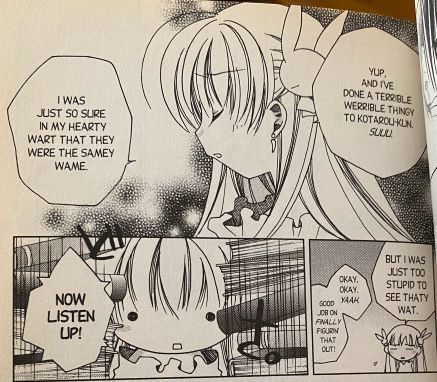
Honestly the worst part of this volume was Misha's way of speaking. While it would work with the silly comedy tone of the beginning of the series, her way of speaking has become way too much in these final volumes when the story is now way too serious for the way she is speaking. Kill me now please.
Meanwhile poor Takashi, not only is he struggling with a hospitalized father, the money constraints meaning he can't go to a national school even though he's so smart, loving Koboshi only for her to love Kotarou instead, and then loving Shia only to have her disappear and Kotarou not telling him she's dead, and then thinking that Kotarou is going to start dating Koboshi--only for Kotarou to be doing this because of his feelings of betrayal towards Misha, so suddenly Koboshi disappears from school.
And then there's the awkward homophobic 4koma chapter ending.
But, man, when I first read this story when I was younger, I really did not think about the implications of their relationship. My stomach kind of twisted when he was kissing her at the shrine. I mean it’s a forehead and a cheek kiss but the way it’s drawn is so intimate it bothers me knowing that this is a GD ELEMENTARY SCHOOLER.
The line of “You’re not any happier than you were before” I think was really good. Kotarou's grief hasn’t subsided just because he has a relationship with someone, in fact he’s clinging to the comfort of a relationship instead of facing the world, and it isn't until seeing Koboshi and Takashi pull themselves back together and move forward is what gives him the push he needs. It's a really strong message for the end of the series, especially how he echoes what Misha said in the first volume about needing to be happy to make other happy, but he says “I have to be happy, not only for Misha, but for myself”. And that's such a good message. You can't rely on other's to take away the pain you're feeling, you have to move forward on your own. And sometimes, you have to let go of the past and move on in order to be truly happy.
Kotarou's perspective that that it’s only through one's own resilience that one can grow and become stronger and he would never grow on his own by constantly depending on Misha and would reach out to her when he’s in pain. And although it is not explicitly stated, Misha in turn always searched out Kotaro(u/h) because he saw her, and this proved she existed. But, that’s not true selflessness, so what is best for them, no matter how much they love each other, is to never see each other again.
The hint that Kotarou saw Misha as she looks like on the cover in his last glimpse of her is a nice touch too.
I hate to say it because it is painfully of its own time, but I am still a little moved by the ending, the comedy in the series really just doesn’t work anymore and all of Misha’s lines are cringe as hell, weird problematic age stuff—no seriously why couldn’t this just be a junior high setting instead of elementary????— but the messages and the little character moments do still work even after all this time.
Series overall: 3/5
This entire review has been hidden because of spoilers.
Pita Ten was one of my first manga and one I still love to this day. I was a little taken aback when I realised there are quite a few negative reviews floating around for this series - after a reread ad mulling it over, I think I can see why. Some of it seems to come down to the English translation which I personally haven't read so I can't comment. But Koge-Donbo has quite a particular style, both art and story telling, which mixes certain elements together that don't often appeal to the same readers, and I find this shows particularly strong in Pita Ten.
This story around Kotaru and the angel Misha who moves in next door has all the signs of being a cutesy manga. The characters are in their early teens, the plot and especially Misha appear quite silly and even random and the distinct but cute art plays right into that. But Koge-Donbo often likes to blend over the top cute content with silly humour and darker underlining themes. While all the going ons in this series may start off seeming silly and without direction, it's actually a bittersweet tale of realising one's own dreams rather than relying on others.
You have to get about half way through the series before the more serious themes start to surface, and some readers might have already been put off by the silliness before they reach that point. Had I read this manga now for the first time, I might have felt the same. Although I still think that this is quite a niche manga that might not appeal to all, I do think that one needs a little patience with it for it to unfold its messages and potential.
One thing that I did notice during my reread is that I think the story would have benefited a lot had the characters been a tad older. Even a year old two older would have helped, at least I think some of the more serious themes - especially around love and loss - feel less impactful purely based on the fact that the characters are just barely teenagers.
Despite its flaws, I very much enjoy Pita Ten and it's more than nostalgia that lets it keep a place in my heart. It is both sweet and bittersweet and I wouldn't expect anything else from Koge-Donbo.
This one was super bittersweet. So as a whole, the series is definitely not for an adult. It's got some super annoying kiddy things (mostly Misha). I can see why 12 year old me really liked the series and wanted to finish it. Though it's got some kiddy things in it it also introduces more adult themes like love and loss. 12 year old me can now die happy that I finally finished reading the series.
Un angelo che è costretto a vestire di nero e un demone che indossa il puro bianco: è questo l'esordio di questo commovente manga. Dove i ruoli del "bene e del male" sono mischiati ma alla continua ricerca della loro vera essenza... proprio come il protagonista Kotaro e i suoi amici, alla ricerca della loro strada.
Bellissimo manga non mi sarei aspettata mai un'evoluzione del genere, ho pianto per la forza delle sue parole.
Ultimately, this barely gets three stars, for three little words:
Misha's f**king vocabulary.
This was such a tough manga for me to get through because seriously, who the hell talks like that. She's supposed to be what, in 6th grade? Not to mention she's an angel that has apparently been alive for over 80 years....so why is she still talking like a toddler? I want to believe it's a poor translation from Japanese...but wow. Really, really hard to stomach.
My favorite character was Shia-san, but of course that went belly up (though the plot around that was nice). In the end, I was happy, mostly
Luckily the series is on the shorter side. The artwork was nice, and Kotarou's character was interesting (again, I loved Shia and Ten-chan was a nice character as the best friend. "Poops" was kinda funny, too, in a more childish way but nowhere near like Misha)...so I grudgingly give it this 3.
This is my second favourite volume of the series, and when I started reading it, I hadn't a clue of how the situation would resolve itself. I did wonder whether there would be a happy ending, and Misha would be allowed to stay with Kotarou permanently, but as I read on, those thoughts soon faded. What I liked was the self-discovery of Kotarou and how he realised he needed to live in this world rather that hiding in his own world with angels and demons, which led to the parting between him and Misha. I liked that it wasn't a happy ending tacked on to the end which didn't make sense. I thought the ending was really emotional and well done, and although it wasn't the happy ending that you would usually expect, the real ending is actually happy in its own bittersweet way, which Misha looking over Kotarou from the Heavens.
The series as a whole if fantastic, and I've heard that the anime differs quite a lot from the manga, which is annoying as you don't get Shia's backstory, the story of Kotaroh and Misha and the emotional ending.
this is a manga book where you read it back to front. it is about a boy who can angel and demons. the person was someone else before life that a angel called misha fell in love. misha has to pass her angel test make the boy happy and can only use her power once. if misha failed or pass either way the boy would never she her again. he made his chose and told misha that he wishes to not be able to see angel anymore. by hanh nguyen
In the final volume it felt like everything was happening at once, with the pacing of the entire story until now moving to a swift conclusion that is bittersweet yet hopeful. A good series if you can stick with it and not get too put of by Misha's style of speaking. I'm glad I read it, even if it never quite developed fully or quite managed to say clearly what it tried so hard to.
I loved the ending and the entire story... I found that the characters were interesting, and Misha's serious moments to be very captivating. I love the plot. Guys, I cried. A LOT.