This is a Baha’i book and would only be of interest to Baha’is. My mother’s been recommending this to me for the longest while and I finally got to read it. Corinne True was born in Kentucky during the Civil War. Having recently read and loved “Gone with the Wind”, one of my favorite books of all time, the whole Civil War thing is of great interest to me. It was in 1899, soon after the death of her three-year-old son, that Corinne True encountered and accepted the Bahá'í Faith. She went through so many trials and difficulties that I honestly thought it would never end. It was painful to read. I can’t even begin to imagine. This book was inspirational and a beautiful reminder as to how to try to live. This quote served as a wonderful reminder:
“Heaven, Corinne realized, was an attitude. And ‘Abdul-Baha demonstrated it every moment of His life regardless of the circumstances. In His presence she sensed someone completely content with God’s will, happy and serene, although not unaware of the tests and problems of the world; He focused on life’s potentialities, always striving to release and develop them, and drawing strength and knowledge from the Divine Source. A group of people with such an attitude, or striving to attain, creates a heavenly atmosphere, like the one in the Master’s home. And sincere visitors like Corinne were so affected by it that they didn’t want to revert to their former outlook.”
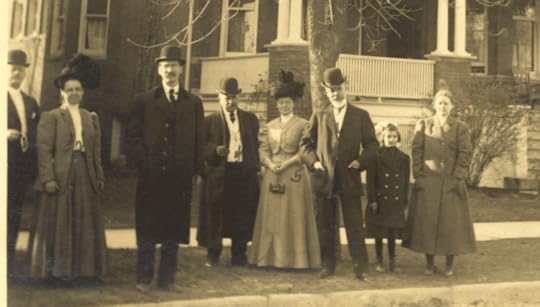
A group of Baha'is, Corinne is second from the left.
An absolutely exceptional window into the life of a truly remarkable soul. Could not put this book down for more than a couple of hours. Corinne’s life as portrayed by Nathan Rutstein will forever be engraved on my heart; something I will always cherish. I would recommend this to the thoughtful study of any Baha’i or non-Baha’i for the profound wisdom, virtue and spiritual understanding one can glean from this Hand of the Cause of God’s life.
11 July 2011: After finishing the Harry Potter series (again), I picked up and discarded "Brain Rules for Baby" and then "The Cat-Nappers" by P.G. Wodehouse in turn, trying to find a story or book that I could relax into, melt into, become absorbed by. Third time lucky, I picked up "Corinne True" and it was a fit. From the first line of the preface or whatever it was, I was into this book, and it was just that wonderful book feeling of knowing that this is one to stick with. A few chapters in, I'm fascinated by Corinne's ancestry, but I wish there had been a bit more detail around the circumstances of her becoming a Baha'i.
13 July 2011: I don't know what's so compelling about this book, but I can't put it down. I think it'll be finished in a couple of days. The things that I love about it are:
1. Lovely little anecdotes to illustrate points and to evoke the person/era. 2. Learning the history of the Baha'i Temple in Chicago, the Mother Temple of the West, and the detail is revealing of the human side of translating the spiritual into the practical. I find this stuff fascinating. 3. The incredible, almost bewildering, descriptions of 'Abdu'l-Baha's interactions with Corinne True. Whether in letter or telegram or person, it's a bit stupefying to me to think of the human 'Abdu'l-Baha acutally living among real people who did things. In America. I mean imagine living at that time! And it wasn't so long ago, or so far away! 4. Learning about and from the example of this persevering servant of humanity, Corinne True. 5. The reliance on primary, or secondary, sources. I do feel like the author isn't getting his own personality in the way of this story.
The things that I wish were a bit different are:
1. Some paragraphs or sentences that seem to be going somewhere, even a tangential somewhere, that just end where they begin. I find this a bit confusing, to the point of being halfway through a chapter and being distracted by how a certain point was hinted at but not made. I want the subplots and anecdotes to be a bit more explicit and completed, please. 2. My lack of grasp on the person of Corinne True. I was thinking about this a little bit, because on the one hand I am learning an awful lot about a person I knew about basically only in name before I started reading this book. But on the other hand I don't think that her personality is really being evoked for me. I'm getting bits and pieces, but I can't imagine her living and breathing and talking. I can't picture it. In contrast to this is, say, Marzieh Gail's foreword to "The Diary of Juliet Thompson's", which for me was deeply evocative of a living, breathing, talking Juliet Thompson. Maybe because Nathan Rutstein doesn't quote Corinne True's speech that much? He quotes her letters, but not things that she's said. Or maybe I'm getting that wrong and there's something else that's the stumbling block. In any case, I keep on turning to the photos to help my visually-oriented brain along.