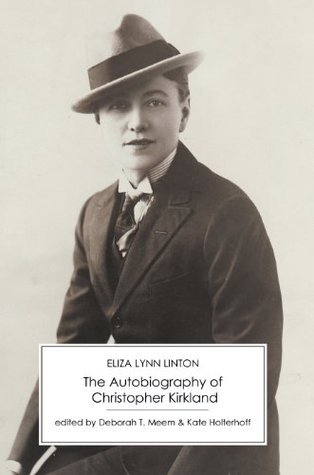
In this astonishing work of literary transvestism, Linton adopts a male persona in order to recount her loss of faith at an early age, her sexual relationships with other women, and her disastrous marriage to the engraver William Linton. She told her publisher, George Bentley: “I have put my very Soul, my life into these pages.” In later life, she said it as “an outpour no one hears me make by word of mouth, a confession of sorrow, suffering, trial, and determination not to be beaten, which few suspect is the underlying truth of my life.”
This edition includes a critical introduction, explanatory footnotes, suggestions for further reading, and contemporary reviews.
Note Eliza's books are sometimes published under Elizabeth Lynn Linton or as E. Lynn Linton.
Eliza Lynn Linton was a British novelist, essayist, and journalist.
The daughter of a clergyman and granddaughter of a bishop of Carlisle, she arrived in London in 1845 as the protegé of poet Walter Savage Landor. In the following year she produced her first novel, Azeth, the Egyptian; Amymone (1848), and Realities (1851), followed. None of these had any great success, and she became a journalist, joining the staff of the Morning Chronicle, and All the Year Round.
In 1858 she married W. J. Linton, an eminent wood-engraver, who was also a poet of some note, a writer upon his craft, and a Chartist agitator. In 1867 they separated in a friendly way, the husband going to America, and the wife returning to writing novels, in which she finally attained wide popularity. Her most successful works were The True History of Joshua Davidson (1872), Patricia Kemball (1874), and Christopher Kirkland.
She was also a severe critic of the "New Woman." Her most famous essay on this subject, "The Girl of the Period," was published in Saturday Review in 1868 and was a vehement attack on feminism. In 1891, she wrote "Wild Women as Politicians" which explained her opinion that politics was naturally the sphere of men, as was fame of any sort. "Amongst our most renowned womené, she wrote, "are some who say with their whole heart, 'I would rather have been the wife of a great man, or the mother of a hero, than what I am, famous in my own person." Mrs Linton is a leading example of the fact that the fight against votes for Women was not only organized by men. -Wikipedia
I read this for research purposes so perhaps people coming to it out of different interests would find it better. That said, a lot of the "tell-all" aspects of her times with other Victorian people didn't mean very much to me and it wasn't particularly focused or immediate as a memoir (aside from the faith/doubt parts, which got tedious to me but probably wouldn't if that's why you were reading this book!).