Jump to ratings and reviews
Rate this book

Arctic Summer

Rate this book
In 1912, the SS Birmingham approaches India. On board is Morgan Forster, novelist and man of letters, who is embarking on a journey of discovery. As Morgan stands on deck, the promise of a strange new future begins to take shape before his eyes. The seeds of a story start to gather at the corner of his a sense of impending menace, lust in close confines, under a hot, empty sky. It will be another twelve years, and a second time spent in India, before A Passage to India , E. M. Forster's great work of literature, is published. During these years, Morgan will come to a profound understanding of himself as a man, and of the infinite subtleties and complexity of human nature, bringing these great insights to bear in his remarkable novel.
At once a fictional exploration of the life and times of one of Britain's finest novelists, his struggle to find a way of living and being, and a stunningly vivid evocation of the mysterious alchemy of the creative process, Arctic Summer is a literary masterpiece, by one of the finest writers of his generation.

369 pages, Kindle Edition

First published March 6, 2014

135 people are currently reading
2649 people want to read

About the author

Damon Galgut

29 books819 followers
Damon Galgut was born in Pretoria in 1963. He wrote his first novel, A Sinless Season, when he was seventeen. His other books include Small Circle of Beings, The Beautiful Screaming of Pigs, The Quarry, The Good Doctor and The Impostor. The Good Doctor was shortlisted for the Man Booker Prize, the Commonwealth Writers' Prize and the Dublin/IMPAC Award. The Imposter was also shortlisted for the Commonwealth Writers' Prize. He lives in Cape Town.

Ratings & Reviews

What do you think?
Rate this book

Friends & Following

Create a free account to discover what your friends think of this book!

Community Reviews

5 stars
402 (24%)
4 stars
664 (40%)
3 stars
408 (25%)
2 stars
110 (6%)
1 star
37 (2%)
Displaying 1 - 30 of 260 reviews
Profile Image for Vit Babenco.
1,782 reviews5,778 followers
April 24, 2022
E.M. Forster was an unhappy man, tormented by his desires and doubts, and he lived a miserable life but his moral suffering did make a great writer out of him.
Love had vexed his mind, making him irritable and irrational. There was something in human affection that was at odds with reason, he thought, like a kind of mild insanity.

Moral qualms and shortage of willpower – I believe Damon Galgut perfectly depicts his protagonist’s drawbacks. And he magically recreates psychological climate and an atmosphere of that long gone era.
That echo. It played in his head at unexpected moments, repeating certain sounds and making nonsense of them. But could you remember an echo? Memory itself was like another kind of echo, everything duplicating endlessly, in shadow versions of itself.

And this is an aura of the place:
He didn’t believe – not really – in the supernatural. But he didn’t entirely disbelieve either. India scraped up to the surface a kind of buried animism in him, a propensity towards the mystical.

And an idea of happiness is always better than the happiness itself…
But the shame, he slowly realised, was part of the point. Degradation had its own sensual power, and no sooner was he hurrying away from one encounter than his mind was leaping ahead to the next one. In the morning when he woke up he was already breathless with anticipation and the hours passed with grinding slowness till the appointed time. But the idea was far more thrilling than the act, which was over almost as soon as it started.
Happiness is self-sufficient – it has nothing to say. Unhappiness makes an individual think.
Profile Image for Orsodimondo.
2,457 reviews2,430 followers
October 21, 2025
FELLOW TRAVELERS


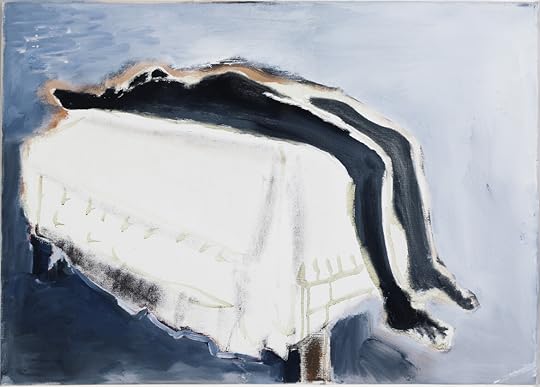
Marlene Dumas, «Waiting (for meaning)», 1988

Mi è difficile dire se aver letto Passaggio in India sia importante, o perfino fondamentale per godere di questo Galgut. Probabilmente conta conoscere Forster: avendo letto i suoi sei romanzi ormai da tanti anni, sento che l’inglese mi è noto, è parte del mio mondo, e questa sua biografia – che però è soprattutto romanzo tout court – proposta dal sudafricano è stata anche per questo lettura oltremodo gradevole.
Ma credo anche che il talento di Galgut è tale che questo suo Estate artica - titolo preso in prestito da un progetto letterario di Forster, che poi lo accantonò – potrebbe essere un buon modo per avvicinarsi all’arte di E.M.Forster.
Conoscendo anche Galgut abbastanza – questo credo sia il suo sesto romanzo che leggo – mi è facile capire il suo interesse per la materia: Forster, l’Inghilterra – soprattutto del primo Novecento, ancora tanto vittoriana, così lontana dal Sudafrica post-apartheid – l’omosessualità – ben più che repressa a quell’epoca, ma comunque vissuta – l’India, la scrittura… Tutti argomenti che ritrovo anche altrove nelle opere di Galgut, che sono un passo ulteriore sulla traccia dei suoi libri, pieni di aperture per il non detto, disseminati di dubbi, coraggio mancato, ricerche frustrate di approdi e amori, tensioni date dalle differenze di classe, razza, sesso.


E tra questa pagine s’incontrano e incrociano altre figure celebri: Leonard e Virginia Woolf, Lytton Strachey, David Herbert Lawrence, Kostantinos Kavafis. Si apprende che Foster partecipò alla Grande Guerra lavorando per la Croce Rossa ad Alessandria d’Egitto, un soggiorno di tre anni senza ritorni a casa. Che visse tutta la sua vita insieme a sua madre. Che impiegò undici anni a scrivere e concludere (1924) il suo romanzo più celebre, Passaggio in India, titolo casuale preso da una poesia di Walt Whitman. Che la gestazione fu lunga non solo per il blocco dello scrittore, ma anche perché nel 1914 aveva concluso il suo quinto romanzo, quel Maurice in cui faceva finalmente per così dire outing e parlava più o meno liberamente della sua omosessualità. Ma scriverlo fu una cosa, pubblicarlo bel altra: il libro uscì dopo la morte di Forster, quasi cinquant’anni dopo averlo composto. Non va dimenticato che quando Maurice fu completato, l’omosessualità era ancora un reato che portava addirittura in prigione. Oscar Wilde docet.


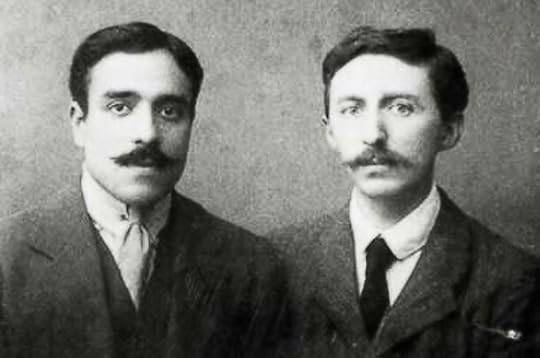
E.M.Forster a dx, il suo grande amore indiano, Syed Ross Masood, a sinistra.

Galgut deve aver sentito molto vicino questo suo collega britannico morto qualche anno dopo la sua nascita (1970 la morte, 1963 la nascita). Non solo per la comune omosessualità (e forse è la prima volta che raccontando di Forster, Galgut parla di questo argomento con tanta libertà); non solo per il comune amore per il continente indiano (che all’epoca non solo era sotto dominio inglese, ma non si era ancora separato dal Pakistan: entrambe nel 1947, la separazione contestualmente all’indipendenza). A unirli e collegarli c’è un territorio comune fatto d’impacci, non detti, una storia di disperata solitudine, il colonialismo, il rapporto tra razze e classi sociali, l’abbandono di un amore, cosa succede se non si esprimono le proprie emozioni, se non si fa quello che si vorrebbe, se non lo si dice neppure, chiedersi quale genere di intreccio può nascere dall’inazione… Viene da dire che Galgut è Forster.
D’altra parte in un’intervista di due anni fa l’autore sudafricano aveva detto: Qualsiasi cosa scrivo, c’è sempre una sola trama. Sto scrivendo di me solo, non conosco altro. Scrivi i tuoi segreti, ti illudi che l’universo ti si aprirà, ma l’universo in realtà sei tu.

PS
Il titolo rimanda al libro incompiuto di Forster, ma indica altro: il senso di luce fredda, di spazi bianchi propri di quella stagione e di quel clima. Nulla si muove, il cielo è sgombro, neve e ghiaccio le uniche cose vive. Eppure il sole splende.


Le grotte di Barbar – che nel romanzo diventano Marabar – dove avviene il fatto attorno a cui ruota tutto, nel libro e nell’omonimo film del 1984, scritto, montato e diretto dal grande David Lean.
Profile Image for Roger Brunyate.
946 reviews740 followers
April 2, 2018
Inside a Very Private Man

I knew E. M. Forster at Cambridge. That is to say, he allowed me to visit him in his rooms at King's College a couple of times in 1962, when I was a young undergraduate. We talked about those few subjects on which he would willingly open up—mainly music, art, and literature sufficiently removed from his own. I found him genial, witty, and welcoming, but also extraordinarily private on any matter having to do with his life or work. Many years later, after he was long dead, I got to know him in a different way, through adapting his novel Where Angels Fear to Tread as an opera libretto.* The choices I had to make gave me a closer insight into Forster's mind as an artist, as I tried to work out not only what was most essential in what he wrote, but also (tentatively) what might lie behind the lines that he could not write. I believe I have read all his fiction other than the incomplete Arctic Summer, whose title the South African writer Damon Galgut borrowed for his biographical novel; I have now corrected that omission. But I have never read a traditional biography of Forster, so this was a revelation, like seeing an old acquaintance in a new light, fresh but familiar at the same time.

The novel opens just over a century ago (and fifty years before I met him), on the steamship carrying Edward Morgan Forster on his first visit to India, in 1912. Immediately, I felt that Galgut had captured his personality just right: his "crumpled, second-hand appearance, which made him seem like a tradesman of some kind"; his exquisite politeness; his extraordinary reticence about personal matters of any kind, especially sexual ones. On board ship, he meets a young army officer called Searight, who recognizes a kindred spirit in Morgan, and is not reticent at all. The author, already famous from the success of his fourth published novel, Howards End, is both horrified and intrigued. For although recognizing himself as a homosexual—Galgut's period-appropriate term is "minorite"—and yearning for love, he would remain a virgin until he was 37.

Galgut's approach is rather similar to what Colm Tóibín did for Henry James in The Master, though he is less episodic and I think more revealing. Both men, according to their authors, were attracted to young men of a lower class, though both struggled against expressing or even admitting it. But unlike James, who easily assumed his status as a public figure, Galgut's Forster is a mass of insecurities, and feels himself something of a fraud. He is also presented as a profoundly lonely man, seeking love and human companionship, but deterred from finding it because of the complications of his physical urges.

Three of the long chapters which make up the meat of this book are named after men, all of other races, each of whom was important to Morgan at different phases of his life. There is Masood, an Indian barrister of good family whom he tutored for admission to Oxford years before, and is now his chief reason for visiting India now; Masood will give much, but he cannot give him all. Then there is Mohammed, a tram conductor whom Morgan befriends during the years he spends in Alexandria during the War, working for the Red Cross. And finally Bapu Sahib, the Indian Mahahrajah who invites Morgan to his court as Private Secretary in the early 1920's; theirs is by no means a sexual relationship, but based on mutual respect and fondness; it also coincides with what was probably the least closeted period of Forster's life.

For the inability to let go emotionally is what Forster sees as the besetting handicap of the English upper-middle class, entrenched behind walls of xenophobia and convention. It is the subject of his early novels such as Where Angels Fear to Tread. Even knowing that book as well as I do, Galgut gave me new insights. I understood the magnetic charm of the Italian ruffian, Gino Carella, and his effect on the hero, Philip Herriton. I also understood that Philip could no more admit these things than could Forster himself, also still trapped in the middle-class proprieties of his mother's world. But away from England, in each of his voyages East, to India, Egypt, and India again, he found himself loosening up more and more. His masterpiece, A Passage to India, went far to expressing the contrasts, not just between two cultures but two sides of his personality. But it did not resolve them; one of Galgut's most impressive scenes is the one in which Forster realizes that the book must be built around an unsolved mystery. And Morgan Forster never could resolve them in print. He lived for 46 years longer, but never wrote another novel.

Galgut's book also made me sad. How little I knew back then! With more homework, for instance, I could have asked Forster about his literary friends, Virginia and Leonard Woolf, D. H. Lawrence, and C. V. Cavafy, all of whom figure in Galgut's book. But he would have brushed me off with polite evasions. For though I shared his conversation and his whiskey, I could never really know him. Now, after reading this deeply perceptive novel, in some essential way I do.

======

*
The three-act opera was composed by Mark Lanz Weiser. It received its student premiere at the Peabody Conservatory in Baltimore in 1999. Its professional premiere was given by Opera San Jose in February, 2015.
Profile Image for William2.
859 reviews4,047 followers
August 31, 2022
A tale of desire and loneliness and literary creation that is exceptionally well written. Summary makes the book sound like a superficial gloss on the life of E.M. Forster. It’s anything but. It exhibits a rich interiority and emotional directness which are bracing. Homosexuality in the Britain of Forster’s day was a state crime. We recall how how Alan Turing, after his work at Bletchley Park, was sexually poisoned.

Here we are with Morgan as he tries to live his life in that toxic society. A very handsome, dark complected, seventeen year old Indian is brought to him one day at his mother’s house because he is in need of tutoring in Latin. There’s very little pretense made toward this academic objective. Instead that two become friends and poor Morgan falls in sadly unrequited love with the fellow. It’s even hard to quote passages, since out of context the prose come across as merely melodramatic. But let us try. A good decade or more later we are in India.

“Morgan was making an early start in the morning, and had told Masood not to wake up. Although he'd said it firmly, he had wanted his friend to overrule him; he had wanted him to insist on waking and seeing him off on his journey. But Masood had yawned and agreed that he was very tired and that there was no point in getting up early. It was a sensible solution. So they had said goodbye just before going to sleep, in a stiff, incomplete way, both feeling shy, and then retreated. But almost immediately after, as he'd started to undress, Morgan had felt himself speared on the point of sharp emotion. He had gone back through to Masood's room and sat on the edge of his bed and taken hold, very tightly, of his hand. Cold anguish made certain details stand out, the white hanging shroud of the mosquito net, the shadows in its folds. Even if he'd been able to speak, he could not have said what he wanted. But the yearning had made him lean towards Masood, trying to kiss him. In the fizzing white burn of the lamp-light, his friend's face had been at first astonished, and then shocked. His hand had come up sharply, to push Morgan away, and that little movement had felt enormous, a force that could move a boulder. Morgan had accepted the refusal, because he'd known in advance it would come, and sat hunched miserably over his kernel of loneliness. By then Masood was merely irritated. He had rubbed Morgan's shoulder and patted him on the back, in a way that was both reassuring and dismissive. Neither of them spoke, but both of them understood. He did not feel as Morgan did; that was all. There was nothing else to say.” (p. 79)

In a letter Hemingway said, criticizing Faulkner, that true literature when it works doesn't give away its methods; that even on second or third reading it somehow transcends its limitations as a text; whereas with Faulkner on a second reading "you can see how he's tricked you."

No trickery is evident in Galgut. Somehow the author succeeds. One reads and rereads it, and there seems no clear formula to its success. But there it is before you in its aching sublimity. I have also read this author’s The Promise and In A Strange Room with great pleasure and at times astonishment.

When WW1 commences he volunteers to help the Red Cross identify British wounded in ancient Alexandria. He is in a role which allows him to befriend the soldiers, write letters for them, run errands, listen to what they have to say. His experience here being uncannily like that of Walt Whitman during the U.S. Civil War. (Whitman’s account appears in his Specimen Days.) He is 37 when he meets Mohammad, aged 18, who works as a train conductor.

Forster’s meetings with C.P. Cavafy are magical. Especially when he finds himself contemplating his Alexandria: A History and a Guide.

“He had tried to flatter Cavafy, but had never been allowed to draw near. Nevertheless, his project almost put their friendship on a new footing. The advice came in a torrent, nearly all of it useful and encouraging. Had Morgan read Plotinus? Did he know about Philo and the Logos? Was he up on his Athanasius? He, Cavafy, had some books that Morgan simply had to read.

“As he researched in preparation, Morgan realised that he and the poet were embarked on a similar labour. He thought of this book as a resurrection, restoring a graveyard to life. And in his own work, in his own way, Cavafy was doing the same thing. Dipping into myth and ancient history, veering off into the modern streets, too, his poems stitched between an old, lost Alexandria and the immediate, sensual, modern one he lived in. In his words, the past quite literally drew breath.

“But Cavafy lived here, after all. What pulled Morgan so powerfully? He hadn't responded warmly to Egypt when he'd first arrived. When he considered it, he decided that it was precisely because Alexandria felt like a place - almost a country, alone - separate from what surrounded it. And what stirred him most deeply was that it was a mixture: an interbred miscegenation, a bastardy of influences and traditions and races. He had learned to mistrust purity — or the idea of purity, rather because the real thing didn't exist. Everybody by now was a blend; history was a confusion; people were hybrids.” (p. 228)
Profile Image for Helle.
376 reviews452 followers
June 6, 2017
Having recently read Damon Galgut’s In A Strange Room, which was brilliant, and having a life-long love of E.M. Forster, I was prepared to love this novel about the English writer. I liked it a lot but for some reason not quite as much as I loved The Master, a similar novel, in which Colm Toíbín eloquently and plausibly muses on Henry James’s life and books.

As in The Master, in which Toíbín calls his protagonist Henry, Galgut calls his hero Morgan throughout, lovingly as I interpreted it, and it brings the reader closer to him (and his first name wasn’t meant to be Edward anyway, Galgut tells us; his father accidentally said his own name at the christening. Had he been less absent-minded, Forster’s first name would have been the same as James’s).

The title – Arctic Summer – was the title of a novel Forster never finished and seems fitting for this portrait of him, his last and unrevealed story, as it were. It is part plausible story-telling based on research and part Galgut’s rendition of Forster’s thoughts about his homosexuality and the two main loves of his life (at least during the period that we follow him), Syed Ross Masood and Mohammed el-Adl, and less so his thoughts about his books. (In a conversation with Virginia and Leonard Woolf at the end of the novel, Forster says that he isn’t really a novelist. Virginia agrees, Leonard does not). For my own part, I would have liked a bit more about his novels.

Galgut returns to India in this novel, and to travelling. He creates a story in which Forster puts together his major works, but the novel builds up to the creation of what many consider to be Forster’s masterpiece, A Passage to India. Galgut’s novel delineates the other novel's development and suggests where many of its ideas spring from. It took Forster some twelve years to write; he continually abandoned it, deeming his memories of India inauthentic, until he visited it again.

Lines from Passage are strewn throughout this novel as if Forster had picked up bits and pieces from conversations and events over the 12 years from its conception to its final composition, which he may well have done. I recognized lines spoken by Dr. Aziz and Dr. Godbole, descriptions of Forster’s journey to the Barabar Caves (which became the Marabar Caves) and his thoughts on the British Raj, many of which made Passage such an important book at the time. Forster had the keenest eyes when it came to observing the English in India but also in-depth knowledge of some of the differences between Hindus and Muslims in India and, thus, of the complexities of Indian politics at the time.

A lot of guess work is necessarily involved as to Forster’s feelings of loss and inadequacy, his way of being a forlorn, gentle man unable to fathom, let alone experience, the depths of his own sexual desires. (We are reminded in the beginning of the novel that Wilde was imprisoned only 17 years previously). Much of this is both probable and reasonable, but I felt less willing to grant Galgut the liberty of imagining Forster’s small sexual encounters so explicitly. It seemed intrusive somehow because Forster himself hid this part of himself from all but his closest friends, although I suspect that may have been one of Galgut’s reasons for including them: to imagine them out into the open. (And my need to protect Forster post-humously is no doubt entirely misplaced – this is art, after all – but those were my feelings). I have to admit that it also grated on my ears that the word nevertheless is used perhaps 20 times in the novel (yet didn’t work? Or even so, however?, leaving it out?).

In conclusion, though, I read this as an affective homage to Forster. Like Forster – and through painting this portrait of him – Galgut explores human connections and travelling, two of my favourite topics. At one point in the novel, Forster sees a sign in India which is characteristically misspelled and which comes to be a kind of theme in A Passage to India: the memorable God si love, an orthographically inaccurate but quite wonderful way, to my mind, of reiterating the epigraph to Howards End: Only connect.


Profile Image for Karen·.
682 reviews900 followers
Read
May 5, 2016
"You see," he told Morgan. "It's as I said. Everything comes down to religion, and it's dull, dull, dull."
"Religion is perhaps not the only element at work here."
"What do you mean? Oh yes, I see.... but even that part of it is dull. A mixture of rapture and cowardice. No action, but all that quivering!"


Oh lawks a mercy. I seem to have turned into one of those people who need something to happen occasionally in the books they are reading.
Beautifully, sensitively written. But once laid down, it was hard to pick up again. At first I blamed the excruciating font, the rough paper, my reddened streaming eyes. I battled on, because I have loved Mr Galgut's work in the past. But it really was a mixture of rapture and (very understandable) cowardice. No action, but all that quivering.
Profile Image for Eric Anderson.
716 reviews3,919 followers
February 26, 2016
Sometimes the feeling of a novel resonates so strongly with my current emotional state that it’s eerie. It’s that magical moment where consciousness becomes fused so tight with the narrative and the particular story becomes my own – particular and universal. True. I had this sensation as I got into the thick of this novel’s story. It seems an unlikely place and person to feel so connected to: Galgut’s fictional imagining of writer EM Forster. The novel mostly takes place between the publication of “Howard’s End” in 1910 and the publication of “A Passage to India” in 1924. Forster (or Morgan as he is commonly called) travels to India primarily to visit a man he's fallen in love with named Syed Ross Masood. He experiences first hand the strained racial relations and the way imperialism was transforming at that time. Having met in England when Morgan was tutoring him the pair became close friends, but never lovers as Masood denied Morgan's advances. When Morgan returns to England he continues to live with his mother who is both his closest companion and worst enemy. During the war Morgan takes up a position in Egypt and there meets the second great love of his life Mohammed. Galgut carefully reconstructs the tentative relationships Morgan builds with other people, elucidating the suppressed sexuality of Morgan and the complexity of racial politics. The story is overall a speculation on the events and emotions which fed into the difficult creation of “A Passage to India” as well as the novel “Maurice” which wasn't published until after the author's death.

Read my full review of Arctic Summer by Damon Galgut on LonesomeReader
Profile Image for Rebecca.
4,185 reviews3,448 followers
February 11, 2016
As a writer he’d felt he had to provide answers, but India had reminded him that no answer would suffice. There had been so much he’d seen and heard in that country which had baffled him and which rational thinking couldn’t penetrate. Mystery was at the heart of things there and it would be at the heart of his novel too.

(3.5) This fictionalized account of the life of E.M. Forster zeroes in on the drawn-out composition of A Passage to India, which he began in 1913 but wouldn’t complete and publish until 1924. In between he broke off to write Maurice (only published posthumously), spent three years working in Egypt during the war, and served as a secretary to an Indian maharajah. For as bold as he was able to be in his writing of Maurice, Morgan (as he is known here) was still a virgin at the time and fought with the idea that his homosexual urges were unnatural and disgusting. India exerted a pull on him in part because his first great, unrequited love was for Syed Ross Masood, a young Indian man he tutored in Latin. Though that relationship was never consummated, later ones with an Egyptian tram conductor and an Indian barber were.

As fictionalized biographies of authors go, I’d rate this somewhere between David Lodge’s A Man of Parts (H.G. Wells) and Colm Tóibín’s superior The Master (Henry James); all three books share a heavy focus on the author’s sexuality. “Buggery in the colonies. It wasn’t noble” is one of my favorite random snippets from this novel, and sums up, for me, its slightly prurient aftertaste. Although Galgut gives an intimate and sympathetic picture of Forster’s struggles to live and write as he wished to – informed by his journals and letters as well as biographies and other secondary source material – I found I had to force myself to keep going with a book that lacked a propulsive narrative. I did enjoy reading about the inspirations and key decisions behind A Passage to India, which I read in a college course on the Modernists, but for me the best scenes featured meetings with other contemporary writers: Leonard and Virginia Woolf, Cavafy, and especially D.H. Lawrence.
Profile Image for notgettingenough .
1,081 reviews1,366 followers
January 8, 2016
The long is: I suspect most people come to this as an EM Forster fan, whereas I'm the contrary case. This was the only Galgut I hadn't read when I picked it up in London a year or more ago. On the other hand, I've never read a thing by EM Forster other than his brilliant short story 'The Machine Stops'.

So enamoured am I of Galgut that when I bought this, I didn't even look at the back cover, only to discover when I sat down to begin it at home that it is a bio-novel. I was crestfallen. I have a historian's distaste for bio-pics, biography, autobiography. Why would a bio-novel be any different? What is it? Some excuse to write a biography without doing the hard work? Without having to bother with the facts? Back on the shelf it sat, and sat. And sat. Until the other day when I came upon it soon after an experience which had given me a different perspective on this sort of book. I read Infinity: The Story of a Moment by Gabriel Josipovici, read it, loved it, and only subsequently discovered it was a bio-novel.

Rest here:

https://alittleteaalittlechat.wordpre...
Profile Image for Hugh.
1,293 reviews49 followers
April 24, 2017
A fascinating portrait of E.M. Forster and his long struggle to produce "A passage to India". Galgut's prose is always well-judged and readable, and it left me wanting to read Forster.
Profile Image for Gerhard.
1,304 reviews885 followers
May 18, 2016
You can see when an author falls in love with his subject matter, as Damon Galgut does with E.M. Forster in this ravishing and devastatingly sad account of the author’s sojourns in India.

Unable to express his true sexuality in his home country, where he was constantly under the watchful eye of his mother and the social barometer of English aristocracy, Forster’s tentative explorations in this regard occurred abroad, in much different circumstances, and with much different results, at the end of the day.

What I loved about Galgut’s book is how much insight it gives into both the writerly process and the lives of famous authors such as Forster, who we simply assume due to their fame that they were always confident in their sense of their own success and worth.

Not so Forster, who juggled the unpublishable Maurice with Arctic Summer (his only unfinished novel) and what was to be his eventual masterpiece, A Passage to India.

Impeccably researched and written with an extraordinary depth of empathy towards and understanding of Forster, Galgut maintains a difficult balance of showing us Forster in context and simultaneously conveying a sense of his literary legacy and achievements. Magnificent.
Profile Image for George Ilsley.
Author 12 books314 followers
August 18, 2022
That wasn't nothing.

This was a private suffering, like lust or literature, lived out mostly in his dreams.

This is historical fiction seeking to flesh out the life of the writer E.M. Forster, and the sources of inspiration behind his famous novels. In that sense, it is similar in ambition to The Magician (the life and work of Thomas Mann) where one writer takes on the task of reimagining another writer's life.

Arctic Summer covers the period when Forster wrote his major works, but stops before he becomes involved in some significant emotional relationships later in his life.

Having only recently read a major Forster biography which provided access to his private letters and journals (A Great Unrecorded History: A New Life of E. M. Forster), and greatly enjoyed it, at times this novel felt a little too familiar (this biography is one of the sources Galgut credits). However the two books also resonated with each other — when the biography speculated on the nature of Forster's first sexual encounter on the beach in Alexandria, I thought I doubt that happened; Galgut describes a different encounter on the beach, one that was more plausible. However, I did not always agree with Galgut's imagined versions of events, either.

Not much had happened between them, it was true, but they had certainly loved one another, and that wasn't nothing. No, it was very far from nothing, even though there was no way to hold it or measure it and — when you looked straight at the place — there did seem, after all, to be nothing there.

A novel is different than a biography; it can be shaped and focused, pruned into a more satisfactory shape. This novel sweeps up into a wonderful conclusion, and left me with a wonderful impression. And like the cover blurb says, it makes you want to read all Forster's books again.

And also, makes you want to read more from Damon Galgut. I liked the idea of literature being a private suffering.
3,538 reviews183 followers
August 17, 2024
Before I say anything else I must offer absolute and fulsome praise for an incredible novel about how the man Edward Morgan Forster grew into and became the man who could write 'A Passage to India'. There is nothing more challenging for an author to write and no novel more inspiring to read then a fictional account of how a how a real historical personage moves towards and accepts their destiny and I could not but think of Sandor Mari's 'Conversation in Bolzano' (about Casanova becoming the Casanova of legend) and Ersi Sotiropoulos's 'What's left of the Night' (about Cavafy becoming the poet who would live on long after everything he knew, including Greek Alexandria, had vanished).

A significant, but not the most important, part of the novel is about Forster's coming to terms with physically expressing his homosexuality. Although this is inextricably connected to and tied up with his coming to understand the hypocrisy and awfulness of the 'Imperial' structure this is in no way a 'coming out' novel or anything like it. It is far to wonderfully diverse, complex, substantial and fascinating for any such reductive understanding. This novel is a wonderful act of ventriloquism, and I only mean that as praise, Mr. Galgut inhabits Forster so completely that it is impossible to be sure what words and opinions he has put in Forster's mouth or head, probably none that do not have a basis in the author's voluminous writings which the author has mastered with masterful skill (I particular admired these words that Forster says in the novel 'To be honest and to be fair is not the same thing' - did Forster say this? I don't know but I thought it a wonderfully apt response to all those who, nowadays, complain that they have been 'hurt' or 'offended' by something).

Any reservations I have are not with the novel but with Forster, for example on page 66 of the novel we see Forster nearly driven to distraction by his mother who is fussing that she can't go out because none of the household tasks have been done, the maid and cook are away and he couldn't look out for himself - this was in 1910/11 when Forster was over 31 years old and his mother had another 30 years to live! By this sta Forster was making money from his novels and was also independently wealthy from an inheritance. With making all due allowances for the time he was born in, and the environment he grew up in, one can't help feeling that Forster rather than being representative of the difficulties a gay man, a middle class gay man, was exceptional in the way he adopted or maybe accepted, at an early age, the fussy lifestyle of a virginal old queen and his managing to have almost no sexual experiences until his thirties should be seen as atypical for his time and class. Even when he finally 'did' something, the emphasis is on the act, he had long known and accepted what he was but he remained in his lifestyle and habits a man of tea parties with maiden aunts. I always feel like I am drowning in antimacassars when I contemplate Forster's life.

But that has nothing to do with the strengths of this novel which are tremendous. I suppose the only caveat I would say is that if you have not read any of Forster's novels particularly 'A Passage to India' then there will be a tremendous hollowness, certainly an absence, because so much presupposes that the reader knows the novels. This is not a criticism, you could not write this novel any other way, but potential readers should be aware of this.
Profile Image for Jonathan.
994 reviews54 followers
January 11, 2015
Being the Forster fan that I am, I was looking forward to this novel about the author's time spent in India and the inspiration for 'A Passage To India', especially as it is written by another great novelist. Damon Galgut has produced a beautifully written book, which portrays this pivotal time in Forster's career.

Central to Forster's life and his later writing, including his decision to not write another novel after 'A Passage To India', were his relationships with Syed Ross Masood and Mohammed el-Adl. Masood was initially a pupil of Forster's, but the two soon formed a firm, highly emotional friendship. Forster found himself falling in love with Masood, and although there is some debate as to how far this friendship was taken, the important aspect is that it was Masood who represented a strong pull to get Forster to make his first journey to India. During the First World War, Forster took on a role in Egypt, taking details from wounded soldiers, when he met and subsequently fell in love with Mohammed (he had accepted that he and Masood were not to become lovers, although they remained friends for the rest of Masood's life). It was with Mohammed that Forster began one of the most physically satisfying relationships of his life.

Love and sex were the two things that changed Forster's direction as a writer, resulting in his novel 'Maurice', not published until after his death, and this is covered too in the book. The writer felt that he was betraying his true feelings by writing about straight couples, and once he had gained some sexual experience, he realised that his own insights into love and marriage were somewhat limited. This is why 'A Passage To India' is so different to his earlier books. Written during the increasing reactions against the British, it is almost a political novel, and one that struck a real chord with reviewers and the public alike when it was eventually published.

Damon Galgut has managed to bring Forster's own wit and style to his book, occasionally dropping great Forsterian lines into the text, especially in the dialogue of some of the characters, and it is this that helps make the book such a success. The detail and understanding of Forster's life are clear, and the plot moves seamlessly back and forth as Galgut explains the background to the events. All in all it is a great addition for any fan of either of the authors' works.
Profile Image for Jay.
75 reviews13 followers
November 3, 2014
I became much too close to the main character in this novel to be able to discuss the book with much objectivity. In fact, at the end of the novel I knew that I would strangely miss accompanying the thoughts of Morgan Forster, or rather Damon Galgut's creation of E.M. Forster. Morgan's loneliness, his sense of being an outsider, his rather sad connections with those he comes to love are not unfamiliar to me in my own experiences and Galgut manages to bring out what elevates and enriches those experiences in a masterful way.

Damon Galgut got my attention with his more experimental "In a Strange Room", which I found fascinating and baffling. After reading that book I noticed myself thinking back on it often with ever greater appreciation, but here in "Arctic Summer" I'm shown a Damon Galgut who writes more traditionally, and still makes the book linger after he's done.

Perhaps Arctic Summer will not be a huge literary milestone for Damon Galgut, mainly due to it's dominant concern with Forster's personal and intimate life as opposed to his writing. But, for me this moving book about a rather gentle man has already been placed among my favorites.


Profile Image for Amanda Patterson.
896 reviews299 followers
June 12, 2014
I loved the idea of this book. Damon Galgut fictionalises EM Forster’s life between 1910 and 1924. It is the story behind the story of ‘A Passage to India’.

I wasn’t quite sure how to review this book, so I made a list of the things I loved first. I enjoyed reading about the literati of the time, and how EM Forster felt alienated. It was interesting to find out about a famous writer’s life through an empathetic novelist’s eyes. I was impressed by the research and time that went into creating the novel, and I liked the idea of finding out about the way people thought in India and Egypt and England in the early 1900s.

The book lacked something, though, and I think it had a lot to do with the sterile telling of the tale. We stayed in EM Forster’s head, and I had no sense of setting because of the lack of sensory details. I also found the scenes in the book overly-long and repetitive, which may be true to real life, but boring when you read them. The magic was lost for me in that final third of the book.

I read ‘A Passage to India’ at university and this story took me back to a very different place and version of myself. It made me think of how we remember things, and how we change. More importantly, it reminded me of how we never forget how we feel about certain things, even after many years have passed. This made me wish Galgut had recreated something more tangible, instead of seemingly following the infatuation with the 'unknown' from Forster’s famous novel.
Profile Image for Márcio.
678 reviews1 follower
March 1, 2022
Something that I very much appreciate in any kind of biography, either as such a genre or presented as a novel, is the ability of the author/biographer/researcher to step aside and allow the object of his interest to appeal to the reader as one is presented by all the pieces of evidence (written, recorded, painted, etc). In my opinion, this is the case for Damon Galgut's biographic novel on E. M. Forster, such a nice and rewardingly reading experience.

Though we are mostly presented to Forster's life from around the publishing of The Longest Journey (1907) to the publishing of A Passage to India (1924), we first meet him aboard the steamship Birmingham heading for India in 1912, together with some of his friends from Cambridge, that is, Goldsworthy Lowes Dickinson, Bob Trevelyan, and Gordon Luce. There, he also meets an official, Kenneth Searight, who presents him to homoerotic poetry and pictures. Regardless of his incipient emotional engagement with his friend HOM (Hugh Owen Meredith), the truth is that Forster (or as he is presented, Morgan) had fallen in love with Syed Ross Masood, who reciprocates his friendship, but not his sexual desires. And it is his Indian friend the main reason for a 6-month trip to India. It is a trip with highs and lows, yet, he can somehow make peace with his innermost feelings for a while.

And it is after his return to England, with the promise to write an Indian novel, that Morgan is faced with other tribulations that end up giving him the chance to visit Edward Carpenter and George Merril, with whom, during a very brief moment of intimacy, feels like a whole of his repressed self is set free, emotionally, sexually. The Indian novel gets stuck; Morgan doesn't seem to be able to come to terms with it, he can't seem to find a reason for the story to unfold. Yet, the brief contact he experienced at Carpenter's home, sets in him an urge to write a novella, one that allows him to freely write about his feelings and take a look at his relation to HOM, nothing but friendship. The whole first chapter seems easy to write, it is his Cambridge experience and his platonic feelings to his friend. Yet, Alec Scudder doesn't give him an easy time, it is a world he little knows about, but one that he has to understand better in order to also accomplish his need to break away with the class status, that he comes to understand as a burden, not as merit as it always seemed to be.

And then comes the war, the 1st World War. It is class merit that allows Morgan to stay in England as long as possible until he finds a position in Alexandria, Egypt, one that is also presented to him because of his social position, while millions of young men from the working class, sometimes teenagers are sent to the front and killed mercilessly. He knew many of such young men at the hospital in Alexandria. And there is Mohammed El Adl, his young Egyptian lover, who also brings a lot of questionings as well. The war reshapes ideas all around the world. It is no surprise that independence movements from the British rule, mostly in India, but also in Egypt and elsewhere.

There is a return to India, and there is a solution to the development of A Passage to India after a talk with Leonard Woolf. Yet, it is of notice that as Morgan blooms sexually in the farther lands, he also seems to bloom political, social, intellectually in his writing, but he can't seem to set himself free of some inherited pessimism of his own. But life, or better saying, any life is a complex set of internal and external influences and limitations. Forster had not only his distressing mother's influence and limitations to his own life but also those of his lifetime and his own nation, that only came to allow sex between consenting men over the age of 21 in 1967.

Yet, regardless of the conflicts Forster might have lived over the course of his life, he noticed the changes of the times happening and moved on. To highlight it, as a counterpoint, at a certain moment, in one of his last visits to Cavafy, the poet told Forster that he was invited to move elsewhere, but he questioned what it would be of him and his art, his life was there in that Alexidrian house where he was born, in his work as a civil servant, and was intended to be buried in the cemetery close by. Cavafy did not even dare to allow Forster to express his eroticism in ideas and talks. It was as if their gayness was a forbidden topic.

As a final word, it was very interesting to notice Forster's personal evolving along with the book, and see the genesis of some of his books, mainly Maurice and A Passage to India, as well to have a first opportunity to read Galgut. Others will surely come.
Profile Image for Will Ansbacher.
357 reviews101 followers
April 1, 2018
Arctic Summer is the fictional account of E.M. Forster’s life from around the time he became known for his early novels until A Passage to India was published, in the mid-twenties. It also provides a compelling and informative background to Maurice, the novel that wasn’t published until 1971 which I read a couple of years ago without the context of Forster’s becoming aware of his sexuality, (he wasn’t at all comfortable with his homosexuality - for which he used the term Minorite - although he did not really try to suppress it).
His longing was for affection even more than physical love: “in any event, the hunger wasn’t satisfied. Even in one’s most physical moments, the real craving was for love”.

Forster lived with his mother at this time, constrained by “empty conversations with elderly women”. By the end of this period he was still essentially a virgin. One deep friendship with Syed Masood, to whom A Passage to India is dedicated – though the flamboyant Masood was not actually gay – another with Mohammed el-Adl, a tram conductor in Egypt, who also subsequently married and had a family. It is amazing really that he was able to write so persuasively about love in his early novels when his experience was so limited.

Initially I wondered how close Galgut’s fictional account would be to an actual biography; were these even real characters populating the pages? But by the end it was evident that he had researched Forster’s diaries minutely and faithfully; the events and characters were real, and the fictional aspect was really limited to Forster’s thoughts and feelings that he didn’t share anywhere.

One revealing episode that reinforces this occurs near the end of the book: Forster overhears two women in a tea-room talking about him and his supposed unhappy life. He responds, indignantly (and completely out of character in my view), telling them that he has loved, has lived. “So terrible was the memory of this incident that he mentioned it to nobody. Not even to the pages of his diary” - so clearly a Galgut invention.

I learned to treat such passages with caution – another that I thought did not really reflect Forster’s personality was a tawdry obsession with teenage boys that took place in India when Forster was for a few months Secretary to the Maharajah of the state of Dewas. I had a feeling Galgut imagined an awful lot into that time.

But despite all of Forster’s “There is nothing I know better than the English tea party,” in Arctic Summer he comes across as passionate about life and writing, though he felt it was a matter of “grinding craft rather than lofty art”. I did love the contrast with DH Lawrence’s revolutionary fervour, though: Morgan interrupted one of DH’s tirades about digging down to his “volcanic base material" instead of fossicking about with Italian love stories and knitting, to say primly, “I don’t knit!”; to which Lawrence scowled and replied “In your soul, you do.” I don’t know if this actually happened, but if not, it should have.

So Arctic Summer is a sort of imaginative dramatized biography, and a very absorbing read it was too, though it has taken me an uncommonly long time to get through it.
Profile Image for Georgia.
1,327 reviews76 followers
July 31, 2024
Δείτε επίσης και στο Chill and read

Είχα διαβάσει το βιβλίο «Η υπόσχεση» και μου είχε αρέσει πολύ η γραφή του Galgut, οπότε ήθελα, φυσικά, να διαβάσω και το «Αρκτικό καλοκαίρι». Χωρίς καλά καλά να έχω δει για τι πρόκειται, όμως με τέτοιο τίτλο και με αυτό το υπέροχο εξώφυλλο δεν άργησα να το προμηθευτώ. Και όπως γίνεται συνήθως, έμεινε στο ράφι μέχρι την κατάλληλη στιγμή.


Αυτή η στιγμή ήρθε μόλις έμαθα πως μια συνανάγνωση ήταν στα σκαριά για το συγκεκριμένο βιβλίο. Με τα συγκεκριμένα άτομα έχουμε διαβάσει αρκετά βιβλία, μόνο με τον Τάσο δεν είχαμε ξαναδιαβάσει παρέα, όμως τελικά πήγε εξαιρετικά για άλλη μια φορά. Το βιβλίο μας άρεσε πολύ και φυσικά ο σχολιασμός ήταν αυτός που έχουμε συνηθίσει!


Πρόκειται για μια μυθιστορηματική βιογραφία, όπως πολύ σωστά τη χαρακτήρισε η Αναστασία –η ειδική της παρέας. Ο Galgut γράφει για ένα πολύ γνωστό συγγραφέα, τον Έντουαρντ Μόργκαν Φόστερ. Πρόκειται για έναν από τους μεγαλύτερους συγγραφείς του 20ου αιώνα και, αν και μπορεί να μην έχετε διαβάσει κάποιο βιβλίο του, σίγουρα θα έχετε ακουστά κάποιους τίτλους ή μπορεί και να έχετε δει ταινίες βασισμένες στα βιβλία του. Τα πιο γνωστά του πιστεύω πως είναι το «Δωμάτιο με θέα», «Το πέρασμα στην Ινδία» και το «Επιστροφή στο Χάουαρντς Εντ» που κάπου πήρε το μάτι μου μια ανάρτηση τελευταία!


Ο Galgut δεν μας μιλάει για ολόκληρη τη ζωή του Φόστερ, αλλά επικεντρώνεται σε δύο βασικά στοιχεία που τον χαρακτηρίζουν. Το ένα είναι η συγγραφή και το άλλο, που κατά πως φαίνεται επηρέασε πολύ τη συγγραφική του πορεία και όλα όσα είχε να πει, είναι η σεξουαλική του προτίμηση στους άντρες. Ας μην ξεχνάμε πως ο Φόστερ γεννήθηκε το 1879 και πως έζησε δύο παγκόσμιους πολέμους. Εκείνη την εποχή, το να μη συμβαδίζεις με την ενδεδειγμένη συμπεριφορά, ήταν παραπάνω από πρόβλημα. Δεν ήταν ο μόνος βέβαια που είχε αυτές τις προτιμήσεις. Ευτυχώς για εκείνον, είχε αρκετούς φίλους με τους οποίους μπορούσε να είναι ο εαυτός του. Όμως αυτό δε σημαίνει πως έζησε μια ελεύθερη ζωή, ή πως πήρε όσα περισσότερα μπορούσε από τη ζωή του στην Αγγλία, την Ινδία, ή την Αίγυπτο.


Οι τρεις αυτές χώρες έπαιξαν πολύ μεγάλο ρόλο στη ζωή του Φόστερ και διαμόρφωσαν το στυλ του στη συγγραφή. Γεννημένος και μεγαλωμένος στην Αγγλία, έγραφε για τις καθωσπρέπει σχέσεις ανάμεσα σε ζευγάρια, χωρίς ο ίδιος να έχει ζήσει κάτι παρόμοιο, αλλά μόνο μέσα από τις συζητήσεις του με ανθρώπους που γνώριζε ή φίλους της μητέρας του. Θα δυσκολευτεί πολύ να εκφραστεί, αφενός γιατί δεν είναι «πρέπον» και αφετέρου γιατί όσο ο καιρός περνάει, τόσο πιο δύσκολο του είναι να πλησιάσει κάποιον.


Ο Φόστερ θα ερωτευτεί και θα απογοητευτεί. Θα ζήσει, θα ταξιδέψει, αλλά θα του λείψουν πολλά, όπως η συναισθηματική ανταπόδοση. Δεν ήταν άνθρωπος που υπέκυπτε εύκολα στον πόθο και τον πειρασμό, ή τουλάχιστον ο Galgut δεν μας τον παρουσιάζει έτσι, όμως μας δίνει και μια εικόνα του διαφορετική από ό,τι βλέπουμε στο υπόλοιπο βιβλίο. Γενικά, πρόκειται για έναν άνθρωπο που έχει ζήσει με συναισθηματικές στερήσεις, με τα πρέπει και τα μη της κοινωνίας και που περιορίστηκε αρκετά σε πολλούς τομείς. Για αρχή, δε θεωρούσε τον εαυτό του συγγραφέα παρά μόνο μετά από το τρίτο του βιβλίο.


Διαβάζοντας το βιβλίο του Galgut για τον Φόστερ, δεν μπόρεσα να μην αναρωτηθώ πόσες από αυτές τις σκέψεις του ήρωα είναι και σκέψεις του συγγραφέα. Φοβάμαι πως αυτό είναι κάτι που δε θα μάθω ποτέ!


Κλείνοντας, θα πω ότι πρόκειται για ένα πολύ ωραίο βιβλίο. Ο Galgut μίλησε για ένα μεγάλο συγγραφέα με πολύ σεβασμό και ωραία γλώσσα, δείχνοντας να τον καταλαβαίνει ακόμα κι αν δεν έχουν μιλήσει ποτέ. Μου άρεσε πολύ και αυτό το βιβλίο του Galgut και θα συνεχίσω να διαβάζω ό,τι άλλο δικό του πέσει στα χέρια μου.


Profile Image for Tasos.
386 reviews86 followers
August 22, 2024
Το «Αρκτικό Καλοκαίρι» κουβαλά μέσα του ως τίτλος και μόνο ένα πολύ ενδιαφέρον και πιασάρικο οξύμωρο, την υπόσχεση μιας αντίφασης που σε κάνει να θες να ανακαλύψεις περισσότερα γι’ αυτή.

“Αρκτικό Καλοκαίρι» ονόμασε ο Ε.Μ Φόρστερ ένα μυθιστόρημα που δεν ολοκλήρωσε ποτέ κι έγινε έναν αιώνα αργότερα ο τίτλος της μυθιστορηματικής βιογραφίας του Άγγλου συγγραφέα από τον Νοτιοαφρικανό Ντέιμον Γκάλγκουτ, μια ιδιοφυής επιλογή, αφού και η ζωή του δημιουργού κλασικών αριστουργημάτων όπως τα «Επιστροφή στο Χάουαρντς Εντ», «Δωμάτιο με Θέα» και «Το Πέρασμα στην Ινδία» δεν ήταν τίποτε άλλο παρά οξύμωρα και αντιφάσεις.

Σε τελείως διαφορετικό ύφος από την υπέροχη «Υπόσχεση» που κέρδισε το Μπούκερ, αν με τη θεματική της αποικιοκρατίας να δεσπόζει και πάλι σε ένα άλλο, ωστόσο, κοινωνικό και πολιτικό συγκείμενο, ο Γκάλγκουτ εξετάζει τη ζωή του Φόρστερ μέσα από τις διαρκείς ματαιώσεις των ερωτικών και σεξουαλικών πόθων του και την ατελέσφορη αφύπνιση των αισθήσεων του κατά τη διάρκεια των ταξιδιών του στις κτήσεις της Βρετανικής Αυτοκρατορίας στην Ανατολή.

Αυτά τα ταξίδια, που περιγράφονται με αισθαντικότητα και γεμάτα από χρώματα, μυρωδιές και σώματα, λειτουργούν ως τελετές μύησης σε ένα συναρπαστικά αλλόκοτο και ακατάληπτο για τον Φόρστερ σύμπαν, σε πλήρη αντίθεση και αντίστιξη με τη μετρημένη ζωή ενός καταπιεσμένου από τη μητέρα του λόγιου σε μια χώρα που η ομοφυλοφιλία ήταν ακόμα απαγορευμένη.

Πιστός στα βιογραφικά δεδομένα των πηγών που παραθέτει στο τέλος, ο Γκάλγκουτ εστιάζει την αφήγηση του στην πολυετή προσπάθεια του Φόρστερ να ολοκληρώσει τη συγγραφή του «Περάσματος στην Ινδία», ενός έργου που αντικατόπτριζε πλήρως τις μάχες, εσωτερικές και μη, που έδινε και ο ίδιος, ανάμεσα στη λογική και το ορμέμφυτο και την αναστάτωση που προκάλεσε η αποκάλυψη ενός ρέοντος και πάλλοντος κόσμου, ο οποίος δεν θα μπορούσε ποτέ να δαμαστεί πλήρως από την καταρρέουσα αποικιοκρατική πειθαρχία και οργάνωση.

Από τις σελίδες του βιβλίου δεν θα μπορούσε να λείπει και ο Καβάφης, με τον οποίο ο Φόρστερ είχε πολυετή φιλία. Οι περιγραφές του Αλεξανδρινού ποιητή αλλά και οι διαφορές που είχαν οι δύο άντρες στην κοσμοθεωρία τους αποδίδονται απολαυστικά.

Μετά τον Μάγο του Τοϊμπίν, ακόμα ένας ανοιχτά gay συγγραφέας αποτίει τη δέουσα τιμή σε έναν κλασικό ομότεχνό του από το παρελθόν χαρίζοντας του ένα πολύ όμορφο και συγκινητικό βιβλίο.
Profile Image for Val.
2,425 reviews88 followers
August 5, 2014
The book is a fictionalised account of a few years in E M Forster's life and shows him unsure of himself as a writer, as a gay man and as a member of a class and society responsible for administering an Empire. It is not necessary to have read Forster to enjoy the book, this could be about any man trying to find a life he feels comfortable living, but it adds to the story if you have. During the book Forster travels to India, makes friends, falls in love, starts writing several books, lives in Egypt, tries to cross cultural divides of class and ethnicity and develops as a man and a writer. All his most important books are from this period in his life.
Damon Galgut is a very good writer himself and I suspect that the only reason this is not on the main Booker list is that publishers were tending to push their US authors at the expense of their Commonwealth ones.
Profile Image for switterbug (Betsey).
936 reviews1,493 followers
September 26, 2014
Well, I concluded that ARCTIC SUMMER is a great book that nevertheless only engages me part-time (I read the first 160 pages). It feels a little repetitive to me, but I can see that Galgut has almost twinned with Forster, and takes on his style of writing and even his personality. The problem with me is that I get weary of his personality. Thus, the mea culpa. I mainly perceive that it is a matter of preference. I want to read something right now that I relate to more. I don't have to relate in profession or background, but I need the main character to have a personality. So, anyway, on to next pick!
Profile Image for Maria Espadinha.
1,162 reviews512 followers
February 25, 2017
O Outsider


Esta é uma biografia romanceada de E.M. Forster, um conhecido romancista que se notabilizou pela obra "Uma Passagem para a Índia".

Forster sentia uma natural anti-empatia pelos seus supostamente iguais. A sociedade britânica não fazia mais que transmitir-lhe uma amarga sensação de Outsider, absorvendo-o como um "Loner Among the Crowd"!

Numa época em que os homossexuais eram apontados a dedo, Forster vivia num estado de Alma Reclusa, sedenta por se Libertar e Expandir.
Urgia Abrir Novas Portas!
Conhecer Outras Terras e Outras Gentes que lhe colassem Asas à Alma, permitindo-lhe Soltar-se e Descobrir-se...
Profile Image for Thomas.
215 reviews130 followers
May 28, 2020
Galgut takes real time to let this play out in Forsterian kind of way. It has more than its share of page-turning moments, but the journey itself is so delightful I found myself putting it down from time to time just to keep my pace slow enough to savor.
Profile Image for Girish.
1,153 reviews260 followers
June 15, 2023
“What did love mean if it was doled out so carelessly, with no thought of consequence?”

"Love had vexed his mind, making him irritable and irrational. There was something in human affection that was at odds with reason, he thought, like a kind of mild insanity."


As a fictionalised biography of E.M.Forester, Damon Galgut surpasses every aspect of empathy in dwelling into the troubled, sad and lonely life of a closeted gentleman in the early 1900s. Ultimately the book explains how and why the author came to write A Passage to India, but that story is one that explores so many "taboos" and "judgements" - not just of homosexuality but also that of racial divides, societal conditioning and colonial.

When I read A Passage to India a couple of years ago, I wrote a raving review especially for the pro-Indian stance it had taken before independence and understanding of a different race. Here in the book, you know why, somehow altering the meaning of a book I loved. I am still conflicted if made it more or less meaningful.

It is 1912 and Morgan Forester is onboard SS Birmingham making his maiden visit to India to meet his beloved friend. Things don't go as planned and he ends up touring India and forming opinions of the rude British and the intelligent but prejudiced Indians. He forms the seed of a story that he wishes to write to showcase to the world his thoughts of India and hiding in it his hero based on his beloved. But in the span that it took to write this book - 12 years - he goes through an odyssey of forbidden loves and as he immolates alone in shamed and confusion, he understands himself more.

There are many pieces of past that goes into defining acts in future, but not all maybe relevant. That is how I felt about the Egypt phase as a Red cross officer which was beautifully written, but could have been trimmed. Galgut however wanted to go through the entire process and in the second time in India, gives characters a lot of depth including the minor characters.

This is a well cooked book and I am in awe with Galgut for pulling this off with so much sensitivity and caring. Perfect book for Pride month read.
Profile Image for Shane.
Author 12 books297 followers
June 14, 2016
(This review was published in the Book Review Literary Trust of India in April 2016 and is reproduced here in its entirety)

A story about the secret life of a novelist and short-story writer, and a famous one at that, never fails to interest, and this novel does not disappoint.

Mainly covering the twelve-year period between 1912 and 1924 when the conception and writing of the classic novel, A Passage to India, took place, Damon Galgut takes us through the repressed life of E.M. Forster, a creature of empire who was also the victim of its restrictive class, racial and morality norms. Forster’s homosexuality was known among his inner circle but never to his wider audience of readers until his posthumous novel Maurice was released. Therefore, all his sexual activity (or most often, inactivity) had to be kept under cloak and dagger. During this period, there were three men in his life: Hugh Owen Meredith (Hom) in England, Masood in India, and Mohammed in Egypt. Hom is a fellow Kingsman from Cambridge who engages in minor sexual activity with Forster (kissing, cuddling and rolling on the carpet) before moving onto the respectability of marriage, family and social standing, leaving his “dark chapter” behind. Masood is a brash intellectual whom Forster tutored in England and meets again in India, a lover who becomes a lawyer and who also pursues marriage to further his career. Mohammed is a poor tram conductor in Alexandria and, by far, the only one to truly reciprocate Forster’s feelings (though not always his actions), but he too must inevitably succumb to marriage, leaving Forster forlorn.

Forster, in 1912, was coming off the success of his acclaimed fourth novel Howard’s End, a book that laid bare the ills of the sterile British class system and signalled the setting of the sun on the Empire, despite Winston Churchill’s claim to the contrary. Howard’s End had been praised by critics but disliked by his domineering mother, Lily, for exposing the vanity of the British middle class; the novel gave Forster the opportunity to quit his day job and take up the life of a full-time writer and make the journey to India, a pilgrimage that every honest British Empire-man was expected to take during his lifetime. He reconnects with Masood in India, but sees the man slipping away from him. Forster is tortured by the heat, and the lust that it ignites in him, a lust that has no outlet except in his imagination. His excursion to the Barabar Caves gives him the impetus for the novel A Passage to India, but he abandons writing it for he does not know how to conclude the outcome of the cave scene—he is missing the “big event.” During this visit, he experiences the two solitudes of culture that exist between the British in India and the locals: reserve vs. demonstrativeness, brevity vs. expansionism, punctuality vs. tardiness, logic vs. superstition, thinking vs. feeling, class vs. caste. The first Indian segment in the novel reads like a travelogue with huge chunks of narrative and with pauses only for Forster to observe the stark differences between this exotic land and his native England. There is no love lost between the rulers and the ruled, and his fellow countrymen in India do not see the value of books, for they place more importance on guns and sports. Forster returns from India, confused and inconclusive in his love life and in his writing.

India however gives him the impetus to write Maurice, a no-holds barred exposé on the lives of “solitaries” and “minorites” and their supposedly deviant sexuality that was still deemed illegal—Oscar Wilde had been sent to prison for his flagrancy within living memory. Maurice would remain a secret and unpublished until Forster passed away. WWII intervenes, Forster enlists to do his bit and is sent to Egypt. In Alexandria, the celebrated author, who had so far only had sex in his imagination, is crudely introduced to the physical act by an injured soldier, at the ripe old age of 37. After this deflowering, Forster lets fly and wants to catch up for lost time. He befriends Mohammed, an impoverished tram conductor. Mohammed understands Forster’s physical needs but cannot go all the way with him, just like the latter’s previous lovers. Mohammed is also a consumptive and destined for a short life. Forster cares for Mohammed during his illness, gets him a better-paying job, and leaves Egypt at the end of the war, still unfulfilled and adrift. All that comes out of his Egyptian episode is a non-fiction book titled Alexandria: a History and a Guide that was published years later by his friend Leonard Woolf via Hogarth Press.

Back in London, Forster is convinced that he must return to India to finish his Indian novel that has now languished for several years. He finds it hard to open forgotten chapters, revisit old ground, but Woolf insists that he persevere until he finds his inspiration again. Forster returns to India and gets a job as a private secretary to a maharajah in a dysfunctional state kept alive by the Raj (“Nawabs and Maharajahs are bred by the inter-marriage of your empire and our silliness,” says Masood). By this time Masood and he have drifted apart, and Foster’s lust is now at fever-pitch. The Maharajah comes to the rescue and procures him a male concubine and the privacy for Forster to indulge in his hitherto imagined and thwarted desires. The episode with the concubine awakens Forster to the knowledge that physical carnality with an obliging servant is not what he desires; he needs the sexual and emotional love of a Hom, a Masood or a Mohammed, something he has only experienced in small, infrequent doses.

This conflict also provides him with the ending of what should really happen, or seem to happen, inside the Barabar Caves between the British woman, Adela Questad, and the Indian, Doctor Aziz.

For all the fanfare that greeted A Passage to India, the novel was riddled with inaccuracies that would be unforgivable today: the court case would not have been heard in a provincial court, the six-spot beetle was non-poisonous, dog-carts and lieutenant governors were anachronistic, and so on. But the inconclusive ending is a metaphor for India when viewed through the foreigner’s eyes: India is a mystery, similar to what happened back in that infamous cave.

Repressed sex permeates the novel and Forster comes across as a tortured soul born at the wrong time in history for his sexuality, but at the right time for lifting the veil on the ailing British Empire. And in writing Arctic Summer, the title of Forster’s own unfinished novel, Damon Galgut has put closure to the life of the great writer who had the modesty to say that he was “not really a writer” despite the immense success he enjoyed throughout his literary career.
Profile Image for Vaso.
1,752 reviews224 followers
August 1, 2024
Αρκτικό Καλοκαίρι είναι ο τίτλος ενός βιβλίου του Ε.Μ.Φώρστερ που δεν ολοκληρώθηκε ποτέ. Αυτός ενδεχομένως να είναι κι ο λόγος που ο Galgut τιτλοφορει έτσι αυτό το βιβλίο - φόρο τιμής στο Φωρστερ, που ξεκινά με ένα ταξίδι το οποίο καταλήγει στην συγγραφή του Πέρασμα στην Ινδία από τον Φωρστερ.

Ο Μόργκαν (ας κρατήσουμε αυτό το όνομα - το ίδιο κάνει κι ο Galgut) είναι ένα άνθρωπος μοναχικός, ο οποίος κρύβει την έλξη που νιώθει για το άλλο φύλο. Η φιλία του με τον Ινδό Μασούντ, ήταν το έναυσμα ώστε να κάνει το ταξίδι στην Ινδία και να γνωρίσει έναν κόσμο διαφορετικό. Ακολουθήσαν κι άλλα ταξίδια, που έγιναν η αφορμή ο Μόργκαν να ξεφύγει από τον κλοιό της μητέρας του και να προσπαθήσει να κυνηγήσει την αγάπη.

Χωρίς να έχω διαβάσει βιβλίο του Φώρστερ, θεωρώ ότι ο Galgut σκιαγραφεί εξαιρετικά τον εσωτερικό κόσμο του ήρωα, τις σκέψεις και τους προβληματισμούς του, δείχνοντας μας τις κοινωνικές ανισότητες στη Βρετανία της αποικιοκρατίας και αλλού, παρουσιάζοντας μικρά κομμάτια από τη διαδικασία της συγγραφής - άλλωστε δεν ήταν αυτός ο σκοπός του.

Τέλος, αν και μυθιστορηματική βιογραφία, ο Galgut χρησιμοποίησε και κομμάτια των ημερολογίων του ίδιου του Φώρστερ πέραν από άρθρα, επιστολές και συνεντεύξεις ενσωματώνοντας τα με φυσικό τρόπο στο κείμενό του.


"Αυτό το ρήγμα, αυτή η βαθιά διαχωριστική γραμμή, θα διέτρεχε το βιβλίο του. Δύο έθνη, δύο εντελώς ξεχωριστοί τρόποι δράσης, βρίσκονταν σε μια ατέλειωτη τριβή μεταξύ τους. Και ήταν ολοφάνερο παντού. Η σύγκρουση συντελούνταν μέσα του και γύρω του και ήθελε να την επεξεργαστεί πάνω στο χαρτί."
Profile Image for TBV (on hiatus).
307 reviews70 followers
July 4, 2019
This biographical novel* about author E.M. Forster commences with a passage to India, i.e. a literal one. It is 1912, and he is on board the SS City of Birmingham en route to India to visit his dear friend Syed Ross Masood whom he met when the latter was a student at Oxford University. Even on board ship Morgan (as the author refers to him) cannot escape the stifling attitude and behaviour of his English compatriots. “The ship was like a tiny piece of England, Tunbridge Wells in particular, that had broken off and been set in motion.” Stifling, as homosexuality was a crime in England; stifling as his mother with whom he lived was constantly concerned about appearances and what the neighbours would think if Morgan should write this or that. Morgan was a keen observer of his countrymen in a foreign location, and as the fictional Morgan states: ““My Italian novels,” he said at last, “are really about the English. Italy was merely a backdrop.”” Perhaps he would be able to write a good novel in India whilst visiting his beloved friend.

Initially thinking that his new novel would be a repetition: “Insofar as he’d considered it at all, the book he’d imagined he might write would repeat his previous novels, where the chilly reserve of his English characters had broken down in the warmth and abandonment of Italy.”, but with the backdrop of India. However, he finds India incomprehensible and full of contradictions. Equally the English in India behave in an incomprehensible manner with their petty racism. There is mutual disdain between Englishman and Indian alike. “This crack, this deep divide, would run through his book. Two nations, two distinct ways of doing things, were in endless friction with each other. And it was everywhere obvious. The conflict was in him and around him, and wanted to be worked out on the page.” But how? Surrounded by chaos he tries to sort through the chaos in his mind.

Author Damon Galgut's well researched Arctic Summer is a sensitive and perceptive exploration of E.M. Forster's friendships, his longing to be loved and to gain acceptance, and his on-going struggle to write A Passage to India, which took him years to complete. It focuses in particular on his friendship with Syed Ross Masood to whom A Passage to India is dedicated**, as well as his friend Mohammed in Alexandria, Egypt, where Forster was stationed during WWI. During the course of this novel, Forster learns acceptance of himself, and writes Maurice in between trying to write his great novel about India.

“From one level to the next, up and down the bewildering social staircase, Morgan passed. He was an outsider; he settled nowhere long enough to take a place. Yet he himself wasn’t free, either of his skin or the designation it bestowed on him. And he had a shadow in tow, to remind him of the depths underfoot.”


###
*This novel is named after an incomplete novel by E.M. Forster.

**Upon completion of his great novel A Passage to India, Forster would dedicate the novel as follows:
TO
Syed Ross Masood
AND TO THE SEVENTEEN YEARS OF OUR FRIENDSHIP

Profile Image for David Hallman.
Author 7 books45 followers
February 21, 2015
…from another Forster fan

I met South African writer Damon Galgut at the 2014 International Festival of Authors (IFOA) in Toronto where he was on several panels reading from and discussing his new novel “Arctic Spring.” Two of Galgut’s previous novels, “The Good Doctor” and “In A Strange Room,” have been Man Booker Prize finalists.

The timing couldn’t have been more propitious. I was at work at the time on a short story in which I recount English author E.M. Forster’s life leading up to and including his writing of his novel “Maurice,” his one explicitly gay novel. Galgut’s novel “Arctic Spring” is a semi-fictionalized take on the years 1912 to 1924 during which Forster was working on his novel “Passage to India.” It was during this period that he also wrote “Maurice.”

The grey area between fiction and non-fiction intrigues me. One of the most widely read contemporary excavators of this terrain is Hilary Mantel with her Oliver Cromwell novels “Wolf Hall” and “Bring Up the Bodies.” This mixed-genre seems to go by various names such as creative nonfiction, literary nonfiction, narrative nonfiction and the somewhat distinct but related historical fiction.

With my short story “Morgan and Maurice,” I was interested not only in depicting the biographical elements in Forster’s life that led up to his writing of the novel but also the dynamics behind his decision not to allow it to be published during his lifetime. I tried a number of structures and approaches before settling on a straightforward recounting of Forster’s life up to 1913 when he wrote “Maurice” and then adding an epilogue in which Forster is in an imagined conversation with the character Maurice. Or to put it more specifically, Maurice chastises Morgan for his reluctance to allow the story out into the reading public for fifty-five years and through their conversation Forster has an opportunity to present the case for his decision.

Galgut has more guts and considerably more skill than I do. His whole novel “Arctic Summer,” while based on the known historical elements of Forster’s life, is a free-flowing journey through those years 1912 to 1924 when he was working on “Passage to India” as experienced from within the skin of the great novelist himself. Having done considerable research myself in preparation for writing “Morgan and Maurice,” reading Galgut’s “Arctic Summer” has been like a protracted and uninhibited conversation with a dear friend who was prepared to share the joy and pain that went into the creation of that work of art.

My copy of “Arctic Summer” bears the inscription: “For David – with very best wishes from another Forster fan, Damon Galgut, Toronto, 26 Oct 2014” - a lovely memento of an inspiring conversation with a very gifted writer.
Displaying 1 - 30 of 260 reviews

Join the discussion

Can't find what you're looking for?

Get help and learn more about the design.