

What do you think?

And No Quarter
The narrator, Martin Somers (an Englishman) is the Adjutant of Women in O'Cahan's Irish regiment that fought with James Graham, the Marquis of Montrose for the King in what is now called the Wars of the Three Kingdoms, and of the adventures (misadventures) in those turbulent times.
317 pages, Hardcover
First published January 1, 1936
About the author
Maurice Walsh
73 books26 followersMaurice Walsh was an Irish novelist best known for the short story The Quiet Man which was later made into an Oscar-winning movie directed by John Ford and starring John Wayne and Maureen O'Hara. Walsh was born in 1879 in Ballydonoghue near Listowel, Co. Kerry, Ireland. He was one of Ireland's best-selling authors in the 1930s.
Ratings & Reviews
Friends & Following
Create a free account to discover what your friends think of this book!
Community Reviews
Displaying 1 - 9 of 9 reviews

February 20, 2015
I HAVEN'T FINISHED YET!!
First of all, ignore the synopsis. It's kinda off. It's from my dust cover and it makes the book sound like its full of blood and guts. In actuality, while this is set during a era full of warfare, the book itself chooses not to depict the wars. The most detail we get is when someone gets an arrow through their cheeks. Otherwise we don't even go on the battlefield.
We have five main characters to remember, the others aren't too important and they will all fit into place once you start reading.
Maurteen (Martin) Somers and his foster brother Tadg Mor are Irish soldiers who have come to Scotland to fight against the highlanders, specifically the Clan Gordon from Strathbogie and the Bog-of-the-Winds and Clan Ranald with "kilted men" from the northern clans Mackenzie and Fraser. Add to that mix the Sutherlands, Forbeses, Findlaters, Roses, Chisholms and Hays and MacRae bowmen from Kintail.
Martin isn't a fighter, he's a mild man who leaves the fighting to his brother Tadg Mor. He is a surgeon and swordsman, as well as it being his duty to look after the women of the camp. (Wives, children, etc.) He tells the story with such feeling and understanding that you understand why he goes to great lengths to save Meg, a young woman who's stubbornness placed her in the stocks.
The three of them, Martin, Tadg and Meg are like siblings, Meg and Tadg teasing each other in between battles and Martin being the gentleman and the one to try and keep Tadg in line.
Róisín Ban, "Fair Rose" Meg Anderson is described in the description and she's the one who Martin and his brother find in the stocks. Partly her own fault since she went against Kirk orders, and I was really surprised to see what a hold the Kirk had on people, all except Meg. Meg was a strong woman. Period. She roped Tadg Mor into shape, told him off and always had a hand ready to smack him if he came close enough. But despite her hard exterior she was really sweet and got along with everybody, except for Rose. Those two couldn't like each other, they just couldn't.
Iseabal Rose better known as, Róisín Dhuv, who the book is named after, meaning "Little Dark Rose" is who this story is about. She doesn't even come into the scene however, till about a third of the way through. She's one of those characters you can't help but like. Yet she is bitter in many ways, she blames it on her "bad Rose blood".
She and Meg keep the camp in order when the men are in battle and maybe because they are both such strong characters they don't care for each other. Not that they are nasty, but just stiff.
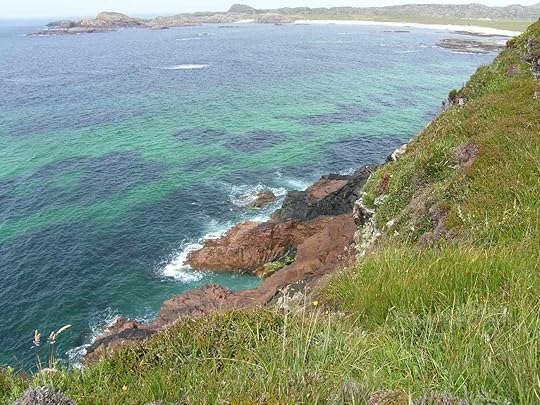
I'm not up on the history in this so I don know how accurate it is. But I do know that every place named in this book exists. We have "The Green Waters of Iona"
There's also Mull, Scotland where Ranald is from.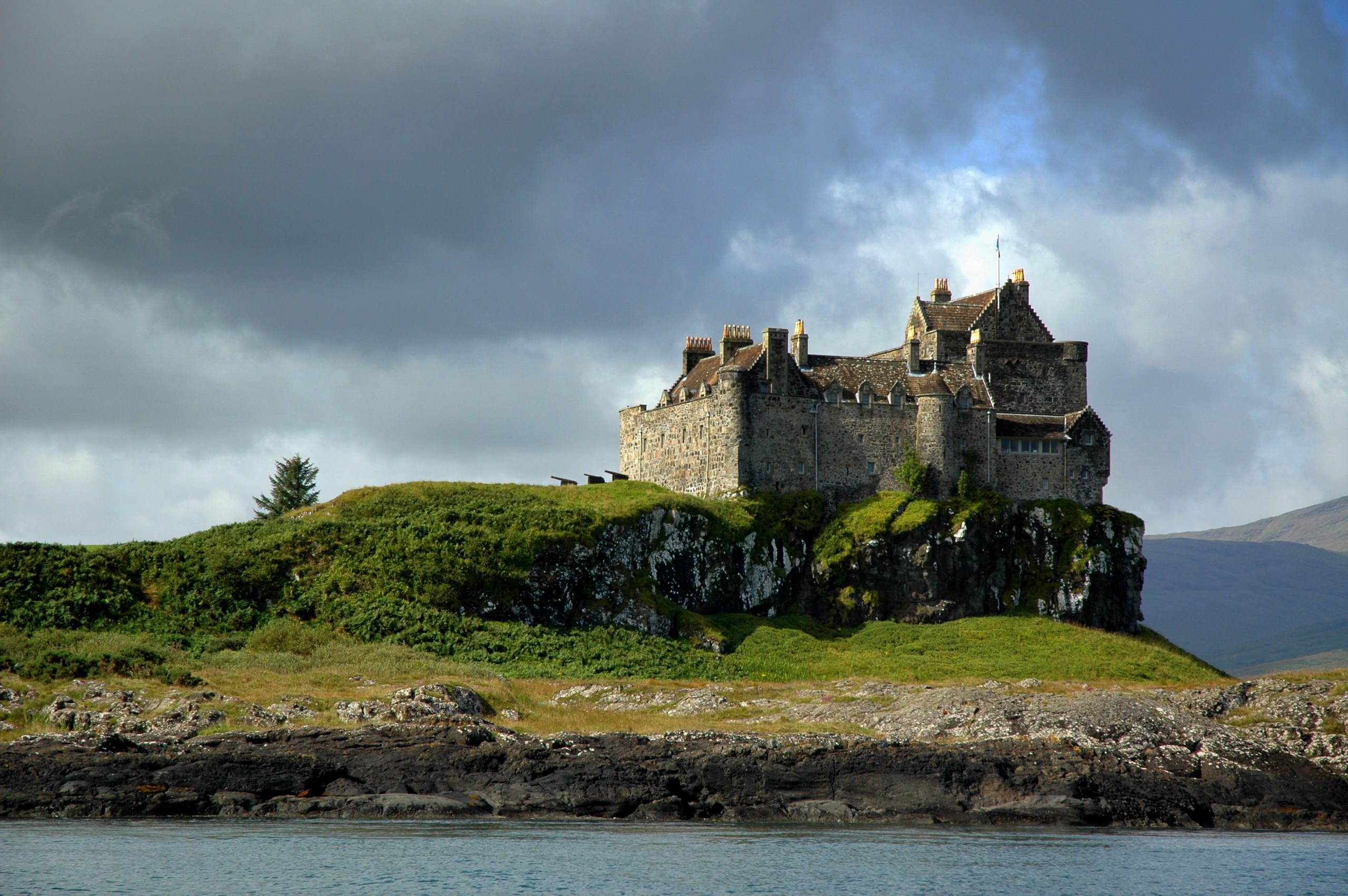
Then we have the Walsh Mountains where Martin Somers is from. While I couldn't find a picture it is a place in Ireland.
PG Some swearing, a murder, fighting and a mascare. (We aren't shown details but we do see one mascare victim, and the murdered man is strangled, though he himself was a murder, so you can't feel too sorry.
First of all, ignore the synopsis. It's kinda off. It's from my dust cover and it makes the book sound like its full of blood and guts. In actuality, while this is set during a era full of warfare, the book itself chooses not to depict the wars. The most detail we get is when someone gets an arrow through their cheeks. Otherwise we don't even go on the battlefield.
We have five main characters to remember, the others aren't too important and they will all fit into place once you start reading.
Maurteen (Martin) Somers and his foster brother Tadg Mor are Irish soldiers who have come to Scotland to fight against the highlanders, specifically the Clan Gordon from Strathbogie and the Bog-of-the-Winds and Clan Ranald with "kilted men" from the northern clans Mackenzie and Fraser. Add to that mix the Sutherlands, Forbeses, Findlaters, Roses, Chisholms and Hays and MacRae bowmen from Kintail.
Martin isn't a fighter, he's a mild man who leaves the fighting to his brother Tadg Mor. He is a surgeon and swordsman, as well as it being his duty to look after the women of the camp. (Wives, children, etc.) He tells the story with such feeling and understanding that you understand why he goes to great lengths to save Meg, a young woman who's stubbornness placed her in the stocks.
The three of them, Martin, Tadg and Meg are like siblings, Meg and Tadg teasing each other in between battles and Martin being the gentleman and the one to try and keep Tadg in line.
Róisín Ban, "Fair Rose" Meg Anderson is described in the description and she's the one who Martin and his brother find in the stocks. Partly her own fault since she went against Kirk orders, and I was really surprised to see what a hold the Kirk had on people, all except Meg. Meg was a strong woman. Period. She roped Tadg Mor into shape, told him off and always had a hand ready to smack him if he came close enough. But despite her hard exterior she was really sweet and got along with everybody, except for Rose. Those two couldn't like each other, they just couldn't.
Iseabal Rose better known as, Róisín Dhuv, who the book is named after, meaning "Little Dark Rose" is who this story is about. She doesn't even come into the scene however, till about a third of the way through. She's one of those characters you can't help but like. Yet she is bitter in many ways, she blames it on her "bad Rose blood".
She and Meg keep the camp in order when the men are in battle and maybe because they are both such strong characters they don't care for each other. Not that they are nasty, but just stiff.
I'm not up on the history in this so I don know how accurate it is. But I do know that every place named in this book exists. We have "The Green Waters of Iona"
There's also Mull, Scotland where Ranald is from.
Then we have the Walsh Mountains where Martin Somers is from. While I couldn't find a picture it is a place in Ireland.
PG Some swearing, a murder, fighting and a mascare. (We aren't shown details but we do see one mascare victim, and the murdered man is strangled, though he himself was a murder, so you can't feel too sorry.

May 29, 2024
Another great novel by Maurice Walsh which captures the spirit of the Irish War of Independence through its well-drawn characters and compelling narrative.
3* The Spanish Lady
3* Danger under the moon
3* The Hill is Mine
4* The Key above the Door
4* And No Quarter
TR The Road to Nowhere
TR While Rivers Run
3* The Spanish Lady
3* Danger under the moon
3* The Hill is Mine
4* The Key above the Door
4* And No Quarter
TR The Road to Nowhere
TR While Rivers Run

May 1, 2014
Similar to Blackcock's Feather this is a first person narrative of a middling character in a period of war. The narrator, Martin Somers is the Adjutant of Women in O'Cahan's Irish regiment that fought with James Graham, the Marquis of Montrose for the King in what is now called the Wars of the Three Kingdoms. Like Blackcock's Feather it has memorable characters and a plot of romance that takes place during battles and involves raids and other adventures.
I needed to get a Scots Dictionary to read the dialogue of this book in many places. Maurice Walsh lived in Scotland for a time and seems to use Scots authentically. It adds a lot to the dialogue and characterization of the protagonists.
In both these books, although it's clear where the narrator's, and the writer's, sympathies lie, there are noble and honourable opponents, as well as villains. In And No Quarter, Walsh argues that the women that followed Montrose's army were not fallen women as the Covenanters painted them (and then took savage pleasure in slaughtering them when they had the chance), but 'the mothers, wives, sisters, sweethearts that always followed the male of Gaeldom to war' (p. 259).
It's a long time, over thirty years now, since I read Nigel Tranter's books on Montrose. With my memory so hazy I can't really compare them, but the focus is quite different; for Tranter Montrose is the focus, whereas Walsh gives an interpretation of life during those events for more ordinary individuals (though his characters are somewhat extraordinary).
I needed to get a Scots Dictionary to read the dialogue of this book in many places. Maurice Walsh lived in Scotland for a time and seems to use Scots authentically. It adds a lot to the dialogue and characterization of the protagonists.
In both these books, although it's clear where the narrator's, and the writer's, sympathies lie, there are noble and honourable opponents, as well as villains. In And No Quarter, Walsh argues that the women that followed Montrose's army were not fallen women as the Covenanters painted them (and then took savage pleasure in slaughtering them when they had the chance), but 'the mothers, wives, sisters, sweethearts that always followed the male of Gaeldom to war' (p. 259).
It's a long time, over thirty years now, since I read Nigel Tranter's books on Montrose. With my memory so hazy I can't really compare them, but the focus is quite different; for Tranter Montrose is the focus, whereas Walsh gives an interpretation of life during those events for more ordinary individuals (though his characters are somewhat extraordinary).

October 14, 2020
Well worth the wait. I had to order an auld copy from Scotland! So much fun to read.
What a pathetic review! I've come back to fix that. This is a book of battles- real battles, and many historical figures- and romance, and love, and humor. It is fun and rousing to read- I want to go to battle and boast of my victories with wonderful exaggeration.
The writing is phenomenal, with hints and bits dropped in passing which curdle the blood as you realize what they are forewarning you about.
In the meantime, I am learning more about what these battles meant, and mourning people I never meant, and some that never existed. This is a book that both makes you sorrow for the dead and relive their memory in your mind as other characters will do in a quiet moment. This book is as good as a movie that way- images, faces, the moody nature around them.
I also mourn how much various Christian factions fought to the death, some dying horribly in history. So much hate in a faith meant to flow with Christlike love. And look at what it's done to the Irish, even.
Walsh is one of my favorite authors. I've hunted down several of his books and enjoy them to no end. His portrayal of human nature, and the Scotch and Irish and English character, and the lands they come from, is keen and deft and deeply compassionate. He is a little known artist these days, but if you come across him, take him up and listen to his story he has to tell. It's going to be a wild ride.
What a pathetic review! I've come back to fix that. This is a book of battles- real battles, and many historical figures- and romance, and love, and humor. It is fun and rousing to read- I want to go to battle and boast of my victories with wonderful exaggeration.
The writing is phenomenal, with hints and bits dropped in passing which curdle the blood as you realize what they are forewarning you about.
In the meantime, I am learning more about what these battles meant, and mourning people I never meant, and some that never existed. This is a book that both makes you sorrow for the dead and relive their memory in your mind as other characters will do in a quiet moment. This book is as good as a movie that way- images, faces, the moody nature around them.
I also mourn how much various Christian factions fought to the death, some dying horribly in history. So much hate in a faith meant to flow with Christlike love. And look at what it's done to the Irish, even.
Walsh is one of my favorite authors. I've hunted down several of his books and enjoy them to no end. His portrayal of human nature, and the Scotch and Irish and English character, and the lands they come from, is keen and deft and deeply compassionate. He is a little known artist these days, but if you come across him, take him up and listen to his story he has to tell. It's going to be a wild ride.

August 17, 2018
As mentioned elsewhere, this is a first person narrative of Montrose's 1644-1645 Scottish campaigns, told from the perspective of Martin Somers, an Englishman serving with the Irish contingent.
My mother had many of Walsh's books, so I've read most of them but this is not one of my favourites. It's an interesting period but while the battle scenes are engaging, the romantic relationships seem artificial and laboured, while the character of Somers himself is strangely hard to grasp.
In addition, this is a highly controversial portrayal of the reality of Montrose's campaign and the devastation inflicted by his army. The bitterness of the Civil War conflict in both Ireland and Scotland was certainly reflected in the Covenanter approach to their prisoners but the depredations of the Montrose's army and his Irish contingent in particular were still remembered centuries later.
In 1956, my Irish father was working near the Highland town of Inverness and went for a walk with a friend from Belfast; they went into a pub and the landlord told them 'We don't serve Irish in here.' (He may have used a few other adjectives). He specifically referenced the 1645 campaign (if you come from Belfast, bearing a grudge for something that happened 300 years before is completely normal).
Walsh was Irish but worked for the Revenue in Scotland from 1901 until 1922 when he returned to Dublin; his local knowledge is put to good use in his descriptions but makes it harder to accept the lack of reality in this. One passage in the book has the main character saying, in reference to the claim that when Irish troops sacked Aberdeen, they forced people to remove their clothes before killing them that he 'never saw any stripped and dirked bodies.' Which is hardly a denial.
My mother had many of Walsh's books, so I've read most of them but this is not one of my favourites. It's an interesting period but while the battle scenes are engaging, the romantic relationships seem artificial and laboured, while the character of Somers himself is strangely hard to grasp.
In addition, this is a highly controversial portrayal of the reality of Montrose's campaign and the devastation inflicted by his army. The bitterness of the Civil War conflict in both Ireland and Scotland was certainly reflected in the Covenanter approach to their prisoners but the depredations of the Montrose's army and his Irish contingent in particular were still remembered centuries later.
In 1956, my Irish father was working near the Highland town of Inverness and went for a walk with a friend from Belfast; they went into a pub and the landlord told them 'We don't serve Irish in here.' (He may have used a few other adjectives). He specifically referenced the 1645 campaign (if you come from Belfast, bearing a grudge for something that happened 300 years before is completely normal).
Walsh was Irish but worked for the Revenue in Scotland from 1901 until 1922 when he returned to Dublin; his local knowledge is put to good use in his descriptions but makes it harder to accept the lack of reality in this. One passage in the book has the main character saying, in reference to the claim that when Irish troops sacked Aberdeen, they forced people to remove their clothes before killing them that he 'never saw any stripped and dirked bodies.' Which is hardly a denial.

January 26, 2022
I have loved this tale since I first read it in the 70´s, THIS is a true Scottish heroic romance, brilliantly written, so profoundly human, Gaelic, heart-breaking, stirring and humorous, shed some tears when Margaret...well I will say no more. Though we are now old, Tadg Mor, Martin and I remember sometimes after a long day on the hunting trail.
IF you are romantic about old Scotland read this!
IF you are romantic about old Scotland read this!

January 8, 2023
I think a better understanding of the British Civil Wars of the times might have helped. The novel is set in the 1644-1645 Royalist campaigns in Scotland. An Englishman serving in an Irish regiment, and his foster brother, rescue two women. One dies. The three remaining characters survive the wars and live out their lives in Virginia, having left Ireland after defeat.

January 6, 2026
Enjoyable and dramatic fiction concerning warring groups in Scotland at the time of the English Civil War. The central characters were serving under Montrose and were fighting for King Charles against the Covenanters.
August 3, 2020
My grandpa loved Maurice Walsh so I’ve inherited some of his old books. I was pleasantly surprised with And No Quarter. I liked the characters and thought they had depth and felt real; the descriptions of life in a 17thC army were convincing and the divisions in Scotland at the time were enjoyable to read.
It was funny, exciting and a strong read: would definitely recommend.
It was funny, exciting and a strong read: would definitely recommend.
Displaying 1 - 9 of 9 reviews