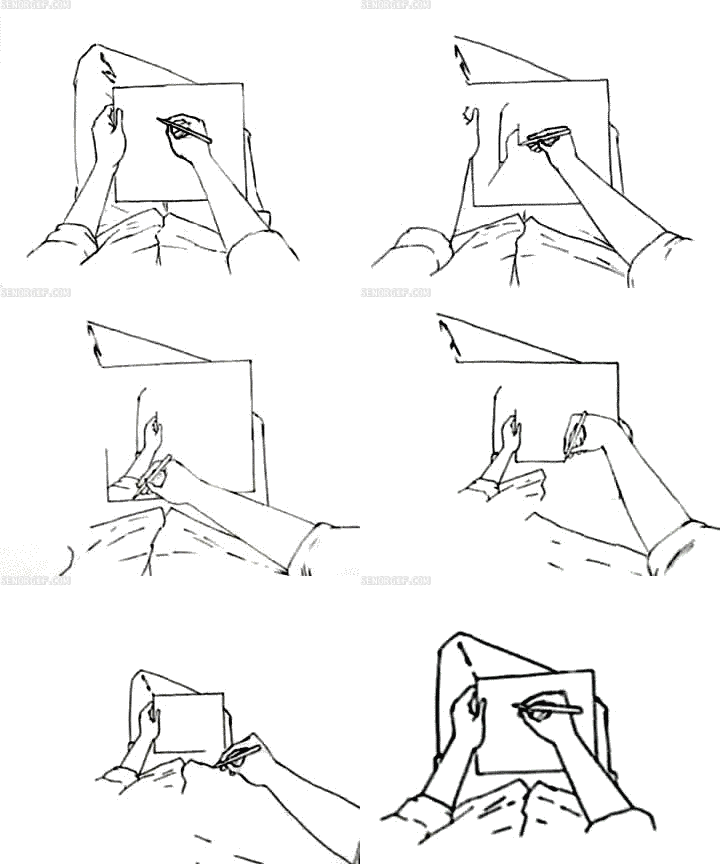
The excursion steamer brought us from Constantinople to the shore of the island of Prinkipo and we disembarked. The number of passengers was not large. There was one Polish family, a father, a mother, a daughter and her bridegroom, and then we two. Oh, yes, I must not forget that when we were already on the wooden bridge which crosses the Golden Horn to Constantinople, a Greek, a rather youthful man, joined us. He was probably an artist, judging by the portfolio he carried under his arm. Long black locks floated to his shoulders, his face was pale, and his black eyes were deeply set in their sockets. From the first moment he interested me, especially for his obligingness and for his knowledge of local conditions. But he talked too much, and I then turned away from him. All the more agreeable was the Polish family. The father and mother were good-natured, fine people, the lover a handsome young fellow, of direct and refined manners. They had come to Prinkipo to spend the summer months for the sake of the daughter, who was slightly ailing. The beautiful pale girl was either just recovering from a severe illness or else a serious disease was just fastening its hold upon her. She leaned upon her lover when she walked and very often sat down to rest, while a frequent dry little cough interrupted her whispers. Whenever she coughed, her escort would considerately pause in their walk. He always cast upon her a glance of sympathetic suffering and she would look back at him as if she would say: "It is nothing. I am happy!" They believed in health and happiness. On the recommendation of the Greek, who departed from us immediately at the pier, the family secured quarters in the hotel on the hill. The hotel-keeper was a Frenchman and his entire building was equipped comfortably and artistically, according to the French style. We breakfasted together and when the noon heat had abated somewhat we all betook ourselves to the heights, where in the grove of Siberian stone-pines we could refresh ourselves with the view. Hardly had we found a suitable spot and settled ourselves when the Greek appeared again. He greeted us lightly, looked about and seated himself only a few steps from us. He opened his portfolio and began to sketch. "I think he purposely sits with his back to the rocks so that we can't look at his sketch," I said. "We don't have to," said the young Pole. "We have enough before us to look at." After a while he added, "It seems to me he's sketching us in as a sort of background. Well--let him!" We truly did have enough to gaze at. There is not a more beautiful or more happy corner in the world than that very Prinkipo! The political martyr, Irene, contemporary of Charles the Great, lived there for a month as an exile. If I could live a month of my life there I would be happy for the memory of it for the rest of my days! I shall never forget even that one day spent at Prinkipo. The air was as clear as a diamond, so soft, so caressing, that one's whole soul swung out upon it into the distance. At the right beyond the sea projected the brown Asiatic summits; to the left in the distance purpled the steep coasts of Europe. The neighboring Chalki, one of the nine islands of the "Prince's Archipelago," rose with its cypress forests into the peaceful heights like a sorrowful dream, crowned by a great structure--an asylum for those whose minds are sick. The Sea of Marmora was but slightly ruffled and played in all colors like a sparkling opal. In the distance the sea was as white as milk, then rosy, between the two islands a glowing orange and below us it was beautifully greenish blue, like a transparent sapphire. It was resplendent in its own beauty. Nowhere were there any large ships--only two small craft flying the English flag sped along the shore.
Jan Nepomuk Neruda was a Czech journalist, writer and poet, one of the most prominent representatives of Czech Realism and a member of "the May school".
The story is set on the Island of Büyükada (Big Island)/Prinkipos (Πρίγκηπος = Prince) a few kilometres south of Istanbul in the Ottoman Empire. (Btw, this car-free Island is a beauty in RL!)
The Narrator tells us about his observations while on an excursion to the Island with a few stranger of whom one a is sickly young girl. We have her family and her lover as well as an artist which the Narrator tells us about and the events, that surrounds them.
This was a nice read with 10 pages (≈ 10 minutes). I was positively surprised by this short piece from an Austrian-Czech Gentleman of the last century. After a few minutes into it (I read while listening to it) I had a good idea about what would happen but I still enjoyed the piece as it was. You can clearly read between the words that the author was a poet AND that the translator is well versed in translating between both languages (Czech & English).
Nearly failed to answer half the questions during the UPCAT because I read this story 3 times over, memorizing it, and eventually finding it once I got home. Worth it.
Actual thoughts: There was more attention given to descriptive language than there was to the plot itself; so when the ending came, it came with a force strong enough to shock but not one strong enough to make perfect sense. Still, I enjoyed reading this one during the test, and I still do.
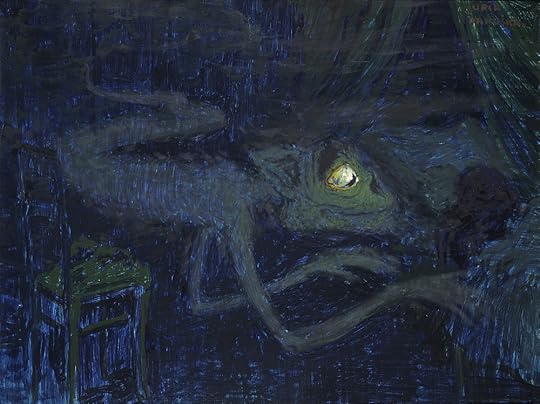
While I was reading, I wondered what kind of vampire the story is talking about. And perhaps this is the very fascination of this short story set on an island near Constantinople. I heard about the story when I read that Jaroslav Panuska drew inspiration from Neruda’s tale for his painting of the same name, where he draws the spirit “with amorphous, elongated, changeable faces, both human and animal” (arte e magia - Rovigo 2018 - Exhibition Catalogue). A very short story, just four pages, downloadable for free on the Internet, and worth reading.
Very short. The author spends more time describing the scenery than attacking the plot line. The title is more than a bit deceiving. This is not a story about a vampire, but rather about a morbid character whom the locals nicknamed "The Vampire".
En el momento que muere la chica logra crear muy buena atmosfera de tensión pero me quedó la sensación que falto algo más, además que como tal no salió la figura del vampiro
This entire review has been hidden because of spoilers.
The English translation of this 1871 story first appeared in 1920. I wonder if it is a mistranslation; the man is referred to as a vampire and a vulture.
But it is rather creepy, but I keep thinking about it. I have so many questions.
3 stars
is it a 'gift', like the cat in the palliative care unit that sits with the next to die. Is he painting people he drained earlier waiting for their life to run out, as it were. Is he a distance vampire?
🔔The waters of the Sea of Marmora were only slightly ruffled, and played in all colours like a sparkling opal. In the distance was the ocean, white as milk, then rose-tinted, then between two islands like a glowing orange, and beneath us of a beautiful greenish-blue like a transparent sapphire. It was alone in its beauty; no large vessels were to be seen. Only two email craft with English flags were slipping along hard by the shore. One was a steam-boat, the size of a watchman's booth, the other was manned by about twelve rowers, and when all their oars were lifted at the same time, it was as if molten silver were trickling from them. Artless dolphins were moving in their midst, and flew in long curves above the surface of the water. From time to time across the blue sky peaceful eagles soared, measuring out a boundary between two portions of the world
3.5 A strange occurrence during a vacation in the Greek islands. Amongst the travelers is an interesting young man, who appears to be an artist because he carries a portfolio with him. It turns out that the locals call him The Vampire. Originally published in Czech in 1871 and finally translated into English in 1920. I liked it, but I wish it had been longer.
This is one of those stories where all the Real Action of the Narrative is going on in the Background.
The Author distracts Our Attention by focusing Our Viewpoint on the Description of the beautiful surroundings and scenery of the Island of Prinkipo. And by Describing the Pleasants Feelings of the Narrator and the Polish Family, and how Happy and Content They feel dispite the state of Covelescence the Daughter is in.
Meanwhile, in the Background the Greek Artist is busy sketching.....A man who is described as having "Long black locks [that] floated to his shoulders, his face was pale, and his black eyes were deeply set in their sockets."
Hmmm...sounds like a Vampire to Me....
" "An artist?" "Fine trade! He sketches only corpses. Just as soon as someone in Constantinople or here in the neighborhood dies, that very day he has a picture of the dead one completed. That fellow paints them beforehand--and he never makes a mistake--just like a vulture!" "
Well maybe He's not a Blood Sucker but He certainly is a Vampire in the traditional sense in that He can Suck the Life Force out of a Person.
The Polish Daughter is interesting in Her covelescence. She sounds like She either has already been bitten by a Vampire, or has TB, which was often inferred to be an Illness caused by the Bite of a Vampire.
As for the Sketch made by the Greek Artist....there an Old Idea in Folklore that an Image Captures a Person's Vital Essence. To have One's Likeness fixed permantly in an object gives an Outsider Domination over Their Vital Life Force.
And...A Mrtyle Wreath can signify a Hope for Eternal Life and a Blessed Afterlife. Which kind of sounds a bit like being a Vampire....in the Romantic sense I guess.
This is such a Short, Little Story yet there is so, so much going on in the Background. It's actually a well-crafted, compact piece of writing.
The Vampire, Jan Neruda (1834-1891), Czech. “The air was as clear as a diamond, so soft, so caressing, that one’s whole soul swung upon it into the distance.” Delightful conditions of the Turkish island of Prinkipo. Cool story of a young Greek artist .. the vampire. ***
I really liked this short story :) the descriptions of the setting, Prinkipo are just beautiful and while the man isn't actually a vampire he still truly embodies the essence of the monster. That's my interpretation. 👍 5/5 stars
"..paints them beforehand--and he never makes a mistake--just like a vulture!"
short story, too short perhaps, beautifully painted by Jan, ...en fin, he, called the vampire, who is not one, in fact, but a painter, sketches the doomed beforehand and completes on the very same day they die, as if prophesying.
Short horror story depicting an artist who can predict death. A group of tourists vacation on the island of Prinkipo. A strange artist in the group has a rare talent of painting people who die within a short time after their portraits are finished. A spooky short story perfect for Halloween!