

What do you think?

The Pacific Circuit: A Globalized Account of the Battle for the Soul of an American City
The NPR host Alexis Madrigal reveals how the Port of Oakland explains the world.
In Pacific Circuit, the award-winning journalist Alexis Madrigal sculpts an intricate tableau of the city of Oakland that is at once a groundbreaking big-idea book, a deeply researched work of social and political history, and an intimate portrait of an essential American city that has been at the crossroads of the defining themes of the twenty-first century.
Oakland’s stories encompass everything from Silicon Valley’s prominence and the ramifications of a compulsively digital future to the underestimated costs of technological innovation on local communities—all personified in this changing landscape for the city’s lifelong inhabitants.
Pacific Circuit holds a magnifying glass to the scars etched by generations of systemic segregation and the ceaseless march of technological advancement. These are not just abstract concepts; they are embedded in the very fabric of Oakland and its people, from dockworkers and community organizers to real estate developers and businesses chasing the highest possible profits. Madrigal delves into city hall politics, traces the intertwining arcs of venture capital and hedge funds, and offers unprecedented insight into Silicon Valley’s genesis and growth, all against the backdrop of Oakland—a city vibrating with untold stories and unexplored connections that can, when read carefully, reveal exactly how our markets and our world really function.
In Pacific Circuit, the award-winning journalist Alexis Madrigal sculpts an intricate tableau of the city of Oakland that is at once a groundbreaking big-idea book, a deeply researched work of social and political history, and an intimate portrait of an essential American city that has been at the crossroads of the defining themes of the twenty-first century.
Oakland’s stories encompass everything from Silicon Valley’s prominence and the ramifications of a compulsively digital future to the underestimated costs of technological innovation on local communities—all personified in this changing landscape for the city’s lifelong inhabitants.
Pacific Circuit holds a magnifying glass to the scars etched by generations of systemic segregation and the ceaseless march of technological advancement. These are not just abstract concepts; they are embedded in the very fabric of Oakland and its people, from dockworkers and community organizers to real estate developers and businesses chasing the highest possible profits. Madrigal delves into city hall politics, traces the intertwining arcs of venture capital and hedge funds, and offers unprecedented insight into Silicon Valley’s genesis and growth, all against the backdrop of Oakland—a city vibrating with untold stories and unexplored connections that can, when read carefully, reveal exactly how our markets and our world really function.
386 pages, Kindle Edition
First published March 18, 2025
Ratings & Reviews
Friends & Following
Create a free account to discover what your friends think of this book!
Community Reviews
Displaying 1 - 30 of 58 reviews

July 17, 2025
I am from Oakland so I loved reading about my city. Anyone who gives time and consideration to The Town is thrilling to me. This book is interesting on a lot of levels, if not a touch confusing in spots. Its is ambitious but doesn't always land the plane, and I found myself confused at times. But overall I did appreciate the effort to craft a story about a place that incorporated race, industry, climate, tech, and so much more.

July 7, 2025
“A Globalized Account of the Battle for the Soul of an American City”. Ok, sure, but that subtitle seems to be overselling what’s actually here a bit. What it is is a good piece of journalism and storytelling; the history of West Oakland, with a focus on the stories of some of the key players, in particular Ms Margaret, a central figure in West Oakland’s environmental justice movement. It’s an interesting and important and unique story; well told. A good book and I enjoyed it and would recommend it.
But… there’s a lot I don’t really agree with as well. The underlying theme of the book, provided up front as a given, is that rampant Capitalism and Globalism are pernicious forces destroying communities and exploiting workers. So, in defense of free trade and globalization: a) despite the title, “pacific circuit”, there isn’t really any space devoted to the impacts of globalized trade on the Asian countries, i.e. that hundreds of millions of people have been lifted out of poverty due to the resulting economic development (by pretty much any measure of poverty you want to use); the greatest increase in living standards in history. Yes, trade has winners and losers, and a focus on communities that have been adversely impacted is very important… but to completely ignore the macro net benefits seems like a pretty huge oversight. b) On prices (and housing): a central theme of the book is that the globalized trade network and the interrelated tech industry in the area is driving up costs and making things unaffordable for local residents. The flood of cheap products coming from Asia is given as a negative (presumably also destroying local communities’ character?). But cheap consumer goods make all of us richer (e.g. dollars spent on food and clothing as percentage of total income), which, in fact, benefits poor people more as the proportion of their income spent on those items is greater than the wealthy. Somewhat ironically, what has not decreased in price (increased, rather) is the amount we pay for housing. This is one specific product unable to be mass produced and shipped over from Asia, and has not been allowed to be produced in greater quantities due to local pushback (nimbyism in its varied forms, but ultimately from the community up). This is something that can’t all be blamed on evil capitalists, though that doesn’t stop the author from trying to make that leap. Are cities dying because of globalization and capitalism, or are cities too expensive because demand to live there is high and no new housing is getting built to accommodate that demand? c) Minor quibbles: for all the attention to urban problems and homelessness, not a single mention of the fentanyl crisis. For all the attention given to the environmental justice aspect of the proposed coal shipping terminal, and the important work in data gathering from the local community, we are never provided with that data showing the issues (not that I don’t believe the reality of the problem, but it is a weird omission).
To be clear, I am very much a bleeding heart liberal: strong social safety nets, strong environmental regulation, investing in local communities… all things I’m very much in favor of. But working in the environmental sector, including remediation projects similar to those in the book, I am somewhat soured on community input. Let scientists and technocrats do their jobs. Community concerns should certainly be listened to, but too often projects, including ones cleaning up contamination, are derailed through a few obstinate individuals representing “the community”. Similarly, living in SF, in a community that was ~40% black in the ‘70s and now under 2%, displacement through lack of available housing is a far greater concern than “wealthy speculators, large companies, and absentee landlords” and the tech industry driving “gentrification”. The book liberally quotes from Huey Newton and other radical leftists, but urban economists with expertise in the subject are conspicuously absent.
While I personally agree with the author in his skepticism of technological changes to society and the tech industry in the Bay area, it’s all a bit “old man yells at clouds”. Technological progress and change have been the rule not the exception (and with AI that’s going to speed up considerably). As with tech changes in the past there will inevitably be positive and negative impacts, but on the whole there’s probably a better case to be made for net good to society and humanity. Community can persist in the face of such changes.
Finally, the overall tone of the book is seemingly written from the perspective of the end of the pandemic, Biden, and BLM movement era (without ever mentioning it directly, strangely), containing a sense of hope that things can be done and progress can be made, not yet contending that the world we live in in now—Trump admin two—is a whole new awful on every dimension of racial justice, environmental health, and human dignity. Well, at least Trump is taking on global trade and the pacific circuit through his blunt and meaningless application of tariffs. The author should be happy about that, at least.
But… there’s a lot I don’t really agree with as well. The underlying theme of the book, provided up front as a given, is that rampant Capitalism and Globalism are pernicious forces destroying communities and exploiting workers. So, in defense of free trade and globalization: a) despite the title, “pacific circuit”, there isn’t really any space devoted to the impacts of globalized trade on the Asian countries, i.e. that hundreds of millions of people have been lifted out of poverty due to the resulting economic development (by pretty much any measure of poverty you want to use); the greatest increase in living standards in history. Yes, trade has winners and losers, and a focus on communities that have been adversely impacted is very important… but to completely ignore the macro net benefits seems like a pretty huge oversight. b) On prices (and housing): a central theme of the book is that the globalized trade network and the interrelated tech industry in the area is driving up costs and making things unaffordable for local residents. The flood of cheap products coming from Asia is given as a negative (presumably also destroying local communities’ character?). But cheap consumer goods make all of us richer (e.g. dollars spent on food and clothing as percentage of total income), which, in fact, benefits poor people more as the proportion of their income spent on those items is greater than the wealthy. Somewhat ironically, what has not decreased in price (increased, rather) is the amount we pay for housing. This is one specific product unable to be mass produced and shipped over from Asia, and has not been allowed to be produced in greater quantities due to local pushback (nimbyism in its varied forms, but ultimately from the community up). This is something that can’t all be blamed on evil capitalists, though that doesn’t stop the author from trying to make that leap. Are cities dying because of globalization and capitalism, or are cities too expensive because demand to live there is high and no new housing is getting built to accommodate that demand? c) Minor quibbles: for all the attention to urban problems and homelessness, not a single mention of the fentanyl crisis. For all the attention given to the environmental justice aspect of the proposed coal shipping terminal, and the important work in data gathering from the local community, we are never provided with that data showing the issues (not that I don’t believe the reality of the problem, but it is a weird omission).
To be clear, I am very much a bleeding heart liberal: strong social safety nets, strong environmental regulation, investing in local communities… all things I’m very much in favor of. But working in the environmental sector, including remediation projects similar to those in the book, I am somewhat soured on community input. Let scientists and technocrats do their jobs. Community concerns should certainly be listened to, but too often projects, including ones cleaning up contamination, are derailed through a few obstinate individuals representing “the community”. Similarly, living in SF, in a community that was ~40% black in the ‘70s and now under 2%, displacement through lack of available housing is a far greater concern than “wealthy speculators, large companies, and absentee landlords” and the tech industry driving “gentrification”. The book liberally quotes from Huey Newton and other radical leftists, but urban economists with expertise in the subject are conspicuously absent.
While I personally agree with the author in his skepticism of technological changes to society and the tech industry in the Bay area, it’s all a bit “old man yells at clouds”. Technological progress and change have been the rule not the exception (and with AI that’s going to speed up considerably). As with tech changes in the past there will inevitably be positive and negative impacts, but on the whole there’s probably a better case to be made for net good to society and humanity. Community can persist in the face of such changes.
Finally, the overall tone of the book is seemingly written from the perspective of the end of the pandemic, Biden, and BLM movement era (without ever mentioning it directly, strangely), containing a sense of hope that things can be done and progress can be made, not yet contending that the world we live in in now—Trump admin two—is a whole new awful on every dimension of racial justice, environmental health, and human dignity. Well, at least Trump is taking on global trade and the pacific circuit through his blunt and meaningless application of tariffs. The author should be happy about that, at least.

April 22, 2025
Really enjoyed this, and it continues to make me think Big Thoughts about life and community.

July 22, 2025
The scope of the research that went into this was incredible! Recommend if you're interested in Bay Area history or logistics infrastructure.
November 3, 2025
The content here is very important: the Pacific Circuit, how containerization and the shipment of goods from Asia to Oakland shaped the latter, controlled by the Silicon Valley technology, and which all began, really, with the Korean War and the shipment of weapons and military goods: “The technologies that generated the vast fortunes of the (Silicon) valley nearly all trace their roots back to military funding, needs, or inspiration.” Also makes sense why currently from Oakland port and airport are where mass amounts of weapons and supplies are being shipped to Israel as well…
Intertwined within the Pacific Circuit, are the themes of capitalism, environmental detriment, gentrification, racism, imperialism, exploitation, etc: “Most important for our story, the Pacific Circuit relentlessly externalizes environmental costs into environmental sacrifice zones both in Asia and the United States. That has generated enormous problems for the health of people across the world, and specifically in West Oakland. Their bodies have been knowingly polluted in exchange for economic growth that benefits a small subset of people.”
I would recommend this book to people as it is extremely informative and touches on a topic that I feel like not many people talk about. I certainly learned a lot from this book. But I felt that there was a LOT of filler and fluff that didn’t need to be there and the book could have been 100 pages shorter IMO. I can see how some people would appreciate Madrigal’s writing style and his attempt to personalize the book by inserting his own personal relationship with Oakland and its communities. However I felt that it made it more difficult to extract his main theses sometimes and I lost the plot at times. Still overall a book worth reading for sure
Intertwined within the Pacific Circuit, are the themes of capitalism, environmental detriment, gentrification, racism, imperialism, exploitation, etc: “Most important for our story, the Pacific Circuit relentlessly externalizes environmental costs into environmental sacrifice zones both in Asia and the United States. That has generated enormous problems for the health of people across the world, and specifically in West Oakland. Their bodies have been knowingly polluted in exchange for economic growth that benefits a small subset of people.”
I would recommend this book to people as it is extremely informative and touches on a topic that I feel like not many people talk about. I certainly learned a lot from this book. But I felt that there was a LOT of filler and fluff that didn’t need to be there and the book could have been 100 pages shorter IMO. I can see how some people would appreciate Madrigal’s writing style and his attempt to personalize the book by inserting his own personal relationship with Oakland and its communities. However I felt that it made it more difficult to extract his main theses sometimes and I lost the plot at times. Still overall a book worth reading for sure

Read
August 26, 2025listened to this audiobook over the course of various transit journeys around the east bay appropriately. ultimately about how the relationships between people caring for place on the most local level have to be the starting point for making a livable world out of this moment where "everything happens but nothing can be done," given how global supply chains diffuse responsibility and externalize costs in ways that trouble traditional models of organizing, which also explains some tensions between labor and environmental organizing surrounding the port of oakland. i'm interested in but still a bit skeptical of the suggestion that the logic of the pacific circuit, with its tendency towards scale and flow, can be repurposed towards a more just and equitable city, but isn't that the also just the premise of any kind of international/intercommunal solidarity in this moment? and can there be a city beyond capitalism? i think its tremendously effective in grounding the city's global/transpacific history and present in the life and work of margaret gordon, among other characters, and in resituating more familiar histories of redlining, urban renewal, and third worldist social movements within the increasingly complex interweavings of military infrastructure and logistics

July 29, 2026
This book so badly needed to be cut down.
Coming right off the back of California: An American History, one, might I add, that has a real focus on legislative impacts on marginalized communities, I was ready for a book that focused on the Bay Area. And The Pacific Circuit is so up-to-date too! It came out in the last year, written by a journalist based right here in the Bay. A man who spent the past 9 years researching and returning to West Oakland to write this story. So what's the problem?
To put it in Silicon Valley terms, the books shows signs of feature creep: what may have started off with a clear premise - how the shipping industry has shaped a predominantly black neighborhood and led to poverty in one of the most affluent parts of America - reads as muddled.
And it's a shame because I enjoyed the first 50 pages or so. Where we discuss "the theory of liquid modernity: anything can happen and nothing can be done", systemic redlining based on a misapplied theory of plan ecology to city planning, "pollution as policy" and using the highway to actively segregate. Really interesting, new-to-me factoids - before we've even broached the subject of containers!
But even here there were signs that this wasn't the book it was blurbed to be. The opening chapter follows our narrator around an aging activist's birthday party in a campaign trailer under 880. I read this carefully, surely this friend of the author would end up being a significant character in Oakland's history of shipping. The more I read, however, the more I was concerned at the level of personal detail about people I had no reason to care about, self-insertion of the journalist, and honestly the lack of real content. I had picked up a book about containers and the city of Oakland - this personal profile wasn't what I was expecting. And I was right to be suspicious, Ms Margaret has nothing to do with the Pacific Circuit. Instead she is a central character in Madrigal's true subject of the book: systemic racism in Oakland.
I moved to the Bay Area around 15 years ago and over and over I'd be warned about Fruitvale, West Oakland, large swathes of downtown. I was always confused - given the run-down nature of large parts of these neighborhoods, the crime, the general ambience - how it had gotten so bad surrounded by so much commerce and higher education and technology?
This book's true focus is just this: how Oakland was systemically shaped by the government to build the military industrial complex, how black communities were dismantled by the very same government, and then how the city was abandoned to redlined, toxic neighborhoods near the industrial core.
Which is itself a troubling and fascinating story.
But Madrigal doesn't commit. The, genuinely interesting, politics and history of this "blighted" city is sidelined to saccharine emotional stories and commentary that detract from the facts.
Ms Margaret, for example, makes frequent appearances as the book progresses. Sometimes, this is to great effect:
But often the level of personal detail involved feels intrusive, despite Madrigal assuring us she has agreed to it, and .. irrelevant. Around halfway through the book, in a chapter entitled Trauma we learn that she lost custody of her son to the state because of physical abuse. Madrigal even finds and reprints the charges from the casefile. Madrigal:
If Madrigal is using Margaret as his example to chart the life and times of a West Oakland resident, including the ugly parts, why does he feel the need to insert his own commentary here? Let the facts stand as they are: Ms Margaret is a passionate advocate for social welfare and she made mistakes, viscious ones, at home. This passage feels like Magrigal is trying to justify violence, to get the reader back on Ms Margaret's side before continuing on with the rest of her story. I don't think it's necessary. Why, also, do we need his justification for being distressed by child abuse and so much info about his life?
Why is any of this in a book about the Pacific Circuit??
Ok, ok, let's say we accept that the Pacific Circuit is actually the subtitle to the true subject of the book: an activist's history of West Oakland. In that case, the focus on neighborhoods and Ms Margaret makes sense. But even with that framing the book has issues. My biggest gripe is the instances of editorializing that hyperbolize the very real racism this community has faced. For example,
Oh because people of color didn't vote for prop 13? This line is from a chapter that omits any further information about prop 13, ironically I learned far more about that bill in California: An American History. This book fails to mention that this was one of the most widely supported bills ever to be passed in the state and that it was intended to stop low income workers being priced out of their, already-purchased, homes. Leaving that out of the book, not providing context for why the bill was so widely supported at all, feels intentional: to make out that prop 13 was rooted in racism. Unlike redlining - which absolutely was segregation disguised as city planning - there was good intention behind prop 13 and framing it as otherwise creates doubt in the reader about other such cases that are presented. Why not talk about prop 13 as a lesson in unintended consequences and that good intentions aren't enough on a broken foundation? That legislature can't add bandaids to fundamental inequalities from prior policy? That would have been a narrative that felt less disingenuous.
Similarly I find passages like this to be patronizing:
As someone from another country.. no Madrigal, most other developed countries are not this degraded. Yes, there are cool parts to Oakland and, yes, the Bay Area is beautiful despite how overcrowded and industrial it is but, no actually, climatically and otherwise, most developed countries are significantly better off.
The Bay Area benefits from things it has no control over: the fog from the ocean, the fantastic Pacific current, its moderate climate, the winds that blow the pollution away. But, climatically and otherwise, most other 1st world countries give a lot more of a shit than Oakland's city council about their people and create a safe place for them to live. Minimizing that is.. undercutting your own book.
You notice that most of this review is not about shipping. That's because most of this book is not about shipping.
It's also not a good history of Oakland: all at once too focused on individuals and lacking a big picture perspective.
Your mileage on enjoying the book may vary. If you are someone who has a deep fondness for biography and immersion journalism you'll probably enjoy this. Personally I want my facts and feelings very distinct, especially with such impactful topics.
Sad to have not enjoyed this. Grateful for the few tidbits that were imparted.
Go check out Oakland and the East Bay's current struggle against Tagami Coal.
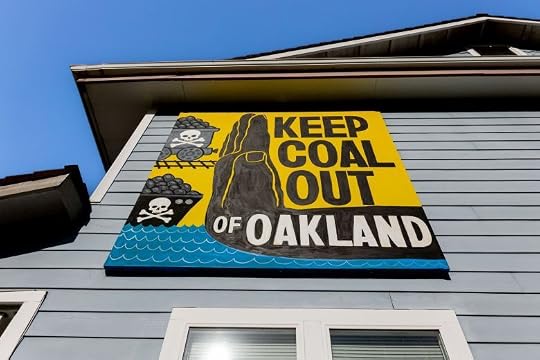
Coming right off the back of California: An American History, one, might I add, that has a real focus on legislative impacts on marginalized communities, I was ready for a book that focused on the Bay Area. And The Pacific Circuit is so up-to-date too! It came out in the last year, written by a journalist based right here in the Bay. A man who spent the past 9 years researching and returning to West Oakland to write this story. So what's the problem?
To put it in Silicon Valley terms, the books shows signs of feature creep: what may have started off with a clear premise - how the shipping industry has shaped a predominantly black neighborhood and led to poverty in one of the most affluent parts of America - reads as muddled.
And it's a shame because I enjoyed the first 50 pages or so. Where we discuss "the theory of liquid modernity: anything can happen and nothing can be done", systemic redlining based on a misapplied theory of plan ecology to city planning, "pollution as policy" and using the highway to actively segregate. Really interesting, new-to-me factoids - before we've even broached the subject of containers!
But even here there were signs that this wasn't the book it was blurbed to be. The opening chapter follows our narrator around an aging activist's birthday party in a campaign trailer under 880. I read this carefully, surely this friend of the author would end up being a significant character in Oakland's history of shipping. The more I read, however, the more I was concerned at the level of personal detail about people I had no reason to care about, self-insertion of the journalist, and honestly the lack of real content. I had picked up a book about containers and the city of Oakland - this personal profile wasn't what I was expecting. And I was right to be suspicious, Ms Margaret has nothing to do with the Pacific Circuit. Instead she is a central character in Madrigal's true subject of the book: systemic racism in Oakland.
I moved to the Bay Area around 15 years ago and over and over I'd be warned about Fruitvale, West Oakland, large swathes of downtown. I was always confused - given the run-down nature of large parts of these neighborhoods, the crime, the general ambience - how it had gotten so bad surrounded by so much commerce and higher education and technology?
This book's true focus is just this: how Oakland was systemically shaped by the government to build the military industrial complex, how black communities were dismantled by the very same government, and then how the city was abandoned to redlined, toxic neighborhoods near the industrial core.
Which is itself a troubling and fascinating story.
But Madrigal doesn't commit. The, genuinely interesting, politics and history of this "blighted" city is sidelined to saccharine emotional stories and commentary that detract from the facts.
Ms Margaret, for example, makes frequent appearances as the book progresses. Sometimes, this is to great effect:
She had made some bad decisions, as she acknowledges, but it's hard not to wondere how much of her difficulties had to go with the negative impact of the American government on her life.
By the time she was twenty years old, every place Margaret had ever lived had been deeply impacted by the state.
The place she was born? Bulldozed.
The place her family purchased in Ingleside? Bulldozed.
Her home in the projects? Already falling apart and filled with rats.
But often the level of personal detail involved feels intrusive, despite Madrigal assuring us she has agreed to it, and .. irrelevant. Around halfway through the book, in a chapter entitled Trauma we learn that she lost custody of her son to the state because of physical abuse. Madrigal even finds and reprints the charges from the casefile. Madrigal:
Margaret had told me what happened, but as I looked at the words there in black and white, I felt a sickness descend on me. I could not help but see Margaret standing over her son, a child, raining blows down on him. Both my parents were abused by their parents. The though of my own kids getting hurt is physically unbearable to me.
But how could I judge? I knew nothing of what it was to send a Black boy into the Oakland strerets at the peak of the crack crisis. Violence was everywhere.
If Madrigal is using Margaret as his example to chart the life and times of a West Oakland resident, including the ugly parts, why does he feel the need to insert his own commentary here? Let the facts stand as they are: Ms Margaret is a passionate advocate for social welfare and she made mistakes, viscious ones, at home. This passage feels like Magrigal is trying to justify violence, to get the reader back on Ms Margaret's side before continuing on with the rest of her story. I don't think it's necessary. Why, also, do we need his justification for being distressed by child abuse and so much info about his life?
Why is any of this in a book about the Pacific Circuit??
Ok, ok, let's say we accept that the Pacific Circuit is actually the subtitle to the true subject of the book: an activist's history of West Oakland. In that case, the focus on neighborhoods and Ms Margaret makes sense. But even with that framing the book has issues. My biggest gripe is the instances of editorializing that hyperbolize the very real racism this community has faced. For example,
Proposition 13 was white folks' message to us that we're going to have to do it ourselves.
Oh because people of color didn't vote for prop 13? This line is from a chapter that omits any further information about prop 13, ironically I learned far more about that bill in California: An American History. This book fails to mention that this was one of the most widely supported bills ever to be passed in the state and that it was intended to stop low income workers being priced out of their, already-purchased, homes. Leaving that out of the book, not providing context for why the bill was so widely supported at all, feels intentional: to make out that prop 13 was rooted in racism. Unlike redlining - which absolutely was segregation disguised as city planning - there was good intention behind prop 13 and framing it as otherwise creates doubt in the reader about other such cases that are presented. Why not talk about prop 13 as a lesson in unintended consequences and that good intentions aren't enough on a broken foundation? That legislature can't add bandaids to fundamental inequalities from prior policy? That would have been a narrative that felt less disingenuous.
Similarly I find passages like this to be patronizing:
But in parts of Oakland, the history embedded in the ground in the form of pollution can hurt you. The air gives your kids asthma. The water is not for swimming.
A perspective level up, the whole planet, climatically and otherwise is a degraded place.
As someone from another country.. no Madrigal, most other developed countries are not this degraded. Yes, there are cool parts to Oakland and, yes, the Bay Area is beautiful despite how overcrowded and industrial it is but, no actually, climatically and otherwise, most developed countries are significantly better off.
The Bay Area benefits from things it has no control over: the fog from the ocean, the fantastic Pacific current, its moderate climate, the winds that blow the pollution away. But, climatically and otherwise, most other 1st world countries give a lot more of a shit than Oakland's city council about their people and create a safe place for them to live. Minimizing that is.. undercutting your own book.
You notice that most of this review is not about shipping. That's because most of this book is not about shipping.
It's also not a good history of Oakland: all at once too focused on individuals and lacking a big picture perspective.
Your mileage on enjoying the book may vary. If you are someone who has a deep fondness for biography and immersion journalism you'll probably enjoy this. Personally I want my facts and feelings very distinct, especially with such impactful topics.
Sad to have not enjoyed this. Grateful for the few tidbits that were imparted.
Go check out Oakland and the East Bay's current struggle against Tagami Coal.

November 12, 2025
Rating: 4.5/10
I'll be honest, this was the most disengaging book I've read all year. And I'm annoyed. I was excited to read it and learn more about our sister city but instead was distracted by the book's total lack of organization. Starting off with city planning, politics, then racism, blighted neighborhoods, racism again, subprime loans, the BART, environmental collective, then a paragraph describing his meal??? Then mention of Japanese immigrants, pollution, seafarers, and the list of randomness goes on. If there is anything to be learned from this book, it's how NOT to write. What this book failed to accomplish compared to comparable pieces of the same genre like Braiding Sweetgrass, Thinking Fast and Slow, The Omnivore's Dilemma, and so on, was it took on a mile-wide inch-deep approach that was wholly unsatisfactory. Tell me more about the Japanese immigrants who came here. Tell me the symptoms of truck pollution through the stories of people you met. SLOW DOWN. The book lacked contiguous anecdotes from his subjects that would have been incredibly powerful and revealing. Instead, what we got were short, shallow, and oftentimes irrelevant details feigning introspection and a string of topics that moved at schizophrenic pace.
I was honestly losing patience reading this book towards the second half and only forced myself to finish it out of obligation as a Bay Area resident and my sunken commitment in the first half.
I'll be honest, this was the most disengaging book I've read all year. And I'm annoyed. I was excited to read it and learn more about our sister city but instead was distracted by the book's total lack of organization. Starting off with city planning, politics, then racism, blighted neighborhoods, racism again, subprime loans, the BART, environmental collective, then a paragraph describing his meal??? Then mention of Japanese immigrants, pollution, seafarers, and the list of randomness goes on. If there is anything to be learned from this book, it's how NOT to write. What this book failed to accomplish compared to comparable pieces of the same genre like Braiding Sweetgrass, Thinking Fast and Slow, The Omnivore's Dilemma, and so on, was it took on a mile-wide inch-deep approach that was wholly unsatisfactory. Tell me more about the Japanese immigrants who came here. Tell me the symptoms of truck pollution through the stories of people you met. SLOW DOWN. The book lacked contiguous anecdotes from his subjects that would have been incredibly powerful and revealing. Instead, what we got were short, shallow, and oftentimes irrelevant details feigning introspection and a string of topics that moved at schizophrenic pace.
I was honestly losing patience reading this book towards the second half and only forced myself to finish it out of obligation as a Bay Area resident and my sunken commitment in the first half.

Read
July 1, 2025quite good!!
i love a book that helps you make sense of where you are. it can be easy to discuss the contradictions of the bay area in the abstract (it's ultimately a crisis of capitalism, after all!) but harder is articulating how the machinations of capital make landfall. in telling the story of several community organizers, but mostly the incredible Ms. Margaret, the book illustrates contemporary West Oakland via the near-incomprehensible global currents that have dispossessed the neighbors of their property, health, and agency for decades, and the incredible stories of resistance that have brought the unknowable, and ostensibly unstoppable, down the earth.
lots of awesome theoretical grounding: huey newton on technology, hardt and negri's empire (shoutout geography 112), not one mention of drumpf. i almost love the conclusion, but he does take a "well maybe capitalism can serve us, just not *our* variety of capitalism" spin at the end. overall really appreciated the way this book took something very abstract and made it feel very real, and shed new light on the place i live and love.
i love a book that helps you make sense of where you are. it can be easy to discuss the contradictions of the bay area in the abstract (it's ultimately a crisis of capitalism, after all!) but harder is articulating how the machinations of capital make landfall. in telling the story of several community organizers, but mostly the incredible Ms. Margaret, the book illustrates contemporary West Oakland via the near-incomprehensible global currents that have dispossessed the neighbors of their property, health, and agency for decades, and the incredible stories of resistance that have brought the unknowable, and ostensibly unstoppable, down the earth.
lots of awesome theoretical grounding: huey newton on technology, hardt and negri's empire (shoutout geography 112), not one mention of drumpf. i almost love the conclusion, but he does take a "well maybe capitalism can serve us, just not *our* variety of capitalism" spin at the end. overall really appreciated the way this book took something very abstract and made it feel very real, and shed new light on the place i live and love.

January 1, 2026
Give me a compelling story about containers and I'll give you my heart. Required reading for everyone living or working in Oakland. (Or the Bay Area...or the US....or.....)
I finished reading this while on a bullet train in Japan which was more appropos than I realized when I made the decision to bring a hardback nonfiction book with me on vacation.
Seriously so good and so readable and I'm excited to read it again.
I finished reading this while on a bullet train in Japan which was more appropos than I realized when I made the decision to bring a hardback nonfiction book with me on vacation.
Seriously so good and so readable and I'm excited to read it again.

September 5, 2026
God this book is beautiful. I love Oakland and Alexis’ reporting and his ability to wrap the black panthers, environmental justice and ground water rise and air districts, Silicon Valley and big tech, globalization, and so much more into one book. And I know these places, know these orgs, know these people!! READ IT

December 30, 2025
So impressed with the deep research that went into this book. Using Ms Margaret’s incredible life story as an anchor to explore sweeping generational storylines was brilliant. I learned so much Oakland history, including some hyper local history about my neighborhood!

December 27, 2025
This is a very narrow study of one aspect of one community in Oakland, not really an account of globalisation or even the growth of Oakland. Any time the book steps away from it's narrow focus it becomes shallow and vague. The story has merit but it's a far cry from what the book claims to be

August 30, 2025
This is one of the best books of nonfiction I’ve read recently or maybe ever. Pacific Circuit tells the story of Ms Margaret Gordon environmental justice champion in West Oakland, and how the neighborhood’s poisoned air, poverty was created by policy as a sacrifice to the Port of Oakland and global system of container shipping, linked closely to the commercial empires of Silicon Valley powered by Asian manufacturing and the rise of American empire in the Pacific.
Researched and written over nine years, the book tells the interlinked stories with rigorous, colorful, and empathetic detail about community organizing in Bayview Hunters Point, Black Panthers, radical scholars, union laborers and leaders, real estate developers and politicians who fought over the building and despoilment of the port and the neighborhood, and the ideas and systems that drove the policies and markets.
And the dude can hella write. Madrigal’s prosody uses rhythm and sound in support of meaning and emotion like a writer who came up with poetry, except without overwriting. It stands alongside Color of Law and American Babylon as powerful stories showing how American metros and the Bay Area in particular have been shaped by apartheid. Pacific Circuit weaves in labor history similar to American Babylon but with way better writing.
Madrigal himself says the book drifted off-course during the pandemic (when the writer led the massive Covid tracking project and the publishing pipeline stalled). The pandemic contributed to massive supply chain disruptions that revealed weaknesses of the global system and sent San Francisco and Oakland into a tailspin; the latter chapters address these stories but are inconclusive as the ways the stories continue to play out in the world.
One weakness in my opinion is that Madrigal attributes too much of the disconnections of modernity and capitalism to the most recent incarnations in delivery apps and the gig economy. Mass production had already deskilled craft production of textiles and housewares centuries ago; the sears catalog and department store and supermarket deracinated and anonymized village commercial relationships nearly two centuries and one century ago respectively; there is plenty of literature from those eras bemoaning the alienation wrought by mass manufacturing and retail; the shopping mall and the big box store eviscerated downtowns; fostered landscapes dominated by parking lots and killer stroads and marginalized public shared spaces a half-century before the expansion of Amazon and its kin. I think it’s premature to draw longterm doom loop conclusions about cities and third spaces due to pandemic impact and apps.
Researched and written over nine years, the book tells the interlinked stories with rigorous, colorful, and empathetic detail about community organizing in Bayview Hunters Point, Black Panthers, radical scholars, union laborers and leaders, real estate developers and politicians who fought over the building and despoilment of the port and the neighborhood, and the ideas and systems that drove the policies and markets.
And the dude can hella write. Madrigal’s prosody uses rhythm and sound in support of meaning and emotion like a writer who came up with poetry, except without overwriting. It stands alongside Color of Law and American Babylon as powerful stories showing how American metros and the Bay Area in particular have been shaped by apartheid. Pacific Circuit weaves in labor history similar to American Babylon but with way better writing.
Madrigal himself says the book drifted off-course during the pandemic (when the writer led the massive Covid tracking project and the publishing pipeline stalled). The pandemic contributed to massive supply chain disruptions that revealed weaknesses of the global system and sent San Francisco and Oakland into a tailspin; the latter chapters address these stories but are inconclusive as the ways the stories continue to play out in the world.
One weakness in my opinion is that Madrigal attributes too much of the disconnections of modernity and capitalism to the most recent incarnations in delivery apps and the gig economy. Mass production had already deskilled craft production of textiles and housewares centuries ago; the sears catalog and department store and supermarket deracinated and anonymized village commercial relationships nearly two centuries and one century ago respectively; there is plenty of literature from those eras bemoaning the alienation wrought by mass manufacturing and retail; the shopping mall and the big box store eviscerated downtowns; fostered landscapes dominated by parking lots and killer stroads and marginalized public shared spaces a half-century before the expansion of Amazon and its kin. I think it’s premature to draw longterm doom loop conclusions about cities and third spaces due to pandemic impact and apps.

May 12, 2025
Full disclosure, I hear the author almost every morning on the radio hosting KQED Forum, one of the best journalistic outlets in the Bay Area, and my consequent admiration and respect for his wit and intelligence predisposed me to liking his book. Which I did. At the same time, my generalist mind recognized another generalist mind (albeit one far more erudite and capacious) and the consequent radical changes in scale, scenery, and subject matter from chapter to chapter often left even me struggling to grasp the point, which maybe is the point in a book that aims to glimpse an economic theory of everything through the pinhole of a single mid-sized city. Despite that, each facet was fascinating. I of course appreciate the Oakland bits (I live here), but the history of immigrant and foreign labor in the actual silicon of Silicon Valley was eye-opening as well. The research is deep, and it shows. A very worthy addition to the Bay Area history shelf.
I wonder about it as a counterpoint to Abundance, another book that made the rounds in my personal mediasphere this Spring. Abundance posits that the left should build, that we over-learned the punishing lessons of pollution and displacement we were taught by post-WWII exuberance to the point that we can't enact our progressive beliefs in the physical world, and The Pacific Circuit definitely explores those lessons in the post-war period and how those wounds were not healed, and, indeed, continue to be inflicted, not just somewhere but here in Oakland. The long, almost uninterrupted quote from Brian Beveridge of the West Oakland Environmental Indicators Project could frankly read as a review of Abundance: the people who live in West Oakland don't need multi-million dollar housing developments so much as fifty thousand dollar loans. Stuff isn't as important and collaboration and investment. I wouldn't say the two books are diametrically opposed, but they're looking at similar forces from different angles.
NOTES
p. 101 the Jones Act, aka the Merchant Marine Act of 1920, requires that shipping between US ports be conducted by companies based in the US, owned by US citizens, with ships crewed with US citizens. Are all Matson ships running between Hawaii and the mainland really crewed by US citizens?!
p. 141 "We hire girls because they have less energy, are more disciplined, and are easier to control." This is attributed to "an Intel manager" and cites Les Levidow's "Women Who Make the Chips", but the original source is Rachel Grosman's "Women's Place in the Integrated Circuit" (p. 29) which reveals the officer to be a "very likable Malay woman in her late 20s" which wasn't exactly the 70s-vintage corn-fed Silicon Valley exec I was picturing. I sort of wonder if the citation was in error b/c he cites Grosman's other publications on surrounding pages. Regardless of my nit-picking, it was amazing to learn how far back this story of grueling human labor under-girding technology touted to save labor goes, not only in Malaysia but right here in the Bay. Plenty of quotes from those Bay Area types on later pages too.
p. 143-145 I should pick up The Silicon Valley of Dreams, b/c this claim of people soldering commercial circuit boards *at home* is insane.
p. 148 "Santa Clara County had more Superfund sites than any other county in the country." Really, more than LA?!
p. 150 "As much as the face of Prop. 13 had been homeowners, two thirds of the tax savings have gone to businesses." I didn't get this and it went unexplained, but this CalMatters piece suggests it's about the fact that commercial properties are subject to the same tax protections as residences, and since corporations hold on to really valuable, large properties for long periods of time, they benefit a lot. I didn't know corporations were largely opposed to Prop 13, as opposed as they were to repealing these corporate protections in 2020. Capital won that one, of course.
p. 225 This long, almost uninterrupted monologue by Brian Beveridge almost seems like the heart of the book, or perhaps the best rebuttal to Abundance. It doesn't have any perfect one-liners, but in a nutshell, he's saying (from experience in West Oakland) building stuff doesn't help people build capacity they don't already have.
p. 256 the homeless as a glitch in a tech utopian fantasy reminded me of the Semplica Girls, maybe because entrenched homelessness and the conditions that create it are now completely normal in the Bay, and it's only when you dwell on it that it becomes horrifying again.
I wonder about it as a counterpoint to Abundance, another book that made the rounds in my personal mediasphere this Spring. Abundance posits that the left should build, that we over-learned the punishing lessons of pollution and displacement we were taught by post-WWII exuberance to the point that we can't enact our progressive beliefs in the physical world, and The Pacific Circuit definitely explores those lessons in the post-war period and how those wounds were not healed, and, indeed, continue to be inflicted, not just somewhere but here in Oakland. The long, almost uninterrupted quote from Brian Beveridge of the West Oakland Environmental Indicators Project could frankly read as a review of Abundance: the people who live in West Oakland don't need multi-million dollar housing developments so much as fifty thousand dollar loans. Stuff isn't as important and collaboration and investment. I wouldn't say the two books are diametrically opposed, but they're looking at similar forces from different angles.
NOTES
p. 101 the Jones Act, aka the Merchant Marine Act of 1920, requires that shipping between US ports be conducted by companies based in the US, owned by US citizens, with ships crewed with US citizens. Are all Matson ships running between Hawaii and the mainland really crewed by US citizens?!
p. 141 "We hire girls because they have less energy, are more disciplined, and are easier to control." This is attributed to "an Intel manager" and cites Les Levidow's "Women Who Make the Chips", but the original source is Rachel Grosman's "Women's Place in the Integrated Circuit" (p. 29) which reveals the officer to be a "very likable Malay woman in her late 20s" which wasn't exactly the 70s-vintage corn-fed Silicon Valley exec I was picturing. I sort of wonder if the citation was in error b/c he cites Grosman's other publications on surrounding pages. Regardless of my nit-picking, it was amazing to learn how far back this story of grueling human labor under-girding technology touted to save labor goes, not only in Malaysia but right here in the Bay. Plenty of quotes from those Bay Area types on later pages too.
p. 143-145 I should pick up The Silicon Valley of Dreams, b/c this claim of people soldering commercial circuit boards *at home* is insane.
p. 148 "Santa Clara County had more Superfund sites than any other county in the country." Really, more than LA?!
p. 150 "As much as the face of Prop. 13 had been homeowners, two thirds of the tax savings have gone to businesses." I didn't get this and it went unexplained, but this CalMatters piece suggests it's about the fact that commercial properties are subject to the same tax protections as residences, and since corporations hold on to really valuable, large properties for long periods of time, they benefit a lot. I didn't know corporations were largely opposed to Prop 13, as opposed as they were to repealing these corporate protections in 2020. Capital won that one, of course.
p. 225 This long, almost uninterrupted monologue by Brian Beveridge almost seems like the heart of the book, or perhaps the best rebuttal to Abundance. It doesn't have any perfect one-liners, but in a nutshell, he's saying (from experience in West Oakland) building stuff doesn't help people build capacity they don't already have.
p. 256 the homeless as a glitch in a tech utopian fantasy reminded me of the Semplica Girls, maybe because entrenched homelessness and the conditions that create it are now completely normal in the Bay, and it's only when you dwell on it that it becomes horrifying again.

July 16, 2025
My favorite parts of the book:
1. Learning Miss Margaret Gordon's life story as a community activist, Port Commissioner, and founder of the West Oakland Environmental Indicators Project.
2. These three guiding questions: What are cities becoming when the big money is made inside a screen or manufactured somewhere in Asia? What is a city for? And what does a city owe to the residents who have made it what it is?
3: Madrigal's long note on sources at the end of the book takes you through the 10 years of research that went into writing this book. Countless interviews, hours spent in libraries and archives across the bay, many book recommendations. This section also directs you to his thorough community archive of documents about the Bay Area, focused on race and housing. I'm excited to reference this in school!
Some gripes I had:
1. The subject matter is vast, both temporally and spatially. It felt easy to get lost in the sauce while reading, with dizzying jumps between local and global scale. It would have been nice to either connect between these jumps more clearly or be more picky about what material to dive deep on. It seemed like we got a very basic introduction to many topics that readers might already be familiar with.
2. The ending feels rushed and generic. Madrigal gives us a glimpse of some ways to fight against the Pacific Circuit, which "strips land of its specificity and turns it into a container of economic objects": community land trusts, reparations, rebuilding state capacity, exciting new political candidates. I wish we got to hear from more people working on this, instead of spending so much time throughout the book on mini-explainers of familiar topics (gripe 1).
3. Madrigal will mention a serious topic and then add little interjections that feel out of place. Example:
1. Learning Miss Margaret Gordon's life story as a community activist, Port Commissioner, and founder of the West Oakland Environmental Indicators Project.
2. These three guiding questions: What are cities becoming when the big money is made inside a screen or manufactured somewhere in Asia? What is a city for? And what does a city owe to the residents who have made it what it is?
3: Madrigal's long note on sources at the end of the book takes you through the 10 years of research that went into writing this book. Countless interviews, hours spent in libraries and archives across the bay, many book recommendations. This section also directs you to his thorough community archive of documents about the Bay Area, focused on race and housing. I'm excited to reference this in school!
Some gripes I had:
1. The subject matter is vast, both temporally and spatially. It felt easy to get lost in the sauce while reading, with dizzying jumps between local and global scale. It would have been nice to either connect between these jumps more clearly or be more picky about what material to dive deep on. It seemed like we got a very basic introduction to many topics that readers might already be familiar with.
2. The ending feels rushed and generic. Madrigal gives us a glimpse of some ways to fight against the Pacific Circuit, which "strips land of its specificity and turns it into a container of economic objects": community land trusts, reparations, rebuilding state capacity, exciting new political candidates. I wish we got to hear from more people working on this, instead of spending so much time throughout the book on mini-explainers of familiar topics (gripe 1).
3. Madrigal will mention a serious topic and then add little interjections that feel out of place. Example:
As American companies prospered by designing and branding chips, TSMC steadily grew its market share, so that by the 2020s, much of the world's semiconductor production took place near Hsinchu in Taiwan, a seismically active region in perhaps the most geopolitically disputed territory on earth. Oops!

January 14, 2026
I live in the East Bay, so the history of Oakland is fascinating to me. I go through Oakland and San Francisco every morning to get to work and pass by the shipping containers on my commute through West Oakland. I also am very aware of the challenges that West Oakland faces today with regards to the environment, gentrification, and homelessness.
The book discusses quite a lot about how the government has failed on almost all levels, and you still see it today in local politics and, by extension, in Big Tech. A lack of accountability and lack of humanity/caring has seeped itself into the most powerful institutions in our country, to the detriment of poor people and, increasingly, middle class people. (There's one part of the book where Madrigal notes that Uber drivers have made less and less money, and the CEO claims that due to the algorithm determining the supply and demand of rides, there's nothing to be done - which is a deliberately obtuse way to say that they just don't care.)
Though this book focuses on Oakland and its history as a port city, this quote really sums up a lot of the heart of the book:
The book discusses quite a lot about how the government has failed on almost all levels, and you still see it today in local politics and, by extension, in Big Tech. A lack of accountability and lack of humanity/caring has seeped itself into the most powerful institutions in our country, to the detriment of poor people and, increasingly, middle class people. (There's one part of the book where Madrigal notes that Uber drivers have made less and less money, and the CEO claims that due to the algorithm determining the supply and demand of rides, there's nothing to be done - which is a deliberately obtuse way to say that they just don't care.)
Though this book focuses on Oakland and its history as a port city, this quote really sums up a lot of the heart of the book:
Watching the American state struggle to contain COVID, and then flounder trying to smooth out the kinks in the supply chains of the West Coast, proved how much our government has been hollowed out. The actual capacity of the American state to do anything but pump dollars through the financial system is a big question.

July 31, 2026
Fantastic book! I feel empowered with so much data, history, and anecdotes from this read! Thanks, Sam G, for the great birthday gift.
This read is the intersection of all of my interests, with Oakland / the Bay / Silicon Valley at the very center. Silicon Valley's rise is dependent on environmental destruction everywhere, from carbon to toxic waste; on intentional, systemic subjugation of Black people; on a state committed to spending trillions and killing millions to maintain dominance; on the backbreaking labor of dockworkers in Oakland and exploited women in Asia; on the crushing of dreams and hopes and richness of communities like West Oakland.
The corporate consolidation of virtually every market is hurting all of us, and while corporate ghouls sell us convenience and efficiency as quick fixes, it's up to us to choose better. To choose struggle and inconvenience for the sake of community and harmony with nature.
This read is the intersection of all of my interests, with Oakland / the Bay / Silicon Valley at the very center. Silicon Valley's rise is dependent on environmental destruction everywhere, from carbon to toxic waste; on intentional, systemic subjugation of Black people; on a state committed to spending trillions and killing millions to maintain dominance; on the backbreaking labor of dockworkers in Oakland and exploited women in Asia; on the crushing of dreams and hopes and richness of communities like West Oakland.
The corporate consolidation of virtually every market is hurting all of us, and while corporate ghouls sell us convenience and efficiency as quick fixes, it's up to us to choose better. To choose struggle and inconvenience for the sake of community and harmony with nature.

June 11, 2026
I thought this was a very well written micro-history of West Oakland, placing neighborhood personalities and landmarks centrally within some of the largest global advances and challenges of our time. The book provides interesting descriptions of front line citizen, labor and business action with and against local government in the post-WW2 era, including fights for property, employment, social services, and the environment. Shipping containers provide a central theme of the book, a physical realization of the virtual, packetized network of our world today. The genius of their design is unquestioned, but the book provides an interesting look at some of the less desirable unintended consequences of their presence in West Oakland. That said, the book is not relentlessly negative and I finished it with a vague, unexplained feeling of optimism.

May 14, 2025
I was expecting this to be more about the technical and commercial aspects of the port but was pleasantly surprised at the way the author wove so many different threads together so that the story was so much bigger than I expected. Environmental justice, labor strikes, redlining, public transportation, and more all played their parts in making the city the way it is today. Because of its ambitious scope, there were some jarring moments as it jumped from subject to subject, but I think it was worth it for the breadth of material covered. (The author spoke to our book club about his revision process and that was his biggest challenge.) A real love letter to Oakland and to the people who fight for their neighborhood.

Read
August 4, 2025DNFed at about 60 pages. Maybe I'll come back to it or use it for reference in the future.
There is a lot of good information here about the how and why of Oakland. There are also interesting dives into redlining and global trade.
As a person who has lived and worked in Oakland and who now resides just a few blocks away from East Oakland, I really was looking forward to this book. But it meanders so much among topics/historical periods/setting, I was having trouble finding a narrative flow. And there were some paragraphs/sentences that I thought just didn't need to be there.
There is a lot of good information here about the how and why of Oakland. There are also interesting dives into redlining and global trade.
As a person who has lived and worked in Oakland and who now resides just a few blocks away from East Oakland, I really was looking forward to this book. But it meanders so much among topics/historical periods/setting, I was having trouble finding a narrative flow. And there were some paragraphs/sentences that I thought just didn't need to be there.
November 26, 2025
This book weaves a complex tapestry of technology, economics, politics, and personalities to expand from a history of Oakland's ports to an exploration of the global forces that shaped it. I listened to Madrigal's excellent narration of the book. As others have written, the jumps that the book takes result in some confusion, which was amplified by listening rather than reading the book. Still, I left feeling I had learned something about a hidden part of a city in my backyard and how the forces of globalization have shaped and endangered it.

September 18, 2026
(4.5)
“The Pacific Circuit” sits somewhere between a history of Oakland and an economic history of our post-WWII world. We see the shifts in logistics and shipping, as trade with Asia changes how goods are made and what kinds of jobs are available. We also see the U.S. military’s role in kicking all of this off. We see the increasing diversity of the city. We see the pollution and disregard for black life.
The book does a great job of connecting this all together. It would make a great primer for someone trying to understand how tech and the economy have gotten into the state we are today. Recommended.
“The Pacific Circuit” sits somewhere between a history of Oakland and an economic history of our post-WWII world. We see the shifts in logistics and shipping, as trade with Asia changes how goods are made and what kinds of jobs are available. We also see the U.S. military’s role in kicking all of this off. We see the increasing diversity of the city. We see the pollution and disregard for black life.
The book does a great job of connecting this all together. It would make a great primer for someone trying to understand how tech and the economy have gotten into the state we are today. Recommended.
April 15, 2025
This is an incredibly thorough portrait of the city of Oakland, how it's become a big player in the context of international trade and container shipping, and the long term back and forth between the businesses that want to optimize the area for their use, and the people who actually live there. The way that environmental, international, racial, and worker treatment concerns are all woven throughout this is incredibly thorough, and I would love to see more books like this.

July 18, 2025
I kept stagnating while reading this, there's some really good history and great insights into local history and politics, and the aftermath of industrial changes, and marginalizing people and locations, there's great stuff here, I just had trouble keeping myself reading and interested. I don't know if the style meandered too much, or I just needed some lighter reading in-between. I may have to return to this and see if I pick up more useful nuggets when I don't feel the pressure to finish.

July 5, 2026
I had never thought of Oakland’s port as a key part of Silicon Valley until reading this, but in hindsight it’s an obvious link. Outsourcing to China for Apple, etc, sure, but not the obvious geographic link.
A good profile of a handful of key players that illustrate larger themes, but I would have liked more about Oakland. The lack of broader detail undermines the book at points, especially given the tease on the cover.
A good profile of a handful of key players that illustrate larger themes, but I would have liked more about Oakland. The lack of broader detail undermines the book at points, especially given the tease on the cover.

April 19, 2025
Fascinating, the way Madrigal weaves the local with the global. It's a history of the port town of Oakland, California - West Oakland more specifically - but it's also about how Oakland served as the epicenter for the military's development of the containerized global trade industry that facilitated Silicon Valley and landed us where we are today.

July 28, 2025
Absolutely fascinating, highly recommend to anyone looking to learn more about Oakland/Bay Area history and how we got to where we are. So much more than just a book about trade, I loved how this wove together narratives of environmental justice, urban development, race, labor struggles, technology, and more that have all made the town what it is. Think global act local!
June 15, 2026
My first 5-star book of the year. A sweeping history of how globalization, city planning, racism, environmental injustice, and gentrification have shaped West Oakland. Did an incredible job of weaving West Oakland's history into a cohesive narrative. A must-read for someone interested in City Planning in Oakland.
Displaying 1 - 30 of 58 reviews