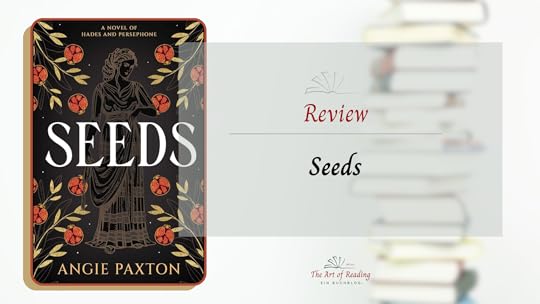
Kore has lived her entire life under her resentful mother Demeter’s shadow, trying her hardest to please a woman grown bitter by betrayal. With her self-esteem in tatters and deliberately isolated by her mother, it’s no surprise that Kore is flummoxed when she meets a collection of otherworldly women – the Goddesses of Olympus – who tell her that her mother is in truth a Goddess herself. Kore tells them her preferred name, Persephone, and hopes they will not only have answers for her new questions, but the friendship and love she craves. Instead, an imposing and stoic figure emerges from a nearby cave on a magical chariot and snatches Persephone away.
Upon realizing she has been taken to the Underworld by Hades, who desires she become his queen, Persephone vows to escape.
Demeter, enraged upon finding her daughter taken, goes to extreme lengths to reclaim her – putting the lives of all humanity, and even the gods, at risk.
Angie Paxton breathes new life into a myth that has been reshaped, adapted, and loved since Homer's "Hymn to Demeter." Seeds is a deeply romantic story of two lonely souls finding one another, the pressure put on children to forgive their parents’ abuse, and the power of resentment.
Just for the sake of clarification and so there won't be any confusions, I'm putting this here:
This book is not the same as Seeds by M. M. Kin, which is also a Hades & Persephone retelling, and the author of this book is a different person.
The one by M. M. Kin started as a fanfiction that was repackaged and republished by the writer (who also goes by M. M. Strawberry on here), whilst this one here is published by Rising Action Publishing. You can check the author's social media for fact-checking yourself as well.
As anyone reading my reviews knows, I am a sucker for the story of Kore/Persephone and Hades. This tale is dually narrated by Persephone and her mother, Demeter. Although there's nothing new in terms of the storyline, most of the tales I have read focus more on Persephone and Hades' story, Demeter is often depicted merely as the strict mother who stands in her daughter's way. So I liked the focus on the mother/daughter dynamic. Dare I say that Angie Paxton was able to draw some empathy from me for Demeter?
Demeter may not have been so pleased to have a daughter but she isn't keen on her girl sticking around in the Underworld with Hades. As for Persephone, she struggles to make her own decisions as she is a chess piece for two stronger players. For this particular story, Demeter is, in my opinion, the character that commands more of our attention. Or maybe that is because I am closer to her age than Persephone's now.
This was a good debut novel. I look forward to the future books that Angie Paxton will write.
I am reading this one early as it will be archived in the next few days but those eager to get their hands on a copy will have to wait until January 7th, 2025.
Seeds is a beautiful and powerful retelling that transcends previous Greek mythology and the story of Persephone, painting her in a fresh and poignant light and putting a new spin on her relationship with Demeter and even Hades.
Persephone lives a life of isolation as an outcast in her village, mainly inflicted by her mother, Demeter. The dynamics between Persephone and her mother were so heartbreaking - demeaned, resented and neglected despite Persephone's all-consuming efforts to please her. My heart broke for Persephone and she is a character that I think resonates with so many girls who just want to be loved and crave connection. But at the same time, she was very one-dimensional, innocent and pure without much else to her. I wanted a bit more there.
Hades abducts Persephone from a meadow just as she's introduced to the other goddesses, with no explanation (at first.) She finds so much unexpected kindness and warmth in Hades despite a rocky beginning - he gradually earns her trust and shows her the strength of his love. It was a beautiful love story, but at times Hades' behavior felt inappropriate and too-soon, especially given how innocent Persephone is portrayed as. The pacing of their relationship was a bit awkward and inconsistent.
Meanwhile, the author intersperses chapters from Demeter's point of view which are such a fascinating contrast to Persephone's. Once Persephone is abducted, she has a complete shift in mindset and goes to extreme lengths trying to get Persephone back. One moment she was being cruel to Persephone, and then the next she was tearing apart the world to find her again. I struggled to grasp whether she truly wanted her daughter back, or if she just felt wronged that a "part" of herself had been taken. Too little too late from Demeter, I think. She's a very multifaceted, gray character in this book; she has faced trauma and been inherently wronged and cast out by Zeus, but at the same time she couldn't help but take out her anger on Persephone and is very self-serving.
I liked how this book was not only a love story but a complex portrayal of a mother-daughter relationship. But I wasn't super immersed in the the story--my attention just wasn't always in it. However at the same time, there are so many wonderful aspects and I applaud the author for her creativity and unconventional take in this retelling.
Thank you so much to Rising Action and NetGalley for this ARC!! 📚
First, a huge thank you to the publisher and author for sending me this ARC. I’ve always had a soft spot for Greek mythology, especially when it comes to Hades and Persephone. It’s one of those myths that never gets old for me. This retelling, though, was quite different from what I’ve come to expect—and in some ways, it was a refreshing change.
What I loved about this book and what made it stand out for me:
1. Dual POV: The story was told from Persephone’s and Demeter’s perspectives, which is something I haven’t seen done often. Most retellings tend to focus heavily on Hades, and while I do love his dark, brooding character, it was nice to get inside the minds of the women in the myth for once. Their emotions, thoughts, and motivations were more fleshed out, especially Demeter’s, which added layers to the mother-daughter dynamic.
2. A Different Hades: This Hades wasn’t the cold, heartless ruler of the Underworld we often see. Instead, he was portrayed as gentle and compassionate, though not without his flaws. I found this portrayal unique—Hades, who is usually shrouded in darkness and cruelty, was humanized. He still had that edge of mystery and power, but it was tempered with kindness. It didn’t feel out of character; it felt like a different lens through which to view him.
3. Not Dark Romance: Unlike most Hades/Persephone retellings that veer into dark romance (because, let's face it, the story lends itself to that with the whole kidnapping and Underworld thing), this was sweet. The romance wasn’t rushed or intense; instead, it explored different facets of love: love for a mother, a lover, a child, and even animals. It was a slower, softer burn, which I wasn’t expecting, but it worked for this particular version. I do enjoy dark romance, and I wouldn’t have minded seeing a bit of that edge, but this approach gave the story a different kind of depth. It highlighted the tender aspects of the relationship rather than focusing solely on the power dynamics.
4. Mother’s Wrath: One of my favorite aspects was the portrayal of Demeter’s wrath. We don’t often see the protective, sometimes vengeful, side of a mother done this well in mythology retellings. Her anger was palpable, but so was her love, and it made her character much more complex and interesting. You could feel her desperation and fear for Persephone, and it wasn’t just blind rage—it was rooted in care.
5. Character Development: There was solid character development, which is always a win for me. Watching the characters, especially Persephone, grow throughout the story kept me invested. They weren’t static; they evolved, learned, and changed as the plot moved forward.
6. Slow-Burning Romance: The romance was slow and steady, which I often prefer over insta-love. However, while I appreciated the build-up, I have to admit the chemistry between Hades and Persephone didn’t completely hit the mark for me. There was tension, but it wasn’t as intense as I’d hoped. I wanted more sparks between them, more moments where their connection felt undeniable, and unfortunately, it didn’t quite reach that level.
That said, while I did like this book, I wouldn’t call it one of the best retellings I’ve read. It had a lot of unique elements that I appreciated, especially the dual POV and the gentler take on Hades, but it lacked the intensity and chemistry I crave in a story like this. Still, if you’re a fan of Greek mythology, this is worth a read, especially if you’re looking for something that strays from the usual dark romance route.
If you are looking for a Hades and Persephone retelling that is more aligned but with a fresh take on a classical myth, this is the book for you! Seeds brought back so many Greek mythology memories to me. I’ve read many different Hades and Persephone retellings and this one felt like coming home to one of my favorite genres.
Being able to read about Demeter’s perspective was a first for me. I enjoyed reading the complex nature of her and Persephone’s dynamic. I’m a sucker for a good romance so I wasn’t sure how much I would enjoy her point of view but the author completely sold it. The book at its heart, really is about the dynamic between mother and daughter. All of the characters in this story really shine and their flaws are so well developed and defined. I also loved some of the inventive creative aspects that the author came up with to define the Underworld especially around a certain three headed dog.
The romance between Hades and Persephone was on the quiet side but I still enjoyed it greatly. I thought this retelling provided the most realistic romantic journey that a couple faced with their circumstances would have experienced. Overall, I loved this book and recommend it to anyone who loves Greek mythology especially mythology tales that are on the more aligned with the actual myths. Solid four star read for me.
Thank you Rising Action Publishing Co. and NetGalley for allowing me to read a free copy of this book in exchange for an honest review.
The E-Arc of Seeds was kindly provided by Netgalley in exchange for an honest review. This has not altered my opinion of the book.
Rating: 4,5 stars.
I feel like I need to start this review with a disclaimer: while this is a story with romance at its core (the one between Hades and Persephone), it is not a romance book. I was expecting a romance book, which put me off at the beginning of the story.
What this really is, is a more truthful rendition of Persephone’s story based on the original myths, with its own original spin of course. Persephone’s story begins with her life as a mortal girl, living with her abusive mother, in a village where everyone shies away from her. We follow her through her abduction at Hades’ hands, witnessing the beginning of her life in the underworld, where she is desperately trying to escape. At the same time, we follow Demeter in the upper world, where she is desperately trying to get her daughter back.
Once I got over my mistaken expectations of this being a straight-forward romance book, I could enjoy it for what it really is. The story is, at its heart, a story of a complex mother-daughter relationship between a Goddess turned resentful mortal and her daughter. At the same time, it is a story of two lonely and lost souls finding each other, and finding love. I loved this story! I think Paxton did a fantastic job of portraying the Greek Gods, with their distaste for mortality and their obsession with power. I also appreciated how Paxton stuck close to the original myth, with Hades’ abduction and his early actions.
All in all, I would wholeheartedly recommend this to mythology lovers! This book will add a new layer to the myth of Persephone, especially if you have only explored romantic retellings so far. Definitely give this one a chance!
A great debut! I know the blood, sweat and tears that went into this one, and I am just so proud of Angie for getting it out there!
A fun take on the story of Persephone and Hades and Demeter and Hekate with all the usual god-like suspects thrown in. While Persephone did not have a choice in going to Hades, she makes the choice to stay with him. I appreciate that Hades is given some scope in this story as I have always felt he is the most under-appreciated.
When I came across this story, I had no idea the strong feelings I would have for Hades. But in "Seeds," Angie Paxton skillfully reimagines the myth of Persephone, exploring the complex dynamics of mother-daughter relationships in the drought-filled lands of Mycenaean Greece. The protagonist, Kore—also known as Persephone—struggles immensely under the weight of her mother, Demeter's resentments, rage, and abuse, creating a debilitating sense of isolation and longing.
Paxton's portrayal of Kore's fraught relationship with her mother is both poignant and deeply heartbreaking. Her struggle under her mother's abuse and the loss of another motherly figure in the village is so heavy that she runs away in an attempt to leave her pain and emotional turmoil and hopes to find acceptance and love. Paxton's writing skillfully weaves a narrative that feels both timeless and current, echoing themes of parental pressures, expectations, and the search for identity.
The story takes an intriguing turn when Persephone encounters the Goddesses of Olympus, who expose bits of her true heritage. This moment of revelation sets in motion a gripping narrative that delves into themes of empowerment and resilience. This part of the story is particularly poignant in Persephone's character development. If you have ever experienced wanting to be a part of a group or are unsure of the group's intention, then you will understand this chapter. It was so real and relatable. I could feel her yearning for connection and the emotion behind just a simple touch from another.
Hades’ arrival introduces a darker element to the storyline as he forcibly whisks Persephone away to the Underworld to make her his Queen, leading to a powerful exploration of captivity versus freedom. However, he is portrayed as a multifaceted character, adding depth to the traditional archetype of the dark lord. I LOVED his character the most in this book!
The stakes rise dramatically when Demeter’s rage to retrieve Persephone from the Underworld threatens the Upper World with drought, famine, and death - creating tension between gods and mortals.
Paxton’s retelling breathes life into the myth with romance, spice, and a love story. The book does not shy away from its content warnings, presenting difficult themes of child abuse, animal death, starvation, and confinement.
While the narrative may tread into some heavy territory, "Seeds" is a compelling tale of love, forgiveness, and resilience. I struggled with some pacing issues in the very beginning, but once Hades entered the story, I couldn't put the book down. I feel it ultimately delivers several powerful messages: *Regardless of your background, you have a choice in how you treat others, *Lack of action, your choice of words, and abuse can have such a long-lasting impact in snuffing out someone's light, *Forgiveness is not always necessary (you do not need to forgive your abuser), *Found family can be stronger than blood, to name a few.
Overall, this debut is a mesmerizing blend of Greek mythology and emotional depth, making it a worthwhile read.
Thank you, #NetGalley, #AngiePaxton, and #RisingActionPublishingCo, for the ARC in exchange for my honest review of #Seeds.
If I had a nickel for every time someone complimented Persephones ankles, I’d have two nickels, which isn’t a lot, but it’s weird that it happened twice.
This was an interesting book, not as much of a retelling but more just a telling of the classic HadesxPersephonexDemeter, myth. It was fun but not exactly what I was expecting.
I went into this book thinking it would be a deeper exploration of the complex relationship between Persephone and her mother, and it was, don’t get me wrong, but I wanted MORE. Hades & Persephone retellings have been done so so so many times and I was hoping this would have more emphasis on the other side of the myth that’s not as talked about. More scenes with Demeter and Persephone together would have been nice. Also I wish Persephone had more growth on her own rather than just as a result of her relationship with Hades.
The romance was okay, but I found the pacing a bit odd and abrupt, and at times inappropriate? But I liked Hades, I thought his character had the most depth. I think by the end they were good together.
Not bad, but not what I was expecting.
Thank you to NetGalley for the ARC. This is my honest review.
Seeds is a retelling of the myth of Hades and Persephone. The POV alternates between Persephone and Demeter. It is marketed towards fans of Madeleine Miller and Pat Baker, two authors I enjoy! Unfortunately, everything about this book was average.
The quality of the writing is basic and is very exposition heavy. The characters lack depth. The story of Hades and Persephone is a well known myth, so I think I was expecting more creativity from the author to make it her own. It just didn't feel special, and I'm not convinced this was a story that needed to be written.
I have read many recently published mythos books in the last few years and all of them have been more enjoyable than Seeds, so I think you can skip it. I'm rating this 2.5 out of 5 stars.
Thank you NetGalley for this advanced reader copy.
Angie Paxton's Seeds is a stunning recreation of the myth of Persephone and Hades, which has enthralled audiences for generations. Paxton's lyrical prose transports you to a universe where gods are more than just great beings; they are flawed, very human characters dealing with the scars of betrayal, rejection, and longing. This novel stands out not only for its gorgeous setting in Mycenaean Greece, but also for its daring choice to portray the story primarily through the eyes of Persephone and her mother, Demeter. While I wished for deeper insight into Hades' perspective, the richness and complexity of the two female characters more than made up for it.
Seeds ♦ Angie Paxton — A Review
Opinion
Complex and Flawed Characters One of Seeds' best features are its characters, notably the three key figures—Persephone, Demeter, and Hades. Paxton's decision to focus on Persephone and Demeter allows readers to delve into the novel's strained and intensely emotional mother-daughter relationship.
Demeter, as depicted here, is a revelation. She is a cynical, spiteful, and wounded goddess who has been wronged, particularly by her sister Hera and her husband Zeus. Paxton doesn’t shy away from depicting Demeter as both a victim and an antagonist. While her pain and cynicism are reasonable given her history, her treatment of Persephone (who she also refers to as Kore) cannot be excused. Persephone's mental and physical maltreatment at the hands of her mother—raised in ignorance of her divine origins and made to feel useless and unwanted—paints a sorrowful image of a daughter yearning for love but being denied it due to bitterness and fear.
Hekate, a secondary yet crucial figure, lends depth to Demeter's character. It is argued that Hekate's influence increased Demeter's domineering and harmful conduct toward Persephone, making their relationship even more complex. However, there is an irrefutable darkness within Demeter that causes her to withdraw affection from her own child. Her inner depth is what makes her such an intriguing character.
Persephone's transformation from a shattered and solitary girl to a woman discovering her strength and identity is at the center of this tale. Her initial helplessness and deep-seated self-doubt, caused by years of trauma, are both familiar and devastating. However, her stay in the underworld with Hades represents the turning point in her narrative. Though initially terrifying, Hades is the first to perceive Persephone as capable of greatness, rather than weak or unneeded. Their encounters, especially when he encourages her to pursue her own interests, such as horseback riding and archery, are among the most riveting in the story.
The story of Persephone and Hades is a masterwork in slow-burn narrative. While the tale is written through Persephone's eyes, Paxton's language allows Hades' quiet vulnerability to seep through. His seclusion and pain, like Persephone's, foster a connection that feels both inevitable and beautifully poignant. Hades is portrayed as a very lonely god who, like Persephone, has been abandoned and dismissed by those who should have cared for him. This common sense of abandonment makes their eventual relationships all the more meaningful.
Themes of Identity and Forgiveness At its core, Seeds is a story about identity, self-worth, and the complicated relationship between parents and children. Persephone's journey is about more than simply finding love; it’s about discovering herself outside of her mother’s shadow. Her eventual revelation that she does not require Demeter's approval to be entire is a watershed moment of empowerment.
The work also addresses the serious issue of forgiveness, particularly the cultural expectation that children forgive their parents' transgressions. Paxton does not provide easy solutions here. While Persephone comes to comprehend the source of Demeter's anguish, she also knows that this does not excuse the harm done to her. This blend of empathy and accountability is one of the book’s most notable strengths.
A Few Missing Pieces If there was one component of Seeds that made me want more, it was Hades' perspective. While his character is well-drawn through Persephone's eyes, more chapters from his point of view could have provided more depth to his feelings and motivations. As a complicated character like Demeter or Persephone, he merits equal narrative weight. Nonetheless, its absence does not reduce the overall effect of the story.
A Modern Myth Reimagined Paxton's ability to rework a well-known story while still tackling contemporary issues of agency, pain, and healing is nothing short of astounding. Her work is both poetic and solid, brilliantly capturing the contrast between the bright, sunlit world of Demeter's domain and the shadowy, eerie beauty of the underworld.
Conclusion
★★★★★🏆
Seeds is a must-read for lovers of mythological retellings, as it not only reinvents, but also adds emotional depth to the Persephone and Hades narrative. This book is a triumph, thanks to its vividly portrayed characters, slow-burn romance, and investigation of family tension. January 7th, 2025, cannot arrive soon enough for those who have yet to witness its magic.
I received an advance review copy for free, and I am leaving this review voluntarily.
This was an interesting Hades and Persephone retelling. Focusing primarily on the relationship between Demeter and Persephone is super unique, but I just feel like there wasn’t enough conflict between the two. I enjoyed reading each character’s arc develop, but I was a bit underwhelmed when the storyline finally converged. My favorite part of the story was the lore behind how Hades became the god of the underworld.
The relationship between Hades and Persephone was lacking in my opinion… I wish there was a bit more emotional build up rather than a sexual one, which was mentioned quite a bit. I also wasn’t a huge fan of the dialogue and felt it a bit awkward and confusing at times.
The premise was super intriguing but unfortunately I wasn’t blown away by the story or writing. Despite this, it was a decent debut, and I still enjoyed reading it. I would recommend to anyone who wants to read a different approach on the Hades and Persephone mythology.
Thank you to NetGalley and Rising Action Publishing Co for the ARC in exchange for an honest review.
I found this retelling unintentionally funny because Persephone and Demeter seem to be living out completely different stories. For Persephone, she's in a fun little 'forced marriage to real marriage slow burn YA romance' situation where she gets to frolic about with horses and have amazing sex with her very sexy, very perfect husband, which is nice for her, BUT her poor mother is Liam Neeson from 'Taken,' immolating humans and literally fighting god himself. The incongruity can be a bit jarring at times, and the exposition-dumping at the end for Hades' lore felt like it dragged on when it could have been a sequel.
I didn't find Persephone particularly compelling, probably because I'm too old now for that, but Demeter's character was more complex and layered. If you had told me she was cantonese I would have believed you because the way she parented was to constantly berate and punish her daughter for making small mistakes, set down strict rules with no explanation, and withhold praise and affection. Demeter does love her daughter more than anything else in the world, but her resentment at being forced into single motherhood and a mortal existence unfortunately poisons her mind, and there is no one to take it out on except the one person too weak to fight back and too inexperienced to leave her. Tale as old as time. Demeter does reflect on her actions and resolve to make amends, but Persephone gets kidnapped before she gets the chance to be a good mother.
Even sadder still, after getting a man to latch onto, Persephone decides to hate against all reason the mother whose approval she constantly sought just a few weeks ago. Demeter is reduced to a humbled, grieving figure who toils to earn her daughter's forgiveness. For all the empathy she shows to strangers and animals, Persephone extends none whatsoever to mother who was doing her best. She strikes me as a vindictive brat.
Thank you to Rising Action Publishing Co. and NetGalley for the advanced copy of Seeds by Angie Paxton.
If you are a Greek mythology and romance fan, I would recommend this debut novel. It’s well written and I found the setting of the Underworld to be very interesting. I also enjoyed reading and seeing the relationship between Hades and Persephone’s grow over the course of the novel. The book switches off each chapter from Persephone and her mother’s Demeter’s POV and I personally was not the biggest fan of Demeter’s chapters. Those were the hardest chapters for me to get through because I found myself uninterested, though I understand why Paxton wanted to give the reader Demeter's POV. I just found myself more drawn to Persephone’s perspective- her journey of falling for Hades, recognizing her own self-worth, and how she had to come to terms with and overcome her mother’s emotional abuse.
I received the ARC copy for this book but was definitely not expecting to love it as much as I did, so big thank you to Angie for the chance to read it! I honestly would have finished it in 24 hours if I didn’t have work. Angie does a great retelling of the famous story of Hades and Persephone so much so that I’m convinced this is what actually happened in Ancient Greece. From the characters to the creative lore, Seeds definitely did it for me.
What I loved most: - The pacing was very well done. I felt intrigued by both sides of the story being told throughout the entirety of the book (one by Persephone and the other by her mother). - The character development was perfect in my opinion. The characters’ actions made sense based on past experiences and you could really feel Persephone and Hades growing. It was sad to see Persephone start to understand her trauma more but loved seeing her strength at the end. (And don’t get me started on Hades’s backstory😭).
It was a quick read but the story felt developed and complete. I wish we got to see a little into the ending more but definitely content with everything in the end. Loved reading and can’t wait to see what other gems this author comes up with!
Uhh I was disappointed with this one. Review to come 💐
(FINAL REVIEW:)
This Hades and Persephone retelling just didn’t work for me nor wow me. There were elements that I really liked and others that either left me scratching my head at or just left me incredibly frustrated by. 😕
As always, I like to start with my positives because I hate getting right out of the gate with negativity. I thought the idea of Demeter and Persephone living their lives as mortals was a great start to the book. It really goes into the idea of how Persephone is different from that of all the other goddesses and provides a rather refreshing take on her character. I LOVED the depiction of the Underworld and Hades. Honestly, I think I stuck this book out simply for the way in which Paxton crafted these two and made me really love this god who has lived through so much trauma, and yet still comes out a rather decent man. I also liked the final standoff between Demeter and Persephone where past traumas of both women are brought to the forefront and how sometimes mother-daughter dynamics are messy and abusive. 🌿
But that’s really where my positives end. As much as I liked the idea that Persephone and Demeter were living out their lives as mortals, I also hated the way in which it was taken leaving Persephone as nothing more than an incredibly naive teenager who makes some of the dumbest decisions I’ve ever seen in a goddess retelling. Does it have to be perfect? No, but man did I want to just dope slap Persephone the majority of the book for just being so inexplicably annoying to me. Also, the sudden switch from “I hate Hades to ends of the earth and back for what he did to me” to suddenly “He was literally made for me by their Moirai” all within the space of say 5 pages . . . My head hurts just thinking about that whiplash of a switch. 😵💫
Demeter also just ground my gears to no end. For one, why is she even present in a book that is marketed as a Hades and Persephone retelling? I get that she has a HUGE role in the return of her daughter, but I thought the spotlight was supposed to be on her daughter and her growing relationship with Hades. I also really didn’t like the idea that Demeter is portrayed as this goddess who is out to replace Hera as Queen of Olympus (also, how on earth did she not realize that Hephaestus was ALIVE??) and was happily seduced by Zeus. Like what? Zeus, one of the biggest and most notorious r@pists of Greek mythology having a hold over women for his, I’m guessing “glowing” personality? It literally made no sense to me and just really made me grind my back molars into literally pain. 🤬
And the depictions of the other Olympian goddesses (even for a few pages) and Hekate? . . . . Why are Athena and Artemis frolicking in a freaking field of flowers happily picking blossoms for Aphrodite??? SERIOUSLY: the VIRGIN goddess of strategic warfare and mistress of the hunt picking flowers for the goddess that is the literal antithesis of what their maidenhood stands for? Hekate being nothing more than a jealous crone who knows all things about healing and midwifery . . . Are we talking about the same Titaness who is the goddess of magic, crossroads and literally scares people with her chthonic elements; this is the one and same goddess? MAKE THIS MAKE SENSE TO ME!!! 🤯
In general, it was a STRUGGLE to get through this. Not only were the characters just a problem for me, but the length of the book could’ve been 100 pages less because man that pacing on Persephone’s side just a slug. I think this book would’ve done so much better if it stuck to Persephone and had given a Hades a POV. I might’ve enjoyed Persephone’s ridiculousness a bit more if it had gone this route. 🙄
Before I get away and just start angrily ranting, I’m just going to end this review here. A big thank you goes out to Rising Action and NetGalley for accepting my request to read this in exchange for an honest review. I wanted to like this and made myself finish it in the hopes it got better, but I just couldn’t. 😞
Publication date: January 7
Overall: 2.5/5 ⭐️ (and these stars are primarily for Hades and the Underworld)
Thank you to NetGalley and publisher for an eARC of this book!
I am undecided on how I feel about this one.
Initially, I was very intrigued. But as the story continued, I found myself losing interest. I think mostly due to how annoying I found Persephone. That said, I also have not read a Hades & Persephone story before so this may be the norm. It may be a me issue TBH.
Even though I was annoyed with Persephone, I didn't overly mind the story. It was interesting and it didn't bore me at any point. It was more of a character (Persephone) issue for me haha. I did really enjoy Hades character though. He was my favorite.
Overall, it was good and I did enjoy a lot of parts. I look forward to reading more from this author!
I was drawn to this book because I’m interested in Persephone beyond the beautiful goddess who unknowingly ate the pomegranate seeds and condemned herself to becoming part of the Underworld. In this retelling, the only thing Hades did against Persephone’s consent was bring her to the Underworld and keep her there as his queen. As two ostracised individuals, Persephone comes to see parallels between herself and Hades, and gradually grows to love him. All the while, Demeter is distraught at the loss of her daughter and will go to all lengths to bring her back, no matter who suffers for it.
In theory, this book should be for me: it explores tensions in mother-daughter relationships, and it presents to me two lonely gods who grow to become each other’s salvation. But the execution didn’t really do it for me. Persephone’s hot and cold attitude towards Hades for most of this book before the two of them finally reconciled after a certain tragedy she indirectly caused, became frustrating to read, even if she’s a young woman who makes questionable decisions. There was a lot of attention paid to desires of the flesh that got tiring after a while—the gods acted far too human-like to be divine. To me, a lot of the gods (save Hekate, who was easily my favourite) lacked nuance: Demeter is extremely self-serving most of the time, Hades is a creepy-seeming but terribly misunderstood softie who wants only for his new wife to be happy, and Hermes is a disrespectful misogynist who speaks like a cishet man in the locker rooms. I really think people should stop slapping Madeline Miller’s name onto an attempt to sell a Greek mythology retelling written by a woman just because it’s a Greek mythology retelling written h a woman.
That being said, this book wasn’t terrible, I just think the first 60% could’ve been a lot shorter and less repetitive. I actually really liked the later chapters, especially from the moment Hades and Persephone encountered Orpheus in the Underworld and things finally picked up. I liked following Persephone’s growth past the abuse of her mother, as she learns to bloom in the relative freedom and kindness of Hades’ companionship, I just wished she stopped acting like a petulant teen sooner.
Thank you to NetGalley and the publishers for sending me this arc! I did really enjoy this book which is why I gave it 3.5 stars, however parts of it were confusing and did not flow how other parts did otherwise it would have gotten a higher rating. I did not expect it to follow the true story of Hades and Persephone, but it did remove some major parts of their story and changed how some parts actually happened. If you love learning about Demeter and Persephone then I highly recommend it, but I would not see myself rereading it for a while.
Seeds is a novel that will abduct you, like Persephone, deep into its pages, taking you on a journey through the darkness and lies in search of freedom and forgiveness. A stunning debut from a talented author to watch.
Thank you NetGalley and Rising Action Publishing for this ARC! This is a fantastic debut novel from Angie Paxton. After reading Seeds, you’ll confidently want to be whisked away by Hades (I know I did). I thought this to be a refreshing take on Hades and Persephone’s story where I was not able to put the book down. Paxton’s novel is a love letter to those who feel lonely, neglected and unloved.
This is a dual POV story featuring perspectives from both Persephone and her mother Dementer. I thoroughly enjoyed Persephone’s POV chapters. This novel is fast-paced, but Paxton does a great job depicting the childhood neglect Persephone has with her mother early on in the story, making you feel pity for her, which goes on to shape her interactions with Hades as well as her distrust, making her an unreliable narrator and leaving it in the readers’ hands to make their own judgment. I adored Persephone’s journey and the change she undergoes throughout the book to realize her worth. There is a confrontation towards the end that was electrifying as it was powerful and it felt earned because of the growth that Persephone underwent as she spent her time in the Underworld. I also loved the rich worldbuilding in this story and how we find out about it along with Persephone. I have always loved Greek Mythology and this only furthered that love.
Hades, you can do no wrong in my eyes. I loved, loved, LOVED Paxton’s take on Hades. This isn’t the cruel, ruthless Hades you are familiar with. This Hades is a gentle giant, someone so misunderstood and lonely and I love how Paxton subverts our expectations. I adored the slow burn between him and Persephone. There are so many squeal worthy moments between them as well as angst and this book tore my heart apart and mended it back together again. Paxton is exceptional at writing tense scenes and emotional ones, making you feel emotionally connected to Hades. I found myself tearing up during certain scenes.
Dementer’s chapters I found slightly difficult to get into initially. I found they dragged out at times, but I liked her motherly rage and seeing her become a monster to save Persephone. You hate her for her treatment of Persephone, her actions throughout the novel, yet there’s a sliver of pity you feel for her.
While I understood Persephone’s trust issues, I also found Persephone annoying at times for the way she treated Hades on certain occasions. There were many sweet moments that were impacted by Persephone’s stubborn and unforgiving nature and at times this did not feel justified. Though once the slow burn took off, it made for an amazing read. I am incredibly grateful for this ARC and I will be rereading all those Persephone and Hades scenes.
I almost skipped this one, as the sample I read didn't really impress me, writing-wise. It felt clunky and unpolished, though having now read the whole thing, I believe the author tried to mimic the style of ancient poetry, to mixed results.
I do love retellings of Persephone's story, especially if they take place in Greece. I enjoyed Paxton's take on our lead heroine; she was sweet, lonely, and eager for understanding and companionship. Her growth is subtle, but undeniably there. She matures, learns to stand up for herself, without losing the core aspects of her personality.
Demeter...As is often the case with Hades/Persephone stories, she got the short end of the stick. The first chapter we got from her PoV was interesting, it truly felt that she wanted to make amends and work on her relationship with her daughter, but all of this goes up in smokes as her story progresses and it becomes painfully obvious she's mostly interested in regaining her power and only clings to Persephone because she believes she owns her. Overall, not a fan of her characterization, or her chapters.
As another review points out, the development of Hades and Persephone's relationship feels inconsistent. For the better part of the book, she is trying to stay away from him, putting as much space between them as possible, After that, it's all smooth sailing, at least regarding her feelings towards him. It conflicts with what she went through during her first night in the Underworld, and even though he apologizes and explains himself, it wasn't enough. I'd have preferred it if that part was omitted, or the story didn't evolve into a romance.
Despite my criticisms, I did really like this book, and it's in my opinion one of the more decent Persephone retellings out there, depending on what you're looking for.
Like any good book girly I’m well aware of the Hades and Persephone mythology, but to be perfectly frank I never really thought about the Demeter side of the equation. For whatever reason, probably to make sure I myself don’t go insane, I always imagined that she was a loving mother who is distraught that her daughter was taken from her against her will, staying in hell against her will and needed saving. So, the way the author chose to portrayed Demeter as a narcissistic and controlling mother, definitely had me living out all kinds of childhood trauma that I wasn’t even aware of.
The romance was also something much more loving than we are used to for this mythology as well.
I hope this becomes a mythology series
I see a lot of people disappointed but I think it’s not because this isn’t a good book but because they are used to the romance HEAVY retellings, where there spice every page. This is mostly a mother daughter dynamics book, with a little romance. And it’s amazing as that. It doesn’t need to be a bodice ripper, it stands without it.
(2/5⭐️) 📚 Thank you Net Galley and Angie Paxton for the ARC of ‘Seeds’. This is a retelling of Persephone and Hades, with dual POV of Persephone and Demeter. I haven’t really read any retelling so I was intrigued to see Angie’s take on the mythological tale. I agree with other reviewers that the first 60% could have been shortened and less repetitive, and the characters lack a bit of depth. I unfortunately do not have other retellings to compare it to, but based on my experience alone I wasn’t as hooked as I had hoped to be. All in all, it’s an interesting retelling with a rather slow start. Nonetheless, I did enjoy it towards the end.
Loved this book! Not generally my genre but read it at the recommendation of a friend. Pleasantly surprised to have enjoyed the story so much, even more impressed with the craft and flow of the writing. I loved the development of characters and author’s ability to examine complicated relationships. Great read, can’t wait to see what’s next for Angie!
*I received a copy of this book on NetGalley in exchange for an honest review. Thank you to the author, publisher, and NetGalley for this opportunity*
In this retelling of the classic myth of Hades and Persephone, PAXTON explores the complicated and fraught relations between mother and daughter and the tender bonds that can form between two abused individuals.
To start, the romance between Persephone and Hades was dutifully complex. How can a hurt and broken individual learn to love another? How does the idolized, imagined version of someone compare to the real person? Can real love form between a kidnapper and his victim (in this story, yes, in real life-- not so much)? Tackling the complex web of Hades' and Persephone's perceptions and feelings revolving the kidnapping, as well as the convoluted motivations behind Hades' actions, adding depth to their love story and some amount of credibility.
Paxton stuck closely to the 'traditional' mythical Underworld, rather than some of the more modern interpretations, which added another, somewhat unexpected, layer to the story. In a similar thread, Paxton captured what life might had been like in Ancient Greek mythology-- not necessarily through historical accuracy, but the turbulence of the god's whims and humanity's fragility in the face of the unstoppable forces.
Demeter's story was also richly layered. She abused Persephone throughout her life (because of her inability to empathize with her daughter and her daughter's humanity? Because she herself had been hurt and scorned and 'hurt people, hurt people'? Because her daughter represented everything Demeter now hated about her life and was the only thing truly in her control?), and only realized she needed her daughter to know she loved her once the kidnapping had occurred.
My personal interpretation of Demeter's character was that her actions were not that of a loving mother as she continued to proclaim throughout the entire book. But the desperation of someone losing power, and an abuser unwilling to let their victim go. While some of her actions could have been truly for the sake of her daughter (), the eventual path of causing the first winter and forcing humans to worship her for more power did not feel... maternal.
But it made for an interesting interpretation.
SEEDS would be an excellent choice for fans of greek mythology retellings, who are looking for a more character-driven and emotional version. I'll warn you though, this version does not have a Hollywood Happy ending-- choices are made and it's Persephone who ends up suffering.
I received an ARC from the publisher in exchange for an honest review
Seeds by Angie Paxton is a third person dual-POV historical fantasy retelling of the Abduction of Persephone. For years, Demeter has pushed her own daughter away but also hides her true identity, making Persephone ill-prepared when Hades abducts her to be his queen. Demeter will fight tooth-and-nail to get her back, but can their relationship be repaired?
This retelling is more focused on the damaged mother-daughter relationship rather than the romance between Hades and Persephone. Demeter lost her immortality years ago due to Hera’s jealousy and so she has kept Persephone pretty much completely in the dark about what goes on on Olympus, who Demeter actually is, and even who the other gods are. Demeter finally gets her godhood back after confronting Zeus for allowing Hades to take their child and uses that power to cause a massive famine in the mortal realms. When I was in Demeter’s POV, I did sometimes wonder if she really wanted her daughter back or if she wanted this extension of herself back. It’s very complicated, as many mother-daughter relationships are, but it leans more on the unhealthy, possessive side rather than the ‘I can’t believe what I lost’ side for me.
In terms of the romance, Hades and Persephone get off on a very rocky start. Hades not only abducts her but also comes on way too strong at first to the point that he scares Persephone. He gives her a bit of time to adjust but is also refusing to allow her to go back home when she asks. What redeems this version of him is that he doesn’t force food of the Underworld onto Persephone and instead replaces her food with things that won’t bind her to his kingdom once he learns that she is ignorant of the Underworld works. This sets the eating of the pomegranate seeds up as an active choice instead of one forced upon Persephone, something I always prefer in my retellings of this myth.
I would recommend this to fans of mythology reframed to focus on familial relationships and those looking for a Hades and Persephone retelling where Hades tries to redeem himself