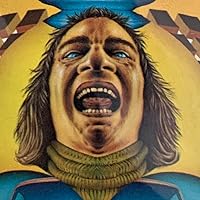
Possessed by an evil entity, a young man becomes a psychotic murderer, turning the peaceful New England town of Quarry into a nightmare of horror and death
While Fear has it moments, I still haven't found a Gates book near the quality of his Grimm Memorials. The story takes place in a small town in Eastern Massachusetts close to Worcester. After a brief, bizarre prologue featuring some proto humans in Africa (more on this later), we have three teenagers making a trek up to a hill above an old quarry to see the first lunar eclipse on the Eastern seaboard in 100 years. Also making the trip is our main protagonist Denny, a 12 yo with psychic abilities who comes from a very abusive home, living with his single mother.
The eclipse is super, but along with it some strange shooting stars appear directly above; one of the teens, pouting after a tiff with the other two, gets coated in some odd ash from the meteors, and feels sick after wards. Denny for his part sees all this, but also has one of his rare 'visions', where two struggling teens are shot to death by some guy right below him and then the guy comes for him. Denny splits the scene with aplomb, leaving his telescope on the hill and the three teens make their way home to smoke another spiff.
So much for the sitrep. Rick, the teen who got the dose of ash from the meteor becomes obviously infected with something, puking his guts out and blacking out repeatedly. What is this infection? To be mildly spoilery, it quickly becomes apparent that it is some sort of alien organism (which Denny calls 'the Monster') that feeds on fear; a psychic vampire of sorts. Rick soon finds that the only thing that can make him feel better is to induce fear in others, and goes (at first under his blackouts) on a homicidal rampage, focusing on kids in town. One the 'Monster' has feed, it is able to spread to others, and then the real foo kicks in!
The plot is rather thin, and the prologue/epilogue are a bit ridiculous, but the foo between just about puts this into splatterpunk territory. While not for the squeamish, the gratuitous violence and seeing people's worst fears come to life are the primary redeeming feature of Fear. Having most of the main characters be subsumed to the 'Monster' is like 10 miles of bad road! That stated, not the best introduction to Gates. If you want some killer old school horror, check out his Grimm Memorials. 2.5 monster stars!
We tend to remember the work of Skip, Spector, Lee, Laymon, Hutson, and Herbert as the original masters of extreme horror. "Fear," first published in 1988 and written by R. Patrick Gates, definitely deserves mention in that pantheon of pain. But does it deserve a resurgence in popularity as a splatterpunk gem?
Well, it certainly should be an example of what happens when subtly is thrown out the window. I'll explain, but beware. Triggers are ahead and aplenty!
The opening page has a drunken white trash mom screaming at her kid, calling him unwanted and worse, just to drive home that she's not just broken, but rotten to the core. From there, we have a non-stop barrage of assault, child murder, exploding bodily fluids, incest, torture, oozing corpses, bugs flying into people's mouths, and pretty much anything disgusting, disturbing, or taboo you can think of. In fact, this book may be one of the most extreme I've ever read, and I've read some doozies!
Does that make it good? If you're seeking a deep-cut example of over-the-top horrors, most definitely. But as an overall piece of entertainment, this was hard to get through--NOT because of the violence, but because all of the shining moments were buried in as much cavalier slipshodness that tempted me to leave the book unfinished and undusted on the shelf.
One thing I must respect is that the author was not writing extreme horror just for the sake of it. Back in 1988, there still wasn't a lot of this kind of thing to be found in bookstores, especially in America, so Gates was not simply following a trend. His point was to portray a force so unequivocally evil as to be completely alien to even the worst of humanity, and so there was no sugarcoating the depravity of this entity. And nobody can accuse R. Patrick Gates of sugarcoating.
Unfortunately, there's very little to the plot other than an excuse to have various characters meet a grisly end. Therefore, to move events along from Murder A to Murder B, often the silliest and most contrived devices are used, making the narrative feel very clunky and unsatisfying. The author is so committed to filling every page with mayhem that even when there is nothing horrific happening in the plot, characters are having bad dreams that are described in vivid detail. The dream sequences get repetitive, but they are unnecessary because there's so much craziness happening already. Sometimes the author uses italics to let us know we're in a dream sequence, but when he doesn't, it's to make the reader think an awful thing is happening when (PSYCH!) it isn't. I hate that trope. Even worse, sometimes the dream plays out beat for beat the way "real events" later happen in the plot. So why do that if nothing is served except to forecast what little surprises the writer may have had in store? All dreams could easily have been eliminated to trim the book down at least thirty pages.
The writing is not terrible, but very amateur, and it seems that even the thirtieth anniversary addition couldn't be bothered with anything beyond amateur editing either. For example, why didn't anyone remind the author that, if you're going to slip in French phrases into your prose, you must first know how to spell in French? Oh well, as R. Patrick Gates says, "se la vie."
He also doesn't know the difference between a psychologist and a psychiatrist. To be fair, most people don't, but they're not writing books. FYI, a psychologist would not be the one giving injections and ordering restraints in a hospital, because they are not physicians. But the character Jane, who is supposed to be a psychologist, doesn't seem to know what her job is either. She acts like a cross between a psychiatrist, a general practitioner, an ER physician, an epidemiologist, a healthcare exec, a social worker, and a forensic specialist. She says she runs an outpatient clinic, but she admits people for long-term stays at the "clinic" like it's actually an inpatient ward. On top of that, she lets her friend Pat, who is not an official employee, nor trained in applying restraints, nor even a healthcare worker, help wrestle agitated patients and look through patient charts like she owns the place. Not a good plan. Jane also keeps a bottle of Southern Comfort in her office and evidently has no problem drinking on the job. Well, on second thought, maybe all of this really is believable--it WAS the Eighties, after all.
Equally careless is the moment when the author placed a bit of dialogue in one part of the story, half-forgot he already covered it somewhere else, and thought, "Aww, screw it. That'll do." So, there's a scene on page 176 where Jane hypothesizes to Pat that their neighbors are being infected by mass hysteria just like some town in France hundreds of years ago that fell victim to hallucinogenic bread mold. Later, on page 212, the same conversation takes place between the same two characters, but this time, it's Pat doing the theorizing:
"Last night on my way home, I remembered something from our Psych 101 class about a town in France that went crazy back in the seventeen hundred’s from eating bread that had been made from grain with a hallucinogenic mold growing on it."
No, you didn't just remember this last night! Jane already told you and the reader about it several chapters ago!
My point is that the author wrote this book like a kid who waited until the last minute to turn in a term paper. He hadn't looked up a damn thing to make sure he knew what he was writing about, and he didn't seem to once check his own work for obvious mistakes before tossing in the towel, which is all the more egregious if you believe his claim that it took him five years to find a publisher. Maybe he could have--I don't know--polished up his manuscript in all that time?
The story concerns a teen named Rick who gets possessed or infected by some cosmic evil while watching a lunar eclipse, which turns him into a sadistic serial killer. As the entity takes hold, Rick spends almost half the novel barely able to stand up straight. He also has frequent vomiting, vivid hallucinations, piercing headaches, blackouts, and the worst case of bullous acne ever. He also smacks his head against a brick wall and has a nasty shiner and bleeding gash on his forehead. He must be surrounded by the most clueless people on the planet, because everyone only seems interested in commenting that he looks like shit or is acting weird. However, he never tells anyone how sick he is either. Instead, we get the following kinds of sceranios...
"Oh, Lord, I'm dying! What's wrong with me? Why am I acting like this? I must have a brain tumor! Septicemia! Meningitis! SPINAL meningitis! No, definitely a brain tumor! Or maybe meningitis? Ugh! I'm dying!"
"Hey, kid, you look like shit. You okay?"
"Yep, I'm fine!"
This happens about fifty times. It's as irritating as you can imagine.
I think the entity in this book is genuinely scary, but this is yet another Pennywise knock off blended with elements of Freddy Krueger. Now, Gates will probably deny that "Fear" has anything to do with "It." Remember what I said about how he claims he spent five years trying to sell this book? If that's true, that would mean he wrote this (at minimum) three years before the first publication of "It." But I don't believe it, because the similarities are way too numerous to ignore.
First of all, "Fear" involves a cosmic entity that preys on fear, and like Pennywise, tends to weaken when people are able to fight their fears. Also like Pennywise and Freddy Krueger, we get the same pitfalls inherent with such monsters, which operate under few to no rules, even those set within the context of their fictional universes. It's easy to reach a point where the villain gets overpowered and the narrative too meanspirited so that the investment of the audience or reader erodes as the hopelessness of the situation increases. That's the case with this book. Suddenly, the entity is possessing everyone in town, or causing people to hallucinate, or hypnotizing them, or invading their dreams, or bringing bodies back from the dead, or controlling animals, or making unplugged phones ring, or levitating appliances, or whatever. Every made-up supernatural power is thrown at the page to see what sticks.
In yet another similarity to "It," the novel takes place in a small town named Quarry, which has more than a passing resemblance to Stephen King's Derry. The citizens are not the most likeable people to begin with, and when they start becoming infected with evil, the reader is left with no one to root for. Sure, there are some main characters you're supposed to be following, but they are all sidelined to the spectacle and are ultimately reduced to just passive spectators or victims for the majority of the narrative.
By the way, if you're still not convinced about the similarities to "It," you Stephen King fans may remember how Pennywise takes on certain forms to induce fear in victims, specifically a hobo, the Mummy, and the Toho kaiju Rodan. Well, the monster in "Fear" does the same thing. Here we also have the hobo, and instead of the Mummy, we have other Universal icons, namely Dracula and Frankenstein's monster. And yes, we have a Toho kaiju, this time Godzilla himself! But I'm sure it's all just coincidence.
I've spent a lot of time complaining, but I will admit that there are genuine high points. Gates has a fascination with evil versus childhood innocence, which he explored further in his most famous novel, "Grimm Memorials." In "Fear," he was trying to create a kind of cosmic horror, where what we want as humans is not in line with the universe. The universe does not care about our sense of justice. It doesn't matter if you're a cute and helpless child--bad things can happen to innocent people. He doesn't shy away from showing what that looks like, which does make for effective horror.
There are moments of true spookiness that I thought were far more effective than the blood and guts. The sound of a rageful and unpredictable parent coming up the stairs to your bedroom, the soft footsteps inducing more dread than the usual yelling and scolding. The feeling of walking into a musty and dark basement only to find that the light doesn't work. Great stuff.
As a final positive, the ending is nuts, but very clever. I can't say anything more about it without major spoilers, but I liked it.
R. Patrick Gates has no shortage of fans who will defend "Fear" as a bold and badass classic of horror literature. For me, this is mainly a condensed version of "It" that really goes for the gross-out factor. If that sounds up your alley, give it a try. If you're a vintage paperback-from-hell enthusiast, you will likely not rest until you've read this yourself, but I can't promise you'll like it unless you're a gore fanatic.
SCORE: 2.5, rounded up to 3 festering boils out of 5.
Well that was fucking insane. Seriously, R. Patrick Gates is demented. This novel certainly has some serious flaws, foremost of which is a lack of early character development. There's enough there to get you into the story, but Gates never goes further with it, and I thought he was going to. Putting that aside, what the book lacks in any real depth, it more than makes up for with absolutely unhinged mayhem. This is easily the goriest, craziest, full blown grossest 80's horror novel I've ever read, and it ain't close. The pacing is frenetic and only seems to get more and more nutty as the novel progresses, until the amount of brutal deaths occurring feels almost too hard to keep up with. And goddamn, this book is mean! No one is safe in Gates's book, not old people, not kids, not animals, not the disabled. If this was published now, it would undoubtedly be considered extreme horror, but I don't really get the sense that the author was just trying to be as gross a possible, so much as he was legitimately writing the kind of book he wanted to write. Man, I wish this had been made into a trashy 80's horror film, it would have been up there with Dead Alive on a splatter level. And that ending! Even more maniacal than everything that came before! I'll have to get around to reading Grim Memorials in the not too distant future!
Ancient Horror History Unearthed!!! Fear by R. Patrick Gates, straight outta 1988!
Fear came to me, via suggestion. Actually, not even for this book. Several readers recommended I check out his sophomore effort, the semi-cult classic, Grimm Memorials. I am yet to read that, but I ordered it months ago. I wanted some foundation for the authors work prior to jumping into what is arguably his best known work. So, I started with this, his first published novel, originally published by Onyx in October 1988.
Copies of this thing are pretty expensive, as it's been long out-of-print, so when I found a copy for a reasonable cost, I was pretty excited. Much more excited when the book arrived...an added surprise was that it was actually signed by the writer!! AND dated November, 1988!! This thing was signed by Gates himself a month after the book's initial release! Definitely a prized possession on my shelf.
Thankfully, the book is equally as prized to me. I can't wait to crack into Grimm Memorials after this. It's quite a ways out on my to-be-read list, but it's coming sooner than later, because I just have gotta read more by Gates after this fantastic time.
I've read mixed reviews and I can totally understand the negative perspective, to be frank. This is a novel where you have to completely suspend disbelief. It's also not a novel with some highly involved plot. There's not a whole bunch of story here, a relatively standard tale of a town overtaken by otherworldly evil driving people mad and to unspeakable acts of violence. You've probably read a very similar book before. But not quite like this.
Fear takes its tried-and-true formula, throws it in a blender and sets it to 10, then runs the resulting puree down a funhouse mirror, having an over-sugared 12 year old jump up and down in front of it, pointing and screaming "LOOK AT THIS! LOOK AT THIS!!".
Point blank-Fear is wild. It's borderline feral reading.
This is quite honestly, what I was hoping for when I first read Johnstone. It's what I wished Johnstone would be.
The kitchen sink approach is just ludicrous, in all the right ways. Everything you'd want to read as a fan of loud, obnoxious horror reading is here. Pages and pages of gore, stomach turning moments, insanely bizarre thought processes and actions on behalf of the books characters, and a pace that is to be reckoned with.
This is a relentless dark ride, unhinged in all the right ways. The book reads like a funhouse, throwing endless gags and nasty bits in your face in such a non-stop way. And it spares none.
Children are brutally discarded in vivid detail, little old ladies are ripped to shreds and in one of my favorite moments in the book, the 12 year old psychic hero just decimates his abusive, alcoholic mother who is melting. Over pages of the book. It's an entire scene, unfliching from every gruesome detail. Other writers would turn away, protecting their readers from the nastiest moments, but Gates forces you to stare at it, with your eyelids taped open.
This isn't perfect reading for everyone, but I'll be absolutely damned if it's not perfect reading for me. Sure, it's a thin tale. It's a ridiculous tale. And it's not very well written, a lot of repetition here.
But I simply don't care. I love this book. It's like reading a carnival attraction designed to make you queasy. It's everything I want from a late 80s horror paperback.
And this is his FIRST BOOK!!! I can't wait to read everything Gates has published.
I give it a 5/5. If you're into the disgusting, it's for you all the way. If you're into brainless, over-the-top-of-tops action, it's for you. If you want insanity, done in all the right ways, while tying in all of the standard 80s horror tropes...look no further.
Overall, a decent, violent read. An alien (in the form of dust?) finds its way to earth and feeds on fear. You can pretty much guess this right off the bat, even though it is not really mentioned until the end. Up till then they just call it the monster. The story tries to be vague as to what is happening, but not enough depth to make it hard to figure out. The deaths are brutal, and not too descriptive. Very imaginative, different deaths though, thinking of the girl who choked to death and the man who bleed to death with her giggidty lol. Also, the ending was very quick, and sort of lackluster. Lots of characters, but you don't need to worry too much about it as not many make it thru till the end. Overall, it just felt sort of "eh" when finished. It was a fun read, but just feel it could have been more.