

What do you think?

The Long London Quintet #1
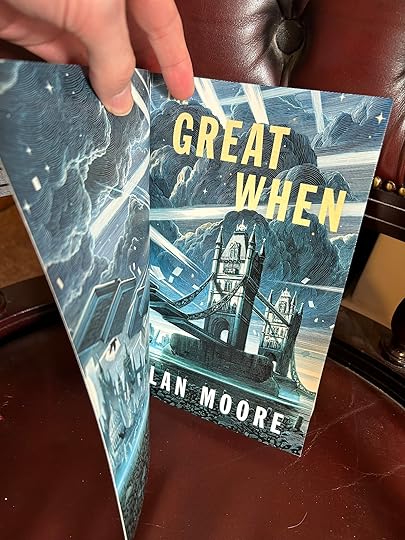
The Great When
A dark and beguiling tour through the streets of a magical London by the Sunday Times bestselling master of modern fantasy, Alan Moore
The year is 1949, the city London. Dennis Knuckleyard is a hapless eighteen-year-old who works and lives in a second-hand bookstore. One day, on an errand to retrieve rare books, Dennis discovers that one of them does not exist. It is a fictitious book, yet it is physically there in his hands nonetheless. How? It comes from the Great When, a dark and magical version of the city that is beyond time. There, epochs blend and realities and unrealities blur. If Dennis does not take this book back to the other London, he will be killed.
So begins a journey delving deep into the city's occult underbelly and tarrying with an eccentric cast of sorcerers, gangsters, and murderers, many of whom have their own nefarious intentions. Soon Dennis finds himself at the center of an explosive series of events that may alter and endanger both Londons.
Mystical, magnificently written and hilarious, The Great When is Moore's most imaginative work yet and the first in the fantastic new Long London series.
The year is 1949, the city London. Dennis Knuckleyard is a hapless eighteen-year-old who works and lives in a second-hand bookstore. One day, on an errand to retrieve rare books, Dennis discovers that one of them does not exist. It is a fictitious book, yet it is physically there in his hands nonetheless. How? It comes from the Great When, a dark and magical version of the city that is beyond time. There, epochs blend and realities and unrealities blur. If Dennis does not take this book back to the other London, he will be killed.
So begins a journey delving deep into the city's occult underbelly and tarrying with an eccentric cast of sorcerers, gangsters, and murderers, many of whom have their own nefarious intentions. Soon Dennis finds himself at the center of an explosive series of events that may alter and endanger both Londons.
Mystical, magnificently written and hilarious, The Great When is Moore's most imaginative work yet and the first in the fantastic new Long London series.
336 pages, Kindle Edition
First published October 1, 2024
About the author
Alan Moore
1,630 books22.3k followersAlan Moore is an English writer most famous for his influential work in comics, including the acclaimed graphic novels Watchmen, V for Vendetta and From Hell. He has also written a novel, Voice of the Fire, and performs "workings" (one-off performance art/spoken word pieces) with The Moon and Serpent Grand Egyptian Theatre of Marvels, some of which have been released on CD.
As a comics writer, Moore is notable for being one of the first writers to apply literary and formalist sensibilities to the mainstream of the medium. As well as including challenging subject matter and adult themes, he brings a wide range of influences to his work, from the literary–authors such as William S. Burroughs, Thomas Pynchon, Robert Anton Wilson and Iain Sinclair; New Wave science fiction writers such as Michael Moorcock; horror writers such as Clive Barker; to the cinematic–filmmakers such as Nicolas Roeg. Influences within comics include Will Eisner, Harvey Kurtzman, Jack Kirby and Bryan Talbot.
As a comics writer, Moore is notable for being one of the first writers to apply literary and formalist sensibilities to the mainstream of the medium. As well as including challenging subject matter and adult themes, he brings a wide range of influences to his work, from the literary–authors such as William S. Burroughs, Thomas Pynchon, Robert Anton Wilson and Iain Sinclair; New Wave science fiction writers such as Michael Moorcock; horror writers such as Clive Barker; to the cinematic–filmmakers such as Nicolas Roeg. Influences within comics include Will Eisner, Harvey Kurtzman, Jack Kirby and Bryan Talbot.
Ratings & Reviews
Friends & Following
Create a free account to discover what your friends think of this book!
Community Reviews
Displaying 1 - 30 of 849 reviews

December 6, 2024
My 17th book of the year - go me, that's a record since I've been keeping score!
https://mark---lawrence.blogspot.com/...
I first encountered Moore's work in the comic 2000AD back in the early '80s. He wrote some excellent and funny stuff for them (D.R and Quinch was my favourite).
And then there's Watchmen. Plus I've seen a number of the film adaptations of his work that he so objected to. And enjoyed them as well.
This was my first read of his long-form fiction. Moore's 71 years old and still plugging away, so there's hope for me yet. I don't have a retirement plan ... drinking seems like a poor hobby, and golf holds no appeal.
The Great When was a mixed bag for me, but much of what was in the mix was excellent, and none of it was bad.
Moore is a really fine wordsmith. He's dialled the language up to 9 on the literary scale here, and despite the fact that it's brilliantly done, that level of ornamentation and abstraction may just turn many fantasy readers off. People who thrive on plot and look for Brandon Sanderson levels of straight forward story-delivery prose, may stumble over Moore's work.
This isn't Ulysses level of barely penetrable prose, but it is approaching Salman Rushdie and exceeding the likes of Murakami Haruki for levels of linguistic complexity. His characters are very Dickensian, writ large. He's also funny in judicious amounts:
"Haltingly, Ada raised herself out of her chair with grunts and groans that made her seem like a forgotten triumph of nineteenth-century engineering."
Moore, in the acknowledgements nods to Moorcock and to Iain Sinclair for preceeding him with alternate / exaggerated Londons. He doesn't mention Neil Gaiman and his book Neverwhere, which seems a much closer and more obvious match -- but I guess Moore didn't read it.
The book centres on the idea of a (very distorted) mirror London, an underneath London, an 'upside down' London. One so wild and abstract that every visit to it reads like a dream sequence. I have to say that I don't really enjoy dream sequences. I don't enjoy prolonged abstract/symbolic description -- it has no grounding for me and rapidly becomes wearisome. Every time the characters in Zelazny's Amber books "ride through shadow", I'm tempted to skip to their destination. Maybe it's the difference between those of us who read the songs in fantasy books that have songs, and those that don't...
So, this is a point against the book for me. It feels like a fresh idea, but I've seen similar before, and this alternate London is such an LSD trip that I don't really enjoy any of the several ventures into it.
The time spent in "real" barely-post-war London is enjoyable. And this London is populated with some excellent characters with Coffin Ada coming top of the list and being responsible for this book holding the world record for number of times the word "cough" appears.
Another point against the book for me, and this is more of a genre thing, is the passivity and uselessness of the only point of view character. A bit like the main character in The Wind-Up Bird Chronicle (though admittedly less so), our man is moved around by the currents and events of the book and shows little initiative. He's mostly terrified. As I would be. And in literary fiction we're used to such characters - whereas in fantasy, we like our main characters to be more proactive and have more bite to them.
And the final point against the book, for me, is that it feels as if it ends about 75% of the way through - with the problems set up in the book dealt with in one way or another.
The remainder involves a twist that seems to come out of nowhere and serve no purpose other than to add to the wordcount.
So, to conclude: it's a book with wonderful literary prose, colourful Dickensian characters, a somewhat aimless plot about getting our MC out of trouble that he is randomly deposited in, some (for me) overdone dream-sequency visits to an alternative London that's reminiscent of (though more extreme than) some I've seen before, and a weird kind of stumble (for me) at the end.
So, depending on where you place importance in your reading, you will come away from the book with quite different opinions. For me, because I enjoyed the prose and the characters so much, I'm giving it 4*.
Join my Patreon
Join my 3-emails-a-year newsletter #prizes
...
https://mark---lawrence.blogspot.com/...
I first encountered Moore's work in the comic 2000AD back in the early '80s. He wrote some excellent and funny stuff for them (D.R and Quinch was my favourite).
And then there's Watchmen. Plus I've seen a number of the film adaptations of his work that he so objected to. And enjoyed them as well.
This was my first read of his long-form fiction. Moore's 71 years old and still plugging away, so there's hope for me yet. I don't have a retirement plan ... drinking seems like a poor hobby, and golf holds no appeal.
The Great When was a mixed bag for me, but much of what was in the mix was excellent, and none of it was bad.
Moore is a really fine wordsmith. He's dialled the language up to 9 on the literary scale here, and despite the fact that it's brilliantly done, that level of ornamentation and abstraction may just turn many fantasy readers off. People who thrive on plot and look for Brandon Sanderson levels of straight forward story-delivery prose, may stumble over Moore's work.
This isn't Ulysses level of barely penetrable prose, but it is approaching Salman Rushdie and exceeding the likes of Murakami Haruki for levels of linguistic complexity. His characters are very Dickensian, writ large. He's also funny in judicious amounts:
"Haltingly, Ada raised herself out of her chair with grunts and groans that made her seem like a forgotten triumph of nineteenth-century engineering."
Moore, in the acknowledgements nods to Moorcock and to Iain Sinclair for preceeding him with alternate / exaggerated Londons. He doesn't mention Neil Gaiman and his book Neverwhere, which seems a much closer and more obvious match -- but I guess Moore didn't read it.
The book centres on the idea of a (very distorted) mirror London, an underneath London, an 'upside down' London. One so wild and abstract that every visit to it reads like a dream sequence. I have to say that I don't really enjoy dream sequences. I don't enjoy prolonged abstract/symbolic description -- it has no grounding for me and rapidly becomes wearisome. Every time the characters in Zelazny's Amber books "ride through shadow", I'm tempted to skip to their destination. Maybe it's the difference between those of us who read the songs in fantasy books that have songs, and those that don't...
So, this is a point against the book for me. It feels like a fresh idea, but I've seen similar before, and this alternate London is such an LSD trip that I don't really enjoy any of the several ventures into it.
The time spent in "real" barely-post-war London is enjoyable. And this London is populated with some excellent characters with Coffin Ada coming top of the list and being responsible for this book holding the world record for number of times the word "cough" appears.
Another point against the book for me, and this is more of a genre thing, is the passivity and uselessness of the only point of view character. A bit like the main character in The Wind-Up Bird Chronicle (though admittedly less so), our man is moved around by the currents and events of the book and shows little initiative. He's mostly terrified. As I would be. And in literary fiction we're used to such characters - whereas in fantasy, we like our main characters to be more proactive and have more bite to them.
And the final point against the book, for me, is that it feels as if it ends about 75% of the way through - with the problems set up in the book dealt with in one way or another.
The remainder involves a twist that seems to come out of nowhere and serve no purpose other than to add to the wordcount.
So, to conclude: it's a book with wonderful literary prose, colourful Dickensian characters, a somewhat aimless plot about getting our MC out of trouble that he is randomly deposited in, some (for me) overdone dream-sequency visits to an alternative London that's reminiscent of (though more extreme than) some I've seen before, and a weird kind of stumble (for me) at the end.
So, depending on where you place importance in your reading, you will come away from the book with quite different opinions. For me, because I enjoyed the prose and the characters so much, I'm giving it 4*.
Join my Patreon
Join my 3-emails-a-year newsletter #prizes
...

June 23, 2024
Firstly - thanks to NetGalley for an ARC in exchange for an honest review.
Where do I begin with The Great When?
I cannot avoid talking about Moore's writing style. Or the narrator's choice of words. So often, nonsensical metaphors and similes detract so much from the story and goings-on, that it is difficult to get through the book.
Genuinely - I cannot emphasise enough how much unnecessary (and all too often incorrectly used and archaic) language frequented this story. There were periods in the first half of this book that had I not received an ARC and needed to submit a review for it, I'd have given up and DNFd.
That said, the pretentious writing seemed to ease off as we neared the final third, engrossing me in a well-paced narrative - which was an enjoyable tale of a young, impressionable, and slightly dense London lad who becomes embroiled in another fantastically grotesque world.
As a stand-alone story, this was good. Not great. I've read other aspects of Moore and love his Graphic Novels and comic-book writing, and having read some of his Illuminations: Stories , was immeasurably excited to get stuck into this.
Sorry, but this one was not for me. Hopefully, the other stories in The Long London Quintet are written with a smoother flow.
2.3/5
Where do I begin with The Great When?
I cannot avoid talking about Moore's writing style. Or the narrator's choice of words. So often, nonsensical metaphors and similes detract so much from the story and goings-on, that it is difficult to get through the book.
Genuinely - I cannot emphasise enough how much unnecessary (and all too often incorrectly used and archaic) language frequented this story. There were periods in the first half of this book that had I not received an ARC and needed to submit a review for it, I'd have given up and DNFd.
That said, the pretentious writing seemed to ease off as we neared the final third, engrossing me in a well-paced narrative - which was an enjoyable tale of a young, impressionable, and slightly dense London lad who becomes embroiled in another fantastically grotesque world.
As a stand-alone story, this was good. Not great. I've read other aspects of Moore and love his Graphic Novels and comic-book writing, and having read some of his Illuminations: Stories , was immeasurably excited to get stuck into this.
Sorry, but this one was not for me. Hopefully, the other stories in The Long London Quintet are written with a smoother flow.
2.3/5

October 26, 2024
The prologue will filter out most of those potential readers for whom the book will be intolerable, with its thick, adjective-laden and -leaden prose, frequently straining clarity, across multiple short sections, pompously assigned various orchestral sections.
If that doesn't do it, the book proper's opening on a botched masturbatory episode will seal the deal.
But if you last that long, it shifts into something more engaging and personable. Sad sack eighteen-year-old Dennis Knuckleyard, orphan, virgin, no prospects, is stuck living with and working for musty bookshop owner Coffin cough cough cough cough cough Ada in post-war London and, as per the book blurb, stumbles into a deadly scenario when he comes into possession of a book which does not exist.
There is more writing than story, if you know what I mean. The prose is anything but terse, but neither is it out of control. It's rife with original metaphor and pointed characterization and loaded alternate descriptors, but I found it all apt on consideration, and it stuffs the book with colour and commentary far beyond its rather straightforward storyline. Names that seem hackneyed and try-hard grow to earn their status. I found much of the content set in 1949 allegorical for contemporary life, and I'm the last person to ever spot anything like allegory. What is at first dense and challenges comprehension becomes enjoyable and illustrative, and surprisingly funny in certain moments.
But then comes the Long London with its extended italicized segments . . . these continue for pages upon pages . . . at first it's only a chunk of six which is bad enough but later it happens again for seventeen pages and then thirteen again still later . . . these portions ramp up the prose poetry and rampant verbosity . . . certainly the use of ellipses in place of periods or commas doesn't help . . . nor the elimination of capital letters to open sentences . . . when I see a section like this I immediately have to flip ahead to see how long it continues . . . I also have ask if I truly must read it . . . unfortunately I determined that these pages were vital to the story and skimming would be detrimental . . . and lamentably I must acknowledge their effectiveness at conveying the disorientation and otherworldliness that is their intent and then I felt like Dennis felt.
This book helped me appreciate Alan Moore more. Previous bits I've heard and especially his author photo gave me the impression of someone I would never want to spend a minute with, and the book's opening didn't help that image much, but as the book went on and the writing won me over, it humanized him for me, as did his acknowledgements section. If you enjoy it, the book points to other potential reads: the very real The Cosy Room and Other Stories by Arthur Machen, which includes the story "N" from which this book's non-book originates; non-1984 George Orwell; possibly others although Moore's devoted praise of Brian Catling's The Vorrh is not enough to make me consider reading it when held up against the sum of its other reviews.
I rather dislike the book's placement as part of a series at the outset, particularly a quintet. It's perfectly standalone book. The thought of more of them, though, adds unnecessary burden to the reading. It was enough that I came to agree with the book's qualities despite my best efforts, but asking me to be on board for four more of it is a bridge too far.
If that doesn't do it, the book proper's opening on a botched masturbatory episode will seal the deal.
But if you last that long, it shifts into something more engaging and personable. Sad sack eighteen-year-old Dennis Knuckleyard, orphan, virgin, no prospects, is stuck living with and working for musty bookshop owner Coffin cough cough cough cough cough Ada in post-war London and, as per the book blurb, stumbles into a deadly scenario when he comes into possession of a book which does not exist.
There is more writing than story, if you know what I mean. The prose is anything but terse, but neither is it out of control. It's rife with original metaphor and pointed characterization and loaded alternate descriptors, but I found it all apt on consideration, and it stuffs the book with colour and commentary far beyond its rather straightforward storyline. Names that seem hackneyed and try-hard grow to earn their status. I found much of the content set in 1949 allegorical for contemporary life, and I'm the last person to ever spot anything like allegory. What is at first dense and challenges comprehension becomes enjoyable and illustrative, and surprisingly funny in certain moments.
But then comes the Long London with its extended italicized segments . . . these continue for pages upon pages . . . at first it's only a chunk of six which is bad enough but later it happens again for seventeen pages and then thirteen again still later . . . these portions ramp up the prose poetry and rampant verbosity . . . certainly the use of ellipses in place of periods or commas doesn't help . . . nor the elimination of capital letters to open sentences . . . when I see a section like this I immediately have to flip ahead to see how long it continues . . . I also have ask if I truly must read it . . . unfortunately I determined that these pages were vital to the story and skimming would be detrimental . . . and lamentably I must acknowledge their effectiveness at conveying the disorientation and otherworldliness that is their intent and then I felt like Dennis felt.
This book helped me appreciate Alan Moore more. Previous bits I've heard and especially his author photo gave me the impression of someone I would never want to spend a minute with, and the book's opening didn't help that image much, but as the book went on and the writing won me over, it humanized him for me, as did his acknowledgements section. If you enjoy it, the book points to other potential reads: the very real The Cosy Room and Other Stories by Arthur Machen, which includes the story "N" from which this book's non-book originates; non-1984 George Orwell; possibly others although Moore's devoted praise of Brian Catling's The Vorrh is not enough to make me consider reading it when held up against the sum of its other reviews.
I rather dislike the book's placement as part of a series at the outset, particularly a quintet. It's perfectly standalone book. The thought of more of them, though, adds unnecessary burden to the reading. It was enough that I came to agree with the book's qualities despite my best efforts, but asking me to be on board for four more of it is a bridge too far.

October 4, 2024
My first novel by Alan Moore. Not my first story by him, mind you, but my first novel. Back when Jerusalem came out, I was almost drowned in a gushing flood of praise and awe by my wingman buddy-reader but so far, I haven't touched it. Not because long books are daunting (I read GRRM, Brandon Sanderson and Stephen King amongst others). Now, after this book thrust itself at me (long story), I find out they might be connected. *sighs* Authors. Fuckers, the whole lot of them, I'm telling you! ;P
We start off on this journey in post-WW2 London where we meet Dennis. Dennis is ... well, there is no kinder way to put it ... not the brightest candle on the cake. He's not really dumb, per se, just not ambitious or curious or driven in any other sort of way. It might, of course, be the post-war depression and having to witness almost unspeakable destruction thanks to the German Luftwaffe.
Dennis works in a run-down bookshop in what is left of a realtively run-down street for a fierce and frightful woman called Ada, who knows how to ... erm ... handle herself and her enemies. But when Dennis brings back a book that shouldn't exist in our world from an errand she had sent him on, even the old lady freaks - which frightens Dennis all the more.
Put out into the street with a huge target on his back, the young fool finds out that there is another London, a parallel place of sorts that is familiar enough to be recognizable as London, but askew enough to be terrifying what with all the weird creatures, magic and whatnot.
Thus a quest from one London to the other and back starts, during which Dennis simply tries to stay alive and perhaps, some way, get rid of the bloody book! *lol*
He is aided in his endeavors by some, most notably (in my opinion) by a certain fruit-and-veggie seller, threatened and hunted by others.
So. The story, is wild! Sure, a number of elements are familiar enough as to be recognizable from other fantasy settings but Moore-ish enough to be their own thing entirely (see what he did there? yep!). The magic system and inhabitants of both Londons are very memorable and life-like, there is nobody who is just background decoration any more than there is any "baby fat" to the story or worldbuilding.
Was it a bit long, at times, following the hapless Dennis around? Yep, I've admitted as much in one of my status updates. However, considering the character and events he's been subjected to, that actually fit as well. Besides, for me at least, it wasn't about Dennis. It's about the book(s), the other world, the magic, people like Blinker of whom I couldn't get enough.
And I'm sure that upon a closer inspection (as soon as I have my hardcover which I ordered in a special edition just now), there will be many more details that only reveal themselves upon re-reading this book. Seriously, it's like a Wimmelbuch (hidden object book)! The author used an almost otherworldly blend of real-world history and magic so while we met people made from wood, we also learned about the horrors of WW2 and after (you don't just flick a switch after "winning", you have the fallout and everything) and what the city as well as her people were like, what they had to do to survive. I LOVED that blend, honestly. I loved the attention to detail and have a deep respect for the amount of research that must have gone into this fantasy book!
It didn't hurt that there seems to be a connection to the tarot (an element wonderfully fit to enhance any fantasy novel if the author is crafty enough).
Utterly hooked? Yep. You could say that I am. Can't wait to find out more although this would almost work as a standalone, too!
We start off on this journey in post-WW2 London where we meet Dennis. Dennis is ... well, there is no kinder way to put it ... not the brightest candle on the cake. He's not really dumb, per se, just not ambitious or curious or driven in any other sort of way. It might, of course, be the post-war depression and having to witness almost unspeakable destruction thanks to the German Luftwaffe.
Dennis works in a run-down bookshop in what is left of a realtively run-down street for a fierce and frightful woman called Ada, who knows how to ... erm ... handle herself and her enemies. But when Dennis brings back a book that shouldn't exist in our world from an errand she had sent him on, even the old lady freaks - which frightens Dennis all the more.
Put out into the street with a huge target on his back, the young fool finds out that there is another London, a parallel place of sorts that is familiar enough to be recognizable as London, but askew enough to be terrifying what with all the weird creatures, magic and whatnot.
Thus a quest from one London to the other and back starts, during which Dennis simply tries to stay alive and perhaps, some way, get rid of the bloody book! *lol*
He is aided in his endeavors by some, most notably (in my opinion) by a certain fruit-and-veggie seller, threatened and hunted by others.
So. The story, is wild! Sure, a number of elements are familiar enough as to be recognizable from other fantasy settings but Moore-ish enough to be their own thing entirely (see what he did there? yep!). The magic system and inhabitants of both Londons are very memorable and life-like, there is nobody who is just background decoration any more than there is any "baby fat" to the story or worldbuilding.
Was it a bit long, at times, following the hapless Dennis around? Yep, I've admitted as much in one of my status updates. However, considering the character and events he's been subjected to, that actually fit as well. Besides, for me at least, it wasn't about Dennis. It's about the book(s), the other world, the magic, people like Blinker of whom I couldn't get enough.
And I'm sure that upon a closer inspection (as soon as I have my hardcover which I ordered in a special edition just now), there will be many more details that only reveal themselves upon re-reading this book. Seriously, it's like a Wimmelbuch (hidden object book)! The author used an almost otherworldly blend of real-world history and magic so while we met people made from wood, we also learned about the horrors of WW2 and after (you don't just flick a switch after "winning", you have the fallout and everything) and what the city as well as her people were like, what they had to do to survive. I LOVED that blend, honestly. I loved the attention to detail and have a deep respect for the amount of research that must have gone into this fantasy book!
It didn't hurt that there seems to be a connection to the tarot (an element wonderfully fit to enhance any fantasy novel if the author is crafty enough).
Utterly hooked? Yep. You could say that I am. Can't wait to find out more although this would almost work as a standalone, too!

Did Not Finish
October 19, 2024DNF na dziesiątej stronie. A czytałam je przez tydzień. Dam szansę, jeśli wyjdzie po polsku, chociaż już współczuję tłumaczowi. Wydawało mi się, że angielski to mój drugi język, ale Moore chyba specjalnie wyszukuje najbardziej niepopularne synonimy w słownikach, bo nic z tego nie rozumiem. Albo to jest po prostu trudne, albo to pretensjonalny bełkot.

Read
May 11, 2024After his first novel did the span of human history without leaving Northampton, and the second took in Heaven, Hell and beyond while largely confining itself to Moore's own neighbourhood, I'd assumed the acknowledged third would be the multiverse as applied to his kitchen, but no; instead we get the first of a projected quintet set in London, or rather Londons. I say all of this observing the polite fiction that What We Can Know About Thunderman wasn't a novel, of course, even though 240 pages is no more a novella than it's my aunt, but in fact The Great When has definite similarities to that one. Not that Jerusalem in particular was free of grubbiness - remember the way that, as it ranged back and forth in time and space, we kept glimpsing that one trodden-on turd? But the exhausted post-War London here, half of it bombed flat and the rest so shabby and seamy it might as well have been, definitely reminded me of the determinedly sordid mood of Thunderman. There's even another spectacularly mortifying wank mag scene, albeit only one this time, rather than geological accumulations of the sods.
Still, that instance of restraint is rare. Sometimes, the excess is absolutely deliberate; whenever we're in Long London, the Fire to our world's Smoke, the intentionally overstuffed prose does an exuberant job of conveying the sheer too-much-ness that threatens to overwhelm unprepared mortal minds. But for that effect to fully come off, Moore would need to rein himself in on the Short London scenes. And, sure, if Alan Moore had once in his life thought 'Is this a bit much?', then he'd probably never have remade a whole medium, so to some extent following his work is all about taking the rough with the smooth. Obviously, lots of what he comes up with does work, because, as we've established, he's Alan bloody Moore. But the profusion risks swamping the dynamics of the novel, not to mention the reader. Every so often there's an absolute clunker of an image; even if you are referring to the progress of a racing tipster who presents himself as exotic royalty, "as stately and involved with gambling as a riverboat" is always going to be an awkward phrase - and yes, this is the worst offender, and yes, it is during a Long London scene, but even so. Elsewhere, little details of the time (salt instead of toothpaste, for instance) sometimes feel crowbarred in; foreshadowing the present in historical novels is always a minefield, and this one keeps losing its feet; most surprisingly, a few times characters deliver exposition to camera in speeches that feel oddly clumsy for how much experience Moore has had getting away with explaining far sillier situations in less forgiving formats over the years.
Or perhaps the exposition felt more glaring to me because I already knew a fair chunk of it. Even in the prologue, with Crowley and Dion Fortune, and the apocalyptic erasing of Cripplegate, I was often on familiar turf, whereas when I'm in Moore's Northampton, I'm being led around terra incognita by a native. I'm aware this is a deeply ungrateful diamond shoes sort of complaint, especially given From Hell was one of my starter texts in the occult history of London, but once the plot proper starts, with heavy reference to Arthur Machen and especially his story N, I started to get twitchy. Oh no, one of my favourite living writers is addressing one of my favourite topics, with particular attention to one of my favourite stories by one of my favourite dead writers! I must be consoled immediately! Part of the problem, obviously, is that since From Hell, there has been some heavy traffic on those ley lines, Gaiman and Mieville only two of the more obvious names to have given us mystical reflected Londons into which the unwary might stumble. When we're back in regular London, the starting point is the book trade, and that just recalls Moore's old mucker Iain Sinclair (credited in the delightful acknowledgements, obviously, alongside Michael Moorcock, one of whose districts is on loan for a couple of cameos). To some extent this feels deliberate; part of Moore's genius has always been polishing up existing materials and finding new life in them, and part of the idea of Long London is that everyone's London is secondhand, third, more, overlaid by every half-remembered tale of the city, which between them are far more real than the mere stones of the place. But even so, and of course this may change in subsequent books, at this point I'm still feeling the familiarity more than the fresh angles.
Exacerbating that, we have the characters. Given the long grudges nursed against Moore by some, I suspect a lot of the criticism will focus on the women, what with the two main female characters being a gargoyle of a landlady, and a gorgeous streetwalker with a heart of gold. But the men, historical and mythical figures aside, are also straight out of central casting, and for the most part reveal fewer further nuances as the novel progresses: the hangdog hack, the witty barrister, and of course our gawky lead, Dennis Knuckleyard. I won't say that he's the least convincing of the lot; yes, it might seem a stretch that he can remember odd little folkloric details he once heard, at the same time as getting instructions on things he absolutely must or must not do back to front, but I have met (and indeed married) the ADHD, so regretfully, I can believe that. But fundamentally, I'm not sure that hapless leads play to Moore's strengths. Or at least, not leads openly presented as hapless; plenty of his previous protagonists were eventually revealed as such, but that's a very different proposition. Obviously there's an element of flipping that here, a fairly straightforward hero's journey under all the debris and urban psychohistory, but he can still be exasperating company at times, and never more so than at the end when his apparent trajectory is brought down to earth by what looks a lot like a punchline that undercuts the story, crossed with a reset button.
That's after the resolution of a second plot, which takes up the slack in the book's final third, once the introductory one has been resolved, and which I suspect will feel familiar to more readers than just the Machen fans. And as I write that, I realise how negative a lot of this review has been. Yeah, it's not the best Alan Moore novel - but that's an extremely high bar, and (as long as we remember Thunderman) it's certainly not the worst either. There's plenty here that's insightful, funny, beautiful, chilling - even some that are all four at once (an extended bit of business with a knife comes to mind). I'm definitely going to give the series one more book, and almost certainly all four, especially after the teasing flash-forward in the epilogue. I just hold wizards to higher standards than everyday writers.
(Netgalley ARC)
Still, that instance of restraint is rare. Sometimes, the excess is absolutely deliberate; whenever we're in Long London, the Fire to our world's Smoke, the intentionally overstuffed prose does an exuberant job of conveying the sheer too-much-ness that threatens to overwhelm unprepared mortal minds. But for that effect to fully come off, Moore would need to rein himself in on the Short London scenes. And, sure, if Alan Moore had once in his life thought 'Is this a bit much?', then he'd probably never have remade a whole medium, so to some extent following his work is all about taking the rough with the smooth. Obviously, lots of what he comes up with does work, because, as we've established, he's Alan bloody Moore. But the profusion risks swamping the dynamics of the novel, not to mention the reader. Every so often there's an absolute clunker of an image; even if you are referring to the progress of a racing tipster who presents himself as exotic royalty, "as stately and involved with gambling as a riverboat" is always going to be an awkward phrase - and yes, this is the worst offender, and yes, it is during a Long London scene, but even so. Elsewhere, little details of the time (salt instead of toothpaste, for instance) sometimes feel crowbarred in; foreshadowing the present in historical novels is always a minefield, and this one keeps losing its feet; most surprisingly, a few times characters deliver exposition to camera in speeches that feel oddly clumsy for how much experience Moore has had getting away with explaining far sillier situations in less forgiving formats over the years.
Or perhaps the exposition felt more glaring to me because I already knew a fair chunk of it. Even in the prologue, with Crowley and Dion Fortune, and the apocalyptic erasing of Cripplegate, I was often on familiar turf, whereas when I'm in Moore's Northampton, I'm being led around terra incognita by a native. I'm aware this is a deeply ungrateful diamond shoes sort of complaint, especially given From Hell was one of my starter texts in the occult history of London, but once the plot proper starts, with heavy reference to Arthur Machen and especially his story N, I started to get twitchy. Oh no, one of my favourite living writers is addressing one of my favourite topics, with particular attention to one of my favourite stories by one of my favourite dead writers! I must be consoled immediately! Part of the problem, obviously, is that since From Hell, there has been some heavy traffic on those ley lines, Gaiman and Mieville only two of the more obvious names to have given us mystical reflected Londons into which the unwary might stumble. When we're back in regular London, the starting point is the book trade, and that just recalls Moore's old mucker Iain Sinclair (credited in the delightful acknowledgements, obviously, alongside Michael Moorcock, one of whose districts is on loan for a couple of cameos). To some extent this feels deliberate; part of Moore's genius has always been polishing up existing materials and finding new life in them, and part of the idea of Long London is that everyone's London is secondhand, third, more, overlaid by every half-remembered tale of the city, which between them are far more real than the mere stones of the place. But even so, and of course this may change in subsequent books, at this point I'm still feeling the familiarity more than the fresh angles.
Exacerbating that, we have the characters. Given the long grudges nursed against Moore by some, I suspect a lot of the criticism will focus on the women, what with the two main female characters being a gargoyle of a landlady, and a gorgeous streetwalker with a heart of gold. But the men, historical and mythical figures aside, are also straight out of central casting, and for the most part reveal fewer further nuances as the novel progresses: the hangdog hack, the witty barrister, and of course our gawky lead, Dennis Knuckleyard. I won't say that he's the least convincing of the lot; yes, it might seem a stretch that he can remember odd little folkloric details he once heard, at the same time as getting instructions on things he absolutely must or must not do back to front, but I have met (and indeed married) the ADHD, so regretfully, I can believe that. But fundamentally, I'm not sure that hapless leads play to Moore's strengths. Or at least, not leads openly presented as hapless; plenty of his previous protagonists were eventually revealed as such, but that's a very different proposition. Obviously there's an element of flipping that here, a fairly straightforward hero's journey under all the debris and urban psychohistory, but he can still be exasperating company at times, and never more so than at the end when his apparent trajectory is brought down to earth by what looks a lot like a punchline that undercuts the story, crossed with a reset button.
That's after the resolution of a second plot, which takes up the slack in the book's final third, once the introductory one has been resolved, and which I suspect will feel familiar to more readers than just the Machen fans. And as I write that, I realise how negative a lot of this review has been. Yeah, it's not the best Alan Moore novel - but that's an extremely high bar, and (as long as we remember Thunderman) it's certainly not the worst either. There's plenty here that's insightful, funny, beautiful, chilling - even some that are all four at once (an extended bit of business with a knife comes to mind). I'm definitely going to give the series one more book, and almost certainly all four, especially after the teasing flash-forward in the epilogue. I just hold wizards to higher standards than everyday writers.
(Netgalley ARC)

April 7, 2025
DNF
I was fighting for my life by page 5. Incomprehensible.
I was fighting for my life by page 5. Incomprehensible.
June 20, 2024
Strange, stylish, and often utterly incomprehensible.

December 19, 2024
This one wasn't for me.
The way it was written seemed very long winded, flowery and pretentious.
It's a shame because the blurb made it sound good but the book itself was disappointing.
The way it was written seemed very long winded, flowery and pretentious.
It's a shame because the blurb made it sound good but the book itself was disappointing.

September 14, 2024
*The Great When* is set in 1949 London, where Dennis Knuckleyard, a hapless eighteen-year-old working in a second-hand bookshop, stumbles upon a novel that shouldn’t exist. The book he finds is fictional, a creation from another novel, yet somehow it physically exists in his hands. This strange book originates from the "Great When," a magical, timeless version of London where reality blurs with fiction, and abstract concepts like Crime and Poetry take on physical form as terrifying, wondrous beings. However, this magical London must remain hidden. If Dennis doesn’t return the book to its rightful place, the consequences could be disastrous—even to the extent of having his body turned inside out.
While the premise is fascinating, the first 100 pages can feel slow. Moore’s command of the English language is undeniable; his prose is lush, almost to the point of excess, with constant reminders of his linguistic prowess. As Dennis ventures into the Great When, it’s hard not to draw comparisons to other magical versions of London, such as Neil Gaiman’s *Neverwhere* or China Miéville’s *The City & the City*. But this is Alan Moore, a writer known for taking familiar concepts and turning them on their head. *The Great When* is no exception, with moments reminiscent of *The League of Extraordinary Gentlemen*, blending literary history and folklore with urban realities.
The plot centres around a fictional book mentioned in Arthur Machen's real-life work *N*, which mysteriously comes to life within this story. This is classic Alan Moore: a metafictional twist embedded within a work of fiction. Then there's Long London, the mystical realm of the title, a place as unsettling as it is intellectually stimulating.
Despite some pacing issues, *The Great When* is a rich and imaginative work, one of my favourite books of the year.
My thanks to both NetGalley and the publishers Bloomsbury for a free e-arc and an honest opinion.
While the premise is fascinating, the first 100 pages can feel slow. Moore’s command of the English language is undeniable; his prose is lush, almost to the point of excess, with constant reminders of his linguistic prowess. As Dennis ventures into the Great When, it’s hard not to draw comparisons to other magical versions of London, such as Neil Gaiman’s *Neverwhere* or China Miéville’s *The City & the City*. But this is Alan Moore, a writer known for taking familiar concepts and turning them on their head. *The Great When* is no exception, with moments reminiscent of *The League of Extraordinary Gentlemen*, blending literary history and folklore with urban realities.
The plot centres around a fictional book mentioned in Arthur Machen's real-life work *N*, which mysteriously comes to life within this story. This is classic Alan Moore: a metafictional twist embedded within a work of fiction. Then there's Long London, the mystical realm of the title, a place as unsettling as it is intellectually stimulating.
Despite some pacing issues, *The Great When* is a rich and imaginative work, one of my favourite books of the year.
My thanks to both NetGalley and the publishers Bloomsbury for a free e-arc and an honest opinion.
September 24, 2024
I received a ARC of The Great When in a Goodreads Giveaway. Thank you to the author and publisher; it’s much appreciated.
What a wild ride. I haven’t read a fantasy novel this imaginative in ages. My only problem is the purple prose. Well, not full on purple, but maybe a bit mallow. I love Dennis Knuckleyard’s foibles, adventures and of course his really appealing name. Each character is weirder than the last and I love them all. I definitely recommend!
What a wild ride. I haven’t read a fantasy novel this imaginative in ages. My only problem is the purple prose. Well, not full on purple, but maybe a bit mallow. I love Dennis Knuckleyard’s foibles, adventures and of course his really appealing name. Each character is weirder than the last and I love them all. I definitely recommend!

April 27, 2025
3,75 / 5
Esta primera parte de la pentalogía Londres Eterno, titulada "El gran cuando", es como "Neverwhere" pasada por el filtro de alucinógenos y sabiduría ocultista de Alan Moore. Sobrescribiendo lo literario y lo histórico, con regustos a La liga de los hombres extraordinarios y el enfoque fantasmagórico de la historia de Londres de From Hell, El Gran Cuando es una captura en el tiempo sobre el crimen moderno repleta de humor anárquico, antiimperialismo, cameos históricos, filosofía ocultista y muchos juegos verbales. Un retrato inquieto y atemporal de la historia de Londres de los años 40, tras una devastadora Segunda Guerra Mundial donde la psique británica se vio gravemente perturbada.
Debemos devolver ese libro, Dennis Knuckleyard
El adolescente aprendiz de librero Dennis Knuckleyard ve su anodino y triste mundo trastocado cuando Ada la Ataud, su jefa, le envía a por una colección de libros extraños a otra librería. Sin embargo, allí se topa con un libro que no debería existir (un tomo supuestamente ficticio cuya única existencia se creía que era una breve mención en un cuento de Arthur Machen), y cuya mera posesión pone al joven Dennis en un peligro considerable e involuntario por parte de aquellos que lo codician. Este misterioso libro abre una puerta a otro Londres, un Londres oculto, iniciando a Dennis en una realidad surrealista y ocasionalmente letal, donde las calles están pavimentadas con oro, las tuberías de desagüe se convierten en boas constrictoras y la palabra equivocada para un gato de aspecto inofensivo puede hacer que te revuelvan las entrañas. Devolver el libro a donde pertenece será un peligro de alto riesgo, pero la única forma de solucionarlo todo para Dennis.
Neverwhere alucinógena y ocultista
Hemos visto, a lo largo de la historia literaria, unos cuantos “otros” Londres. Los Ríos de Londres de Ben Aaranovitch, La materia oscura de Philip Pullman o el Jonathan Strange & el señor Norrell de Susanna Clarke. Sin embargo, este El gran cuando de Alan Moore está mucho más cercano a ser una especie de Neverwhere pasado por un filtro febril de alucinógenos y ocultismo. Este londres hiperreal, plagado de los residuos de la literatura pulp, es un lugar fantasmal y mutante donde habitan seres de todo tipo más cercanos a las ficciones de J. G. Ballard o Ian Sinclair. Parecido a su Mundo Ardiente —una especie de refugio para personajes ficticios en nuestro vasto mundo— de La liga de los hombres extraordinarios y plagado de algunos arquetipos literarios e históricos que parecen sacados de el Sueño de Sandman, este Londres Eterno de Moore se siente como el cimiento imaginario que sustenta la realidad material de la ciudad. La membrana entre lo físico y lo ficticio se vuelve semipermeable en la novela conforme pasan las páginas, y su frontera, parece cada vez más difusa.
Todo este Londres Eterno y sus contactos esta remarcado en la novela con unas cursivas que pretenden sacarnos del marco habitual de la novela. Así, las visitas de Dennis a este otro Londres se sienten como encontrarse en un estado diferente, incierto, donde cualquier cosa puede pasar. Al igual que demuestra la Saga de los niños descarriados de Seanan McGuire, cualquier contacto con un universo de fantasía puede ser devastador. Si algo hace Moore es mostrar esas consecuencias inmediatas (sobre todo en las reacciones de sus personajes) cuando visitan ese hogar de la imaginación donde habitan la esencia de las cosas. El Gran Cuando tiene elementos londinenses reconocibles (la famosa batalla callejera contra los fascistas, por ejemplo), pero tan distorsionados y perturbadores a nuestros ojos, que a veces parecen un viaje surrealista de ácido complicado de discernir.
Somos historias que nos contamos historias
Como el propio autor lo expresa en el epílogo del libro: «Todo está hecho de historia». Ya lo decía hace poco en la reseña de Verde de Ramiro Sanchiz, somos la historia que nos contamos, la que otros cuentan sobre nosotros y la que recordamos. Creamos nuestro mundo con nuestras propias palabras, pero ese mundo, de alguna manera, también nos moldea y nos crea a nosotros. El mundo de Moore, ese otro Londres alternativo, cuenta historias con sumo detalle de diversas partes de Londres y de los curiosos personajes que lo habitan. El texto, repleto de juegos de palabras, adjetivos rebuscados en un guerra con los clichés y una verbosidad incandescente, nos induce una especie de estado comatoso repleto de imágenes memorables y sinónimos sin parangón. Moore, que toma siempre el camino más largo para llegar hacia algún lugar, nos sumerge en los detalles, con florituras y filigranas, en un estilo de lo más barroco pero que a la vez lúdico. Sin embargo, cuando se entrecruza el elemento surrealista de El Gran Cuando, Moore parece perderse entre las impactantes imágenes que crea, como si estuviera describiendo alguno de sus famosos paneles de cómic.
Esta primera parte de la pentalogía del Londres Eterno puede pecar —en ocasiones— de ser demasiado introductoria y explicativa. Hay mucha exposición y divagación sobre términos teológicos, pudiendo resultar a veces intermitente y difícil de seguir, pese a que la trama es más bien sencilla. Las escenas, por no hablar de los momentos importantes, son verdaderamente desbordantes para el lector. Sin embargo, Moore consigue centrarse e iluminar todo con su extraña habilidad visual. Con cierto carácter dickensiano, la aventura de Dennis Knuckleyard sirve a Moore para contar a su manera parte de la historia de Londres a la vez que entabla una conversación (real e imaginada) con muchos personajes históricos. Menciones pasajeras y discusiones sobre gente como Arthur Machen, Aleister Crowley, George Orwell, Ana Bolena y muchos más comparten espacio en el texto. Moore está interesado en contar con todos aquellos que han dado forma a la política, la historia y la cultura de Londres a la vez que viaja (y nos lleva) por esa ciudad, esa Londres, como nunca antes la has visto.
Reseña completa en el blog: https://boywithletters.blogspot.com/2...
Esta primera parte de la pentalogía Londres Eterno, titulada "El gran cuando", es como "Neverwhere" pasada por el filtro de alucinógenos y sabiduría ocultista de Alan Moore. Sobrescribiendo lo literario y lo histórico, con regustos a La liga de los hombres extraordinarios y el enfoque fantasmagórico de la historia de Londres de From Hell, El Gran Cuando es una captura en el tiempo sobre el crimen moderno repleta de humor anárquico, antiimperialismo, cameos históricos, filosofía ocultista y muchos juegos verbales. Un retrato inquieto y atemporal de la historia de Londres de los años 40, tras una devastadora Segunda Guerra Mundial donde la psique británica se vio gravemente perturbada.
Debemos devolver ese libro, Dennis Knuckleyard
El adolescente aprendiz de librero Dennis Knuckleyard ve su anodino y triste mundo trastocado cuando Ada la Ataud, su jefa, le envía a por una colección de libros extraños a otra librería. Sin embargo, allí se topa con un libro que no debería existir (un tomo supuestamente ficticio cuya única existencia se creía que era una breve mención en un cuento de Arthur Machen), y cuya mera posesión pone al joven Dennis en un peligro considerable e involuntario por parte de aquellos que lo codician. Este misterioso libro abre una puerta a otro Londres, un Londres oculto, iniciando a Dennis en una realidad surrealista y ocasionalmente letal, donde las calles están pavimentadas con oro, las tuberías de desagüe se convierten en boas constrictoras y la palabra equivocada para un gato de aspecto inofensivo puede hacer que te revuelvan las entrañas. Devolver el libro a donde pertenece será un peligro de alto riesgo, pero la única forma de solucionarlo todo para Dennis.
Neverwhere alucinógena y ocultista
Hemos visto, a lo largo de la historia literaria, unos cuantos “otros” Londres. Los Ríos de Londres de Ben Aaranovitch, La materia oscura de Philip Pullman o el Jonathan Strange & el señor Norrell de Susanna Clarke. Sin embargo, este El gran cuando de Alan Moore está mucho más cercano a ser una especie de Neverwhere pasado por un filtro febril de alucinógenos y ocultismo. Este londres hiperreal, plagado de los residuos de la literatura pulp, es un lugar fantasmal y mutante donde habitan seres de todo tipo más cercanos a las ficciones de J. G. Ballard o Ian Sinclair. Parecido a su Mundo Ardiente —una especie de refugio para personajes ficticios en nuestro vasto mundo— de La liga de los hombres extraordinarios y plagado de algunos arquetipos literarios e históricos que parecen sacados de el Sueño de Sandman, este Londres Eterno de Moore se siente como el cimiento imaginario que sustenta la realidad material de la ciudad. La membrana entre lo físico y lo ficticio se vuelve semipermeable en la novela conforme pasan las páginas, y su frontera, parece cada vez más difusa.
Todo este Londres Eterno y sus contactos esta remarcado en la novela con unas cursivas que pretenden sacarnos del marco habitual de la novela. Así, las visitas de Dennis a este otro Londres se sienten como encontrarse en un estado diferente, incierto, donde cualquier cosa puede pasar. Al igual que demuestra la Saga de los niños descarriados de Seanan McGuire, cualquier contacto con un universo de fantasía puede ser devastador. Si algo hace Moore es mostrar esas consecuencias inmediatas (sobre todo en las reacciones de sus personajes) cuando visitan ese hogar de la imaginación donde habitan la esencia de las cosas. El Gran Cuando tiene elementos londinenses reconocibles (la famosa batalla callejera contra los fascistas, por ejemplo), pero tan distorsionados y perturbadores a nuestros ojos, que a veces parecen un viaje surrealista de ácido complicado de discernir.
Somos historias que nos contamos historias
Como el propio autor lo expresa en el epílogo del libro: «Todo está hecho de historia». Ya lo decía hace poco en la reseña de Verde de Ramiro Sanchiz, somos la historia que nos contamos, la que otros cuentan sobre nosotros y la que recordamos. Creamos nuestro mundo con nuestras propias palabras, pero ese mundo, de alguna manera, también nos moldea y nos crea a nosotros. El mundo de Moore, ese otro Londres alternativo, cuenta historias con sumo detalle de diversas partes de Londres y de los curiosos personajes que lo habitan. El texto, repleto de juegos de palabras, adjetivos rebuscados en un guerra con los clichés y una verbosidad incandescente, nos induce una especie de estado comatoso repleto de imágenes memorables y sinónimos sin parangón. Moore, que toma siempre el camino más largo para llegar hacia algún lugar, nos sumerge en los detalles, con florituras y filigranas, en un estilo de lo más barroco pero que a la vez lúdico. Sin embargo, cuando se entrecruza el elemento surrealista de El Gran Cuando, Moore parece perderse entre las impactantes imágenes que crea, como si estuviera describiendo alguno de sus famosos paneles de cómic.
Esta primera parte de la pentalogía del Londres Eterno puede pecar —en ocasiones— de ser demasiado introductoria y explicativa. Hay mucha exposición y divagación sobre términos teológicos, pudiendo resultar a veces intermitente y difícil de seguir, pese a que la trama es más bien sencilla. Las escenas, por no hablar de los momentos importantes, son verdaderamente desbordantes para el lector. Sin embargo, Moore consigue centrarse e iluminar todo con su extraña habilidad visual. Con cierto carácter dickensiano, la aventura de Dennis Knuckleyard sirve a Moore para contar a su manera parte de la historia de Londres a la vez que entabla una conversación (real e imaginada) con muchos personajes históricos. Menciones pasajeras y discusiones sobre gente como Arthur Machen, Aleister Crowley, George Orwell, Ana Bolena y muchos más comparten espacio en el texto. Moore está interesado en contar con todos aquellos que han dado forma a la política, la historia y la cultura de Londres a la vez que viaja (y nos lleva) por esa ciudad, esa Londres, como nunca antes la has visto.
Reseña completa en el blog: https://boywithletters.blogspot.com/2...
February 16, 2025
The Great When, Book 1 of a projected series of 5 books by Alan Moore, is an alternate history set in London in 1949 with fantasy elements. The Long London series is set to follow London and our protagonist Dennis Knuckleyard (this book is funny, more on that later 😁) post WWII over five decades. Having completed the first installment, I felt that Moore successfully used fantasy elements as a motif for insightful and humorous commentary on society and societal issues in the second half of the 20th century.
I thoroughly enjoyed this book. The writing is very intelligent, chaotic, but not overdone. There is a wry humour throughout which had me chuckling in many places. There are lot of mysteries, a sense of disorientation, as to what is going on and the narrative momentum was very compelling - I read the book in two sittings! We get the right balance of maintaining suspense/curiosity for the later books as well as answers to some questions in the current installment so that this functions quite well as a standalone.
Here are some (non-spoiler) examples of the dark humour I found so entertaining:
"Unable to recall a time of ever being in his depth, Dennis was nonetheless aware that he was getting out of it."
"His emotional death penalty commuted thus to a suspended sentence, Dennis found he was in a much better mood."
There is a lot of meaningful commentary on post-war effects and societal malaises.
"He would have thought that everybody’d had enough of loud bangs in the dark, of sparks and flames and rockets, but then Dennis wasn’t a psychologist; had barely a psychology to call his own when it came down to it."
There are memorable characters whose personality quirks further enhance the subtle humour in the narrative. The writing of the alternate London setting (which has been attempted many times in fantasy) is very unique and is one of the highlights of the novel. I was surprised each time I encountered such a section - it is where the playing with form occurs. Moore does not linger too much on it, but there is enough to get across the feeling of otherworldliness and leave the reader unmoored very effectively.
A lot of powerful theming is conveyed through casual conversations, but not in a heavy-handed manner.
"I think that the war blew up a lot of buildings, but it blew up our behaviour as well, I reckon. Even though it’s over, it’ll leave its mark on things for years and years to come.’"
I recommend this book to readers interested in alternate history/weird fiction/urban fantasy or just any narrative beckoning one to join a chaotic, intriguing journey!
I am keen to read the rest of the series and reread this book, whether it is to find such relatable passages like
"His bubbling and fizzing mind was an alchemic glass retort where unknown substances appeared to be reacting badly with each other: somewhere in the random slop of information that he took into his close-cropped head without examination, contradictory facts were screaming at each other, urgent and irreconcilable, but Dennis couldn’t for the life of him tell where the increasingly panicked disagreement issued from."
or just a lovely piece of writing: 😊
"Out of the scattered wreckage and the burn mark it had made on Dennis’s internal landing-strip, his dream defied all laws of aeronautics and miraculously lifted off into the sky again, this time as a Wright brothers model that had lowered expectations but which seemed a great deal sturdier; seemed airworthy."
I thoroughly enjoyed this book. The writing is very intelligent, chaotic, but not overdone. There is a wry humour throughout which had me chuckling in many places. There are lot of mysteries, a sense of disorientation, as to what is going on and the narrative momentum was very compelling - I read the book in two sittings! We get the right balance of maintaining suspense/curiosity for the later books as well as answers to some questions in the current installment so that this functions quite well as a standalone.
Here are some (non-spoiler) examples of the dark humour I found so entertaining:
"Unable to recall a time of ever being in his depth, Dennis was nonetheless aware that he was getting out of it."
"His emotional death penalty commuted thus to a suspended sentence, Dennis found he was in a much better mood."
There is a lot of meaningful commentary on post-war effects and societal malaises.
"He would have thought that everybody’d had enough of loud bangs in the dark, of sparks and flames and rockets, but then Dennis wasn’t a psychologist; had barely a psychology to call his own when it came down to it."
There are memorable characters whose personality quirks further enhance the subtle humour in the narrative. The writing of the alternate London setting (which has been attempted many times in fantasy) is very unique and is one of the highlights of the novel. I was surprised each time I encountered such a section - it is where the playing with form occurs. Moore does not linger too much on it, but there is enough to get across the feeling of otherworldliness and leave the reader unmoored very effectively.
A lot of powerful theming is conveyed through casual conversations, but not in a heavy-handed manner.
"I think that the war blew up a lot of buildings, but it blew up our behaviour as well, I reckon. Even though it’s over, it’ll leave its mark on things for years and years to come.’"
I recommend this book to readers interested in alternate history/weird fiction/urban fantasy or just any narrative beckoning one to join a chaotic, intriguing journey!
I am keen to read the rest of the series and reread this book, whether it is to find such relatable passages like
"His bubbling and fizzing mind was an alchemic glass retort where unknown substances appeared to be reacting badly with each other: somewhere in the random slop of information that he took into his close-cropped head without examination, contradictory facts were screaming at each other, urgent and irreconcilable, but Dennis couldn’t for the life of him tell where the increasingly panicked disagreement issued from."
or just a lovely piece of writing: 😊
"Out of the scattered wreckage and the burn mark it had made on Dennis’s internal landing-strip, his dream defied all laws of aeronautics and miraculously lifted off into the sky again, this time as a Wright brothers model that had lowered expectations but which seemed a great deal sturdier; seemed airworthy."

May 2, 2024
"The Great When" marks the debut of a new urban fantasy series by Alan Moore, renowned for his work in comic books and graphic novels. Set in 1949 London, the novel follows 18-year-old Dennis Knuckleyard, who, orphaned during the war, works and resides in a bookshop owned by a peculiar woman named Coffin Ada. One day, Dennis stumbles upon a strange book that seems to originate from another London, known as the Great When. He soon discovers that returning the book is imperative, as failure to do so poses a threat to his life. With the aid of friends and strangers alike, Dennis embarks on a journey into an unfamiliar world filled with surprises beyond his wildest imagination.
What I liked most about this book, paradoxically, was not its speculative elements and the existence of a parallel, fantastical London, but rather its setting. It's worth noting that while the book contains elements of high fantasy, most of the action takes place in the ordinary world, namely London in the late '40s. Although several years had passed since the end of the war, the lingering effects of the conflict are palpable and very present in people's daily lives. The author skillfully portrays the realities of the time and place, blending them seamlessly into the narrative.
As for the plot itself, it struck me as somewhat uneven. The first half of the book is quite slow, with the dynamic action kicking in more prominently after the halfway point. This slower pace paradoxically diminished the stakes for me, making the urgency of the situation feel somewhat muted. While I found the main character, Dennis, and his newfound friend and love interest, Grace, compelling, I struggled to connect with the other characters, who, apart from Coffin Ada, felt somewhat one-dimensional and thinly woven into the plot. This made it difficult for me to keep track of who was who. Additionally, the book's narrative style, characterized by lengthy descriptions, abstract language, and minimal dialogue, may not be to everyone's taste. Personally, I found it somewhat dense and at times detracted from my enjoyment of the story. Nevertheless, I did appreciate the abundant humor.
Despite these reservations, I think "The Great When" is a fair start to a new urban fantasy series, and it's worth giving the book a chance. I hope that subsequent volumes will offer a more fast-paced and dynamic narrative.
Thank you NetGalley and Bloomsbury Publishing for providing me with an ARC in exchange for my honest review.
What I liked most about this book, paradoxically, was not its speculative elements and the existence of a parallel, fantastical London, but rather its setting. It's worth noting that while the book contains elements of high fantasy, most of the action takes place in the ordinary world, namely London in the late '40s. Although several years had passed since the end of the war, the lingering effects of the conflict are palpable and very present in people's daily lives. The author skillfully portrays the realities of the time and place, blending them seamlessly into the narrative.
As for the plot itself, it struck me as somewhat uneven. The first half of the book is quite slow, with the dynamic action kicking in more prominently after the halfway point. This slower pace paradoxically diminished the stakes for me, making the urgency of the situation feel somewhat muted. While I found the main character, Dennis, and his newfound friend and love interest, Grace, compelling, I struggled to connect with the other characters, who, apart from Coffin Ada, felt somewhat one-dimensional and thinly woven into the plot. This made it difficult for me to keep track of who was who. Additionally, the book's narrative style, characterized by lengthy descriptions, abstract language, and minimal dialogue, may not be to everyone's taste. Personally, I found it somewhat dense and at times detracted from my enjoyment of the story. Nevertheless, I did appreciate the abundant humor.
Despite these reservations, I think "The Great When" is a fair start to a new urban fantasy series, and it's worth giving the book a chance. I hope that subsequent volumes will offer a more fast-paced and dynamic narrative.
Thank you NetGalley and Bloomsbury Publishing for providing me with an ARC in exchange for my honest review.
Read
June 10, 2025This was real weird. I'm not saying I didn't enjoy it, but I am definitely saying that it gave off "Mieville's Kraken vibes." If you're into that, this is right up your alley. Also, I just discovered that the author in the book that is much discussed is REAL, and the story that they discuss is also real?! What?! I need to find that!
And yes, it's THAT Alan Moore- creator of The League of Extraordinary Gentlemen, modern day wizard, bon vivant.
*I am not rating books read for the World Fantasy Award.*
And yes, it's THAT Alan Moore- creator of The League of Extraordinary Gentlemen, modern day wizard, bon vivant.
*I am not rating books read for the World Fantasy Award.*

November 25, 2025
The writing sometimes felt fanciful and lush, sometimes just obnoxious and too much. I certainly liked the humor in this and the plot had its moments.

January 5, 2025
I tried 3 times to read this book. It was time to give up. I was reading words not a story. It was very disappointing.

September 30, 2025
I have just finished reading The Great When by Alan Moore, and it was a truly unique experience. Moore is best known as a master of comics, the author of classics such as Watchmen, V for Vendetta, and From Hell. In recent years, however, I have discovered his novels, where he uses his talent as a visionary storyteller to blend historical realism, noir, horror, and magical realism into a distinctive literary mosaic.
The novel is set in post-war London, a city scarred by ruins and struggling with reconstruction. The main character, Dennis, is someone you can’t help but like: naïve and a bit clumsy, but honest and kind. Starting from what seems like a simple task – returning a book – he finds himself drawn into a series of adventures, meeting eccentric and unusual figures along the way. Without really knowing how to handle it, he discovers the existence of a parallel London, a strange and sometimes dangerous world. In his journey, he will meet friends who help him and shady characters who try to stop him.
What struck me most is the idea of the two Londons: the real one, visible to everyone and marked by the wounds of war, and the hidden one, magical and mysterious, existing alongside the first without anyone noticing. This contrast gives the story a unique charm. Moore’s style is generally smooth and enjoyable, though in the passages about the “other” London it becomes more complex and artificial. I don’t see this as a flaw—it’s a deliberate choice to make that world feel more enigmatic and surreal. In fact, his ability to shift tone shows his skill as a writer. The depiction of London is almost artistic, like reading the description of a painting from the inside rather than the outside.
One of the most fascinating aspects of the novel is the theme of collective memory: the magical London seems to embody what the city has forgotten or repressed, a reservoir of hidden stories and identities. The contrast between the real and the hidden London becomes a symbol of cultural layers and the tension between modernity and tradition. Even the mysterious book Dennis must return is a powerful symbol: it represents forbidden knowledge, a gateway to a world that should not exist.
Overall, I recommend this book to anyone who enjoys original stories with a touch of magic and mystery, but also rooted in historical reality. It is not a simple read, but if you like to lose yourself in strange and fascinating worlds, it is worth the effort. And keep in mind: this is only the beginning, as Moore has more chapters planned to explore this universe even further.
The novel is set in post-war London, a city scarred by ruins and struggling with reconstruction. The main character, Dennis, is someone you can’t help but like: naïve and a bit clumsy, but honest and kind. Starting from what seems like a simple task – returning a book – he finds himself drawn into a series of adventures, meeting eccentric and unusual figures along the way. Without really knowing how to handle it, he discovers the existence of a parallel London, a strange and sometimes dangerous world. In his journey, he will meet friends who help him and shady characters who try to stop him.
What struck me most is the idea of the two Londons: the real one, visible to everyone and marked by the wounds of war, and the hidden one, magical and mysterious, existing alongside the first without anyone noticing. This contrast gives the story a unique charm. Moore’s style is generally smooth and enjoyable, though in the passages about the “other” London it becomes more complex and artificial. I don’t see this as a flaw—it’s a deliberate choice to make that world feel more enigmatic and surreal. In fact, his ability to shift tone shows his skill as a writer. The depiction of London is almost artistic, like reading the description of a painting from the inside rather than the outside.
One of the most fascinating aspects of the novel is the theme of collective memory: the magical London seems to embody what the city has forgotten or repressed, a reservoir of hidden stories and identities. The contrast between the real and the hidden London becomes a symbol of cultural layers and the tension between modernity and tradition. Even the mysterious book Dennis must return is a powerful symbol: it represents forbidden knowledge, a gateway to a world that should not exist.
Overall, I recommend this book to anyone who enjoys original stories with a touch of magic and mystery, but also rooted in historical reality. It is not a simple read, but if you like to lose yourself in strange and fascinating worlds, it is worth the effort. And keep in mind: this is only the beginning, as Moore has more chapters planned to explore this universe even further.

September 3, 2024
Thanks to Netgalley and the publisher for the ARC in return for an honest review.
A young man in post war London finds a hidden version of the city by means of a fictional book from an Arthur Machen story which has somehow manifested itself in our reality,
Neil Gaiman used the concept of secret version of London in Neverwhere but where he gave us a fantasy version of the city Alan Moore gives us the full, terrifying platonic truth of the metropolis.
The parts set in “the other” are written in a flowing, surrealist prose that demands concentration from the reader. But in turn, we the readers are rewarded for our patience with a vison that is truly breathtaking at times.
The “normal” London is populated with a wonderful cast of characters. Moore fills the story with magicians, gangsters, artists and bohemians.
Time and again I was forced to pause my reading and dive in to the numerous rabbit holes a simple google search for a character opened up.
Moore uses real life figures in the book and they are a fascinating bunch. Like the self styled african prince Monolulu who makes a living selling racing tips or the surrealist painter and occultist Austin Spare who I’d never heard of before this book.
This is by far the best fantasy novel I’ve read this year and I wait for the next installment in what I hope will be a great series.
A young man in post war London finds a hidden version of the city by means of a fictional book from an Arthur Machen story which has somehow manifested itself in our reality,
Neil Gaiman used the concept of secret version of London in Neverwhere but where he gave us a fantasy version of the city Alan Moore gives us the full, terrifying platonic truth of the metropolis.
The parts set in “the other” are written in a flowing, surrealist prose that demands concentration from the reader. But in turn, we the readers are rewarded for our patience with a vison that is truly breathtaking at times.
The “normal” London is populated with a wonderful cast of characters. Moore fills the story with magicians, gangsters, artists and bohemians.
Time and again I was forced to pause my reading and dive in to the numerous rabbit holes a simple google search for a character opened up.
Moore uses real life figures in the book and they are a fascinating bunch. Like the self styled african prince Monolulu who makes a living selling racing tips or the surrealist painter and occultist Austin Spare who I’d never heard of before this book.
This is by far the best fantasy novel I’ve read this year and I wait for the next installment in what I hope will be a great series.

April 22, 2024
This style wasn't for me. Way too wordy and abstract.
I received an advanced copy of this for review.
I received an advanced copy of this for review.

September 3, 2026
Rec. by: Previous work; MCL
Rec. for: Callow youth
Not since I read Alan Moore's own great work Jerusalem back in 2017 have I encountered a novel so demanding of sustained attention. Indeed, The Great When strikes me as something of a Jerusalem in miniature, for all that this 2024 novel is about a much bigger City, and about the even greater City from which our own London's sooty shadow is cast.
Moore's prose is remarkably dense, endlessly daedal (prone to using words like "daedal," though I don't think that particular word appears in the text), transcribing dialect and slang with pinpoint accuracy... it's impossible to skim with any success. The cumulative effect of Moore's massive collection of period details (from multiple periods, although the events of The Great When take place almost entirely in the Year of Our Lord 1949) is to create an intricate mosaic.
Which is to say, Moore refuses to meet the reader halfway—keep up, look up, buckle up!
And, occasionally, Moore's writing is utterly beautiful, as in the creaky conclusion of this sentence:
Our protagonist is one Dennis Knuckleyard, a callow youth indeed, whose eighteen years on God's rather gray and bombed-out earth have left him world-weary beyond his current age but still quite naive. Soon enough, Dennis encounters Grace Shilling—a prostitute with the proverbial heart of gold, one who actually reads books. Grace takes Dennis in when he is in distress—and thereby entangles herself in his dealings with that other London.
For when his employer and landlady, the literally phlegmatic Coffin Ada (whose nickname is not because of her constant catarrh) who runs Lowell's in Cripplegate, directs Dennis to purchase a collection of Arthur Machen books from a seller halfway across London, he comes back with an extra volume, a book that should not exist... an artifact of that other London sometimes known as the Great When.
And so, all unwilling, Dennis must return that book to its source.
Thereby hangs Moore's tale.
Moore does round things off, eventually, and rather forcibly at that—The Great When does not come to a natural conclusion, not really, despite its common arc.
And despite its complexity, I got the feeling that The Great When was not half as long as Moore really wanted it to be. This is, after all, the inaugural volume of a projected quintet. So I guess that, after Jerusalem, this is Moore being restrained.
And, in this case, I think that restraint ends up being a good thing...
Rec. for: Callow youth
Not since I read Alan Moore's own great work Jerusalem back in 2017 have I encountered a novel so demanding of sustained attention. Indeed, The Great When strikes me as something of a Jerusalem in miniature, for all that this 2024 novel is about a much bigger City, and about the even greater City from which our own London's sooty shadow is cast.
"It seems that I was wrong about a lot of things."
—p.2
Moore's prose is remarkably dense, endlessly daedal (prone to using words like "daedal," though I don't think that particular word appears in the text), transcribing dialect and slang with pinpoint accuracy... it's impossible to skim with any success. The cumulative effect of Moore's massive collection of period details (from multiple periods, although the events of The Great When take place almost entirely in the Year of Our Lord 1949) is to create an intricate mosaic.
Which is to say, Moore refuses to meet the reader halfway—keep up, look up, buckle up!
And, occasionally, Moore's writing is utterly beautiful, as in the creaky conclusion of this sentence:
In the months following the riot, he joins the Communists, he goes to Spain and more than ever is convinced in poetry, but on sanity's floorboards is thereafter apprehensive, having felt their sag and heard their threatening splinter.
—David, p.9
Our protagonist is one Dennis Knuckleyard, a callow youth indeed, whose eighteen years on God's rather gray and bombed-out earth have left him world-weary beyond his current age but still quite naive. Soon enough, Dennis encounters Grace Shilling—a prostitute with the proverbial heart of gold, one who actually reads books. Grace takes Dennis in when he is in distress—and thereby entangles herself in his dealings with that other London.
"You'll probably turn out to be a bloody nuisance, but at least you're interesting."
—Grace, p.95
For when his employer and landlady, the literally phlegmatic Coffin Ada (whose nickname is not because of her constant catarrh) who runs Lowell's in Cripplegate, directs Dennis to purchase a collection of Arthur Machen books from a seller halfway across London, he comes back with an extra volume, a book that should not exist... an artifact of that other London sometimes known as the Great When.
And so, all unwilling, Dennis must return that book to its source.
He'd clumsily tripped out of fact and on to the precarious sliding floor of fiction, where nothing was safe.
—p.164
Thereby hangs Moore's tale.
This was the whole problem with the past, that it was never really over, when the dreadful bricks of yesterday were what tomorrow would be built from.
—p.191
Moore does round things off, eventually, and rather forcibly at that—The Great When does not come to a natural conclusion, not really, despite its common arc.
And despite its complexity, I got the feeling that The Great When was not half as long as Moore really wanted it to be. This is, after all, the inaugural volume of a projected quintet. So I guess that, after Jerusalem, this is Moore being restrained.
And, in this case, I think that restraint ends up being a good thing...

July 6, 2025
3.5 stars
I really enjoyed this story. The characters were great and the story was so complex and interesting. My issues would be that, at times, the story was confusing for me and I did not like the ending at all. If there is a second book, I would definitely read it but not before reading this one again.
I really enjoyed this story. The characters were great and the story was so complex and interesting. My issues would be that, at times, the story was confusing for me and I did not like the ending at all. If there is a second book, I would definitely read it but not before reading this one again.

Want to Read
June 21, 2026Review I saw that prompted me to add this was by John Folk-Williams from SciFi Mind at Substack. His review is also at Goodreads: https://www.goodreads.com/review/show...
Excerpt:
"Moore’s Long London is a magnificent surreal rendering of the lives of a crowded place from all its ages and peoples roiled together in an overflowing mass of lurid color and constant motion. The Great When is full of sharply drawn, unforgettable characters and moves quickly with a propulsive plot."
I'm looking forward to trying this one.
Excerpt:
"Moore’s Long London is a magnificent surreal rendering of the lives of a crowded place from all its ages and peoples roiled together in an overflowing mass of lurid color and constant motion. The Great When is full of sharply drawn, unforgettable characters and moves quickly with a propulsive plot."
I'm looking forward to trying this one.

January 2, 2025
Alan Moore is, it goes without saying, a genius. Head and shoulders above every comic book writer that has ever existed, in my opinion (and the opinion of many others). But as a novel writer, this wasn’t good.
The premise was enough to intrigue me even without Alan Moore’s name on the cover. Set in a still-bombed-out London of the late 1940s, the protagonist Dennis Knuckleyard stumbles on a book that is mentioned in a few works of fiction by an author, but shouldn’t exist in reality. This leads him on a path that takes him to the Great When, Long London, the *true* reality of which ours is only a reflection. It’s a chaotic place, accessible here and there in Dennis’ London for those who know where to look. It’s a place where things like Crime, Riots, and Poetry are incarnated as beautiful but terrible beings. Plato’s Cave is mentioned more than once: Long London is the true thing, and the London from our world is only a pale reflection on a cave wall.
It’s a cliche to say that a picture is worth a thousand words, and it felt sometimes like Moore was taking that a bit too literally and felt the need to make up for the lack of artwork. The sentences are long and many-claused; it was a struggle to read. By trying to force my way through this, I figured out that I tend to read by paragraphs. I’ll generally process one paragraph at a time when I read; here, I had to make myself stick to a single sentence at a time in order to be able to comprehend it.
Another issue was accents. England has a huge diversity of accents, and there are plenty within London itself. It used to be common practice to try to reproduce accents as accurately as possible, but that’s fallen by the wayside in recent decades. It’s unnecessary, and it’s as a rule classist and/or racist; the pronunciations of the lower rungs of society would be phonetically captured in excruciating detail, but you’d never see a rich gentleman saying “years” written as “hyeas.” This book features a great deal of lower-class Londoners, meaning there’s a whole lot of dialogue like:
It just gets tiring.
The parts set in Long London are a challenge to read for a different reason. It’s a chaotic, surreal landscape, and one that I think would be awesome in the hands of a talented comic book artist. But reading Moore’s descriptions of it was another matter. This is the main reason for my picture-is-worth-a-thousand-words line earlier in this review; all the description here brought the narrative to a dead halt at the heart of what should have been some of the most action-packed and fast-paced moments of the book.
The last thing I want to mention is the chief secondary character, Grace Shilling. She’s a prostitute that gets caught up in all of Dennis’ affairs, and he develops a strong crush on her. None of this is a problem as such, but if you’re going to use something as cliche as the problematic “hooker with the heart of gold” trope, I do expect you to do something interesting with it. None of what Moore did with Grace felt interesting to me. She’s quick-witted, clever, well-read, unashamed of her job, yet aspiring to rise above it as well. And she’s a redhead, because of course she is. Nothing about her was surprising, except for one moment at the end of the book that left a bad taste in my mouth and was the final nail in my desire to continue this series.
Not really recommended, I’m sorry to say.
My blog
The premise was enough to intrigue me even without Alan Moore’s name on the cover. Set in a still-bombed-out London of the late 1940s, the protagonist Dennis Knuckleyard stumbles on a book that is mentioned in a few works of fiction by an author, but shouldn’t exist in reality. This leads him on a path that takes him to the Great When, Long London, the *true* reality of which ours is only a reflection. It’s a chaotic place, accessible here and there in Dennis’ London for those who know where to look. It’s a place where things like Crime, Riots, and Poetry are incarnated as beautiful but terrible beings. Plato’s Cave is mentioned more than once: Long London is the true thing, and the London from our world is only a pale reflection on a cave wall.
It’s a cliche to say that a picture is worth a thousand words, and it felt sometimes like Moore was taking that a bit too literally and felt the need to make up for the lack of artwork. The sentences are long and many-claused; it was a struggle to read. By trying to force my way through this, I figured out that I tend to read by paragraphs. I’ll generally process one paragraph at a time when I read; here, I had to make myself stick to a single sentence at a time in order to be able to comprehend it.
Another issue was accents. England has a huge diversity of accents, and there are plenty within London itself. It used to be common practice to try to reproduce accents as accurately as possible, but that’s fallen by the wayside in recent decades. It’s unnecessary, and it’s as a rule classist and/or racist; the pronunciations of the lower rungs of society would be phonetically captured in excruciating detail, but you’d never see a rich gentleman saying “years” written as “hyeas.” This book features a great deal of lower-class Londoners, meaning there’s a whole lot of dialogue like:
‘ere, Jack, ‘ave a dekko over ‘ere! It’s Dennis and a woman ’oo’s too good for ‘im. Smashin’ to see yer, young ‘un.
It just gets tiring.
The parts set in Long London are a challenge to read for a different reason. It’s a chaotic, surreal landscape, and one that I think would be awesome in the hands of a talented comic book artist. But reading Moore’s descriptions of it was another matter. This is the main reason for my picture-is-worth-a-thousand-words line earlier in this review; all the description here brought the narrative to a dead halt at the heart of what should have been some of the most action-packed and fast-paced moments of the book.
The last thing I want to mention is the chief secondary character, Grace Shilling. She’s a prostitute that gets caught up in all of Dennis’ affairs, and he develops a strong crush on her. None of this is a problem as such, but if you’re going to use something as cliche as the problematic “hooker with the heart of gold” trope, I do expect you to do something interesting with it. None of what Moore did with Grace felt interesting to me. She’s quick-witted, clever, well-read, unashamed of her job, yet aspiring to rise above it as well. And she’s a redhead, because of course she is. Nothing about her was surprising, except for one moment at the end of the book that left a bad taste in my mouth and was the final nail in my desire to continue this series.
Not really recommended, I’m sorry to say.
My blog

Read
March 13, 2025Tenéis una amplia reseña en https://capsulaslj.blogspot.com/2025/...
El Gran Cuando es una lectura entretenida, a ratos compleja, llena de referentes históricos y literarios. Un canto de amor a la ciudad de Londres y todo lo que la conforma.
Es difícil encontrar una definición corta y funcional para El Gran Cuando y es el propio Moore el que me dio la pista en sus agradecimientos finales: volátil.
El Gran Cuando es una novela volátil, misteriosa, llena de historia, cultura, mitos y ocultismo, si se quiere ahondar en su esencia. Si no os apetece bucear en el libro, os vais a encontrar una fantasía urbana ubicada en un maravilloso retrato del Londres de 1949, con toques de humor y un emocionante tramo final.
¿Al estilo de Susanna Clarke, por ejemplo? ¿O las ciudades de China Miéville? Bueno, son referencias directas, puede ser, pero el enforque y estilo es diferente, aunque os sirve para haceros una lejana, lejanísima, idea.
Disfruté mucho con su lectura porque es la clásica novela que te da pie a rebuscar: a buscar nombres, fechas, libros, calles. Tiene ese tipo de fantasía inalcanzable, un Londres etéreo que se siente real y peligroso, conformado por todo lo que aúna la cultura londinense. Alan Moore sabe ser directo, cuando quiere, en ideas y lenguaje, y otras veces destaparse como un loco de las letras, retorciendo la complejidad a su gusto.
El Gran Cuando es una lectura entretenida, a ratos compleja, llena de referentes históricos y literarios. Un canto de amor a la ciudad de Londres y todo lo que la conforma.
Es difícil encontrar una definición corta y funcional para El Gran Cuando y es el propio Moore el que me dio la pista en sus agradecimientos finales: volátil.
El Gran Cuando es una novela volátil, misteriosa, llena de historia, cultura, mitos y ocultismo, si se quiere ahondar en su esencia. Si no os apetece bucear en el libro, os vais a encontrar una fantasía urbana ubicada en un maravilloso retrato del Londres de 1949, con toques de humor y un emocionante tramo final.
¿Al estilo de Susanna Clarke, por ejemplo? ¿O las ciudades de China Miéville? Bueno, son referencias directas, puede ser, pero el enforque y estilo es diferente, aunque os sirve para haceros una lejana, lejanísima, idea.
Disfruté mucho con su lectura porque es la clásica novela que te da pie a rebuscar: a buscar nombres, fechas, libros, calles. Tiene ese tipo de fantasía inalcanzable, un Londres etéreo que se siente real y peligroso, conformado por todo lo que aúna la cultura londinense. Alan Moore sabe ser directo, cuando quiere, en ideas y lenguaje, y otras veces destaparse como un loco de las letras, retorciendo la complejidad a su gusto.

Did Not Finish
July 26, 2026I persisted for fifty pages, read across nearly a month, but simply cannot stomach Moore's relentless barrage of adjectives any longer. I've never read so many epithets used to describe a cardboard box in my life. Every paragraph has this same unwieldy rhythm:
Such a style is simply too turgid for my taste. Moreover, the plot and setting (but not the protagonist) appear curiously similar to Francis Spufford's Nonesuch, which I recommend. The Great When can go back to the library.
Manoeuvring out of his seat, Dennis once more took up a load like Sisyphus's boulder but with corners, and then made his clumsy and protracted exit from Bond's Coffee House. This took him past the hypothetical proprietor at the front counter, who seemed both uncertain as to whether he should bow, and how to do it if he did. On this occasion, he opted for the back-and-forth sway of a startled metronome, curtailing his obeisance only to rush from behind the till and hold the glass door open for his burdened customer. Allowing the intimidated serf what he thought was a passable aristocratic nod, the fifth Lord Oxydol and his heraldic cardboard box continued up the Strand towards the inky latitudes of Fleet Street.
Such a style is simply too turgid for my taste. Moreover, the plot and setting (but not the protagonist) appear curiously similar to Francis Spufford's Nonesuch, which I recommend. The Great When can go back to the library.

August 17, 2026
Єрусалимно. Тобто важковісно і мозковиймально де не зовсім треба. Темп часто просідає, герої дивні (інколи реально існуючі постаті), але є гумор. До того ж непогано шарити в лондонській географії для повного розуміння що де відбувається. Взагалі така собі ода Лондону, але подивимось що буде в наступних книгах.
Read
July 4, 2024The book is about a somewhat hapless youth called Dennis Knuckleyard who, against his will, finds himself tied to the Great When, a sort of surrealist other London that acts as a metaphoric source of reality for real London.
Fantastic book. Alan Moore really, REALLY has a way with words. I could see every surreal item and scene he describes, even when it is borderline incomprehensible. There were moments when it reminded me a lot of 'The Vorhh,' and reading his acknowledgements at the end, I can now see why! It is also just an entertaining book. If you were not a fan of The Vorhh (why?), I would say you would still enjoy this book. The surrealism is similar, but employs a more familiar narrative structure. It has a nice streak of humour also. I too cannot tell anybody's age.
I've only read random comics of his yonks ago, so I can't really compare his novel writing to comic writing, but I can certainly imagine an artist working with him seeing how articulate his description is!
Ps. Really unhappy with the description of an over-dunked digestive biscuit being described as 'an oversaturated morsel falling with a faecal plop into their laps.' I'll think of that every time my biscuit collapses ):
Fantastic book. Alan Moore really, REALLY has a way with words. I could see every surreal item and scene he describes, even when it is borderline incomprehensible. There were moments when it reminded me a lot of 'The Vorhh,' and reading his acknowledgements at the end, I can now see why! It is also just an entertaining book. If you were not a fan of The Vorhh (why?), I would say you would still enjoy this book. The surrealism is similar, but employs a more familiar narrative structure. It has a nice streak of humour also. I too cannot tell anybody's age.
I've only read random comics of his yonks ago, so I can't really compare his novel writing to comic writing, but I can certainly imagine an artist working with him seeing how articulate his description is!
Ps. Really unhappy with the description of an over-dunked digestive biscuit being described as 'an oversaturated morsel falling with a faecal plop into their laps.' I'll think of that every time my biscuit collapses ):

February 9, 2025
Imbibing the patiently crawling hurricane winds of this maelstrom of black as pitch ink scattered across an innocent sheet of parchment whorled my formerly alert and erect brain towards burgeoning stupefaction.
In simpler terms: this book was almost incomprehensible due to excessive (and seemingly random) figurative language.
The plot was pretty simple. Large sections of the prose were lengthy descriptions of running through a macabre and dreamlike London. It made my brain hurt. I'm not sure where there's supposed to be time travel... didn't seem to be any actual time travelling from what I could see. The double crosses and character arcs were predictable (although I loved Coffin Ada and she will remain in my brain). There were rather too many random references to masturbation and erections. Not sure why horse racing seemed to be so prevalent as a theme.
It's probably someone's cup of tea but not mine. Maybe I'm missing something.
In simpler terms: this book was almost incomprehensible due to excessive (and seemingly random) figurative language.
The plot was pretty simple. Large sections of the prose were lengthy descriptions of running through a macabre and dreamlike London. It made my brain hurt. I'm not sure where there's supposed to be time travel... didn't seem to be any actual time travelling from what I could see. The double crosses and character arcs were predictable (although I loved Coffin Ada and she will remain in my brain). There were rather too many random references to masturbation and erections. Not sure why horse racing seemed to be so prevalent as a theme.
It's probably someone's cup of tea but not mine. Maybe I'm missing something.

October 24, 2024
as soon as life gets a bit slower, I will write something more about this amazing book.
For now, five stars alone on entertainment value, but there's much more to this novel than mere entertainment. It's definitely a no-miss for fans of Arthur Machen -- I had to go dig out my copy of The Green Round and his story "N" to reread after finishing The Great When -- but also a look at the changes to the psyche of the city brought by World War II, especially the Blitz. Oh my god, this was just incredible. I seriously can't wait for the next installment.
more soon.
For now, five stars alone on entertainment value, but there's much more to this novel than mere entertainment. It's definitely a no-miss for fans of Arthur Machen -- I had to go dig out my copy of The Green Round and his story "N" to reread after finishing The Great When -- but also a look at the changes to the psyche of the city brought by World War II, especially the Blitz. Oh my god, this was just incredible. I seriously can't wait for the next installment.
more soon.
Displaying 1 - 30 of 849 reviews