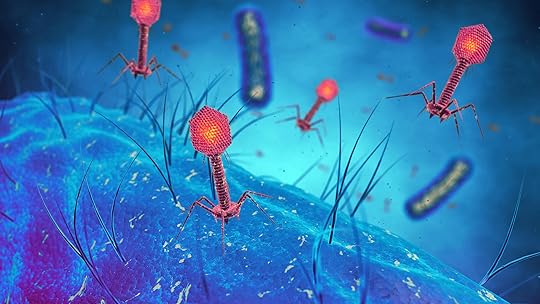
Bacteriophages, or phages, are viruses that infect bacteria. These are "highly specialised, deceptively complex biological entities that do a lot with very little". Phages are simple organisms that consist of a core of genetic material (DNA or RNA) surrounded by a protein capsid or head - tails are optional.
Bacteriophages are a fascinating, but little known, topic that has languished in limbo for decades. Tom Ireland provides a compelling and easily digestible book exploring the discovery of phages, their initial use to treat bacterial infections in the former U.S.S.R, their fall from favour, and what appears to be their eventual rise to (possible) stardom. Ireland provides case studies of patients that suffered from antibiotic resistant infections and turned to phage therapy as a last resort. Not all these cases were successful, for a variety of reasons. He also takes a look at the current state of government approved phage therapy in the USA, EU and former USSR, and eventually world wide (reams of red tape here!). This is also the first popular science book I've come across that mentions the development of the electron microscope. Ireland also takes a look at the other things phages do besides kill bacteria: such as their biological roles in nutrient recycling, bacterial life cycles and metabolism, viral ecology, the facilitation of gene transfer within and between species (usually microbes, but not always); their integral part of the immune system (this part was particularly interesting); and their use as research tools in molecular biology, biochemistry, and medicine (e.g. CRISPR). The last section of the book deals with the future of phage biotechnology. Things like synthetic phages, made specifically for a particular person's medical issue and produced on site; as well as the use of phages as a means of water purification in those regions where water purification plants have been inundated with antibiotic resistance bacteria. All very exciting stuff with lots of potential!
However, the book completely missed the potential for spectacular and impressive, science-fiction-like graphics... by failing to include electron microscope images of phages, also failing to include photographs of the important people mentioned in the book, and by failing to provide a simple illustration of the phage life-cycle. The "Field Guide to Phages" as the back of the book provides a handful of mug shots sketches depicting more well known phages. However, since bacteriophages aren't really main stream science, and there aren't that many books about the discovery of bacteriophages, failing to include some photographs and relevant illustrations is a bit of a disappointment.
But, I still enjoyed all the new-to-me information, presented in a mix of science and history. A nicely written, compelling and exciting book on the viruses that can help us, instead of harming us.
___________ NOTE 1: There are footnotes! Glorious footnotes!!! At the bottom of the page where they are supposed to be, as opposed to stuck at the end where so many footnotes end up. This makes the book so much more pleasant to read. You don't have to flick backwards and forwards to see if there is anything exciting that you might be missing out on when reaching an asterisk. _____________ NOTE 2: If anyone is interested, there is a type of bacteria (Halteria) that has recently been shown to feed on viruses. _____________ NOTE 3: PET PEEEVE!!! The stupid description of DNA on page 204 is a minor issue but it pisses me off! Especially when the majority of "science" writers sprout this nonsense.
"...famously clever staircase-shaped chemical called deoxyribonucleic acid or DNA, which encodes information in the form of a string of chemical letters, which are translated by cells into the thousands of different proteins*...".
If you know what DNA is, that description is pure rubbish. If you don't know what DNA is, then that description is completely nonsensical and useless! The primary DNA structure is a double helix shape and it is most certainly not a sting of letters! DNA is a string of nucleotides [nucleobase + pentose sugar (aka deoxyribose) + phosphate group]. The only reason nucleotides are depicted as letters in diagrams is because scientists are too lazy to write out the full name of each nucleotide, so they get abbreviated. Either leave out the asinine "description" of DNA (and RNA for that matter) or put in something that is accurate and makes sense.
*quoted from page 204 of 2025 paperback edition of The Good Virus by Tom Ireland, published by Hodder Press [ISBN 978-1-529-36528-3].
A good introduction to the world of phages and virus-like particles. I was drawn to the book primarily by the references to Ed Yong's "I contain Multitudes" and have not been disappointed by the quality of writing.
great intro into what phages are and what they can do for us!! brought into light researchers who are actively contributing to the field as well, and it really is a well-researched book! it’s a great starting point to those who are interested in phages and would love to learn more about it. highly recommended!
This is the blueprint of excellent science writing. Take something fascinating, that is all around us but utterly overlooked, and highlight the two virtues science has given us. First, the world is teeming with life and contains so many wonders beyond what we can see. This is how the book begins. We learn about the history of microbiology and how researchers discovered that random samples from rivers, soil or sewage mysteriously inhibited the growth of bacteria. With advances in microscopy, it was found that spider-like entities in the nanometer scale attach to bacteria. Through a yet unknown mechanism, these viruses consumed the bacteria and hijacked its molecular machinery to make more of it. The term bacteriophage (phag0 being greek for eating) was born. It was clear early on that these phages could be used to rid our body of unwanted bacteria that cause disease. However, the history of phages, as Tom Ireland recounts, is tightly connected to the personalities of their discoverers and researchers. (Medical) science is a deeply human endeavour with all its strikes of geniuses buffered by stubbornnes and skepticism. What I love about this type of science writing is how it brings the human element into the spotlight. Ireland shows us how politics, culture, and chance have stalled progress in our understanding of phages and, most crucially, how to use them as "natural" antibiotics. Something that was once common in the Soviet Union but forgotten in the West. Instead, its pharmaceutical industry was sparked by small molecules made by chemists. While their precise formulation, manufacturing, and medical evaluation paved the way to a tight system of regulation and innovation incentives (synthetic structures can be patented!), this importantly excluded a biological remedy like phage therapy. Its active ingredients are all around us and ever-changing due to the evolutionary arms race with mutating bacteria. A nightmare for investors in the current regulatory framework. But change is underway, triggered by the crisis of antimicrobial resistance and the second virtue of science. Besides discovering the richness of the biosphere, blowing our minds with numbers like 10^31 phages out there, simple human curiosity to study these phages has enabled unprecedented technological advances. While the first virtue was wonder, the second is usefulness (or power). Tom Ireland dedicates an entire section to how the modern life sciences grew out of fundamental phage research. In a nutshell, it was by studying how phages hijack bacteria that scientists uncovered that DNA contains genes and the information to make new phages. This paved the way to solve its structure, which kick-started the whole field of structural biology, as DNA is a beautiful molecule that reveals its function through its 3D assembly. But not only that, since then, phages have been intensively studied as model organisms due to their relatively small size, simplicity (in some cases), and versatility. In their age-old struggle against bacteria, they have developed fascinating biochemistries, of which CRISPR is only the tip of the eisberg what we can still discover.
In essence, this book is a great snapshot of science in action: of an unseen sphere bustling with crazy lifeforms, eccentric scientists pushing the limits of knowledge and their peers alike, of powerful technologies that are only waiting for us to be discovered, and the dangers that they bring. After all, there is not only "The good virus" out there and the line between good and bad (not just from a medical point of view) is worryingly dynamic and blurry.
One of the best non-fiction books I have ever read. A mix of science, geopolitics, personalities, and a glimpse of how phage research may literally save humanity in a post-antibiotic era.
It's a very good book and unlike many popular science books, it is an easy read. The combination of crazy characters and interesting science makes it a hit. I was born in Russia and somehow I've never heard of bacteriophages, so I read about it with a bit of disbelief. However, a quick search through Russian online pharmacies confirmed that it's indeed a very popular drug. Why 4 stars and not 5? Well, naming the book "The Good Virus" played a trick on the author. It's hard not to see that he is describing a horrifying biological weapon, especially when he started speculating about phages delivering drugs directly to the brain or explained how phages created cholera. How to protect ourselves from phages should have been discussed in the book, but it's not. It's a bit like an autobiography that skips over all the bad decisions or questionable moral traits of the main hero and only focuses on the good ones.
4.5/5 if I could. Gives a very thorough and comprehensive view of the history, practicality (pros and cons), and potential of phages in every scientific discipline, but mainly medical. The book is very interesting and educational but can at points be dense-definitely a slower read. Ireland does a good job explaining scientific terms for the laymen reader but having prior scientific knowledge about synthetic biology/microbiology/biochemistry makes the book more readable.
Wow! What a read! It's written like a thriller that you absolutely cannot put down. Makes it understandable for a layman.
The topic is definitely one of which mankind needs to find a solution. Can we make life saving treatments out of viruses when antibiotic resistance is so rampant?
Would have also loved some coverage of how 'bad' viruses work. Otherwise it definitely deserves 5 stars.
I struggle to read biology books sometimes due to the fact that you must understand the concepts that they describe. This book was such a lovely and interesting read hence the five stars. It revealed a field of biomedical science that may become a career of mine? Who knows?
combines science and history in a way i gobbled up; wanting to study biomed this book is the perfect eye opener to the vast potential of bacteriophages.
Fantastic book, definitely recommend to anyone interested (or wants to know more) about phage and how they could be used to help us fight antimicrobial resistance.