The exacting Miranda's search for a suitable companion brings her family into contact with a very different kind of household, raising a plenitude of questions about the ability to manage alone, the difficulties of living with strangers and some strange discoveries about intimates.
Dame Ivy Compton-Burnett, DBE was an English novelist, published (in the original hardback editions) as I. Compton-Burnett. Her works consist mainly of dialogue and focus on family life among the late Victorian or Edwardian upper middle class. She was awarded the 1955 James Tait Black Memorial Prize for her novel Mother and Son.
Il romanzo uscì in Inghilterra nel 1955, per la Grande Signorina si trattava del quindicesimo parto. In Italia fu tradotto da Einaudi dieci anni dopo e presentato con parole senza incertezza: Il nome di Ivy Compton-Burnett, cioè del massimo romanziere inglese contemporaneo, è ancora poco noto in Italia. Poche, fino a oggi, le traduzioni. E tuttavia vi sono molte ragioni per cui la narrativa di Ivy Compton-Burnett diventi, nei prossimi anni, uno dei più vivi temi di discussione in Italia, come già è in Francia…
Invece, così non mi pare sia stato: in Italia Ivy Compton-Burnett continua a restare poco nota, poco letta, di nicchia, anche mezzo secolo dopo.
I romanzi di Ivy Compton-Burnett sono simili l’uno all’altro come vaste case di campagna di un medesimo periodo tardo-vittoriano mai del tutto spento: facoltose e sepolcrali, abitate da immense famiglie lunatiche e frotte di servi rimbambiti; e piene dalle cantine ai solai di ricordi macabri e di fratellastri ingiustificati, cariche di stravaganti ricchezze accumulate da diverse generazioni, successive e maniache, senza mai buttar via niente, neanche all’ultimo gradino della decrepitudine. Così si esprime, invece, la Casalinga di Voghera par excellence, Alberto Arbasino.
Anche questa volta Ivy Compton-Burnett in apparenza non racconta nulla, sembra rinunciare al plot, nulla accade in senso tradizionale, rimane confinata in un’unica dimora domestica, nel ristretto circolo di famiglia e parenti allargato alla servitù. E mette in scena il suo consueto ballo di dialoghi serrati, con le parti descrittive ridotte all’osso, tramite cui racconta quello che è accaduto (ed era meglio non accadesse), racconta i segreti i peccati le tensioni le colpe. E quindi, le cose succedono sì, ma fuori scena, off screen.
Qui di seguito è ancora Alberto Arbasino che si esprime, e lo cito a profusione perché oltre essere un estimatore della Grande Signorina, e colui che me l’ha fatta scoprire e conoscere.
L’originalità di Miss Ivy si manifesta sconcertante e senza remore: economizzando tirchiamente le emozioni, affinando micidialmente il cicaleccio della commedia borghese ‘di maniere’, scarnificando ferocemente il dialogo di ogni didascalia descrittiva o behavioristica o psicologica (ma rimanendo più freudiana di Freud, più edipica di (Edipo Re).
Ad aggiungere fascino mistero e curiosità a questo stile così personale e così insistito è anche il fatto che Miss Ivy viveva lontano dalla pazza folla, non amava l’esposizione (in vita sua ha concesso solo due o tre interviste), ha convissuto con Margaret Jourdain fino alla morte di quest’ultima: in pratica, nella sua vita succedeva ancora meno che in quella dei suoi personaggi. Con questo romanzo vinse un premio letterario importante, il James Tait Black Memorial Prize.
Ma né le trame né le conversazioni hanno mai un minimo riferimento a qualsiasi realtà, in qualunque epoca, e meno che meno alla vita. Sono strutture formali estremamente stilizzate, strizzate, autosufficienti, senza buttar via nulla, men che meno i colpi di scena e le emozioni violente… lasciate freddamente seccare come vecchie felci in un libro di salmi… Non si fornisce mai un’informazione su nulla. Mai un sospiro socchiude uno spiraglio sulla psicologia dei personaggi. Ma dietro le porte chiuse, si sfrena ansimando il Romanzo Nero: come minimo, si perpetrano omicidi e suicidi, adulteri e incesti, furti di testamenti, falsificazioni di documenti, sostituzione di lettere rubate… mentre nel salotto che resta l’unico set di tutti questi romanzi, la famiglia benestante esegue gesti perbene, stereotipi come nei quadri ‘di genere’ […] fuori del Tempo, col suo carico di nonni e nipoti e cognate e cugine e governanti e precettori e cuoche, quasi tutti immondi e quasi tutti vittime, e tutti cinguettanti nello stesso falsetto… attraverso un dialogo sfacciatamente comico, di una verve scatenata e interminabile, che lascia indovinare eventi catastrofici, fra i più sinistri... Non di rado, villanamente da feuilleton…
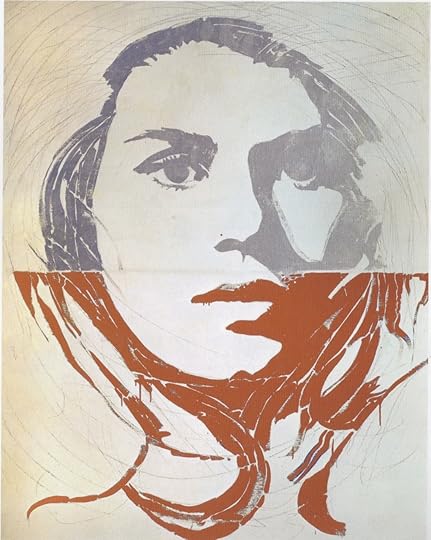
Ragazza TV, 1964. Questa e le altre opere sono di Giosetta Fioroni, grande amica di Arbasino (per restare in famiglia).
I spent the last five weeks reading five novels by Ivy Compton-Burnett. It was a period when reading time was in short supply so I needed books that I could read small amounts of every so often yet not feel lost when I picked them up later. Ivy Compton-Burnett suited perfectly because her books contain no descriptive writing, no meditative passages, in fact very little that is not in dialogue form. The dialogues don't have many 'he said, she said' tags, and the few non-dialogue lines sound like stage directions so reading these books feels like being at the theatre—there's a small cast of characters, often related to each other, and the action tends to take place in one location, eg., the main character's dining-room or drawing-room.
Compton-Burnett's books are all set among upper middle-class English people in the late nineteenth or early twentieth centuries, a time when such people could live in comfortable seclusion from the problems beyond the walls of their landed properties. War or unemployment or poverty are never mentioned although two of the characters in Mother and Son (published in 1933) have reduced income and are obliged to become gentlewomen companions. The Middleton family in The Mighty And Their Fall (published in 1961) also face curbing their comfortable lifestyle but are saved by a timely inheritance. Quite a few 'timely' things occur in Compton-Burnett's novels—wills are lost, letters are found, characters overhear what they shouldn't, secrets get revealed, people thought to be dead turn up—melodrama of every type in other words. As a character in one of the books says, 'What a day it has been! There is material for an epic. The fall of Lavinia; the return of Ransom; the uplift of Ninian; the tragedy of Ransom; the escape of Lavinia; the lament of Selina. I hope there will be no more.'
I don't often read melodrama so how did I manage to read five books full of it? Well, the first one I picked up, A Father and His Fate (published in 1957), in spite of having an absurd plot, impressed me because of the characters' barbed speech, full of double meanings and innuendos. Reading a single page of such exchanges is a brain workout for the entire day!
'Miss Gibbon is perhaps hardly educated enough for a governess.' 'Well, if she was, she would not be one. That is why governesses are not educated. Sometimes I almost wonder why Mother engaged her.' 'She was suitable for us when we were young. And then she could not be got rid of without being dismissed.' 'Father would not have that. And we should think less of him, if he would.' 'And he does not think education necessary for daughters. He has said he did not intend us for governesses.” 'I am sure any element of dishonesty on Miss Gibbon’s part has been unconscious.' 'Well, dishonesty may be that. It is honesty that never is. I suppose it takes too much effort. It is too unnatural.' 'It is made easy for most of us,' said Audrey. 'But I should yield to temptation.' 'People always do,' said Ursula. 'If they resist it, it is something else.' 'I do not agree,' said Constance. 'I am sure there are many instances of heroic resistance of it.' 'If you are thinking of martyrs, I hardly believe they were tempted. If they had not been martyrs, they would have been nothing. And that tempts no one.'
Some of the lines reminded me of Oscar Wilde's aphorisms mixed with the wittiest bits out of Jane Austen's novels, eg.: 'It is less embarrassing to lose a parent than to gain one.' Or this: 'Mother is not here to console him for her death. It will be his last grievance against her. Or again: 'May I congratulate you on a charming speech?' 'I was afraid you were going to congratulate me on my marriage, and opinions differ so much more on speeches. I am sorry for the hint of effort about mine; I had no time to make it spontaneous.'
But underneath all the wit lies a morass of manipulation and hypocrisy unlike anything I've ever found in Wilde or Austen. The family groups Compton-Burnett sets before us are invariably dominated by one tyrannical figure, usually the father, and his children, even when grown up, are as powerless as servants. They defend themselves with the only weapons they possess, their sharp tongues, and often speak in asides to each other which the tyrant figure always manages to overhear. Incidentally, people never fully leave a room in an Ivy Compton-Burnett book, they linger in the doorway on the off chance of hearing something they can pounce on and twist to their own purposes—though they don't always succeed, as in this scene from More Women Than Men (published in 1933): 'And what are you wagging your tongues about so busily? I hope, as the children say, it was not about me, or I shall perforce interrupt your colloquy.' 'I have no respect for people who cannot have their colloquies interrupted,' said Felix. 'We were not talking about you, but of course we might often do so. I should never suggest anything else to a person who thought he was being talked about.'
Visitors to the characters' houses sometimes find such exchanges a bit unusual, as in this scene from A House and Its Head (published in 1935): 'No one can speak in this house without meaning too much.' 'Oh, nonsense. You are not used to meaning anything. And so you are struck by the difference.'
It goes without saying that the 'meaning' of words is one of the things the characters love to pin down. Any casual phrases, such as the one I just used, 'it goes without saying', are challenged—in a constant search for the truth behind what is being said. 'We need not say that our time is yours, it goes without saying.' 'It does not do that. But I will remember it.' Or 'We are here to prove we are your friends through thick and thin.' 'Which is this?' said Nance Or 'He said all was fair in love and war. I have always thought it an immoral saying.' 'It means the opposite of what it says. But why say all is unfair in love and war? We all know it.' Or 'What should we do without our daughter?' said Mr Bode, right that they would do differently.
Truth can even be turned inside out in these books as happens when a bullying husband, after his wife has died, comes to see himself as having been a model one—though the reversal cannot happen without him bullying someone else. Duncan drew his daughter from the room, and led her to the library. It was an hour before she emerged and followed the others. 'I feel I have lost both my parents. Mother has not vanished more completely than Father. In his stead there is a man, who has been an almost monotonously amiable husband. I dread he will begin to repent of the monotony.' 'Has he been telling you?' said Sibyl. 'I have been telling him. He inclined himself, as you know, to the opposite view. It is fortunate I am not a person who cannot tell a lie. I hardly remember the difference between truth and falsehood; and he is not in any way concerned with it.' 'Poor Father! It is the least we can do for him.' 'It was the most I could do. You don’t know how much virtue has gone out of me. The virtue was Father’s, but I had to produce it.'
Some of the characters, the daughters in particular, reminded me of the people in Nathalie Sarraute's Tropismes, victims as a result of having to live at close quarters to hugely selfish others, becoming diminished at every contact—and eventually as hard-hearted as the people who bully them. 'Is Father all right alone?' ‘Not if appearances are deceitful,’ said Nance. ‘But we do not consider remedying his condition.'
No one ever remedies anyone's condition in Compton-Burnett's books. Characters may marry in the course of the melodramatic plots but there's no hint of real affection in sight. Unrestrained feelings such as love don't feature—everyone is too busy trying to better their own position or else settling for the lesser of two evils. Bleak House might have been a good title for any of the five novels I read—and that reminds me of an apt line to finish on: 'Your grandmother was a great woman. I should like to be Dickens, so that I could be unrestrained about her.'
Here are the first couple of pages, which gives you a taste of the ICB style. Personally I think it genius.
Chapter I
“The person has arrived, ma’am.”
“What person?” said Mrs. Hume.
“The person who was expected, ma’am.”
“And who was expecting her?”
“I supposed it was yourself, ma’am. It would be the assumption.”
“And how would you refer to someone I was expecting?”
“I understood she was to be under consideration, ma’am.”
“Is that an answer to my question?”
“The lady has arrived, ma’am. She has found her way,” said the parlourmaid, with a change in her tone.
“Found her way? What do you mean?”
“Along that road from the station, ma’am. Under the shadow of all those trees. The dusk is already threatening.”
“You can show her in,” said Miranda Hume, not raising her eyes or her hands from the newspaper on her knees. “And you children keep to your side of the room and appear to be occupied. You can stay where you are, my son.”
Two boys and a girl exchanged a glance and moved away, and were actually occupied in giving their attention to the scene. A middle-aged man remained, as directed, in his seat.
The maid ushered in a neatly dressed woman, who had an appearance of keeping her personality neutral, in case any particular form should be required.
Miranda had no such aspect. Her tall, upright frame, strong, white hair, firm, unremarkable features and small, pale, experienced eyes gave the impression of being what they were and had reason to be.
“Good-morning, Miss — Burke,” she said, referring openly to a paper at her hand, and not concerned with the fact that it was afternoon. “It is good of you to come to see an old woman and to think of being her companion. Will you tell me in what ways you are suited to such a post?”
“I am companionable,” said Miss Burke, hesitating in spite of the appositeness of her claim. “And I am interested in other people and their lives.”
Miranda’s face showed that something confirmed her expectations.
“What is your age?”
“I beg your pardon, Mrs. Hume?”
“How old are you? How many years have you lived?”
“I am over thirty, Mrs. Hume.”
“Yes, so I see. So am I. By how much are you over it?”
“I did not expect to be asked my age.”
“I am under no obligation to consider that.”
“I am not much under forty,” said Miss Burke, changing her tone under Miranda’s eye. “I am actually forty-seven.”
“You would pass for less. You could say you were forty-two. It comes of the easy life of a companion.”
“I never tell untruths,” said Miss Burke, her answer seeming to cover the whole of Miranda’s speech.
“You can give a wrong impression. You do not mind doing that. It would be your object.”
“It is a disadvantage to be too old, when you are placed as I am.”
“Yes, of course it is,” said Miranda, not without sympathy. “But that makes it more important that the falsehood should be plausible.”
“I should not use the word, ‘falsehood’,” said Miss Burke, not mentioning the term of her choice.
“What word would you use?”
Miss Burke still did not give it.
“We will not pursue the matter. Indeed I see we cannot. Are you good-tempered in ordinary life?”
“Yes, I think I am. Of course I have my own opinions.”
“Does that mean you would hold to them argumentatively?”
“We cannot alter what we think,” said Miss Burke, not without a touch of this quality.
“Surely we can, if light is thrown on a subject. Do you not try to profit by your employer’s companionship?”
“It is my companionship that is the point,” said Miss Burke, causing herself to smile.
“Do you often change your posts?”
“Never, unless there is some reason.”
“Well, I suppose not. Dismissal or your own dissatisfaction. I asked if it was often.”
“Not oftener than is natural.”
“You regard that as an answer?” said Miranda, sending her eyes over Miss Burke’s face, as though receiving light on her.
“I have stayed for some time in some cases, and not in others. I suppose that it is how it must be.”
“How it has been with you. So sometimes people do not take to you?”
“Well, sometimes I do not take to them,” said Miss Burke, with some spirit.
Miranda nodded to herself, her eyes still on Miss Burke’s face.
“Do you for example take to me?”
“It is difficult to judge on a first impression.”
“Be quiet, boys,” said Miranda, turning and speaking with a hiss in her tone, as there was a sound of mirth. “I think I do not find it so. You would come to me and leave me at your own convenience?”
“Well, you would dismiss me at yours,” said Miss Burke, trying to speak lightly.
“Why did you leave your last situation?” said Miranda, with a note of ruthlessness on the last word.
“I found that things were expected of me, that were not in the arrangement.”
“You mean you were asked to be useful in the house?” said Miranda, raising her eyes.
“Well, housework has nothing to do with companionship.”
“Surely it has, in a case of emergency. If a companion could not rise to that, she would not deserve the name. What did they ask you to do?”
“I need hardly tell you that, Mrs. Hume.”
“You will tell me what I wish to know,” said Miranda, not disguising the range of her own requirements. “Was it something you cannot mention?”
“They asked me to wash up dishes at the sink,” said Miss Burke, in a full tone, as though this idea of Miranda’s were not hers.
“Well, where would you wash them? They would not ask you to do so at the piano.”
“No, they would not,” said Miss Burke, agreeing that this amelioration was not possible.
“What did you say to them?” said Miranda, with the hint of a smile.
“I pointed out that it was not in the arrangement.”
“If an emergency arose here, would you expect me to wash the dishes?”
“No,” said Miss Burke, on an uncertain note, as though feeling that their attitude to the activity had something in common.
“Then would you leave them unwashed?”
“I would help you to wash them,” said Miss Burke, perhaps meaning to strike a companionable note, but doing so too completely.
“Have you a good voice for reading aloud?” said Miranda, in a colder tone.
“It would hardly be different from my ordinary voice.”
“Would you read as if you had written the books yourself, and felt self-conscious about them?”
“No, I should only try to interpret them.”
“You cannot just read simply and clearly what is before your eyes?” said Miranda, giving a sigh.
“Yes, if that is what you want.”
“Well, it naturally is. Why should I wish for your implied opinion? I could ask you for it.”
“Well, I would remember that.”
“And you would not sit as if you had a host of unspoken thoughts seething within you?”
“It is not likely I should have a host of them.”
“Or as if your mind were a blank?”
“I would try to strike the mean.”
“I have no liking for smart answers.”
“You do not seem to have any liking for answers at all,” said Miss Burke, lightening her tone too late.
“Well, I must not waste your time,” said Miranda, in an almost pleasant manner. “It is never a kindness to do that. I will give you your fare and meet any other expenses. It was natural to apply for the post; indeed it shows your sense, as it is a good one. I hope you will find another equal to it.”
“You do not think we should suit each other, Mrs. Hume?”
“I do not think you would suit me,” said Miranda, answering something in the tone. “Our interpretation of companionship is different.”
“Have you ever had a companion before?”
“What makes you think I have not?”
“You seem to expect the impossible.”
“It is what in a sense I do expect, and feel I cannot face,” said Miranda, half to herself. “You will find some tea ready for you in the next room. And this will cover your outlay and give you something over for your time.”
“I do not ask anything but my bare expenses, Mrs. Hume.”
“But you are glad to have something,” said Miranda, handing her an envelope and waiting for her fingers to close on it. “We need not pretend that things are not as they are. I am not a person who does that.”
The truth of this caused another sound of mirth, and Miranda sent a rapid frown in its direction. “I hope you will soon find a suitable position. There are many in which you might be useful; that is, if you do not set your face against being so. The maid who gives you tea will tell you about your trains.”
Miranda offered her hand without raising her eyes, as though to save herself from seeing the effects of the interview. There was nothing about them to disturb her. Miss Burke went to the door with an air of having dealt as she could with another item on her list.
I had a lot of trouble understanding A House and Its Head, but I conjectured that if I could only find the right angle, as it were, from which to see it, it would probably be one of my favorite books. I had no such trouble with this one and indeed, I find it utterly breathtaking! I know of nothing with which to compare it.
- È arrivata quella persona, signora - Quale persona? - Quella che doveva venire, signora. - Venire da chi? - Da lei, credevo. Era l'idea più naturale. - E chi sarebbe secondo lei la persona che sto aspettando? - Se ho capito bene va presa in esame, signora. - È una risposta alla mia domanda? - Quella signora è qui, signora. Ha trovato la strada, - disse la cameriera in tono diverso. - Trovato la strada? Come sarebbe a dire? - Sul viale che viene dalla stazione, signora, all'ombra di tutti quegli alberi. C'è già un buio tremendo. - La faccia passare, - disse Miranda Hume, senza sollevare né lo sguardo né le mani dal giornale che teneva in grembo. - Voi mettetevi nel vostro angolo, bambini, e fate finta di essere occupati. Tu, figliolo, puoi rimanere dove sei.
Ma cosa c'è da dire di Ivy Compton-Burnett se non di leggerla parola per parola? Il divertimento per me è assicurato. Ogni libro è il solito libro e nonostante questo la voglia di leggerne ancora ti persuade sempre più della sua bravura nell'inventare. Come al solito: ci sta che la odierete. Io la adoro. Personaggi culto del libro: Plauto e Tigrato (i due gatti).
About 80% through this novel, one character asks: "...is there any point in adding to the amount of fiction that appears?" It is a valid question for Compton-Burnett in her later years, it seems. Mother and Son produces all the usual devices--country families, secret children, questions of inheritance and legitimacy, the relative position of servants to families which they have served for decades, the education of children, the nature of friendship, trust, dealing with death, etc. The one new element in this novel--one applauded by me--is the fully-developed character of Plautus: a cat. The attitudes of characters to the cat (and, apparently, of said cat re the humans) makes for entertainment--at least for any reader who loves cats.
You have to imagine all the dialogue in a stiffly proper British voice and it works. The book opens much like the beginning of Mary Poppins, with the family interviewing candidates for a domestic position. In this case, the duties of the desired "companion" are never explicitly stated, though it is assumed she would need to be willing to do whatever the exacting, eagle-eyed Mrs. Hume demanded. Superfluous husband and (certainly unhealthily) devoted son look on as Mrs. Hume disposes of the candidate with a few, sharp, cutting questions.
Every member of the household is bound by an incredibly detailed code of behavior devised by Mrs. Hume and (pre-world war?) society from which she comes. On the one hand, it seems an incredibly constricted way of life for everyone involved. But, I imagine there is some comfort in knowing with great certainty exactly what is expected of you in every conceivable circumstance. I was reminded of The King's Speech, with its nuanced treatment of social class.
“‘Perhaps we are sound at heart. That is said of people who are unusually unpleasant.’ ‘Why is it said of them?’ ‘Well, they are clearly sound nowhere else, and we cannot see the heart.’”’
“‘There is probably nothing like living together for blinding people to each other,’ said Francis. ‘In the case of Mrs. Pettigrew and myself time has added to our mutual understanding. But I must not adduce my own experience as typical.’ ‘Everything adds to understanding,’ said Alice. ‘That is why people seem better when you don’t really know them, and why new friendships are often best.’ ‘Now that is an attempt to be cynical,’ said Mr. Pettigrew. ‘And a successful one,’ said Francis.”
I really enjoyed this. Challenging for anyone (like me) who has to sight read it out loud to a listener. (My little repertory company of voices cast the novel quite nicely!). In fact it reads far more like a play, in structure and character development than a novel in some ways; reminded me in parts of Beckett, Ionesco and Pirandello. It also reminded me of Alan Bennett’s History Boys in the way the children both challenge authority and provide a commentary on the adult world around them.
Unique. I’ve never read anything quite like it, and I’m very glad I did read it.
Having said that, I’m not in any great hurry to read another Compton Burnett. I plumped for 4 stars but could just as easily have given it 5 or 2.
But, what a writer. What a woman. What a life. Talk of turning your misery into greatness.
'She is not to be mildly liked or disliked. She is a writer to be left alone, or else to be made into an addiction.' Pamela Hansford Johnson
Ivy Compton-Burnett non è molto nota qui in Italia, ma in Inghilterra è considerata una delle massime scrittrici del Novecento, anche se i più ritengono la sua produzione decisamente ostica. Per lo più è considerata una di quelle autrici di cui innamorarsi oppure da odiare al primo libro (come si può evincere dall'epigrafe). Ovviamente, al mio primo libro l'unica cosa di cui sono sicura è che non rientro in nessuna delle due categorie. In base alle informazioni raccolte, i romanzi della Compton-Burnett sono tutti molto simili (non è una asserzione negativa, comunque) a causa delle tematiche condivise e anche dei titoli che seguono sempre la stessa struttura (fatta eccezione, immagino, per il suo romanzo d'esordio che successivamente l'autrice stessa parve rinnegare).
La trama di Madre e figlio è presto detta: la signora Miranda Hume vive con il marito Julius, il figlio Rosebery e tre nipoti, figli del fratello di Julius e orfani sia di padre che di madre. All'inizio del romanzo Miss Burke si presenta a casa Hume per il posto di dama di compagnia per Miranda, ma non viene accettata. La cuoca degli Hume la indirizza verso un'altra casa in cui stanno cercando una governante, e qui Miss Burke viene impiegata, al servizio della signora Emma Greatheart, che vive con il gatto Plautus e la sua amica d'infanzia la signora Hester Wolsey. Poiché quest'ultima ha recentemente perso la sua rendita e sta cercando un lavoro, nonostante la disponibilità della sua amica di prendersi cura di lei, Hester decide di proporsi come dama di compagnia per Miranda Hume, che la assume. In qualche modo le due case diventano così collegate, e la trama si sviluppa seguendo un canovaccio che è in parte commedia, in parte satira (familiare).
Quello che colpisce subito dello stile di questa autrice è il suo utilizzo del dialogo: l'intero romanzo è costituito quasi totalmente da dialoghi, con brevi, brevissimi intermezzi narrativi. E' uno stile bizzarro, ma non spiacevole. La tentazione è però quella di leggere molto velocemente, seguendo il ritmo del parlato, scelta però controproducente in quanto i dialoghi di questo romanzo vanno gustati lentamente a mio avviso: sono pieni di piccole chicche, di riflessioni interessanti su tutta una serie di argomenti che si concentrano sui rapporti familiari (l'autrice è specializzata nel riprendere frasi fatte o cliché e smontarle argutamente) che però si perdono con una lettura rapida. Inoltre i 'colpi di scena' della trama spesso vengono comunicato in una riga di dialogo con così poca enfasi da rischiare di passare inosservati. Nel complesso una lettura davvero interessante, spero di potermi fare un'idea più precisa con il prossimo romanzo.
I liked the two comments 'Jane Austin on bad drugs' and 'what an odd book. I don't think I'll read any more.'
I abandoned it when I found out it was nothing like what I expected and I wasn't up for the verbal sparing and witticisms. It does have the artificial glitter of an Edwardian stage play..
So a family of husband and wife, their adult son and the son's two nephews and one niece (children around 9-12) are in the room (or on stage) while the wife interviews a hapless applicant for the post of companion. The interview is unpleasant in that the woman in power constantly pokes holes in the poor applicant's answers. I see that a few chapters later we follow the applicant into another job and I found that could be of interest. Some time.
The chapter when the children spar verbally with their tutor, again ridicule from a position of social privilege, is also unsatisfactory and moreover I had trouble sorting out who was who.
I was not ready for this but I may come back to it when I'm feeling more sturdy. It was not what I was looking for at the moment.
So I did reread and put my later review in a comment to this review.
What an odd book. I read it because it because the author was recommended by Hilary Mantel--one can only hope on the basis of some other book she wrote! I will not be exploring Compton-Burnett's work further.