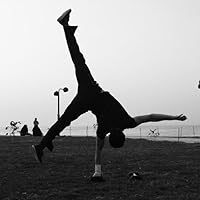
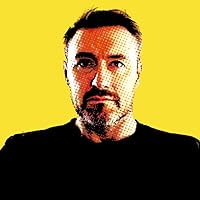
Exercise and philosophy, two things i know nothing about. Thus reading this book is a treat, mostly for seeing Haruki Murakami's rare image stretching (just kidding, ha) but also learning about those two topics I mentioned in an educative yet nevertheless fun way. :))
~*~
"We humans have a short span of life, and an even shorter span of prime fitness.'If a man attains his wish let him cling to it and not let it go for something far off' --'There is no telling what will be a year from now.' Enjoy your triumph, says Pindar, because life is brief and brutal."
"It is also a sense of the worth of this achievement: that, with limited days and vitality, we still bother to hone ourselves by striving physically. Given all the possible ways to sit idle, and to justify this, we have dedicated ourselves to some act of uncomfortable toil."
"--pride is also a kind of virtue. In the pride of sprinting, power-lifting or pedaling, we rightly celebrate ourselves for our committed exertion; for the willingness to move as hard and fast as we possibly can, instead of watching others do so on television. We are, in short, exerting ourselves when we might equally not. -- This takes not only fitness, but also a keen sense of responsibility: recognition that we might die tomorrow having never touched the edges of our own abilities. This is less about 'seizing the day', and other positive-thinking slogans, and more about more firmly grasping ourselves: as fragile, precarious things, with a small portion of vitality. -the self is something we must continually, often consciously, create."
"To commit, as a human being, to anything is to renounce some quantum of [pleasure- a measure that is enlarged by every increase in dedication. Every game exacts a cost."
"This is why we still call it 'fitness': because it is fit for something. Int his sense, to savor the beauty that arises with exercise is to respond to the promise of accomplishment. Whether or not we actually achieve anything is neither here nor there. The point is that the increasing visibility of muscles suggest increasing potency: the circle of our influence has widened. This, in turn, can be uplifting or comforting: the knowledge that, should we be challenged or threatened, we have more resources at our disposal. Muscularity is an antidote to a more general human condition: insecurity and uncertainty."
"Put simply. beauty is not as universal as the classical ideal suggests. It has sweet spots, but they are vague and variable - certainty not written into the fabric of the cosmos. It is important to own up to our own conceit: with exercise (and often diet) , we are crafting our own ideal."
"The point is not that we must be 'down on ourselves' - exercise does not mandate self loathing. The point is that achievement requires a combination of ambition and failure. We have to be able to envisage difficult goals: aims that challenge our physical gifts and mental acuity. - But to enter this state of skillful engagement we also have to recognize our own insufficiency and imperfection. Even if we have the most refined talents - and most of us do not - we often have flaws of character: holes in attention, wayward emotions, fickle habit of perception. These will not be overcome abstractly, just by thinking about them. We have to do, fail, reflect on the task and our failure, and then do it again. But we would not fail at all if it were not for the original ambition: the willingness to strive for something other than our customary aims. "
"-Put another way, the humility of exercise is not simply a virtue of saints and holy men. Instead, it is a very human willingness to recognize that we are incomplete, and always will be, and that our attempts to remedy this existential shortfall will be enjoyable for their own sake, not because we will ever achieve perfection."
"The whole body is involved in the creative endeavor: sitting for hours, scribbling at a notebook, refusing the legs' restlessness; stomach aches as anxiety releases acid; headaches and stringing eyes from sitting staring at white pages or screens two feet away. And the brain itself requires energy: it cannot concentrate for hours every day, for months or years, without taking a toll. 'You might not move your body around,' writes Murakami, 'but there's a grueling, dynamic labor going on inside you."
"The point is not to break records or write a masterpiece. The point is to keep training the body to best support the mind; to enhance the organs of labour. If we are thinking beings, we are also beings with bodies - bodies with organs and muscles, including brains, which thrive with blood and flexing."
"In his landmark 1984 book After Virtue, philosopher Alasdair MacIntyre argued that the modern age has lost a crucial idea of what it is to live a whole life. Lives, he said, are not random collections of moments, not dust piles made of scattered dumps. They are unities. - This is why MacIntyre argued that lives are actually narratives. This is the stuff of human existence: beginnings, middles, ends; departures and destinations; courtships, arousals and climaxes. 'Stories are lived,' wrote MacIntyre, 'before they are told - except in the case of fiction.' -- We are the best 'co-authors' of our lives."
"To live a good life, says MacIntyre, these stories have to be pulled together as wholes. We easily become fractured, divided, conflicted. We can 'lose the plot', so to speak. This is why we need the virtues of integrity and constancy. Integrity is achieved in changing circumstances: constancy over changing times. Both character traits are tendencies towards wholeness: virtues of consistency, which pull our stories together."