Dans un monde qui voit les hommes naître libres ou esclaves et dans lequel la beauté des filles s’achète à la criée sur les marchés, un homme court après le bloc de glace qui renferme en son cœur le mirage de la femme idéale. Quête désespérée d’une chimère, fuite éperdue au travers du chaos, PÉPLUM est le chant épique et grandiose de l’impossibilité qu’il y a à concilier la pureté et le genre humain. Librement inspiré du Satyricon de Pétrone, ce livre phénoménal est considéré par les amateurs éclairés comme un chef d’œuvre de la bande dessinée. Nouvelle édition à partir des originaux.
I am not sure what to make of Peplum, Blutch’s second major work to be translated into English. My understanding is that Blutch had written a number of things that he came to see as too derivative of his influences, and he wanted to break away from them and that process to make something wholly new (Eisnein, Blutch expert, help?), artistically.
And to make something wholly new he went back to the past, to the history of the Roman empire, and to the Satyricon. The translator Edward Gauvin, who also translated So Long Silver Screen, his homage to fifties French New Wave films (and actresses he is crazy about), writes in a fine introduction that this is Blutch’s “toga epic,” from the nineties.
So Peplum is a revision of or sequel to the Satyricon that kind of weaves in related Roman tales, including references to Shakespeare, in a deliberately fragmented, sort of expressionistic way. The story begins with the murder of Julius Caesar; memorable images along the way include a group of guys that find a woman in ice that figures in the big picture. Obsessions with sex and death are the central epic themes.
I am not aware of all Blutch is referencing, but this is more an art object than a straightforward narrative, anyway. It’s deliberately challenging and provocative and not meant to be a typical, emotionally-engaging story. But the art is worth the ride, if you don’t mind being a little lost, as I was/am. I would at the very least take a look at it for the art from a master. I liked it, but I’d like it more if I understood his intentions somewhat better, I’m sure. In my rating I’ll give him the benefit of the doubt.
The jacket flap description says it so much better than any summary I could ever hope to write:
"... a grand, strange dream of ancient Rome. At the edge of the empire, a gang of bandits discovers the body of a beautiful woman in a cave; she is encased in ice but may still be alive. One of the bandits, bearing a stolen name and with the frozen maiden in tow, makes his way toward Rome--seeking power, or maybe just survival, as the world unravels."
Eh. I wasn't as blown away by this as so many others seem to be. Yes, Blutch has crazy mad drawing skillz. But the story just didn't do much for me. It's pretty much the textbook definition of "artsy." If one is looking for something by which professors can be impressed and about which term papers can be written, then, by all means, check this out. But if you're looking for something to read simply for the pleasure of it, your mileage may vary. I accept the possibility that I simply wasn't in the proper frame of mind to appreciate this. Jupiter knows I've enjoyed plenty of obscure and arty things in my time. Just couldn't get into this for some reason ...
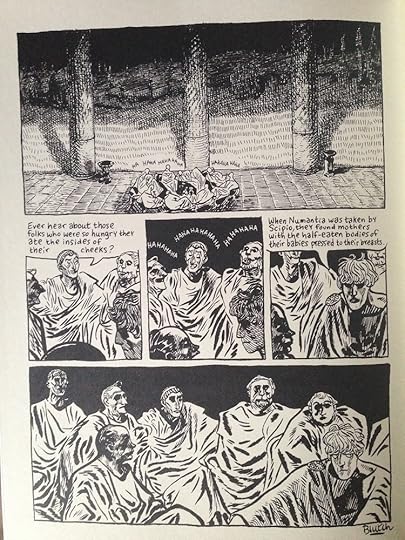
The best thing about it is the artwork. It reminds me of sort of a cross between Will Eisner and Harvey Kurtzman, with maybe a bit of Roy Crane and even Frank Stack for good measure. Blutch has a line that's expressive without being manic, and a love of crosshatching that rivals Bill Griffith and Edward Gorey combined. His figures have such weight and movement to them that it's a joy to behold. Basically, I loved the art, but not the story.
Hallucinatory, fragmented, and thrilling variation on "Satyricon" - with several other Roman tales thrown in and rewired for good measure. An epic that feels both intimate and distilled. Plus this Blutch guy can really draw. 4.5 stars
The best graphic novels, I feel, pull off the interplay between images and words perfectly. You're pulled in to that perfect blend that can only be found in comics. It should be more than cinematic: it has to be as sensory as standing in front of great art at a museum or in a gallery and drawn in briefly to that alternate universe. I hated Fellini's Satyricon when I finally got around to seeing it 10 years ago. I'm still on the fence as to how I feel about the great director having been deeply moved by La Strada. Satyricon is a reference point—but not much more. Peplum tosses in a heap of Shakespeare, and probably other sources, literary and cinematic, that I'd have to bother scrounging for. Regardless, it's all transmuted into this crazed delirium that makes you linger on panel after panel of imaginative inkwork. I was so excited by this book I begged the daughter of my local bookstore to procure a copy for her father's store. This is one of those books that I would get my best friends for a gift. Unlike Satyricon, which took me years to come around to watching only to regret the time lost, Peplum did not disappoint.
Crafted as a sweeping, aggressive, formally rigorous adaption-cum-sequel to Satyricon that flirts with themes of love, madness, violence, obsession, and identity Peplum is an objet d'art. Blutch, seemingly more interested in provocation than emotional connection, treats his plot turns like chess pieces: carved from his source material, positioned for maximum impact, then forgotten once taken off the board.
Case in point: the extended anti-climatic limp boner sequence that makes up the bulk of the final act, a humiliating one-note joke Blutch builds on for page after page of abstracted, ecstatic melodrama to squirm inducing cringe-comedic effect, and then ends with a few moments of abrupt violence.
Or consider the final page a non-sequitur "happy ending" that comes out nowhere to close the book on an audience trolling dead baby knee-slapper and shocked silence. This is a book that substitutes any sense of purpose beyond the aesthetic with a sense of humor so dark jokes loop from funny to offensive to fascinating in their grotesqueness.
It seems that every single French comic artist I've read has been marketed with blurbs gushing about the hallucinatory journey you're about to be taken on by this masterful artist. "Trippy" as shorthand for "this is deep and meaningful," even if it isn't deep and meaningful. I don't know why I bother reading comics that are presented in this way when I've never liked a single one of them. You'd think I'd learn at some point that it simply isn't for me!
The art is pretty good - his full bodies are expressive, and I was initially drawn in by the stark lines, but the more I read, the more his scratchy style wore on me. I was surprised to read that this took him two years, so a bit more than four days per page. I would not have guessed.
I didn't hate it. What it says on the tin of the two-star rating: It was okay!
Blutch (aka Christian Hincker) is emerging as one of my favorite living comics artists, and Peplum is easily his best work currently available in English translation. This book won't appeal to everyone, with its frenetic fever dream take on the world of Imperial Rome. But I'm a huge fan of Fellini Satyricon, the 1969 film based on the surviving fragments of Petronius' first century novel, so I'm exactly the kind of reader who is primed to appreciate Peplum.
While Blutch has been cagey in interviews as to whether or not Federico Fellini's film served as any sort of inspiration for this book, he has affirmed that Petronius' novel is a prime source. Like the surviving bits of Petronius' text, Peplum is beautifully decadent and wonderfully vulgar, but there's no wallowing in muck in these pages: Blutch's energetic black-and-white pen work is scratchy, sketchy, and gorgeous, and his visual style perfectly mirrors the story's mix of gritty realism and trance-like tableau inspired by classical Greek theater.
Peplum won't appeal to a reader who is looking for a clear narrative through-line, but it will appeal to a reader who wants to get lost in a disjointed reverie filled with exceptional artwork. I'm in the latter category, and enjoyed each and every page of Peplum.
It's very surreal- a journey with bizarre obstacles and stranger characters. The protagonist is difficult to encourage because there is not much to like about the guy but his folly certainly entertains. There is plenty of metaphor and hidden meanings to chomp on philosophically- the brainy parts I enjoyed the most.
His art is very expressive, which is typically against my tastes, but when done well it really stands out and pleases me. My favorite specific was how he drew the eyes of the main character. It's hard to explain but serves to give you a window into his specific emotion.
I’m not sure what to make of PEPLUM by Blutch, a French cartoonist. The title, I’m told in the introduction, designates the genre of “toga epic.” The story fits that loose garment, starting with the murder of Julius Caesar and then moving on to a young Roman nobleman and his obsession with a beautiful woman frozen in ice. There’s lots of sex and violence to keep the pages turning, though the episodes never fully connected for me, and mostly what I took away from the narrative was its long excursion into erectile disfunction. But I’ve never been that interested in stories, not when there’s such great visual art to behold. Blutch is a fantastic artist, whose brushwork and supple figurative expression reminds me of no less a master of the form than Harvey Kurtzman. I could look at his pages for hours. His draftsmanship is inspiring and I don’t want to write about it anymore, I want to draw.
"Across a backdrop of misadventures in what Peplum’s English translator, Edward Gauvin, calls Blutch’s attempt 'to create a sequel to . . . the Satyricon,' we experience the protagonist’s journey with two main loves: his found 'little brother' and his ideal love, a 'goddess' encased in ice. While love, and the idea of love, is one of the underlying themes, the brutality and immediacy of the others, such as sex and death, are brought out more in Blutch’s artwork. He utilizes a scratchy, deceptively simplistic style that brings a real grit and action to the world being displayed." - D. Emerson Eddy
This book was reviewed in the March 2016 issue of World Literature Today magazine. Read the full review by visiting our website: http://www.worldliteraturetoday.org/2...
I picked this book out because it just looked very readable. I like graphic novels that have that particular quality. The art and pacing seem familiar. Artists like Will Eisner and Craig Thompson come to mind. Of course this book was done some time ago and recently got an English Translation. The story is pretty amazing and raw. Things that can feel disgusting, but human. I'm sure it's tame compared to the atrocities man has done, but it touches briefly at time into those places. I think the book was beautifully designed and translated. I didn't get the feeling that I was missing out on something because it was originally written in French. I'd like to see more work from Blutch. This graphic novel kind of sticks to you. Good or bad.
This is wonderful. It is at times surreal to the point of being vague, or maybe it was vague to the point of being surreal,.. but either way mythic themes played out in a (gross) down-to-earth way.
The intro (or preface, I forget which) helped clarify why the book reads like it does, but still I was glad to have not read the intro until after reading the story.
Blutch ofrece una adaptación del satiricon de Petronio al más puro estilo expresionista, tanto por el brutal trazo con el que dibuja a los personajes torturados y desamparados que se pierden entre los pliegues de la existencia como por el estilo narrativo de la obra. En Peplum, Blutch sacrifica de forma deliberada cualquier intento de mantener una estructura narrativa tradicional y a cambio nos ofrece una sucesión de escenas que logran hacer brotar las emociones más descarnadas, esas que nacen de las entrañas o del estómago. A lo largo de los diez capítulos que componen la obra, Blutch vuelca su particular visión acerca de la identidad, la traición, el naufragio, la caída y la búsqueda del amor en sus facetas más trágicas: desde el vano intento por abrazar una imagen/representación que el tiempo se encarga de derretir hasta la frustración por la incapacidad de amar con plenitud, la muerte de la pasión y los afectos mutilados. Hay en Peplum viñetas que invitan a la contemplación y otras que impresionan por su crudeza. Todas realizadas con exquisita maestría. Tiene algo de arte en mayúsculas esta novela gráfica.
Riffing on Petronius’s Satyricon and on contemporary sword-and-sandals flicks, Blutch’s Peplum attempts to thread the needle between Roman tragedy and cinematic camp, all while avoiding too many references to Federico Fellini’s better known film adaptation. It’s an interesting, if unfulfilling, experiment.
Blutch’s expressionist drawing technique is fantastic, but the story itself—despite its deliberately fragmented structure—isn’t very ground-breaking, compelling, or necessary.
Weird little book. It’s very beautifully made, really interesting art style that suits the mood and themes. I’ve never heard of this artist before, interesting to read something translated from French. Glad I picked it up at the NYRB sale!
Blutch’s Peplum is a comic I was recommended by LondonFroggy as one of his favorite comics of all time, and I can definitely see why. Like a lot of the comics I like, this one uses the graphic medium to expand the narrative in ways others couldn’t. It centers mostly around the art, which is very expressive and action-focused, thus reducing the amount of text that remains on the page. Paradoxically, the little test that exists is written in a very archaic and Shakespeare-reminiscent language that’s much more grandiose than the story being told.
The story is set in roman times, jumping from the assassination of Julius Caesar in the first chapter to the adventures and misfortunes of Publius Cimber, the only survivor of a group of bandits who discover a marvelous statue. From there, the story jumps from place to place and action to action, focusing on the moments the author wanted to draw and leaving the rest up to the reader. By doing so, the comic has a grand sense of authorial voice, something I really appreciate and not many authors can pull off without feeling preachy or out-of-place.
Blutch’s art is good, especially at expressing emotions. It is centered around the action and the feeling rather than aesthetic beauty, which doesn’t mean it’s not incredible and far above the average comic art. It’s also scratchy and dark, a choice that is very much up my alley and combines really well with the idea behind the story.
The downsides to having this dark, experimental, and almost dream-like story is that there’s not much character or plot driving the story. This is a comic driven by its art and the idea behind it, something that’s very hard to convey in a review.
This won’t be to everyone’s appeal, but for those looking for something more abstract and unconventional, it may very well become one of their favorite comics ever.
The book jacket was right to call it a 'grand, strange dream'. The dialogue is rendered (or translated) poetically, but what really stands out are the images - bold and dark and nightmarish. His use of thick lines, menacing shadows and liberal use of silhouettes reminds me of the horror manga artist Junji Ito. Figures are thrown into sharp relief by harsh white, couched in pure black gloom, some with large staring eyes like bottomless pits. Its impressionistic style is the source of its fascination, every panel speaking a visual language, eliciting emotions and affects that transcend words. It was interesting to me that Blutch sometimes opted for hurried strokes but at moments of action each panel freezes the characters into wonderfully composed tableaux, like a long take in slow-motion. There was definitely a cinematic quality to his composition; it doesn't feel as if it follows the usual flow and logic of a comic book or a graphic novel narrative, his images work more like graphic montages.
Allucinante e frammentato fumetto storico o semplicemente versione a fumetti del Satyricon, da cui prende indubbiamente spunto. L’opera è, come ci sovviene dal titolo, un peplum, una “spada e sandalo”, ovvero un sottogenere che appesta frequentemente sia il cinema che il fumetto, però viene affrontato con audacia da Blutch. Il fumetto è molto rocambolesco, surreale, assurdo, grottesco e comico, e allo stesso modo il segno risulta sporco, graffiato, astruso, artificioso, pieno di tratti ma anche minimalista e scarno all'impatto. Eros e Thanatos potrebbero essere le chiavi principali di lettura, d’altronde è molto violento e baccanale… se non proprio “priapesco”. Viscerale, carnale, pieno di ansietà eppure poetico a suo modo. continua su: https://lazonafatua.blogspot.com/2021...
With it's fracture narrative structure Peplum is a hard book to fully grasp. It is this darken dream where time functions against its own rules as you are never given enough time to comprehend the details of what is occurring. Blutch's artwork is made up of haunting imagery that seeps into your consciousness bit by bit. By the end you are wrapped up in this tangled weeve of emotion that you never saw coming. As pretentious as it may sound I cannot fully explain what occurred in this book but I can tell you the emotion it evokes is grand.
This is the type of comic I could see a director like Terrence Malick adapting. He'd would of course add in more shots of people walking through fields, but similar to his style it survives greatly on its way to create mesmerizing imagery.
An odd, dreamlike, simultaneously aggravating and eye-opening piece of work. Kind of a ancient-Roman pastiche loosely inspired by the Satyricon, it purposefully refuses to coalesce into an easy narrative, offering fragmented scenes from the life of an unnamed vagabond who adopts the name of an exiled patrician in order to make his way across the Empire with a unique treasure: the ice-entombed body of a woman. At moments I thought, "this is bullshit," while at other moments I thought, "this is brilliant" - and maybe it's a bit of both. The star is Blutch's scratchy but precise drawings, which evoke a wild variety of moods and atmospheres to bring the various sensational moments of this work to life. If this sounds at all interesting to you, you will probably like it.
Though I am unfamiliar with The Satyricon (stated in the introduction as an influence), and history of Rome isn't my forte, I read this all in one go and then read it again. I can tell a lot of the subtleties are beyond my ken. The simple inkbrush art is emotive and compelling. There's a lot of story in this succinct book. The protagonist isn't a hero, just a necessarily selfish and utterly human guy trying to get by, and this brought my mind the movie Barry Lyndon. Definitely glad I picked this one up.
I picked this one entirely at random. I'm a sicker for anything that could potentially appear in Heavy Metal magazine. Grant Morrison's editor in chief now, by the way. Read Heavy Metal. As for this, it's a tale of a band of thieves in Rome who find a woman frozen in ice. They separate and one of them assumes a stolen identity and guards this maiden encased in ice with his life. It's a mostly visual odyssey and it has some pretty cool terrifying and depraved things. High strangeness.
Labyrinthine, sultry, and gorgeously illustrated…but also completely and utterly confusing. I interpreted it as a grotesque parable about the corrosive powers of lust shown through Latinist hedonism, but I could also be WAY off the mark here…the French, in cinema, literature, and graphic novels, have their own roundabout way of doing things in an artistic fashion, and the best we can do is attempt to understand it. Or at least appreciate it, if understanding is out of our grasp.
This was my first experience with Blutch. So Long, Silver Screen has been on my to-read list for awhile, but I wanted to read this one in preparation for my interview with the book's translator, Edward Gauvin: http://comicsalternative.com/comics-a....
In terms of graphic novels, this one was certainly beautiful, but difficult for me to follow, for some reason I had a hard time tracking which character was which, honestly reading this book felt like a terrible, terrifying trip, which may be as the author intended, but is not really my cup of tea.
Ummmm....ok? That was...different. Not bad just different. The story flowed well even with the hallucinatory aspect and the illustrations were great but I honestly just read through and didn't really capture anything out of it. Ah well.