From the critically acclaimed author of Bunny comes a horror-tinted, gothic fairy tale about a lonely dress shop clerk whose mother’s unexpected death sends her down a treacherous path in pursuit of youth and beauty. Can she escape her mother’s fate—and find a connection that is more than skin deep?
For as long as she can remember, Belle has been insidiously obsessed with her skin and skincare videos. When her estranged mother Noelle mysteriously dies, Belle finds herself back in Southern California, dealing with her mother’s considerable debts and grappling with lingering questions about her death. The stakes escalate when a strange woman in red appears at the funeral, offering a tantalizing clue about her mother’s demise, followed by a cryptic video about a transformative spa experience. With the help of a pair of red shoes, Belle is lured into the barbed embrace of La Maison de Méduse, the same lavish, culty spa to which her mother was devoted. There, Belle discovers the frightening secret behind her (and her mother’s) obsession with the mirror—and the great shimmering depths (and demons) that lurk on the other side of the glass.
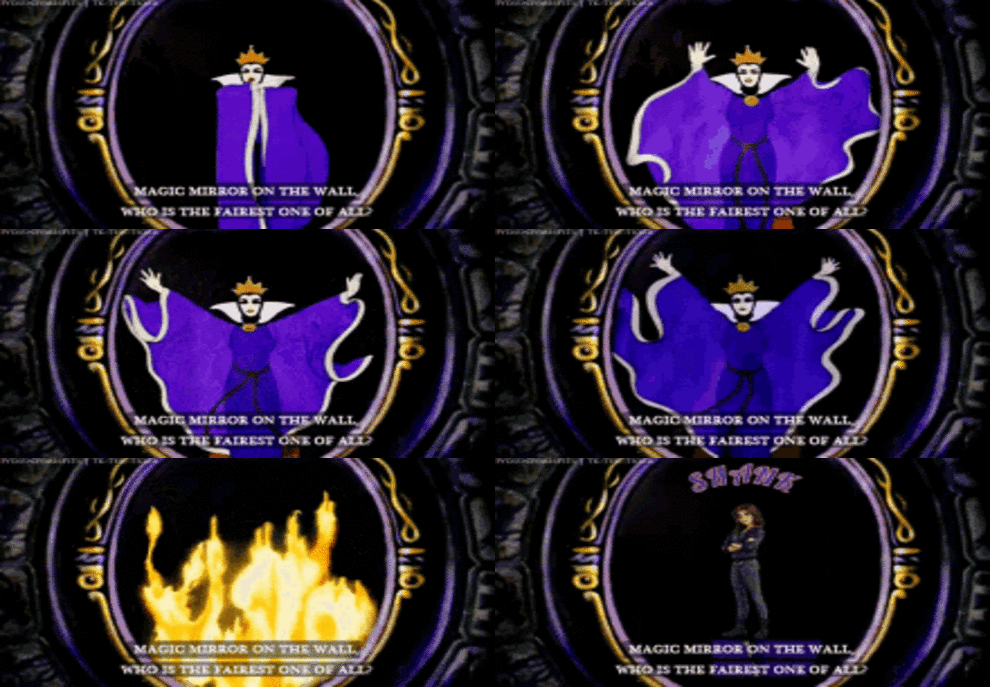
Snow White meets Eyes Wide Shut in this surreal descent into the dark side of beauty, envy, grief, and the complicated love between mothers and daughters. With black humor and seductive horror, Rouge explores the cult-like nature of the beauty industry—as well as the danger of internalizing its pitiless gaze. Brimming with California sunshine and blood-red rose petals, Rouge holds up a warped mirror to our relationship with mortality, our collective fixation with the surface, and the wondrous, deep longing that might lie beneath.
Mona Awad is the bestselling author of the novels BUNNY, ROUGE, ALL'S WELL and 13 WAYS OF LOOKING AT A FAT GIRL. She is a three time finalist for a Goodreads Choice Award, a finalist for the Giller Prize, and a winner of the Amazon Best First Novel Award. BUNNY was also a finalist for the New England Book Award and it won the Ladies of Horror Fiction Best Novel Award. It's currently in development for film with Bad Robot Productions. Her forthcoming novel, WE LOVE YOU, BUNNY will be released with Simon & Schuster in September 2025.
She earned an MFA from Brown University and an MScR in English from the University of Edinburgh where her dissertation was on fear in the fairy tale. In 2018, she completed a Ph.D. in Creative Writing and Literary Studies at the University of Denver. She currently teaches creative writing at Syracuse University and lives in Boston.
Rouge has me all in a tizzy. I’m so conflicted over how to rate it.
The problem is that I wanted to love it more than I did. And my want-to-love-it is fighting to take control of my review.
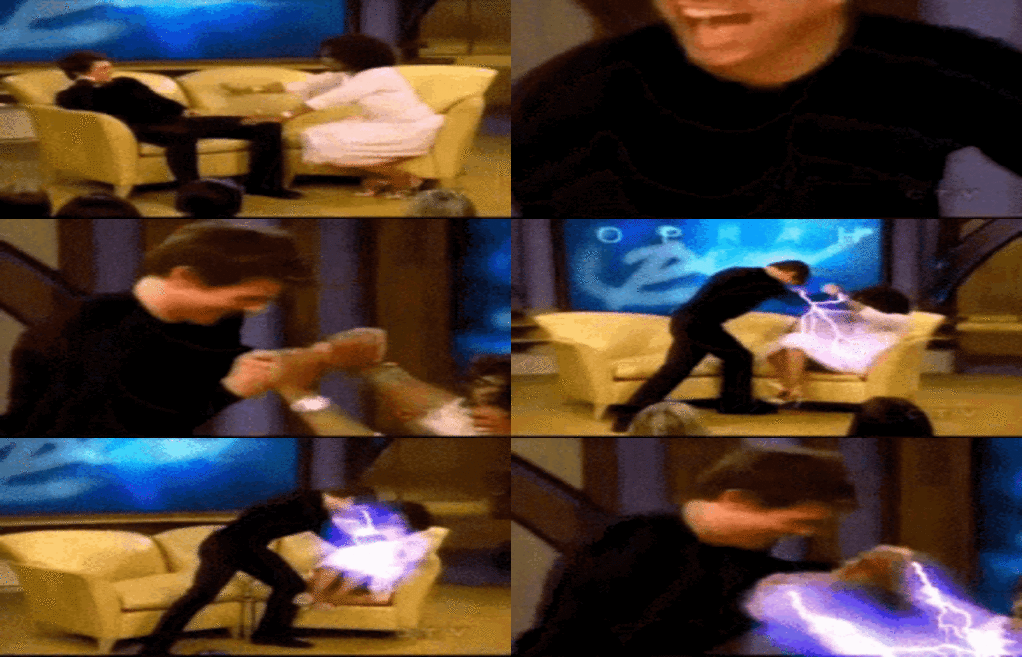
Mona Awad's latest is my first foray into her writing: a dark, trippy fairy tale about a woman who loses her mother and then spirals down a dangerous path in search of youth and beauty. Reading very much like a fever dream, the story is filled with gorgeous red, white, and black imagery, and there are shades of Snow White and even Tom Cruise (but not really) in its pages.
Throughout the book, Awad fiercely attacks the beauty industry and the pressure it places on women to look younger and be our most beautiful selves. And she makes us question: how much are we willing to sacrifice in order to meet these unreasonable standards?
And Awad handles it so well. Her jabs hit the target, and she’s unapologetic while making them. But as I mentioned above, much of the narrative is written as a surreal, druggy dream, and what happens inside of these dreams isn’t always interesting. Parts feel repetitive and I was bored at times, even though I wanted not to be, more than anything.
I was also looking for a more intricate and nuanced approach to the story and its themes. By the last chapter, Awad spells most everything out, what happens and why, and there isn't much left for us to piece together on our own.
The ending is killer, though. Even without the depth and complexity I craved, if Awad had given us more of what's in the last 50 pages – emotion, horror, and thrills – then I wouldn’t be stuck on a 3.5 star rating.
My sincerest appreciation to Mona Awad, S&S/Marysue Rucci Books, and NetGalley for the digital review copy. All opinions included herein are my own.
horror retelling of snow white focusing on the impossible beauty standards of today as unwillingly passed down from the women that came before us...
this was brilliant before i even started reading it.
i wish i hadn't read all's well before this, because the two are sadly very similar (with nearly identical protagonists, writing styles, and meltdown arcs) and this one is much more interesting to me.
instead, i felt pretty irritated by the middle of this book, which was not only a bit repetitive in and of itself but far too reminiscent of that one.
do i feel like it was necessary to make tom cruise and a surfer bro window-washer and a cop character with a romance hero's name major characters? no. but who am i to question whatever was going on here?
mona awad's writing is so, so weird. and if the beauty industry was any less freakish, it wouldn't work. but thankfully we don't have that problem, and the two fit well!
bottom line: in a weird-off, mona wins every time.
mother bunny mona awad’s mastery of the written word… oh, i envy! the perfect conclusion to what mona has called her "fairy tale trilogy".
much like bunny and all's well, the magic happens when they, and their protagonists, descend into the madness of the mind. many describe her novels as fever-dream-trips and while this is true, i feel it can sometimes be reductive. yes, there is an obvious blurring of the real and the imagined, but there is also endless substance within what some read as nonsensical, and perhaps unenjoyable, journeys and conclusions. these works exist for the readers who thrive in experiencing the unknown, and who don't want or need clearcut, black and white storytelling.
a story about girls who call each other bunny is not a critique of them, but of a society that admonishes women for loving each other and vocalising that love. a shakespearean medley about a woman living with chronic illness is a comment on how often our pain is unseen and unacknowledged, until we lose ourselves in it. a reimagining of snow white is a cry against the immortalised and impossible standards of beauty we must seek to maintain under patriarchy, and how that fruitless fight impacts our connections with each other.
bunny = women's relationship to other women and art. all's well = women's relationship to pain and trauma. rouge = women's relationship to beauty and expectation. it's all there, and once you start exploring and questioning everything on her pages, you'll never stop. for me, that is the brilliance of her voice. she always surprises me, even if i've read it before.
‘I stared up at the horrified white face masks on the red walls. Twisted in varying degrees of terror. As if each face had been frozen confronting its worst nightmare, really. It was lovely.’
Rouge by Mona Awad is a novel that delves deep into the complexities of identity, beauty, and the pursuit of perfection. Awad's prose is undeniably eloquent, weaving a narrative that is both haunting and thought provoking. The story follows the journey of our protagonist as she grapples with societal pressures, personal insecurities, and the allure of beauty in its various forms.
One of the strongest aspects of Rouge is its richly drawn characters. The protagonist is flawed yet compelling, her struggles and inner turmoil will resonate with readers on a visceral level. Awad skillfully navigates the intricacies of her characters' psyches, painting a nuanced portrait of individuals grappling with their own desires and shortcomings.
Furthermore, Awad's exploration of beauty standards and the cosmetic industry is both timely and relevant. Through her sharp wit and keen observations, she exposes the superficiality and shallowness that often underlie society's obsession with physical appearance.
However, despite its strengths, Rouge is not without its flaws. The pacing of the novel can be uneven at times, with certain sections dragging while others feel rushed. This inconsistency in pacing detracts from the overall flow of the narrative and may leave readers feeling disconnected from the story at times.
Additionally, while Awad's prose is undeniably beautiful, it occasionally veers into the realm of pretentiousness. There are moments where the language feels overly ornate, obscuring the clarity of the storytelling and making it difficult for readers to fully immerse themselves in the world of the novel.
Rouge is a novel that offers a compelling exploration of identity, beauty, and the human psyche. While it may stumble in terms of pacing and occasionally succumb to literary excess, Awad's keen insights and vivid storytelling ultimately make Rouge a worthwhile read for those willing to engage with its challenging themes.
my relationship with awad's works seems to be very much one step forward and two steps back. while this did not frustrate me as much as bunny it was just...boring...lacklustre. a lot of scenes and exchanges were too reminiscent of all's well. the first chapter sees a woman of the not-feeling-too-good variety giving Patrick-Bateman-lusting-after-business-cards energy as she is hiding away watching a video promising wellness or a better improved happier self all the while someone is calling her name.
anyway, rouge felt like a short-story stretched out into novel form that amounts to a series of not particularly shocking or interesting dream(y) sequences that might appeal to fans of, i don't know, mulholland drive (love lynch but, at the risk of incurring the wrath of cinephiles, that film was not it). i found the commentary on beauty and ageing terribly on the nose and not particularly clever or subversive (that a character references 'eyes wide shut'...subtle). the 'french' elements embodied by the mc's mother, were laughable. the dynamic between the mc & her mother, seemed reminiscent of shirley jackson's work (her 'mother/mother' refrain was very much giving The Haunting of Hill House). the novel reveals little and, worst still, failed to entertain me the way the author's previous novel at least managed to. murky scene after murky scene, in which we are meant to question our mc's sanity. maybe if awad hadn't immediately blurred the line between reality and fantasy, maybe then i would have felt some unease at whatever was going on, but i didn't. i felt bored by awad's writing which often relies on the same stylistic 'tricks': the use of 'you', repeating words, the avoidance of a subject matter, 'fragmented' yoda-like sentences, and tumblr-esque phrases ("You nodded. An ache opening up inside you. Deep, deep." / "Cynical smile of the beautiful who know they're on the downhill slope." / "Don't know why I came here. Can't afford this place, not at all" / "She's brimming with it: a longing for delusion." / "A friend of a co-worker. Lonely. We both were." / "Shake her lovely head." / "I lean in and kill him on the lips and he kills me right back."...i mean this last one is truly giving dark fantasy ya). and sure, these choices can be effective, if used sparingly or increasingly to reflect the mc's delusional state of mind, but that's not the case here. reading a page felt like wading through molasses, and i soon felt mired by awad's laboured prose. whereas all's well managed to provide a few diverting plot-points and scenes, i felt nothing while reading rouge.
as per usual, the opinions above are very much based on my very subjective personal taste and i would recommend my fellow readers to check out some different and more positive reviews out.
Rouge is the 2023-release from Mona Awad. It's my second novel from this author, the first being All's Well.
I actually felt very similar to this one that I did All's Well, except I enjoyed the content and messages of this one more.
In this story we meet Belle, a lonely shopkeeper, living in Montreal, with a penchant for skincare and watching skincare videos. When Belle's mother, Noelle, unexpectedly dies, Belle has to travel to her mom's home in Southern California to settle her estate.
As she's there and begins to dig into her mother's life, she finds Noelle had built up considerable debt and was living a lifestyle that raises a lot of questions about her death.
The mystery thickens when a woman in red appears at the funeral offering clues about Noelle's life. These clues, along with a pair of red shoes, help Belle to find Maison de Méduse, a lavish, yet eerily cult-like salon to which her mother was completely devoted.
This is where Belle, like her mother before her, becomes obsessed with the mirror, and the Alice in Wonderland-like world that exists behind it.
Rouge is described by the publisher as being a surreal descent into the dark side of beauty, envy, grief, and the complicated love between mothers and daughters. With black humor and seductive horror, Rouge explores the cult-like nature of the beauty industry.
I did get all of these things, but only wish I could have understood what was going on in the second-half of the story more. It started strong, then lost me.
As with All's Well, I loved the beginning, but as Belle got more involved and invested in the world of Maison de Méduse, the narrative went so far into fever-dream territory, that I'm afraid the majority of it went over my head.
Therefore, by the time I got to the end, I couldn't decipher what I'd read. Honestly, the latter half, I had pretty much given up on true understanding and was more invested in the lyrical writing and word play.
I think for people who have loved Awad's stories in the past, or people who love weird fiction in general, particularly with beautiful writing, you should read this.
I'm glad I picked it up. It was beautiful. I did love the modern Dark Fairy Tale quality of the story. I could actually see this being turned into a great movie, or limited series. Maybe I would understand it more in that format.
Thank you so much to the publisher, Simon Element, for providing me with a copy to read and review.
I know so many Readers are going to love this, even if it wasn't 100% for me.
with rouge mona awad explores the ever so complex dynamics of a mother-daughter relationship. and as any other mona book it only gets “weirder” and more confusing as it progresses into a truly twisted and incredibly intense tale.
at the forefront of the story is loss and grief. but the book overall is also a powerful commentary on, and critique of, the beauty industry and how wanting to conform to the beauty ideal can result in loss of self; here obsession and “where to draw the line” plays a significant role. throughout the story, lines can also be drawn to capitalism and how companies feed on the insecurities of women; more precisely, ones forced upon us by impossible beauty standards.
the publisher kindly provided this arc through netgalley in exchange for an honest review.
Rouge was one of my most anticipated new releases for the second half of the year. Mona Awad must've been high off of her mother’s Dior perfume fumes when she wrote this book because this was wild. Rouge is an acid-trippy psychological novel that explores the topics of strained mother-daughter relationships, grappling with identity as a multi-ethnic person, American beauty standards, and toxic obsession with the beauty industry. Rouge had the recipe for a masterpiece, but it was half-baked. I'm all for weird, but the weirdness isn't my gripe with this book. The problem is it was way too repetitive. We get it Mona, you have an affinity for red rose petals, jellyfish, and Tom Cruise. I felt like I was trapped in a never-ending episode of Black Mirror, but in the worst way possible. The same thing was repeated over and over again to the point where when the story was finally coming to a head, I just didn't care anymore because I was so drained. And then, that ending? It was unnecessary and lackluster. I think this story would've been a lot more effective and engaging if it were a short story or novella. The topic of beauty standards and society's obsession with youth and beauty products is nothing new and, in my opinion, a little played out, and Rouge didn't give us anything revolutionary about the topic.
Thank you Netgalley, Simon Element/Simon & Schuster, and Mona Awad for the eARC.
Mona Awad writes mad women like no other author, redefining magical realism for a contemporary audience. Her protagonists are a particular type of women on the verge, obsessed with some form of beauty (writing, performance, physical appearance), desperate to belong. They fall into their own madness, losing their ability to discern reality from imagination, fantasy from truth. The spectacle of their descent is something to behold.
Rouge is Awad’s latest gothic, exploring the relationship between women’s value and age, beauty as currency, and the dynamics of different female relationships. From the protagonist’s grappling with her ethnic heritage, her physical looks, and the social rules she has been taught by her mother and girl friends growing up, her mind is consumed by others’ ideas: how to be beautiful, which skin color is the most desirable, women should behave this way; men like this. Despite her desire to distance herself from her mother’s ways, as an adult, Belle’s vanity, desire to be desired, and inability to confront herself are inherited directly from mother. With horror, she realizes that she is becoming her.
A tone of desperation threads its way throughout the novel, through Belle’s encounters and responses to men, recurring memories of her mother when she was younger, her fixation on skincare and beauty, and the ever-present elements of vanity that she cannot help but be drawn to. Mirrors are one of the most effective symbols and themes of the narrative, coming in the form of physical objects (broken and unbroken), trick elements that seem to show alternate realities, and other people’s faces and words. Rouge seems to suggest that the most important mirror is the fated one between a parent and their child.
Is there any relationship like that between a mother and daughter? The tensions and tenderness of love, withholding and negotiations of affection, and imitations and jealousies that are found in this most intricate relationship are all explored in the novel. Rouge offers the lesson that childhood can leave lasting internal scars that adulthood perpetually seeks to heal. It also suggests that a more complicated response than forgiveness is required to let grief go and to begin again.
The mystical elements of this fairytale, from a sinister French spa that operates in an unusual way to the recurring characters whose costumes and looks seem to change with each encounter, are expressed in trademark Awad style, toeing the line between a nightmare and a daydream. One particularly ominous expression, “going the way of roses”, repeats itself, shading something seemingly delicate with darkness. The color red pervades each page, alternatively foreboding and beautiful. Phantom men come and go, as enigmatic as the women. Like the characters themselves, everything appears immaculate on the surface but is much more complex when examined in the interior. Having read nearly all of Awad’s works, this novel truly reflects an already gifted artist’s continual refining of their craft.
Like the renewing qualities of Belle’s many products, the novel offers a revitalization, by applying an acid to strip everything off the surface to allow what is underneath to grow, better and more beautiful. The process isn’t designed to feel comfortable, but there’s a morbid pleasure in the pain. Afterwards, you’re left with yourself, but new. The transformation and its tantalizing promise demonstrates the softness we sacrifice to grow up and to become a person we must live with. Awad holds up a mirror to her readers, inviting us to ask ourselves what darkness we find inside and whether we can bear to face its image.
(review posted on @thegirlwhoreadsonthemetro on Instagram)
Okay so I really loved this book. I really enjoy books that keep me intrigued. Like I seriously had no idea where this book was going. I loved the way it was written, I seriously couldn’t get enough of it!
The only reason it gets 4 stars and not 5 is because I still feel like some parts of the story didn’t match up or some parts I was just confused about by the end. I loved the ending and thought it was great, but thinking back on some parts, they just aren’t really explained.
But other than that I thought it was great. It kept me guessing and interested the whole way through and I think would definitely be better after I read it a second time.
Mona Awad’s labelled Rouge the “twisted, culty sister to Bunny.” Her hauntingly gothic story draws on sources that range from fairy tales to Egyptian mythology. Mirabelle – Mira to her friends and Belle to her family - seems settled in Montreal. She has a steady job in a local dress shop and finds solace in watching skincare videos. Her spare time is taken up with obsessively recreating their rigid regimes which hold out the promise of someday achieving facial perfection. But then her mother dies in strange circumstances. So, Mira travels back to her mother’s home in La Jolla where she receives an unexpected invite to an exclusive, opulent spa La Maison de Méduse whose clandestine operations mask a horrific secret.
Like earlier writings, Awad’s tale of desire and transformation mines her own life, here she returns to an exploration of physical self-loathing and the ways in which women’s self-worth is too often tied to the pursuit of impossible standards of beauty. Mira or Belle is dual heritage, like Awad her mother was white, her father Egyptian. Growing up Belle couldn’t see herself reflected in the people around her, increasingly desperate to resemble her achingly glamorous mother whose “skin is as white as snow” rather than be continually compared to her “swarthy” father. It’s a scenario that conjures comments Awad’s made about her own background and the various forms of racism she’s personally experienced - particularly acute in the period after 9/11.
Awad was also inspired by the rise of UK skinfluencers who command billions of views on platforms like TikTok - with skincare products fast overtaking purchases of conventional makeup. Beauty gurus whose soaring popularity is fuelled in part by narcissism, envy or feelings of inadequacy that, it seems, might be addressed by finding just the right combination of Tretinoin and Korean snail extracts. Awad’s fluid, nightmarish narrative has a distinctly visual, cinematic flavour in keeping with its central themes: carefully-conceived colour palettes and elaborate settings abound, with here and there dashes of Hitchcock in his Vertigo era spliced with early Argento while vivid echoes of Cocteau’s La Belle et La Bête mingle with The Wizard of Oz. And the final, frenzied revelations about the spa’s exclusive treatments are pure Cronenberg. Awad also incorporates film star Tom Cruise who has a pivotal, gloriously perverse role in Belle’s story. What brings all of these elements together is Awad’s underlying examination of the intricate bonds formed between mothers and daughters, and the challenging, conflicting emotions that may accompany grief and sudden loss. Although I thought there were times when this faltered and it didn’t always feel as satisfyingly complex as All’s Well, it was still an immensely intriguing, consistently gripping read.
Thanks to Edelweiss and publisher Marysue Rucci Books/Simon & Schuster
By the time I came to chapter 7 of this amazing dream of a novel I began to hear Eric Burden's old song SPILL THE WINE singing strongly in my head and, although I can't exactly tell you why it's true, or even begin to explain it, this novel is exactly that song, in a very great, most excellent, not-to-be-missed way, and for those of you too young to remember this song I will brazenly add the lyrics here and I encourage you to seek it out immediately. Take that pearl.
Spill The Wine by War
I was once out strolling One very hot summer's day When I thought I'd lay myself down to rest In a big field of tall grass I lay there in the sun And felt it caressing my face As I fell asleep and dreamed
I dreamed I was in a Hollywood movie And that I was the star of the movie This really blew my mind The fact that me, an overfed long-haired, leaping gnome Should be the star of a Hollywood movie
But there I was I was taken to a place The Hall of the Mountain King I stood high up on a mountaintop Naked to the world In front of Every kind of girl There was long ones, tall ones, short ones, brown ones Black ones, round ones, big ones Crazy ones
Out of the middle Came a lady She whispered in my ear Something crazy She said
Spill the wine, dig that girl Spill the wine, take that pearl Spill the wine, dig that girl Spill the wine, take that pearl
I could feel hot flames of fire roaring at my back As she disappeared But soon she returned In her hand was a bottle of wine In the other, a glass She poured some of the wine from the bottle into the glass And raised it to her lips And just before she drunk it She said
Take the wine, take that pearl Spill the wine, take that pearl Take the wine, take that pearl Spill the wine, take that pearl Take that pearl, yeah! It's all good Oh, you got to do it Spill that wine, spill that wine
Spill the wine, spill the wine, spill the wine, spill the wine, spill the wine Take that pearl
I misted diligently between skins with the rosewater and birch milk Moon Juice to create what Marva calls a moisture mille feuille
With this book Awad has sealed the deal and become a must-read author for me. Her imagination is so gloriously fertile in the way she binds together issues that are connected but not always obviously so: here her field is the complicated terrain of mother-daughter relationships, grief and mourning, the racialised nature of beauty ideals and the cult-like realm of recent skincare regimes. Underpinning and holding together what could have been a hotchpotch of topics is a return to fairy tales and myths such as those used in Bunny.
This story is creepy, absurdist, darkly funny, moving and downright bonkers by turn. But there's a real journey here for our narrator and while the book may be a tad too long, it reaches a satisfying ending for both characters and reader.
I like Mona Awad in general, but this one bored me. There wasn’t anything subtle or clever. It was all over the place and simultaneously nowhere. (This will make sense if you choose to read it, but I think you are better off not knowing what that means because you’ll be better off saving that time towards a better book.)
This was like suffering though someone telling you their dreams every single morning and they are all basically the same and boring and you just don’t give a shit.
Mona Awad’s books can best be described as a lit fic wtf, and I say that in the best possible way because her books always have a clear and powerful message. They’re also always deliciously devious and so much fun! I don’t know too much about Awad’s journey as an author, but I first read her books with her chaotic novel, BUNNY. It’s so much fun and bizarre and a total blast! Her books aren’t for everyone, but I was excited to pick up her upcoming novel, ROUGE.
ROUGE takes on the beauty industry in this Eyes Wide Shut meets Snow White (I also got Death Becomes Her vibes slightly too) with the protagonist Mirabelle (nicknamed Belle) and her mother Noelle. Living in Montreal, Belle’s relationship with her mother is estranged to say the least, but when she dies, Belle flies over to her mother’s apartment in San Diego to prepare funeral arrangements. There, she is embraced by this exclusive spa called La Maison de Méduse, which is apparently where her beauty obsessed mother would regularly spend her time. There, she learns more about her mother’s obsession with mirrors and her appearance, and how dangerous the path her mother led before her demise.
ROUGE touches on unrealistic beauty standards, race, mother/daughter dynamics, and the mental stability of those who place superficial aesthetics above all else. This book is dark, wildly entertaining, and thought-provoking. ROUGE is the perfect infusion of horror, dark comedy, and social commentary. I loved this one so much and it’s definitely Awad’s best. I battled with giving it a 5 star or a 4 star, which led me to the only 4.5 star read I’ve had all year. I still am struggling with whether this rating is right or not, but readers will definitely be polarized on this one. I cannot WAIT to see this as a movie, because the imagery that Awad uses through the setting (you’ll know what I mean when it gets to the jellyfish) is absolutely remarkable. I’ll be tuning into Mona Awad’s next story. STARS: 4.5, PUB: 9/12
One of my favorite authors is back with a phenomenal story that's part Gothic fairy tale and part horror. Just wait until you hear the synopsis on this one:
Even though Belle is estranged from her mother Noelle, they both share an obsession over vanity, and especially skincare. When Belle receives the news that her mother passed away under mysterious circumstances, Belle travels to her mother’s apartment in Southern California. Soon after arriving, Belle discovers a secret, ultra-lavish spa called La Maison de Méduse where she learns that her mother was a member. Belle soon unearths a terrifying secret behind her and her mother’s obsession with the mirror and the sinister abyss that lurks on the other side of the glass.
Sounds amazing, right? Well, let me tell you, it is extraordinary! Reading Rouge is like being inside a surrealist painting. Dreamy, beautiful, terrifying, and full of symbols. As with Mona Awad’s prior works Rouge would be impossible to put into a single genre. Rouge is a blend of literary, horror, magical realism, and even a bit reminiscent of a Grimm’s fairytale.
Rouge explores the complex dynamics of the mother-daughter relationship, our distorted views of ourselves, how toxic our vanity-obsessed culture is, grief, and trauma. Rouge also begs to answer one of life’s greatest mysteries, what exactly is Tom Cruise? And the ending on this one? Tres magnifique.
Mona Awad brilliantly crafts these unforgettable tales with remarkably flawed and relatable female main characters. It's been a few years since I've read her prior works, Bunny and All’s Well but I still think about them from time to time. Rouge is no different. I'm positive that I will still be thinking about this spell-binding story in the years to come.
Rouge by Mona Awad will be available on September 12. A massive thanks to Marysue Ricci Books/Simon and Schuster and Netgalley for the gifted copy!
No spoilers. 4 1/2 stars. Since childhood, Belle has had a compulsive relationship with her skin care regimen...
And with Tom Cruise...
Belle's mother Noelle had her own fixation with beauty and perfect, youthful skin. Now, many years later...
Mom is dead...
... She went for a nighttime walk along the cliffs above the beach in La Jolla, California, and fell to her death...
A mysterious woman in red attending Mom's funeral party told Belle that her mother went the way of roses...
But what does that mean?...
As Belle cleans out Mom's seaside condo, she notices that every mirror hanging on the walls has a crack running down the middle...
One night...
Walking along the same cliffs that killed her mother, Belle finds herself on the doorstep of an opulent spa-like palace...
The door opens, and she is welcomed...
... into a party in progress. The guests seem to already know who she is, and these beautiful people are interested in her...
Belle is invited into the spa/mansion called Rouge with its floor-to-ceiling aquarium of red jellyfish...
... to go on a very exciting journey to discover her most magnificent self...
But...
The floating jellyfish aren't jellyfish, and the mirrors hanging on the walls aren't just mirrors...
Letting go...
... is so worth it, Belle is told, and she's encouraged to go the way of roses with a free beauty treatment while at Rouge...
I was unsure if I'd like this novel because of its subject matter (beauty spas), but it was really very good. It was a mix of horror and mystery and very well written. In fact, it is one of the best novels I've read this year.
There were a few loose ends, so I removed 1/2 a star, but overall, it's a great story.
im convinced mirabelle is on hallucinogenics and mona awad forgot to tell us. my credentials for judging ? i share a psychologically intense relationship with my mother too.
the "fever dream" style of this book, is a terrible passage for dissecting realworld issues like colorism and racial identity. mirabelle's racial identity felt like a forgotten accessory. the plot constantly devolves into talking mirrors, and cult rituals or some aesthetic 'pinterest worthy' motif, therefore lacking the ground for the very real issue to be discussed without the addition of some stupid cream lexicon.
this is an immensely important topic... correct? i mean her mother literally justifies mirabelle’s 'ugliness' by weaponising her father’s Egyptian genes to 'validate' it. it’s sick, it’s heavy, and it’s the only intellectually stimulating aspect. but yes, one could argue thats the point though, its supposed to delve into the obsessive cult like industry and make us spiral reading it. and i would agree, but just not with the issue of colorism as a side chick.
i liked the ending though, i thought it was wholesome.
I’ve read a few fictional books recently that take the dangers of the “wellness” industry to extremes and I’m kind of loving the recent genre pushback against the predatory beauty industry that profits by making people feel like absolute shit about themselves. Natural Beauty by Ling Ling Huang, Aesthetica by Allie Rowbottom and 9 Perfect Strangers (I’ve only seen the tv adaptation which was depressing but also amazing) are some other recent pieces that tackle this subgenre. Rouge, with its dark fairytale feels and exquisitely painted mother/daughter issues, is my favorite so far.
It’s very much a sister book to Awad’s book Bunny. I’m guessing if you loved Bunny for all of its WTFery and weirdness, you’re going to love Rouge probably just as much or maybe even more. Who am I to say? It’s grounded in realism while it manages to wrap itself in a dreamlike aura (or nightmare depending on your POV) and it bounces between the two until they start to merge with an almost upsetting, off-kilter feeling that kept me on edge throughout, sort of like a David Lynchscape. It’s called “seductive horror” somewhere on the cover of my book and that’s an accurate description. You’ll either be seduced by it or you won’t. I love this kind of stuff but I know it’s not for everyone.
Mirabelle has always had a difficult relationship with her beautiful and desperately unhappy mother. When her mother dies under mysterious circumstances Mira must face down her past and look deeply into her mother’s faults as well as her own as she closes out her mother's affairs. She puts on her mama’s red shoes which lead her straight to a strange beauty treatment center run by exquisitely beautiful and very eccentric wealthy party people. She’s immediately welcomed into their world and offered coveted beauty treatments as life as she knew it slowly unravels because nothing in this world comes without a steep price. It’s a tale drenched in envy, jealousy, neglect, fear, and the dissatisfaction that comes along with wanting something that you simply cannot attain.
This book is effortlessly sinister. Everything about it is unnerving, especially the “Tom Cruise” appearances 😂 and that’s all I’m saying. Read it and freak yourself out. That’s my advice.
Are you looking to brighten? Tighten? Lighten? Whiten? Do you need to firm up? Plump up? Lift up? Do you wish to glow? To glisten? Then Treatment™ might be for you.*
*Don’t take Treatment if you are allergic to Treatment. Side effects may include numbness, burning, cracking mirrors, lost time, missing words, delusions of grandeur, suicidal ideations, hallucinations, jellyfish, going the way of the roses or Tom Cruise.
Mona Awad’s latest release is a warning to all about the quest to find the fountain of youth. It is part . . .
And part . . .
It’s batshit crazy which I think just has to be expected from this author and it is a case where I truly wish there were half stars on Goodreads. I’m giving this one 3.5 and rounding down because, while I’m in for a ride on the crazy train, at some point I was also ready to get off and this one probably went about 100 pages too long for me.
If you previously were a fan of Chuck Palahniuk who has been disappointed in his past few offerings, maybe give Mona Award’s stuff a spin. She’s nucking futs.
Hi Bunny, it pains me to say this, because I really, really wanted to love this, but Rouge sadly, did not rock my world. The story was disjointed and while weird, felt forced and chaotic in a bad way. A hodgepodge of elements are thrown together that while wacky, didn’t align particularly well with the gothic, dark atmosphere Awad was trying to build. This atmosphere by the way, felt more akin to a YA series like Caraval than something darker and deeper like Crimson Peak or The Hacienda. A bit juvenile and hastily put together, Rouge follows a blueprint for dark, romantic and gothic but with no real substance.
The thesis statement of “skewering the beauty industry” is also quite superficial, and gets repetitive and tedious early on. We get it, down with 25 step routines filled with acids, serums and creams oh my! Down with beauty influencers! I guess I just hoped for more from such a creative, unique voice than the similar retread of beauty industry critiques I could read on The Cut any given day. Thanks for the weird Tom Cruise fixation though I guess?