

What do you think?

Pellucidar #1-3
At the Earth's Core/Pellucidar/Tanar of Pellucidar
From the vaults of The SF Gateway, the most comprehensive digital library of classic SFF titles ever assembled, comes an ideal introduction to the fantastic worlds of one of the greatest adventure writers of all time, Edgar Rice Burroughs.
The son of a Civil War veteran, Edgar Rice Burroughs was a prolific writer for the early pulp magazines. Famous the world over as the creator of Tarzan - and in SF circles for his Martian tales featuring John Carter - Burroughs is a household name. But there was more to him than apemen and four-armed Martians! This omnibus collects his tales of the world within a hollow Earth: At the Earth's Core, Pellucidar and Tanar of Pellucidar.
The son of a Civil War veteran, Edgar Rice Burroughs was a prolific writer for the early pulp magazines. Famous the world over as the creator of Tarzan - and in SF circles for his Martian tales featuring John Carter - Burroughs is a household name. But there was more to him than apemen and four-armed Martians! This omnibus collects his tales of the world within a hollow Earth: At the Earth's Core, Pellucidar and Tanar of Pellucidar.
- GenresFictionScience Fiction
410 pages, Kindle Edition
First published June 1, 1929
About the author
Edgar Rice Burroughs
3,243 books2,806 followersEdgar Rice Burroughs was an American author, best known for his creation of the jungle hero Tarzan and the heroic John Carter, although he produced works in many genres.
Ratings & Reviews
Friends & Following
Create a free account to discover what your friends think of this book!
Community Reviews
Displaying 1 - 7 of 7 reviews

August 8, 2025
As per the title, an omnibus collecting the first three of Burroughs' Pellucidar books: At the Earth's Core, Pellucidar and Tanar of Pellucidar.
Pellucidar is the third of Burroughs' major series (after Barsoom and Tarzan) and arguably the weirdest (although I admit that Barsoom remains my first love).
At the start the first book, David Innes (our narrator and protagonist) and Abner Perry (eccentric, older scientist and comic relief) are testing Perry's latest invention: A mechanized underground drilling machine ("mechanical mole", they call it). Because it can't corner worth a damn, instead of drilling downwards a bit, then turning and popping back out, it spends a couple of (nearly fatal) days drilling straight downwards until it penetrates the surface of Pellucidar, the inner world that exists within our own (the Earth being, in fact, a hollow sphere with a whole 'nother world on its inner surface; and gravity pulls towards the inner side of the shell because Burroughs never cared too much about physics, and there's a sort of sun hanging dead smack in the center of the hollow earth, providing perpetual daylight).
And Pellucidar as a setting is great. And weird. It (well, at least, the areas where we spend most of our time in these first few books) is a savage, primeval land inhabited by prehistoric beasts and various types of hominids, which lets Burroughs do his jungle adventure thing like in Tarzan, but without (well, mostly without) the extremely distasteful racial stereotypes that pop up in the Tarzan books in particular with distressing regularity.
(And Burroughs can also be surprisingly playful and inventive, even if things don't always hold together under close scrutiny -- like, because the inner sun is at the center of the hollow void, it's always perpetually noon, with no shadows and no way to measure the passage of time other than subjectively in terms of how much stuff you're doing, so on multiple occasions our heroes get separated and David has lengthy series of escapades before being reunited with Abner, who didn't even notice that he was gone for any length of time.)
And, this being a Burroughs novel, they step out of the mole machine into a jungle and are immediately chased by giant, prehistoric beasts and captured by Sagoths (savage ape-men who are themselves enslaved by the Mahars, a race of sort of intelligent, telepathic pterodactyls who are the closest thing to what passes for civilization in Pellucidar). And, this being Burroughs, there are some natives who are at least physically identical to (mostly incredibly attractive) native humans who have also been captured by the Sagoths, and David promptly falls for one (Dian the Beautiful, and we know she's beautiful because she's played by Caroline Munro in the film version).
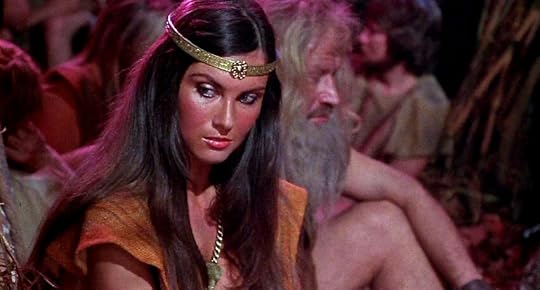
And, this being Burroughs, David Innes initially bollixes the whole thing up, but will True Love Conquer All Obstacles? And will the true humans throw off the chains of their reptilian oppressors? Again: Burroughs.
And that, very loosely, is the first two books, which were published in relatively rapid succession.
The third book, Tanar of Pellucidar, came some years later, is told from the perspective of a native Pellucidarean named, well, Tanar, and ends on a pretty massive cliffhanger, just FYI. This time around, most of the book is David Innes being kidnapped by "Korsars" (a ruthless band of nautical types who sail big, piratical looking galleons and have big, piratical cannon and flintlocks and dress straight out of Treasure Island and speak a sort of version of Spanish and hmmm ... is it possible that maybe there's a polar opening that would enable one to sail right from the outer world to the inner?), and ends with a call for help that will be answered by ... well, I don't want to give it way, but our story will be continued in Tarzan at the Earth's Core .
And overall, Pellucidar is probably my second-favorite Burroughs series (after Barsoom but pretty much neck & neck with Tarzan), but I prefer the later, less Innes-centric books because David Innes is kind of a wet blanket, not to put too fine a point on it, especially when compared to, e.g., John Carter or Tarzan himself. But I would probably recommend these books before Tarzan because of the aforementioned unfortunate racial stereotypes.
Also, as I think about it, the Pellucidar books are more explicitly colonialist than either Tarzan or John Carter. Tarzan and John Carter are arguably white savior figures, coming to foreign lands and being better at things than the locals, but David Innes and Abner Perry, once they find that the inner world is full of "primitive" humans, are bound and determined to drag them kicking & screaming into the 20th Century by introducing such wonders of the modern age as gunpowder and firearms and timekeeping (although in the third book, Tanar tells us that the locals hated the idea of a fixed clock so much that Innes & Perry had to abandon it).
(And, as an aside, the specific edition I'm reading is a Dover trade paperback that was printed probably in the 1970s or 1980s and I have to hand it to Dover -- they make some very nice, durable, easy-reading books.)
Pellucidar is the third of Burroughs' major series (after Barsoom and Tarzan) and arguably the weirdest (although I admit that Barsoom remains my first love).
At the start the first book, David Innes (our narrator and protagonist) and Abner Perry (eccentric, older scientist and comic relief) are testing Perry's latest invention: A mechanized underground drilling machine ("mechanical mole", they call it). Because it can't corner worth a damn, instead of drilling downwards a bit, then turning and popping back out, it spends a couple of (nearly fatal) days drilling straight downwards until it penetrates the surface of Pellucidar, the inner world that exists within our own (the Earth being, in fact, a hollow sphere with a whole 'nother world on its inner surface; and gravity pulls towards the inner side of the shell because Burroughs never cared too much about physics, and there's a sort of sun hanging dead smack in the center of the hollow earth, providing perpetual daylight).
And Pellucidar as a setting is great. And weird. It (well, at least, the areas where we spend most of our time in these first few books) is a savage, primeval land inhabited by prehistoric beasts and various types of hominids, which lets Burroughs do his jungle adventure thing like in Tarzan, but without (well, mostly without) the extremely distasteful racial stereotypes that pop up in the Tarzan books in particular with distressing regularity.
(And Burroughs can also be surprisingly playful and inventive, even if things don't always hold together under close scrutiny -- like, because the inner sun is at the center of the hollow void, it's always perpetually noon, with no shadows and no way to measure the passage of time other than subjectively in terms of how much stuff you're doing, so on multiple occasions our heroes get separated and David has lengthy series of escapades before being reunited with Abner, who didn't even notice that he was gone for any length of time.)
And, this being a Burroughs novel, they step out of the mole machine into a jungle and are immediately chased by giant, prehistoric beasts and captured by Sagoths (savage ape-men who are themselves enslaved by the Mahars, a race of sort of intelligent, telepathic pterodactyls who are the closest thing to what passes for civilization in Pellucidar). And, this being Burroughs, there are some natives who are at least physically identical to (mostly incredibly attractive) native humans who have also been captured by the Sagoths, and David promptly falls for one (Dian the Beautiful, and we know she's beautiful because she's played by Caroline Munro in the film version).
And, this being Burroughs, David Innes initially bollixes the whole thing up, but will True Love Conquer All Obstacles? And will the true humans throw off the chains of their reptilian oppressors? Again: Burroughs.
And that, very loosely, is the first two books, which were published in relatively rapid succession.
The third book, Tanar of Pellucidar, came some years later, is told from the perspective of a native Pellucidarean named, well, Tanar, and ends on a pretty massive cliffhanger, just FYI. This time around, most of the book is David Innes being kidnapped by "Korsars" (a ruthless band of nautical types who sail big, piratical looking galleons and have big, piratical cannon and flintlocks and dress straight out of Treasure Island and speak a sort of version of Spanish and hmmm ... is it possible that maybe there's a polar opening that would enable one to sail right from the outer world to the inner?), and ends with a call for help that will be answered by ... well, I don't want to give it way, but our story will be continued in Tarzan at the Earth's Core .
And overall, Pellucidar is probably my second-favorite Burroughs series (after Barsoom but pretty much neck & neck with Tarzan), but I prefer the later, less Innes-centric books because David Innes is kind of a wet blanket, not to put too fine a point on it, especially when compared to, e.g., John Carter or Tarzan himself. But I would probably recommend these books before Tarzan because of the aforementioned unfortunate racial stereotypes.
Also, as I think about it, the Pellucidar books are more explicitly colonialist than either Tarzan or John Carter. Tarzan and John Carter are arguably white savior figures, coming to foreign lands and being better at things than the locals, but David Innes and Abner Perry, once they find that the inner world is full of "primitive" humans, are bound and determined to drag them kicking & screaming into the 20th Century by introducing such wonders of the modern age as gunpowder and firearms and timekeeping (although in the third book, Tanar tells us that the locals hated the idea of a fixed clock so much that Innes & Perry had to abandon it).
(And, as an aside, the specific edition I'm reading is a Dover trade paperback that was printed probably in the 1970s or 1980s and I have to hand it to Dover -- they make some very nice, durable, easy-reading books.)

November 9, 2018
Review for Tanar of Pellucidar.
I have seen some reviews of Edgar Rice Burroughs works, immensely critical of various aspects of content, from sexism through to repetition. I am guessing that the people who review this are quite young or have not really thought about the context in which Burroughs was writing.
Tanar of Pellucidar is the 3rd book in the Pellucidar series, set beneath the surface of the world where another land exists, more primitive, filled with creatures that are analogues of the prehistoric creatures that used to roam the surface world. This book was published in 1928, thirteen years after the previous book in the series and it makes you wonder why Burroughs took so long to returns. (Probably too busy writing Tarzan, with a little John Carter on the side – there can be no doubt that these characters are his most successful creations.)
Time has passed since the previous novel, and although the natives of Pellucidar do not view time in the same way as we do, it is clear that it must be over a decade. The Empire founded by David Innes, hero of the previous novels has thrived, the various tribes have united and are knowing a period of peace and prosperity that they have not known before.
Time, though has passed, and characters who were children have grown up, one such is Tanar, son of a chief. Things take a turn though when their empire is attacked by a new threat, the Korsairs, and although they are repelled, they take a number of hostages, of which Tanar is one. And, as soon becomes apparent, this is not a story about David Innes, but about a new generation.
Burroughs opens up his world, exploring more of it, but there seems to be a bit of the creativity missing that was there in the first two books. The world is still fun, but the creativity and invention that was so impressive in the earlier novels (and the Mars books) is missing here. He builds up the geography of the world, but the depth of previous novels does not seem to be there, it is still interesting, but the sense for me of ‘Wow! The creativity here is astounding.’ was missing. In some cases, the construction seemed rather simplified. From an island of love where everyone is happy to an island where everyone is cruel and unhappy
The Korsairs save the day slightly, although their society is close to 2 dimensional, they play out as good villains and the fact that they are descendants of other people who have stumbled into Pellucidar from the surface world give them a different feel.
Burroughs has improved over the intervening years when it comes to setpiece action scenes, he was always good, but here you find yourself holding your breath and really caught up in the moment on a number of occasions. There are a couple of descriptive pieces that work well too, really conveying the sense of the situations in question.
So, repetitive? Yes, but not in a horrendously bad way. One has to remember that Burroughs’ work was published in episodic format before being collected into a novel, so in order to convey excitement and adventure there is almost going to be some repetitive parts, that stand out when collected together than when they were published in monthly instalments. The reader would want to be thrilled again and again, and if a character escaped and was captured again then so be it. It was no different to the adventure film series that would follow decades later.
Sexist? Well, by todays standards probably so, but even then not so much. The context should be taken into account, Burroughs was writing in a time when the role of the female in society was incredibly different than today, and taken into account it is possible to argue that his main female characters are quite forward thinking and are almost feminist role models. Yes, there is a bit of swooning, and they can’t help falling in love with the male lead, but they are also strong characters. In this book the main female is Stellarer and she is a magnificently strong creation. She is prepared to fight fore herself, stand up to the patriarchal society to which he was born. She choses her own partner, and makes decisions that are hard but done to protect others.
For a book of its era it is a lot better than some.
More enjoyable than its predecessor like a lot of Burroughs work it is laying the ground work for later generations and should be judged on the merits of its time, not by modern standards.
I have seen some reviews of Edgar Rice Burroughs works, immensely critical of various aspects of content, from sexism through to repetition. I am guessing that the people who review this are quite young or have not really thought about the context in which Burroughs was writing.
Tanar of Pellucidar is the 3rd book in the Pellucidar series, set beneath the surface of the world where another land exists, more primitive, filled with creatures that are analogues of the prehistoric creatures that used to roam the surface world. This book was published in 1928, thirteen years after the previous book in the series and it makes you wonder why Burroughs took so long to returns. (Probably too busy writing Tarzan, with a little John Carter on the side – there can be no doubt that these characters are his most successful creations.)
Time has passed since the previous novel, and although the natives of Pellucidar do not view time in the same way as we do, it is clear that it must be over a decade. The Empire founded by David Innes, hero of the previous novels has thrived, the various tribes have united and are knowing a period of peace and prosperity that they have not known before.
Time, though has passed, and characters who were children have grown up, one such is Tanar, son of a chief. Things take a turn though when their empire is attacked by a new threat, the Korsairs, and although they are repelled, they take a number of hostages, of which Tanar is one. And, as soon becomes apparent, this is not a story about David Innes, but about a new generation.
Burroughs opens up his world, exploring more of it, but there seems to be a bit of the creativity missing that was there in the first two books. The world is still fun, but the creativity and invention that was so impressive in the earlier novels (and the Mars books) is missing here. He builds up the geography of the world, but the depth of previous novels does not seem to be there, it is still interesting, but the sense for me of ‘Wow! The creativity here is astounding.’ was missing. In some cases, the construction seemed rather simplified. From an island of love where everyone is happy to an island where everyone is cruel and unhappy
The Korsairs save the day slightly, although their society is close to 2 dimensional, they play out as good villains and the fact that they are descendants of other people who have stumbled into Pellucidar from the surface world give them a different feel.
Burroughs has improved over the intervening years when it comes to setpiece action scenes, he was always good, but here you find yourself holding your breath and really caught up in the moment on a number of occasions. There are a couple of descriptive pieces that work well too, really conveying the sense of the situations in question.
So, repetitive? Yes, but not in a horrendously bad way. One has to remember that Burroughs’ work was published in episodic format before being collected into a novel, so in order to convey excitement and adventure there is almost going to be some repetitive parts, that stand out when collected together than when they were published in monthly instalments. The reader would want to be thrilled again and again, and if a character escaped and was captured again then so be it. It was no different to the adventure film series that would follow decades later.
Sexist? Well, by todays standards probably so, but even then not so much. The context should be taken into account, Burroughs was writing in a time when the role of the female in society was incredibly different than today, and taken into account it is possible to argue that his main female characters are quite forward thinking and are almost feminist role models. Yes, there is a bit of swooning, and they can’t help falling in love with the male lead, but they are also strong characters. In this book the main female is Stellarer and she is a magnificently strong creation. She is prepared to fight fore herself, stand up to the patriarchal society to which he was born. She choses her own partner, and makes decisions that are hard but done to protect others.
For a book of its era it is a lot better than some.
More enjoyable than its predecessor like a lot of Burroughs work it is laying the ground work for later generations and should be judged on the merits of its time, not by modern standards.
April 20, 2021
ERB novels tend to fall into one of three categories: Noble savages/warrior. Man flung to exotic other world or noble knucklehead stumbles into adventure.
This series seems to combine all three.
David Innes is a pretty normal guy, so when he joins eccentric scientist Abner and ends up in the savage world at the center of the earth, he has no grand scheme and spends all of of his time stumbling around, as he is in way over his head.
One of ERBs most imaginative series, and also one of his most frustrating.
He cranks out so many crazy and brilliant ideas, and then follows up on almost none of them, because he's too busy having every woman in the cast getting kidnapped.
I get that alot about Pellucidar makes no sense, but why invent this stuff, if you are just going to ignore it?
Not that the love triangles and daring rescues aren't fun and well written, but after awhile, you are just so tired of yet another beautiful woman getting kidnapped and would rather Burroughs went back to the psychic pterodactyls, the moon at the center of the earth, the pirates or just exploring the world.
Especially the third book, where the heroine is passed around like a freaking library book!
Some great pulpy adventure here, but maybe reading three books back to back was not a great idea. Think this series works better with a pause in-between.
This series seems to combine all three.
David Innes is a pretty normal guy, so when he joins eccentric scientist Abner and ends up in the savage world at the center of the earth, he has no grand scheme and spends all of of his time stumbling around, as he is in way over his head.
One of ERBs most imaginative series, and also one of his most frustrating.
He cranks out so many crazy and brilliant ideas, and then follows up on almost none of them, because he's too busy having every woman in the cast getting kidnapped.
I get that alot about Pellucidar makes no sense, but why invent this stuff, if you are just going to ignore it?
Not that the love triangles and daring rescues aren't fun and well written, but after awhile, you are just so tired of yet another beautiful woman getting kidnapped and would rather Burroughs went back to the psychic pterodactyls, the moon at the center of the earth, the pirates or just exploring the world.
Especially the third book, where the heroine is passed around like a freaking library book!
Some great pulpy adventure here, but maybe reading three books back to back was not a great idea. Think this series works better with a pause in-between.
August 15, 2024
I had never read any of the Pellucidar books before, and only had a vague understanding that they were a series of Hollow Earth stories by Edgar Rice Burroughs. So, when I was gifted the Dover book collecting all three Pelllucidar novels I read the trilogy with no real preconceptions.
Of course, they're all exciting, high adventure in the ERB style. But I was surprised at how solid the science fiction elements were--especially in the first two volumes. I was expecting more of a fantasy series with some sci-fi elements. But Burroughs actually does a pretty admirable job of describing Pellucidar, and how this civilization in the center of the Earth--with it's own stationary sun and oceans that curve upward instead of downward--could exist.
I also enjoyed the prologues to each book, in which ERB explains how he came to learn of Pellucidar, and how the primary hero of the series, David Innes, came to travel there. These prologues are both amusing, as Burroughs engages in a bit of self-mockery about his literary work, and nicely set the stage for the fantastical story he's about to tell us.
My one complaint about the series is that it's not really a trilogy. While the first two novels tell a complete story, the third feels like an add-on, with mostly a different set of characters, and mostly set among different lands in Pellucidar. The third novel, "Tanar of Pellucidar," is the weakest of the three. This one does play more like high fantasy rather than science fiction, and, while it's chockfull of incident and adventure, doesn't seem to lead anywhere. By the end of the third novel, I was left thinking it could have gone on for another 100 pages, or ended 100 pages earlier, and it wouldn't have made that much of a difference.
The Dover edition is beautifully done, and well worth seeking out for anyone with an interest in this series. This edition includes wonderful illustrations by J. Allen St. John and Paul F. Berdanier, although interior illustrations are only included for the first book, "At the Earth's Core." The second two books only feature frontispiece illustrations.
Of course, they're all exciting, high adventure in the ERB style. But I was surprised at how solid the science fiction elements were--especially in the first two volumes. I was expecting more of a fantasy series with some sci-fi elements. But Burroughs actually does a pretty admirable job of describing Pellucidar, and how this civilization in the center of the Earth--with it's own stationary sun and oceans that curve upward instead of downward--could exist.
I also enjoyed the prologues to each book, in which ERB explains how he came to learn of Pellucidar, and how the primary hero of the series, David Innes, came to travel there. These prologues are both amusing, as Burroughs engages in a bit of self-mockery about his literary work, and nicely set the stage for the fantastical story he's about to tell us.
My one complaint about the series is that it's not really a trilogy. While the first two novels tell a complete story, the third feels like an add-on, with mostly a different set of characters, and mostly set among different lands in Pellucidar. The third novel, "Tanar of Pellucidar," is the weakest of the three. This one does play more like high fantasy rather than science fiction, and, while it's chockfull of incident and adventure, doesn't seem to lead anywhere. By the end of the third novel, I was left thinking it could have gone on for another 100 pages, or ended 100 pages earlier, and it wouldn't have made that much of a difference.
The Dover edition is beautifully done, and well worth seeking out for anyone with an interest in this series. This edition includes wonderful illustrations by J. Allen St. John and Paul F. Berdanier, although interior illustrations are only included for the first book, "At the Earth's Core." The second two books only feature frontispiece illustrations.

January 10, 2023
First published as a magazine serial, Burroughs' first two books in the Pellucidar series follow the exploits of David Innes and his elderly inventor friend Abner, who lose control of their new burrowing vehicle and end up 500 miles below the Earth's surface. Here they find that the Earth is hollow and contains the wild world of Pellucidar, governed by a winged lizard race called the Mahars and their servants, the Neanderthalish Sagoth, who enslave humans. Now follows a vivid adventure in which the protagonists are captured as slaves, and Innes fights to save the lovely Dion the Beautiful from the clutches of Hoojah the Sly One and Juba the Ugly One, and finally from becoming sacrificed in a Mahar fertility ritual. The end of book one sees Innes capturing both a Mahar and their secret book of reproduction, and returning to Earth. The second book sees him returning to Pellucidar and leading the humans in revolt.
American Burroughs did not invent the concept of adventures in a hollow Earth, but he certainly perfected it, as he did the Martian fantasy adventures two years earlier in "A Princess of Mars". His later books devolved into pure pulp nonsense, but the first two Pellucidar entries, while building on established adventure tradition, are almost unrivalled in their scope and imagination. Pulpy, yes, but immensely immersive and fun, written in a wonderfully floral style.
Unfortunately the SF Gateway edition doesn't contain any illustrations, save for Burroughs' map of Pellucidar.
American Burroughs did not invent the concept of adventures in a hollow Earth, but he certainly perfected it, as he did the Martian fantasy adventures two years earlier in "A Princess of Mars". His later books devolved into pure pulp nonsense, but the first two Pellucidar entries, while building on established adventure tradition, are almost unrivalled in their scope and imagination. Pulpy, yes, but immensely immersive and fun, written in a wonderfully floral style.
Unfortunately the SF Gateway edition doesn't contain any illustrations, save for Burroughs' map of Pellucidar.

December 4, 2017
Yes, this really isn't very good, and yes by today's standards, some of it is just so wrong, but in middle school these were the books that got me to read. So this was a foray into the nostalgia of my youth.

May 28, 2013
A childhood favorite.
Displaying 1 - 7 of 7 reviews