Jump to ratings and reviews
Rate this book

Microcosmos

Rate this book
Nina Allan’s fiction has appeared regularly in magazines such as Interzone, Black Static and Albedo One and has featured in many anthologies including Gardner Dozois’s Year’s Best SF #28, Ellen Datlow’s Best Horror of the Year #2, and Rich Horton’s Year’s Best Fantasy and Science Fiction 2012. She has been shortlisted for the British Fantasy Award twice, the BSFA Award three times, and was named the winner of Ireland’s Aeon Award in 2007.

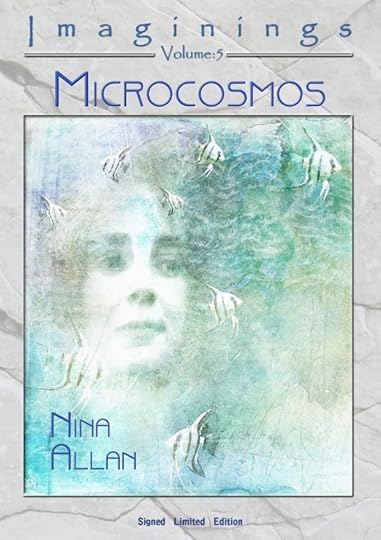
Microcosmos collects seven mini-masterpieces from one of most intelligent and interesting writers of genre fiction to emerge in recent years, including the BSFA Award shortlisted “Flying in the Face of God” and two brand new stories, “A.H.” and “Higher Up”, that are wholly original to this book.

“…does things with fiction, and the possibilities of fiction, that dazzle with their ambition.” – Robert Shearman

“Beautifully written and paced and enigmatic, yet in an entirely lucid way.” – Ian Watson

Contents:
1. Foreword
2. Microcosmos
3. The Phoney War
4. Chaconne
5. A. H.
6. Orinoco
7. Flying in the Face of God
8. Higher Up

175 pages, Kindle Edition

First published April 1, 2013

38 people want to read

About the author

Nina Allan

110 books174 followers

Ratings & Reviews

What do you think?
Rate this book

Friends & Following

Create a free account to discover what your friends think of this book!

Community Reviews

5 stars
2 (14%)
4 stars
10 (71%)
3 stars
2 (14%)
2 stars
0 (0%)
1 star
0 (0%)
Displaying 1 - 3 of 3 reviews
Profile Image for Blair.
2,045 reviews5,893 followers
July 21, 2018
Microcosmos is a collection of seven short stories. Initially I assumed the stories formed a linked sequence; this assumption led me to look for connections that probably weren't there, and this was, perhaps strangely, quite a satisfying way to approach it. It was only when I read what Allan herself had to say about Microcosmos that I realised it wasn't as interconnected as I'd thought. Yet I feel like there are connections between these stories in a more esoteric sense, in the same way all Nina Allan's fiction seems to be connected, in that I imagine all her stories taking place in a web of overlapped universes.

The stories in Microcosmos are often themselves about stories, particularly the stories people weave around their own lives and those of the people they love. Characters are often searching for someone, or searching for the truth about someone. It was while reading this book that I decided I am certain Nina Allan is the most inspiring writer I have ever read. It motivated me to dig out a notebook filled with half-finished stories for the first time in about four years. It also makes me wonder whether there is any point in even trying to write short stories when she has clearly perfected the art.

At this point I'm infatuated with Allan's work and it would be difficult for her to write something I didn't like. Needless to say, I liked every story in Microcosmos; the standouts were 'A.H.' and 'Orinoco'.

---
'Microcosmos'
Melodie and her parents are driving to the home of a man named Ballantine. Melodie's age is unclear; her parents treat her like a helpless little child, but when she is left alone with Ballantine, he acts like she's almost an adult. There is something disturbing in this, some dark undertones – in fact, some dark overtones – in the man's behaviour. There are intimations of disaster or perhaps drought in the world beyond this scene. Even after rereading the story, I don't really understand what is happening here or what kinds of things are being left unsaid; but that is surely the point, and also, it makes me want to understand.

'The Phoney War'
Nicky is on a journey to visit Sophie, her childhood best friend, whom she hasn't seen for more than a decade; Nicky broke off their friendship because of Sophie's paranoid delusions. The landscape Nicky traverses is a possible future England, a place of fuel shortages, ghost towns and rumours of aliens. (It could easily be the same setting as in 'Microcosmos', and like Melodie, Nicky carries a photograph on her travels.) This is a lovely story about personal fictions, the erosion of the familiar, and impermanence.

She kissed Sophie's hair. It brushed softly against her face, silvery and light as the coats of the Lipizzaner horses she had loved to watch on television at Christmas, more a dream of horses than horses themselves.

'Chaconne'
The most explicitly fantastical story here, embracing magical realism in a tale of post-war Russia. ('Chaconne' makes slightly more sense when you're aware of the context in which it was originally published – as part of an anthology paying homage to Mikhail Bulgakov and particularly The Master and Margarita.) Alena is searching for her missing partner, Orest, and has returned to the near-ruined family dacha. There she finds their cat, Snow, malnourished and close to death. A remarkable dream sequence – or is it? – follows.

'A.H.'
Marian is told a memorable story by her ailing grandmother: when she (the grandmother) was a teenage music student, she had coffee with Adolf Hitler. Could this possibly be true? Marian's mum is dismissive, but Marian becomes determined to prove it one way or another. 'A.H.' is written in first person, my favourite narrative mode and one Allan is particularly brilliant at, so for me this is easily one of the best stories in the book. Marian's whole family feels wonderfully authentic, as does the narrator herself. The plot is compelling and poignant – and often quite amusing because of Marian's voice – but ever-so-slightly chilling too.

'Orinoco'
Since her boyfriend Rob was killed in a terrorist attack five years ago, Marie has struggled to move on. She is living with her brother Brian, who works in an aquarium and keeps, among others, Orinoco angelfish. Slowly, Marie begins a relationship with Brian's colleague Alan, and finds her creative mojo returning too. Aside from anything else, this story seems a perfect distillation of an idea that runs through a lot of Allan's writing: that relationships are transient but this does not diminish their inherent value.

But Allan also has this ability to deliver a sucker-punch of a narrative surprise very calmly. She rarely (going by what I've read so far) deploys it, which makes it all the more effective when one turns up in a story. There's a KILLER twist to this, something I didn't see coming at all. The sudden reveal reminded me of a particularly effective moment in The Race.

'Flying in the Face of God'
This follows Allan's earlier story 'Angelus', returning to the theme of the mysterious 'fliers'. (It also shares some attributes with her Tor.com short The Art of Space Travel, enough to make me wonder whether that story was, at least to some extent, a reworking of this one.) Anita is a filmmaker who is working on a documentary about female fliers. She has become close to one of her subjects, Rachel, who is about to leave on a mission; at the same time, she is wrestling with her family history. Again, this is an exquisite series of scenes that seem to pin down inexpressible feelings.

'Higher Up'
Laine is ten years old when the 9/11 attacks take place. She vividly remembers hearing the news, and this memory continues to exert an influence over her life for many years. As an adult, she works on the check-in desk at Heathrow, and gets into a relationship with a pilot. And then she starts hearing an impossible broadcast, again and again, that warns of a future catastrophe. Despite the fantasy element, this is a compassionate, believable tale of obsession and dread.

TinyLetter | Twitter | Instagram | Tumblr
Profile Image for Gary Dalkin.
2 reviews2 followers
July 11, 2013
Microcosmos by Nina AllanIn the Forward to Microcosmos Nina Allan explains that, having forgotten the finer details of the requirements for the collection, with her stories tending to ‘run away with themselves’ and being rather long for short stories, she had amassed considerably more material than the book would be able to contain. She had intended a survey of her work from the publication of her first book, A Thread of Truth (2007) up to The Silver Wind (2011). However, with a target length of 60,000 words, she ‘decided to shape the collection around the two new stories’ which would feature in Microcosmos. ‘Without abandoning my idea of presenting a survey of the kind of stuff I’d been working on since A Thread of Truth, I now began to see the book as a chance to show what I’d been working towards, a statement, if you like, about where I had got to.’

Microcosmos contains seven stories in 191 pages. The title story is the oldest, dating from 2009. Melodie is with her parents on a long, uncomfortable day trip to see Ballantine, who has had a disastrous relationship with Melodie’s aunt. As in many of these stories what is not said is as important as what is. Lakes have dried up, the land choked with bramble and giant hogweed. There is an ambiguity, a tension, when Melodie is left alone for a short while with Ballantine, not least because we never know how old she is. Ballantine opens up a new world of possibilities for her, the hidden universe of the microcosmos. An unsettling few hours in a life which leaves a lasting impression. To read the rest of this review visit my website at http://tothelastword.com/allan1/
Profile Image for Ron Henry.
335 reviews1 follower
February 1, 2021
Very good collection of stories linked by Allan's particular sensibility and concerns -- as others have remarked, the book has the feel of an interconnected series, but it really isn't. I found all of the stories compelling and readable -- though a little less so for the Hitler story, I have to admit (the premise felt strained in that one).
Displaying 1 - 3 of 3 reviews

Can't find what you're looking for?

Get help and learn more about the design.