Jump to ratings and reviews
Rate this book

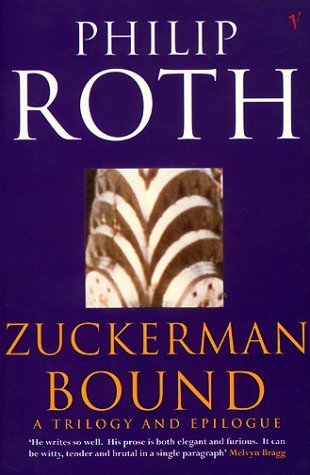
Zuckerman Bound #1-4

Zuckerman Bound: The Ghost Writer / Zuckerman Unbound / The Anatomy Lesson / The Prague Orgy

Rate this book
The comedy of neuroses, as Roth practices it, has much of the elegance of an 18th-century comedy of manners, but it also allows itself plenty of latitude. ZUCKERMAN UNBOUND has room for farce, when Zuckerman spends a night with an Irish film star whose steady lover is Fidel Castro; as well as for a full, accomplished treatment of a grim routine, the death of a Jewish father. But mainly it has one great comic character, tha sad and threatening Alvin Pepler, ex-Marine and ex-Tv celebrity, now alleging the theft of his private hang-ups, which are on the same lines as Portnoy's, for use in the famous novel. In this chapter Dickens and Waugh live again' LONDON REVIEW OF BOOKS.

240 pages, Paperback

First published January 1, 1985

55 people are currently reading
1389 people want to read

About the author

Philip Roth

311 books7,300 followers
Philip Milton Roth was an American novelist and short-story writer. Roth's fiction—often set in his birthplace of Newark, New Jersey—is known for its intensely autobiographical character, for philosophically and formally blurring the distinction between reality and fiction, for its "sensual, ingenious style" and for its provocative explorations of American identity. He first gained attention with the 1959 short story collection Goodbye, Columbus, which won the U.S. National Book Award for Fiction. Ten years later, he published the bestseller Portnoy's Complaint. Nathan Zuckerman, Roth's literary alter ego, narrates several of his books. A fictionalized Philip Roth narrates some of his others, such as the alternate history The Plot Against America.
Roth was one of the most honored American writers of his generation. He received the National Book Critics Circle award for The Counterlife, the PEN/Faulkner Award for Operation Shylock, The Human Stain, and Everyman, a second National Book Award for Sabbath's Theater, and the Pulitzer Prize for American Pastoral. In 2005, the Library of America began publishing his complete works, making him the second author so anthologized while still living, after Eudora Welty. Harold Bloom named him one of the four greatest American novelists of his day, along with Cormac McCarthy, Thomas Pynchon, and Don DeLillo. In 2001, Roth received the inaugural Franz Kafka Prize in Prague.

Ratings & Reviews

What do you think?
Rate this book

Friends & Following

Create a free account to discover what your friends think of this book!

Community Reviews

5 stars
587 (42%)
4 stars
545 (39%)
3 stars
201 (14%)
2 stars
34 (2%)
1 star
14 (1%)
Displaying 1 - 30 of 114 reviews
Profile Image for Cosimo.
443 reviews
October 21, 2018
Non sarà più nessun altro

Qualche giorno fa, sul New Yorker, Zadie Smith ricordava Philip Roth e parlava di una conversazione su un'attività condivisa, il nuoto. Philip Roth le domandò a cosa pensasse mentre faceva una vasca. Zadie risponde. “Prima vasca, prima vasca, prima vasca; e poi seconda vasca, seconda vasca, seconda vasca. E così via”. Roth era un ottimo nuotatore e ridendo chiese: “Vuoi sapere cosa penso io?” Zadie, timida, annuiva. “Io scelgo un anno. Penso a quello che è successo nella mia vita e nella mia piccola cerchia. Poi penso a cosa è successo a Newark e a New York. Poi in America, e infine in Europa. E così via”. Zadie ride e scrive: “Roth non era diverso alla sua scrivania, era scrivere allo stato puro, era energia e verità, intimo e scomodo nel suo legame con la letteratura, irresponsabile nello spirito di analisi della realtà, vivo e cosciente parola per parola, libro dopo libro”. Roth credeva nello scrivere come atto di opposizione, si disperava nell'insolvibile contraddizione tra storia sociale e invenzione personale; in fondo, non poteva fare altro. Dopo aver smesso, non si è mai voltato indietro; leggeva e viveva. Non si è mai risparmiato una parola, né un brandello di sé, per tutta la vita. Iniziò a amare la letteratura in tenera età, e capì presto che doveva scrivere, che era la sua vocazione. Nelle sue pagine scorrono le avventure del mistero e della speranza, la lotta per porre un sigillo contro il tempo, con le sue ossessioni, il successo, le donne e il sesso, la relazione con i genitori, l'amicizia, la passione, la tradizione e il nuovo, gli imprevisti dell'esperienza. Un giovane scrittore si avvicina al maestro recluso e ne indaga il lato tenero e indecifrabile, mentre scopre una donna attraente quanto fantasiosa. Poi lo scrittore diventa famoso e ricco: tutti vogliono qualcosa da lui, e lui non sa nemmeno più chi sia e cosa voglia. Si ribella ai tormenti e alle catene, cerca di fuggire alle leggi del mondo, insegue una curiosità trascendente e disinnesca le trappole dell'inconscio. Infine è maturo, preda di un dolore cronico, che dovrebbe alleggerire la psiche, mentre invece tutto si fa più feroce e ostile, e la parodia si alterna alla tragedia. Intreccia con le donne un'alleanza invisibile, vive l'erotismo e la solitudine, sa essere irresistibile e sa sempre quando cedere. L'esistenza è grottesca e la linea etica è edonista; e questo conduce alle soglie della follia, nemici di se stessi, guidati dal rimpianto, dalla volontà estenuante di rovesciare l'ordine delle cose. Roth ci nutre di ironia e paure, è padrone di un linguaggio preciso e potente, sempre sospeso tra menzogna e profondità. L'autore ebreo americano affida a una molteplicità di personalità il suo studio del carattere umano: in questo è un umanista e un moralista in senso classico, si è scritto; egli accoglie in una stratificazione autoriale iterativa l'esilarante, il macabro, il mortifero, il maniacale, il frammentato, il complesso, l'osceno, il crudele e il cattivo, insieme al metafisico e al sublime, contrastando per stile ogni forma di negazione. Si reinventava come uomo ad ogni capitolo, amando e odiando ogni aspetto dell'esistere, dal più esecrabile e brutale al più nobile e poetico. Ha tracciato una straordinaria geografia del desiderio. Ha percorso le strade dell'impersonation partendo sempre dal reale per giocare poi reimmaginando; la tensione costante delle sue vicende descrive un groviglio di emozioni e sentimenti sempre in conflitto nei legami con le compagne e con le figure familiari. Era spudorato e ricco di humour, venerava e sfidava i maestri (Bellow e Malamud) ed era un eclettico e geniale compositore di variazioni e prospettive. La sua scrittura si rivela tra fiction e vita, in un'intertestualità circolare, aspirando a una visione ideale e imperfetta, a un dialogo radicale e acuto sul destino, sulla mortalità e sulla natura umana.
Profile Image for Makis Dionis.
558 reviews155 followers
October 4, 2017
Ο Roth ποτέ δεν πέφτει κάτω από το όριο του υπέροχα! Εδώ σιχτιριζει έναν αμερικανό Εβραίο συγγραφέα παγκόσμιου βεληνεκούς...τον εαυτό του. Το ποιόν της φιλοσοφίας του, εναντίον της μικροαστικής καθημερινότητας. Πώς η καταξίωση κάθε άλλο παρά γιατρεύει τα υφερποντα κόμπλεξ...Το διανοουμενιστικο αμάρτημα της ελαφράς ψυχαγωγίας!!!
Profile Image for Aggeliki Spiliopoulou.
270 reviews93 followers
December 26, 2020
Ζούκερμαν Δεσμώτης, Φίλιπ Ροθ
1. Ο συγγραφέας-φάντασμα
Βρισκόμαστε στην Αμερική της δεκαετίας του 1950. Ο επίδοξος, εικοσάχρονος, συγγραφέας Νέιθαν Ζούκερμαν, εβραϊκών καταβολών, επισκέπτεται τον συγγραφέα-ίνδαλμά του Ε. Ι. Λόνοφ και περνά μαζί του μιάμιση μέρα στην απόμερη κατοικία του στη Νέα Αγγλία, όπου διαμένει με τη σύζυγο και τη φοιτήτρια-βοηθό του.
Γνωρίζει την πραγματικότητα, τον τρόπο ζωής του συγγραφέα-προτύπου του σκεπτόμενος τις δικές του επιλογές, θέλω και συνέπειες αυτών. Η ιδεολογική σύγκρουση με τον βιολογικό του πατέρα και η αναζήτηση στο πρόσωπο του Λόνοφ ενός πνευματικού πατέρα, που θα συμμερίζεται τις απόψεις του και τον τρόπο έκφρασης τους. Θέτει το εβραϊκό ζήτημα μέσα από τη λογοτεχνία και το θεμελιώδες θέμα σχέσης λογοτεχνικού έργου-συγγραφέα σε επίπεδο αξίας βάσει χρονικών συνθηκών και ιστορικών συγκυριών.
Ποιες οι παράμετροι που καθορίζουν την ταυτότητα του δημιουργού και την αθανασία ενός λογοτεχνικού έργου; Πώς αντιλαμβανόμαστε, αποκωδικοποιούμε και αξιολογούμε ιστορικά γεγονότα;
Συγκροτημένος, ώριμος λόγος με αρκετά στοιχεία αυτοσαρκασμού και σε πολλά σημεία αυτοβιογραφικό. Μας φέρνει αντιμέτωπους με αποκρυσταλλωμένες απόψεις, μας οδηγεί σε αναθεώρηση και αποδοχή της παραπλάνησης-παρανόησης μας.
2. Ζούκερμαν λυόμενος
Μία δεκαετία περνά, ο Νέιθαν είναι πλέον επιτυχημένος συγγραφέας που προσπαθεί να βρεί ισορροπίες μέσα στη ροπή που έχει πάρει η ζωή του. Καυστικός και ανυποχώρητος στις απόψεις του χάνει τον συγγραφικό οίστρο του, αποπροσανατολισμένος και παγιδευμένος από τους σωματοποιημένους πόνους αυτής της εσωτερικής πάλης.
Λυόμενος από την Τρίτη σύζυγό του, από το πατρικό πρότυπο, συγκρουόμενος με τις επιλογές του, εξαργυρώνοντας την επιτυχία του και το κόστος αυτής, λυόμενος από το ίδιο του το παρελθόν.
«Δεν είσαι κανενός γιός, πια, δεν είσαι καμιάς καλής γυναικούλας ο άντρας, δεν είσαι κανενός αδελφού ο αδελφός, κι ούτε έρχεσαι από πουθενά, πλέον»
3. Μάθημα ανατομίας
Μανχάταν,1973. Καθηλωμένος και εγκλωβισμένος ακόμα από το άλγος, παραμένει στείρος συγγραφικά. Αναμοχλεύει μνήμες, συμπεριφορές, απώλειες, συναισθήματα. Αποκαμωμένος επιζητεί δι-έξοδο και σωτηρία μέσα από δαιδαλώδη μονοπάτια σκέψεων, προσπαθώντας την εξιλέωση μέσω σπασμωδικών αποφάσεων.
4. Το όργιο της Πάργας
1976 και ο Νέιθαν ταξιδεύει στην Πράγα αναζητώντας τα ανέκδοτα γραπτά ενός Εβραίου συγγραφέα, στα γίντις, με σκοπό να τα παραδώσει στο γιό του συγγραφέα που ζει εξόριστος στην Αμερική. Γνωρίζει εκκεντρικές προσωπικότητες και τις συνθήκες διαβίωσης στην κομμουνιστική Τσεχοσλοβακία. Είναι ένας περιπλανώμενος Ιουδαίος σε αναζήτηση εβραϊκής κληρονομιάς. Ένα ταξίδι προσομοίωσης με την πορεία του εβραϊκού λαού όπου έρχεται αντιμέτωπος με τις καταβολές του.
Profile Image for B. Faye.
270 reviews65 followers
January 19, 2019
« Όχι, η ιστορία του καθενός δεν είναι δέρμα για να το αλλάζεις σαν φίδι – είναι αναπόφευκτο, είναι το σώμα και το αίμα του καθενός. Εξακολουθείς να αντλείς έως ότου πεθάνεις, ιστορία είναι γεμάτη φλέβες με θέματα της ζωής σου, η διαρκώς επαναλαμβανόμενη ιστορία που είναι ταυτόχρονα επινόηση σου και επινοητής σου»
Σε αυτό το βιβλίο βλέπουμε τον Roth να χρησιμοποιεί για πρωταγωνιστή το alter ego του τον Ζούκερμαν. Ένα συγγραφέα που ξεκινάει γεμάτος όρεξη και στο πρώτο μυθιστόρημα συναντάει το είδωλό του που τον προειδοποιεί για τις συνέπειες της διασημότητας (τις οποίες βλέπουμε ότι θα υποστεί στο δεύτερο μέρος) Στο τρίτο μέρος σαραντάρης πια πολύ πλούσιος και πολύ διάσημος υποφέρει από χίλιους δυο ψυχοσωματικούς πόνους που καμιά θεραπεία δεν μπορεί να γιατρέψει για να καταλήξει στον επίλογο σε ένα καφκικό όργιο που διαδραματίζεται στην Πράγα.
Απολαυστικός Roth που ασχολείται με τις εμμονές του χωρίς να χάνει το ιδιαίτερο χιούμορ του και την ικανότητα του να αυτοσαρκάζεται.
Σταθερή αξία !
B.R.A.CE 2019 (4). Ένα βιβλίο που πήρες μαζί σου σε ένα ταξίδι. 2 / 75 αδιάβαστα
Profile Image for Gabril.
1,039 reviews253 followers
June 30, 2018
Goodbye, Zuckerman.
Profile Image for robin friedman.
1,945 reviews414 followers
November 27, 2022
Zuckerman Bound In The Library Of America

The Library of America has recognized the importance of Philip Roth by publishing his complete novels in a uniform set of nine volumes. This volume includes the three novels and epilogue that Roth himself grouped together and subsequently published as "Zuckerman Bound". The novels tell the story of a novelist, Nathan Zuckerman, at various critical moments of his life. Roth subsequently wrote additional novels with Zuckerman as the protagonist, but these four works stand as a set.

There is a broad, dazzling array of writing in these books. The strong ego of both the author and his character are on full display. Initial impressions are important and these books show at the outset sharp humor, irony, and irreverence. These qualities are combined with an equally important degree of thought and introspection. Sexuality and its difficulties pervade these books, from the restraint imposed upon a young man from family and religious tradition to, perhaps, the different restraint suggested later in time by certain forms of feminism. Throughout the books, Zuckerman struggles with his vocation as a writer and with his Jewishness. He responds in different ways throughout the novels. The books suggest, at length, that a person, a writer particularly must learn to live with ambiguity and conflict. For example, late in the final book of the trilogy, "The Anatomy Lesson", Zuckerman observes.

"Oh, too delicate, too delicate by far for even your own contradictions. The experience of contradiction is the human experience; everybody's balancing that baggage-- how can you knuckle under to that? A novelist without his irreconciliable halves, quarters, eighths, and sixteenths?"

Nathan Zuckerman bears many resemblances to Roth, but it would be a mistake to conflate character and author. A major these that runs through the books is the relationship between events and characters and their portrayal in an imaginative work of fiction. Roth embroiders on this theme through playing upon the Roth-Zuckerman relationship and through many scenes and details in the books.

The books begin with Zuckerman in young adulthood, and it might be useful to sketch the background of Zuckerman's life as presented throughout the trilogy. Zuckerman was born in the 1930's and spent his childhood in Newark, New Jersey. His family was culturally and religiously Jewish, although for the most part nonobservant. His mother and father had risen from immigrant poverty to the modest life of the middle class. Zuckerman's father was a foot doctor and his mother a homemaker. Zuckerman had a brother four years his junior. Showing an early precocity and passion for literature, Zuckerman was admitted to the University of Chicago at the age of 16 and graduated with high marks. He served two years in the Army and, upon his discharge, began his literary career in earnest. With this background, the Zuckerman Trilogy begins, and I will briefly describe each book in what follows.

Told in the first person, "The Ghost Writer" features a 23 year old Nathan Zuckerman who has received an invitation from a writer he reveres, Lonoff, to visit at his secluded home in the Berkshires. Lonoff sees in the young man a writer of promise and offers a toast to his future as an author who will thrive on "turbulence". Zuckerman has just endured a stormy break-up with a young woman due to his being flagrantly unfaithful one time too many. Zuckerman is about to publish a short story which has father belives casts his family and the Newark Jewish community in an unflattering light. At first, Zuckerman tries to see Lonoff as a father figure but in the course of the book has reason to be put off by this remote and cold man. Lonoff is rigid and aloof from his wife and may be involved with a mysterious young protege and immigrant Amy Belette. Infatuated with Amy, Zuckerman invents an outrageous story about her to help make peace with his family. The sacredness of the writer's or artist's calling loses much of its luster to Zuckerman in this book, but he dauntlessly proceeds.

"Zukerman Unbound", the second book of the trilogy is told in third person narration and is set in New York City when Zuckerman is in his mid-30s. By this time, Zuckerman has published four novels, and has achieved both wealth and notoriety by the most recent of the four, titled "Carnovsky". This book is a thinly-veiled reference to Roth's own "Portnoy's Complaint" and describes a young adolescent's sexual frustration growing up in Newark and what he perceives as the smothering of his parents. Young Carnovsky becomes an ardent practitioner of masturbation. In the novel, "Carnovsky" attracts many readers by its brutal frankness and humor and repels almost as many. Zuckerman, a solitary and introspective man, must deal with the in many ways unsought for fame. He also must deal in the book with his three failed marriages and with the death of his father. On his deathbed, Zuckerman's aging father curses and disowns what he sees as his reprobate, apostate son. Nathan Zuckerman again must persevere and carry on.

The final book in the trilogy, "The Anatomy Lesson" is set four years after "Zuckerman Unbound" in New York City and Chicago and is also recounted by a third person narrator. This book shows Zuckerman at the end of a four year writer's block following the publication of "Carnovsky" Zuckerman also is plagued by mysterious, debilitating physical ailments. Four young women tend to him at different times and satisfy his carnal and other needs. The book includes long scenes of the death of Zuckerman's mother, which followed his father's death within about a year. The book breaks into two parts. In the first, Zuckerman struggles with his sorrow, his illness, his angers and conflicts and his writer's block. While he seemingly decides to abandon writing and become a physician, Zuckerman, unknown to himself, discovers latent sources of strength. In the second part of the book, set in Chicago, Zuckerman undergoes a severe accident and beating but discovers himself. He reinvents himself by imagining his life as a callous and successful pornographer and so persuades the reader with great gusto. With his conflicts, he is still able to move ahead.

The epilogue to the trilogy, "The Prague Orgy" is in the nature of a coda. Some critics see this epilogue as the highlight of the entire work, but I think it more of a short teasing anticlimax. The epilogue is recounted from what purport to be Zuckerman's notebooks. It is told in the first person and is set in New York and in Prague in 1976, with Soviet control of the city. Zuckerman travels to Prague in search of what he has been told are stories in Yiddish by a writer killed by the Nazis. Among many sexual scenes and portrayals of communist repression, Zuckerman thinks again about the nature of the writer's calling. The story is tinged with irony as at its climax the cultural commissar lectures Zuckerman about the responsibility of the creative artist to develop and articulate the values expressed by a culture rather than engaging in an effort to mock and undermine these values. The double irony is that this function may be a proper and neglected role of the writer and intellectual in the contemporary United States while it is a source of repression and hypocrisy in the communist world of Prague. The Zuckerman trilogy takes a different turn in its brief epilogue.

Roth is a storyteller. His "Zuckerman" novels are richly detailed, full of bluster, ranting, and thought. They are infuriating, thought provoking and funny. Many readers, not only Roth, may identify with at least some of Zuckerman, his issues, and his ways of working towards resolution. The Zuckerman Trilogy deserves its place in the Library of America as a work describing and elucidating important parts of the American experience.

Robin Friedman
Profile Image for Vicente Ribes.
901 reviews169 followers
March 14, 2023
Un gran libro que contiene cuatro novelas de la serie de Nathan Zuckerman de Philip Roth.
Dentro de la amplia obra de Roth encontramos dos tipos de novelas, aquellas donde se incide en temas de temática social y la historia de los EEUU y otras de tipo más personal donde se deja entrever la propia vida de Roth, el tema del judaismo y las experiencias del autor como escritor.
Las cuatro novelas incluidas aquí siguen la temática del segundo grupo y aunque Zuckerman sea un personaje hay mucho de Roth en él y asemeja un trasunto del autor. Nathan Zuckerman es un escritor y a través de su vida vamos a aprender muchísimo sobre el oficio de escritor, la culpa y como nos puede afectar, las relaciones afectivas y el impacto de la religión y las viejas tradiciones en las vidas de las nuevas generaciones que buscan un cambio y se resisten a seguir la pauta marcada.
Es un libro que he ido alternando con otros ya que creo que se disfruta mejor novela a novela que como un compendio, eso sí la variedad de temas y la escritura de Roth esta aquí en su cúspide junto a las para mí son sus mejores obras: "Pastoral Americana" y "El Mal de Portnoy".

La cuatro novelas merecen un comentario a parte:

La visita al maestro (*****): Un inicio francamente bello donde Nathan Zuckerman visita a uno de sus más queridos e influyentes escritores, lo que para él viene a ser un mentor. Allí conocerá a una enigmatica joven a quien reconocerá como Ana Frank. La verdad es queno sabemos si es la autentica Ana o no pero ese toque mágico combinado con las enseñanzas de Lonoff, el viejo mentor, sobre la vida y la escritura hacen de esta novelita una obra muy interesante.

Zuckerman desencadenado(****): Han pasado varios años y estamos en 1969. Nathan tiene ya treinta y seis años, tres divorcios en su biografía y se ha hecho célebre y millonario tras escribir una novela, "Carnovsky", que lo ha catapultado a la fama sin casi tener tiempo a asimilarlo.
La experiencia se basa en lo que le ocurrió al propio Roth en 1969 a raíz de la publicación de "El lamento de Portnoy". Ambas novelas además son similares pues tratan de la adolescencia de un muchacho judío y sus problemas con el sexo, la culpa y una madre demasiado posesiva.
Creo que esta novela es la más personal y donde la vida de Roth y su dificultad para lidiar con la fama y la muerte de su padre está más latente.

La lección de Anatomia(****): En esta novela encontramos ya a Nathan hastiado de la escritura, aquejado de dolorosos prblemas de cuello y espalda y planteandose entrar en la universidad de medicina a sus 40 años. La muerte de sus padres, el desfile de amantes que no le acaban de llenar y en quienes busca una madre y situaciones disparatadas o humorísticas hacen de esta novela la más divertida del bloque. Tragicomedia a lo Woody Allen que me recordó en su fina ironia a " El mal de Portnoy"

La orgia de Praga(**): Una especie de coda o epilogo que resulta bastante inferior al resto. Aquí Zuckerman viaja a Praga para recuperar unos manuscritos de un escritor judio fallecido tiempo atrás. Se topará con el gobierno opresivo de Checoslovaquia y un montón de disparatados personajes.

En general, leer a Roth en este libro es aprender mucho sobre el oficio de escritor y como por fácil que parezca a veces( si se tiene un éxito masivo como él , claro) el camino está lleno de piedras y se renuncia a muchas cosas, entre ellas a una vida medianamente normal.
Profile Image for Elena Sala.
495 reviews93 followers
October 14, 2018
ZUCKERMAN BOUND is a trilogy (THE GHOST WRITER, ZUCKERMAN UNBOUND and THE ANATOMY LESSON), plus an epilogue (the Kafkaesque THE PRAGUE ORGY).
Witty, humourous and parodic, these books deal with the adventures, pains, ancestral burdens and complaints of novelist Nathan Zuckerman. It is no secret that Roth's books borrow heavily from his own life. Zuckerman is a Jewish author with many things in common with Roth himself. He writes about sexual desire and repression, the pain of the relationship between children and their parents, between husband and wife and also many themes related to being Jewish.
The Modern Library edition of this book points out that these novels are about "the unforeseen consequences of art". I agree, and would add that they are also an exploration of the difficulties when art and life combine.
The Spanish translation of this book was really terrible. If you can read it in English, do so.
Profile Image for Roger DeBlanck.
Author 7 books147 followers
May 17, 2024
The Ghost Writer :
Nathan Zuckerman is at twenty-three a talented, ambitious writer who has recently gained praise from critics for his first published stories. With anxiousness and expectation, he reaches out to his literary hero, the renowned E.I. Lonoff. When Lonoff invites Nathan to visit him at his secluded farmhouse outside of Boston, Nathan heads off in the middle of a snowy winter to meet his hero.

Nathan encounters Lonoff as a generous and humble host with an obsessive regimen to his work. He also gains sight of a beautiful young woman, a former student of Lonoff’s, who is staying with Lonoff and his wife of thirty-five years. Unclear to Nathan is this lovely young woman’s function in the household, a mystery that contributes to his instant infatuation with her. Who she could be stimuluses his imagination to construct a fantastical narrative about her from the vague details Lonoff provides during their conversations.

Over the course of dinner and during the night as Nathan stays over as a guest, he hears and observes more details that help embellish his tale to offer a stunning revelation about this beguiling woman. Just like she is entrancing, The Ghost Writer delivers a captivating tale of a relationship between an older and younger writer, and how their experiences play out in their work.

Roth is masterful with how he blurs the boundaries between artistic vision and reality, and with how he addresses questions of what responsibility the writer has to his work and others. As he constructs a story within a story about the purpose of literature, Roth delivers an enthralling drama about identity and passion that charges forward like a thriller. As is trademark with his brilliant work, his stories rage with ideas and philosophy woven seamlessly into compelling narratives.

Zuckerman Unbound :
No one quite matches Philip Roth’s genius at dark comedy, and Zuckerman Unbound, the second installment featuring Roth’s iconic alter-ego character Nathan Zuckerman, may be his most satirical and outlandish work. Roth’s central aim, beyond his brilliance at grave humor, is steering his narrative towards an examination of the unavoidable sorrow at the heart of human frailty and impermanence.

In holding back nothing as he addresses the follies and consequences of both controllable and uncontrollable forces, Roth likes to blur the lines between what is known about his real life and what he portrays in his fiction. His efforts give us a more truthful, authentic, and robust set of mirrors to reflect on the impact society has on us in relation to our own decisions.

Zuckerman similar to Roth is a writer at the height of his fame, and so he cannot escape the absurdity of tabloids and the press, in addition to interactions with those who either love or hate him. Much like we know of Roth, Zuckerman too struggles with relationships and marriages that drive him batty. Zuckerman also relishes and resents the puzzlement others make of him, causing his motives to be misunderstood as a writer.

Typical of Roth’s artistic vision, everything he depicts through Zuckerman veers on tragedy and human weakness and our oftentimes inadequacy to cope, yet everything Zuckerman deals with is often hilarious while at the same time unsettling. What makes Roth so mesmerizing is the way he delivers narratives so imbued with a blend of comic truth and crushing sadness so that you laugh one minute while feeling your heart breaking the next.

The ending of Zuckerman Unbound is particularly solemn and moving and offers Roth at his signature best. He is remarkable at taking us on these intense, bizarre, dizzying, and of course raucous rides before slowly pulling us towards a dramatic climax that is devastating as much as affecting.

The Anatomy Lesson :
At forty, the famous writer Nathan Zuckerman (Roth’s iconic alter-ego character) has come down with a bizarre affliction of excruciating pain that channels from his neck down across his shoulders and into his arms. The ailment, of course, drives Zuckerman to utter madness because he cannot focus and write and also because from one doctor to another none can diagnose the cause, source, or reason for the debilitating pain.

Having endured through what he feels is misguided attacks on his satirical novel Carnovsky about Jewish heritage, Zuckerman feels lost with his commitment to his fiction, more so with the pain derailing him from his writing routine. In a desperate and valiant attempt to confront the inexplicable pain that is ruining his life, Zuckerman fantasizes about going back to school to be a medical doctor. So he heads off to his alma mater in Chicago with the hope of overcoming the dilemma of his hardships.

The Anatomy Lesson is a wild escapade of a novel strewn throughout with Roth’s genius use of wry, dark humor and his trademark of having no inhibitions with exploring carnality and desire. It’s also one of his most erudite and philosophical narratives as he tackles the anguish of mental and physical pain, brought on both by Zuckerman’s own madness of excessive bitterness towards those with criticism of his books and by his abuse of prescription drugs and alcohol.

Even when Roth’s ecstatic prose becomes so intense with hypnotic details and lyrical insight, he knows how to steer his narratives towards unforgettable endings. The Anatomy Lesson offers a profoundly humbling and humane conclusion to this fierce and comedic installment within the Zuckerman series. Roth showcases his brilliance in addressing the most challenging questions of what life amounts to when faced with the madness of suffering.

The Prague Orgy :
One of Roth’s shorter works, The Prague Orgy lacks nothing in the impact it delivers and the reflection it demands. Roth’s genius toys with us the way he assembles stories within stories blurring one fiction within another to the point where reality is made clearer, and simultaneously more elusive and dangerous, through his superb use of irony and how he opposes forces: nobility against perversity, good against evil.

After encountering a repressed Czech writer named Sisovsky seeking refuge in New York, renowned American author Nathan Zuckerman travels to Prague on a mission to attain the unpublished Yiddish manuscript penned by Sisovsky’s father. As he traverses the highly policed city of Prague, Zuckerman becomes entangled in the despondent lives of Olga, Sisovsky’s estranged wife, and others among Prague’s literary underground. Whose story is true and what truth lies in the power of literature to counteract the shortcomings of reality?

Olga’s sad and comical lust with wanting to marry Zuckerman to escape the oppressiveness of the communist state contrasts with the sad and grave tactics of the state watching Zuckerman’s every move, whether he realizes it or not, to retrieve the manuscript and take it with him back to America. Employing his signature blend of hilarity and bawdiness, Roth is every bit as playful as he is serious about the power of art, particularly the written word, which totalitarian states will do anything to suppress.

The Prague Orgy begins with a simple adventure, but it bolts forward into a suspenseful drama that registers with scathing indictment against restrictive governments and authoritative regimes doing everything in their power to bury writers and their works. Roth reminds us of the power of art because if books weren’t powerful, those trying to silence the written word wouldn’t be using so much of their power to keep writers quiet.
Profile Image for Els Lens.
381 reviews23 followers
March 28, 2018
Dit zijn eigenlijk DRIE boeken. Ik heb geweldig genoten van de vloeiende schrijfstijl en van de humor van Roth. Maar de drie boeken achter elkaar uitlezen, is wel wat van het goede te veel. Dus: best tussen elk deel ook eens iets anders lezen. En daarna is het weer een fijn weerzien met Philip Roth.
Ik ga zeker nog ander werk van hem lezen.
Profile Image for Alan.
1,267 reviews157 followers
December 4, 2011
"Bigger jerks than me review books."
—Alvin Pepler, p. 214
A writer writing about a writer meeting a writer he admires... what could be more circular, more insular than that? More effete, affected, and downright boring? Yet that is how Philip Roth begins The Ghost Writer, the first volume of his celebrated Zuckerman series of novels... and in Roth's hands, the story of Nathan Zuckerman's meeting with the reclusive E.I. Lonoff becomes a vehicle for examining the particular, for observing and reporting with a hyper-realistic, lapidary focus that intensifies whatever catches Roth's attention.

It doesn't hurt that Zuckerman is a lusty lad from the first time we meet him, either, with a lively imagination and a five-story walkup apartment in New York City that his ex-girlfriend described as the abode of an "unchaste monk." But that's not the point of the exercise, it seems to me. The nippleless bra and Gucci blindfold from Zuckerman Unbound (p.339), for example, really are just toys. Arresting as they are, the explicit erotic passages appear simply interstitial, sticky bits holding together the real import of Zuckerman's musings on when to write, what to write, how to write (and not to write)...when Roth drops in observations like "Desperation doesn't help either; it takes longer than one night to make a story, even when it's written in a sitting," (p.351) then you know he's serious.

Or—well, maybe he's not so serious with this one, but it rings true too:
"Who quarrels with an obstetrician? Even the obstetrician who delivered Bugsy Siegel goes to bed at night with a clear conscience. He catches what comes out and everybody loves him. When the baby appears they don't start shouting, 'You call that a baby? That's not a baby!'" (p.329)


The Ghost Writer is short, too—they're all short novels, really. This handsome Library of America edition manages to squeeze in The Ghost Writer, Zuckerman Unbound, The Anatomy Lesson and The Prague Orgy as well as an unproduced BBC television script for The Prague Orgy, and despite all that is still easy to carry around and read. Roth gets in, says what he has to say, and gets out... none of these thousand-page cinderblock monuments to logorrhea that electronic word-processing has foisted upon us. Not that there's anything wrong with long books, mind you. I like those too. But I think Roth knows, even if Zuckerman doesn't, that brevity is best when you're writing such intensely recursive fiction.

The Zuckerman novels are also very Jewish books—Nathan spends much of his time on the page defining and redefining himself in opposition to (and, albeit less often, in accord with) the Jews he grew up with in New Jersey and the ones he works with in New York City. But... well, I hesitate to call it universal, but really most of what Zuckerman's about isn't unique to Jews at all... he's looking for answers; dealing with pain; trying to get laid, to distinguish between sex and love... all topics of deep interest to people from many cultures. Certainly Nathan's varied (and often self-inflicted) predicaments resonated deeply with me, despite my own resoundingly goyishe background.

Where Zuckerman fails in universality, I think, is in his treatment of women. To Nathan, women are—and sure, this is just a special case of his attitude towards all humanity—important solely in relationship to him. In his conversations with the chauffeur in Chicago, he uses her as a sounding board for his displaced rants on sexuality, but barely lets her get a word in edgewise. More central women in his life—Diana, Gloria, his wives and lovers and even his mother—are important because they care for him, not as themselves. I don't know whether this is Roth's own attitude—I am resolutely not attempting to psychoanalyze the author through his work—but I do think it's one of Zuckerman's biggest problems.

Nathan Zuckerman is no sympathetic protagonist, no hero, and maybe not even an Everyman. But he is, even in the depths of his frequent self-pity, an interesting man.


Philip Roth, with whom it turns out I share a birthday, is a recognized giant of American letters, and from this omnibus of his Zuckerman novels it's easy to see why. This isn't my first exposure to his work; I'd actually run across his mordant and more sfnal alternate-history novel, The Plot Against America years ago (that one's worth picking up too, by the way). Nor will Zuckerman be my last round with Roth, not if I remain uninterrupted.
Profile Image for Alberto.
Author 7 books168 followers
January 28, 2021
Ojalá hubiera leído este libro hace diez años.
Profile Image for Christina Stind.
536 reviews66 followers
September 18, 2008
This volume consists of the Zuckerman trilogy as well as an epilogue. I'm going to write a bit about each part as I finish it and then comment on the whole when I'm done with the entire thing. This is the first thing I've ever read by Philip Roth and I apparently Zuckerman is an alter ego that he has written several books about.
The Ghost Writer
Nathan Zuckerman is a young Jewish writer who after having upset his father and his Jewish community with a story about an old familiy feud visits his idol, the famous author E.I. Lonoff. The book is about how to deal with being Jewish and how to present yourself to the world as Jewish - is it okay to portray Jews in negative ways or will that just make people hate them more? During Nathan's stay he meets Amy, a young girl involved in somewhat of a love triangle with Lonoff and his wife. Nathan is immediately taken with the girl and creates a story about her identity that really had me going for a while before I realized that it was a fiction, created by Zuckerman.
Very interesting start - I enjoyed it!
Zuckerman unbound
This volume features a Zuckerman in his 30s, struggling with his suddenly gained fame after publishing the best-seller Carnovsky, a sexually loaded book with a Jew as its main character. The same themes as in the first book are therefore elaborated further in this one as well as an author's relationship with his public, whether it be fans, potential kidnappers, nutjobs or his own family.
Didn't enjoy it quite as much as the first one but still a solid, good read.
The Anatomy lesson
This is so far my least favourite part of the series. We catch up with Zuckerman who is now 40, struggling with chronic pain and being unable to write. Instead, he spends his time fighting with a Jewish critic, hanging out with his harem, pretending to be a pornographer, selfmedicating with booze and pills, and considering a new career - going to medical school.
The Prague Orgy
This short story ends the Zuckerman trilogy. Zuckerman gets drawn to Praque to try and recover the short stories of an unpublished, dead Jewish writer and spends 48 hours there. It's continues the discussion of being Jew and whether you should write what you feel and like or if you should bow down to the establishment.
It reminded me of both Kundera The lightness of being and Kafka The process in that all three deals with Prague during the Russian occupation - very interesting to see the different ways the authors portrayed the city during this time, even though the portrayals are rather similar.

I really enjoyed this book - especially the first part which was the one that reallyl blew my mind and convinced me to read more Roth. But even though especially the two last parts wasn't as good in my opinion, I want to read more, both Roth in general and about Zuckerman.
Profile Image for Enrique Carro Alayza.
33 reviews
April 7, 2020
Un viaje a las profundidades de la vida de un escritor lleno de complejos, miedos, soledades. La magia de la primera novela, en la que Nathan ve el presagio de una vida llena de caos y de lucha contra las propias represiones, se convierte en una dura cadena que llega con el éxito, que lacera al escritor, sometiéndolo a unos dolores cervicales que llegan a agobiar hasta al mismo lector, pero que parece ser el dolor de la contención, de las ataduras del hombre que mira atrás y duda si seguir o no adelante.
El final es una oda a la literatura y a la vida.
Profile Image for Ella.
736 reviews152 followers
Read
March 3, 2019
I read the books before this came out, and I bought it the second it was published. I really liked these books at the time that I read them, but I honestly don't think I would read them again, and I didn't complete Nathan Zuckerman's saga ever. That's on my bucket list for some day...eventually, if I don't die first, which I probably will.
Profile Image for Ferna.
126 reviews3 followers
September 8, 2019
“Más poderoso que la espada?. Este lugar demuestra que ningún libro es más poderoso que la cabeza de su lector más ignorante.”
Profile Image for Drew.
303 reviews11 followers
January 28, 2021
I'm still angry that Bob Dylan won a Nobel Prize and Philip Roth didn't.
Profile Image for Gonzo.
55 reviews136 followers
May 14, 2013
This book might also be titled Portrait of the Artist as a (OK, not young) Middle-Aged Man. This book does not exactly give us insight to the birth of a writer, but it does let us in on the development of a writer's conscience. In this book, Roth is able to make profound statements on art, the artist, and the interplay between the two. Roth is so often considered (or should I say "condemned as") a libertine a la Portnoy or Kepesh. This books shows that Roth takes the moral ramifications of art very seriously; in fact, I've never heard of a book that takes on the morality of art so head-on.

Though the book is technically composed of three novels and a novella, I can't imagine anyone settling with reading just one. Taken as a whole, the collection shows us the development of Nathan Zuckerman, from his days as a struggling young writer, to his status as an international literary icon, and into a creative morass which follows his success.

The Ghost Writer begins what will be an obsession of Zuckerman's in the latter books: The effect his writing has on the Jewish community. Zuckerman's father is disheartened that his son treats his family--and the Jews as a whole--so ungraciously in his short stories (Zuckerman's predicament is taken from Roth's early experience as a writer, when his great short story "Defender of the Faith" made critics condemn him as a "self-hating Jew"). Zuckerman is consumed by the guilt he feels for embarrassing his father, yet he is unwilling to surrender his art in order to appease the man.

Zuckerman's problems are contrasted with those of his mentor, the Jewish literary icon E.I. Lonoff, and with a young student of Lonoff's Zuckerman first imagines to be his mistress...then the most famous Jewish writer of the 20th Century. The fantasy that Zuckerman conjures up resembles the conflicts occurring in his own life between the artist and his art. In the end, as is the case in all the Zuckerman books, there is no pat resolution to the problems posed in the book. While Roth exposes us to many contrasting issues, he does so in about the most objective way possible, and forces readers to come to their own conclusions about Zuckerman's predicament.

Zuckerman Unbound is the funniest and most rambling of the individual novels. Zuckerman is now a rich celebrity, owing to the success of his novel Charnovsky, which of course is a stand-in for Roth's own Portnoy's Complaint. Again, Zuckerman must deal with the effect his work has had on his parents, including his ailing father and his estranged brother. Whereas in the previous book, Zuckerman was still debating whether he should pursue his art, here he is a successful artist, and in turn suffering for the life he has chosen. He has left his wife, due to her in essence being too perfect for him; he has estranged his brother for insulting the brother's middle-class way of life; and he has alienated his disgraced parents, including his ailing father. Even his hometown of Newark has been burned down and repossessed since his youth. Zuckerman is now an exile the same way Joyce was of Dublin; he simply has no home to return to.

The plot of Zuckerman Unbound mainly focuses on Zuckerman's obsession with being stalked and killed by a rabid fan in the form of disgruntled former quiz show contestant Alan Pepler.

The Anatomy Lesson sees Zuckerman in great physical pain, owing to what he believes to be his guilt over his disgraceful art. He decides to give up on being a writer and is newly-dedicated to remaking his life by becoming a doctor. The problem that arises is that because of his art, he really has no life left: His parents are dead, his brother is gone, and his wives are out of the picture. Zuckerman has no big projects brewing, and in fact cannot work on any project owing to his crippling back pain. The best he can do is write angry screeds to his critics and perform oral sex on his mistresses. If Zuckerman Unbound showed us the pride before the fall, here Zuckerman is fallen. Art has left him spiritually and physically destitute. Was it worth it?

The most interesting part of The Anatomy Lesson is when Zuckerman pretends to be what all his critics think he is: A pornographer. The rancid contrast between Z's once-great belief literature and the terribly lewd, degrading pornography Zuckerman describes makes clear how deep Zuckerman's cynicism runs, and how bitter he is over the path he has chosen.

The collection ends with The Prague Orgy which, yes, does actually feature an orgy in which all the vanquished artists of totalitarian Czechoslovakia partake. The Czech artists in effect are living out Zuckerman's fantasies in The Anatomy Lesson: Prohibited by the Stalinist government from achieving their art, the artists have only sex to express themselves.

Zuckerman is at his least sexual in The Prague Orgy. Rather than succumbing to the tempting Olga or any of the other various perversions offered to him, Zuckerman is consumed with retrieving a collection of Yiddish stories for a man in New York who may be trying to exploit the stories for his own personal gain. The liveliness inherent in the Yiddish stories, and the tales of pre-Soviet Prague, contrast with the ennui and torpor experienced by the orgy's participants. In all, The Prague Orgy is a perfect and succint way to end the Zuckerman trilogy.

Roth doesn't provide us with easy answers as to what the value of art really is. After reading The Prague Orgy I couldn't help but feel encouraged at Zuckerman's dedication to art. Regardless of the invidious nature of both artists and the public, Zuckerman seems to find innate value in art for the sake of art. However, I could imagine a reader coming to the end of this collection and coming to the exact opposite conclusion--that art is itself useless, and Zuckerman himself has come to believe this. Zuckerman Bound does not provide any one simple or obvious answer, and this is its greatest strength.

Zuckerman Bound is a very intellectually stimulating book, owing to the way Roth allows the reader to come to his own conclusions about the issues presented. Neither Roth nor Zuckerman will hold your hand while describing the perils of art, and ultimately a reader will have to do a good deal of thinking on his own to understand what points Roth is trying to make. These points themselves are ambiguous, and require a good deal of contemplation on the reader's part. But for anyone who enjoys reading, and is intrigued by the nexus between art and artist, the experience will be a rewarding one.

I would not recommend this to first-time Roth readers only for the fact that the book is so self-referential. Before reading this, I would check out Goodbye, Columbus and Portnoy's Complaint to better understand the books Zuckerman references when discussing his own work. Having read these earlier Roth works is not a prerequisite, but would add to enjoyment of this book.

Profile Image for Christine Goudroupi.
143 reviews91 followers
November 4, 2019
Υπάρχουν λίγα πράγματα που μπορεί να πει κανείς για τον μεγάλο ρεαλιστή Philip Roth.
Διαβάζοντας κανείς τα βιβλία του, και ιδιαιτέρως την τριλογία του Ζούκερμαν, αντιλαμβάνεται αμέσως ότι έχει να κάνει με έναν συγγραφέα χαρισματικό, που παίρνει το τραύμα, τη νεύρωση, την εμμονή, και τα μετατρέπει σε μυθιστορήματα γεμάτα βάθος, ειλικρίνεια και χιούμορ.
Ως Αμερικανός Εβραίος, ο Φίλιπ Ροθ φτιάχνει ήρωες "κατ'εικόνα και καθ'ομοίωσιν", και μέσα από αυτούς πραγματεύεται τον αντισημιτισμό, την σεξουαλική απελευθέρωση του δεύτερου μισού του 20ού αιώνα, την αντίδραση και την υπακοή. Και μέσα από αυτήν την πραγματεία, ξεπροβάλλει άλλη μια, αυτή του συλλογικού τραύματος του Δευτέρου Παγκοσμίου Πολέμου.
Ο Ροθ γράφει για τα βιώματα της γενιάς του, για τους Εβραίους, για την Αμερική, για τα βιβλία, για την κοινωνία. Πάνω από όλα όμως, γράφει για τους ανθρώπους, και το κάνει γεμάτος από αλήθεια, με ο,τι καλό και ο,τι κακό αυτό συνεπάγεται.
"Η εμπειρία της αντίφασης είναι η ίδια η ανθρώπινη εμπειρία. Όλοι προσπαθούν να κρατηθούν στα πόδια τους κουβαλώντας αυτό το φορτίο - πώς είναι δυνατό να γονατίζεις από κάτι τέτοιο; Ένας συγγραφέας χωρίς τα ασυμφιλίωτα μισά του, τέταρτά του, όγδοά του, δέκατα έκτα του; Είναι κάποιος που δεν διαθέτει τα μέσα για να φτιάξει μυθιστορήματα. Ούτε και το δικαίωμα".
Profile Image for Donald.
488 reviews33 followers
July 13, 2018
Ghost Writer: not as good as I remembered. The Anne Frank sequence doesn't quite work.

Zuckerman Unbound: excellent. All the classic Rothian themes: New Jersey, Jews, race, sex, writing, Nixon, politics. I love Alvin Pepler.

The Anatomy Lesson: most of the novel is terrible, almost unreadable at times (intentionally so?), especially during the pornographic rants. But what an ending! Everything from the cemetery scene on is perfect, maybe the best work Roth ever did.

Prague Orgy: excellent. And Roth knew what he was writing about. He did as much as anyone to get the work of dissident soviet bloc writers published in America. Great last page.

Glad there are five more Zuckerman novels waiting for me.

May your memory be a blessing, Philip Roth.
Profile Image for Christopher.
406 reviews5 followers
November 16, 2020
Contains a screenplay for an unproduced television adaptation of ‘The Prague Orgy’ that adds material to the original short novel.
Profile Image for Alexandre Roy.
139 reviews8 followers
August 11, 2022
L'écrivain fantôme: 7/10
Zuckerman délivré: 8/10
La leçon d'anatomie: 6.5/10
L'orgie de Prague: 6.5/10

Moyenne: 7
Profile Image for Carlos.
787 reviews28 followers
June 4, 2025
Dense la dicha de leer a Philip Roth.
Profile Image for Marcelo Aguila Maldonado .
253 reviews7 followers
June 23, 2025
"Zuckerman encadenado" contiene tres novelas y una historia corta protagonizadas por Nathan Zuckerman, escritor judio, neoyorquino, ¿alter ego de Roth?.

La visita al maestro
4.0 Un escritor joven visitando a uno consagrado. Lo mejor es el manejo del tiempo y el clima de la historia, con una interesante reflexión sobre Ana Frank.

Zuckerman desencadenado
4.5 La mejor de las cuatro. Excelente sátira sobre el precio del éxito.

La lección de anatomía
3.0 Una novela sobre el dolor y el bloqueo creativo que tiene momentos, pero se me hizo pesada de leer.

La orgía de Praga
4.5 Un relato ambientado en la Praga comunista. Divertido.
Profile Image for Jacob Longini.
84 reviews
July 27, 2022
Roth’s Nathan Zuckerman series has had a hold on me for just over a month. I began with the operative prequel, My Life as a Man, and plan on continuing with The Counterlife soon, but I will try to limit my comments to the content of Zuckerman Bound: The Ghost Writer, Zuckerman Unbound, The Anatomy Lesson, and The Prague Orgy. Perhaps the first area to address are the problematic aspects of the novels. More specifically, those that are problematic in a way uncomplicated by self-awareness or varied interpretations. There are several moments of hideous misogyny, violence, and racial insensitivity. There is no excuse here, and they definitely take away from the story (perhaps with a slight exception in some of the character-defining moments of misogyny that seem to be self-consciously portraying the perpetrator negatively). That being said, wrestling with these moments and pondering what they mean about the time, Roth, and the people he tried to convey was, if not illuminating, at least stirring.
Now, to turn to the strengths of the series. For one, the scope of the novels is incredible. Each book picks up at a different time in Zuckerman’s life, growth (or decline), and career. Through snippets as short as a couple days, we get a vast array of the character’s biography, both outer and inner lives. His deep pathologies are (at times physically) revealed, struggled with, and evolved as the character ages and looks back upon his time. Zuckerman is at once abhorrent and charming, someone I’d love to get dinner with and also love to send to prison. Zuckerman Bound becomes a compact yet wide-ranging account of a man’s struggle with toxic self-expectations and an ever-constricting feeling of failure. Reading this work (with a strong understanding of what is morally wrong about it) is interesting and beneficial for the modern young man who must decide why he shan’t follow Zuckerman’s example. Zuckerman’s pain is well-relayed and deeply relatable, but his solutions to this pain must be distained. Practice balancing human empathy with human contempt is the emotional payout of this collection.
923 reviews23 followers
June 25, 2019
Only in the last five years have I read enough Roth to recognize and appreciate his talent and prodigious creativity. Years ago when I encountered Portnoy’s Complaint, I thought it merely a clever, entertaining book, and it didn’t inspire me to read more. After reading The Ghost Writer, Everyman, American Pastoral, Nemesis, The Plot Against America, The Human Stain (and several others) I’ve come to see that the common denominator is a vigorous, sinewy prose, driven by mordant wit distilled from outrage and ego. Roth does not use metaphor and simile as Updike does, but there’s the same vital engagement with the profusion of things, people, thoughts, actions. While there may be some quibble about obsessiveness in Roth’s writing, the reader finds that even as Roth’s fictional character is circling a subject, Roth has made of this a vortex that can draw in everything. Roth’s own sensibility, his filter on the world—which he further refines in the use of first-person surrogates who either tell their own story or someone else’s story (in these instances, it is Nathan Zuckerman)—has as its existential fount and locus a mid-20th century childhood in Newark, New Jersey, where he was the oldest son in a middle-class Jewish family.

So much for my general appreciation of Roth, a writer whom I perceive as having been admirably, unstintingly dedicated to craft over a 50-year career, even if, as he appears to indicate via his personae, there was nothing else he wanted to do. In this present volume, with novellas spanning a six-year period, Roth employs a persona, Nathan Zuckerman, both near and far enough from Roth himself to permit creative license to alter (embroider, exaggerate, twist, re-imagine) facts and extrapolate fictions true to Roth’s own existential core. The underlying lifestory of Nathan Zuckerman is not unlike Roth’s, and probably there is something of Roth in this young, brash, querulous, charming, offensive, eager Zuckerman. Like Roth, Zuckerman is at first a promising, then a successful writer, trying to figure out—and deal with—what his writing means to him and to the world at large.

In The Ghost Writer, a young Zuckerman (who’s only thus far written short stories) is confronted with a situation that allows him a way to respond to demands from his father that his work reflect/depict Jews in a favorable light. There is seldom anything completely straightforward in Roth’s storytelling; Zuckerman presents an initial filter/distortion and there are further screens/events through which to discern the nub about which the story is unfolding. This is the seemingly obsessive vortex to which I referred, in which everything is absorbed. In this instance, Zuckerman imagines for himself a chance to tell his father (and a buttinsky judge) that his fiction cannot be questioned because he’s married to Anne Frank herself. This fictional daydream is a flight from the reality that Zuckerman faces, which is to write in dedicated manner like his idol, a reclusive, well-respected writer whose wife finally (or again, as if for the umpteenth time…?) explodes and walks out in frustration at his neglect...

Zuckerman Unbound treats of the phenomenon of success (contrasted strongly with neglect, envy, and paranoia) as Zuckerman is just beginning to reap the benefits of his successful bestseller Carnovsky (a correlate to Roth’s own Portnoy’s Complaint), which makes him rich and recognized. The same concern about the depiction of Jews underlies Zuckerman’s angst, and—when an obsessive fan begins to blackmail Zuckerman with threats against his mother—he is forced to worry about the way relatives and strangers may react to his parents. There is considerably more humor in this novel than in The Ghost Writer, and Zuckerman/Roth gains great traction from playing up readers’ inability to understand how fiction is not autobiography.

In The Anatomy Lesson, Roth ratchets up Zuckerman’s doubt and guilt, has it metastasize as a back and neck pain that wholly incapacitates him. Even Zuckerman’s harem of female caregivers cannot offset his frustration about being unable to write, his discipline and need to write shattered by a pain that lays him out flat on his back. He is still playing in his mind his brother’s assertion that his novel Carnovsky killed his father, and it makes him wonder if the pain is some sort of penance/punishment. Alcohol, pot, and opioids escalate, and Zuckerman fixates on the idea that he wants to become a doctor. In his quest to change himself, he impersonates a pornographer, making up for himself the role of editor of small-time rag Lickety-Split, conjuring First Amendment court cases, a swinger’s club, even a family. Wildly oscillating behavior sends Zuckerman to the hospital, where as he recovers from his physical injuries and withdraws from his addictions, he observes and serves others in the clinic.

In the novella (and the screenplay) Prague Orgy, Zuckerman’s becomes involved in a scheme to retrieve from communist Czechoslovakia the unpublished Yiddish writings of a Jew killed during WWII. Zuckerman recounts his visit to Prague, where artists and writers have been neutered, any real art a threat to their survival. Driven underground, artists dissipate themselves in alcohol and sex, staying just this side of clandestine agents of the state. Zuckerman secures the manuscript, but it’s taken from him by police, agents of the Ministry of Art, and he’s given the bum’s rush back to the States. In the screenplay, Zuckerman’s failed effort is given more explicit purpose, that it was (or is perceived to be) a means to make his own art meaningful.

These four novellas cover a lot of terrain in Roth’s examination of the ways Zuckerman and his readers respond to his fiction. The self-doubt (and the deprecating, pratfall comedy) is not evident in the later Zuckerman of American Pastoral, where his role is to serve as a focusing conduit, much as Marlow served Conrad. In Zuckerman Unbound, Roth stays very close to home, and he is able to have it both/several ways, playing out his own concerns via a surrogate, making fun and creating alternate realities for his own lived experience, denying full identification with Zuckerman’s conflicts because he is, after all, just a fictive persona, and received critical theory holds that author and persona are not the same (wink, wink), or maybe not...
Profile Image for Bobparr.
1,148 reviews88 followers
August 5, 2017
E' Roth. Quattro libri in uno. Lo scrittore fantasma (***) è forse il piu' debole, ma ha il grande vantaggio di iniziare alla saga (e il piu' brutto di R. è sempre cosi' pieno e perfetto che non ha molto senso fare classifiche). Zuckerman scatenato (**** + *) è potente, sanguineo, sboccato, scritto benissimo, il migliore. La lezione di anatomia (****) con grandi passaggi narrativi, e il senso della morte ebraico che si manifesta. Mi ha lasciato con un poco di curiosita' circa il Percodan. L'orgia di Praga (***), forse un poco sopra le righe, ha il grande pregio di dare uno spaccato storico su una realtà ceca che spesso è sconosciuta ai piu'.
Profile Image for Diego.
171 reviews
January 13, 2014
Muy interesante, no había leído a otro autor estadounidense desde que leí "El ruido y la furia". Este en particular se disfruta mucho cuando hace las retrospectivas sobre los personajes que aparecen alrededor de Nathan Zuckermann (el protagonista de las 4 novelas que integran este volumen) y se deja uno llevar por la lectura. Hay muchas reflexiones acerca de la escritura y los conflictos a los que se puede enfrentar un autor por lo que ha escrito.
Profile Image for Juan José.
33 reviews
February 19, 2022
Este es el primer libro (o los tres primeros) que leo de Roth, el cual obtuve de forma mas bien casual, sin expectativas, y vaya que quedé encantado. La forma de crear cada momento es buenísima, ya que no llega a hacer descriptiva cada escena pero aún así te reconoces en el lugar.
La naturaleza de los personajes es otra gran hazaña, es una mezcolanza de distintas formas en cada uno de ellos.

En resumen; una gran lectura y, para mí, un gran descubrimiento para iniciar el año.
Displaying 1 - 30 of 114 reviews

Can't find what you're looking for?

Get help and learn more about the design.