

What do you think?

Code Noir: Fictions
Eagerly awaited debut fiction from one of Canada's most exciting and admired young writers. A daring and inventive reimagining of the infamous set of laws, the Code Noir, that once governed Black lives.
Canisia Lubrin's debut fiction is that rare work of art: a brilliant, startlingly original book that combines immense literary and political force. Its structure is deceptively simple and ingenious: it is modeled on the infamous real-life "Code Noir," a set of historical decrees originally passed in 1685 by King Louis XIV of France defining the conditions of slavery in the French colonial empire. In other words, the Code that contained and restricted the activities of Black people in the Caribbean.
The original Code had fifty-nine articles; Code Noir has fifty-nine short, linked fictions that present vivid, unforgettable, multi-layered fragments of Black life as it really existed and still exists, winding in and around, over and under the official decrees, refusing to be contained or ruled. Ranging in style from contemporary realism to dystopia, from fantasy to historical fiction, this loosely linked stream of 59 irrepressible stories comments on, underscores, undermines, mocks, breaks and redefines the Code's intent. An original, timely, culturally daring, virtuoso performance by a rising literary star.
Canisia Lubrin's debut fiction is that rare work of art: a brilliant, startlingly original book that combines immense literary and political force. Its structure is deceptively simple and ingenious: it is modeled on the infamous real-life "Code Noir," a set of historical decrees originally passed in 1685 by King Louis XIV of France defining the conditions of slavery in the French colonial empire. In other words, the Code that contained and restricted the activities of Black people in the Caribbean.
The original Code had fifty-nine articles; Code Noir has fifty-nine short, linked fictions that present vivid, unforgettable, multi-layered fragments of Black life as it really existed and still exists, winding in and around, over and under the official decrees, refusing to be contained or ruled. Ranging in style from contemporary realism to dystopia, from fantasy to historical fiction, this loosely linked stream of 59 irrepressible stories comments on, underscores, undermines, mocks, breaks and redefines the Code's intent. An original, timely, culturally daring, virtuoso performance by a rising literary star.
416 pages, Hardcover
First published February 4, 2025
About the author
Canisia Lubrin
18 books73 followersCanisia Lubrin is a writer, editor, and teacher. Her books include the acclaimed and awards-nominated Voodoo Hypothesis and The Dyzgraphxst, nominated for ten prizes, finalist for the Trillium and Governor General’s awards for English poetry, and winner of the OCM Bocas Prize for Caribbean Literature, the Griffin Poetry Prize, and the Derek Walcott Prize. Lubrin was also awarded the 2021 Joseph Stauffer Prize in literature by the Canada Council for the Arts. Poetry editor at McClelland & Stewart, she is the Creative Writing MFA Coordinator in the School of English and Theatre Studies at the University of Guelph. In 2021, she was awarded a Windham-Campbell prize for poetry. Lubrin’s debut work of fiction is Code Noir: Metamorphoses.
Born in St. Lucia, Lubrin lives in Canada.
Born in St. Lucia, Lubrin lives in Canada.
Ratings & Reviews
Friends & Following
Create a free account to discover what your friends think of this book!
Community Reviews
Displaying 1 - 30 of 41 reviews

March 21, 2025
Winner of the Carol Shields Prize for Fiction
Nominee for the Governor General's Literary Awards for Fiction
Finalist for the Atwood Gibson Writers' Trust Fiction Prize
Code Noir by Canisia Lubrin is a very impressive work, one that doesn't constrain itself by the usual boundaries of novels, and is consequently hard to do justice in a review, other than recommending people to read it for themselves.
The work consists of 59 pieces, stories perhaps although some are closer to prose poems (Christine Sharpe's introduction describes them as 'these stories, these drafts, these fictions, these meditations, songs, dreams and spells'), together with Opening and Closing Remarks. The Opening Remarks begin:
THE MURDERERS IN THIS DRAFT are those who write the laws, who tell you to prepare for the tragedy of the afternoon because they have claimed-with their Black Codes-every morning of every country on Earth. They won't tell you that it is their minister, their president, their physician, or their deacon swept up in another breaking, buried language all those who will be ridiculed by midmorning. The murderers must admit you are growing into their fictions, that it is your hello that begins the conjuring. There is only one word for this fiction in the English language: belief. And two in the French: croyance et loi. Okay, there's also la foi. But who's counting? In five minutes a strange order of time that does not involve experience or awareness-only innocence-will arrive, and you must be prepared. On another bridge, with a lit match, there's a poet asking, What does it mean to speak as though the world you know is the world?
I do not require your belief.
Each piece is paired (although not in numerical order) with one of the Articles of the Code Noir, a decree passed by King Louis XIV of France in 1685 defining the conditions of slavery in the French colonial empire, as the author explains:
THIS IS A work of invention. I draw the epigraph for each of the fictions in Code Noir from Louis XIV's Code Noir (1685). These laws governed chattel slavery and have had a profound hand in shaping the modern world. They are artefact in this work of literature.
And each Article from the Code Noir, as translated by Lubrin, is presented with an overlaid charcoal artwork by Torkwase Dyson, one example:
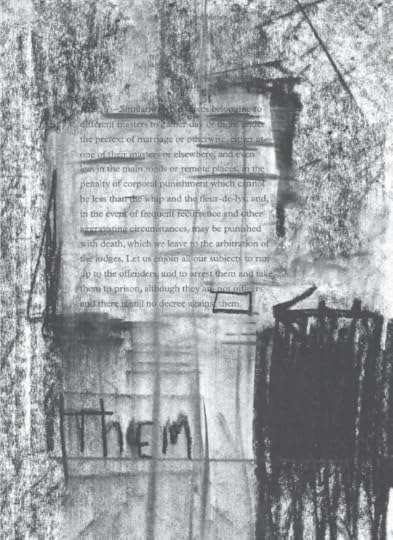
The stories/drafts are set in different places, although Toronto and St Lucia feature frequently, and in different times, indeed some of the stories reject the conventional boundaries of time:
[23]
METAMORPHOSIS 2: CORPSE EXQUISITE
THE EARTH WAS a boiling world. Across the continents, voices for every language moved through something like time: the idea, the theory, in the direction of something, a solution maybe. But time was kept separate from everything visible beyond the plantation. The clock-towers, long evaporated, will reappear when the fires cease again in one hundred years.
Across the continents, we met stone gods with wrecked noses, infant deities painted in egg tempera, stroked to erections by their mothers and framed in the rooms of men-at-arms; we laid marble effigies to dust, naming things against which we thrashed and lived. With the feeling that we were travelling towards a wind that would scatter oue lives elsewhere, past any perfect space, we left that world behind. We had no songs for killing left in us and we raised our glasses to finish off our beers because the hour of the new human being was at hand.
What, then, did we bring to our new evening?
My favourite story was '[39] A History of a Noise' which, as well as dissecting Disraeli's 1864 words "Is man an ape or an angel? My lord, I am on the side of the angels" (referring at the time to the debate on evolution), and touching on the colonial history of St Lucia manages to include the mathematical formulae for compound interest and volume of a pyramid, and a graphical representation of the existence of both a (actually two of each) direct common tangents and tranverse common tangents between any two non-overlapping circles (as an aside, a theorem proved I think neatly via the intermediate value theorem).
The Closing Remarks read simply:
NOW THAT YOU have read all the early draft, prepare for consequences from friends, lovers and enemies
The author discussed the book in detail with the Between the Covers podcast - transcript available here.
Strongly recommended
Nominee for the Governor General's Literary Awards for Fiction
Finalist for the Atwood Gibson Writers' Trust Fiction Prize
Code Noir by Canisia Lubrin is a very impressive work, one that doesn't constrain itself by the usual boundaries of novels, and is consequently hard to do justice in a review, other than recommending people to read it for themselves.
The work consists of 59 pieces, stories perhaps although some are closer to prose poems (Christine Sharpe's introduction describes them as 'these stories, these drafts, these fictions, these meditations, songs, dreams and spells'), together with Opening and Closing Remarks. The Opening Remarks begin:
THE MURDERERS IN THIS DRAFT are those who write the laws, who tell you to prepare for the tragedy of the afternoon because they have claimed-with their Black Codes-every morning of every country on Earth. They won't tell you that it is their minister, their president, their physician, or their deacon swept up in another breaking, buried language all those who will be ridiculed by midmorning. The murderers must admit you are growing into their fictions, that it is your hello that begins the conjuring. There is only one word for this fiction in the English language: belief. And two in the French: croyance et loi. Okay, there's also la foi. But who's counting? In five minutes a strange order of time that does not involve experience or awareness-only innocence-will arrive, and you must be prepared. On another bridge, with a lit match, there's a poet asking, What does it mean to speak as though the world you know is the world?
I do not require your belief.
Each piece is paired (although not in numerical order) with one of the Articles of the Code Noir, a decree passed by King Louis XIV of France in 1685 defining the conditions of slavery in the French colonial empire, as the author explains:
THIS IS A work of invention. I draw the epigraph for each of the fictions in Code Noir from Louis XIV's Code Noir (1685). These laws governed chattel slavery and have had a profound hand in shaping the modern world. They are artefact in this work of literature.
And each Article from the Code Noir, as translated by Lubrin, is presented with an overlaid charcoal artwork by Torkwase Dyson, one example:
The stories/drafts are set in different places, although Toronto and St Lucia feature frequently, and in different times, indeed some of the stories reject the conventional boundaries of time:
[23]
METAMORPHOSIS 2: CORPSE EXQUISITE
THE EARTH WAS a boiling world. Across the continents, voices for every language moved through something like time: the idea, the theory, in the direction of something, a solution maybe. But time was kept separate from everything visible beyond the plantation. The clock-towers, long evaporated, will reappear when the fires cease again in one hundred years.
Across the continents, we met stone gods with wrecked noses, infant deities painted in egg tempera, stroked to erections by their mothers and framed in the rooms of men-at-arms; we laid marble effigies to dust, naming things against which we thrashed and lived. With the feeling that we were travelling towards a wind that would scatter oue lives elsewhere, past any perfect space, we left that world behind. We had no songs for killing left in us and we raised our glasses to finish off our beers because the hour of the new human being was at hand.
What, then, did we bring to our new evening?
My favourite story was '[39] A History of a Noise' which, as well as dissecting Disraeli's 1864 words "Is man an ape or an angel? My lord, I am on the side of the angels" (referring at the time to the debate on evolution), and touching on the colonial history of St Lucia manages to include the mathematical formulae for compound interest and volume of a pyramid, and a graphical representation of the existence of both a (actually two of each) direct common tangents and tranverse common tangents between any two non-overlapping circles (as an aside, a theorem proved I think neatly via the intermediate value theorem).
The Closing Remarks read simply:
NOW THAT YOU have read all the early draft, prepare for consequences from friends, lovers and enemies
The author discussed the book in detail with the Between the Covers podcast - transcript available here.
My outlook on narrative is that, as [Dionne] Brand says, I quite agree with what she says about the kind of power structures that the grand narrative of history, the history of the transatlantic slave trade, the history of colonialism, which is the major organizing principle of our world, the way that has been reproduced in the library and what we like to think of as the primary library, the main forms of description, the main phonetics of myth, the main knowledges that come to us with all kinds of contradictions that we might not give the required skepticism to that we should because we have been conditioned in the workshop, so to speak, of colonial literary forms.
I knew that in entering Code Noir, I wanted to have a different orientation to the narrative that would be about the ways that we actually tell stories in spite of the dominant narratives and the dominant narrative modes. When you encounter anybody out there, there is a kind of embodied storytelling that we find ourselves in the presence of.
[...]
The different orientations that people have to different ways of telling stories, the grand orality of the Caribbean, and the kind of mellifluous multiple censorial that something like that offers, that was my guiding principle in the book, which is why there is, to my mind, a poetics of intimacy at play. What we have in the book are a lot of people telling each other stories. These are the ways, really, truly.
If you want to think about the invitation of Code Noir, my Code Noir, the book next to King Louis the XIV Code Noir, the invitation is that there are all of these practices that we carry about in our person that allow us to survive what should be unsurvivable. There are places in us, on the inside of us that the law, the “blunt instrument of the law” in its conflations with morality and ethics as we know that don’t always bear out, and that are outright lies sometimes or most of the time, it’s about power and instituting balances of power or imbalances of power, and allow the most powerful and moneyed in the world to carry on as if the world only belongs to them, how we survive that are the things that actually fall outside the dominant structures that we encounter in the temporality and in the improvisations of our daily living.
I wanted to find these modes and make them central to the forms of storytelling that happen in the book, that choreography between the stories, and what the main voices are doing. I do use first-person narration quite a lot and even in the opening remarks that I read just a little bit ago but it is a shape-shifting perspective. That voice treats the project of making a book. It’s the book being aware of itself really. The stories are sentient things.
[...]
We move by a different kind of authority, not one that is interested in domination or the singular characterization of the hero and that arc, the beginning, middle, and end hero’s journey but in another orientation to agency and not necessarily to a kind of broad strokes authority in which you simply have the fictive spell that reduces the world only to its instrumental parts. The different kinds of storytelling are about privileging the relational over the instrumental.
Strongly recommended

December 28, 2024
Maybe it's a good book that flies over the head of most readers, and maybe it's not a good book because it flies over the head of most readers.

June 7, 2024
Code Noir is a unique and highly moving book. Lubrin is a marvelous poet, and I've followed her work, so it is exciting to see how she works in prose. The structure she's chosen works well for the pieces she's presenting, with the 59 articles of the Code from 1685 echoed in her writing. There are stories, and there are prose poems, phrases with varied discourses to encompass the speakers. Every part of the book is carefully reflective of the themes that Lubrin is trying to express; both the text design by Kate Sinclair (the opening page filled with Code Noir ) and the images by Torkwase Dyson that move beyond illustration into stories themselves work together with Lubrin's prose to give us a rich experience. I can't recommend it highly enough.

Read
March 25, 2024My grandmother always said things happen for a reason. The e-book and e-audiobook both came available at the same time on my Libby so I took them both. Sweet serendipity… and… Thank goodness.
I listened to almost 2 hours of this and it was just NOT working for me. At that point I opened up the e-book on my iPad to take a look at it. It is easy to see what (some of) the issue is.
Pieces of the actual text from the Code Noir are rendered as artwork in the e-book and serve as break points between the different “sections” - for lack of a better word. While it makes sense in the physical book - it was nothing short of confounding in the e-audiobook.
Also, while I definitely appreciated that this is voiced with multiple narrators - male and female - to provide some cueing to the listener that we have moved on to a new section, it’s not enough.
I was really struggling to follow what little narrative thread there is. This is really a bunch of vignettes, snippets strung together by bits of the Code Noir…
Further, I struggled - listening to it - to make the/any connection between each excerpt from the Code Noir and the “story” that followed (presuming that there is a connection).
This is a title that I will park for the time being - and that I will come back to when I have time to actually read the physical book. This is not a book that I can follow well enough by listening to it. I think the form, and the words, need to be seen and savoured.
Given that, I won’t “score” it at present… I’ll save that for when I’ve finished reading it (in the truest sense of the word).
I listened to almost 2 hours of this and it was just NOT working for me. At that point I opened up the e-book on my iPad to take a look at it. It is easy to see what (some of) the issue is.
Pieces of the actual text from the Code Noir are rendered as artwork in the e-book and serve as break points between the different “sections” - for lack of a better word. While it makes sense in the physical book - it was nothing short of confounding in the e-audiobook.
Also, while I definitely appreciated that this is voiced with multiple narrators - male and female - to provide some cueing to the listener that we have moved on to a new section, it’s not enough.
I was really struggling to follow what little narrative thread there is. This is really a bunch of vignettes, snippets strung together by bits of the Code Noir…
Further, I struggled - listening to it - to make the/any connection between each excerpt from the Code Noir and the “story” that followed (presuming that there is a connection).
This is a title that I will park for the time being - and that I will come back to when I have time to actually read the physical book. This is not a book that I can follow well enough by listening to it. I think the form, and the words, need to be seen and savoured.
Given that, I won’t “score” it at present… I’ll save that for when I’ve finished reading it (in the truest sense of the word).

January 1, 2026
This might also have something in common with Faber Faber After You Were, I Am.. Both are written by poets and based on historical texts. And both are hella challenging!
This often just felt like word salad to me. Some stories were clear and nearly enjoyable but I kind of felt like I was just flipping through the channels and reading something in progress with no context. I didn't get that the stories were connected to each other or the Code Noir.
I'd feel bad dissuading anyone from reading this so tackle it if you want to read an ambitious writing project. It does go quickly when you settle in.
This often just felt like word salad to me. Some stories were clear and nearly enjoyable but I kind of felt like I was just flipping through the channels and reading something in progress with no context. I didn't get that the stories were connected to each other or the Code Noir.
I'd feel bad dissuading anyone from reading this so tackle it if you want to read an ambitious writing project. It does go quickly when you settle in.

Read
April 23, 2024Unfortunately, I’m just not smart enough to understand this book. Parts of it are beautifully written but it went right over my head. Hence, no rating for this one from me.
No fault of the author’s, it’s my own shortcomings as a reader. Looking forward to other reviews to help me understand this book better.
No fault of the author’s, it’s my own shortcomings as a reader. Looking forward to other reviews to help me understand this book better.

February 10, 2025
In her ambitious fiction debut, award-winning poet Canisia Lubrin attempts something both daring and complex - a creative reimagining of the infamous Code Noir, the 1685 legal framework that governed slavery in the French colonial empire. Through 59 interconnected stories mirroring the original code's 59 articles, Lubrin weaves together fragments of Black experience across time, space, and literary genres. While the concept is innovative and many individual pieces shine with powerful imagery and incisive commentary, the collection as a whole sometimes struggles under the weight of its experimental structure.
Literary Style and Structure
Lubrin brings her poetic sensibilities to bear in these stories, which range from lyrical magical realism to stark contemporary narratives. Her prose often achieves a haunting musicality, particularly in pieces like "The Origin of the Lullaby" and "Earth in the Time of Billie Holiday." The writing is dense with metaphor and meaning, rewarding careful reading while occasionally testing the reader's patience with its opacity.
The 59-story structure allows Lubrin to explore diverse narrative approaches:
- Historical fiction grounded in specific times and places
- Surreal, dreamlike sequences that blur reality
- Contemporary slice-of-life narratives
- Dystopian and speculative fiction pieces
- Meta-textual experiments that play with form
This variety showcases Lubrin's range as a writer but also leads to an uneven reading experience. The transitions between styles and timeframes can be jarring, and some of the more experimental pieces sacrifice clarity for conceptual ambition.
Thematic Depth
Memory and History
One of the collection's greatest strengths is its exploration of how historical trauma echoes through generations. Stories like "The Keeper of the Dates" and "Cedar Grove Rose" examine how memories of oppression shape present-day lives and relationships. Lubrin skillfully depicts the ways in which the past refuses to stay buried, emerging in unexpected and often painful ways.
Identity and Belonging
Many pieces grapple with questions of identity in a world shaped by colonial legacies. Characters navigate complex relationships with heritage, language, and place. The story "No ID, or We Could Be Brothers" particularly stands out for its nuanced exploration of solidarity and alienation within immigrant communities.
Power and Resistance
Throughout the collection, Lubrin examines how power operates at both systemic and personal levels. While some stories directly confront historical oppression, others explore more subtle forms of control and resistance in contemporary settings.
Technical Elements
Character Development
The fragmentary nature of the collection means that character development is often limited. While some stories feature memorable protagonists, many characters feel more like vehicles for ideas than fully realized individuals. This appears to be a conscious artistic choice but may frustrate readers seeking deeper emotional connections.
Dialogue
Lubrin demonstrates skill with dialogue, particularly in capturing the rhythms and cadences of Caribbean speech patterns. However, in some of the more experimental pieces, dialogue becomes abstract and difficult to follow.
Setting
The stories move fluidly across time and space, from historical Caribbean locations to contemporary Canadian cities to surreal landscapes. Lubrin excels at creating atmosphere, though the constant shifts can be disorienting.
Critical Assessment
Strengths
- Innovative concept and structure
- Rich, poetic language
- Powerful exploration of historical themes
- Strong individual pieces
- Ambitious scope
Weaknesses
- Uneven pacing
- Sometimes overly abstract
- Challenging transitions between stories
- Variable accessibility for general readers
- Some pieces feel overcomplicated
Reader Experience and Recommendations
Code Noir demands active engagement from its readers. This is not a collection to be rushed through - individual stories often require multiple readings to fully appreciate their layers of meaning. While some pieces immediately resonate, others may initially perplex before revealing their significance.
The collection will likely appeal most to:
- Readers interested in experimental literature
- Those familiar with Caribbean literary traditions
- Readers who appreciate poetry and poetic prose
- Students of postcolonial literature
General readers seeking more straightforward narratives may find the collection challenging.
Final Verdict
Code Noir represents an ambitious and often successful attempt to confront historical trauma through innovative literary forms. While not every experiment succeeds, the collection's strongest pieces demonstrate Lubrin's considerable talents and the potential of formal experimentation to illuminate complex histories. Despite its unevenness, this is an important addition to contemporary Caribbean literature that rewards patient engagement.
Code Noir shows tremendous promise and contains moments of brilliance, but its experimental nature and uneven execution may limit its appeal to general readers. It's a significant work that sometimes gets lost in its own complexity.
Literary Style and Structure
Lubrin brings her poetic sensibilities to bear in these stories, which range from lyrical magical realism to stark contemporary narratives. Her prose often achieves a haunting musicality, particularly in pieces like "The Origin of the Lullaby" and "Earth in the Time of Billie Holiday." The writing is dense with metaphor and meaning, rewarding careful reading while occasionally testing the reader's patience with its opacity.
The 59-story structure allows Lubrin to explore diverse narrative approaches:
- Historical fiction grounded in specific times and places
- Surreal, dreamlike sequences that blur reality
- Contemporary slice-of-life narratives
- Dystopian and speculative fiction pieces
- Meta-textual experiments that play with form
This variety showcases Lubrin's range as a writer but also leads to an uneven reading experience. The transitions between styles and timeframes can be jarring, and some of the more experimental pieces sacrifice clarity for conceptual ambition.
Thematic Depth
Memory and History
One of the collection's greatest strengths is its exploration of how historical trauma echoes through generations. Stories like "The Keeper of the Dates" and "Cedar Grove Rose" examine how memories of oppression shape present-day lives and relationships. Lubrin skillfully depicts the ways in which the past refuses to stay buried, emerging in unexpected and often painful ways.
Identity and Belonging
Many pieces grapple with questions of identity in a world shaped by colonial legacies. Characters navigate complex relationships with heritage, language, and place. The story "No ID, or We Could Be Brothers" particularly stands out for its nuanced exploration of solidarity and alienation within immigrant communities.
Power and Resistance
Throughout the collection, Lubrin examines how power operates at both systemic and personal levels. While some stories directly confront historical oppression, others explore more subtle forms of control and resistance in contemporary settings.
Technical Elements
Character Development
The fragmentary nature of the collection means that character development is often limited. While some stories feature memorable protagonists, many characters feel more like vehicles for ideas than fully realized individuals. This appears to be a conscious artistic choice but may frustrate readers seeking deeper emotional connections.
Dialogue
Lubrin demonstrates skill with dialogue, particularly in capturing the rhythms and cadences of Caribbean speech patterns. However, in some of the more experimental pieces, dialogue becomes abstract and difficult to follow.
Setting
The stories move fluidly across time and space, from historical Caribbean locations to contemporary Canadian cities to surreal landscapes. Lubrin excels at creating atmosphere, though the constant shifts can be disorienting.
Critical Assessment
Strengths
- Innovative concept and structure
- Rich, poetic language
- Powerful exploration of historical themes
- Strong individual pieces
- Ambitious scope
Weaknesses
- Uneven pacing
- Sometimes overly abstract
- Challenging transitions between stories
- Variable accessibility for general readers
- Some pieces feel overcomplicated
Reader Experience and Recommendations
Code Noir demands active engagement from its readers. This is not a collection to be rushed through - individual stories often require multiple readings to fully appreciate their layers of meaning. While some pieces immediately resonate, others may initially perplex before revealing their significance.
The collection will likely appeal most to:
- Readers interested in experimental literature
- Those familiar with Caribbean literary traditions
- Readers who appreciate poetry and poetic prose
- Students of postcolonial literature
General readers seeking more straightforward narratives may find the collection challenging.
Final Verdict
Code Noir represents an ambitious and often successful attempt to confront historical trauma through innovative literary forms. While not every experiment succeeds, the collection's strongest pieces demonstrate Lubrin's considerable talents and the potential of formal experimentation to illuminate complex histories. Despite its unevenness, this is an important addition to contemporary Caribbean literature that rewards patient engagement.
Code Noir shows tremendous promise and contains moments of brilliance, but its experimental nature and uneven execution may limit its appeal to general readers. It's a significant work that sometimes gets lost in its own complexity.

August 21, 2024
"We know that to remember is to call upon something like time and for everything to move in response like a mirage. It was our dead who sent us this far out to sea. We came this way when The Torment forced us into a nakedness that rose up, past the frozen hills, into the sky, to the moon from which our new skins grew."
the writing in Code Noir is often so poetic that it is impenetrable. by me, at least. which is fine, i guess, but in bits of prose fiction which are otherwise trying to convey a "story", the word stew can be just a little too thick to digest.
looking at the slider for "Spoilers?", i'm sat here thinking: i can't imagine how one could spoil this book...
today, i listened to a chunk of Canisia Lubrin's chat with David Naimon on Between the Covers, and it was insightful, but also bent towards words and more words tied together to form knots of language.
i really wanted to really like this book, but in the end it's... fine. just okay.
the writing in Code Noir is often so poetic that it is impenetrable. by me, at least. which is fine, i guess, but in bits of prose fiction which are otherwise trying to convey a "story", the word stew can be just a little too thick to digest.
looking at the slider for "Spoilers?", i'm sat here thinking: i can't imagine how one could spoil this book...
today, i listened to a chunk of Canisia Lubrin's chat with David Naimon on Between the Covers, and it was insightful, but also bent towards words and more words tied together to form knots of language.
i really wanted to really like this book, but in the end it's... fine. just okay.

January 20, 2024
This is sure to be the book of the year.

November 12, 2024
I just don’t think my brain has the capacity to comprehend this piece of literature.

July 26, 2026
Winner of the Carol Shields Prize for Fiction, Code Noir is one of those books that demands your full attention. It is not an easy read, either in terms of subject matter or structure, but it rewards the concentration it requires.
Interspersed throughout with stark black-and-white illustrations by visual artist Torkwase Dyson, the novel weaves together the real Code Noir laws that governed French colonial slavery with fifty-nine interconnected stories. The result is a kaleidoscopic portrait of how those laws continued to shape lives across generations. Some stories are only a few pages long, others linger a little longer, but together they build into something far greater than their individual parts.
Canisia Lubrin constantly shifts form, genre, point of view and even the way stories are told. At times I found myself having to slow down and reorient myself, but there is a clear purpose behind the experimentation. This is not a conventional historical novel. Instead, it explores the enduring legacy of slavery, showing how its consequences ripple through time and reminding us that race underpins so much of history and continues to shape the present.
This is not a book I raced through. It is one to read thoughtfully, allowing each story to settle before moving on to the next. Challenging, inventive and deeply thought-provoking, Code Noir is well worth the effort.
Interspersed throughout with stark black-and-white illustrations by visual artist Torkwase Dyson, the novel weaves together the real Code Noir laws that governed French colonial slavery with fifty-nine interconnected stories. The result is a kaleidoscopic portrait of how those laws continued to shape lives across generations. Some stories are only a few pages long, others linger a little longer, but together they build into something far greater than their individual parts.
Canisia Lubrin constantly shifts form, genre, point of view and even the way stories are told. At times I found myself having to slow down and reorient myself, but there is a clear purpose behind the experimentation. This is not a conventional historical novel. Instead, it explores the enduring legacy of slavery, showing how its consequences ripple through time and reminding us that race underpins so much of history and continues to shape the present.
This is not a book I raced through. It is one to read thoughtfully, allowing each story to settle before moving on to the next. Challenging, inventive and deeply thought-provoking, Code Noir is well worth the effort.

June 18, 2025
As a lover of bizarre and abstract literature I think we may have found the limit of just how bizarre and abstract you can become before you cross over into incomprehensible.

Read
March 23, 2025Somewhat dream-like. Unfortunately I couldn’t really piece together what was going on.
“There's only so much trying before anyone decides to give up or level up.” p135
“There's only so much trying before anyone decides to give up or level up.” p135

Did Not Finish
March 22, 2025DNF @ pg. 63
I tried to connect the vignettes to each other and to the concept of responding to the historic Black codes, but it's just not clicking for me. Super cool idea but the execution isn't making sense in my brain.
I tried to connect the vignettes to each other and to the concept of responding to the historic Black codes, but it's just not clicking for me. Super cool idea but the execution isn't making sense in my brain.

Read
December 15, 2025Winner of the 2025 Carol Shields Prize for Fiction
[experienced mostly as an audiobook, but having the print nearby as there’s lots of visual elements]
2025 Carol Shields Prize for Fiction
1. All Fours, Miranda July
2. Liars, Sarah Manguso
3. Code Noir, Canisia Lubrin [WINNER]
—The Hearing Test, Eliza Barry Callahan
—Everything Flirts: Philosophical Romances, Sharon Wahl
[up next to read, in 2026: River East, River West, Aube Rey Lescure]
[experienced mostly as an audiobook, but having the print nearby as there’s lots of visual elements]
2025 Carol Shields Prize for Fiction
1. All Fours, Miranda July
2. Liars, Sarah Manguso
3. Code Noir, Canisia Lubrin [WINNER]
—The Hearing Test, Eliza Barry Callahan
—Everything Flirts: Philosophical Romances, Sharon Wahl
[up next to read, in 2026: River East, River West, Aube Rey Lescure]

March 6, 2024
DNF @ pg 245.
Not because it's not good. It is interesting, and well written, and not bad at all. But it was not for me, and it was a struggle to pick it up to read.
Not because it's not good. It is interesting, and well written, and not bad at all. But it was not for me, and it was a struggle to pick it up to read.

March 1, 2026
I love the intention of this book. And its biggest success is that it helps me feel some of the pain and fragmentation that has its roots in Europe's choice to codify, entrench and export its racism about 440 years ago. Both as a white person and as somebody who grew up in the English speaking colonies, I hadn't heard of this French foundation of racist slavery, the Code Noir. It is terrifying and the book succeeded in conveying to me the ongoing pain and damage inflicted by it, and also gave me a glimpse into how it affected Canada's roots via the French colonisation that happened here.
And I struggled to read this book, not just because its subject is painful. For me, everything about the writing was opaque: I couldn't easily read the excerpts from Code Noir at the top of each chapter (reading the book on my phone). There seemed to be no character or story link between one chapter or the next. Some fragments were less than a page even on my phone screen. It was like trying to catch an autumn leaf blowing down from a tree and across the other side of a fence.
This is OK. There is a lot that I don't understand in life and these stories join that mystery. I know it is the writer's conscious choice not too put too much energy into making her stories accessible to readers, because I went to her public lecture at the University of Toronto this week. She was very clear that she chooses what and how to write, and readers get to choose whether to persist with reading or put the book down.
Today, my borrowed copy of the book has gone back to the library because my time was up and I was barely half way. As one of the speakers said at the U of T event this week, when you put a book down it might be forever, or for a while. And when you pick it up again it's a different you that is reading it. I look forward to exploring what happens next.
And I struggled to read this book, not just because its subject is painful. For me, everything about the writing was opaque: I couldn't easily read the excerpts from Code Noir at the top of each chapter (reading the book on my phone). There seemed to be no character or story link between one chapter or the next. Some fragments were less than a page even on my phone screen. It was like trying to catch an autumn leaf blowing down from a tree and across the other side of a fence.
This is OK. There is a lot that I don't understand in life and these stories join that mystery. I know it is the writer's conscious choice not too put too much energy into making her stories accessible to readers, because I went to her public lecture at the University of Toronto this week. She was very clear that she chooses what and how to write, and readers get to choose whether to persist with reading or put the book down.
Today, my borrowed copy of the book has gone back to the library because my time was up and I was barely half way. As one of the speakers said at the U of T event this week, when you put a book down it might be forever, or for a while. And when you pick it up again it's a different you that is reading it. I look forward to exploring what happens next.

July 31, 2025
Thank you Soft Skull Press and The Carol Shields Prize for Fiction for the gifted copy.
4.5 stars - Intertwining the real slavery Code Noir articles from French colonialism with 59 short stories, we experience a kaleidoscopic range of the ways in which these laws impacted future generations. Lubrin plays with form, genre, POVs, and storytelling to remind us of the cruelties of slavery and that everything is always about race.
This was incredibly successful in establishing an engaging, puzzle-like reading experience that kept you involved and wondering what was actually being said and who else we were going to meet. Those are the moments that I really enjoyed—when I started to figure out connections between characters. (Note, not all of them directly connect but some of them do.)
And even if there were stories that weren’t as impactful as others, nothing was ever boring, and to keep a reader engaged for almost 400 pages (of stories and articles turned into artwork) is no small feat. And the ‘Closing Remarks’ are a stunning, chilling sentence.
This is also a book that’d be great for a buddy read because there will be parts you’ll want to talk through in order to understand. With how experimental and artistic this is, you won’t get the full impact by only reading via audiobook, but tandem reading like I did was a great, immersive experience and I would really recommend doing so if you can. The audiobook is fantastic and narrated by a full cast (I used Hoopla!).
💭 I recommend this to anyone looking for: a fresh take on a short story collection, or a book that’s genre bending while examining the effects of slavery.
📚Follow for more on Instagram: @oliviasbooktalk
4.5 stars - Intertwining the real slavery Code Noir articles from French colonialism with 59 short stories, we experience a kaleidoscopic range of the ways in which these laws impacted future generations. Lubrin plays with form, genre, POVs, and storytelling to remind us of the cruelties of slavery and that everything is always about race.
This was incredibly successful in establishing an engaging, puzzle-like reading experience that kept you involved and wondering what was actually being said and who else we were going to meet. Those are the moments that I really enjoyed—when I started to figure out connections between characters. (Note, not all of them directly connect but some of them do.)
And even if there were stories that weren’t as impactful as others, nothing was ever boring, and to keep a reader engaged for almost 400 pages (of stories and articles turned into artwork) is no small feat. And the ‘Closing Remarks’ are a stunning, chilling sentence.
This is also a book that’d be great for a buddy read because there will be parts you’ll want to talk through in order to understand. With how experimental and artistic this is, you won’t get the full impact by only reading via audiobook, but tandem reading like I did was a great, immersive experience and I would really recommend doing so if you can. The audiobook is fantastic and narrated by a full cast (I used Hoopla!).
💭 I recommend this to anyone looking for: a fresh take on a short story collection, or a book that’s genre bending while examining the effects of slavery.
📚Follow for more on Instagram: @oliviasbooktalk
May 9, 2025
This is a highly experimental work that echoes off the clinical 1685 French colonial decree, also known as the Code Noir, which clinically addressed the commodification and regulation of slaves in minute detail. The 59 interconnected pieces of this work, often so loosely as to seem imperceptible, mirror the original 59 articles. It’s a kaleidoscopic postmodern conundrum that plays with genres and time, and includes historical fiction, spec sci-fi, poetry, realism, magic realism and even a song. If one were unkind, they might say that it reads like an MFA assignment that asks for a piece that contains all the literary tricks. Lubrin’s plain, largely unadorned, language, which includes dialects and code switching, throughout this highly fragmented work, keeps the reader at a distance which isn’t typical for works that deal with historical trauma. However, the very dense and layered presentation drives home the important themes of Black identity, resilience, and resistance across eras and geographies. Lubrin attempts to give voice, often conflicting, to many of the countless facets that represent the Black experience.
For me, Code Noir is a very bold and ambitious work that, frankly, was ultimately a very laborious read. I found it uneven, but that may well have to do with the fact I found some of the pieces challenged comprehension and/or relevance. There were just too many things going on, and I found that distracting as I was constantly pulled out of the narrative to consider stylistic and thematic elements. Even the art accompanying the original code decrees starting each piece had this effect. The work pushes many boundaries, maybe a little too far for my tastes.
For me, Code Noir is a very bold and ambitious work that, frankly, was ultimately a very laborious read. I found it uneven, but that may well have to do with the fact I found some of the pieces challenged comprehension and/or relevance. There were just too many things going on, and I found that distracting as I was constantly pulled out of the narrative to consider stylistic and thematic elements. Even the art accompanying the original code decrees starting each piece had this effect. The work pushes many boundaries, maybe a little too far for my tastes.

July 26, 2026
Winner of the 2025 Carol Shields Prize for Fiction
A novel which deliberately seeks to undermine the dominant concepts, conventions and underlying organisational principles of narrative and novels as a way of explosing that the undermining dominant concepts, conventions and underlying organisational principles of our world were largely forged by colonialism and the slave trade.
It alternates deliberate blurred, rearranged and smudged extracts of the Articles from the 1695 Code Noir (which set out how slavery was to operate in the French colonies) with paired fictional pieces ranging from flash fiction to prose poems to short stories.
I am at best lukewarm on short story collections and averse to flash fiction so this was always going to be a stretch for me.
However I must admit to being disappointed that I was unable to find many links either between the fictions themselves or between the fictions and their paired Code Noir article – whether this was my failing or my expectations is less clear to me.
And ultimately I did come away feeling that the author had largely undermined everything I enjoy about reading novels – which while deliberate makes it hard to rate or recommend this novel.
A novel which deliberately seeks to undermine the dominant concepts, conventions and underlying organisational principles of narrative and novels as a way of explosing that the undermining dominant concepts, conventions and underlying organisational principles of our world were largely forged by colonialism and the slave trade.
It alternates deliberate blurred, rearranged and smudged extracts of the Articles from the 1695 Code Noir (which set out how slavery was to operate in the French colonies) with paired fictional pieces ranging from flash fiction to prose poems to short stories.
I am at best lukewarm on short story collections and averse to flash fiction so this was always going to be a stretch for me.
However I must admit to being disappointed that I was unable to find many links either between the fictions themselves or between the fictions and their paired Code Noir article – whether this was my failing or my expectations is less clear to me.
And ultimately I did come away feeling that the author had largely undermined everything I enjoy about reading novels – which while deliberate makes it hard to rate or recommend this novel.

March 2, 2026
I won't lie: I was deeply frustrated by my inability to comprehend this book for most of the first half. Settings (both time and place) were often ambiguous, the narrator was usually not identified, and the connections between the stories and the articles of the Code Noir were subtle to non-existent.
But about halfway through it became clear to me that that was the point. The Code Noir (and other forms of "black codes") codified and reified the dehumanization of people seen as "less than", and the architecture of that dehumanization continues to shape us today. It doesn't matter where or when—or most of the time even who—and the fictions play with that narrative freedom. At the same time, these fictions take seriously the task of rejecting the dehumanization by telling deeply human stories, in all their cacophonous, polyphonic, nonlinear glory. It was confusing at times, yes, but also a lot of fun once I locked in.
But about halfway through it became clear to me that that was the point. The Code Noir (and other forms of "black codes") codified and reified the dehumanization of people seen as "less than", and the architecture of that dehumanization continues to shape us today. It doesn't matter where or when—or most of the time even who—and the fictions play with that narrative freedom. At the same time, these fictions take seriously the task of rejecting the dehumanization by telling deeply human stories, in all their cacophonous, polyphonic, nonlinear glory. It was confusing at times, yes, but also a lot of fun once I locked in.

January 14, 2025
We often have a corporeal response to a work of art that takes the top off our head. And that's so, with Code Noir. That is what it's done with me. We may spend less time thinking what that art places in us, in the space left by the part of yourself now open, now irretrievably open, to receive it.
To start - I don't desire retrieval from this space. How open I feel, to the past full of its dead, to the present teeming with its muscular ghosts, to the future where I taste every knowing until they become ammonites on my tongue, coiled helixes of everything I cannot fathom. Try to fathom these fictions, these incandescent and direct Black poetries in prose, and you may be left wanting. Simply open yourself to them, instead. Let the top of your head be taken off, to have so much more pour into you.
To start - I don't desire retrieval from this space. How open I feel, to the past full of its dead, to the present teeming with its muscular ghosts, to the future where I taste every knowing until they become ammonites on my tongue, coiled helixes of everything I cannot fathom. Try to fathom these fictions, these incandescent and direct Black poetries in prose, and you may be left wanting. Simply open yourself to them, instead. Let the top of your head be taken off, to have so much more pour into you.

November 14, 2024
A harrowing, essential read. Each vignette reflects articles from 1685’s Le Code Noir, issued by Louis XIV, presented with erasures from the Code itself.
"I stood there withholding the weight of what we were both thinking: that here was something true and strange between us, lacking a name, and we had turned around at the same time and seen each other."
"We know that to remember is to call upon something like time and for everything to move in response like a mirage. It was our dead who sent us this far out to sea.”
“The story that does not obey itself produces another mark of authority... Who reads the unclassifiable mind?”
“The voice speaking has a nature such as the nature of sound in a wilderness, or a cave underwater, the voice has a wilderness.”
"I stood there withholding the weight of what we were both thinking: that here was something true and strange between us, lacking a name, and we had turned around at the same time and seen each other."
"We know that to remember is to call upon something like time and for everything to move in response like a mirage. It was our dead who sent us this far out to sea.”
“The story that does not obey itself produces another mark of authority... Who reads the unclassifiable mind?”
“The voice speaking has a nature such as the nature of sound in a wilderness, or a cave underwater, the voice has a wilderness.”

April 13, 2025
I am frustrated, sad, confused, and disappointed that I somehow was not blown away by this. I haven’t read and of their poetry, and since styles are numerous in that genre, I can only note I am at a loss. Language and syntax and tone and the sound of words are often hallmarks of great poets. I saw little of that here. Maybe the genre switch to prose stifled the writing? The idea was fabulous, but the execution leaves much to be desired. There is some intellectual hints and no shortage of the realities of humans as property, but that aspect has been done better elsewhere, in and out of fiction.
Wanted and envisioned so much more.
Wanted and envisioned so much more.
Read
January 28, 2026I keep getting burned by short story collections. The collection isn’t bad but the combination of the post colonial Black trauma (though given the title I probably did this to myself) and it being very clear from the style of the writing that the author is primarily a poet made it a bit of a slog. Like all short story collections, there were a few gems but when there are 59, it’s kind of a given. Definitely need to take a break from short stories for quite a long time.

January 18, 2026
Canadian Author, winner of the 2025 Carol Shields prize for fiction, an examination of the 1685 decrees by King Louis XIV of France defining the conditions of slavery in the French colonial empire; this book had a lot of potential for me but was ultimately a few good fictional short stories, a really good final chapter, and quite a lot of ‘eh?’ in between.

Read
April 15, 2025I wasn't totally sure what happened in this book. And by "not totally sure," I mean not at all. On the kindle version, it was hard to make out the code noir article artworks which didn't help. Writing was pitch perfect throughout.

July 27, 2025
Some beautiful prose but too full of itself to accomplish anything outside of niche deconstruction. There are many better ways to tackle the salience of this topic without the tasteless mental masturbation.
1.02857201
1.02857201

October 1, 2025
I have to sit with my thoughts on this one. It was interesting and unlike anything I've read. The stories that dealt with relatable themes like social violence and familial dysfunction were affecting, but the ones that were written with a complex bend do take some ruminance.

May 10, 2025
I couldn't make sense of the 25% I read.
Displaying 1 - 30 of 41 reviews