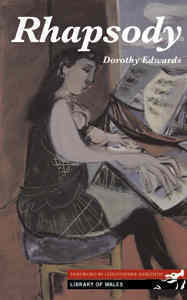
Dorothy Edwards was a Welsh author who is very little read or known these days. Rhapsody is a collection of her short stories. Edwards remained little known and out of print after her death in 1934, until Virago (bless them) published her only novel and this collection of her short stories in the 1980s. The edition I have in the recent Library of Wales edition has three extra stories.
Dorothy Edwards committed suicide leaving a heart-rending note;
“I am killing myself because I have never sincerely loved any human being all my life. I have accepted kindness and friendship, and even love, without gratitude and given nothing in return."
She was born in 1903 and her father was a socialist and Independent Labour Party activist; a political tradition she followed. She read Greek and Philosophy at Cardiff University. I found out about her work when reading David Garnett’s book on his friends. The chapter on T E Lawrence mentions her. Garnett was a fan of her writing (as was Lawrence) and she stayed with him and his wife rent free for a time. Lawrence thought that her story A Country House was one of the best written in the English Language. Garnett also thought she was a brilliant writer. Christopher Meredith sums up well in his introduction to this edition;
"Fashion for re-readings according to various theories have helped critics to rediscover her from time to time, but I believe that Dorothy Edwards is a great deal more than an interesting literary case. She's an important, utterly original modernist. Whichever way you read her, she's the extraordinarily accomplished author of powerful and suggestive fictions."
Here’s the rub, where should this type of writer sit in the canon, if at all. Having just finished reading Rhapsody I can say that these stories stand up against any others I have read; Woolf, Mansfield, Chekov, Maupassant. I am astonished that Dorothy Edwards is so little known.
The stories are fairly minimalist and usually written with a male narrator. There is a control and a holding back, desire is constrained and relationships incomplete, loneliness often a given. Edwards was interested in music and music is a recurrent motif and theme, often representing an undercurrent of passion. Meredith points out that a number of the stories refer to fairy tales, but in themselves they resemble fairy tales that are ironic with a menacing edge, covered by what seems to be a conventional English backdrop. Often outsiders or visitors arrive to disturb marriages and well established relationships. The emotional tensions between the characters is palpable’ the prose is stylised and often deliberately awkward. The movement and development of the stories often seems logical, but on reflection there is an underlying disturbance and all is not as it seems. The opening of A Country House illustrates this;
“From the day when I first met my wife she has been my first consideration always. It is only fair that I should treat her so, because she is young. When I first met her she was a mere child with black ringlets down her back and big blue eyes. She put her hair up to get married. Not that I danced attendance on her. That is nonsense.”
There is an odd construction here, although it may seem straightforward. There is nuance and almost menace and the narrator almost seems to be arguing with himself. On reflection I found that opening quite chilling.
Edwards herself says; “you must be realist or you must invent a personal isolated odd universe composed exclusively of your own experience”
I now feel the need to get hold of Claire Flay’s recent biography. She argues that Edwards uses the male narrators in the way she does in order to deconstruct their authority.
David Garnett has had a good deal of say in how we have seen Edwards until recently as her biography has been written. He indicates that Edwards was not always comfortable with people and indeed her stories are more ice sculpture than ardent passion. There is a picture of her in the back of Rhapsody and it is haunting. Given her upbringing, it is not surprising that class is important element for Edwards, but not in the way you would expect. Her women are often marginalised, but Edwards examines and critiques their position and treatment in a highly original way. These stories deconstruct and explore; the endings are unusual and I was often left thinking “Did that just end?” The stories just stop, often it feels like mid-sentence. However they make you think and they stay with you.
These short stories rank with the best I have ever read; they are haunting and are much more than they seem on the surface. These are a must read.