

What do you think?

Po Safonie
Oni mówili: safistki, inwertytki, trybady, amazonki, magiery, kryminalistki, istoty prymitywne ulegające histerii. One odpowiadały: gatunek kobiecy, osoby, o których myśli się w innym porządku. Kim były queerowe intelektualistki przełomu XIX i XX wieku?
Lina Poletti, Djuna Barnes, Gertrude Stein, Colette, Virgina Woolf czy Sarah Bernhardt to tylko kilka z wielu bohaterek tworzących zbiorową narratorkę Po Safonie. Choć rozproszone po całej Europie, pochłonięte twórczością, miłością i życiem, pod piórem Selby Wynn Schwartz tworzą chór kobiet odważnie domagających się wyzwolenia i społecznej akceptacji. A wszystko to na tle przełomowych wydarzeń: I wojny światowej, marszu na Rzym, rodzącego się faszyzmu.
Schwartz utkała swoją wielowątkową opowieść z najróżniejszych elementów, łącząc prawdę z tym, co podpowiadała jej wyobraźnia. Patronką swojej książki uczyniła Safonę i to za nią zdaje się powtarzać: "Te rzeczy teraz dla moich towarzyszek / pięknie zaśpiewam".
Lina Poletti, Djuna Barnes, Gertrude Stein, Colette, Virgina Woolf czy Sarah Bernhardt to tylko kilka z wielu bohaterek tworzących zbiorową narratorkę Po Safonie. Choć rozproszone po całej Europie, pochłonięte twórczością, miłością i życiem, pod piórem Selby Wynn Schwartz tworzą chór kobiet odważnie domagających się wyzwolenia i społecznej akceptacji. A wszystko to na tle przełomowych wydarzeń: I wojny światowej, marszu na Rzym, rodzącego się faszyzmu.
Schwartz utkała swoją wielowątkową opowieść z najróżniejszych elementów, łącząc prawdę z tym, co podpowiadała jej wyobraźnia. Patronką swojej książki uczyniła Safonę i to za nią zdaje się powtarzać: "Te rzeczy teraz dla moich towarzyszek / pięknie zaśpiewam".
264 pages, Paperback
First published July 6, 2022
About the author
Selby Wynn Schwartz
4 books88 followersSchwartz holds a PhD in comparative literature (Italian/French) from the University of California, Berkeley and currently teaches writing at Stanford University.
Ratings & Reviews
Friends & Following
Create a free account to discover what your friends think of this book!
Community Reviews
Displaying 1 - 30 of 1,422 reviews

July 22, 2022
After Sappho is a story of women and womanhood, a story of creativity, freedom, and excellence. This is scholar Selby Wynn Schwartz’s debut work of fiction, published by the excellent Galley Beggar Press. Schwartz traces the lives of European women in the Sapphic tradition who pushed against boundaries and laid the groundwork for liberation on their own terms. Many of these women are unsung, at least in our male-dominated society, although they are hardly obscure. Schwartz’s focus is unapologetically Euro-centric and covers the roughly 50-year period from the 1870s to the 1920s. Others have noted where writers of color seem to have been excised from the record, with Schwartz focusing instead on white woman who are already part of the canon. Despite that limited focus, I appreciate Schwartz's willingness to play with form and sit at the intersection of genres.
Did Not Finish
September 8, 2022Longlisted for Booker Prize 2022
Sorry, but this isn't for me. i no longer lose time with books I do not enjoy. The fact that the book was not shortlisted finally made me decide to drop this.
For me, this novel read like a series of academic Wikipedia entries about known Lesbian/Bi women from the past. Interesting subject but it felt like the book had no soul and I could not get invested.
Sorry, but this isn't for me. i no longer lose time with books I do not enjoy. The fact that the book was not shortlisted finally made me decide to drop this.
For me, this novel read like a series of academic Wikipedia entries about known Lesbian/Bi women from the past. Interesting subject but it felt like the book had no soul and I could not get invested.

August 21, 2022
Longlisted for the Booker Prize 2022
This book is crafted around an ambitious, interesting idea: Amalgamating and intertwining the biographies of important lesbian feminist thinkers and pioneers in order to show their cultural impact and tell their stories in context. Alas, it does not work: The short alternating paragraphs do not come together to form a coherent whole, the text just reads like cut-up literature using Wikipedia articles about lesbian feminists. These women are fascinating characters, but the novel is a boring slog, because it does not provide the key factor that would be required to make this work: To open the window to the consciousness of these women instead of enumerating biographical facts (even if slightly fictionalized in parts).
Frankly, I don't see how anyone could perceive this as revelatory, because it doesn't really distill anything new or offer an innovative angle by employing this particular aesthetic concept. And to point out that men are not the main characters here and that this is like a super-feminist idea is unbelievably sad (I mean, who are you if you really believe that in the year 2022?). I wanted to love this, and I applaud the ambition and the daring idea, but the result falls short.
This book is crafted around an ambitious, interesting idea: Amalgamating and intertwining the biographies of important lesbian feminist thinkers and pioneers in order to show their cultural impact and tell their stories in context. Alas, it does not work: The short alternating paragraphs do not come together to form a coherent whole, the text just reads like cut-up literature using Wikipedia articles about lesbian feminists. These women are fascinating characters, but the novel is a boring slog, because it does not provide the key factor that would be required to make this work: To open the window to the consciousness of these women instead of enumerating biographical facts (even if slightly fictionalized in parts).
Frankly, I don't see how anyone could perceive this as revelatory, because it doesn't really distill anything new or offer an innovative angle by employing this particular aesthetic concept. And to point out that men are not the main characters here and that this is like a super-feminist idea is unbelievably sad (I mean, who are you if you really believe that in the year 2022?). I wanted to love this, and I applaud the ambition and the daring idea, but the result falls short.

July 25, 2022
Selby Wynn Schwartz’s hybrid of novel and creative non-fiction opens in an era dubbed “the golden age of the lesbian.” Multi-millionaire Natalie Clifford Barney held court in France, centre of a queer circle so famous/notorious that Paris became widely known as “Paris-Lesbos.” Lesbos because, for Barney and the women who flocked to her literary salon, the poet Sappho was both their icon and central to their sense of self. Schwartz structures her work using Sappho as a point of identification, her choral narrator speaking on behalf of a community of women to a community of women, as some believe Sappho and her followers acted in their time. These poetic voices weave together the lives of a group of self-proclaimed, sapphic women from Italian poet Lina Poletti, author and activist Sibilla Aleramo to artist Romaine Brooks, and writer Gertrude Stein through to Radclyffe Hall, Vita Sackville-West, Virginia Woolf and many, many more. Sappho as a signifier for women who loved women was not new, even the Ladies of Llangollen tucked away in their 18th-century hideout named a succession of their beloved dogs after the poet, a clue to the true nature of their so-called “romantic friendship.” It was the notion of sapphic as an explicit identity, a whole way of being, that marked the beginnings of something radically different.
In the wider society lesbians or sapphists were labelled deviant figures, corrupt, depraved and doomed to a bad end unless, of course, men of science could somehow save them from themselves - although they could also be sources of unusually stimulating, voyeuristic pleasures. But, as Schwartz demonstrates, Barney’s inner circle with its roots in the iconoclastic Decadent movement, had no interest in men’s theories or desires, choosing to forge their own paths through society, active in newly-emerging feminist movements, as well as in art and literature. Schwartz documents the lives of her chosen women in a series of fragments, echoing what remains of Sappho’s verses, shifting between individual women and moments in time. But her subjects are also looking forward to modernism and modernity, their actions a challenge to the limits of patriarchal authority, their very existence threatening the established order of things. And Schwartz counters the optimism of a sapphic yielding to desire by invoking the shadow of Cassandra, the ill-fated, prophet whose words went unheard, resulting in chaos and despair. A figure who becomes increasingly important as Schwartz’s narrative moves forward to the outbreak of war and then the first stirrings of fascism.
There are some excellent passages here, some exceptionally-fascinating material, but there were times too, when I felt this read like a rather dry, academic thesis. Although I particularly enjoyed Schwartz’s probing of the nature of writing in her discussion of Orlando versus The Well of Loneliness. Overall, After Sappho’s an ambitious, often intriguing piece, but it’s also a puzzling one, part of what Schwartz claims to be doing relates to speculative biography, which mingles the factual with the imagined. She’s openly drawing on the work of novelists like Bernadine Evaristo, and, significantly, historian Saidiya Hartman who’ve experimented with ways of documenting hidden histories of marginalised, Black women. Hartman’s imagined Black lives were playing out in America, at a similar point in history. Yet, unlike Hartman’s dispossessed, her obscure, queer girls and women, whose existence could only be glimpsed in court records and official documents, Schwartz’s overwhelmingly-white subjects were predominantly privileged, most of them already exhaustively documented by biographers and writers, like Diana Souhami, who focus on lesbian histories. So, for the most part, Schwartz’s is well-trodden ground, tied to an established, lesbian canon that’s easy to track because of the sheer volume and array of source material available, much of it still widely accessible: from artwork to diaries to fiction and memoir. Although branding this as somewhere between truth and necessary fiction does mean that Schwartz’s is freed up to be partial, which perhaps explains why her treatment of issues around gender identity sometimes seems limited and oddly conventional. It’s a book I’d recommend trying but not in isolation. Instead, for a slightly different. less narrow perspective, I’d follow this with Hartman’s exquisitely-written Wayward Lives, Beautiful Experiments and LOTE, Shola von Reinhold’s brilliantly inventive take on Woolf, queer lives and Black modernism.
In the wider society lesbians or sapphists were labelled deviant figures, corrupt, depraved and doomed to a bad end unless, of course, men of science could somehow save them from themselves - although they could also be sources of unusually stimulating, voyeuristic pleasures. But, as Schwartz demonstrates, Barney’s inner circle with its roots in the iconoclastic Decadent movement, had no interest in men’s theories or desires, choosing to forge their own paths through society, active in newly-emerging feminist movements, as well as in art and literature. Schwartz documents the lives of her chosen women in a series of fragments, echoing what remains of Sappho’s verses, shifting between individual women and moments in time. But her subjects are also looking forward to modernism and modernity, their actions a challenge to the limits of patriarchal authority, their very existence threatening the established order of things. And Schwartz counters the optimism of a sapphic yielding to desire by invoking the shadow of Cassandra, the ill-fated, prophet whose words went unheard, resulting in chaos and despair. A figure who becomes increasingly important as Schwartz’s narrative moves forward to the outbreak of war and then the first stirrings of fascism.
There are some excellent passages here, some exceptionally-fascinating material, but there were times too, when I felt this read like a rather dry, academic thesis. Although I particularly enjoyed Schwartz’s probing of the nature of writing in her discussion of Orlando versus The Well of Loneliness. Overall, After Sappho’s an ambitious, often intriguing piece, but it’s also a puzzling one, part of what Schwartz claims to be doing relates to speculative biography, which mingles the factual with the imagined. She’s openly drawing on the work of novelists like Bernadine Evaristo, and, significantly, historian Saidiya Hartman who’ve experimented with ways of documenting hidden histories of marginalised, Black women. Hartman’s imagined Black lives were playing out in America, at a similar point in history. Yet, unlike Hartman’s dispossessed, her obscure, queer girls and women, whose existence could only be glimpsed in court records and official documents, Schwartz’s overwhelmingly-white subjects were predominantly privileged, most of them already exhaustively documented by biographers and writers, like Diana Souhami, who focus on lesbian histories. So, for the most part, Schwartz’s is well-trodden ground, tied to an established, lesbian canon that’s easy to track because of the sheer volume and array of source material available, much of it still widely accessible: from artwork to diaries to fiction and memoir. Although branding this as somewhere between truth and necessary fiction does mean that Schwartz’s is freed up to be partial, which perhaps explains why her treatment of issues around gender identity sometimes seems limited and oddly conventional. It’s a book I’d recommend trying but not in isolation. Instead, for a slightly different. less narrow perspective, I’d follow this with Hartman’s exquisitely-written Wayward Lives, Beautiful Experiments and LOTE, Shola von Reinhold’s brilliantly inventive take on Woolf, queer lives and Black modernism.
March 6, 2023
I wanted to like this one a lot. It won a prize. The cover is beautiful. The premise had me.
What went wrong? Not that this is exactly that, but I have issues with short stories. And while we follow several women along the courses of their lives, it's not really in a linear fashion. The hopping back and forth between POVs gets confusing.
🎧 Thank you to NetGalley and HighBridge Audio
What went wrong? Not that this is exactly that, but I have issues with short stories. And while we follow several women along the courses of their lives, it's not really in a linear fashion. The hopping back and forth between POVs gets confusing.
🎧 Thank you to NetGalley and HighBridge Audio

July 17, 2022
Now shortlisted for the James Tait Black Memorial Prize and an Orwell Prize for Political Fiction finalist.
8th in my 2022 Booker Prize longlist rankings (although very close to my shortlist) - my Bookstagram rating, ranking, summary review and Book themed Golden Retriever photo is here: https://www.instagram.com/p/ChWflKqMP...
Kudos to the Booker judges for picking such an innovative novel.
This book is published by Norwich based small press Galley Beggar – consistent publisher of excellent literary fiction and perhaps best known for one of their first (“A Girl is a Half-Formed Thing”) and last books (“Ducks, Newburyport). Both of those books have won the Goldsmith’s Prize for fiction “that breaks the mould or extends the possibilities of the novel form” (two wins in the nine years of the prize being astonishing for a press which publishes only 1-3 novels a year). Similarly Galley Beggar have, equally astonishingly, twice won the Desmond Elliott Prize for Debut Fiction in the last 10 years (with “A Girl …” and “We That Are Young”).
And I think this is very relevant here as this is: a debut novel; a novel which not just itself extends the boundaries of the novel form (the author in her Acknowledgement pays particular tribute to Elly and Sam – the co-founders of Galley Beggar who “decided this was going to be a novel”;) but also one which largely celebrates female authors who themselves deliberately aimed to extend that form; and a novel which very explicitly celebrates women who broke the mould (not just in literary or artistic terms but in societal ones).
This is a book I think best sampled over multiple readings – the author herself describes it best in what is an excellent and extensive Biographical note:
The subjects of these biographies are real-life turn of the 20th century women who as the book’s blurb says were “trailblazers … push[ing] against the boundaries of what it means, and can mean to be a woman” or to take a Q&A from the Galley Beggar website “they wanted to say for themselves what their genders & sexualities & artistic practices & political rights should be”
Many if not most were I have to confess completely unknown to me I suspect someone more familiar with the characters would have a very different reading experience) such as Lina Poletti, Rina Faccio, Anna Kuliscioff, Laura Kieler, Sibilla Aleramo, Eleanoro Duse (to pick from some earlier chapters) and others know at least a little (Virginia Woold, Vita Sackville-West, Sarah Bernhardt, Gloria Stern) if perhaps often filtered through the gaze of male biographers and contemporaries.
On this last point I did particularly enjoy how the author not just wrote these women back into the story of history but wrote many men deservedly out, as the author says in the aforementioned Note:
Aside: earlier on we are told of Sibilla Aleramo’s “Una Donna” was “was published instead by a small typographical agency in Torino, and almost immediately throngs of readers bought up all of the copies. The editors in Milano were greatly surprised, but as reasonable businessmen they acquired the rights for reprinting the book.” – and one could hardly help reflect on what happened to “A Girl is A Half Formed Thing” (a book rejected by all conventional publishers over a decade or so) after Galley Beggar published it to success.
Many if not all of the subjects practiced sexual freedom and the subject of lesbianism is explored through the book – via the writings of the titular Sappho (and at least for me the fragmentary biographies was an excellent way to mirror the way that poets writing has come to us in fragments), via the actions and writings of the biographical subjects and, particularly amusingly, by the attempts of male writers and legislators to somehow come to terms with, explain and contain it.
Sappho becomes something of a role model/inspiration for the characters and also for a Greek chorus “we” which permeates the writing - and with Cassandra I think set up as something of a voice of warning/despair against the inspiration/encouragement of Sappho. I must say here that I have little knowledge of or interest in Greek antiquity and literature (not exactly on the curriculum at my state school) so I probably had much less identification with and understanding of these parts than many other readers will have.
If I had any minor criticism the novel is perhaps a little lighter on intersectionality than diversity. I may be wrong but it felt like the subjects were; overwhelmingly white (Josephine Baker was featured on a wonderful set of cards that came with the novel, but was not I thought a major character in the novel itself); almost if not all European or North Americans; almost all writers or actors; and also again almost all of them, by virtue of either birth, artistic status or connections (or even a combination of those) more privileged than almost all their female contemporaries with a much greater degree of economic freedom as a result (for me this reached bit of a literal peak when two characters travel to Greece and decide to buy a hill and have a temple built there). I would say that in an interview I. The Galley Beggar page the author does say of the importance of the central quest for identity ”And I believe that this should also hold true for people who are not mostly well-educated white women with comfortable incomes in Western European cities.”
What I did find thought was that if I was slightly struggling to follow or connect with one section (some of the Italian political sections or Greek literature/Island settings started to lose me) it was best to move on to slightly more familiar ground (e.g. Virginia Woolf), re-establish the connection (for example I particularly loved the nuanced way in which the characters reacted to the literally man-made horrors of World War I) and then return to the earlier sections, to find that the connections there were partly re-established.
And the writing is uniformly excellent – this is an author completely in control of her research, her love for her biographical subjects and her literary skills and who is able to allow those three areas to support and reinforce each other to the benefit of the reader.
So a book to persist with, to explore and to return to – and ultimately to really enjoy.
8th in my 2022 Booker Prize longlist rankings (although very close to my shortlist) - my Bookstagram rating, ranking, summary review and Book themed Golden Retriever photo is here: https://www.instagram.com/p/ChWflKqMP...
Kudos to the Booker judges for picking such an innovative novel.
In these new lives, Virginia Woolf wrote, there would be that queer amalgamation of dream and reality we knew so intimately: it was the alchemy of our own existence. These biographies would bring forth moments of becoming that lasted for centuries; there would be more than one life unfurling in every life. The lines would not break off on the page just when we had fallen in love, and in each chapter Sappho might become a different one of us.
This book is published by Norwich based small press Galley Beggar – consistent publisher of excellent literary fiction and perhaps best known for one of their first (“A Girl is a Half-Formed Thing”) and last books (“Ducks, Newburyport). Both of those books have won the Goldsmith’s Prize for fiction “that breaks the mould or extends the possibilities of the novel form” (two wins in the nine years of the prize being astonishing for a press which publishes only 1-3 novels a year). Similarly Galley Beggar have, equally astonishingly, twice won the Desmond Elliott Prize for Debut Fiction in the last 10 years (with “A Girl …” and “We That Are Young”).
And I think this is very relevant here as this is: a debut novel; a novel which not just itself extends the boundaries of the novel form (the author in her Acknowledgement pays particular tribute to Elly and Sam – the co-founders of Galley Beggar who “decided this was going to be a novel”;) but also one which largely celebrates female authors who themselves deliberately aimed to extend that form; and a novel which very explicitly celebrates women who broke the mould (not just in literary or artistic terms but in societal ones).
This is a book I think best sampled over multiple readings – the author herself describes it best in what is an excellent and extensive Biographical note:
This is a work of fiction. Or possibly it is such a hybrid of imaginaries and intimate non-fictions, of speculative biographies and suggestions for short pieces (as Virginia Woolf called them while she was drafting Orlando), as to have no recourse to a category at all.
The subjects of these biographies are real-life turn of the 20th century women who as the book’s blurb says were “trailblazers … push[ing] against the boundaries of what it means, and can mean to be a woman” or to take a Q&A from the Galley Beggar website “they wanted to say for themselves what their genders & sexualities & artistic practices & political rights should be”
Many if not most were I have to confess completely unknown to me I suspect someone more familiar with the characters would have a very different reading experience) such as Lina Poletti, Rina Faccio, Anna Kuliscioff, Laura Kieler, Sibilla Aleramo, Eleanoro Duse (to pick from some earlier chapters) and others know at least a little (Virginia Woold, Vita Sackville-West, Sarah Bernhardt, Gloria Stern) if perhaps often filtered through the gaze of male biographers and contemporaries.
On this last point I did particularly enjoy how the author not just wrote these women back into the story of history but wrote many men deservedly out, as the author says in the aforementioned Note:
Moreover, men like Gabriele d’Annunzio – who swaggers prepotently through every account ever written of Eleonora Duse and Romaine Brooks – do not merit here even a footnote about who they married or how they died. It has been surprisingly easy to leave out these sorts of men: a simple swift cut, and history is sutured without them. I think of Vita Sackville-West, who said in a letter in 1919 that the only revenge one could take on certain men was to brazenly rewrite them.
Aside: earlier on we are told of Sibilla Aleramo’s “Una Donna” was “was published instead by a small typographical agency in Torino, and almost immediately throngs of readers bought up all of the copies. The editors in Milano were greatly surprised, but as reasonable businessmen they acquired the rights for reprinting the book.” – and one could hardly help reflect on what happened to “A Girl is A Half Formed Thing” (a book rejected by all conventional publishers over a decade or so) after Galley Beggar published it to success.
Many if not all of the subjects practiced sexual freedom and the subject of lesbianism is explored through the book – via the writings of the titular Sappho (and at least for me the fragmentary biographies was an excellent way to mirror the way that poets writing has come to us in fragments), via the actions and writings of the biographical subjects and, particularly amusingly, by the attempts of male writers and legislators to somehow come to terms with, explain and contain it.
Sappho becomes something of a role model/inspiration for the characters and also for a Greek chorus “we” which permeates the writing - and with Cassandra I think set up as something of a voice of warning/despair against the inspiration/encouragement of Sappho. I must say here that I have little knowledge of or interest in Greek antiquity and literature (not exactly on the curriculum at my state school) so I probably had much less identification with and understanding of these parts than many other readers will have.
If I had any minor criticism the novel is perhaps a little lighter on intersectionality than diversity. I may be wrong but it felt like the subjects were; overwhelmingly white (Josephine Baker was featured on a wonderful set of cards that came with the novel, but was not I thought a major character in the novel itself); almost if not all European or North Americans; almost all writers or actors; and also again almost all of them, by virtue of either birth, artistic status or connections (or even a combination of those) more privileged than almost all their female contemporaries with a much greater degree of economic freedom as a result (for me this reached bit of a literal peak when two characters travel to Greece and decide to buy a hill and have a temple built there). I would say that in an interview I. The Galley Beggar page the author does say of the importance of the central quest for identity ”And I believe that this should also hold true for people who are not mostly well-educated white women with comfortable incomes in Western European cities.”
What I did find thought was that if I was slightly struggling to follow or connect with one section (some of the Italian political sections or Greek literature/Island settings started to lose me) it was best to move on to slightly more familiar ground (e.g. Virginia Woolf), re-establish the connection (for example I particularly loved the nuanced way in which the characters reacted to the literally man-made horrors of World War I) and then return to the earlier sections, to find that the connections there were partly re-established.
And the writing is uniformly excellent – this is an author completely in control of her research, her love for her biographical subjects and her literary skills and who is able to allow those three areas to support and reinforce each other to the benefit of the reader.
So a book to persist with, to explore and to return to – and ultimately to really enjoy.
In 1923 “The Birth of the Day” was published … What, we demanded plaintively of Colette, what genre of thing was this? Smiling mischievously, Colette replied that its genre was feminine:
Biographies without births, elegies without deaths: we could hardly tell what bounded a life any more. Moreover in French genre means both gender and the form of a book. Some autobiographies were disintegrating into solipsism while others were turning their warmest parts outwards, opening at the centre into a dizzying constellation of moving parts.

Read
August 20, 2022This novel drives home for me that my reviews here on goodreads aren't in any way recommendations to read, or not to read a given book. They are just my thoughts about what a book has meant to me.
Here is a novel where I can see the merit on every page. The novel is thoughtful and full of surprises and new revelations, and it even has a thesis or two about women and creativity, and how creative women survive, or not, in a repressive patriarchal world.
But here's what happened to me when I read it. I felt no connection, as I read, with the mind and works of the women I was reading about. Late in the book I realized that there is almost no attempt in the book to enter the interior mind of any of these women--the story trots along from one exterior fact to the next. It feels like a missed opportunity. It leaves each woman a cypher on the page.
I think, in this way, that Schwartz's nonfiction roots for the novel show through--she doesn't allow herself to speculate beyond what can be observed from the outside of each historical figure she surveys. Surely any novel with Virginia Woolf as a character would venture inside her mind and give her passages a rhythm not unlike what Michael Cunningham imagined for his modern Mrs. Dalloway? In some passages the women's voices join in a sort of greek chorus, or to answer one another wittily, but I was more interested in the solitary interior truth of each of these women.
Fiction allows you to speculate about what someone was like on the inside, and to take the most intimate and audacious liberties about what people think and how they feel. Another reader will love the novel for exactly what it does so well and be glad it doesn't do what I'm craving for it to do.
Here is a novel where I can see the merit on every page. The novel is thoughtful and full of surprises and new revelations, and it even has a thesis or two about women and creativity, and how creative women survive, or not, in a repressive patriarchal world.
But here's what happened to me when I read it. I felt no connection, as I read, with the mind and works of the women I was reading about. Late in the book I realized that there is almost no attempt in the book to enter the interior mind of any of these women--the story trots along from one exterior fact to the next. It feels like a missed opportunity. It leaves each woman a cypher on the page.
I think, in this way, that Schwartz's nonfiction roots for the novel show through--she doesn't allow herself to speculate beyond what can be observed from the outside of each historical figure she surveys. Surely any novel with Virginia Woolf as a character would venture inside her mind and give her passages a rhythm not unlike what Michael Cunningham imagined for his modern Mrs. Dalloway? In some passages the women's voices join in a sort of greek chorus, or to answer one another wittily, but I was more interested in the solitary interior truth of each of these women.
Fiction allows you to speculate about what someone was like on the inside, and to take the most intimate and audacious liberties about what people think and how they feel. Another reader will love the novel for exactly what it does so well and be glad it doesn't do what I'm craving for it to do.

August 2, 2022
Longlisted for the Booker 2022
That 'with all our lives' is one of my nagging issues with this book which, fundamentally, I'm all for. The thing is - and I'm not alone in pointing this out - the women traced here are almost totally white, European, and largely privileged in terms of wealth and material support. They are writers, artists, actors, dancers; they build themselves houses in France and Italy; they travel; they agitate; they call out the patriarchy - but to what extent are their lives supported and enabled by countless nameless working class women who act as their maids, their cleaners, their dressers, who remain nameless and unacknowledged?
Even more disturbing, is that when one of only two Black women is cited, she is called 'you' rather than 'us' or 'we' so is placed outside of the community whose story this is, however empathetic the narrative is to her: 'But Ada Bricktop Smith had also learned things we would never know: what it was to black up your face when you were already a black girl, for example, in order to earn your living singing minstrel songs to white Southerners' (my emphasis). For the record, the other Black woman is Josephine Baker, called Josie, and merely name-checked. Just saying...
It's a shame because this is the Booker longlister that I really wanted to love: the writing is wonderful - fluid and pliant, with a distinctive rhythm, witty and sharply scathing with some deliciously funny lines ('Léo Taxil claimed, the Sapphists communally delivered themselves to unnamable orgies. Had there in fact been a Lesbian Academy of any accreditation, we would have valiantly undertaken the curriculum'). But I would have liked to see a more wide-ranging collection of women unearthed: too many of these are the usual suspects - Sibilla Aleramo, Liane de Pougy, Pauline Tarn, Mabel Dodge (recently fictionalised in Cusk's Second Place), Gertrude Stein, Colette, Isadora Duncan, Radclyffe Hall, Vita Sackville-West, Djuna Barnes... and the latter sections seem to become all about Virginia Woolf.
The premise is that the extant remains of Sappho's poetry become the bones that are filled in with the lives of modern women, from the late nineteenth to mid-twentieth century: 'from her fragments would emerge our new modern forms' and the narrative itself braids together slices of larger lives to create both a chorus of 'we' female voices and a tapestry of (artistic) women to reclaim a chronology through history that has largely been seen as male.
I think I'd have liked to have seen a little more self-consciousness about the fact that Sappho's fragments were never intentional, simply that they're all that have survived, and that modern feminist scholarship has questioned the easy readings of her poetry as 'lesbian' - one suggestion is that her poetry was to acculturate Greek young women to the idea of marriage and the all-important business of providing children, after years of being told by patriarchy they had to be pious, virtuous, silent and essentially asexual. It's also ironic that for her early Roman readers, Sappho was seen as 'Eastern' (the 'East' started in Greece for classical Romans) with Lesbos once the possession of Troy in present-day Turkey yet this book appropriates her as completely Western and, implicitly, white. Still, this is a historicised reception and positioning of Sappho, even as it's one we might wish to interrogate more closely.
For all my questions, there's no doubt that this is joyous and positive in its approach and affect as it, tongue-in-cheek, recreates these 'sapphists, inverts, tribades, Amazons, viragos, actresses, delinquent women', and I love the way it moves from broken fragments to an interwoven textile of women's lives, loves, friendships and community. One of the loveliest moments is when the text foregrounds the connection between queer sexuality and modernist textuality: 'In these new lives, Virginia Woolf wrote, there would be that queer amalgamation of dream and reality we knew so intimately'.
So, perfect? No. But creative, striving, politicised and imaginative - I'd love to see this win the Booker this year.
For example, we might open a seemingly ordinary biography, its chapters neatly partitioned, and find that it was webbed throughout with the most extraordinary filaments of life. A life after all did not happen by itself, in discrete units. Thus this biography would be bound together with all our lives, twined through from preface to index: curling, animate, verdant.
That 'with all our lives' is one of my nagging issues with this book which, fundamentally, I'm all for. The thing is - and I'm not alone in pointing this out - the women traced here are almost totally white, European, and largely privileged in terms of wealth and material support. They are writers, artists, actors, dancers; they build themselves houses in France and Italy; they travel; they agitate; they call out the patriarchy - but to what extent are their lives supported and enabled by countless nameless working class women who act as their maids, their cleaners, their dressers, who remain nameless and unacknowledged?
Even more disturbing, is that when one of only two Black women is cited, she is called 'you' rather than 'us' or 'we' so is placed outside of the community whose story this is, however empathetic the narrative is to her: 'But Ada Bricktop Smith had also learned things we would never know: what it was to black up your face when you were already a black girl, for example, in order to earn your living singing minstrel songs to white Southerners' (my emphasis). For the record, the other Black woman is Josephine Baker, called Josie, and merely name-checked. Just saying...
It's a shame because this is the Booker longlister that I really wanted to love: the writing is wonderful - fluid and pliant, with a distinctive rhythm, witty and sharply scathing with some deliciously funny lines ('Léo Taxil claimed, the Sapphists communally delivered themselves to unnamable orgies. Had there in fact been a Lesbian Academy of any accreditation, we would have valiantly undertaken the curriculum'). But I would have liked to see a more wide-ranging collection of women unearthed: too many of these are the usual suspects - Sibilla Aleramo, Liane de Pougy, Pauline Tarn, Mabel Dodge (recently fictionalised in Cusk's Second Place), Gertrude Stein, Colette, Isadora Duncan, Radclyffe Hall, Vita Sackville-West, Djuna Barnes... and the latter sections seem to become all about Virginia Woolf.
The premise is that the extant remains of Sappho's poetry become the bones that are filled in with the lives of modern women, from the late nineteenth to mid-twentieth century: 'from her fragments would emerge our new modern forms' and the narrative itself braids together slices of larger lives to create both a chorus of 'we' female voices and a tapestry of (artistic) women to reclaim a chronology through history that has largely been seen as male.
I think I'd have liked to have seen a little more self-consciousness about the fact that Sappho's fragments were never intentional, simply that they're all that have survived, and that modern feminist scholarship has questioned the easy readings of her poetry as 'lesbian' - one suggestion is that her poetry was to acculturate Greek young women to the idea of marriage and the all-important business of providing children, after years of being told by patriarchy they had to be pious, virtuous, silent and essentially asexual. It's also ironic that for her early Roman readers, Sappho was seen as 'Eastern' (the 'East' started in Greece for classical Romans) with Lesbos once the possession of Troy in present-day Turkey yet this book appropriates her as completely Western and, implicitly, white. Still, this is a historicised reception and positioning of Sappho, even as it's one we might wish to interrogate more closely.
For all my questions, there's no doubt that this is joyous and positive in its approach and affect as it, tongue-in-cheek, recreates these 'sapphists, inverts, tribades, Amazons, viragos, actresses, delinquent women', and I love the way it moves from broken fragments to an interwoven textile of women's lives, loves, friendships and community. One of the loveliest moments is when the text foregrounds the connection between queer sexuality and modernist textuality: 'In these new lives, Virginia Woolf wrote, there would be that queer amalgamation of dream and reality we knew so intimately'.
So, perfect? No. But creative, striving, politicised and imaginative - I'd love to see this win the Booker this year.

October 10, 2022
After Sappho is a sapphic historical fiction, which involves many women and is told in cascading vignettes.
The book begins with three women: Lina Poletti (Italian poet), Rina Faccio (Italian writer), and Anna Kuliscioff, who was born in Ukraine, but studied medicine in Italy and became one of the first doctors in Italy, and strong voice for women across Europe.
It’s a story of women who fought for human treatment of women. They didn’t want lives that led to asylums. They also demanded freedom to grow intellectually, to be able to read and discuss it with other women. They argued that voting for men only is not democracy, but tyranny.
The story involves many fascinating women and this is what I appreciate, shedding light on them. As the story is told in brief pieces and keeps introducing new women, it hardly feels as a novel. After the introduction of the three women, they in a way connect, but I thought there would be more to their stories. Instead, the book progresses with introduction of more women.
The short vignettes give it a feel of brisk introduction of different women, but I wanted to connect with those women on a deeper level. That was the missing part for me.
Overall, it is a fascinating story of women who were brought to light.
Source: ARC was provided by the publisher via NetGalley in exchange for an honest review.
The book begins with three women: Lina Poletti (Italian poet), Rina Faccio (Italian writer), and Anna Kuliscioff, who was born in Ukraine, but studied medicine in Italy and became one of the first doctors in Italy, and strong voice for women across Europe.
It’s a story of women who fought for human treatment of women. They didn’t want lives that led to asylums. They also demanded freedom to grow intellectually, to be able to read and discuss it with other women. They argued that voting for men only is not democracy, but tyranny.
The story involves many fascinating women and this is what I appreciate, shedding light on them. As the story is told in brief pieces and keeps introducing new women, it hardly feels as a novel. After the introduction of the three women, they in a way connect, but I thought there would be more to their stories. Instead, the book progresses with introduction of more women.
The short vignettes give it a feel of brisk introduction of different women, but I wanted to connect with those women on a deeper level. That was the missing part for me.
Overall, it is a fascinating story of women who were brought to light.
Source: ARC was provided by the publisher via NetGalley in exchange for an honest review.

July 19, 2022
Longlisted for the 2022 Booker Prize
Another gem from Galley Beggar, this is a book which I am struggling to find words to describe, and as a man maybe I shouldn't.
It is a historical novel whose focus is on a group of remarkable and groundbreaking women, some of them well known (Virginia Woolf, Colette, Vita Sackville-West) and some rather less so (notably Lina Poletti whose story both opens and closes the book). Like the surviving remnants of the work of the Greek poet Sappho who inspired them, their stories are told in short episodic fragments mostly shorter than a page, but there is a loose chronology than runs from the 1870s to the late 1920s, and the fragmentary nature of the story never makes it difficult to follow.
Their fights against the limits imposed by patriarchal legal systems have uncanny echoes in current events that give the story an additional relevance. It is also lively, engaging funny and perceptive. There is a degree of fiction, and I am not really enough of an expert to know where the boundaries of fact and fiction lie, but my perception is that most of the fiction comes from fleshing out the characters, particularly those for whom the historical records are scant, and adding a chorus that gives a collective voice to a wider group of observers. There are also editorial constraints - for example the list of Natalie Barney's lovers is too long for them all to be given space, and Schwartz made a conscious and understandable decision to leave out the roles of most of the men involved.
Another gem from Galley Beggar, this is a book which I am struggling to find words to describe, and as a man maybe I shouldn't.
It is a historical novel whose focus is on a group of remarkable and groundbreaking women, some of them well known (Virginia Woolf, Colette, Vita Sackville-West) and some rather less so (notably Lina Poletti whose story both opens and closes the book). Like the surviving remnants of the work of the Greek poet Sappho who inspired them, their stories are told in short episodic fragments mostly shorter than a page, but there is a loose chronology than runs from the 1870s to the late 1920s, and the fragmentary nature of the story never makes it difficult to follow.
Their fights against the limits imposed by patriarchal legal systems have uncanny echoes in current events that give the story an additional relevance. It is also lively, engaging funny and perceptive. There is a degree of fiction, and I am not really enough of an expert to know where the boundaries of fact and fiction lie, but my perception is that most of the fiction comes from fleshing out the characters, particularly those for whom the historical records are scant, and adding a chorus that gives a collective voice to a wider group of observers. There are also editorial constraints - for example the list of Natalie Barney's lovers is too long for them all to be given space, and Schwartz made a conscious and understandable decision to leave out the roles of most of the men involved.
August 19, 2022
I loved the overarching concept of this book, but really didn't enjoy the experience of reading it. After Sappho shares the lives of a number of women who were feminist, lesbian, and living in Europe over a span covering the late 1800's until just after WWI. Most of the women were also involved in the arts (writing, theater, painting, etc.). The book is broken into paragraphs, each with a heading, and each paragraph tells a snippet (not even a vignette) about one of the characters before moving on to the next snippet.
The idea of focusing on the intertwining lives of women striving for visibility and recognition in a man's world is such a good idea. But, When We Cease to Understand the World did something similar, except with scientific discovery, and it was so much more engaging. I wanted to like this book, or at least appreciate it, but it was pretentious and overwritten and really didn't bring these women to life in any way. Plus it was nearly impossible to discern the biographical from the fictional, and I didn't really care enough to even try.
I can so see this book being taught in an English lit class somewhere, and there were some gorgeous turns of phrase . . .but at the end of the day, I want a novel to move me emotionally and engage me with some semblance of a story, and this book just didn't do that for me at all.
There was one paragraph that really encapsulated this book for me.
. . .we might open a seemingly ordinary biography, its chapters neatly partitioned, and find that it was webbed throughout with the most extraordinary filaments of a life. A life after all did not happen by itself, in discrete units. Thus this biography would be bound together with all of our lives, twined through from preface to index: curling, animate, verdant.
I think this is what the author was trying to do, intertwine the biographies of these women, and I love the concept of that! But the reality just didn't live up to the promise.
The idea of focusing on the intertwining lives of women striving for visibility and recognition in a man's world is such a good idea. But, When We Cease to Understand the World did something similar, except with scientific discovery, and it was so much more engaging. I wanted to like this book, or at least appreciate it, but it was pretentious and overwritten and really didn't bring these women to life in any way. Plus it was nearly impossible to discern the biographical from the fictional, and I didn't really care enough to even try.
I can so see this book being taught in an English lit class somewhere, and there were some gorgeous turns of phrase . . .but at the end of the day, I want a novel to move me emotionally and engage me with some semblance of a story, and this book just didn't do that for me at all.
There was one paragraph that really encapsulated this book for me.
. . .we might open a seemingly ordinary biography, its chapters neatly partitioned, and find that it was webbed throughout with the most extraordinary filaments of a life. A life after all did not happen by itself, in discrete units. Thus this biography would be bound together with all of our lives, twined through from preface to index: curling, animate, verdant.
I think this is what the author was trying to do, intertwine the biographies of these women, and I love the concept of that! But the reality just didn't live up to the promise.

August 24, 2022
Longlisted for the 2022 Booker Prize
This book is poetry. It's fragmented. It's a tapestry of sapphic women of the late 1900s/early 20th century. It's not so much a novel as a window into a time and place; a reimagining, or simply an imagining, of the many lives, the interior lives, of women like Lina Poletti, Sarah Bernhardt, Virginia Woolf, Romaine Brooks, Gertrude Stein.
Selby Wynn Schwartz weaves together these stories of women overlapping, seeking equality, making a life for themselves, modeling Sappho and her poetics. It's very much a *vibe* book and it took me a bit to get into, but once I did, I was hooked. I don't even know if I fully understand everything this book did, but I feel like it's brilliant.
It's both reverential and reformative. Attempting to honor the past and craft a future from those remnants. As the lives of the women in this story unfold, Schwartz also creates something wholly new and yet indebted to those who came before. It's at times extremely, glaringly transparent, hiding nothing from the reader; and yet feels like it's written for a specific audience whom I'm sure will appreciate this even more than I did.
This book is poetry. It's fragmented. It's a tapestry of sapphic women of the late 1900s/early 20th century. It's not so much a novel as a window into a time and place; a reimagining, or simply an imagining, of the many lives, the interior lives, of women like Lina Poletti, Sarah Bernhardt, Virginia Woolf, Romaine Brooks, Gertrude Stein.
Selby Wynn Schwartz weaves together these stories of women overlapping, seeking equality, making a life for themselves, modeling Sappho and her poetics. It's very much a *vibe* book and it took me a bit to get into, but once I did, I was hooked. I don't even know if I fully understand everything this book did, but I feel like it's brilliant.
It's both reverential and reformative. Attempting to honor the past and craft a future from those remnants. As the lives of the women in this story unfold, Schwartz also creates something wholly new and yet indebted to those who came before. It's at times extremely, glaringly transparent, hiding nothing from the reader; and yet feels like it's written for a specific audience whom I'm sure will appreciate this even more than I did.

September 30, 2022
Rating: ⭐⭐⭐
Genre: Historical Fiction + LGBTQ+
After Sappho is a fictional reimagining of the lives of a few famous and influential female figures in the literary, poetry, and other artistic fields. The author takes the readers to experience the imaginary stories of these feminists in different time frames to see how they fight for their own rights and equality. They seek full liberation from societies that tend to treat females in a stereotypical approach.
The book is both important and informative at the same time. The reformative approach that the author has taken makes the stories intriguing. However, the continuous jumps from one character to another and from one period to another have hindered the impact that this book should have made on me. I enjoyed the parts about Virginia Woolf the most because I’m already fascinated by her as an author and by her life story in general.
Another problem that I feel this kind of narration will cause is the inability of the readers to connect with the characters. The narration gave me the impression that I was reading a magazine article about these women rather than a story. You need to have a suitable scene and setting, as well as other story components like a build-up to a conflict and a satisfying conclusion, in order to qualify something as a story. All this was lacking here, hence the feeling of reading an article instead. Despite its flaws, I nevertheless believe that this was a good read on such a crucial topic.
Genre: Historical Fiction + LGBTQ+
After Sappho is a fictional reimagining of the lives of a few famous and influential female figures in the literary, poetry, and other artistic fields. The author takes the readers to experience the imaginary stories of these feminists in different time frames to see how they fight for their own rights and equality. They seek full liberation from societies that tend to treat females in a stereotypical approach.
The book is both important and informative at the same time. The reformative approach that the author has taken makes the stories intriguing. However, the continuous jumps from one character to another and from one period to another have hindered the impact that this book should have made on me. I enjoyed the parts about Virginia Woolf the most because I’m already fascinated by her as an author and by her life story in general.
Another problem that I feel this kind of narration will cause is the inability of the readers to connect with the characters. The narration gave me the impression that I was reading a magazine article about these women rather than a story. You need to have a suitable scene and setting, as well as other story components like a build-up to a conflict and a satisfying conclusion, in order to qualify something as a story. All this was lacking here, hence the feeling of reading an article instead. Despite its flaws, I nevertheless believe that this was a good read on such a crucial topic.

July 31, 2022
Shortlisted for the James Tait Black Prize for Fiction
The manuscript of Una donna had initially been rejected by a set of editors in Milano because it was too boring. It was only the story of a woman, they said. It was a story that they already knew, there was only one story. It had no dramatic tension.
A fascinating novel in “cascading vignettes” and a welcome diversion from the character and plot driven novels that tend to feature on the Booker.
A novel I finished, appropriately, on the day that England’s Women’s team, one where players are open about their diverse sexuality, erased 56 years of hurt caused by the men (men’s football still chronically inflicted by homophobia). And yet the big question hanging over the representative nature of the England women’s team is the lack of racial diversity, a fact often attributed to the lack of ground-level opportunities for women to access football.
And another brilliant discovery by the UK’s finest publisher of Anglophone literature, Galley Beggar Press, twice winner of the Goldsmiths Prize for innovative fiction. It is always wonderful to have a book featured on a prize like the Booker when one’s name is in the back of the book as one of the Galley Buddies who helped fund it.
The novel intersperses snippets of lightly fictionalised biographies with a narration driven by a Greek chorus of women’s voices. It focuses largely on women (men are largely and consciously written out) from the first three decades of the 20th century, notably Lina Poletti and Sibilla Aleramo, Virginia Woolf and Vita Sackville-West and the Paris salon gathered around Natalie Barnay, with Sappho’s inspiration a key link, alongside (as the years are marked by both WW1 and the rise of fascism in Italy) Cassandra (whose inclusion is also a nod to Christa Wolf’s work).
Some quotes from the book and related works:
But which books should we read? asked one girl very seriously, twisting the ends of her plaits. Virginia Woolf replied, If a novel bores you, leave it. Try something else. Poetry is too like fiction to be a change. But biography is a very different thing. Go to the bookcase & take out a life of anybody.
From the author’s afterword:
Moreover, men like Gabriele d'Annunzio — who swaggers pre-potently through every account ever written of Eleonora Duse and Romaine Brooks — do not merit here even a footnote about who they married or how they died. It has been surprisingly easy to leave out these sorts of men: a simple swift cut, and history is sutured without them. I think of Vita Sackville-West, who said in a letter in 1919 that the only revenge one could take on certain men was to brazenly rewrite them. At that time, all she had at hand was an unfinished chapter of her novel Challenge. Therefore, Vita recounted, 'last night I went to Aphros and imprisoned all the Greek officials, which gave me a certain ferocious satisfaction'. The fact that my claim here about gender and fiction rests upon a quote from a real letter -which I have gleaned from a reputable scholarly source, Georgia Johnston's The Formation of 20th-Century Queer Autobiography: Reading Vita Sackville-West, Virginia Woolf; Hilda Doolittle, and Gertrude Stein — in which the author explains that she has, in some fictional yet satisfying sense, gone to Greece for a night, in order to exact narrative retribution for the wrongs done to her protagonist (under whose name she sometimes went around in the world): this, I think, illustrates the genre of the present work.
Review by Virginia Woolf of The Feminine Note in Fiction by W.L. Courtney (Chapman & Hall, 1904), from the Guardian, Jan 25th 1905
Women, we gather, are seldom artists, because they have a passion for detail which conflicts with the proper artistic proportion of their work. We would cite Sappho and Jane Austen as examples of two great women who combine exquisite detail with a supreme sense of artistic proportion.
Quote from Lote by Shola von Reinhold, winner of the Republic of Consciousness Prize 2020
‘Indeed, I would venture to guess that Anon, who wrote so many poems without signing them, was often a woman,’ Virginia Woolf said.
‘And/or Black,’ Malachi said.
This last highlights one obvious criticism of the book - that the women featured are almost exclusively white and privileged. The author has acknowledged this in an interview:
DO YOU SEE THIS – THE KIND OF QUEST AND RIGHT TO ONE’S OWN IDENTITY AND LIFE – AS ONE OF THE CENTRAL THEMES OF THE NOVEL?)
Yes! And I believe that this should also hold true for people who are not mostly well-educated white women with comfortable incomes in Western European cities.
4.5 stars
The manuscript of Una donna had initially been rejected by a set of editors in Milano because it was too boring. It was only the story of a woman, they said. It was a story that they already knew, there was only one story. It had no dramatic tension.
A fascinating novel in “cascading vignettes” and a welcome diversion from the character and plot driven novels that tend to feature on the Booker.
A novel I finished, appropriately, on the day that England’s Women’s team, one where players are open about their diverse sexuality, erased 56 years of hurt caused by the men (men’s football still chronically inflicted by homophobia). And yet the big question hanging over the representative nature of the England women’s team is the lack of racial diversity, a fact often attributed to the lack of ground-level opportunities for women to access football.
And another brilliant discovery by the UK’s finest publisher of Anglophone literature, Galley Beggar Press, twice winner of the Goldsmiths Prize for innovative fiction. It is always wonderful to have a book featured on a prize like the Booker when one’s name is in the back of the book as one of the Galley Buddies who helped fund it.
The novel intersperses snippets of lightly fictionalised biographies with a narration driven by a Greek chorus of women’s voices. It focuses largely on women (men are largely and consciously written out) from the first three decades of the 20th century, notably Lina Poletti and Sibilla Aleramo, Virginia Woolf and Vita Sackville-West and the Paris salon gathered around Natalie Barnay, with Sappho’s inspiration a key link, alongside (as the years are marked by both WW1 and the rise of fascism in Italy) Cassandra (whose inclusion is also a nod to Christa Wolf’s work).
Some quotes from the book and related works:
But which books should we read? asked one girl very seriously, twisting the ends of her plaits. Virginia Woolf replied, If a novel bores you, leave it. Try something else. Poetry is too like fiction to be a change. But biography is a very different thing. Go to the bookcase & take out a life of anybody.
From the author’s afterword:
Moreover, men like Gabriele d'Annunzio — who swaggers pre-potently through every account ever written of Eleonora Duse and Romaine Brooks — do not merit here even a footnote about who they married or how they died. It has been surprisingly easy to leave out these sorts of men: a simple swift cut, and history is sutured without them. I think of Vita Sackville-West, who said in a letter in 1919 that the only revenge one could take on certain men was to brazenly rewrite them. At that time, all she had at hand was an unfinished chapter of her novel Challenge. Therefore, Vita recounted, 'last night I went to Aphros and imprisoned all the Greek officials, which gave me a certain ferocious satisfaction'. The fact that my claim here about gender and fiction rests upon a quote from a real letter -which I have gleaned from a reputable scholarly source, Georgia Johnston's The Formation of 20th-Century Queer Autobiography: Reading Vita Sackville-West, Virginia Woolf; Hilda Doolittle, and Gertrude Stein — in which the author explains that she has, in some fictional yet satisfying sense, gone to Greece for a night, in order to exact narrative retribution for the wrongs done to her protagonist (under whose name she sometimes went around in the world): this, I think, illustrates the genre of the present work.
Review by Virginia Woolf of The Feminine Note in Fiction by W.L. Courtney (Chapman & Hall, 1904), from the Guardian, Jan 25th 1905
Women, we gather, are seldom artists, because they have a passion for detail which conflicts with the proper artistic proportion of their work. We would cite Sappho and Jane Austen as examples of two great women who combine exquisite detail with a supreme sense of artistic proportion.
Quote from Lote by Shola von Reinhold, winner of the Republic of Consciousness Prize 2020
‘Indeed, I would venture to guess that Anon, who wrote so many poems without signing them, was often a woman,’ Virginia Woolf said.
‘And/or Black,’ Malachi said.
This last highlights one obvious criticism of the book - that the women featured are almost exclusively white and privileged. The author has acknowledged this in an interview:
DO YOU SEE THIS – THE KIND OF QUEST AND RIGHT TO ONE’S OWN IDENTITY AND LIFE – AS ONE OF THE CENTRAL THEMES OF THE NOVEL?)
Yes! And I believe that this should also hold true for people who are not mostly well-educated white women with comfortable incomes in Western European cities.
4.5 stars
August 3, 2022
I did not research how this book has been written. But it seems to me, it is an example how to imaginatively recycle the cast offs of an academic research (the bits that might not pass a test of vigour) into a creative piece of writing. And i mean it is a compliment in this particular case.
As a novel, it is hardly groundbreaking - it consist of small fragments devoted to a prominent woman of culture or a group of them during roughly the first three decades of the 20th century. Each fragment is either in a form of a factoid (we do not know fictional or not) or an observation. Together, they do not necessary aggregate into a bigger common picture as it is often the case with this type of a novel. In fact, the author is ambivalent to assign her work to any particular genre like some of her protagonists. But I found the writing luminous and rhythmic; the observations quite special and the facts curious. So it kept me turning the pages. Here is an example - a randomly chosen passage I’ve just picked up by opening the book:
“Eleonora Duse has been so many women that she could understand and sorrow: an actress is someone who carries ghosts for a living. Even if she is tired and ill, she remains a prism of other selves” (p 144)
Implicitly or explicitly, Sappho plays an important role in the lives of these women. The book is peppered with the surviving fragments of her poetry. Another literary device chosen to echo the ancients is that the narrator’s voice is presented as “we” (second person plural). On one level, it is the obvious reference to the greek chorus.
On another level, I found it a bit more confusing. It is relatively rare to see “We” as the main narrative voice. In my recent reading history, I remember it only two cases when it was successful. Once it was in The Years Ernaux where it represented the collective voice of the generation. It was very effective and relevant. Another time in Checkout 19. There, it was used only in a few parts just to add an additional dimension to the internal voice of the main protagonist. Here, it took me a while to understand who were those “We”. It was obvious pretty quickly it was a collective voice. But whom it belonged to? The prominent women each had their own third person voice. “We” were not the voice of the generation, not the voice of all the women of the generation, not even the voice of all the lesbian women of that generation. “We” was important though as it gave the main point of view of the whole book. Slowly, it was becoming clearer and clearer who were they (or “we”). And only in the last chapter I’ve read the following:
“While we would admit to being vain, naive, spoiled, romantic, and arrogant, we were not lost souls. We had been fighting for decades, sometimes desperately, for the rights to our own lives. …It was 1928 and we insisted to Natalie, it was time for books where we could poetically be everyone at once. “
It actually characterises this group of women very accurately. The novel was written on behalf of well-off, educated, creative and sensual women (but also “vain, arrogant and spoiled”) who were opening up to a queer side of their identity and started to reflect this in their imaginative creative work (paintings, writing, dance etc). The prominent individual women featured in this book were their role-models in these endeavours.
I am not totally sure this “we” voice has added anything to my personal enjoyment of the text. But at least it defined at the end the scope this work actually explores.
This leads me to the next point - there are many potential angles here which this book does not attempt to consider. It is sometimes a very deliberate choice to make a point. On other occasions, it seems just not within the scope of the authorial intention. This book does not explore working class lesbians; it does not explore working class woman who helped our “we”- women in their daily life. In fact there is one maid mentioned and her memoirs brought about. But it seems she is used just to share her memories about the habits of her ladies.
The passage below has brought a smile to my face. I really hope it was ironic. But this wasn't totally clear. In any case, it definitely characterises the other features of these “we”-women apart from their creative talents:
“After an acquisition of another building Eva things of course it was not right Eva told herself as she looked out to sea, to expect all Greeks to revere the ancient verses. Some part of populace would want cheap modern things, ragtime and motion pictures and mail order stockings. … The woman of lesbos did not recite in dactylic pentameter and the girls were not nymphs mumbling in violets. As far as Eva could tell, these Lesbians were utterly ordinary, with no fragment of Sappho flickering anywhere in them. This was the lament that Eva tried to still in her heart.”
And men. They are deliberately excluded it seems. In the bibliography, the author says:
“Man like d’Annunzio who swaggers pre-potently through every account ever written of Duse and Brooks - do not merit even a footnote about who they married and how they died. Vita Sackville-West said: “Only revenge one could take on a certain man to brazenly rewrite them”
However, some of the historical figures featuring were at minimum bisexual. Therefore men have played a big role in their lives including their creative life. So to exclude them all together it actually to exclude a significant dimension from the source of their creativity, and, respectively - the depiction of their personality.
It brings up the old question how one should judge the work of fiction: by what is there or by what is not there? I am bit conflicted in this case. But the fairer part of me goes for the first option. The author set out the scope of her novel as it was. I think she has affectively reached her goal to celebrate a specific group of people. To some extent, it takes the depth out of the narrative. But I think the pathos and the element of the literary history in this work was more important to her than the depth.
The general thread of this narrative is Sappho-Cassandra-Lina Poletti. The first two do not need an introduction. The third is “violent, luminous wave”. And you can read the book or look up who she was. This trio bears the main symbolism of this work as far as I can see it - a fearless feminine creative spirit is getting reincarnated through the centuries. (Orlando of course got a mention as well as a half of Woolf’s oeuvre. ). This spirit inspires other people, breaks new boundaries and help in the fight to make this world better place (let’s hope). That is as soon as these women are timely listened to (unlike Cassandra).
Overall I enjoyed reading this book but I cannot say it was an event of the year for me.
(3.5 stars for GR purposes for now).
As a novel, it is hardly groundbreaking - it consist of small fragments devoted to a prominent woman of culture or a group of them during roughly the first three decades of the 20th century. Each fragment is either in a form of a factoid (we do not know fictional or not) or an observation. Together, they do not necessary aggregate into a bigger common picture as it is often the case with this type of a novel. In fact, the author is ambivalent to assign her work to any particular genre like some of her protagonists. But I found the writing luminous and rhythmic; the observations quite special and the facts curious. So it kept me turning the pages. Here is an example - a randomly chosen passage I’ve just picked up by opening the book:
“Eleonora Duse has been so many women that she could understand and sorrow: an actress is someone who carries ghosts for a living. Even if she is tired and ill, she remains a prism of other selves” (p 144)
Implicitly or explicitly, Sappho plays an important role in the lives of these women. The book is peppered with the surviving fragments of her poetry. Another literary device chosen to echo the ancients is that the narrator’s voice is presented as “we” (second person plural). On one level, it is the obvious reference to the greek chorus.
On another level, I found it a bit more confusing. It is relatively rare to see “We” as the main narrative voice. In my recent reading history, I remember it only two cases when it was successful. Once it was in The Years Ernaux where it represented the collective voice of the generation. It was very effective and relevant. Another time in Checkout 19. There, it was used only in a few parts just to add an additional dimension to the internal voice of the main protagonist. Here, it took me a while to understand who were those “We”. It was obvious pretty quickly it was a collective voice. But whom it belonged to? The prominent women each had their own third person voice. “We” were not the voice of the generation, not the voice of all the women of the generation, not even the voice of all the lesbian women of that generation. “We” was important though as it gave the main point of view of the whole book. Slowly, it was becoming clearer and clearer who were they (or “we”). And only in the last chapter I’ve read the following:
“While we would admit to being vain, naive, spoiled, romantic, and arrogant, we were not lost souls. We had been fighting for decades, sometimes desperately, for the rights to our own lives. …It was 1928 and we insisted to Natalie, it was time for books where we could poetically be everyone at once. “
It actually characterises this group of women very accurately. The novel was written on behalf of well-off, educated, creative and sensual women (but also “vain, arrogant and spoiled”) who were opening up to a queer side of their identity and started to reflect this in their imaginative creative work (paintings, writing, dance etc). The prominent individual women featured in this book were their role-models in these endeavours.
I am not totally sure this “we” voice has added anything to my personal enjoyment of the text. But at least it defined at the end the scope this work actually explores.
This leads me to the next point - there are many potential angles here which this book does not attempt to consider. It is sometimes a very deliberate choice to make a point. On other occasions, it seems just not within the scope of the authorial intention. This book does not explore working class lesbians; it does not explore working class woman who helped our “we”- women in their daily life. In fact there is one maid mentioned and her memoirs brought about. But it seems she is used just to share her memories about the habits of her ladies.
The passage below has brought a smile to my face. I really hope it was ironic. But this wasn't totally clear. In any case, it definitely characterises the other features of these “we”-women apart from their creative talents:
“After an acquisition of another building Eva things of course it was not right Eva told herself as she looked out to sea, to expect all Greeks to revere the ancient verses. Some part of populace would want cheap modern things, ragtime and motion pictures and mail order stockings. … The woman of lesbos did not recite in dactylic pentameter and the girls were not nymphs mumbling in violets. As far as Eva could tell, these Lesbians were utterly ordinary, with no fragment of Sappho flickering anywhere in them. This was the lament that Eva tried to still in her heart.”
And men. They are deliberately excluded it seems. In the bibliography, the author says:
“Man like d’Annunzio who swaggers pre-potently through every account ever written of Duse and Brooks - do not merit even a footnote about who they married and how they died. Vita Sackville-West said: “Only revenge one could take on a certain man to brazenly rewrite them”
However, some of the historical figures featuring were at minimum bisexual. Therefore men have played a big role in their lives including their creative life. So to exclude them all together it actually to exclude a significant dimension from the source of their creativity, and, respectively - the depiction of their personality.
It brings up the old question how one should judge the work of fiction: by what is there or by what is not there? I am bit conflicted in this case. But the fairer part of me goes for the first option. The author set out the scope of her novel as it was. I think she has affectively reached her goal to celebrate a specific group of people. To some extent, it takes the depth out of the narrative. But I think the pathos and the element of the literary history in this work was more important to her than the depth.
The general thread of this narrative is Sappho-Cassandra-Lina Poletti. The first two do not need an introduction. The third is “violent, luminous wave”. And you can read the book or look up who she was. This trio bears the main symbolism of this work as far as I can see it - a fearless feminine creative spirit is getting reincarnated through the centuries. (Orlando of course got a mention as well as a half of Woolf’s oeuvre. ). This spirit inspires other people, breaks new boundaries and help in the fight to make this world better place (let’s hope). That is as soon as these women are timely listened to (unlike Cassandra).
Overall I enjoyed reading this book but I cannot say it was an event of the year for me.
(3.5 stars for GR purposes for now).
August 14, 2022
“After Sappho” combines everything I love in fiction: seductive prose, fictionalized history, experimentation in form, and the invitation to go on a parallel multimedia adventure.
The book focuses on female trailblazers around the turn of the 20th century, from Virginia Woolf, to Romaine Brooks, to Natalie Barney, Sarah Bernhardt, Lina Poletti and many others.
These are all women who don’t belong. They are deemed too interior, too volatile, too alchemical for their times. They defy their circumstances, take on new identities, find comfort in the arms of one another. They burn with a dry rage against the long tyranny of men, then transmute that rage into art. They are writers, actresses, poets, painters, dancers, prophetesses. Guilty of the crimes of sapphism, of insubordination, of harbouring outlandish desires.
Schwartz tells their stories in glimpses and in shards.
Reading “After Sappho” requires the reader to suspend expectations of plot, of narrative, of dramatic tension. Instead, it invites the reader to kick off her shoes, to venture out barefoot, to find refuge in the work of those who have come before, to reclaim literature, to reclaim language, even if only one word at a time. For women cannot create art by relying on the tools and frameworks designed to oppress them. Or, as Cusk asserts in Coventry, “The women writer might have to break everything — the sentence, the sequence, the novel itself — to create her own literature.”
Yes. “After Sappho” is fragmentary in nature, but intentionally so. It is abrupt and full of interruptions, for “interruptions there will always be” (Virginia Woolf). It invites the reader to fill in the gaps, to consult historical texts for missing context. To read Orlando, to connect the dots of Romaine Brooks’ paintings, to pick up The Well of Loneliness, to consult the fragments of Sappho’s surviving poetry.
To me, reading “After Sappho” is like the striking of a match. It sparks in me some distant memory, some primal notion of how things could be, even though I don’t quite have the language to explain exactly what, or how, or why.
Mood: Defiant, experimental, alchemical
Rating: 9/10
Also on Instagram.
The book focuses on female trailblazers around the turn of the 20th century, from Virginia Woolf, to Romaine Brooks, to Natalie Barney, Sarah Bernhardt, Lina Poletti and many others.
These are all women who don’t belong. They are deemed too interior, too volatile, too alchemical for their times. They defy their circumstances, take on new identities, find comfort in the arms of one another. They burn with a dry rage against the long tyranny of men, then transmute that rage into art. They are writers, actresses, poets, painters, dancers, prophetesses. Guilty of the crimes of sapphism, of insubordination, of harbouring outlandish desires.
Schwartz tells their stories in glimpses and in shards.
Reading “After Sappho” requires the reader to suspend expectations of plot, of narrative, of dramatic tension. Instead, it invites the reader to kick off her shoes, to venture out barefoot, to find refuge in the work of those who have come before, to reclaim literature, to reclaim language, even if only one word at a time. For women cannot create art by relying on the tools and frameworks designed to oppress them. Or, as Cusk asserts in Coventry, “The women writer might have to break everything — the sentence, the sequence, the novel itself — to create her own literature.”
Yes. “After Sappho” is fragmentary in nature, but intentionally so. It is abrupt and full of interruptions, for “interruptions there will always be” (Virginia Woolf). It invites the reader to fill in the gaps, to consult historical texts for missing context. To read Orlando, to connect the dots of Romaine Brooks’ paintings, to pick up The Well of Loneliness, to consult the fragments of Sappho’s surviving poetry.
To me, reading “After Sappho” is like the striking of a match. It sparks in me some distant memory, some primal notion of how things could be, even though I don’t quite have the language to explain exactly what, or how, or why.
Mood: Defiant, experimental, alchemical
Rating: 9/10
Also on Instagram.

August 24, 2022
This has been longlisted for the 2022 Booker Prize, although I had already identified it for reading prior to that. Published by the very excellent Galley Beggar press. It’s something that I assumed I would love. It is a novel, although it does feel like a selection of fragments of biography. It is a look at the lives of mainly European lesbians and feminists from around the 1880s to around 1928. The women involved include Lina Poletti, Romaine Brooks, Isadora Duncan, Virginia Woolf, Natalie Barney, Nancy Cunard, Radclyffe Hall, Vita Sackville-West, Gertrude Stein, Sarah Bernhardt, Eva Palmer, Eileen Gray, Rina Faccio, the remarkable Ada Bricktop Smith (a black woman who had to black up her own face to make a living) and many others. There are also interspersed fragments of and reflections on Sappho which are central. There is also, as the Guardian review puts it, a “Sappho-Cassandra dialectic” which is interesting.
The novel because it is in brief fragments, is of necessity fragmentary, which has been a common critique for many reviewers as it feels difficult to follow. The novel is in the plural first-person (we) which gives it a more collective and communal feel. Noel Pemberton-Billings and his Black Book shows up with an account of the trial relating to Wilde’s Salome. There is also an amusing account of the necessity of having to explain to a judge what a clitoris was!
There are pertinent points for today as well. In 1914 Eugenia Rasponi said:
“We are still denying to women the right to their own bodies? It is as if the new century has changed nothing.”
Given what is happening in the US, this could have been said this year. The role of men here, apart from being patriarchal oppressors don’t appear much at all (apart from Wilde) and Schwartz quotes Woolf:
“Virginia Woolf wondered later if perhaps we should have asked the men of Europe why we went to war. Frankly it hadn’t occurred to us that they might produce a coherent answer.”
There is a good deal of humour as well as pain and women reading to each other in gardens and trees. It is about learning from other women and from ancestors. There are laments as well as paens. A good deal of research has gone into this and I learnt about women I had previously barely any knowledge of. This is experimentally written. It must be pointed out that the women are primarily white and middle class. There are only a couple of black women and as other reviewers have pointed out she is referenced as you rather than us or we.
There are issues with this, but there are lots of positives as well. It is fragmented and sometimes difficult to read, but it documents struggles for freedom and justice.
“…we were not lost souls. We had been fighting for decades, sometimes desperately, for the rights to our own lives”
The novel because it is in brief fragments, is of necessity fragmentary, which has been a common critique for many reviewers as it feels difficult to follow. The novel is in the plural first-person (we) which gives it a more collective and communal feel. Noel Pemberton-Billings and his Black Book shows up with an account of the trial relating to Wilde’s Salome. There is also an amusing account of the necessity of having to explain to a judge what a clitoris was!
There are pertinent points for today as well. In 1914 Eugenia Rasponi said:
“We are still denying to women the right to their own bodies? It is as if the new century has changed nothing.”
Given what is happening in the US, this could have been said this year. The role of men here, apart from being patriarchal oppressors don’t appear much at all (apart from Wilde) and Schwartz quotes Woolf:
“Virginia Woolf wondered later if perhaps we should have asked the men of Europe why we went to war. Frankly it hadn’t occurred to us that they might produce a coherent answer.”
There is a good deal of humour as well as pain and women reading to each other in gardens and trees. It is about learning from other women and from ancestors. There are laments as well as paens. A good deal of research has gone into this and I learnt about women I had previously barely any knowledge of. This is experimentally written. It must be pointed out that the women are primarily white and middle class. There are only a couple of black women and as other reviewers have pointed out she is referenced as you rather than us or we.
There are issues with this, but there are lots of positives as well. It is fragmented and sometimes difficult to read, but it documents struggles for freedom and justice.
“…we were not lost souls. We had been fighting for decades, sometimes desperately, for the rights to our own lives”

February 13, 2023
An intertwined biography of fact and myth which highlights the legacy of liberation, defiance, and creativity left by Sappho, one of history’s most beloved and speculative queer icons. This is a chorus of several artists, writers, and feminists of 19th and 20th century Europe, pushing back against oppression, conventional gender roles, and the male gaze of the arts. After Sappho is an academic thesis of feminine expression and freedom, using bulletins of early western feminism to support the spirit of Sappho as she continues to inspire and defend creative minds.

August 28, 2022
Schwartz is certainly innovating here, and I am always interested to read stories about womanhood. But unfortunately I loved the concept but I did not really like the execution. Structurally I never really got “into” the story that Schwartz is constructing here, and voices that I’d expected to move me kept me at a distance.

May 3, 2024
“This is a work of fiction. Or possibly it is such a hybrid of imaginaries and intimate non-fictions, of speculative biographies and 'suggestions for short pieces' (…) as to have no recourse to a category at all.” In her afterword, Wynn Schwartz herself indicates how stylistically ambiguous her approach is. I would call it an example of very ingenious docu-fiction. In hundreds of short pieces (rarely more than a page long) Wynn Schwartz portrays the lives of several dozen women from the end of the 19th and beginning of the 20th century: very well-known figures pass by, such as Sarah Bernard, Colette and Viriginia Woolf, and also Nora Helmer from Ibsen's A Doll's House, but most of them are – at least to me – completely unknown women, especially Italian feminists.
I can imagine that many readers won't like Wynn Schwartz's style, because it is very dry, almost purely matter-of-fact and encyclopedic, and told by a collective personality ("we") that has a time-and- place-transcending agency, suggesting a link with a global movement of militant women and especially lesbians. And so not only the subordination of women in that period, and the open or covert struggle against it, comes into focus, but also the breaking of sexual conventions (also open or covert). And then the link with Sappho is not far to seek. In this way, very subtly but well thought out, Wynn Schwartz brings the impenetrable poetry of Sappho (we only have fragments of sentences from her entire oeuvre) to life.
Nicely done, for sure. But as far as I'm concerned, way too cerebral and therefore not really captivating or resonating for me. And inevitably, Wynn Schwartz has been very selective. Her selection of women she portrays is limited to aristocratic and bourgeois epigones, wealthy and privileged, and almost all of them writers, artists and actresses; it's a select club, and almost exclusively European. And, of course, it is also a conscious choice to interpret Sappho's poetry as lesbian, following the classical, 19th century interpretation; but historically this is not entirely uncontroversial, and from a gender perspective, in turn, this is a limitation. The biggest shortcoming of this book however, is that the remarkable women who are portrayed, in my opinion, do not really come to life. Due to the deliberately fragmentary and detached approach of Wynn Schwartz, they remain very ephemeral. In that way they are not unlike Sappho herself.
I can imagine that many readers won't like Wynn Schwartz's style, because it is very dry, almost purely matter-of-fact and encyclopedic, and told by a collective personality ("we") that has a time-and- place-transcending agency, suggesting a link with a global movement of militant women and especially lesbians. And so not only the subordination of women in that period, and the open or covert struggle against it, comes into focus, but also the breaking of sexual conventions (also open or covert). And then the link with Sappho is not far to seek. In this way, very subtly but well thought out, Wynn Schwartz brings the impenetrable poetry of Sappho (we only have fragments of sentences from her entire oeuvre) to life.
Nicely done, for sure. But as far as I'm concerned, way too cerebral and therefore not really captivating or resonating for me. And inevitably, Wynn Schwartz has been very selective. Her selection of women she portrays is limited to aristocratic and bourgeois epigones, wealthy and privileged, and almost all of them writers, artists and actresses; it's a select club, and almost exclusively European. And, of course, it is also a conscious choice to interpret Sappho's poetry as lesbian, following the classical, 19th century interpretation; but historically this is not entirely uncontroversial, and from a gender perspective, in turn, this is a limitation. The biggest shortcoming of this book however, is that the remarkable women who are portrayed, in my opinion, do not really come to life. Due to the deliberately fragmentary and detached approach of Wynn Schwartz, they remain very ephemeral. In that way they are not unlike Sappho herself.

July 29, 2022
I am fully aware that what I am about to say is really about my limitations as a reader rather than about this book, but I’m afraid I have to assign this one to the “admire but not love” pile (there’s a few books there, some by some of my favourite authors).
Anyway, I’ve said it now.
There really is a lot to admire here, though. Working from the 1870s to the 1920s (ish) and concentrating on European women, this is a book of fragments that work by accretion to give us a picture of the lives of a fairly large number of women all of whom pushed against the boundaries imposed on them by the male-dominated culture they lived in. At the heart of the book is Sappho and the narrative returns again and again to the Sapphic tradition and to excerpts from Sappho’s poetry.
For me, a lot of the names of the women here were unfamiliar (again, another element of my failing as I read the book!). So, I think I learned a lot as I read (I used Google quite a bit, too, to fill in some context). I am not sure what it would be like to read this book if you were already aware of these women and the context in which they were working. You might appreciate the book a lot more than I could. You might, of course, think it is too limited in its scope. For someone with such limited knowledge as me, there were just enough times when a familiar name cropped up to keep me alert.
That said, I did find the fragmentary nature of the book made it difficult for me to engage. Books written in a fragmentary style seem to be very popular at the moment and I’ve read several this year already. What I haven’t been able to put my finger on is why some of them work better than others. I think that this is a completely personal reaction and the books that work will be different for different individuals. I found that with this one I had to take breaks, read something else for a while and then come back to it.
It’s impressive and I admire it. I learned a lot from it and I’m glad I read it. But I didn’t really enjoy the actual reading of it.
Anyway, I’ve said it now.
There really is a lot to admire here, though. Working from the 1870s to the 1920s (ish) and concentrating on European women, this is a book of fragments that work by accretion to give us a picture of the lives of a fairly large number of women all of whom pushed against the boundaries imposed on them by the male-dominated culture they lived in. At the heart of the book is Sappho and the narrative returns again and again to the Sapphic tradition and to excerpts from Sappho’s poetry.
For me, a lot of the names of the women here were unfamiliar (again, another element of my failing as I read the book!). So, I think I learned a lot as I read (I used Google quite a bit, too, to fill in some context). I am not sure what it would be like to read this book if you were already aware of these women and the context in which they were working. You might appreciate the book a lot more than I could. You might, of course, think it is too limited in its scope. For someone with such limited knowledge as me, there were just enough times when a familiar name cropped up to keep me alert.
That said, I did find the fragmentary nature of the book made it difficult for me to engage. Books written in a fragmentary style seem to be very popular at the moment and I’ve read several this year already. What I haven’t been able to put my finger on is why some of them work better than others. I think that this is a completely personal reaction and the books that work will be different for different individuals. I found that with this one I had to take breaks, read something else for a while and then come back to it.
It’s impressive and I admire it. I learned a lot from it and I’m glad I read it. But I didn’t really enjoy the actual reading of it.

October 21, 2022
Occasionally, I enter a Goodreads giveaway. I select carefully because I am truly committing to reading, finishing, and reviewing the book! This is the first time I won a Goodreads giveaway! Today, 10/23/22, is the first day of my reading adventure with After Sappho by Selby Wynn Schwartz, which made the 2022 Booker Prize Longlist.
Update, 12/23/22: I have been taking my sweet time to read this book, which is different from any other novel that I have undertaken. The writing is lyrical, which is something I truly enjoy. It is easy to dip in and out of the book as it is divided into small portions within each chapter by subject headings, usually the name of a character. Some names I recognize, such as Sarah Bernhardt, Virginia Woolf and Gertrude Stein, others were new to me. All were fascinating to learn about!
Each time I opened this book I felt a sense of excitement and wonder and became quickly absorbed in the characters' life stories. From the back cover: "Writing in cascading vignettes, Selby Wynn Schwartz spins an invigorating tale of women whose narratives converge and splinter as they forge queer identities and claim the right to their own lives." I can think of no better way to state this, as it is true to my reading experience.
Update, 12/23/22: I have been taking my sweet time to read this book, which is different from any other novel that I have undertaken. The writing is lyrical, which is something I truly enjoy. It is easy to dip in and out of the book as it is divided into small portions within each chapter by subject headings, usually the name of a character. Some names I recognize, such as Sarah Bernhardt, Virginia Woolf and Gertrude Stein, others were new to me. All were fascinating to learn about!
Each time I opened this book I felt a sense of excitement and wonder and became quickly absorbed in the characters' life stories. From the back cover: "Writing in cascading vignettes, Selby Wynn Schwartz spins an invigorating tale of women whose narratives converge and splinter as they forge queer identities and claim the right to their own lives." I can think of no better way to state this, as it is true to my reading experience.

August 20, 2022
I screwed up and inadvertently erased my original review, and I don't think I actually remember a lot of what I said in it, but here's the gist...
Basically, while I have some grudging admiration for the author/compendiumatrix (to coin a phrase) of this, I found it hard to follow and the short pithy chapters all too often seemed like the driest of Wikipedia entries. When literally 10% of a book is detailed endnotes showing where all the minutiae originated from, I knew I'd be in trouble.
I found the sections detailing the lives and loves of the more (in)famous of the 'characters': Isadora D., Duse, Bernhardt, Stein & Toklas, V. Woolf and Vita S-W, Colette, R. Hall, etc. to be somewhat interesting - but most of that I already knew from previous readings. While the myriad other characters: Lina, Eve, Sibella, Berthe, Natalie, Eileen, Violet, Rina, Anna, Romaine, Penelope, etc. etc., all blended together and even using the search feature on the Kindle, I ultimately gave up trying to distinguish them - not that it really mattered, especially when they adopted pseudonyms or alternate personas so frequently. Everyone eventually wound up screwing each other anyway!
Although I appreciate the sentiment that women, especially queer ones, have been neglected and ignored throughout history, that wasn't really much of a revelation, and the book's only real saving grace was that it was short enough to get through rather quickly. Due to its sui generis qualities, I fully expect to see it make the short list, however, given the fact it ticks off all the usual boxes for Booker judges, but it's going to the bottom of my rankings.
Basically, while I have some grudging admiration for the author/compendiumatrix (to coin a phrase) of this, I found it hard to follow and the short pithy chapters all too often seemed like the driest of Wikipedia entries. When literally 10% of a book is detailed endnotes showing where all the minutiae originated from, I knew I'd be in trouble.
I found the sections detailing the lives and loves of the more (in)famous of the 'characters': Isadora D., Duse, Bernhardt, Stein & Toklas, V. Woolf and Vita S-W, Colette, R. Hall, etc. to be somewhat interesting - but most of that I already knew from previous readings. While the myriad other characters: Lina, Eve, Sibella, Berthe, Natalie, Eileen, Violet, Rina, Anna, Romaine, Penelope, etc. etc., all blended together and even using the search feature on the Kindle, I ultimately gave up trying to distinguish them - not that it really mattered, especially when they adopted pseudonyms or alternate personas so frequently. Everyone eventually wound up screwing each other anyway!
Although I appreciate the sentiment that women, especially queer ones, have been neglected and ignored throughout history, that wasn't really much of a revelation, and the book's only real saving grace was that it was short enough to get through rather quickly. Due to its sui generis qualities, I fully expect to see it make the short list, however, given the fact it ticks off all the usual boxes for Booker judges, but it's going to the bottom of my rankings.

September 21, 2022
We had begun so long ago with our poems after Sappho, carefully styled in fragments, our paintings and blushes all done in likeness. Perhaps at last the future of Sappho would be delivered into our hands like a packet of books knotted up with string. For example we might open a seemingly ordinary biography, its chapters neatly partitioned, and find that it was webbed throughout with the most extraordinary filaments of a life. A life after all did not happen by itself, in discrete units. Thus this biography would be bound together with all of our lives, twined through from preface to index: curling, animate, verdant. In the end we might become the readers of our own afterwords.
When I started After Sappho I got that same kind of breathless feeling that I had when I read Naomi Alderman’s The Power or Emma Cline’s The Girls — that deep-gut reaction to having feminist truths named that had formerly only been experienced — and I luxuriated in author Selby Wynn Schwartz’s lyrical prose; was intrigued by her episodic biographies of women who dared to break the patriarchal molds they had been born into. But as the book proceeded, it began to feel less like a novel and more like a textbook or a series of Wikipedia entries: it read as all surface, no depth; all sizzle, no steak. It became a bit of a slog — despite frequent yummy prose — and while I admire the effort, and appreciate what I learned, this, unfortunately, did not satisfy me novelistically. (Note: I read an ARC through NetGalley and passages quoted may not be in their final form.)
We longed for writing tables that were not in the kitchen, stained with onions; we wanted to read the novels kept from us because they were decadent and suggestive; we wanted to exchange the finger-pricked linens of our trousseaus for travel guides and foreign grammars; we wanted to meet each other in rooms and discuss the rights of women, we wanted to close the doors to the rooms and lie in each other’s arms, the light pouring in the window, the curtains drawn back, the view over the bay running in cerulean and azure swaths into the open sea. We dreamed of islands where we could write poems that kept our lovers up all night. In our letters, we murmured the fragments of our desires to each other, breaking the lines in our impatience. We were going to be Sappho, but how did Sappho begin to become herself?
Covering a period between the 1880s and the 1920s (and mostly centering on queer white women from Western Europe), Schwartz sketches the lives of women artists familiar to me (Sarah Bernhardt, Isadora Duncan, Gertrude Stein, or Virginia Woolf among others), and many more names unfamiliar. And while I was moved by Sibilla Aleramo’s early experiences of watching her mother dive out the window, and being married off to her rapist (as per Italian law at the time), or learning of Radclyffe Hall and her efforts to convince the British House of Lords that she was as fine a gentleman as any of them, there were so many unfamiliar names, criss-crossing each others’ paths over the years, that the storyline became both confusing and tedious to me. And because these lives are treated at a surface-level, with no effort made at exploring these women’s interiority, the lyrical Greek chorus/fragments from Sappho bits just added to the confusion instead of elevating the material.
Readers according to Colette were like lovers. The best were attentive, intelligent, exigent, and promiscuous. She urged us to read widely and well, to seek out precisely the novels prohibited to us and lie down for hours in bed with them. We should read to gorge and sate ourselves, Colette enjoined us; after a good book we should lick our fingers.
I wish that this book had impelled me to lick my fingers in its aftermath, but despite its initial promise, I lost engagement with this material pretty quickly. Certainly not a waste of my time, but simply not to my taste.

October 17, 2022
LONGLISTED FOR THE 2022 BOOKER PRIZE
2.5, rounded down. This is a curious hybrid of genres, more a curated collection of non-fictional biographies than a novel. Schwartz splices together the life stories of a hall of fame of lesbian and bisexual writers, artists, actresses, and performers who were prominent in Italy and England (some famous, others obscure) between the 1880s and the 1920s. The prose is elegant and measured, if occasionally fussy and monotonous. And Schwartz's academic enthusiasm and intellectual engagement with her subjects is evident on every page.
But After Sappho is a frustrating reading experience: it's neither literary novel nor literary scholarship. These miniaturist-scale chapters were too fragmentary to impart any kind of narrative momentum, beyond the passage of historical time. Schwartz is too bound by academic convention to venture even slightly beyond the outlines of the primary sources she copiously researched, and too reticent to project the emotional imagination and insight that would transform these academic subjects into literary characters: credible, individualized human beings. And there's very little character development, because the members of her pantheon of heroines are basically indistinguishable, aside from their chosen art forms, with cookie-cutter personality structures and basic drives.
Thanks to Liveright and Netgalley for giving me a free ARC in exchange for an honest, unbiased review.
2.5, rounded down. This is a curious hybrid of genres, more a curated collection of non-fictional biographies than a novel. Schwartz splices together the life stories of a hall of fame of lesbian and bisexual writers, artists, actresses, and performers who were prominent in Italy and England (some famous, others obscure) between the 1880s and the 1920s. The prose is elegant and measured, if occasionally fussy and monotonous. And Schwartz's academic enthusiasm and intellectual engagement with her subjects is evident on every page.
But After Sappho is a frustrating reading experience: it's neither literary novel nor literary scholarship. These miniaturist-scale chapters were too fragmentary to impart any kind of narrative momentum, beyond the passage of historical time. Schwartz is too bound by academic convention to venture even slightly beyond the outlines of the primary sources she copiously researched, and too reticent to project the emotional imagination and insight that would transform these academic subjects into literary characters: credible, individualized human beings. And there's very little character development, because the members of her pantheon of heroines are basically indistinguishable, aside from their chosen art forms, with cookie-cutter personality structures and basic drives.
Thanks to Liveright and Netgalley for giving me a free ARC in exchange for an honest, unbiased review.
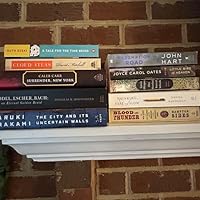
December 16, 2023
This innovative work of fiction, also a collective biography of artistic and literary women of the late 19th-early 20th century, is as challenging to describe as it was to settle into. Selby Wynn Schwartz has layered together bits of the lives of perhaps 20 women of the era as they attempted to establish an existence outside that which had been predetermined for them by their fathers, their husbands, and the men in governmental authority.
Schwartz uses the first person plural as a window on these individuals, most often as they interact with, or at least have an affect on, one another. She begins with names that were new to me - Lina Poletti and Rina Faccio, for instance - and because she moves quickly and fluidly from one to another, I started out confused. But then the names became more familiar - Natalie Barney, Radclyffe Hall, Eleanora Duse - and I felt on firmer ground, confident that the women were not fictional, though the details of their relationships might be. Eventually everyday names like Sarah Bernhardt, Collette, Gertrude Stein, Isadora Duncan, Vita Sackville-West and Virginia Woolf are folded into the flow as the new century takes hold.
Thematically, Schwartz integrates into these stories fragments of the poetry of Sappho, who represents the freedom to be themselves that these women crave. Eventually a mythical Greek woman, Cassandra, inserts herself as a cautionary voice, a signal that the freedom that seems to have been won can readily be lost. (As we know so well...)
Once I had wrapped my head around the format, I found the book to be a rare treat. It's an anything-but-conventional approach to describing women who were brave, confident and determined to be themselves, to love one another, to dress and name themselves as men in defiance of the constrictions on women. It's quiet and subtle and utterly convincing.
I gather there has been some criticism of the book on the grounds that it is concerned almost exclusively with white European women, with a sprinkling of Americans. To which I say, "It is what it is." It's a book about a specific group of people in a few specific places (mostly Paris, Italy and Greece). Two African American women who fit the profile since they were prominent on the scene in Paris in the early 20th century, Josephine Baker and Bricktop, do make appearances.
Schwartz's language has also come under the gun as being too florid. At times it is a bit lush, but for me it was another one of those instances where the style choice reflected the characters - or in this case, the women who are the subjects of the book. Writing with more straightforward language would have created a different book.
One last note - I recommend against the audio version. The narrator has no facility with Italian, or, more importantly, French, and I found myself cringing from time to time as she struggled with the names of people or places. I don't claim to be a linguist, but it doesn't seem too much to ask for fluency in pronunciation.
Schwartz uses the first person plural as a window on these individuals, most often as they interact with, or at least have an affect on, one another. She begins with names that were new to me - Lina Poletti and Rina Faccio, for instance - and because she moves quickly and fluidly from one to another, I started out confused. But then the names became more familiar - Natalie Barney, Radclyffe Hall, Eleanora Duse - and I felt on firmer ground, confident that the women were not fictional, though the details of their relationships might be. Eventually everyday names like Sarah Bernhardt, Collette, Gertrude Stein, Isadora Duncan, Vita Sackville-West and Virginia Woolf are folded into the flow as the new century takes hold.
Thematically, Schwartz integrates into these stories fragments of the poetry of Sappho, who represents the freedom to be themselves that these women crave. Eventually a mythical Greek woman, Cassandra, inserts herself as a cautionary voice, a signal that the freedom that seems to have been won can readily be lost. (As we know so well...)
Once I had wrapped my head around the format, I found the book to be a rare treat. It's an anything-but-conventional approach to describing women who were brave, confident and determined to be themselves, to love one another, to dress and name themselves as men in defiance of the constrictions on women. It's quiet and subtle and utterly convincing.
I gather there has been some criticism of the book on the grounds that it is concerned almost exclusively with white European women, with a sprinkling of Americans. To which I say, "It is what it is." It's a book about a specific group of people in a few specific places (mostly Paris, Italy and Greece). Two African American women who fit the profile since they were prominent on the scene in Paris in the early 20th century, Josephine Baker and Bricktop, do make appearances.
Schwartz's language has also come under the gun as being too florid. At times it is a bit lush, but for me it was another one of those instances where the style choice reflected the characters - or in this case, the women who are the subjects of the book. Writing with more straightforward language would have created a different book.
One last note - I recommend against the audio version. The narrator has no facility with Italian, or, more importantly, French, and I found myself cringing from time to time as she struggled with the names of people or places. I don't claim to be a linguist, but it doesn't seem too much to ask for fluency in pronunciation.

January 27, 2023
16th book of 2023. Artist for this review is Catalan painter Miguel Carbonell Selva (1854-1896).
2.5. I didn't quite manage the whole of the Booker and International Booker longlists last year because I can't afford to buy books new and the reservation queues on books, when they are first announced on the list, are far too long for my impatient self. The other day though, after a job interview in a nearby city, I wandered opposite to their circular 1967 build library and found some of those longlist books that I couldn't get a hold of last year. This being one of them, of course.
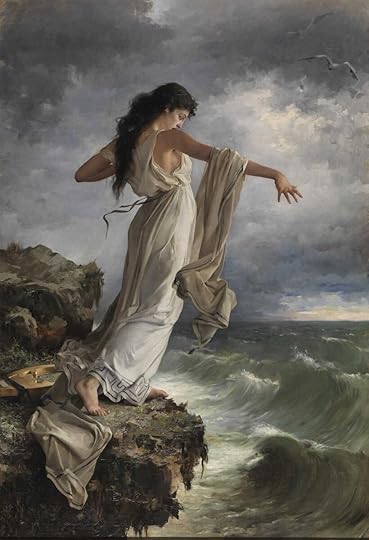
Death of Sappho, 1881
I think it's great that this made the longlist. It's original, it's different. Sometimes it barely feels like a novel and I'm fine with that. The novel, to me, is uncategorisable. I can also see why other reviewers on this website say it reads like Wikipedia entries. It's a smorgasbord of stuff: women, feminism, gender, names, identity. I preferred the latter half of the book which began to focus on Virginia Woolf and her novels. That felt focussed to me. In the beginning there was too much going on and too many characters. Interestingly it's a blend of fact and fiction, which is usually my favourite sort of thing to read. It is funny in parts, well-written, too. Some of the historical women who are explored are Sarah Bernhardt, Colette, Eleanora Duse, Josephine Baker, Djuna Barnes, Isadora Duncan... The latter of whom I end up reading about all the time, completely by accident. So I like it for its boldness and its experimentation, even if I don't think it landed it.
And also credited to Woolf:
And marital advice for later: 'The best sorts of marriage were companionable and involved a shared taste in novels and furniture.'
2.5. I didn't quite manage the whole of the Booker and International Booker longlists last year because I can't afford to buy books new and the reservation queues on books, when they are first announced on the list, are far too long for my impatient self. The other day though, after a job interview in a nearby city, I wandered opposite to their circular 1967 build library and found some of those longlist books that I couldn't get a hold of last year. This being one of them, of course.
'Readers according to Colette were like lovers. The best were attentive, intelligent, exigent, and promiscuous. She urged us to read widely and well, to seek out precisely the novels prohibited to us and lie down for hours in bed with them.'
Death of Sappho, 1881
I think it's great that this made the longlist. It's original, it's different. Sometimes it barely feels like a novel and I'm fine with that. The novel, to me, is uncategorisable. I can also see why other reviewers on this website say it reads like Wikipedia entries. It's a smorgasbord of stuff: women, feminism, gender, names, identity. I preferred the latter half of the book which began to focus on Virginia Woolf and her novels. That felt focussed to me. In the beginning there was too much going on and too many characters. Interestingly it's a blend of fact and fiction, which is usually my favourite sort of thing to read. It is funny in parts, well-written, too. Some of the historical women who are explored are Sarah Bernhardt, Colette, Eleanora Duse, Josephine Baker, Djuna Barnes, Isadora Duncan... The latter of whom I end up reading about all the time, completely by accident. So I like it for its boldness and its experimentation, even if I don't think it landed it.
'But life itself was in constant variance, Virginia Woolf protested, a novel ought to run alongside it the way the shadow of a railway carriage travels over the landscape. Now rising fleetingly along a low wall, now falling away into a riverbed, passing its silhouette unevenly over grass and gravel: that was a novel, that was the spirit of a life moving on a page. Is it not the task of the novelist, Virginia Woolf demanded, to convey this varying, this unknown and uncircumscribed spirit, whatever aberration or complexity it may display?'
And also credited to Woolf:
'Half of writing a novel is looking out of the window in gentle despair and idleness.'
And marital advice for later: 'The best sorts of marriage were companionable and involved a shared taste in novels and furniture.'

October 2, 2022
This book makes evident the fact that it takes more than great writing to make a great novel (or whatever other genre of literature this is). Among the 13 Booker longlist contenders this year, this one contains the most gorgeous, elegant language. From that perspective it was a delight to read.
And points, too, for the homage to great lesbian artists and political activists of days gone by. It's like Alison Bechdel's Dykes to Watch Out For as applied to historical Sapphists and given a more elevated, classical treatment.
But did I love it? No. And was it better than melatonin at inducing delta waves? Yes.
And points, too, for the homage to great lesbian artists and political activists of days gone by. It's like Alison Bechdel's Dykes to Watch Out For as applied to historical Sapphists and given a more elevated, classical treatment.
But did I love it? No. And was it better than melatonin at inducing delta waves? Yes.

August 5, 2023
5 stars
“A poet is always living in kletic time, whatever her century. She is calling out, she is waiting. She lies down in the shade of the future and drowses among its roots. Her case is the genitive of remembering.”
After Sappho collects the lives of many writers and artistic creators to explore their relationship to Sappho, whether directly or indirectly. It examines the function of art, how women liberate themselves through the process of creation, and to what extent writing can be a form of union between women.
I love texts that investigate the power of writing and language, especially in connection to women. This book asks how women can engage with literature to resist the confines of patriarchy- should they infiltrate masculine forms of writing or should they break away completely and create a separate sphere?
The narrator speaks with the plural pronoun ‘we’, identifying themselves with Sappho’s chorus. The novel itself embodies the presence of a cacophony of voices, collecting together fragments and snapshots of different women’s realities to portray the force of such a union.
A memorable, poetic, witty and challenging read- I’m obsessed.
“A poet is always living in kletic time, whatever her century. She is calling out, she is waiting. She lies down in the shade of the future and drowses among its roots. Her case is the genitive of remembering.”
After Sappho collects the lives of many writers and artistic creators to explore their relationship to Sappho, whether directly or indirectly. It examines the function of art, how women liberate themselves through the process of creation, and to what extent writing can be a form of union between women.
I love texts that investigate the power of writing and language, especially in connection to women. This book asks how women can engage with literature to resist the confines of patriarchy- should they infiltrate masculine forms of writing or should they break away completely and create a separate sphere?
The narrator speaks with the plural pronoun ‘we’, identifying themselves with Sappho’s chorus. The novel itself embodies the presence of a cacophony of voices, collecting together fragments and snapshots of different women’s realities to portray the force of such a union.
A memorable, poetic, witty and challenging read- I’m obsessed.
October 15, 2022
"In these new lives, Virginia Woolf wrote, there would be that queer amalgamation of dream and reality we knew so intimately: it was the alchemy of our own existence."
I LOVE THIS BOOK SO MUCH WHO ALLOWED THIS TO EXIST I JUST WANT TO THANK YOU OH MY GOD. thank you netgalley for the arc this was amazing, truly felt like it was speaking to me? I love women, so much. Also? Changed my entire outlook on ibsen's a doll's house? i feel like I'm obliged to tell people to actually read this because it deserves so much.
I LOVE THIS BOOK SO MUCH WHO ALLOWED THIS TO EXIST I JUST WANT TO THANK YOU OH MY GOD. thank you netgalley for the arc this was amazing, truly felt like it was speaking to me? I love women, so much. Also? Changed my entire outlook on ibsen's a doll's house? i feel like I'm obliged to tell people to actually read this because it deserves so much.
Displaying 1 - 30 of 1,422 reviews