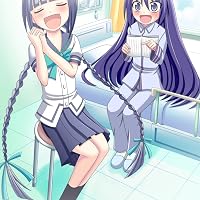
Life in the literary club has settled into a predictable - if unusual - routine. Junior member Konoha Inoue dutifully writes short stories for his club president, Tohko Amano, who subsequently shreds them and devours each morsel like the book-eating goblin she is. When the club begins receiving cryptic messages, though, routine goes out the window as Tohko sets out to find the culprit with Konoha in tow! When their investigation suggests that a tormented spirit might be stalking the school halls, matters quickly take an ominous turn. Is it possible that ghosts really exist, or is there something even more disturbing at play? But if there is room in the world for a literature-consuming goblin, then, really, how unlikely is a famished spirit?
Unlike several other people who reviewed this book, I won't spoil which novel this volume of Book Girl was loosely based on. I spoiled myself about it several years ago, decided I ought to read the inspiration, then never got around to it, and finally decided I'd never make progress on this series if I had that as a requirement. And so, dear reader, I read Book Girl and the Famished Spirit anyhow. ;)
On the whole, girls are objects rather than subjects, here: sexual objects, objects of pity, objects of manipulation. The story starts off with a fair amount of objectification of the girls in the main cast. Tohko is disparaged for being flat-chested, and Nanase, Inoue's tsundere classmate, is described boobs-first. Maki's a creepy weirdo, or at least pretends she's one, but there's no reason to make that distinction when she's asking underclassmen to pose nude for a painting. None of this objectification is called into question, or revolted against (whether subtly or overtly), at any point along the way.
The major plot arc of this story didn't make sense to me. I'm not sure if that's because I didn't have a good idea of the ethos or outlook of [redacted] through having read it, or whether the conclusions the book came to didn't build enough of a foundation on their own without that context--or both. Who was manipulating whom? Or were these characters pure creatures of pure emotion? To me, Hotaru's either a broken, unsuccessful project of a Pygmalion, or , or both, and neither of those point to her as someone who has control of her own destiny. It's interesting that she and her, um, male counterpart, have the same physiological malady that ties into this volume's title.
Saying that someone is "strong," as Hotaru is described in the endgame, doesn't magically make them so, or reverse the all-too-common sexism that pervades light novels for boys. We can question why "strength" is an important character trait, or why primary characters aren't allowed to be weak, or why they're considered unworthy of a reader's sympathy. (The book doesn't go into that at all; it's just where my mind wandered as I was typing this out.)
There are quieter moments between the characters that encourage me to read more of this series, despite my irritable, tepid and/or baffled response to how the plot played out in this one. Inoue isn't a terrifically endearing narrator much of the time (see above re: objectification), but his vulnerabilities and breakdowns give him a bit more interest than being a simple observer of the story's events or a lurid "camera." The mystery of Miu didn't really progress this time, but there's a few more volumes where more details can come to light. The frequent bibliophilia is appealing as well, though there's always an undercurrent of mistrust that I'm basking in flattery when that shows up in books.
The stories in each volume of Book Girl are self-contained, fill the reader in on important character traits and could stand alone fairly well, but even in this second book there's a lot of development hinging on hints and background from book 1. I'd recommend starting there.
As with the first book, Book Girl and the Famished Spirit features self-styled "book girl" Tohko (a literature loving and eating goblin in schoolgirl form) and her force recruited book club junior Konoha. His job is to write Tohko snacks, and occasionally unravel strange events stemming from requests left in the club's personal mailbox.
Describing the series' concept and main characters is a bit of a problem because it makes the books sound different in tone and approach than what they are. Tohko's "unusual" appetite is largely just a character trait in a sense - the stories at this point do not center around it nor explain what she is. Her love of literature is much more relevant. Also the absurdity and strangeness of the premise might seem to indicate light, whimsical tales. Not so.
FAIR WARNING - while extremely well written, compelling, and laced with subtle touches of humor, the Book Girl series is incredibly dark and deals with very heavy themes.
Creepy doesn't even begin to describe the events Tohko and Konoha get caught up in this time, and it starts with a disturbing opening page description of an unknown character deciding to kill someone. A few pages of prologue follow recounting Konoha's disastrous brush with fame in the past and the specters that still haunt him. It's done in wonderfully direct fashion and before the fist chapter has even begun Nomura reintroduced the main character, discussed his personal demons in a way that ties to the themes of this particular story, and established a gripping, chilling atmosphere that will continue throughout the book.
Strange notes in the club mailbox and the possibility of a ghostly presence are only the beginning. As Tohko and Konoha approach an answer from different angles they'll each run afoul of distinct, unusual personalities and mysterious happenings. The supporting cast contains a good mix of familiar faces from the first book and newcomers, and is used remarkably well to build a multilayered mystery that gets scarier and more dangerous the more it unravels. The suspense elements are nicely done, with some pieces falling into place as the reader goes and some vital connections remaining elusive until they are explained. The clues are in place though, and the author "plays fair" with the storyline and the readers.
There is again a nice literary tie in to the themes and progression of the plot which is fully understandable even if you haven't read the associated works.
The writing flows well, is dripping with emotion and really establishes the proper feeling and atmosphere for the story. This is a great accomplishment both on the part of the author and the translator. The descriptions are quite detailed in parts but I never felt like the pace suffered. If fact I found the story moved along at quite a good clip while still fully conveying what was happening at any given time.
Despite being quite unsettled at times, I was very impressed with Book Girl and the Famished Spirit . But know what you're getting into before reading. This is a very odd series that meanders a little sometimes, hits hard and isn't afraid to deal with dark, depressing topics. What's done with it all is top notch so if you can handle the con-caveats I mentioned I highly recommend checking out this strange duo's adventures.
For future reference to myself, I must remember to do more research into books before I read them. This is an especially good idea if the book is one that references, and is partly based on, other famous books. Since Book Girl tends to be a series of mysteries wherein the protagonists use their knowledge of other books to solve said mysteries that eerily resemble other famous tales, this is especially a good idea.
In Book Girl and the Famished Spirit, the plot reference of the novel is, which I would have known had a read the afterword first, Wuthering Heights. I hated that novel, and couldn't get more than a quarter of the way through it, so obviously I wouldn't like this one either. Yep, definitely should have looked ahead.
The story is one where this mysterious girl dresses up in an older school uniform and leaves random bits of paper in the book club's advice box. The book club, composed of our protagonists Konoha and Tohko, the titular “Book Girl” (a goblin who eats stories), decide to investigate. Of course, in the course of this, they have some discord and everything is a mess. I won't spoil who the Heathcliff and Catherine analogues are.
The thing is that this was easy not to see at first how this volume of Book Girl, unlike the first one, would be dark with no light at the end of the tunnel. It had no “victory” if you will, like in the first book. Indeed, the story started out with the weird bit of magical realism that the first book contained, and thus it didn't occur to me just how this was going to turn out until, about halfway through, I started to suspect. I confirmed it and wow! I hate this book. It is, if possible, even darker and more disturbing than Heights was, with possibly more messed-up secondary characters analogous to the Heights ones.
I can't say that the story wasn't enjoyable (as far as I got through it, at least...), but it was just too dark. Really, really dark. I can't recommend it, despite the good writing, as it was entirely too depressing.
Không thích bằng tập "Tên hề thích chết". Có thể một phần do mình không thích "Đồi gió hú" lắm, nhưng cũng nhờ đến tập này mà mình đã hiểu hơn về nó. Có thể một lúc nào đó mình sẽ thử đọc lại để cảm nhận lại nó. Mà trong tập này nhân vật "chị Tooko" xuất hiện ít quá.
The story ends with a satisfied but a tragic ending which makes me really wanted to cry because of the hidden truth which maybe considered as it is a selfish decision like Catherine Earnshaw made resulted in a storyline filled with sorrow and darkness. Sometimes, a storyline with a selfish decision still can be a good story. Human who led by greed and vengeance can lead to a devastating ending.
Ryuto's role in the story is big and well played, from the introduction until the ending of the story. However, Nanase's role still was the same as before, just staring at Konoha and makes bad impression in front of everybody just because she loves him secretly. And Tohko's role was shortened in this light novel.
In addition, readers will have to be cautious on the translation of this light novel. As in original and the manga, the numbers are based on the hiragana while westerns are based on alphabets. Multi language readers can read other language of this light novel or manga to see the difference.
Plus, I also stand at Maki's side. Those who still object Wuthering Heights, please at least read until the end with your hatred within you against this book. You will find that Emily Brontë has written this book with not just her imagination and creativity, but her soul as well. That's what she said.
Overall, this is a good book and I recommend to those who loves dark stories and those who finished Book Girl and the Suicidal Mime should pick up this story. Before you read, try to read Wuthering Heights before picking up this book and read the manga after you finish to get a clearer picture.
Once again, we have to deal with Konoha’s teeth-grating submissive attitude towards the page-devouring Tohko Amano. But matters develop somewhat differently in this story. Konoha is showing welcome signs of rebellion, ignoring Tohko’s demands and taking off on his own. But he’s still subject to weird fits of depression, inner torrents of guilt involving the suicide of Miu (and I’m still not sure if she was ever real or not!).
Also, it appears that Tohko isn’t a demon, after all. She’s just a girl with bibliophagy. She’s suffering from an eating disaster…although it might be a mistake to say that she’s suffering. She doesn’t appear to be in ill health and has tons of energy. However, the subject of eating and consumption are of primary importance in this novel and others do undergo tremendous pain from hunger, hence the title.
This installment involves a possible ghost, abuse, anorexia and revenge from beyond the grave. It’s convoluted, bizarre and has so many different characters tossing their hats into the ring, the reader struggles to remember who’s who and what part they’re playing. There’s Ryuto, a player who thrills in having his various girlfriends hate him (he just loves the drama). Maki is a powerful rich girl with lots of influence and is obsessed with getting Tohko naked so she can paint her. The nasty Nanase Kotobuki also reappears and it seems her baffling catty behavior towards Konoha may be hiding completely opposite feelings. There’s a girl named Kayano Kujo who is also Hotaru Amemiya…or vice versa.
Just as in the previous novel, this book revolves around the plotline of another famous novel: Wuthering Heights. Emily Brontë’s story looms large over this one, further complicating the already Byzantine plot and intertwined relationships among the various characters. The story straightens itself out by the end but by then I was too mentally exhausted by the effort of sorting out the story to care much.
While I can’t claim to like this novel overly much, it did prove compelling, enough for me to follow it to its bitter conclusion.
And yet, despite my strong dislike for Wuthering Heights, I loved this book. I think it's because I love Tohko, Konoha, and crew, whereas I couldn't stand anyone in Wuthering Heights.
Essentially, this story borrows heavily from the main plot points, but gives it that wonderful mystery Book Girl twist. Reading Wuthering Heights is not required to love this book. In fact, they give you a two page summary of the book at one point in the story (not really necessary, I think, and that's my only complaint with this volume).
If you liked Book Girl and the Suicidal Mime, you'll love this book. If you haven't read Book Girl and the Suicidal Mime yet, it's not required to understand what's going on in this volume, but I'd recommend reading that one first if only because I'm a fan of reading things in order and think you should, too (so, no, you don't have to and other than a brief, non-spoiler mention early on, there's not much relating to the first book in the second).
Câu chuyện lần này u ám hơn hẳn. Những tâm hồn không có lối thoát. Tuy vậy do dựa trên tác phẩm văn học kinh điển nên không thoát được cái bóng của nó và diễn biến vì thế cũng trở nên cứng nhắc. Vẫn đủ để tôi tiếp tục đọc.
أردت أن أقرأ رواية خفيفة, فصدمت عندما وجدت بأنها تبدأ بهذه الكلمات: He would kill her. His body trembled with a tempest of madness as he made the decision. Yes. Kill her. Do it. So that time would never flow back on its original path. So that she would be forever bound in his world. Embrace her corpse, drink her blood, devour her flesh, lay your head on her bones, and rest in the same casket. Her eyes, her nose, her lips, her skin, her flesh, her blood, her bones—all of it belonged to him. As each of his fingers bit into her throat—white as snow and cold as an icicle—he whispered hoarsely. “Good-bye, Kayano, my betrayer.” لكني تجاهلت التحذير و قلت بأنه لا يمكن أن تكون أكثر سوداوية من الجزء الأول, كيف لا وقد تحدث عن رائعة أوسامو دازاي "نينغن شيكاكو" أو "مقصي كإنسان" الذي انتحر بعد 3 أشهر من كتابتها لكني كنت مخطأ و لا أجد الكلمات المناسبة للتعبير عن شعوري غير اقتباس قول توهكو فتاة الكتب: “But still, at some point that tumultuous story and the deeply flawed people living in its shut-off world—the forthright souls free of deception—become so dear that they tear at your heart. “It makes you think that it would be great if you could rip open your heart like that and have a love that would go to the farthest extremes to pursue and lay claim to one another, and it makes you believe that if you had someone who loved you that much, you wouldn’t need anyone else, or that if you could meet someone like that, there could be no greater happiness. “That’s the kind of story this is. “Even as you feel terror and anxiety crushing your chest, wrapped up in a world of bellowing storms, you can’t stop reading. You may be afraid, you may despise it, you may refuse to accept it, but you can’t help but be intrigued. Even the flaws become charming. That’s the kind of power this story has. “Technique alone could never produce something like that. It had to be written with Emily’s soul. That’s the reason it’s still being read more than a hundred years later.”
If you read the other reviews you'll know this one uses the story of Wuthering Heights as it's back drop. And does it go off the rails. This is a misogyny filled mess of everything. First Touko is constantly called flatchested and compared to other girls. Basically both sexualized and objectified. He also constantly calls her a 'youkai' even after she tell him to stop. (This is verbal abuse) This comes into play when you find out that Hotaru Amemiya is being abused and starved. All because a man thought he was entitled to a woman. (It should be noted that 'Hotaru' means firefly and is used as a death symbolism. The fleeting nature of the fireflies, etc.) We have the predatory lesbian in Maki, who wants to see Touko naked. We also have a woman being punished for daring to hate a man. Plus said man is played as a sad pitiful soul who should be pitied instead of shot for his abuse of a child. But it gets WORSE. Kurosaki takes ownership of Amemiya and brainwashes her to be her mom. Kurosaki is old enough to be her father. Amamiya is 16 which is the age girls can legally get married. (Boys is 18. Yeah it's fucked up. But that's men for ya) Now at the end of it all we have Amemiya loving her abuser, as a lover. (She's 16) and the author plays this as some kind of sweet love story and not the fucked up mess it is. Let's add a dash of HE'S OLD ENOUGH TO BE HER FATHER into this for pedophilia and he IS her father so there fucking incest. Remember this is being played up to be a tragic, but sweet love story. Then she dies. Because a woman can't live who has hatred in her heart for a man, even when he fucking abused the shit out of her.
Oof, I set this down with an audible, "What did I just read?" The beginning was strong. It had the feel of a typical manga/anime, with situational comedy, over-the-top quirkiness, with a spirited (no pun intended) lead and her suffering, brooding author friend. There was enough mystery to keep me going, until the big reveals started hitting towards the last third of the book.
I think, too, that the themes of anorexia, abuse, and severe mental health became taxing, and I strongly warn the reader against it if you're sensitive to that content.
Having never been a fan of Wuthering Heights, much of this story went right over my head (I had no patience for Catherine and Heathcliff, so I have no patience for this) and it became mentally stressful by the end. You know how a book leaves you in a kind of haze afterwards? This one left me feeling just so strange that I have no plans on keeping it. The interpretation of characters, their complicated relationships, it all became too much.
I do like Tohko's book recommendations and tend to jot down what she mentions, but, I'd rather have more of that and less of... what just happened. I don't think I'll continue on with the series.
I read Book Girl and the Suicidal Mime several years ago and enjoyed it enough that I bought four more entries in the series. Book Girl and the Famished Spirit is the next in the series and the first I have read since.
What I did not appreciate at the time of that first reading is that these books mirror more serious literary works. Suicidal Mime mirrored "No Longer Human", a Japanese classic by Osamu Dazai. I am not familiar with that work so did not pick up on the connection.
Famished Spirit mirrors a classic English novel; I won't spoil the reader's discovery of which novel by this review. It is a novel I am aware of, but had not read. I think this to be a valuable way to introduce readers to classic works.
I enjoy the main characters Tohko Amano and Konoha Inoue and the mix of comedy and drama provided by these stories.
Couldn't put it down, riveting storyline, wonderful characters, charmingly written!
This might be the first light novel I've ever read, seriously regretting that now. This series is so entertaining and addictive, definitely going to read the other novels immediately, wish the graphic novels were available in English too. If you enjoy mystery, drama, romance, intertextuality, a bit of a gothic literary flair, this is a franchise for you. Can't wait to see what future installments have in store, and also seek out other promising light novels by publisher. If you like Poe, Arthur Conan Doyle, Agatha Christie, Shakespeare, you won't be disappointed!
Có lẽ do vừa đọc xong hai tác phẩm khá hiện thực là "Hãy chăm sóc mẹ" và "Socrates in Love" nên khi chuyển sang quyển này mình có phần hơi khó chịu. Mystery thì vẫn hấp dẫn, vẫn khiến mình muốn đọc một mạch đến cuối để biết rõ toàn bộ câu chuyện, nhưng vấn đề tâm lý mà mấy nhân vật trong này mắc phải thực sự quá melodramatic, quá điên khùng rồi.
Mấy nhân vật phụ thì không nói làm gì, đến cả nam chính Inoue Konoha cứ mỗi khi nghĩ đến Miu là lại lên cơn làm mình khó chịu cực kỳ. Khó chịu một phần là do phản ứng thái quá, một phần là do cứ kể đi kể lại chuyện của Miu & Konoha trước đây mà không biết rõ rốt cuộc chuyện gì đã xảy ra. Những đoạn bình thường thì không sao nhưng mình bắt đầu thấy ghét Konoha mỗi khi nghĩ đến Miu, mỗi khi nói chuyện với 1 nhân vật nữ nào đó trừ Tooko và mỗi khi trưng cái nụ cười giả dối lên mặt. Mình vẫn ghét cay đắng cái con bé tsun nhưng chưa dere Kotobuki Nanase, nhưng ít nhiều cũng đã hiểu tại sao nó ghét kiểu cười của Konoha rồi. Có điều phải mình thì mình chẳng thèm để mắt đến chứ không phải cứ như Kotobuki lườm chằm chằm đâu, con bé thích Konoha quá rõ ràng luôn.
Bực nữa là Tooko xuất hiện ít quá. Không hiểu sao những đoạn Tooko được miêu tả đang đọc sách hoặc ăn sách đều khiến mình cảm thấy dễ chịu, dù khá là đói do Tooko mô tả mấy món sách thơm ngon quá. Nhiều lúc mình hi vọng chuyện điều tra được viết dưới góc nhìn của Tooko hơn. Vì một cơ số sự khó chịu mà mình phải dừng lại khi đọc được nửa quyển để viết ngay mấy dòng cảm xúc này không tí nữa quên mất.
Dù sao thì sau tất cả những bí ẩn thương tâm thì cái kết này cũng được xem là trọn vẹn. Konoha cũng nghĩ được quay ngược thời gian là không thể rồi nên từ tập sau hi vọng là bớt phát bệnh Miu đi giùm cái. Sau tất cả thì mình nghĩ một ngày nào đó mình cũng sẽ cầm được quyển "Đồi gió hú" lên mà thưởng thức thôi, có bi kịch mấy thì cũng không thảm bằng cái câu chuyện này đâu.
This story is extremely dark, depressing and not for everyone! I may complain a lot but I still can't stop reading. So contradicted!
Cuốn này còn hay hơn cuốn trước nhiều lần, từ sự trau truốt trong ngôn ngữ, câu chuyện dù có là dựa trên một cuốn sách mà tác giả yêu thích, Nomura đã tạo nên một câu chuyện rất của riêng cô, với một cái plot-twist tương tự như cuốn đầu tiên. Với lối hành văn xen kẽ giữa hai người kể chuyện, giống như cuốn đầu, càng đọc càng lôi cuốn, càng muốn lí giải những bí mật. Tuy thế có điểm trừ là lời dịch chưa được hay, in ấn có nhiều chỗ sai. Ngoài ra cũng khá khó hiểu nếu bạn chưa đọc cuốn sách tác giả dựa vào để viết lên câu chuyện này:
Lúc mới nhìn cái bìa, thật sự chả muốn đọc gì. Cơ mà bạn khốn cứ lăng xê dữ quá nên thôi thì đọc thử. Chao ôi, câu chuyện lấy cảm hứng từ Đồi gió hú, ly kì và teen teen giống 1 bộ manga. Tập này là 1 tập trong seri light novel Cô gái văn chương với nhân vật chính là 1 nàng học lớp 12 có sở thích kỳ dị là ăn sách theo đúng nghĩa đen :3 nàng ta bị cuốn vào những sự kiện bí ẩn ở trường học và khám phá bóc tách dần từng lớp một sự thật về cô bạn lạ lùng cùng lớp và những lá thư có ghi những dãy số kỳ quặc được nhét vào câu lạc bộ văn học. Đọc xong cuốn này, tự dưng muốn đọc lại Đồi gió hú một lần quá :v
Please forgive that I've forgot most characters name due to how long it was.
It should be 4 stars, but I deducted 1 star for disgusted I felt with certain characters. While I do understand why Hotaru would feel a certain way toward her father that she never knew. The way he treated a child is unacceptable. Hotaru's family didn't even wrong him in anyway. And yet he acted like an asshole.
This entire review has been hidden because of spoilers.
So với tập 1 thì mình lại thích tập này hơn. Có vẻ nỗi đau do tình yêu mang đến vẫn có sức hút hơn đối với mình, mặc dù mình không hoàn toàn muốn như vậy.
cho 4/5 vì đây là một câu chuyện tình đầy đau thương 🥲 cuồng nộ như một cơn bão đến không đúng thời điểm, thiệt hại cho cả bên hứng chịu lẫn bên gây ra TTT
I have to say, these novels keep surprising me quite a lot. Another great story, a bit heavier and darker than the first book. I'm really liking the fact that there is an overall story that is happening in the background while the main characters go through the main problems in each book.
This book deals with social status and how it impacts relationships, and goes to some pretty dark places (some characters are mentally tortured until the get anorexia).
It's been a while since I picked up the previous book in the series, so forgive me if I forget a little something here or there from the previous work. I have to say though, that reading the second book makes me wonder why I waited so long to get back into this.
There's a lot about this light novel that I liked. I think what stood out to me first and foremost about this light novel was that it was such a dark and somber book at times. It's very adult in tone when you get down to it, which makes it a stark contrast to books such as the Haruhi Suzumiya, which tend to focus more on crazy antics. Those series do have some serious subject matters, but ultimately tend to look at the lighter side of teenage life in surreal surroundings.
Not so with the Book Girl series. It's a light novel, which means that none of the subject matter will delve too deeply into the tougher stuff. However at the same time, the series doesn't exactly shy away from it either. Let's just say that death does occur as far as this particular book is concerned and some of the events here are bloody and depressing. This isn't exactly something you'd hand a very young reader.
I have to use this point to sort of elaborate on what made this a four star read rather than a five star. It's the very nature of this series that sort of works against it at times. We're given enough to where the characters are fleshed out enough to make the story work and for us to mostly care for everyone, but the subject matter here (eating disorders, obsession, death of Wuthering Heights proportions) really sort of longed to be more fully developed. It's more of a tease when you get down to it and I can't help but feel that some readers will get frustrated when they finally turn the last page. It's the type of story that will undoubtedly do well when the animated adaptation hits, as they'll be able to do far more than the original story contained.
Overall, I highly recommend this to anyone looking to get into light novels but wants to avoid the stuff that's more along the lines of Haruhi Suzumiya (a great series, but not for everyone). It's a surprisingly adult book and one that I hope Yen Press releases the entirety of.
The Seijoh Academy Literary Club (which consists entirely of book-munching goblin Tohko Amano and the burned-out prodigy Inoue Kanoha) is back, and this time they're trying to catch a ghost that's been leaving creepy letters in their mailbox. Their investigation leads them to Hotaru Amemiya, a girl who seems to be possessed by the ghost of her dead mother and is apparently being abused by the uncle who's raising her. But the more Our Heroes investigate, the more complex the situation becomes.
Plot-wise this is a vast improvement upon the first volume, which had some serious pacing issues. And while the supernatural elements this time too turn out to be explicable through ordinary means, there aren't any of the abrupt tonal shifts that plagued the previous book -- once we find out the truth of what's going on, it doesn't get any less creepy.
Where this book lags behind The Suicidal Mime is the characters. Inoue and Tohko are still well drawn, but the guest stars aren't as interesting as Takeda and Kataoka, and the sections told from their point of view lack the power of the Dazai-inspired diary entries. I'm also disappointed in the handling of the secondary characters. Akutagawa is relegated to a walk-on role -- if this were a TV show, I'd think the studio had some contractual obligation to write him in -- and while Kotobuki gets some good moments early on (which confirm that even though her lips say, "tsun tsun," her heart says "dere dere") she's sidelined halfway through. OTOH, Maki, who was little more than a plot device in the first book, does get more screen time here, and the les-yay of the first book is cranked way up.
Taken as a whole, I'd place this book on a par with the first -- the improvements in one area match the problems in the others, so all told it's a wash. If you liked The Suicidal Mime you'll probably like this as well; if you didn't, you won't.
I'm rather critical of this series so please read this and future reviews with a handful of salt.
A big driver of the Book Girl series is the mystery setting but I felt the 'mystery' was very predictable in this one; there was not a single plot twist that floored me. However, I gave this particular book 4 stars because the emotions in this one was extremely intense and well written. I couldn't fly through the pages as I did in the other books; the content was so heavy I needed to slow down and savor each word.
I usually frown on incest relationships, given the reputation Japan has with them, but I thought this particular book handled it well. There was no 'happy and perfect life without any struggles' ending that seem to be the popular conclusion for these kind of stories. Instead, there were lots of conflicts that had to be resolved by Hotaru and Kurosaki. I liked how in this book the main characters took a few steps back and acted as the supporting cast for the two, more so than the other books.
One of the scenes that really struck me was when Maki was narrating Hotaru's story in the epilogue. The reader gets to see Hotaru's story in another perspective and in Maki's eyes, Hotaru's love meant so much more than through Konoha's eyes. I really liked how one story was told in two perspectives so it almost felt as if they were unrelated. However, in my opinion, this would not have hit home as hard unless the reader had read "Book Girl and the Undine Who Bore a Moonflower" beforehand like I did.
Overall, this book was exceptional less in the mystery aspect and more emotionally.
This entire review has been hidden because of spoilers.