A unique history of the ancient Near East that compellingly presents the life stories of kings, priestesses, merchants, bricklayers, and others
In this sweeping history of the ancient Near East, Amanda Podany takes readers on a gripping journey from the creation of the world's first cities to the conquest of Alexander the Great. The book is built around the life stories of many ancient men and women, from kings, priestesses, and merchants to bricklayers, musicians, and weavers. Their habits of daily life, beliefs, triumphs, and crises, and the changes that they faced over time are explored through their own written words and the buildings, cities, and empires in which they lived.
Rather than chronicling three thousand years of kings and kingdoms, The Fertile Crescent instead creates a tapestry of life stories through which readers will come to know specific individuals from many walks of life, and to understand their places within the broad history of events and institutions in the ancient Near East. These life stories are preserved on ancient tablets, which allow us to trace, for example, the career of a weaver as she advanced to became a supervisor of a workshop, listen to a king trying to persuade his generals to prepare for a siege, and feel the pain of a starving young couple who were driven to sell all four of their young children into slavery during a famine. What might seem at first glance to be a remote and inaccessible ancient culture proves to be a comprehensible world, one that bequeathed to us many of our institutions and beliefs, a truly fascinating place to visit.
“Six or eight thousand years ago They laid down the law. In Mesopotamia. They laid down the law!”
Sorry everyone! I just couldn’t resist starting this review with some lyrics from one of my favourite numbers by the B-52s. (For my younger GR Friends, the B-52s were an 80s pop group).
It is of course true that in Mesopotamia, “they laid down the law”, and I found the chapter on Hammurabi the Lawgiver, and the society of his time, one of the best in the book, although interestingly the author says that judges of the period were not inclined to worry too much about the law as written down, and simply applied their own judgements/sanctions as they saw fit.
I listened to the audio version of this book. The author narrates it herself. Often I feel that’s a mistake, but this author does a pretty good job.
In summary, she tells the story of ancient Mesopotamia through translation of some of the tens of thousands of cuneiform tablets that have been found by archaeologists. Because the book concentrates on cuneiform, it is very much focused on the areas that used that script, primarily Mesopotamia and present day Syria and the Levant. Other societies such as Egypt, ancient Israel/Judah, Elam etc, only feature insofar as they impact on the central cuneiform-using region. On the whole the author likes to present a picture of peaceful and orderly societies, though this being the ancient world, warfare cannot be ignored entirely. The story is a very long one, opening with the development of Uruk as a city from about 3500BCE, and ending with the conquest of Mesopotamia by the Persians in the 6th century BCE. Continuity of some of the locations is a theme. Uruk was still occupied at the at the time the book ends, in exactly where it had been for 3,000 years.
There are plenty of kings, princes and princesses in here, but the author likes wherever possible to “knock on the doors and eavesdrop” on the lives of ordinary people. There are far too many of such lives to be summarised in here, other than to mention a few of my favourite chapters. One featured a father and son operating an import-export business, the father based in the city of Aŝŝur in Assyria, the son in an Assyrian trading colony in a city called Kaneŝ, in central Anatolia, hundreds of miles away. Despite the distance the patriarch tries to micro-manage his son’s end of the business, and we can all recognise the family tensions at play. Another chapter featured a Naditum in ancient Babylonia, one of a group of women who performed a societal role similar to that of nuns. Centuries later, during the period of chaos known to historians as the Bronze Age Collapse, the book describes a legal document in which a couple, facing starvation, sell their four children into slavery in order to survive. Behind the dry legalese of that particular clay tablet, one can imagine a family experiencing indescribable pain.
The author manages to place the above stories within the wider context of the region’s history, mixing the two styles of narrative. Overall, a really good read for those with an interest in ancient history and society.
In many ways this certainly is a general history of Mesopotamia, one of the earliest human civilizations. Podany follows the developments from about 4000 BCE (the Uruk period) to the Persian Empire (about 500 BCE), although the emphasis is on the period 2500-600 BCE. She summarizes the latest scientific insights well and also warns in time about gaps and speculative views. But the greatest strength of this book is that it tries to focus on people that have really existed. As Podany herself puts it: “In this book I will take you behind many of those doors to listen in on men and women from the very ancient past. Some of them were famous in their time and wanted to be remembered; they would no doubt be delighted to know that their names have lived on so long after their deaths. Others had no way to make a mark on history; they were illiterate and powerless, subject to the whims of their employers and leaders or the vagaries of the climate and agricultural pests. But we know about them anyway.” It was not always possible to portray ordinary people, but it is still a nice attempt. Absolutely worth it! More in my History account on Goodreads: https://www.goodreads.com/review/show...
I love the idea of this book: telling the history of the Ancient Near East through the lives of its specific inhabitants, as much as we can reconstruct their life-stories from archaeological findings and especially from cuneiform texts. For some of these people not much more is known than their name and occupation, but sometimes surviving cuneiform documents allow surprisingly detailed insight into their lives and fates. From Sumer, Assyria and Babylon to Hittites, Mitanni, Persia and many more, it's a fascinating time travel through millennia, proceeding along the cunei-crumb trail left by clay tablets, stone slabs, cylinder seals and other inscribed objects, from one contract, letter, dedication, literary text or school exercise to the next.
Foundation stone tablet of Ur-Nammu, king of Ur. The inscribed cuneiform text states that the building is the Temple of Inanna at Uruk. Ur III period, 2112-2095 BCE. Vorderasiatisches Museum, Berlin. (Image credit:Osama Shukir Muhammed Amin FRCP(Glasg), CC BY-SA 4.0 , via Wikimedia Commons)
The audiobook is narrated by the author herself, and quite well too (unlike in many other cases of self-narration). In the epilogue she mentions working on this book during her sabbatical year -- time well spent!
P.S. Update 2026: I did listen to the lectures in January 2025 and they were very good. Unfortunately, this is the only thing I still remember clearly today, but that's not Amanda H. Podany's fault.:)
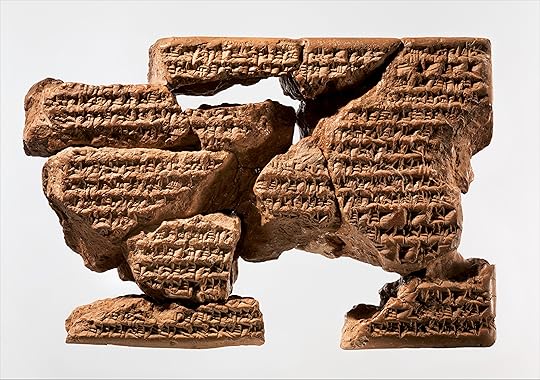
Cuneiform tablet: letter of Sin-sharra-ishkun to Nabopolassar, 2nd century B. C. (Image credit: Metropolitan Museum of Art, CC0, via Wikimedia Commons)
Ancient Mesopotamia had quite a dynamic history in the period between 2600 and 400 BCE, with a succession of empires and cultures, and a constant change of population groups. This means that any historical overview of this area inevitably places heavy demands on the reader, especially compared to the relative stability of the Nile Valley. But Amanda Podany pulls it off well and provides an overview that is still reasonably easy to follow. However, her focus is not so much political, but rather social and existential: if the sources allow it, she draws a picture of life in Mesopotamia, through the eyes of concrete people. Occasionally rulers, that is inevitable, but also regularly ordinary people: traders, temple servants, weavers, musicians, brewers, and so on. As it goes, there is no real way to to distill some form of common experience from those different testimonies (the uniqueness of each human experience is perhaps a common thread in itself), except for one striking one: that people tried to live the best possible life, for themselves or their family and surviving relatives, and often did not realize that the (global) context had changed. It is an indication that one should not exaggerate the importance of periodization of history: when another ruler or another regime comes to power this does not automatically mean that life for the specific people of that period changes fundamentally.
The source material not always allows us to delve deeply into a human life, but Podany really knows how to highlight dramatic scenes. For example, there is the testimony about a family in the Assyrian city of Emar around 1200 BCE hat encountered great difficulties due to economic setbacks. Father Zadamma-Ku'e was obliged to first sell of one of his daughters, and then all his children (2 sons and 2 daughters) as slaves to make ends meet. It's a heartbreaking story, highlighting also a common practice in Ancient Near East: a lot of people were enslaved, just because of economic need (with this relativising note that enslaving usually wasn't a harsh fate).
A few weak points of this book. It is not always possible to avoid the obvious great rulers, there is simply far too much source material about those men. Because yes, they were almost exclusively men. But Podany does her best to also include women (sometimes in powerful positions) and more or less ordinary people. Another shortcoming is that she also mainly focuses on Mesopotamia as a self-contained world. Okay, she occasionally includes other areas in her field of view (certainly as history progresses and Assyria/Babylonia also becomes the ruling power in the Levant and Egypt), but a truly interactive history (the migration flows, for example) or a comparative history she doesn't offer. Of course, this would have made the book so much thicker. But it is one factor that continues to strike me again and again: scientists hardly look over the wall. Still, all in all I think this is an introduction to early Mesopotamia that is more than worth it!
An informative survey of what we know based on archaeological findings about life in the ancient Near East. The author is an academic and the book published by a university press, but it is intended for a general audience—though not a light or casual read, it is an accessible one. Because of the length (text is 541 pages) and the many different people and places and eras covered, it’s one I read slowly. It is worth the trouble though, if you want to see illuminated a part of history most of us don’t know much about.
I did find Podany a bit uncritical of ancient texts, generally assuming that what the powerful wrote down reflects the reality on the ground—when has that ever been true? This also extends to values and culture: if you only looked at what gets written in stone, you might think no one in our society questioned religion either. And this book is based entirely on the cuneiform-writing world, so either stone or clay tablets that survived by getting baked, as when the building they were in burned down. Compared to more modern eras there’s not much to go on, though the happenstance of survival of particular storerooms results in a whole lot of information about very specific topics and places.
Some interesting facts gleaned from this book:
- Substitute kings: following an omen that the king was about to die, some of them responded by appointing some other guy—a gardener, say—as substitute king, in order to fool the gods into killing him instead. The king might then go pretend to be a peasant and even sign his letters with a fake name. In one case this worked out for the gardener, when the real king died anyway and the substitute took over and founded his own dynasty, but usually the substitute king was killed after a few months and the real one returned.
- Queens often also had a lot of authority, being involved in every aspect of governance besides war. They maintained their own separate diplomatic relations with other queens, and with vassal kings, who were supposed to send gifts for both king and queen. The queens of Hatti (in Turkey) remained queen even after their husbands died, reigning alongside their sons; the daughter-in-law would be promoted only once her mother-in-law died.
- Women were pretty active in public life, though this seems to have been more true earlier in the period. Priestesses were a huge deal, to the point that kings would often name the year (they named every year after their accomplishments rather than having a numbered calendar) for the appointment of an important one. In the Old Babylonian period, there was an entire class of women “dedicated to the gods” who must remain unmarried and mostly lived together in warrens of tiny rooms, but seem to have spent much of their time engaged in business activity—they often came from wealthy families and adopted nieces who were likewise dedicated. Textile-making was a key economic activity, mostly carried out by women, and employee lists from royal workshops have shown both men and women as supervisors. Music was another one, and records show aristocratic girls working as musicians in palaces before their marriage.
- The earliest known concrete temple was constructed 5500 years ago. Though it survived to be excavated, such an engineering feat was never attempted in the area again. Meanwhile the ziggurats were essentially piles of brick with no interior; whatever rites conducted there would’ve had to happen on top. Even in major construction projects, it wasn’t uncommon to see every brick stamped with a statement about the king’s service to the gods.
- Gift exchanges seem to have been a major source of economic activity: during periods of peace, “gifts” exchanged among kings essentially took the place of commerce when it came to exchanging products from different places. (Kings could thus petition each other for particular “gifts.”) But everybody could expect gifts: kings gave them to courtiers, courtiers gave them to kings, queens and viziers exchanged them with their counterparts in other countries, messengers got them in exchange for delivering messages, etc.
- Hammurabi was far from promulgating the first law code, just the most extensive early one to have been discovered. Ur-Namma had one inscribed 300 years prior, though in both cases it’s unclear that the very incomplete codes had much to do with the actual justice system. The justice system in Ur-Namma’s time involved prominent men investigating cases and making decisions based on their own judgment. Ordeals (throwing people into the river, where only the innocent were meant to survive) were an option but seem to have existed more as a threat than a regular practice.
- Slavery was ubiquitous, mostly involving either war captives or debtors, though enslavement also seems to have been passed on to children. Debtors could be forced to give up their children to creditors to work off the debt, or poor families who couldn’t afford to feed them might be forced to sell their children. This was common enough that an ancient word for “freedom” literally meant “return to mother.” Being enslaved for adults sometimes didn’t mean much more than having to give a percent of the profit of one’s business to the enslaver, although others clearly found their condition onerous, as they tried to escape and people could collect a bounty for catching them.
- It took nearly two millennia of kingdoms before empires really got going in the Near East, though the area was then ruled by a succession of empires for 3000 years. The Assyrians engaged in a massive program of deporting populations from one place to another to suppress dissent. Because people didn’t keep track of ages or birthdays, children were classified by height to determine how ready to work they were.
- A surviving census from Assyria shows most ordinary people living in nuclear families; because ages weren’t included, it’s unclear whether the elderly lived separately from their children, or just few people reached that age at all. Boys stayed with their parents longer than girls, who seem to have married young.
- Polygamy was not as common as you might think: generally limited to the upper classes, and even then, usually just when the first wife was infertile. Kings on the other hand might have many wives (Egyptian kings, who refused to marry out their daughters to other countries and so had to do all the diplomatic marriages themselves, wound up with so many they didn’t always know who they all were), but only one queen.
- Last names were a feature of people important enough to have a dynasty (not just kings; wealthy families carrying on a particular business for generations had them too). Everybody else went by a first name and patronym.
- The ancient history of the Middle East spans so much time (the book covers 3000 years) that antiquarians collected artifacts from earlier in the period, even creating private museums to display them.
Obviously, I learned a lot from this book, though I think I might have gotten more out of it had it been organized topically rather than chronologically; we get snapshots into many places and times, without necessarily knowing how representative they are. On the other hand, due to the partial and random nature of the surviving evidence, perhaps archaeologists don’t either. As the author noted, there’s one whole important kingdom that we know almost nothing about. At any rate, it was worth the read, though I am also glad to be done!
This was such a grate resource to have. It was such and engaging read my learned so much! I will be using what I learned here for inspiration and world building in a Nove that I will be working on in the near future.
"These young men were not just learning a craft that they could use for a job; they were becoming scholars who would belong to an elite intellectual community, one that was conversant in Sumerian and its literature. Sumerian wasn’t a spoken language by this time. The intense focus on it was, in a way, an attempt to hold on to what they thought of as a golden age in the past, and even to define a Sumerian culture that brought order and authority to what was for them the modern world. When you think about it, the in-depth study of old stories and hymns in a dead language wasn’t a particularly practical thing to do."
Compelling view of ~2500 years of history. As always with broad histories, sometimes it can seem like a lot of names and stuff are breezed through quickly. However, her focus on picking out individuals and looking at society through them helps keep you anchored and gives a decent image of a particular moment. She covers basically the era when cuneiform was used, ending when it was going into severe decline due to Persian domination and only continued in niche groups of astrologers. There's a certain level of continuity due to this, with some shared cultural references all the way through, as well as Sumerian (and then Akkadian) being used for things even after they were both long dead as spoken languages. It's interesting seeing things preserved by constantly being written out again for a couple of thousand years due to being selected for the scribal curriculum (which seems to have been mostly static for a very long time).
Often not much is known about the people she selects - a few are only known from a single mention in a salary list or a census - but by focusing on them and talking about the life they might have experienced based on other sources she keeps things less abstract, even if the names are still quite hard to wrap your head around. Although many of the names only appear in formal documents like contracts, sales receipts and records of salary distribution, a few have left somewhat more personal records. The Amarna records of Egypt's communications with the Mesopotamian kingdoms during a particularly peaceful and diplomatic period show the idiosyncrasies of various rulers - Tushratta of Mittani was very verbose and frequently declared his "love" of the pharaohs who he sent letters to in a way no other king did, possibly an artefact of translation from his native Hurrian. The Hittite queen Puduhepa had a leading role in diplomatic negotiations - after Ramses II complains she has not sent a daughter for him to marry (an essential component of alliances), she replies “But my brother (Ramses) has not accepted in his own mind my status as a sister and my dignity.” There are lots of little stories that are striking. When the city of Sippar-Amnanum was attacked, we can reconstruct what Ur-Utu was doing in his house as he went to flee due to where he dropped different tablets - he tried to collect the most important evidence of contracts and land sales from his archive but at some point fleeing apparently became more urgent and he had to leave them all behind. When the city of Nippur was attacked in 1672BC, the temple of its god Ekur was desecrated and a new temple had to be created in a different Babylonian fort. "One man’s seal inscription reads, plaintively, “May [the scribe] Nanna-mesha, who reveres the god Marduk, (live to) see the restoration of the Ekur temple and of Nippur" - shades of "next year in Jerusalem".
There's a lot of questions I had reading that would require a full length book to address. I was generally stunned by the scale of building projects - any major city building seemed like a huge amount of labour and resources over years and years. One of the earliest buildings discussed - the Stone-Cone Temple of Uruk - is from ~3500BC and used about 3900 tons of limestone taken from 31 miles away just for the foundations and walls - even more was used to make concrete. Other key materials, like bitumen, coloured stone and timber, had to be transported from 250 miles away and even further, involving a sophisticated trade network as well as the transport. There was a very limited writing with numerals attached to a few symbols. The labour to build the temple would have been immense and part of a corvee system in addition to significant amounts of expertise for each specialised part of the construction. This was to build a temple in a single city state ruling a limited area. And then... it was ritually buried ~100 years later! The effort involved was unbelievable and then it was discarded.
This is just the first example of many, with things getting grander in empires. Several rulers are mentioned who planned out a whole new huge capital, had it part built, then it was abandoned by their successor in favour of another location with another new city. I just find it staggering. These sorts of building projects are incredibly difficult today, in situations with far advanced technology and a far greater surplus allowing full time workers. And yet a whole new city could be thrown up in a decade.
Similarly, the administration of something like the Neo-Assyrian Empire feels unimaginable. It had a constantly active military that could invade others easily. The constant deportations and movements of peoples around the empire are hard to comprehend - there was a huge bureaucracy involved in it and the constant uprooting of huge numbers of people and moving them around seems like a mammoth task that involved a lot of death that you'd think would starve the empire of resources. Yet they succeeded and thrived (at least for several reigns). It's just hard to understand.
Ultimately I always find myself wondering why and how authority concentrated in one person became such a thing, and how the vanity projects decided by one person were not only complied with but succeeded, given the limits of economic surplus at the time. I know this is obviously a major topic that's been given a lot of study but even thinking about it just feels weird.
I confess to struggling with this after a while, as there are just so many names, so many fragments of people....But looking back on it, I certainly feel my holistic sense of the period has massively deepened. Well worth checking out if you are interested in this sort of thing.
Podany ably weaves political and social history of this broad-scoped book, and does it all while remaining very accessible. She focuses her attention on those cultures which used cuneiform writing, which means this is by no means an exhaustive volume. Egypt, Israel, the Canaanites, and Arameans only come into view when they affect the happenings of the cuneiform world. Still, the author wasn't hurting for material. I especially appreciated the attention she brought to significant women in the ancient world. Highly recommend to anybody interested in the ancient world.
This was my second real (published by a university press, has ~100 pages of citations and bibliography at the back) history book I’ve read this year. Which I think probably explains why it took me about as long to read as the other 7 books this month put together. Which is the opposite of a complaint, just to be absolutely clear. I’ve kind of missed chewing through a history book that would double as a decent self-defence aid in a pinch.
The title explains the book well enough – this is a broad survey history of the ancient near east. Specifically, it’s a history of civilizations that recorded their records and correspondences and stories in cuneiform on clay tablets. So the narrative begins with Uruk in Sumeria, follows it through the spread of city-states throughout Mesopotamia, expands its view to include Syria, the Levant and regions of Anatolia (and to a much lesser extent Egypt) and the western Iranian plateau in the late bronze age, and keeps that frame through the iron age until reaching the Achaemenid conquests and the decline of cuneiform in favour of writing in Aramaic on paper or parchment.
Part of that is just arbitrary because you need to pick some outer borders of what your book is about, but it’s also a fact that writing everything down on (often baked, either purposefully or because they got caught in a fire) clay tablets was a truly incredible gift to future historians. Paper and parchment and cloths decays away over the course of a historical eyeblink, whereas we still have legal contracts and bureaucratic records from literally four thousand years ago that were recorded on fired clay. Combined with some incredible archaeological luck, and we can see stretches of late bronze age history in higher definition than very nearly anything until, like, the Early Modern Period.
The necessary condition of that is obviously that these cuneiform-writing civilizations actually wrote enough down for written records to really let us understand their societies. Which did very over time, and is definitely overwhelmingly biased towards the great institutions and upper classes, but actually does seem to have been true! Podany all but dedicated the book Mesopotamia’s scribal class, and they got everywhere. And the change over time in just what’s written about - the spread of written records and letters from temples and palaces to the private homes, the spread in literacy from an arcane art only trained scribes would understand to something every halfway prominent merchant would be expected to grasp the basics of for record-keeping – is illuminating enough about how these societies evolved on its own.
Aside from all the waxing poetic about clay tablets, the book does try quite hard to be an approachable historical survey. To that end, basically every chapter is split into a few different sections, each pocket biographies of individuals (or, occasionally, pieces of architecture) that we have enough visibility of to make them a useful entry point to illustrating some broader aspect or society or important process they lived through. The vast majority of them aren’t great kings or conquerors, either – scribes, merchants, weavers, farmers, priestesses, and even the occasional slave get pride of place. On balance, the book tries to be a social history, getting across how people actually lived (or Podany’s best guess of it, though she’s quite explicit about what the actual evidence we have for every given biography is and when she’s speculating) is favoured over the exact sequence of battles and kings.
I’ve mentioned it before, but prior to reading this my only real familiarity with the ancient Near East (and specifically with the development of pristine states in Mesopotamia) was from Scott’s Against the Grain. Which adds a slight sense of whiplash to the entire first third or so of this book, honestly; as opposed to Scott, Podany actually seems sympathetic to the position that civilization was a good idea. Part of that is just that she takes the actual emergence of the first city-states as a given (instead of something approaching original sin), but the book very clearly portrays the growth of a literary culture, monumental architecture, specialized labour, grand and impressive rituals and festivals, institutionalized long-distance trade, and so on as interesting and impressive things worth studying and appreciating. It’s a book about a project of state-based urban-agrarian civilization, as told through its archaeological remnants and literary corpus, and as a whole it portrays that project as admirable and sympathetic. The book doesn’t brush over slavery or warfare, but they’re not especially focused on, either. Famine and plague actually are pretty much brushed over or at least portrayed as irregular calamities. A lot of the book’s wordcount is spent sketching out lives that seem at least slightly familiar to a modern reader, and making the Mesopotamian world seem like a place you could live a happy life in. Quite a contrast to Scott’s constellation of slave societies held together by brute force and exemplary terror, forever raiding the hinterland to abduct new workers to make up the losses from constant disease outbreaks and always on the verge of collapse.
Well, that’s all only mostly true. Podany’s sympathies for pristine states and bronze age empires does not extend to the iron-age Assyrian Empire. Her disdain for their whole imperial project is pretty clear through those chapters, and from her telling they (especially during what’s called the Neo-Assyrian Empire) were responsible for a lot of the brutal innovations that are now such core parts of imperialism. The mass deportation of conquered populations to settle and work other provinces, using exemplary terror to cow subjects, and royal legitimacy established nearly entirely through glorious victories in warfare and exulting in the same. (Along with less objectionable but still important practices like appointing regional governors from the centre.)
The book makes a real point of keeping a balance between men and women in who it focuses on. This is, I get the feeling, kind of just a matter of wanting to show off that we have a historical record that actually includes women in it as more than accessories and footnotes to men for this period (unlike, say, Classical Athens), But Podany’s clearly made a secondary goal of the book to try and push back on the whole image of a primordial and unchanging ultra-patriarchal order across all of history. So there’s a lot of attention paid to how the role of women in public life changed over time, and the sort of political and economic power elite women could wield. Which was actually quite a bit, as it turned out! Obviously nowhere in the ancient world was anything like a feminist utopia (and as a general trend, seems to have grown more patriarchal over time), but compared to a lot of periods I know more about, the available space for women in public life is quite a bit larger; on the upper extreme, queens and priestesses managed and controlled massive estates in their own right, and on the lower we’ve got plenty of bureaucratic records showing women in various prestigious or managerial roles. Always paid significantly less than men doing the same of course, but still a far sight from being totally cloistered or official ideologies saying women are soulless or incapable of rational thought!
Speaking of priestesses – Podany goes into great detail trying to describe Mesopotamian religion and the place religion had in the ancient near east. Which again changes over time – in the early dynastic period the great temples seem to have been the core organizing institutions of economic and social life, but two thousand years latter they were still rich and important, but relatively speaking much less central – but is basically always incredibly important. The endowment of high priestesses and the creation of some public work then given over as the property of an important gods were common themes of year names across the region’s kingdoms, and by all accounts pretty key legitimizing activities. The idea that the gods would sanctify oaths and punish anyone who broke them was likewise a pretty core part of Mesopotamian systems of justice. The book’s a bit vague on how the actual theology and practice of religion over time, but there’s plenty of lovely, evocative descriptions of rituals and festivals, and of the architecture of temples and design of the statue-avatars that were considered to be literal bodies of the divine.
The book’s also very interested in forms of government – both day to day systems of contracts and justice and land allocation, and the high politics of royal courts and governance. Though there’s unsurprisingly quite a bit more available on the latter than the former. Still, it’s pretty fascinating to the degree that the whole ‘absolute tyrant bronze age god-king’ was...well, not not a thing, but very much an occasional aberration. The growth of centralized royal authority was a real trend over a lot of the period, but especially in the beginning arrangements that seem pretty close to what we’d call a constitutional monarchy, with power shared with councils of notables, really do seem to have predominated. Special shouout to Ashur, which before it became a militaristic empire in the late Bronze Age was actually a prosperous trading city where the king was in large part a ritual/religious figure and the balance of executive power seems to have been held by an official who was elected by the city’s merchant class for annual terms.
I’ve done a poor job getting it across in this review, but the book does an amazing job really confronting you with the sheer depth of history – bronze age kingdoms and city-states were the dominant political institutions of the near-east for millennia. The period covered by the book is literally nearly as long as the period between the end of the book and the present. It’s enough to give you a sense of vertigo.
Anyway, absolutely incredible book, that I’m very happy to have read. Now I need to go find a decent one on Achaemenid Persia.
The ancient near east left a lot of written record so that historians/archeologists can reconstruct the history for us to some extent. This is a book full of these stories. The author (Podany) also wrote the VSI on Ancient Near East. This book is (obviously) a lot more detailed/specific than the VSI version. For the casual reader, I recommend the latter. But “Weavers” do have a lot of photos showing some of the artifacts (which, unfortunately, are only in black and white).
Weavers, Scribes, and Kings feels like the literary equivalent of walking through a museum wing on Mesopotamian history. It is at the same time both a macro- and micro-history, giving the reader the sweep of historical change across several thousand years of history while also honing in on the lives of (often lowly) individuals: butchers, bakers, candle-stick makers, etc.
However, this particular museum tour, while informative, comes with an enthusiastic and overly chatty tour-guide who insists on telling you all there is to know about every tablet, name, and artifact in the wing. Podany is our tour-guide here, writing in a deliberately informal style that was just a shade too informal for me. I am not saying that academic writing needs to be purposely dense and obscure, but Podany can only be described as “chatty,” and the chatter became a little grating after a while. Since the book aims to tell the larger history of ancient Mesopotamia through the lives of little-known individuals, there is also a great deal of speculation and guessing: “He/she might have thought/felt/done this/that when this/that happened.” Necessary, to be sure, but the qualifiers grew old after a while.
Hence, the tour guide comparison. At times, the commentary was welcome, but other times I wished that I could walk around and just read the plaques myself, thank you.
4.5 ⭐️ wonderfully narrated by Amanda herself! I was lucky enough to interview Amanda in 2022 about this book, and I’m very glad to have gotten the chance to read and enjoy this labour of love!
An insightful and enjoyable journey through the lives and homes of those living and working in the ancient Near East. I would certainly recommend this to all lovers of ancient history and archaeology!
A vivid gallop through 3000 years of the rise and fall of cuneiform (3500 - 500 BCE), told largely through ancient texts. Rather dense at times, but overall: exhilarating.
What a fascinating look at the daily lives of people from so long ago. I’ve read many works that reference these records, but never one that followed a record through from beginning to end. Most of my study of these times and places has been through the Bible or related works. It was interesting to read the letters, histories, and accounts of those living around and interacting with the ancient Israelites. Still, surely, probably, could have, maybe, likely… start to add up and make much of this book guesswork. She takes the letters and records that have survived the centuries and builds out the lives of their authors with sections prefaced with those words. There are sections that build out the history of the cities these people lived in and the political events that affected their lives, but her focus is mostly on the lives of people in prominent industries or the religious sector. I hadn’t heard of most of them, and that made this look into their lives even more interesting. I would recommend it, especially to every believer. While not Christian, it helps build out the world that the Patriarchs, Kings, and Prophets lived in. It shows us the wealth and power that Abraham left behind to follow God’s commands, the religion that tempted Israel away from God, and the power the nations God turned back from their borders so many times. In a way, it helped me better see the faithfulness of God to Israel and just how different He was from the gods of all the nations around Israel. As He has not changed, it helped put today's troubles in a little better focus.
An incredible journey through the ancient near east history where cuneiform scripts were used. from the world's first known city uruk 3500bce to achaeminid Persian empire where such scripts came to an end as the official written language, podany presented many extremely rich and vivid lives, not only those who ruled and were well documented, but also the ordinary people, weavers, scribes, slaves, merchants, artists, all through the many ancient tablets dug up in the last two centuries. this was an impressive and touching approach. can you imagine a sale contract which where parents sold 4 young children where their little footprints were part of? the many neo Assyrian reliefs that recorded not only their kings valor but also the many displaced peoples agonizing journeys? they were so far yet so close.
Well it has taken me almost four months to finish this book - but that is because it is such a wonderfully immersive history that I kept having to stop and take notes.
Amanda Podany has created something truly wonderful. Unlike many history books, she takes us through the day to day lives of ordinary citizens of the Near East from Ancient Ur and Uruk up to Alexander the Great. While you will see many familiar names from history such as Sargon and Darius, many more will be unfamiliar because how often do we hear of beer makers and innkeepers in history class.
I need a while to digest everything I read here but I am sure I will be picking it up again sooner rather than later to do a deeper dive.
Fabulous book! Amanda Podany has written a wonderful, accessible and easy to follow account of Mesopotamia. Anyone with an interest in this time period will appreciate this book. Podany explains things clearly and references the archaeological record, telling us where and when and how objects were found and what they tell us. And they tell us a lot!
Relying mostly on clay cuneiform tablets, Podany tells us fascinating stories of trade, slavery, religion and of empires and cities that rise and fall. Sargon, Nebuchadnezzar, Ashurbanipal and Cyrus are all here. But we also see ordinary people - men, women, free and enslaved - living ordinary lives. It’s wonderfully interesting. What emerges is a region that had multiple “dark ages” when the archaeological record goes silent for centuries, only to reemerge. Gods and beliefs come and go, as do languages (Sumerian, apparently a language isolate, goes out of spoken usage even as it survives as a written language of high prestige), but cuneiform survives for thousands of years. It finally ends some time during the Parthian and Roman Empire period. Amazing to think that the writing system lasted so long! When it ends, it ends with a whimper, probably no one noticed.
This book was a joy to read and I highly recommend it to everyone interested in history, especially ancient history. Tons of entertaining stories of daily lives, while also giving a sketch of the overall history of the region. But the facts about individuals and the stories of their lives is the book’s focus, certainly not political history as she makes clear from the start (and the title). There is a serious lack of the ancient near east in popular history, and this book is a valiant effort towards solving it.
Unfortunately, “Weavers, Scribes, and Kings” suffers the all-too-common fate of pop historyish books written by scholars: missing the audience. Like Cline’s recent book, Dr. Podany explains basic things at enough length to annoy the knowledgeable reader while leaving out things and at other times assuming the readers knowledge that would probably leave a lay-person quite confused. She lacks an over-all narrative, gives a relative lack of analysis, and mentions general trends in passing.
An excellent popular history of the ancient near east (~3500-500 BC) in the true sense of the word, this book is composed of countless vignettes of people’s lives from the period. It fuses cuneiform with other archeological evidence to paint pictures from a broad cross-section of society that draw you in and make you feel closer to a distant realm in both time and space, in the process humanizing the various subjects and the reader. The author accomplishes her goals well on the whole and this was an insightful and enjoyable read.
My critiques are twofold. Although expecting to maintain the same interest in the manifold and diverse cast of characters throughout would be too much, some chosen portrayals are too thinly drawn by necessity and they could have been dropped in editing. Similarly, the author’s quite familiar style can sometimes be a little jarring for this kind of book and also would have benefited from better editing. I had the feeling that around page 400 the editor went off for an extended lunch and figured most readers wouldn’t get that far.
That said, there are not many books out there that accomplish what this book did in making accessible and even essential the understanding of 3000 years of history, and I came away with as many new and exhilarating questions as answers.
It doesn't get any better than this. The beginning of civilization, of writing, of mathematics, kings, and complaint letters. Kings with superiority complex, exasperated teenagers and their cranky old grandfather's, they were all there waiting in their cuneiform tablets to be written and read again thousands of years later. A true window through time.
This book has three maps, 50 pages of notes, x amount of bibliography, two lists of names and dates, and an index. And pictures! I absolutely loved the lists. What I normally try to write down was now all there in the back. A list of characters on alphabetical order and the other was a list of kings and important battles, etc. in chronological order.
I loved how Amanda Podany brings every character to life, no matter how small or big their impact on history was. She wrote vividly about their struggles and their surrounding area, painting just as much a lively picture of palaces as of family homes.
This book covers an enormous amount of ground (3000 or so years!) and despite that huge scope, Dr Potany is able to both provide an illuminating history of the procession of empires and kings while also zeroing in on the stories of a wide range of individuals who weren't kings- but priests, weavers, traders, or scribes. The individual stories are compelling and provide a view into the wider world of these different periods of Mesopotamian history. The book can be surprisingly touching, and it humanizes seemingly remote, ancient people and gives us snapshots into their lives, their foibles, their struggles, and their beliefs. I am enamored by this masterpiece of historical writing and am already re-reading it. If you have even a passing interest in the ancient near-east, it is a must-read.
Really fascinating, up to date, delves deeply into the subject of ancient near east cultures while remaining extremely engaging. Would recommend to anyone with an interest in the era or region. Full of tasty tidbits.
"Weavers, Scribes, and Kings" is inarguably one of the most fascinating books I have ever read. Dr. Podany expertly blends archaeology, sociology, theology, linguistics, geography, and political science into a series of cohesive narratives that open the readers' eyes to an ancient world that--despite the millennia that separate us--is not unlike our own.
Podany's book advances in chronological order, beginning with the oldest city on earth: Ur, in southern, modern-day Iraq. It was founded around 3800 BC and continued to be inhabited until just before the conquests of Alexander the Great (356-323 BC). Her book describes the history of Mesopotamia throughout this period. To tell the region's complete story, she covers more than a dozen dynasties and cultures, including the Sumerians, Hittites, Babylonians, Elamites, Egyptians, Israelites, Phoenicians, Assyrians, and many more.
Before I started the book, I wondered how we could have enough information to elucidate ancient Mesopotamian history in such clarity. The answer is quite simple: cuneiform! First developed by the Sumerians around 3500 BC, cuneiform recorded the doings of the Mesopotamians (and Persians and Egyptians) for more than three millennia before being replaced by the Syriac and Greek alphabets during the late Persian Empire and early Macedonian Empire. Cuneiform was primarily written on clay tablets that survive to the modern day for many reasons (some of which Podany explains in the book).
Not only is the history contained within "Weavers, Scribes, and Kings" endlessly fascinating, but Podany's writing (and narration!) are excellent. She explains each of the complex topics covered in her book with expert clarity. I would happily take a class from her if she explains everything as simply as she did in her book.
If you're interested in ancient history or learning the context behind some of the Bible's most iconic moments, you can't find a better introduction than Podany's "Weavers, Scribes, and Kings." It's so good that I will likely reread it in the future.
Hundreds of thousands of people lived and existed in the Near East, transforming a daunting three-millennium span into a vibrant, human-centric tapestry. Vanished lands where the golden threads of early kingship were inextricably entwined with the humble, rough-spun wool of the everyday artisan. The Near East wasn’t just a prelude to our Western history, but a refined and deeply human theater of existence. “Weavers, Scribes And Kings” is a reliquary for the ghosts of Mesopotamia. Denizens who walked its soil, made up of those who made a mark on Eastern heritage and those who didn’t but are recounted nonetheless. This is the rich sinew of lived experience, and I’m thankful for all the research that ables us to glimpse a series of small, persistent efforts to thrive ✨
I found this book extraordinary. We’re not just told of the Sumerians, Akkadians, and Babylonians; but we are introduced to them. Real names appear on the page. Reading Podany’s meticulous work makes you feel no longer separated by time, but brought closer together to their world. Cuneiform tablets have become a tactile reality of antiquity and I am completely mesmerised by these stories and portraits of life. For someone like me wishing to dig deep into the flesh of human history- this is comprehensive material and difficult to put down. Learning about these people is a real privilege 🌞
I love the many ways in which Podany reveals a world that thrums with an almost startling vitality. The interconnected trade networks of the Bronze Age. The women who go from a historical footnote to a central pillar of civilization. Travelling merchants and a girl/ musician named Bazatum who lived in a palace at Mari near Syria. Powerful Queens and death chambers. Squabbles and disputes similar to the ones we have today. It feels like knocking on many doors and peering into the lives of ordinary people. They were ordinary, but they were also relatable. Humans haven’t changed much at all ✨
The book is, in many ways, a love letter to the cultures of Mesopotamia. The author traces their history from the emergence of cuneiform writing around 2900 BC through more than three thousand years of kingdoms, empires, and social change.
Her chosen approach is to tell the story of these societies through the lives of the people who inhabited them, ranging from political and military leaders to ordinary individuals whose voices survive in written records. The result is an invaluable glimpse into everyday life, to the extent that surviving documents allow us to reconstruct it.
Beyond the historical value of these narratives, what struck me most was how familiar these ancient societies often feel. The similarities in what people cared about, how they loved, built families, pursued status, worried about the future, and navigated daily life are almost unsettling. The book serves as a powerful reminder that, despite five thousand years of recorded history, human nature has changed remarkably little.
The author's technique also keeps the narrative moving. Each dive into the life of a particular individual, often illuminated by a specific set of documents, opens a window onto an entirely different world. The cumulative effect is to make these long-vanished societies feel vivid and alive.
A fantastic read, and highly recommended to anyone interested in Mesopotamian history.
I promised myself I was going to read at least 5 non-fiction books this year (which is still my goal), but I might have been a bit overly ambitious choosing this as my first one. It was a lot for someone who has very little knowledge on this subject. I put this book on my TBR because one of my degrees is on the Middle East and I love ancient history so I thought it would be really cool to go so far back in that region… but my knowledge on the Middle East is decidedly more modern and honestly most of the countries I studied don’t end up getting mentioned a lot here.
All that said, this was still an interesting book. I’d probably give it more like a 2.5. The first few chapters are really hard to get through with Amanda Podany going so deep into the start of the use of cuneiform— definitely the right starting point, but still a bit mind-numbing. But the chapters that go into the lives of ordinary people in Mesopotamia is where this book really shines. With so much of history focused on “great men who do great deeds” the amount we are able to learn about ordinary people so long ago in history is amazing and incredibly fascinating.
So, a good read but might give myself a little bit of a break before I pick up another non-fiction. And this time I think I’ll be checking that page count more closely.
Podany does a great job at giving an overview while also providing specifics of events, peoples, cultures, etc. of the Ancient Near East. Her main focus is to cover Cuneiform material from the Uruk period (4000 BC) to the end of the Persian period (331 BC) respectively.
Sadly, Podany does not have a high view of the Bible and critiqued it with truth claims absence of at least some sort of evidence. For example, she critiqes the Daniel 5:2 as a mistranslation because Nebuchadnezzar was not Belshazzar’s father but his grandfather. While it is true that Nebuchadnezzar is the grandfather of Belshazzar, the Aramaic word for father אַב denotes more of an ancestorial understanding rather than a strict sense of father.
Overall, a great introduction to the Ancient Near East from various angles based on Cuneiform.
I had been sold Sumer as mystical set-dressing. Late night YouTube of Ishtar’s Gate, arcane ziggurats, priest-kings with cosmic secrets. Amanda Podany’s “Weavers, Scribes and Kings” does something more radical: it treats 5,000-year-old clay tablets as records of ordinary human life. Not gateways to arcane hidden knowledge. And it’s more powerful than the secrets of lost gods.
And it’s devastating. Here are parents raising kids. Merchants hustling for profit. Kings desperate to be remembered. The same struggles, just engraved in stone. This is what powerful scholarship looks like: not the manufactured mystery of alternative history, but the simple beauty of recognizing ourselves across five millennia. Human life has changed enormously. The core struggle hasn’t changed at all.
Podany just does the historian’s work and in doing so, reveals how much we’ve needed permission to see ancient people as people.