

What do you think?

Galaxy Raiders #1
Abyss
The riveting and deeply immersive first installment in a new military sci-fi series—pitting amortal humans against a mystifying alien intelligence in a galaxy-spanning conflict—from New York Times bestselling author Ian Douglas.
Centuries in the future, the Galactic Authority reigns over millions of advanced civilizations throughout the cosmos. From deep within the Galactic Core, the Authority’s principal Mind has won the allegiance of myriad nations, offering security, connection, and access to a network of interstellar Gates in exchange for compliance.
While technological advancement has brought interstellar travel and life-extending procedures to Earth, humans are struggling to maintain their sovereignty and cultural identity. The Galactic Authority’s presence and technological prowess looms large, eliciting both awe and apprehension from a human society that finds itself at a yield to the allure of advanced alien technologies, or preserve their autonomy in an increasingly fractious cosmic landscape.
Naval captain Alexandra Morrigan has little trust for the Authority, and by all accounts, war is brewing. When the extrasolar colony at Sirius goes silent, suspicions arise that Galactic forces or their proxies are pressuring humankind into submission. To preserve any hope of Earth’s future, Morrigan and the forces she commands will do the travel through the Abyss gate, and make one last stand against the Galactic forces, whose powers may defy comprehension.
Centuries in the future, the Galactic Authority reigns over millions of advanced civilizations throughout the cosmos. From deep within the Galactic Core, the Authority’s principal Mind has won the allegiance of myriad nations, offering security, connection, and access to a network of interstellar Gates in exchange for compliance.
While technological advancement has brought interstellar travel and life-extending procedures to Earth, humans are struggling to maintain their sovereignty and cultural identity. The Galactic Authority’s presence and technological prowess looms large, eliciting both awe and apprehension from a human society that finds itself at a yield to the allure of advanced alien technologies, or preserve their autonomy in an increasingly fractious cosmic landscape.
Naval captain Alexandra Morrigan has little trust for the Authority, and by all accounts, war is brewing. When the extrasolar colony at Sirius goes silent, suspicions arise that Galactic forces or their proxies are pressuring humankind into submission. To preserve any hope of Earth’s future, Morrigan and the forces she commands will do the travel through the Abyss gate, and make one last stand against the Galactic forces, whose powers may defy comprehension.
396 pages, Kindle Edition
Published February 4, 2025
About the author
Ian Douglas
106 books587 followersIan Douglas is a pseudonym used by William H. Keith Jr..
Ratings & Reviews
Friends & Following
Create a free account to discover what your friends think of this book!
Community Reviews
Displaying 1 - 30 of 35 reviews

January 12, 2026
I really enjoy Ian Douglas's view of our technological future. I've read his Star Carrier series, which I very much enjoyed, and now this one starts another series in a similar manner to that one. I must say that I hope our future does proceed down this path in many ways.

June 21, 2026
Military Science Fiction
and
Space Operatic
Xover. Admiral Alexandra Morrigan of the US
Space Navy
fights
Space Battles
with an
Intergalactic Superpower
dominated by a
Mechanistic Alien Culture
determined to
Kill All Humans
. First book in the Galaxy Raiders series.
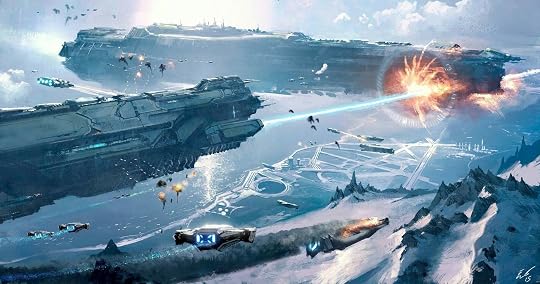
US Space dreadnought USS Constellation flagship of Admiral Alexandra Morrigan in combat with a galactic alien capital ship.
My audiobook version was about 15 hours and 20 minutes long. It had a US 2025 copyright. A dead-tree version would be 400 pages.
Ian Douglas is one of the many noms de plume of William H. Keith Jr.. He is an American author of military science fiction and military fiction and related game design. He has published more than 50 books across many series, as well as standalone titles and collaborations with other authors. I don't recall having read any of his books before. However, with so many aliases he used over 45 years of writing science fiction, I may have.
Devon Sorvari was the narrator. She did an adequate job. Her voicing of the female protagonist was good. However, she made several mistakes in pronunciation of the heavily used techno-speak. In addition, her script should have been edited to omit the scientific notation and initialisms Douglas habitually used.
Having some background with military SF, particularly with the Standard Sci-Fi Setting and its subordinate Standard Sci-Fi Fleet would be helpful with reading this book.
TL;DR Synopsis
In the 25th Century, still fractious humans having developed high-technology, and colonized the solar system, discover the Portal Network and begin interstellar expansion, only to learn they're millennia late to the party. The local administration of the established machine-based intergalactic empire exerts The Right of a Superior Species and decides to exterminate the human species. Humans Are Warriors . 400-year-old, and still young, Alexandra Morrigan, an Officer and a Gentlemanwoman
, rises from Captain to Admiral in the initial battles. She then leads a campaign of
Asymmetric warfare
reminiscent of
Sheridan's Shenandoah Valley campaign
against the technologically and numerically superior Galactic’s. The story ends, setting up the next book in the series.
Military SF similar to Peter Hamilton's, John Campbell's, Nick Webb's, David Weber, or Neil Asher's, with hard-ish SF, large-scale space battles, and fast-paced action. Space war has a Wooden Ships & Iron Men flavor to it with line of battle and an updated, gender-bent Horatio Hornblower-like protagonist. MIL-SF-wise, the author throws in almost every possible operation in a space naval campaign. Worldbuilding was crowded with future-tech tropes. There is an ungainly amount of future-tech and worldbuilding exposition that only a geek could love. Character dynamics are handled through multiple POVs, with the protagonist, Morrigan, being in the majority. Douglas boils the ocean in this first book and produces a book that is very much on the nose.
The Long Review
I’ve been looking for a new space opera for a while. Summer is a good time to pollute your mind like that with popcorn reads. Actually, I want to read the space operatic works of the reincarnation of Iain M. Banks—that's not going to happen. A MIL-SF Enthusiast pal recommended this to me. Thank God, I chose the audiobook format. I ground out this book over about a month on one of my gym's treadmills, where the only alternative would have been the Puppies & Kittens Channel on the overhead TVs.
Having ear-read this book, I can’t comment on its original text's production values.
Douglas has written many books. He is a solid journeyman in his niche. He is quite good at his descriptive and action narrative. The military and technical dialog is solid, if a bit too formal. While descriptive and action sequences are good, they did include a noticeable amount of repetition. There was an almighty amount of exposition to go along with the extensive worldbuilding. I found the narrative wanting in its development of interpersonal and inner dialogue to create character conflicts, inner struggles, and motivations. In particular, I found the 400-year-old, female protagonist in a 22-year-old's rejuv-ed body to be an unconvincing female character. The switching between POVs was well done. However, among the POVs, the protagonist's POV had the greatest share.
A particular annoyance with Ear-reading in this story was the use of scientific notation to describe distance and time. Several times, the narrator was forced to relate distances such as “1.2 × 10⁹ km”, where she pronounced “km” as Kay-Em and not "kilometers". The same applied to “6.95 × 10**4 seconds”, which is almost 20 ½ hours. The precision was admirable, the contribution to the story was eyerolling.
The POVs for the story were Adm. Alexandra Morrigan, Lt. John Damian, Machinist’s Mate (Quantum) Chief Todd Kranhouse, Colonel Chesty Puller, and an (unnamed) Dr’kleh Mind.
Morrigan is yet another incarnation of the Hornblower in Space character. Douglas gender-bends the character and makes her 400 years old. Morrigan has always been female, although with the available tech, she likely could have had no sex. (Douglas ignores even a whiff of the potential for this.) As a naval officer, a perk is free rejuvenations, which are nanotech refurbs to reverse either aging or severe injury. In addition to having four lives of experience, she's intelligent, skilled, and daring like her arch-type. She's also burdened by introspection and self-doubt, like her template character, although unlike him, she's (hetero)sexually active. Morrigan provides an Admiral’s eye (strategic/operational) view of the story, although inconsistently. Damian is a male full of piss and vinegar Space Fighter Ace Pilot with one rejuv. His initial priorities are "flying" and heterosexual fornication. He matures, quite unevenly, over the course of the book. Damian consistently provides a tactical view of the battles along with that from the flagship’s wardroom. Kranhouse is The Reliable One . He’s a 35-year Navy veteran, up through the ranks, an enlisted man with no rejuvs, who keeps the flagship’s propulsion systems working like a charm despite horrific battle damage. Kranhouse provides the view from the mess deck and the flagship’s “engine room” during battles. Puller is the Semper Fi character, to provide the planet-side ground combat perspective, no MIL-space opera being complete without Space Marines . His character receives the least development and is the most clichéd.
The POVs were a mixed bag. Admirals are typically concerned with strategy, the operational maneuvering of their thousands of ships, and the logistics of the campaign. One problem was that, after being promoted from captain to Admiral, Morrigan continued to view the space battles from the perspective of her flagship’s captain. Another problem I had with her, was she was more a man, than the other men on the bridge. That is, she was unconvincing as a female character. Normally, enlisted men, except their servants, never have access to flag officers. Peculiarly, Kranhouse has the Admiral’s ear, which cuts across the fleet’s normal Chain of Command, in recognition of exemplary service in combat. Damian and Puller stayed in their swim lanes as characters. I also found it incongruous that there was a lack of diversity, not just sexual and racial, within the 25th-century space navy.
The antagonist’s POV is provided by the millennia-old, Dr’kleh Mind. It’s an artificial intelligence installed by the Galactic's to administer the galactic sector containing Sol. That mind administratively rules to exterminate humanity, because spacefaring organic life is disruptive and can be destructive. All the space and planet-side battles are fought with the mind's subordinate machine and organic culture minions. At the highest level, this makes the story's conflict one of man against machine.
There are a plethora of other characters. They were all just thick enough for their limited roles. They were mostly government apparatchiks; clueless many times rejuv’d Rich in Dollars, Poor in Sense Eloi-like idyl; military officers and enlisted in-support of the POV characters, typically with some technical or combat aptitude, scientists to provide area-specific exposition. There were numerous supporting AIs, both good guys and Galactic bad guys. There were also organic aliens. These aliens are mostly Galactic minions. They were from the more imaginative side of having been seen before with suitably Bizarre Alien Biology .
Pacing was OK, on the brisk side. The ending was good-ish. This being Serial Fiction, it was an HFN and thankfully not a cliffhanger. I noted there has been no declaration of how many books there will be in the series. I'm not a big fan of serial fiction.
The story contained sex, drugs, and contemporary rock 'n roll. Folks had hookups, on and off the ship. They were respectful of rank. All the sex was heteronormative and non-graphic, of the fade to black type. It was interesting that nobody was queer or used the rejuvenation tech to switch genders in the 25th Century? Folks consumed alcohol and drugs, sometimes in excess, but never on duty. Antidotes for instant sobriety were in use. Music was described as background noise during social occasions.
Violence was: physical, and military-grade ordinance. All of it was due to combat or its collateral damage. Blood, gore, and other trauma were minimized in the prose. Body count was genocidal. A lot of humans, aliens, and AIs died. Note that AIs were considered sentient and appeared to lack backups or clones. The protagonist, Morrigan, made a habit of breaking her legs, getting thrown about like a ragdoll in the flagship's CIC due to battle damage. Most bodily harm was repairable with the medical nanotech of the Auto-Docs, with AI physician assistance, if there were enough parts left over and time to regrow them as new.
Worldbuilding was ambitious. For the 25th Century, it was very good in places, but unexceptional in others. Riffing on the Space Navy and Space Opera tropes, which are layered on top of the Standard Sci-Fi Setting helped. Douglas pedantically embellished these with his own spins on: AI, nanotech, rejuvenation, and a solar system-wide Post-scarcity society. They have what amounts to Replicators and unlimited energy power source technologies. He embellishes all with long tracts of exposition. If you don't look too closely, you won't see the plot holes his gilding of the (trope) lily opens up. However, it failed at being infotainment for this listener.
For example, the galactics attempt an extinction event against humanity where the great majority of humanity lives in ease on the Earth's surface. In the aftermath, which would have been a good story by itself, he lavishes prose on the dirt-side Survival of the Fittest, Lawlessness, and Desolation resulting. Meanwhile, extraterrestrial humanity, whose entire infrastructure remained undisturbed, uses its AIs and robots, aided by nanotech swarms, to decompose metallic asteroids into ginormous space dreadnoughts in scant weeks and smaller artifacts almost instantaneously. The post-apocalyptic situation on Earth is at odds with the disaster relief capabilities of extraterrestrial nanoswarms, which could easily provide food, shelter, and clothing under AI and robot supervision.
Douglas has been doing space warfare gaming (online MIL-SF) for a while in addition to writing books. The real hardcore of MIL-SF folks are experiencing it online and have been for 30 years. The numerous combat sequences reminded me a lot of the space combat found in online games, like EVE Online .
Despite the attention to detail, some things are just wrong. Time gets very hinky when traveling at near light speed. Douglas goes to great lengths to describe and use the effects of near-light-speed travel in the story. He mandates aligned timelines at the beginning and end of light-speed travel, rather than the alternate futures that IRL are mathematically described.
Another issue he repeatedly hand-waves away is how Earth's three-millennia-old advanced technological culture can allow them to go toe-to-toe militarily and technologically with a billion-year-old machine- and AI-based galactic culture. However, that wouldn’t have made for a story of space ships-of-the-line exchanging broadsides from energy and kinetic weapons at distances of 100’s of meters. The same goes with putting a character in the loop for space combat with AIs, where a millisecond's hesitation should be the difference between life or death.
In general, Douglas' love of detail opened more and larger plot holes the more he lovingly gilded his tropes.
Serial Fiction sucks. Sometime long before the midpoint of this book, despite my interest in space opera, the story became very repetitively boring. Frankly, all the tropes used in the story were too familiar to be long-term entertaining. Douglas appeared to be embroidering the very worn sow's ear of a Wooden Ship’s and Iron Woman-like MIL-SF space opera and making it into an updated silk purse. Reading the 1000’s of pages to finish a TBD number of series books would be a grinding waste of time. This was despite the potential of some of his story's future plotlines, short and long term. If the author were writing a two or three-book series (1000 to less than 1200 pages total), I could have been persuaded to continue.
Summary
This story ran long. It resembles Nick Webb's Legacy Fleet, Jack Campbell's Lost Fleet, and David Weber et al's Star Fire regarding interstellar strategy and conflict.
Morrigan is an OK spin on Hornblower. Sorvari's narration was passable, though abridging the techno-speak was needed. "Six times ten to the twenty-third K away" is just a long distance; in space, all distances are long.
It wasn't a great work—too complex for a popcorn read, technically complicated, and essentially a novelization of MIL-SF video games using familiar tropes. Douglas had a potentialy better story with the sociological aspects of a post-scarcity world with a population with longevity (echoing Bruce Sterling's Holy Fire ) but abandoned that for a bog-standard MIL-SF slugfest. His failure lies in tweaking tired tropes rather than having previously learned "show, don't tell," which would have shortened the read.
I can't recommend this; it's inferior to similar series like the: Polity, Void, Legacy Fleet, and Lost Fleet, and suffers from excessive detail.
Readable only if you crave immersive worldbuilding and epic space battles. That worldbuilding is extensive but problematic and pedantic. Ultimately, it was just more of the same MIL-SF.
US Space dreadnought USS Constellation flagship of Admiral Alexandra Morrigan in combat with a galactic alien capital ship.
My audiobook version was about 15 hours and 20 minutes long. It had a US 2025 copyright. A dead-tree version would be 400 pages.
Ian Douglas is one of the many noms de plume of William H. Keith Jr.. He is an American author of military science fiction and military fiction and related game design. He has published more than 50 books across many series, as well as standalone titles and collaborations with other authors. I don't recall having read any of his books before. However, with so many aliases he used over 45 years of writing science fiction, I may have.
Devon Sorvari was the narrator. She did an adequate job. Her voicing of the female protagonist was good. However, she made several mistakes in pronunciation of the heavily used techno-speak. In addition, her script should have been edited to omit the scientific notation and initialisms Douglas habitually used.
Having some background with military SF, particularly with the Standard Sci-Fi Setting and its subordinate Standard Sci-Fi Fleet would be helpful with reading this book.
TL;DR Synopsis
In the 25th Century, still fractious humans having developed high-technology, and colonized the solar system, discover the Portal Network and begin interstellar expansion, only to learn they're millennia late to the party. The local administration of the established machine-based intergalactic empire exerts The Right of a Superior Species and decides to exterminate the human species. Humans Are Warriors . 400-year-old, and still young, Alexandra Morrigan, an Officer and a Gentle
Military SF similar to Peter Hamilton's, John Campbell's, Nick Webb's, David Weber, or Neil Asher's, with hard-ish SF, large-scale space battles, and fast-paced action. Space war has a Wooden Ships & Iron Men flavor to it with line of battle and an updated, gender-bent Horatio Hornblower-like protagonist. MIL-SF-wise, the author throws in almost every possible operation in a space naval campaign. Worldbuilding was crowded with future-tech tropes. There is an ungainly amount of future-tech and worldbuilding exposition that only a geek could love. Character dynamics are handled through multiple POVs, with the protagonist, Morrigan, being in the majority. Douglas boils the ocean in this first book and produces a book that is very much on the nose.
The Long Review
I’ve been looking for a new space opera for a while. Summer is a good time to pollute your mind like that with popcorn reads. Actually, I want to read the space operatic works of the reincarnation of Iain M. Banks—that's not going to happen. A MIL-SF Enthusiast pal recommended this to me. Thank God, I chose the audiobook format. I ground out this book over about a month on one of my gym's treadmills, where the only alternative would have been the Puppies & Kittens Channel on the overhead TVs.
Having ear-read this book, I can’t comment on its original text's production values.
Douglas has written many books. He is a solid journeyman in his niche. He is quite good at his descriptive and action narrative. The military and technical dialog is solid, if a bit too formal. While descriptive and action sequences are good, they did include a noticeable amount of repetition. There was an almighty amount of exposition to go along with the extensive worldbuilding. I found the narrative wanting in its development of interpersonal and inner dialogue to create character conflicts, inner struggles, and motivations. In particular, I found the 400-year-old, female protagonist in a 22-year-old's rejuv-ed body to be an unconvincing female character. The switching between POVs was well done. However, among the POVs, the protagonist's POV had the greatest share.
A particular annoyance with Ear-reading in this story was the use of scientific notation to describe distance and time. Several times, the narrator was forced to relate distances such as “1.2 × 10⁹ km”, where she pronounced “km” as Kay-Em and not "kilometers". The same applied to “6.95 × 10**4 seconds”, which is almost 20 ½ hours. The precision was admirable, the contribution to the story was eyerolling.
The POVs for the story were Adm. Alexandra Morrigan, Lt. John Damian, Machinist’s Mate (Quantum) Chief Todd Kranhouse, Colonel Chesty Puller, and an (unnamed) Dr’kleh Mind.
Morrigan is yet another incarnation of the Hornblower in Space character. Douglas gender-bends the character and makes her 400 years old. Morrigan has always been female, although with the available tech, she likely could have had no sex. (Douglas ignores even a whiff of the potential for this.) As a naval officer, a perk is free rejuvenations, which are nanotech refurbs to reverse either aging or severe injury. In addition to having four lives of experience, she's intelligent, skilled, and daring like her arch-type. She's also burdened by introspection and self-doubt, like her template character, although unlike him, she's (hetero)sexually active. Morrigan provides an Admiral’s eye (strategic/operational) view of the story, although inconsistently. Damian is a male full of piss and vinegar Space Fighter Ace Pilot with one rejuv. His initial priorities are "flying" and heterosexual fornication. He matures, quite unevenly, over the course of the book. Damian consistently provides a tactical view of the battles along with that from the flagship’s wardroom. Kranhouse is The Reliable One . He’s a 35-year Navy veteran, up through the ranks, an enlisted man with no rejuvs, who keeps the flagship’s propulsion systems working like a charm despite horrific battle damage. Kranhouse provides the view from the mess deck and the flagship’s “engine room” during battles. Puller is the Semper Fi character, to provide the planet-side ground combat perspective, no MIL-space opera being complete without Space Marines . His character receives the least development and is the most clichéd.
The POVs were a mixed bag. Admirals are typically concerned with strategy, the operational maneuvering of their thousands of ships, and the logistics of the campaign. One problem was that, after being promoted from captain to Admiral, Morrigan continued to view the space battles from the perspective of her flagship’s captain. Another problem I had with her, was she was more a man, than the other men on the bridge. That is, she was unconvincing as a female character. Normally, enlisted men, except their servants, never have access to flag officers. Peculiarly, Kranhouse has the Admiral’s ear, which cuts across the fleet’s normal Chain of Command, in recognition of exemplary service in combat. Damian and Puller stayed in their swim lanes as characters. I also found it incongruous that there was a lack of diversity, not just sexual and racial, within the 25th-century space navy.
The antagonist’s POV is provided by the millennia-old, Dr’kleh Mind. It’s an artificial intelligence installed by the Galactic's to administer the galactic sector containing Sol. That mind administratively rules to exterminate humanity, because spacefaring organic life is disruptive and can be destructive. All the space and planet-side battles are fought with the mind's subordinate machine and organic culture minions. At the highest level, this makes the story's conflict one of man against machine.
There are a plethora of other characters. They were all just thick enough for their limited roles. They were mostly government apparatchiks; clueless many times rejuv’d Rich in Dollars, Poor in Sense Eloi-like idyl; military officers and enlisted in-support of the POV characters, typically with some technical or combat aptitude, scientists to provide area-specific exposition. There were numerous supporting AIs, both good guys and Galactic bad guys. There were also organic aliens. These aliens are mostly Galactic minions. They were from the more imaginative side of having been seen before with suitably Bizarre Alien Biology .
Pacing was OK, on the brisk side. The ending was good-ish. This being Serial Fiction, it was an HFN and thankfully not a cliffhanger. I noted there has been no declaration of how many books there will be in the series. I'm not a big fan of serial fiction.
The story contained sex, drugs, and contemporary rock 'n roll. Folks had hookups, on and off the ship. They were respectful of rank. All the sex was heteronormative and non-graphic, of the fade to black type. It was interesting that nobody was queer or used the rejuvenation tech to switch genders in the 25th Century? Folks consumed alcohol and drugs, sometimes in excess, but never on duty. Antidotes for instant sobriety were in use. Music was described as background noise during social occasions.
Violence was: physical, and military-grade ordinance. All of it was due to combat or its collateral damage. Blood, gore, and other trauma were minimized in the prose. Body count was genocidal. A lot of humans, aliens, and AIs died. Note that AIs were considered sentient and appeared to lack backups or clones. The protagonist, Morrigan, made a habit of breaking her legs, getting thrown about like a ragdoll in the flagship's CIC due to battle damage. Most bodily harm was repairable with the medical nanotech of the Auto-Docs, with AI physician assistance, if there were enough parts left over and time to regrow them as new.
Worldbuilding was ambitious. For the 25th Century, it was very good in places, but unexceptional in others. Riffing on the Space Navy and Space Opera tropes, which are layered on top of the Standard Sci-Fi Setting helped. Douglas pedantically embellished these with his own spins on: AI, nanotech, rejuvenation, and a solar system-wide Post-scarcity society. They have what amounts to Replicators and unlimited energy power source technologies. He embellishes all with long tracts of exposition. If you don't look too closely, you won't see the plot holes his gilding of the (trope) lily opens up. However, it failed at being infotainment for this listener.
For example, the galactics attempt an extinction event against humanity where the great majority of humanity lives in ease on the Earth's surface. In the aftermath, which would have been a good story by itself, he lavishes prose on the dirt-side Survival of the Fittest, Lawlessness, and Desolation resulting. Meanwhile, extraterrestrial humanity, whose entire infrastructure remained undisturbed, uses its AIs and robots, aided by nanotech swarms, to decompose metallic asteroids into ginormous space dreadnoughts in scant weeks and smaller artifacts almost instantaneously. The post-apocalyptic situation on Earth is at odds with the disaster relief capabilities of extraterrestrial nanoswarms, which could easily provide food, shelter, and clothing under AI and robot supervision.
Douglas has been doing space warfare gaming (online MIL-SF) for a while in addition to writing books. The real hardcore of MIL-SF folks are experiencing it online and have been for 30 years. The numerous combat sequences reminded me a lot of the space combat found in online games, like EVE Online .
Despite the attention to detail, some things are just wrong. Time gets very hinky when traveling at near light speed. Douglas goes to great lengths to describe and use the effects of near-light-speed travel in the story. He mandates aligned timelines at the beginning and end of light-speed travel, rather than the alternate futures that IRL are mathematically described.
Another issue he repeatedly hand-waves away is how Earth's three-millennia-old advanced technological culture can allow them to go toe-to-toe militarily and technologically with a billion-year-old machine- and AI-based galactic culture. However, that wouldn’t have made for a story of space ships-of-the-line exchanging broadsides from energy and kinetic weapons at distances of 100’s of meters. The same goes with putting a character in the loop for space combat with AIs, where a millisecond's hesitation should be the difference between life or death.
In general, Douglas' love of detail opened more and larger plot holes the more he lovingly gilded his tropes.
Serial Fiction sucks. Sometime long before the midpoint of this book, despite my interest in space opera, the story became very repetitively boring. Frankly, all the tropes used in the story were too familiar to be long-term entertaining. Douglas appeared to be embroidering the very worn sow's ear of a Wooden Ship’s and Iron Woman-like MIL-SF space opera and making it into an updated silk purse. Reading the 1000’s of pages to finish a TBD number of series books would be a grinding waste of time. This was despite the potential of some of his story's future plotlines, short and long term. If the author were writing a two or three-book series (1000 to less than 1200 pages total), I could have been persuaded to continue.
Summary
This story ran long. It resembles Nick Webb's Legacy Fleet, Jack Campbell's Lost Fleet, and David Weber et al's Star Fire regarding interstellar strategy and conflict.
Morrigan is an OK spin on Hornblower. Sorvari's narration was passable, though abridging the techno-speak was needed. "Six times ten to the twenty-third K away" is just a long distance; in space, all distances are long.
It wasn't a great work—too complex for a popcorn read, technically complicated, and essentially a novelization of MIL-SF video games using familiar tropes. Douglas had a potentialy better story with the sociological aspects of a post-scarcity world with a population with longevity (echoing Bruce Sterling's Holy Fire ) but abandoned that for a bog-standard MIL-SF slugfest. His failure lies in tweaking tired tropes rather than having previously learned "show, don't tell," which would have shortened the read.
I can't recommend this; it's inferior to similar series like the: Polity, Void, Legacy Fleet, and Lost Fleet, and suffers from excessive detail.
Readable only if you crave immersive worldbuilding and epic space battles. That worldbuilding is extensive but problematic and pedantic. Ultimately, it was just more of the same MIL-SF.

April 15, 2026
Hard one to review. It was mostly good. But it lacked something. The space combat stuff should have been riveting, but i kept loosing interest. I only realized half way through that this was book 1 of a new series, and that might have dampened my enthusiasm somewhat because i could se it was not going to end anywhere near the end of the book.
Some good ideas, some interesting world building, but idk. I might try some more by the author.
Some good ideas, some interesting world building, but idk. I might try some more by the author.

April 18, 2025
Paul di Filippo gives this new mil-sf space opera high marks here:
https://locusmag.com/2025/03/galaxy-r...
Excerpt:
"Douglas has crafted a state-of-the-art space opera that honors the traditions of the past and carries them forward into new realms. Anyone who enjoys the work of Neal Asher will settle down happily here."
This is the review that led me to read the book, by a new-to-me writer, who turns out to be a prolific author of many mil-SF (and other) novels: https://en.wikipedia.org/wiki/William.... I strongly suggest reading that review now.
So. Back already? This is a competent work of commercial fiction. It doesn't always make sense, but it moves right along, and kept me entertained (and occasionally annoyed) for a day. The book gets better towards the end, and pauses at a good stopping point for the promised sequel, which I'll consider reading when it appears. For me, this was a 3.5 star book. Certainly not a classic, and not something I'm likely to reread. But a solid piece of work. If military SF appeals, you should consider this one.
https://locusmag.com/2025/03/galaxy-r...
Excerpt:
"Douglas has crafted a state-of-the-art space opera that honors the traditions of the past and carries them forward into new realms. Anyone who enjoys the work of Neal Asher will settle down happily here."
This is the review that led me to read the book, by a new-to-me writer, who turns out to be a prolific author of many mil-SF (and other) novels: https://en.wikipedia.org/wiki/William.... I strongly suggest reading that review now.
So. Back already? This is a competent work of commercial fiction. It doesn't always make sense, but it moves right along, and kept me entertained (and occasionally annoyed) for a day. The book gets better towards the end, and pauses at a good stopping point for the promised sequel, which I'll consider reading when it appears. For me, this was a 3.5 star book. Certainly not a classic, and not something I'm likely to reread. But a solid piece of work. If military SF appeals, you should consider this one.

February 25, 2025
Fast paced, hard hitting military scifi! I found this story to be engaging if a little tedious at times with a lot of detail but in the way you expect for a more old school military scifi feel.
I’d be interested to see the series continue and wonder at the end goal. I recommend to those who love epic space battles and alien aggression against humans haha.
My rating: 3.8*
—-
Thanks to NetGalley for this gifted copy of this audiobook. All opinions are my own.
I’d be interested to see the series continue and wonder at the end goal. I recommend to those who love epic space battles and alien aggression against humans haha.
My rating: 3.8*
—-
Thanks to NetGalley for this gifted copy of this audiobook. All opinions are my own.

October 26, 2025
Another GREAT Military Science Fiction story from my favorite Author and hopefully the start of a new series.
A superior intelligence that dominates the galaxy has it's eye on Earth and not without ill thoughts for humanity.
Captain/Admiral Morrigan is sent out to rattle the intelligence with the idea to make it think it's just too much trouble to dominate Earth.
Great story line and character development make this a MUST READ.
HIGHLY RECOMMENDED
A superior intelligence that dominates the galaxy has it's eye on Earth and not without ill thoughts for humanity.
Captain/Admiral Morrigan is sent out to rattle the intelligence with the idea to make it think it's just too much trouble to dominate Earth.
Great story line and character development make this a MUST READ.
HIGHLY RECOMMENDED
December 26, 2025
DNF nach 21%. Die Menschheit hat die galaktische Union getroffen, und die will, dass die Menschen zu Hause bleiben, dafür gibt's tolle Technologien als Belohnung. Aber dann wird eine Kolonie der Menschen zerstört... das Setting hat mich nicht wirklich interessiert.
February 21, 2026
I stopped reading military SF sometime in the 2010s because I realised I was reading the same story over and over again just with the names changed - the pro US jingoism and US Marine Corp worship didn't help either. Fortunately Douglas appears to have gotten the sub-genre out of that ghetto by coming up with an original plot, some clever world building and toning down both the jingoism and USMC worship (They're still present but at far more tolerable levels). The plot involves Earth running afoul of a Billions of years old Galactic government which decides to wipe out Humanity as a potential threat. A move that quite understandably makes Humanity angry. This book is on the harder end of the SF spectrum and the author has gone to considerable lengths to keep things plausible. Also the author is one of the minority of SF authors who has a sense of scale but despite this is able to make the 'One plucky planet decides to take on the galaxy' plot believable. If you want to get into military SF, I'd recommend this book.

February 25, 2025
Ian Douglas (https://iancdouglas.com) is the author of nearly half a dozen novels. Galaxy Raiders: Abyss was published earlier this month. It is the 9th book I completed reading in 2025.
I received an ARC of this book through https://www.netgalley.com with the expectation of a fair and honest review. Opinions expressed here are unbiased and entirely my own! Due to some minor violence, mature situations, and mature language, I categorize this novel as PG.
The setting is the distant future. The Authority is the dominant power in our Galaxy. Because of the long distances, the Authority is slow to react. Now that it has encountered the Earth, it wants to bring it into its folds. There is peace throughout the area ruled by the Authority, but that comes at a cost.
Earth does not want to join the Authority, at least not under the terms the Authority is offering. It does want to have access to the network of interstellar Gates connecting the millions of advanced civilizations that are part of the Authority. They also want the opportunity to trade and have access to Authority technology.
When one of the Authority species, the Veykaar, attacks Earth colonies, there seem to be only three choices. Earth can submit to the Authority. They can reject the Authority, and be isolated to the Solar System. Or they can fight.
US Navy Captain Alexandra Morrigan of the UTS Constellation is assigned to command Task Force Morrigan. The mission is to pass through the gate system and bring the battle to the Authority. The hope is that this will lead to a more agreeable arrangement with the Authority. There is little hope of winning against the might of the Authority but, hopefully, Task Force Morrigan will be enough of an irritant to cause the Authority to settle with Earth.
Beyond all expectations, Task Force Morrigan is successful in its confrontations with Authority forces. The Task Force suffers high casualties, but They continue to make their way deeper into Authority-controlled space.
I enjoyed the 12+ hours reading this 396-page science fiction novel. I like the chosen cover art. I give this novel a rating of 4.7 (rounded to 5) out of 5.
You can access more of my book reviews on my Blog ( https://johnpurvis.wordpress.com/blog/).
I received an ARC of this book through https://www.netgalley.com with the expectation of a fair and honest review. Opinions expressed here are unbiased and entirely my own! Due to some minor violence, mature situations, and mature language, I categorize this novel as PG.
The setting is the distant future. The Authority is the dominant power in our Galaxy. Because of the long distances, the Authority is slow to react. Now that it has encountered the Earth, it wants to bring it into its folds. There is peace throughout the area ruled by the Authority, but that comes at a cost.
Earth does not want to join the Authority, at least not under the terms the Authority is offering. It does want to have access to the network of interstellar Gates connecting the millions of advanced civilizations that are part of the Authority. They also want the opportunity to trade and have access to Authority technology.
When one of the Authority species, the Veykaar, attacks Earth colonies, there seem to be only three choices. Earth can submit to the Authority. They can reject the Authority, and be isolated to the Solar System. Or they can fight.
US Navy Captain Alexandra Morrigan of the UTS Constellation is assigned to command Task Force Morrigan. The mission is to pass through the gate system and bring the battle to the Authority. The hope is that this will lead to a more agreeable arrangement with the Authority. There is little hope of winning against the might of the Authority but, hopefully, Task Force Morrigan will be enough of an irritant to cause the Authority to settle with Earth.
Beyond all expectations, Task Force Morrigan is successful in its confrontations with Authority forces. The Task Force suffers high casualties, but They continue to make their way deeper into Authority-controlled space.
I enjoyed the 12+ hours reading this 396-page science fiction novel. I like the chosen cover art. I give this novel a rating of 4.7 (rounded to 5) out of 5.
You can access more of my book reviews on my Blog ( https://johnpurvis.wordpress.com/blog/).
April 6, 2025
I was delighted to learn Ian Douglas had begun a new series. I’ve read 20 of his previous books, the 9 Carrier books & the three trilogies of his galactic series, plus a couple of the first books of other series that I didn’t like as much. I know what I’m getting into with his books: Lots of exposition, lots of action with some current science thrown into the mix. The books are fun & fast and ask questions about humanities place in the stars.
This time around the humans of Earth have run into the Galactic Authority, a supermind that runs everything. If you join them, they’ll share, but you have to be good. If you don’t, then they isolate you. Or worse. Humans, being humans in Ian Douglas’s books push back hard.
There are a number of similarities to the Carrier series. Huge space battles, sleek fighters, AI and star systems. Some of the same technologies. Some of the same political issues with Earth. We’re back to slower-than-light with galaxy spanning gates linking systems.
There are a few twists, but those are mainly the exploration part, the bit of wonder the author brings after a battle. I love the Lixies. If they can impress the Marines in the book, I’m in.
The main point is the book is meant to be fun, with some philosophical questions intertwined. I look forward to more in the series.
This time around the humans of Earth have run into the Galactic Authority, a supermind that runs everything. If you join them, they’ll share, but you have to be good. If you don’t, then they isolate you. Or worse. Humans, being humans in Ian Douglas’s books push back hard.
There are a number of similarities to the Carrier series. Huge space battles, sleek fighters, AI and star systems. Some of the same technologies. Some of the same political issues with Earth. We’re back to slower-than-light with galaxy spanning gates linking systems.
There are a few twists, but those are mainly the exploration part, the bit of wonder the author brings after a battle. I love the Lixies. If they can impress the Marines in the book, I’m in.
The main point is the book is meant to be fun, with some philosophical questions intertwined. I look forward to more in the series.

May 28, 2025
Outstanding! BUT... there are only two women in the entire plot and they already hate each other? WTF? Teaching a new generation your old ways? Why did Alexandra even brought up such a hot hate bearing 3/4 thru the book towards a woman who she only met once?! What are you trying to add to the plot with this? Seeding hate speech from a woman-to-woman to grow us weaker part of humankind? I'd put 5*, but I'm compelled this kind of hate should be irradiated one * at a time. I did hate when a woman-captain who expressed her grief for lost family member was fired on a spot, but a guy who did the SAME damn thing was still a captain. Thank you for that colorful reminder of how, even 400 years from now, society still invalidates women.
I still loved the usage of the new real tech - 2008 invention of the "Blackest Black", the time dilation explained, the cute detail of power boost needed when emerging thru the gate, Von Neumann machine, an invention of a word "Baltis (sea region folks in Europe) effect", sprinkled up with Bremsstrahlung (which X-ray radiation dose to crew concerns was not addressed, if a character saw that, it was already too late. Magnetic/electrostatic shielding can redirect charged particles before they hit solid matter. Why/how do they deal with radiation produced?)
I still loved the usage of the new real tech - 2008 invention of the "Blackest Black", the time dilation explained, the cute detail of power boost needed when emerging thru the gate, Von Neumann machine, an invention of a word "Baltis (sea region folks in Europe) effect", sprinkled up with Bremsstrahlung (which X-ray radiation dose to crew concerns was not addressed, if a character saw that, it was already too late. Magnetic/electrostatic shielding can redirect charged particles before they hit solid matter. Why/how do they deal with radiation produced?)

August 9, 2024
Military SF that smudges the hard science
just a smidge.
Earth (still divided into nation states that
do not quite get along)
has discovered the rest of our
galaxy is ruled by a hegemonic hive
mind of ancient thinking machines.
These ancient machines
are not too terribly
fond of organics.
Especially pesky ones like Humanity
that don't want to fall in
line and do what they're told.
After an almost disastrous
invasion by the slave races
of Galactic Intelligences
Earth creates an enormous fleet
under the command of the
most experienced Fleet Officer
they have,
Admiral Morrigan.
(she just happens to be named after
the Celtic Goddess of Death...)
So the destruction and chaos begins.
Turns out if you are an Ancient IMMORTAL
being the notion of getting
MUR-DERED
scares the shit right out of you.
So we kick some ass
we take some names.
Lots of violent fun to be had
until the next book
which will most likely
be more of the same.
But I'm ok with that.
just a smidge.
Earth (still divided into nation states that
do not quite get along)
has discovered the rest of our
galaxy is ruled by a hegemonic hive
mind of ancient thinking machines.
These ancient machines
are not too terribly
fond of organics.
Especially pesky ones like Humanity
that don't want to fall in
line and do what they're told.
After an almost disastrous
invasion by the slave races
of Galactic Intelligences
Earth creates an enormous fleet
under the command of the
most experienced Fleet Officer
they have,
Admiral Morrigan.
(she just happens to be named after
the Celtic Goddess of Death...)
So the destruction and chaos begins.
Turns out if you are an Ancient IMMORTAL
being the notion of getting
MUR-DERED
scares the shit right out of you.
So we kick some ass
we take some names.
Lots of violent fun to be had
until the next book
which will most likely
be more of the same.
But I'm ok with that.

August 2, 2026
Lu en anglais.
Tome 1 de la série Galaxy raiders
Quelques centaines d'années dans le futur, l'humanité est entré en contact avec des éléments de l'autorité galactique qui représente des millions de civilisations extrêmement avancées partout dans la galaxie.
Mais pour des civilisations qui, pour la plupart, ne sont plus biologiques et dont la durée s'étend sur des centaines de millions d'années, l'humanité parait illogique, impulsive et menaçante.
Et une des factions des galactiques décide d'éliminer la menace pour de bon.
Que faire ? Est-ce que l'on pourrait forcer les Galactiques à négocier ?
Ce rôle est dévolu à l'amirale Alexandra Morrigan qui à la tête d'une flotte de guerre fait sentir aux Galactiques les conséquences de leurs actes en espérant les pousser à reconsidérer l'existence de l'humanité.
Une autre très bonne série de science-fiction militaire, mais aussi de space opéra et de hard science, non traduite pour l'instant. L'auteur connait la science et a intégré plusieurs aspects assez récent des recherches, dont l'intelligence artificielle, les implants d'amélioration des humains, la théorie quantique, et.. Et c'est sans compter quelques bonnes batailles spatiales par dessus le marché.
J'ai beaucoup aimé, comme c'est souvent le cas avec cet auteur, Ian Douglas, pseudonyme de William H. Keith jr.
Tome 1 de la série Galaxy raiders
Quelques centaines d'années dans le futur, l'humanité est entré en contact avec des éléments de l'autorité galactique qui représente des millions de civilisations extrêmement avancées partout dans la galaxie.
Mais pour des civilisations qui, pour la plupart, ne sont plus biologiques et dont la durée s'étend sur des centaines de millions d'années, l'humanité parait illogique, impulsive et menaçante.
Et une des factions des galactiques décide d'éliminer la menace pour de bon.
Que faire ? Est-ce que l'on pourrait forcer les Galactiques à négocier ?
Ce rôle est dévolu à l'amirale Alexandra Morrigan qui à la tête d'une flotte de guerre fait sentir aux Galactiques les conséquences de leurs actes en espérant les pousser à reconsidérer l'existence de l'humanité.
Une autre très bonne série de science-fiction militaire, mais aussi de space opéra et de hard science, non traduite pour l'instant. L'auteur connait la science et a intégré plusieurs aspects assez récent des recherches, dont l'intelligence artificielle, les implants d'amélioration des humains, la théorie quantique, et.. Et c'est sans compter quelques bonnes batailles spatiales par dessus le marché.
J'ai beaucoup aimé, comme c'est souvent le cas avec cet auteur, Ian Douglas, pseudonyme de William H. Keith jr.

December 8, 2024
Galaxy Raiders: Abyss : Galaxy Raiders, Book 1 by Ian Douglas
This is the seventh book by this author that I’ve read. I’m guessing that foreshadows my review as I certainly wouldn’t keep reading a writer I don’t like.
This story is set in a human time of innovation and longevity extension. AI and nanotechnology are flourishing. Mankind has encountered a galactic civilization that infers that it is willing to help mankind move smoothly into the future.
The results turned out to be different than the alien inferences. Morrigan is on her fourth life extension and tired. She decides not to rejuve any more. Events take place that put her in command of a Earth force designed to impress the Galactics.
The book has plenty of action, subterfuge and personal interplays.
I really enjoyed it and can’t wait for the sequel.
This is the seventh book by this author that I’ve read. I’m guessing that foreshadows my review as I certainly wouldn’t keep reading a writer I don’t like.
This story is set in a human time of innovation and longevity extension. AI and nanotechnology are flourishing. Mankind has encountered a galactic civilization that infers that it is willing to help mankind move smoothly into the future.
The results turned out to be different than the alien inferences. Morrigan is on her fourth life extension and tired. She decides not to rejuve any more. Events take place that put her in command of a Earth force designed to impress the Galactics.
The book has plenty of action, subterfuge and personal interplays.
I really enjoyed it and can’t wait for the sequel.

February 23, 2025
This book was fine. There wasn’t anything wrong with it, it was just fine. I vacillated between totally locked in and bored to tears. It felt like it wanted to be the Expanse in the mid-series books, but without the amazing and engaging characters.
The saving grace for me was the overall philosophical and moral questions posed throughout. The inherent - and very relevant - concerns about where our human society is going, and an interesting mirror in the form of a galactic colonial power.
The saving grace for me was the overall philosophical and moral questions posed throughout. The inherent - and very relevant - concerns about where our human society is going, and an interesting mirror in the form of a galactic colonial power.
February 28, 2025
As a fan of Ian Douglas novels, I found this a great start to a new series. Full of suspense and action, the book will grab and hold your attention. In addition, the book causes one to think about how we as a society and civilization is advancing and what impacts technology will have on or humanity. A great Sci-fi novel and a great new series,
Thank you to #NetGalley for the ARC in exchange for my honest opinion.
Thank you to #NetGalley for the ARC in exchange for my honest opinion.
April 23, 2026
It's Hornblower in space, but that's not a bad thing entirely. Space battles have been done better elsewhere; here's its broadsides and line-of-battle from the Age of Sail. More problematic for me was that a Billion-year civilization of of super-intelligent aliens species from galaxy of 100,000s of races struggle to deal with upstart Earthlings. Its possible to overlook this on the basis that they are hidebound in their ways, and through this lens the story is enjoyable.

May 15, 2026
I've read a lot by Ian Douglas, including all of the wonderful Star Carrier series. I was very excited when this book was released to see a new series in the same mould. Sadly, I didn't find this book nearly as good as those. The premise seemed a bit of a stretch. The world building didn't feel as real, and beyond Morgan, there was little character development. I didn't find the story nearly as engaging.
June 19, 2026
I read the Star Carrier series first and thoroughly enjoyed it. I was excited for more by Ian Douglas, but this honestly felt like it was written by a different person. The plot seemed much more forced. I had a tough time connecting with these characters, possibly because there were just too many points of view happening. And, contrary to Star Carrier, the action scenes felt rushed, hard to follow, and like events didn't follow logical progression.
June 4, 2025
A well crafted classic science fiction epic of galactic warfare with survival of humankind in jeopardy. There are great battles, terrific aliens and philosophical asides that make for an excellent read in my estimation. Looking forward to more of the saga, and also to reading some of Douglas's earlier works.
April 22, 2025
Imagination
This Space Opera is a jewel. It has required a lot of imagination to write it.
So compliments to the author.
Hopefully he will write a sequel.
Johannes Vervloed
The Netherlands
This Space Opera is a jewel. It has required a lot of imagination to write it.
So compliments to the author.
Hopefully he will write a sequel.
Johannes Vervloed
The Netherlands

September 5, 2025
Another excellent Space Opera
Humans battling authoritarian AI robots to the galactic core. New worlds and vast vistas, close run battles at near the speed of light. New aliens friends and strange civilization. Hopefully this is just the first volume of this saga.
Humans battling authoritarian AI robots to the galactic core. New worlds and vast vistas, close run battles at near the speed of light. New aliens friends and strange civilization. Hopefully this is just the first volume of this saga.
December 19, 2025
I would have given it 3 or possibly even 4 stars but once again with these American writers, aliens attack Earth and either China is destroyed and Russians become collaborators or vice-versa. Seems like every time! Loses at least 1 star for the lack of originality.
February 18, 2026
It was Ian Douglas. Nanotechnology, billion year-old galactic species that hate humans, lots and lots of of repetition. It was okay, but i don't think I'll ever like anything as well as I did his Heritage Trilogy.

February 22, 2025
This novel is a great read.

February 23, 2025
A great read by Douglas! Thoroughly enjoyed it.
April 20, 2025
A by-the-numbers spaceship warfare military sci-fi. Touches many tired tropes, brings nothing new and the story is just a tad above workmanlike. There are many better space battles books out there

May 18, 2025
Reminds me a lot of an updated version of Ben Bova's The Star Conquerors.

June 2, 2025
An engrossing space opera adventure with good galaxy-building and a compelling protagonist. The political elements on Earth are hackneyed; everything else was well done. Worth a read.
July 28, 2025
Somewhat of a good read. Ian Douglas is better than this.
Ideas are good but more to come. It’s hard to think up something new when it comes to space. A great effort.
Ideas are good but more to come. It’s hard to think up something new when it comes to space. A great effort.
Displaying 1 - 30 of 35 reviews