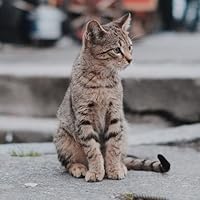
The past, present and future of the world's most popular and beloved pet, from a leading evolutionary biologist and great cat lover.
Why don’t lions meow? Why does my cat leave a dead mouse at my feet? And why is a pet ocelot a bad idea?
Jonathan B. Losos unravels the secrets of the cat using all the tools of modern technology, from GPS tracking (you’ll be amazed where they roam) and genomics (what is your so-called Siamese cat, really?) to forensic archaeology. He tells the story of the cat’s domestication (if you can call it that) and gives us a cat's-eye view of the world today. Along the way we also meet their wild cousins, whose behaviours are eerily similar to even the sweetest of house cats.
Drawing on his own research and life in his multi-cat household, Losos deciphers complex science and history and explores how selection, both natural and artificial, over the millennia has shaped the contemporary cat.
Yet the cat, ever a predator, still seems to have only one paw out of the wild, and readily reverts to its feral ways as it occupies new habitats around the world. Looking ahead, this charming and intelligent book suggests what the future may hold for the special bond between Felis catus and Homo sapiens.
Enjoyable, but a mixed bag. As a lifelong cat person, I'm always in search of serious, credible, scientific information about these beings with whom I share my life. Losos is a breezy, readable, affable guide to the scientific literature about cats: how they evolved, spread throughout the world and were domesticated (sort of), the varieties there are: big cats vs small cats, purebreds vs randombreds, house cats vs wildcats; and how they live their lives under various circumstances. He's a hands-on sort of guy: after researching the various studies that track free-ranging cat activity (or lack thereof) via GPS and/or videorecordings, he gets one for his own cat and "replicates" the data point of his cat Winston himself. We get a peek into the world of the "cat fancy," cat shows, and breeders. I kept wandering out of the room to read tidbits to my husband and whichever cats were nearby, who stared at me sagely with a look like, well, duh! Cat lovers will find lots of such snippets to enjoy.
However, an editor might have put a gentle paw on Losos's arm to rein in an excess of genomics - lengthy, detailed descriptions of genes and alleles and natural selection and the bits and pieces that influence coat color and texture, body shape, ear placement, even tooth length. While I always applaud good efforts to explain scientific information to interested laypeople, sometimes there is just too much of a good thing, and eyes start to glaze. He also gets rather excited about the messing about with genes that humans like to do to animals - like maybe creating cats that don't want to go outdoors, in order to keep the cats and the world's birds safer - while being appropriately critical of the wretchedness of Persian cats deliberately bred to not have a nose or the Scottish Fold cats whose ears lie flat because of a genetic defect that actually weakens ALL their cartilage, dooming them to deteriorating and painful joints. But I part company with him when he enthuses about the potential for re-creating small, friendly saber-toothed cats, or the penchant of breeders to create "new" cat breeds via crossbreeding with servals or other cat types, creating a whole lot of "not quite there" versions along the way - who all need homes too, right? The ethics of deliberately creating a whole lot of "stylish" new cats as status symbols and commercial merchandise doesn't really come up, and I fault him for that.
Other readers have complained about the plethora of footnotes - I read and enjoy those extra asides and scraps of information. But for a book intended to transmit scientific information, I hated the way the references are given - dense paragraphs listing mostly websites at the back of the book, and while he clearly knows the literature and the experts, his reliance in the text on references to Facebook pages and online surveys can feel a bit superficial. Still, I'd have loved to take his introductory "Science of the Cat" class!
ADDENDUM: Just because I like to do this, I found Losos's email address and wrote him a "fan letter." I told him how much I enjoyed much of his book, and described our own household's anecdotal evidence of the socialization of feral kittens adopted at different ages, which exactly matched what he wrote in the book. I chided him cheerfully about the genetic meddling issue, and he said he and his editor had had long discussions about that. He originally wrote a much longer, more detailed discussion of the ethical issues, etc., but it kind of got left on the cutting room floor. He said he expected to get more pushback on what was published than he's gotten so far. I also said that while I was sure his cat Nelson is a very fine cat, I felt obliged to correct him that The Best Cat in the World is NOT Nelson, but in fact lives with me and his name is Little Fox, photo attached. He gracefully agreed that they could share the title. So it was a very friendly and pleasant exchange all the way around! I love when that happens.
Very mixed emotions about this book. I originally expected to enjoy it more and rate it a lot higher. The author has a very enjoyable conversaitonal style, and this book is full of fascinating (and sometimes funny) information about cats today and in history, like the practice in ancient Egypt of family members shaving their eyebrows to mourn their cat's death. Unfortunately, he REALLY likes his subject, and there is MUCH too much detail in many areas, wordy and often repetitive, especially in how studies were conducted and the science of the genetics. Several times I was tempted to quit.
I LOVE cats. I've pretty much wanted a cat since I knew what a cat even was, though it took about 15 years for this dream to come to fruition with the arrival of Tiggy (above). If anything, my interest in cats has gone up more now that I have one of my own, so I figured this book would be catnip for me. (Apologies for the terrible pun...)
Unfortunately, while Losos is dealing with some interesting subject material, he manages to suck much of the fascination from it. There are what feels like countless chapters on feline genetics, presented in a particularly mind-numbing way that relies heavily on the use of repetition and footnotes. Losos is a very big fan of footnotes. They have their place, but he uses them CONSTANTLY to insert random irrelevant pieces of data, and I found my patience wearing thin.
The chapters on cat history (specifically the fun lives they led in ancient Egypt) are better, probably because genetics is Losos's own specialism so he went overboard there. When he tones it down, as he does in the history chapters, he reveals himself to be a mildly funny and sometimes even interesting writer. I especially liked the fact about how the earliest archaeological evidence we have on human-cat ownership comes from a guy in ancient Cyprus, who was buried with his pet cat over 9000 years ago.
Leaving this one on hold for now, but I hope to return and slog it out later.
Pretty good book -- really a collection of essay-chapters. Some are first rate. Others you can skim or skip over. Such as his proposal to design a new breed of lapcat: a cuddly mini sabre-tooth! That would be a challenge. And the kitty-cam chapter goes on and on and ON. He's an enthusiastic writer, a working biologist (lizard evolution), and knows his stuff. But he tends to get carried away!
The review to read first is Julie Stielstra's: https://www.goodreads.com/review/show... Preview: "Enjoyable, but a mixed bag. As a lifelong cat person, I'm always in search of serious, credible, scientific information about these beings with whom I share my life. ... However, an editor might have put a gentle paw on Losos's arm to rein in an excess of genomics ...."
Back already? The book starts out well, but I didn't end up liking it as much as I had hoped. Still, if you are a fellow cat-person, you will definitely want to take a look. A *selective* look.
The review that led me to read the book: WSJ review: https://www.wsj.com/arts-culture/book... (Paywalled. As always, I'm happy to email a copy to non-subscribers.) Excerpt: "... as a specialist in lizard biology, he is at one or two removes from the field, allowing him to examine the research with a little more distance and to situate it within a broader context. .... He explores the gigantic cat-data repository called YouTube. He offers engaging portraits of biologists who reveal feline secrets using genomic tools, isotopic signatures and kittycams."
Very much worth reading for anyone interested in kitty cats and the nice review of how evolution works is always of interest to me. There is a good deal of humor mixed in with the facts, which seem very up-to-date. I am not really interested in cat shows but the author wrote about these in such an entertaining way that I can't object. I'm sure anyone who loves cats would love this book.
I mostly enjoyed the parts about the history of cats, their relationship with people, and their behaviors. I did not care for the speculation about the genetic modulation of cats to make them more " people-oriented." Leave cats alone - they are what they are, and that is what makes them special!
Visto il titolo, mi aspettavo un libro sì informativo (è pur sempre un saggio in una collana importante) ma anche divertente. E nonostante abbia i suoi momenti, è molto più scientifico di quanto mi aspettassi (e infatti non è il titolo originario). Il fatto è che su alcune cose è molto specifico, un buon 60% è dedicato proprio solo ed esclusivamente alla genetica dei gatti, con prove ed esempi. Interessante ma forse un po' troppo settoriale se uno non è così tanto appassionato di genetica. Ci sono comunque un sacco di cose interessanti, intanto certe conferme (tipo che i gatti non si sono evoluti poi troppo), tutta la questione delle razze e degli allevamenti (con quello che comporta a livello etico) e del comportamento all'esterno dei gatti domestici.
Un saggio che qualunque gattaro di questo mondo dovrebbe leggere.
Non tratta tanto di come allevare un gatto, di quali sono i suoi comportamenti tipici o della descrizione delle varie razze, ma di come il gatto, da essere selvatico, si sia nei secoli evoluto per divenire l'animale di compagnia preferito dai Sapiens e diffuso ovunque in numeri incredibili (si stima che la popolazione di gatti attualmente sul pianeta sia di 1 miliardo di esemplari). E di come l'evoluzione dei gatti, soprattutto di razza, abbia avuto una accelerazione poderosa nel Novecento, grazie alla selezione artificiale che da un lato ha portato alla creazione di un numero notevole di razze feline completamente diverse l'una dall'altra e che in seconda battuta ha sviluppato gatti sempre più mansueti e affettuosi nei confronti dell'uomo.
Personalmente, ringrazio, essendo possessore di due gatti straordinariamente affettuosi e amorevoli.
I loved this book and have been recommending it to everyone I know who enjoys science and/or cats. A great survey course on the most recent scientific understanding of feline domestication, past and present.
Gave me some great new food for thought on the value of breeding cats intentionally (and how the circumstances differ vastly from dogs).
Often more questions than answers, but what questions they are! 😻
I love cats and the author clearly loves cats, but I ain´t gonna lie. I listened to this on audio and kept realising my mind had wandered off too many times. It is not uninteresting or badly written, but I don´t know if it was what I was looking for in the first place. Leaving this one without a rating because I have no idea how to rate it.
Wirklich nett, aber hätte mir ein wenig mehr Biologie gewünscht a la „warum Katze immer auf vier Beinen landet oder Brezel machen kann“ statt 150 Beispiele verschiedener Rassen zu hören…
✦ Interesting for about the first 35% (or at least I recall still being engaged then) and then became more boring as Losos discussed how specific breeds were developed by so and so people from some cats they picked up on the street or encountered randomly ... blabla. I didn’t realize Losos would spend entire chapters waxing about specific breeds — those rapidly became my least favorite.
Also I’m not a fan of pedigreed cats (or pedigreed pets in general — again ’cause there are a lot of other animals out there who need adopting, but also because of multiple reasons such as: “pedigree” is yet another way of putting status signals up — ‘look at me, I can afford a pedigreed pet’ and also because “pedigree” is yet another manufactured demand bullshit schema feeding into our capitalist society).
Losos seems to like pedigreed cats, so he waxes poetic about them, but doesn’t seem to be able to muster up the same vigorous defense for adopting, y’know, non-pedigreed cats. His defense is “with pedigrees, you know what you’re getting!! Personality!! Temperament!!” Pretty sure if you look for an adult cat at a shelter, their personality & temperament will be pretty well-known.
✦ Losos apparently doesn’t see any contradiction between the havoc cats wreak on the environment and his own decision to let his cats outside. “A majority of the environmental destruction comes from unowned cats,” he tells us self-importantly. Sure — but doesn’t mean your owned cat wandering around doesn’t contribute to the havoc. Similarly, corporations and first-world countries have an outsized responsibility for the climate crisis we find ourselves in, but that doesn’t mean individuals and developing countries shouldn’t also try to limit their impact within their means.
And he absolutely has the means to give his cats a catio, I’m pretty sure. He’s an evolutionary biologist in a first-world country who’s a published author about cats. He’s rich.
✦ He absolutely had to put in a section to humble brag about one of his pedigreed cats becoming a premier or whatever. Jesus. I thought it was going to go somewhere, and I was like … oh. He just wanted to brag about his cat.
OK, legit, but where are the pictures?
✦ For real though — for a book about cats, it doesn’t have enough cat pictures. He had like one pic of Nelson I think it was wearing his nice vest. But what about Winston?? Those once-in-a-while b&w illustrations DO NOT CUT IT. Just for the non-payment of cat tax, this book is like negative 4★.
This entire review has been hidden because of spoilers.
I’m actually more of a dog than a cat person, but thought… what the heck? I loved improbable destinies by this author, so expected to love this one.
However, despite the breezy conversational style, I found it kind of dull. Way too much focus on cat breeds/ cat fancy and genetics, not enough on adaptations and senses. The author isn’t rescuing cats or even keeping them indoors, practices that are ethically dubious. And sometimes he even took the conversational style a bit too far. Please don’t ‘trigger warning’ me about lion infanticide.
I liked the first half on evolution and phylogeny quite a bit. I did not realize how extensive the cat family is. The parts on breeding cats with their wild ancestors was interesting too as was the speculation on their domestication.
Perhaps I am just not the audience for this book. I think if you’re a cat nut and a science geek this is the one for you. I pushed myself to finish this one as it wasn’t the page turner the author previously wrote.
Anything about Cats and am there….this was really fun interesting read that made me question my own little cats behaviours and quirks I always say he is a wee snow leopard at heart and this book proves it. Can tell the author is very a cat person in his writing. Think this would make a great stocking filler gift at Christmas. Sorry for the rushed the review but I hear the meowing from downstairs telling me to get my nose off a book and feed the boss…. It’s a paws up read here
Fascinating early on, but it degraded by the chapters on breeding arrived. By chapter 14 it was disgusting, and I couldn’t make it through the pages on ‘twisters.’ How can the breeders look at what they have done and go home without feeling guilty? I guess they pass that part off on others, as long as the money keeps coming in.
I've got three cats and learnead a lot about them reading this book. Well researched, informative, and easy to read. Highly recommended. Many thanks to the publisher for this arc, all opinions are mine
I've read a lot about biology the last couple of years. What becomes obvious, and makes me wish I'd had better teachers, is how none of biology makes sense without the theory of evolution. How could we have lions and tigers and cheetahs and housecats and know they're all cats if evolution wasn't a thing? But I went to school in Alabama, so I had to wait until college before I got a decent-ish grounding in evolution and how it works. Sometimes I think I might have gone further in the sciences if I'd had better schooling, but then I remember how dissecting a starfish nearly made me puke, so maybe not.
This is an accessible and interesting overview of the current state of biological knowledge about cats. Where did housecats come from, how did they evolve, how were they domesticated, and how did we learn about them are all covered in this book. The author is a certified cat fan and he writes with humor and heart about the little fluffy beasts that live in our homes.
Mildly disappointing. The subtitle should be something more like "a bunch of loosely disconnected facts about cats, observations on the non-existence of cat research, and obsessive concern with different cat breeds." None of which is bad or exactly off point, but I was hoping for more from an author whose Impossible Destinies is one of the best books I've read in recent years about evolution. If you do care about cat shows and breeds, you'll probably like that more than I did.
This often felt like all of my undergrad evolution classes word vomited onto the page, and there were several times I considered DNFing. But, I can’t deny the fact that I feel incredibly well versed in cat breeds and that I have properly armed myself with fun facts about cats (my goal w/ the book). The author does a nice job of keeping the tone conversational even when the descriptions got pretty science heavy.
Три звёзды - достаточно много для этой книги, но они заслужены. На удивление, о кошках известно не так уж и много, и финансирование на их изучение приходится буквально выгрызать! Четких ответов на многие вопросы не найти (как и в любой книге, касающейся ДНК), но само повествование идёт легко и подаётся с юмором. Советую для всех, кто интересуется историей кошачьих и их разведением:)
Мало про поведение кошек, много о всякой другой хрени. За генетические вставки спасибо, но про камеры, камон, мы все знаем что сначала они были больше и неудобные, а потом стали маленькие и удобные. Не надо об этом целую главу писать. Жаль, но автор не в курсе, что краткость как бы сестра таланта, он пока слишком любит все, что выходит из под его пера, ничего не отбрасывает.
Die Evolution und Ist-Stand Ein grandioses Buch, dass die Adaptionsfähigkeit und flexible Evolution der Katzen sehr schön darstellt. Für jeden Katzenmenschen eine absolute Empfehlung. Wissenschaft, die Freude macht.






![Profile Image for Namera [The Literary Invertebrate].](https://i.gr-assets.com/images/S/compressed.photo.goodreads.com/users/1773790297i/31792110._UX200_CR0,33,200,200_.jpg)