

What do you think?
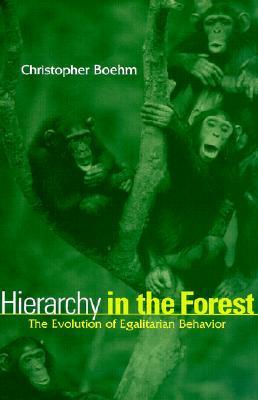
Hierarchy in the Forest: The Evolution of Egalitarian Behavior
Are humans by nature hierarchical or egalitarian? Hierarchy in the Forest addresses this question by examining the evolutionary origins of social and political behavior. Christopher Boehm, an anthropologist whose fieldwork has focused on the political arrangements of human and nonhuman primate groups, postulates that egalitarianism is in effect a hierarchy in which the weak combine forces to dominate the strong.
The political flexibility of our species is we can be quite egalitarian, we can be quite despotic. Hierarchy in the Forest traces the roots of these contradictory traits in chimpanzee, bonobo, gorilla, and early human societies. Boehm looks at the loose group structures of hunter-gatherers, then at tribal segmentation, and finally at present-day governments to see how these conflicting tendencies are reflected.
Hierarchy in the Forest claims new territory for biological anthropology and evolutionary biology by extending the domain of these sciences into a crucial aspect of human political and social behavior. This book will be a key document in the study of the evolutionary basis of genuine altruism.
The political flexibility of our species is we can be quite egalitarian, we can be quite despotic. Hierarchy in the Forest traces the roots of these contradictory traits in chimpanzee, bonobo, gorilla, and early human societies. Boehm looks at the loose group structures of hunter-gatherers, then at tribal segmentation, and finally at present-day governments to see how these conflicting tendencies are reflected.
Hierarchy in the Forest claims new territory for biological anthropology and evolutionary biology by extending the domain of these sciences into a crucial aspect of human political and social behavior. This book will be a key document in the study of the evolutionary basis of genuine altruism.
304 pages, Paperback
First published December 1, 1999
Ratings & Reviews
Friends & Following
Create a free account to discover what your friends think of this book!
Community Reviews
Displaying 1 - 28 of 28 reviews

September 9, 2024
(Materialist) Anthropology 101: “Human Nature”?
Preamble:
--Beneath the popularity of Graeber/Wengrow’s 2021 best-seller The Dawn of Everything: A New History of Humanity is a storm of debates in the field which Graeber had the greatest responsibility in representing/popularizing: (critical) anthropology.
--Unpacking (materialist) anthropology’s critique of Graeber’s idealism was a fruitful challenge. Graeber’s writings (critically communicating social structures beneath surface appearances… all in a playful style!) have been a huge inspiration for me to explore/share how the world works through critical nonfiction (I still remember reading Debt: The First 5,000 Years while visiting China).
--Within this materialist critique of Graeber, Boehm’s 1999 book is foundational. I have a bunch of other reviews in progress just waiting for this one to lay out the structures…
The Good:
1) “Human Nature” History:
--The “materialist” lens starts with the material conditions, as opposed to the idealist lens starting with ideas (i.e. culture). For “human nature”, it’s inevitable that we connect cultural analysis to natural history at some point…
--Bruce M. Knauft’s U-shaped riddle: humans seem to have originated from despotic (social dominance) hierarchy (given relations with despotic great apes), then seem to evolve egalitarian politics as hunter-gatherers for hundreds of thousands/“possibly millions of years”, only to suddenly revive despotic hierarchy in the last thousands of years…
i) Despotic Origins:
--7 million years ago was the last of the “Common Ancestor” of the 4 African-based hominoids: gorillas/chimpanzees/bonobos/humans.
…At this time, the gorilla was the first to split. Today’s gorillas are despotic, with alpha males (“silverback”) having a huge size dominance over females (harem structure of multiple females and offsprings).
--Humans split 5 million years ago. Chimpanzees and bonobos split 1.5-3 million years ago. Bonobos are “semi-despotic”, organized by female coalitions. Chimpanzees are more generalist, thus more compared with humans; alpha male chimps are more bullies that regulate conflicts; resources are more dispersed than for gorillas, so chimps have more mobility.
--Humans, meanwhile, developed pre-adaptations to egalitarian politics: weapons likely triumphed over physical features (esp. difference in size between males vs. females, along with canine teeth for fighting and body hair for bluffing).
…Large-game hunting (esp. during climate instability/cooling) likely encouraged cooperation and sharing. Large brain development evolved language, useful for social gossiping (leveling mechanism against deviants, esp. alpha males), imagining the future, intuition on human nature, etc. …leading to Culture (100,000 years ago)/Cognitive Revolution (70,000 years ago).
ii) Egalitarian Hunter Gatherers:
--The estimate here ranges from “possibly millions of years” to a conservative starting point of 100,000 years ago (Middle Paleolithic).
--Since archaeological evidence is sparse, the evidence revolves around the aforementioned pre-adaptation theories and most importantly ethnographical studies of modern hunter gatherers.
--The key political commonality for modern hunter gatherers in every continent with diverse ecologies/cultures is an “egalitarian ethos” to prevent alpha male upstarts leading to despotic rule. Note: the focus here is on the band kinship level above the nuclear family. This political egalitarianism is most notable in adult males (hunting/warfare). My next review focuses on female/family in Mothers and Others: The Evolutionary Origins of Mutual Understanding.
--“Bands” here are used for nomadic (mobility), basically hunter gatherers. Woodburn's “Egalitarian Socieites” considers the material conditions most connected to egalitarianism:
a) “immediate return” hunter gatherers
b) in contrast to “delayed return”, which uses long-term food storage (thus, surplus/material accumulation).
...Outside the family, the band does not have specialized economic production (Adam Smith’s division of labour).
--The Neolithic (starting 12,000 years ago) brought the Agricultural Revolution, with nomadic bands shifting to tribes (i.e. with domestication: horticulturalists being settled while pastoralists remaining nomadic; but all are still stateless). Despite the material changes of food surplus/settled/population increases, the “egalitarian ethos” often remained but seems to be eroding. I’m assuming this is because the material changes were not yet significant enough to derail the cultural preferences.
…However, with the rise of surplus/settlement/population density comes property and “genocidal” warfare, and thus systematic patriarchy: military male status/patrilineal inheritance/patrilocal residence.
--“Big Man” societies are a form of egalitarian tribal society marked by Big Men hosting hyper-generous feasts, thus losing their humility.
iii) Despotic Civilizations:
--The past 5,000 years have seen increasing despotic hierarchy, with tribes becoming chiefdoms (hereditary privilege; “egalitarian ethos” is lost although still some first-among-equals in public opinion), primitive kingdoms (royals/noble intermediaries/slaves), and eventually ancient civilizations/modern states (writing/bureaucracy/economic specialization social classes).
--Boehm adds the past centuries has seen some reversals, listing democracy/women’s rights/decolonization.
…see comments below for rest of the review…
Preamble:
--Beneath the popularity of Graeber/Wengrow’s 2021 best-seller The Dawn of Everything: A New History of Humanity is a storm of debates in the field which Graeber had the greatest responsibility in representing/popularizing: (critical) anthropology.
--Unpacking (materialist) anthropology’s critique of Graeber’s idealism was a fruitful challenge. Graeber’s writings (critically communicating social structures beneath surface appearances… all in a playful style!) have been a huge inspiration for me to explore/share how the world works through critical nonfiction (I still remember reading Debt: The First 5,000 Years while visiting China).
--Within this materialist critique of Graeber, Boehm’s 1999 book is foundational. I have a bunch of other reviews in progress just waiting for this one to lay out the structures…
The Good:
1) “Human Nature” History:
--The “materialist” lens starts with the material conditions, as opposed to the idealist lens starting with ideas (i.e. culture). For “human nature”, it’s inevitable that we connect cultural analysis to natural history at some point…
--Bruce M. Knauft’s U-shaped riddle: humans seem to have originated from despotic (social dominance) hierarchy (given relations with despotic great apes), then seem to evolve egalitarian politics as hunter-gatherers for hundreds of thousands/“possibly millions of years”, only to suddenly revive despotic hierarchy in the last thousands of years…
i) Despotic Origins:
--7 million years ago was the last of the “Common Ancestor” of the 4 African-based hominoids: gorillas/chimpanzees/bonobos/humans.
…At this time, the gorilla was the first to split. Today’s gorillas are despotic, with alpha males (“silverback”) having a huge size dominance over females (harem structure of multiple females and offsprings).
--Humans split 5 million years ago. Chimpanzees and bonobos split 1.5-3 million years ago. Bonobos are “semi-despotic”, organized by female coalitions. Chimpanzees are more generalist, thus more compared with humans; alpha male chimps are more bullies that regulate conflicts; resources are more dispersed than for gorillas, so chimps have more mobility.
--Humans, meanwhile, developed pre-adaptations to egalitarian politics: weapons likely triumphed over physical features (esp. difference in size between males vs. females, along with canine teeth for fighting and body hair for bluffing).
…Large-game hunting (esp. during climate instability/cooling) likely encouraged cooperation and sharing. Large brain development evolved language, useful for social gossiping (leveling mechanism against deviants, esp. alpha males), imagining the future, intuition on human nature, etc. …leading to Culture (100,000 years ago)/Cognitive Revolution (70,000 years ago).
ii) Egalitarian Hunter Gatherers:
--The estimate here ranges from “possibly millions of years” to a conservative starting point of 100,000 years ago (Middle Paleolithic).
--Since archaeological evidence is sparse, the evidence revolves around the aforementioned pre-adaptation theories and most importantly ethnographical studies of modern hunter gatherers.
--The key political commonality for modern hunter gatherers in every continent with diverse ecologies/cultures is an “egalitarian ethos” to prevent alpha male upstarts leading to despotic rule. Note: the focus here is on the band kinship level above the nuclear family. This political egalitarianism is most notable in adult males (hunting/warfare). My next review focuses on female/family in Mothers and Others: The Evolutionary Origins of Mutual Understanding.
--“Bands” here are used for nomadic (mobility), basically hunter gatherers. Woodburn's “Egalitarian Socieites” considers the material conditions most connected to egalitarianism:
a) “immediate return” hunter gatherers
b) in contrast to “delayed return”, which uses long-term food storage (thus, surplus/material accumulation).
...Outside the family, the band does not have specialized economic production (Adam Smith’s division of labour).
--The Neolithic (starting 12,000 years ago) brought the Agricultural Revolution, with nomadic bands shifting to tribes (i.e. with domestication: horticulturalists being settled while pastoralists remaining nomadic; but all are still stateless). Despite the material changes of food surplus/settled/population increases, the “egalitarian ethos” often remained but seems to be eroding. I’m assuming this is because the material changes were not yet significant enough to derail the cultural preferences.
…However, with the rise of surplus/settlement/population density comes property and “genocidal” warfare, and thus systematic patriarchy: military male status/patrilineal inheritance/patrilocal residence.
--“Big Man” societies are a form of egalitarian tribal society marked by Big Men hosting hyper-generous feasts, thus losing their humility.
iii) Despotic Civilizations:
--The past 5,000 years have seen increasing despotic hierarchy, with tribes becoming chiefdoms (hereditary privilege; “egalitarian ethos” is lost although still some first-among-equals in public opinion), primitive kingdoms (royals/noble intermediaries/slaves), and eventually ancient civilizations/modern states (writing/bureaucracy/economic specialization social classes).
--Boehm adds the past centuries has seen some reversals, listing democracy/women’s rights/decolonization.
…see comments below for rest of the review…

April 7, 2016
Christopher Boehm is a professor of anthropology and director of the Jane Goodall Research Center at the University of California. He has read hundreds of anthropological studies on a variety of human societies. He also spent time with Goodall at Gombe National Park, observing the behavior of wild chimpanzees. These experiences inspired him to speculate on our evolutionary journey, and to attempt the daunting challenge of defining “human nature,” the core essence shared by all humans. He presented his ideas in Hierarchy in the Forest.
Before we begin, the goal of my work is to help people who are interested in learning about ecological sustainability. Boehm’s book pays little attention to ecology, and I quit reading about 75 pages before the end. Folks who are eager to learn about the various trends and controversies in cultural anthropology should put it on their reading list. I was intrigued by some of the passages I read. My plan is to jabber a bit about these, and then call it a day.
There are numerous types of societies, ranging from egalitarian (no bosses) to hierarchical (some have more power than others). Among hierarchical societies, some have many layers of rank and status, like wolf packs. At the extreme, despotic societies have a dominant alpha to whom all others must submit, like chimps or Nazis. Boehm presented theories on the evolution of politics and morality among chimps, bonobos, gorillas, and humans. Based on how the four species behave today, he imagined that the common ancestor of all four, who lived seven million years ago, was innately despotic — and that all four today remain near the despotic end of the political spectrum.
He believed that humans took a strange path. In the beginning, we were hierarchical. Later, for much of the hunter-gatherer phase, we were egalitarian. Then, around 12,000 years ago, with the domestication of plants and animals, hierarchy returned to ascendance, and grew to monstrous proportions over the centuries. This was not black and white, some early societies of herders or horticulturalists remained egalitarian, despite having private property and unequal wealth.
Oddly, egalitarian societies were also hierarchical. Civilized societies have pyramid-shaped hierarchies, with the powerful at the top, and the dominated masses spread out below. Egalitarian societies have an upside down pyramid, a “reverse dominance hierarchy.” When someone began behaving in an inappropriate manner, the entire group united to confront the misbehaving oddball.
Cooperation was fundamental to the success of hunter-gatherer societies, so conflict avoidance was imperative. Upstart males, exhibiting impulses to dominate others, were a serious threat to the stability and survival of the society. Nothing was more uncool. The antidote to disruptive upstarts was sanctions — criticism, ridicule, disobedience, ostracism, shunning. Sanctions often helped the upstart get the message, and return to conformity. If these failed, the upstart might move to a different group. If all else failed, he might be executed.
Hunter-gatherer cultures had time-proven methods for encouraging conformity, and discouraging the impulses of problem personalities. It was always uncool to be boastful, arrogant, or overbearing. When a hunter brought home excellent meat, he would apologize for the worthless crap that was unfit for dog food. Self-depreciation helped to level out differences, and discourage painful swellings of pride.
Once upon a time, Boehm had succeed in earning the trust of Navajo elders, in his quest to learn about mental illness in the tribe. One day, he realized that he had left a watermelon in his car, which he had bought to be a gift. He ran out, got it, ran back, offered it to the elder — and immediately obliterated the trust he had carefully earned, terminating his research. His action had been too sudden, and was perceived as aggressive. The Navajo have a low opinion of white people, and are highly distrustful of them. In Indian country, people are expected to be calm, composed, dignified, and respectful.
One passage especially touched me. Jean Briggs was an anthropologist who spent more than a year with the Utku Eskimos of northern Canada. She apparently behaved like an ordinary American, who had moody days, and sometimes displayed a flash of anger when irritated. This freaked out the Eskimos, who sometimes ran out the cabin when she was crabby and hissing. In that society, folks were expected to smile, laugh, and joke — to behave like happy people. Nothing was more uncool than showing your emotions, because strong thoughts can kill or cause illness. Anger was dangerous juju, highly toxic.
The Eskimos tolerated a lot of extremely inappropriate behavior, because Briggs was a visitor from a tribe that was notoriously loony. They gave her hints for behaving more politely, but she missed their meaning. Eventually, they reached their limits, and Briggs became a nonperson. She simply could not learn how to conform.
Briggs was brought up in a hierarchical culture, where we all compete against one another to acquire, hoard, and display the most status trinkets. Self-centeredness is the expected norm. Most of us live amidst hordes of perfect strangers, and the sight of strangers must make our tropical primate brains squirm and sweat. When chimps see a strange male, they don’t welcome him with smiles and hugs; they kill him. Gorillas are also impolite to unknown visitors. Of course, humans take great delight in savagely killing foreigners by the millions.
It’s hard for us to imagine spending our entire lives among a small group of people, where survival depends on cooperation, where competition and conflict were toxic. The Eskimos were not merely “acting” happy. They were raised in a culture where it was normal and healthy to mindfully maintain respectful relationships with all others. They had to spend long dark winters in close quarters, so it was impossible to tolerate selfish spoiled brats or infantile tyrants. Everyone’s highest responsibility was to maintain the stability of the group.
Boehm’s book was published in 1999. Most research on wild bonobos occurred after 2003. Early studies had to be abandoned, because of a civil war that raged between 1994 and 2003, claiming three million lives. Based on incomplete information, Boehm assumed that bonobos were at the despotic end of the spectrum, but later research revealed that they were remarkably egalitarian. Also, they were not egalitarian in the sense of “reverse dominance hierarchy.” For bonobos, egalitarian behavior was normal, natural, almost effortless. Humans are closely related to both despotic chimps and egalitarian bonobos.
Why are chimps and bonobos so different? Ecology may be the primary factor. Bonobos enjoy an ideal habitat, with abundant food, and no serious competitors in their niche. Chimps live in leaner lands, and compete for food with gorillas and baboons. Scarcity creates tensions, and territorial boundaries must be aggressively defended against trespassers. Crowding is the mother of conflict. Extreme crowding turns humans into bloodthirsty mass murdering maniacs.
Before we begin, the goal of my work is to help people who are interested in learning about ecological sustainability. Boehm’s book pays little attention to ecology, and I quit reading about 75 pages before the end. Folks who are eager to learn about the various trends and controversies in cultural anthropology should put it on their reading list. I was intrigued by some of the passages I read. My plan is to jabber a bit about these, and then call it a day.
There are numerous types of societies, ranging from egalitarian (no bosses) to hierarchical (some have more power than others). Among hierarchical societies, some have many layers of rank and status, like wolf packs. At the extreme, despotic societies have a dominant alpha to whom all others must submit, like chimps or Nazis. Boehm presented theories on the evolution of politics and morality among chimps, bonobos, gorillas, and humans. Based on how the four species behave today, he imagined that the common ancestor of all four, who lived seven million years ago, was innately despotic — and that all four today remain near the despotic end of the political spectrum.
He believed that humans took a strange path. In the beginning, we were hierarchical. Later, for much of the hunter-gatherer phase, we were egalitarian. Then, around 12,000 years ago, with the domestication of plants and animals, hierarchy returned to ascendance, and grew to monstrous proportions over the centuries. This was not black and white, some early societies of herders or horticulturalists remained egalitarian, despite having private property and unequal wealth.
Oddly, egalitarian societies were also hierarchical. Civilized societies have pyramid-shaped hierarchies, with the powerful at the top, and the dominated masses spread out below. Egalitarian societies have an upside down pyramid, a “reverse dominance hierarchy.” When someone began behaving in an inappropriate manner, the entire group united to confront the misbehaving oddball.
Cooperation was fundamental to the success of hunter-gatherer societies, so conflict avoidance was imperative. Upstart males, exhibiting impulses to dominate others, were a serious threat to the stability and survival of the society. Nothing was more uncool. The antidote to disruptive upstarts was sanctions — criticism, ridicule, disobedience, ostracism, shunning. Sanctions often helped the upstart get the message, and return to conformity. If these failed, the upstart might move to a different group. If all else failed, he might be executed.
Hunter-gatherer cultures had time-proven methods for encouraging conformity, and discouraging the impulses of problem personalities. It was always uncool to be boastful, arrogant, or overbearing. When a hunter brought home excellent meat, he would apologize for the worthless crap that was unfit for dog food. Self-depreciation helped to level out differences, and discourage painful swellings of pride.
Once upon a time, Boehm had succeed in earning the trust of Navajo elders, in his quest to learn about mental illness in the tribe. One day, he realized that he had left a watermelon in his car, which he had bought to be a gift. He ran out, got it, ran back, offered it to the elder — and immediately obliterated the trust he had carefully earned, terminating his research. His action had been too sudden, and was perceived as aggressive. The Navajo have a low opinion of white people, and are highly distrustful of them. In Indian country, people are expected to be calm, composed, dignified, and respectful.
One passage especially touched me. Jean Briggs was an anthropologist who spent more than a year with the Utku Eskimos of northern Canada. She apparently behaved like an ordinary American, who had moody days, and sometimes displayed a flash of anger when irritated. This freaked out the Eskimos, who sometimes ran out the cabin when she was crabby and hissing. In that society, folks were expected to smile, laugh, and joke — to behave like happy people. Nothing was more uncool than showing your emotions, because strong thoughts can kill or cause illness. Anger was dangerous juju, highly toxic.
The Eskimos tolerated a lot of extremely inappropriate behavior, because Briggs was a visitor from a tribe that was notoriously loony. They gave her hints for behaving more politely, but she missed their meaning. Eventually, they reached their limits, and Briggs became a nonperson. She simply could not learn how to conform.
Briggs was brought up in a hierarchical culture, where we all compete against one another to acquire, hoard, and display the most status trinkets. Self-centeredness is the expected norm. Most of us live amidst hordes of perfect strangers, and the sight of strangers must make our tropical primate brains squirm and sweat. When chimps see a strange male, they don’t welcome him with smiles and hugs; they kill him. Gorillas are also impolite to unknown visitors. Of course, humans take great delight in savagely killing foreigners by the millions.
It’s hard for us to imagine spending our entire lives among a small group of people, where survival depends on cooperation, where competition and conflict were toxic. The Eskimos were not merely “acting” happy. They were raised in a culture where it was normal and healthy to mindfully maintain respectful relationships with all others. They had to spend long dark winters in close quarters, so it was impossible to tolerate selfish spoiled brats or infantile tyrants. Everyone’s highest responsibility was to maintain the stability of the group.
Boehm’s book was published in 1999. Most research on wild bonobos occurred after 2003. Early studies had to be abandoned, because of a civil war that raged between 1994 and 2003, claiming three million lives. Based on incomplete information, Boehm assumed that bonobos were at the despotic end of the spectrum, but later research revealed that they were remarkably egalitarian. Also, they were not egalitarian in the sense of “reverse dominance hierarchy.” For bonobos, egalitarian behavior was normal, natural, almost effortless. Humans are closely related to both despotic chimps and egalitarian bonobos.
Why are chimps and bonobos so different? Ecology may be the primary factor. Bonobos enjoy an ideal habitat, with abundant food, and no serious competitors in their niche. Chimps live in leaner lands, and compete for food with gorillas and baboons. Scarcity creates tensions, and territorial boundaries must be aggressively defended against trespassers. Crowding is the mother of conflict. Extreme crowding turns humans into bloodthirsty mass murdering maniacs.

January 10, 2015
Great book and information. Terrible writing.
Pro:
This is must-know information for everyone working with groups. Very useful and informative to know that foragers became tribes and chiefdoms but still remained egalitarian as much as they could.
Con:
He starts the book with great examples from anthropology literature about bands and tribes. Great examples that illustrate his points. But the last 1/3 of the book is just mediocre philosophy without any good academic references like in the first part. Remove 60 various pages from this book and you have a great book - but still with a dry writing style. Only for nerds.
Pro:
This is must-know information for everyone working with groups. Very useful and informative to know that foragers became tribes and chiefdoms but still remained egalitarian as much as they could.
Con:
He starts the book with great examples from anthropology literature about bands and tribes. Great examples that illustrate his points. But the last 1/3 of the book is just mediocre philosophy without any good academic references like in the first part. Remove 60 various pages from this book and you have a great book - but still with a dry writing style. Only for nerds.

December 22, 2011
On early human politics. Did we/do we have to live in a world described by the hideous phraseology of dominance, submission and the alpha male?
No. We didn't; nobody (apes included) ever likes to, and we (and the apes indeed) defeated tyranny by coalitions, and kept tyranny down -- by the vigilance of coalitions. He looks at such behaviour in the apes, and in hunter-gatherers who remain in the world for us to study. Freedom, as a value, is gained and maintained in early-style societies, that are insistently egalitarian, against the ever-present threat. Apes don't come off well. I wish he had made a better use of bonobos, whom he seems to rate as hopelessly hierarchical like the others. ?
No. We didn't; nobody (apes included) ever likes to, and we (and the apes indeed) defeated tyranny by coalitions, and kept tyranny down -- by the vigilance of coalitions. He looks at such behaviour in the apes, and in hunter-gatherers who remain in the world for us to study. Freedom, as a value, is gained and maintained in early-style societies, that are insistently egalitarian, against the ever-present threat. Apes don't come off well. I wish he had made a better use of bonobos, whom he seems to rate as hopelessly hierarchical like the others. ?

September 18, 2016
Boehm has a relatively simple hypothesis: environmental circumstances pressured early hominids to evolve altruistically despite strong genetic pressure toward selfishness. His arguments are mostly convincing, and his knowledge of anthropology expansive enough to support any claims of expertise.
The packaging of this argument, however, leaves much to be desired. Boehm apparently feels the need to cover entirely too much ground in the effort to support his case, leaving the book feeling long, plodding, disorganized and convoluted. He also gets into trouble in the later goings with conspicuously thin hypothesizing while attempting to shore up any holes in his theory.
Chapter 7, "Ancestral Politics," is probably the most egregious chapter on the whole. Here he claims, for example, that the hominid's Common Ancestor had the potential to revolt against tyrannical leadership, but bases the claim solely on one documented instance among captive Chimpanzees. Another example of shoddy hypothesizing is evident in the "Pleiotropic Support" and "Warfare" hypotheses at the end of Chapter 9, the explanations of which more resemble throwing darts at a wall than any sort of scientific rigor.
Much of the book's value lies in the 1st half, where Boehm describes fascinating anthropological and primatological studies. He makes a decent argument for how weapons could have revolutionized political and social organization (Ch. 8), and gives countless examples of tribal prohibitions against selfishness. The most interesting points for me were his explanations of how tribes keep potential upstarts in check via an escalating spectrum of social sanctions. The tension between this reality and our alleged genetic selfishness, which do not theoretically allow for such communal actions, is the central conflict of the book.
I would recommend this book only to avid amateur anthropologists, because it becomes unfortunately dry and droning as it goes on. I also believe that political theorists, evolutionary psychologists or philosophers could get some value out of it, but that they can probably stop after Chapter 6 (p. 148) and not miss anything at all.
Not Bad Reviews
@pointblaek
The packaging of this argument, however, leaves much to be desired. Boehm apparently feels the need to cover entirely too much ground in the effort to support his case, leaving the book feeling long, plodding, disorganized and convoluted. He also gets into trouble in the later goings with conspicuously thin hypothesizing while attempting to shore up any holes in his theory.
Chapter 7, "Ancestral Politics," is probably the most egregious chapter on the whole. Here he claims, for example, that the hominid's Common Ancestor had the potential to revolt against tyrannical leadership, but bases the claim solely on one documented instance among captive Chimpanzees. Another example of shoddy hypothesizing is evident in the "Pleiotropic Support" and "Warfare" hypotheses at the end of Chapter 9, the explanations of which more resemble throwing darts at a wall than any sort of scientific rigor.
Much of the book's value lies in the 1st half, where Boehm describes fascinating anthropological and primatological studies. He makes a decent argument for how weapons could have revolutionized political and social organization (Ch. 8), and gives countless examples of tribal prohibitions against selfishness. The most interesting points for me were his explanations of how tribes keep potential upstarts in check via an escalating spectrum of social sanctions. The tension between this reality and our alleged genetic selfishness, which do not theoretically allow for such communal actions, is the central conflict of the book.
I would recommend this book only to avid amateur anthropologists, because it becomes unfortunately dry and droning as it goes on. I also believe that political theorists, evolutionary psychologists or philosophers could get some value out of it, but that they can probably stop after Chapter 6 (p. 148) and not miss anything at all.
Not Bad Reviews
@pointblaek

July 21, 2022
The best parts of the book were its surveys of the ethnographical literature of the political nature of egalitarian bands and tribes. Boehm convincingly shows that human egalitarianism, as both an ethos and a political system, is not due to an inherently peaceful nature. Instead, egalitarianism is enforced via complex (and often violent) social and behavioral mechanisms for the sharing of material resources and for preventing respected leaders from attaining routinized authority.
Does he succeed in explaining the "evolution of egalitarian behavior", though? I'm not sure - he demonstrates first that various primates have the disposition to be despotic, but also a weak disposition to form coalitions to resist domination. He then suggests that egalitarianism may be useful for the survival of small bands in conditions of unpredictable or scarce food supply, or in migratory situations where the band must collectively decide where it will travel. This is backed up by the ethnographies of modern hunter-gatherers. Finally, the last 100,000 years, with various ice ages, gave many times of scarcity, where egalitarianism may have been a successful strategy. This prolonged egalitarianism may have further influenced humanity's genetic disposition towards altruism (not to deny a contradictory disposition to selfishness).
But this seems to merely say: "egalitarianism was possible for humans, in certain material circumstances it is useful, and it may have changed our nature". The only "evolutionary" aspect of this argument is either a vague evolution of culture, or a genetic evolution of altruism that occurred after the development of egalitarianism.
Perhaps Boehm is suggesting that there was a positive feedback loop, where limited egalitarianism at the cultural level reinforced genetically-based altruistic traits which in turn allowed for a stronger, more effective egalitarianism. Thought-provoking, but needs a more careful study of altruism to be convincing, especially since his model of egalitarianism was based not on altruistic tendencies but on "reverse domination hierarchies".
Does he succeed in explaining the "evolution of egalitarian behavior", though? I'm not sure - he demonstrates first that various primates have the disposition to be despotic, but also a weak disposition to form coalitions to resist domination. He then suggests that egalitarianism may be useful for the survival of small bands in conditions of unpredictable or scarce food supply, or in migratory situations where the band must collectively decide where it will travel. This is backed up by the ethnographies of modern hunter-gatherers. Finally, the last 100,000 years, with various ice ages, gave many times of scarcity, where egalitarianism may have been a successful strategy. This prolonged egalitarianism may have further influenced humanity's genetic disposition towards altruism (not to deny a contradictory disposition to selfishness).
But this seems to merely say: "egalitarianism was possible for humans, in certain material circumstances it is useful, and it may have changed our nature". The only "evolutionary" aspect of this argument is either a vague evolution of culture, or a genetic evolution of altruism that occurred after the development of egalitarianism.
Perhaps Boehm is suggesting that there was a positive feedback loop, where limited egalitarianism at the cultural level reinforced genetically-based altruistic traits which in turn allowed for a stronger, more effective egalitarianism. Thought-provoking, but needs a more careful study of altruism to be convincing, especially since his model of egalitarianism was based not on altruistic tendencies but on "reverse domination hierarchies".
January 31, 2018
This book was super interesting and important because it really changed my understanding of hunter-gatherer egalitarian politics.
That being said, the author isn't a great writer; the book is repetitive, and it's annoying because this is not a report so much as a war cry and instruction manual for the assumed reader (the average man). "Guys!" Boehm says, "I have figured out a way for us to get rid of the alpha males that are stealing all the best chicks!"
I am super glad I read this book because I used to think hunter-gatherers lived in freedom. But hunter-gatherers are actually only free to be exactly like everyone else in their group. They are free to never earn more and free to share everything they do earn. They are free to never excel at anything, free to never be better than their neighbor, and free to never compete. And woah to the guy who is a better hunter than everyone else in his group - hunter-gatherers have a 15% homicide rate to deal with uppity people like that.
Boehm argues, convincingly, that hunter-gatherers were/are extremely hierarchical, extremely politically controlling and dominating - it's just the hierarchy pyramid is upside down. Rather than the heroes at the top ruling the kingdom, the peasants are at the top dominating the heroes.
Naturally Boehm idealizes this and thinks it was/would be a good thing. He thinks that the best hunter in a village should share all his meat, and that people should make sure he never gets a big head by not even appreciating his meat. The better you are, the more you should be made fun of and put down, so that you are kept on the same level as everyone else.
Explains everything I have always wondered about hunter-gatherers.
-Why such slow innovation?! Because you only have the freedom to be equal with everyone else, and innovating would make you a threat, and they would kill you.
-Why were the hunter-gatherers so easily obliterated by the hierarchical farmers? Because hunter-gatherers murder their best and brightest or at least keep them down whereas in hierarchies the best and brightest are encouraged, rewarded, and admired.
-I remember in Guns, Germs, and Steel when the hunter-gatherer asks the Westerner why the Westerner has so much more stuff than he has. Well, because we reward, admire, and revere those who invent stuff. Because... competition + property rights = extremely motivating.
-And finally, why did anyone ever agree to be ruled? Because it benefitted him (or her). Most likely an alpha-type female approached the best hunter and was like, "Let's go start our own band. Then you only have to share your meat with me. And in exchange, I will acknowledge that you are, in fact, the best hunter, and I won't try to keep you down, in fact, I'll let you boss me around. I'll make you a king." And then all the best hunters were like, "That is a WAY better arrangement!" And all the women thought so too because in exchange for giving their man some reverence, they had meat every day for them and their children. And best of all, the crafty female could tell everyone in the group that she wanted to share and be part of the group, but her husband just wouldn't allow it. She's just an innocent victim of this big, bad, bully man.... (She's playing both sides. If the group rises up and kills her husband, she can return to them.)
Also, Boehm, thinking that women are naturally submissive, ignores them for the entire book. Idiot. (I only say that to help him not get too big for his britches. It's good for people to be made fun of. I like what Jordan Peterson says about the oppressed woman narrative, "Have you ever been married? Have you ever actually tried to oppress a woman? It's really really hard.") What if women were largely responsible for hunter-gatherer egalitarianism? Who is more motivated to make sure the strongest is dominated - men or women? But then women realized that they could actually get a lot more from their best men in hierarchy. But a thousand years in men started to actually believe that they were the boss in the relationship and keep women down so ... back to egalitarianism. (The last four hundred years have seen a huge "feminization" of the political sphere according to Revolt of the Masses.) Hmmmmmm.
Then again, maybe it had nothing to do with women. Maybe at some point the best hunters realized that they didn't need the rest of the tribe, and they shrugged off together and invented a culture that worshipped the strong and the capable. They called it Rome.
The most annoying thing about this book was that, for Boehm, "best hunter" is sometimes synonymous with "despotic bully" and sometimes not, sometimes "best hunter" just means best hunter. Made the book confusing at times.
Lastly: seeing things from only one side is quite boring. I have presented the other side here in this review, but I can also see Boehm's side. He's not wrong. If you have the freedom to work harder than I do, you will eventually have more stuff than I have, and you will most likely end up with the best mate. You will also most likely end up with more power than I have. If I don't want you to have access to the best mate or to have more power than I have ... you must be prevented from working harder than I work. It's brilliant. To stop power you have to "nip it in the bud."
But as I said above, it doesn't work. Boehm, myopic academian that he is, seems to know little of history after hunter-gathers, like that societies that embraced hierarchy obliterated them. That will not change because ... math. If all the average people in the world move to Scandinavia to live out their fantasies of equality, and all the ambitious Scandinavians move to the United States to compete, who wins the eventual war? The best and brightest will always want to live where they are supported and encouraged, not where they are despised and oppressed. Hierarchy is a social technology that cannot be "uninvented."
That being said, the author isn't a great writer; the book is repetitive, and it's annoying because this is not a report so much as a war cry and instruction manual for the assumed reader (the average man). "Guys!" Boehm says, "I have figured out a way for us to get rid of the alpha males that are stealing all the best chicks!"
I am super glad I read this book because I used to think hunter-gatherers lived in freedom. But hunter-gatherers are actually only free to be exactly like everyone else in their group. They are free to never earn more and free to share everything they do earn. They are free to never excel at anything, free to never be better than their neighbor, and free to never compete. And woah to the guy who is a better hunter than everyone else in his group - hunter-gatherers have a 15% homicide rate to deal with uppity people like that.
Boehm argues, convincingly, that hunter-gatherers were/are extremely hierarchical, extremely politically controlling and dominating - it's just the hierarchy pyramid is upside down. Rather than the heroes at the top ruling the kingdom, the peasants are at the top dominating the heroes.
Naturally Boehm idealizes this and thinks it was/would be a good thing. He thinks that the best hunter in a village should share all his meat, and that people should make sure he never gets a big head by not even appreciating his meat. The better you are, the more you should be made fun of and put down, so that you are kept on the same level as everyone else.
Explains everything I have always wondered about hunter-gatherers.
-Why such slow innovation?! Because you only have the freedom to be equal with everyone else, and innovating would make you a threat, and they would kill you.
-Why were the hunter-gatherers so easily obliterated by the hierarchical farmers? Because hunter-gatherers murder their best and brightest or at least keep them down whereas in hierarchies the best and brightest are encouraged, rewarded, and admired.
-I remember in Guns, Germs, and Steel when the hunter-gatherer asks the Westerner why the Westerner has so much more stuff than he has. Well, because we reward, admire, and revere those who invent stuff. Because... competition + property rights = extremely motivating.
-And finally, why did anyone ever agree to be ruled? Because it benefitted him (or her). Most likely an alpha-type female approached the best hunter and was like, "Let's go start our own band. Then you only have to share your meat with me. And in exchange, I will acknowledge that you are, in fact, the best hunter, and I won't try to keep you down, in fact, I'll let you boss me around. I'll make you a king." And then all the best hunters were like, "That is a WAY better arrangement!" And all the women thought so too because in exchange for giving their man some reverence, they had meat every day for them and their children. And best of all, the crafty female could tell everyone in the group that she wanted to share and be part of the group, but her husband just wouldn't allow it. She's just an innocent victim of this big, bad, bully man.... (She's playing both sides. If the group rises up and kills her husband, she can return to them.)
Also, Boehm, thinking that women are naturally submissive, ignores them for the entire book. Idiot. (I only say that to help him not get too big for his britches. It's good for people to be made fun of. I like what Jordan Peterson says about the oppressed woman narrative, "Have you ever been married? Have you ever actually tried to oppress a woman? It's really really hard.") What if women were largely responsible for hunter-gatherer egalitarianism? Who is more motivated to make sure the strongest is dominated - men or women? But then women realized that they could actually get a lot more from their best men in hierarchy. But a thousand years in men started to actually believe that they were the boss in the relationship and keep women down so ... back to egalitarianism. (The last four hundred years have seen a huge "feminization" of the political sphere according to Revolt of the Masses.) Hmmmmmm.
Then again, maybe it had nothing to do with women. Maybe at some point the best hunters realized that they didn't need the rest of the tribe, and they shrugged off together and invented a culture that worshipped the strong and the capable. They called it Rome.
The most annoying thing about this book was that, for Boehm, "best hunter" is sometimes synonymous with "despotic bully" and sometimes not, sometimes "best hunter" just means best hunter. Made the book confusing at times.
Lastly: seeing things from only one side is quite boring. I have presented the other side here in this review, but I can also see Boehm's side. He's not wrong. If you have the freedom to work harder than I do, you will eventually have more stuff than I have, and you will most likely end up with the best mate. You will also most likely end up with more power than I have. If I don't want you to have access to the best mate or to have more power than I have ... you must be prevented from working harder than I work. It's brilliant. To stop power you have to "nip it in the bud."
But as I said above, it doesn't work. Boehm, myopic academian that he is, seems to know little of history after hunter-gathers, like that societies that embraced hierarchy obliterated them. That will not change because ... math. If all the average people in the world move to Scandinavia to live out their fantasies of equality, and all the ambitious Scandinavians move to the United States to compete, who wins the eventual war? The best and brightest will always want to live where they are supported and encouraged, not where they are despised and oppressed. Hierarchy is a social technology that cannot be "uninvented."

April 9, 2015
This book gives you a lot to think about. I'm just not a fan of calling collective self-defense against bullies a "reverse hierarchy." It's kind of an interesting way of looking at things and it makes for a provocative book but it also leads to some screwy ideas regarding the necessity of hierarchy to exist "in some form" in all human societies. Since human nature arguments will always be used to justify and demonize different political arrangements people are never gonna come to a full agreement on this stuff. Even less important topics like why humans are mostly hairless will probably remain contentious issues (is it because our ancestors were semi-aquatic apes, because we invented clothing, because bipedalism orients our bodies differently to the sun, because we no longer needed intimidating "bristling displays" as this author seems to think or just because of a weird sexual selection preference? Is it even worth worrying about?) Putting some serious thought into these theories should help us design better models of governance (or anti-governance) but at some point scientists need to admit that they're never gonna be able to definitively end all these debates and tell us for sure what the best living arrangement is for all of humanity. Cultural diversity limited the damage of our mistakes for most of our history and power accumulation has been having the opposite effect. Rather than worry about what a perfect culture is we'd be better off striving for a world that tolerates many more imperfect cultures. That's what I think about when I read stuff like this anyway.
February 24, 2013
Hierarchy in the Forest was, for me, one of those happy and serendipitous circumstances when finding a book in a used book store changed my view of the world and my approach to research. Not only did it reframe how I understood political humor, and its role in egalitarian societies (the focus of my research), it changed how I viewed politics more generally. A good deal of research in political science, even that using evolutionary theory, tends to assume humans are ruled and defined by authoritarian impulses and structures. Boehm's thoughtful, well-researched and beautifully written book provides a different perspective, one that is gaining adherents as more research in this area is carried out. I highly recommend this book for those wishing to gain a greater understanding of fairer, more equal societies, nt only in humanity's past, but also, hopefully, its future.

February 19, 2018
Highly informative anthropological account of hierarchy, inequality, and gender roles as they are observed in primates and hunter gatherer tribes/bands.
In my top 5 nonfiction recommendations.
In my top 5 nonfiction recommendations.
August 15, 2023
Interesting I won't lie but a tad dry, need to spice up my book choices I think
December 10, 2024
I came to this book because it was prominently cited in two of the best books I've read in the past few years: "The Dawn of Everything" by David Graeber and David Wengrow, and "Righteous Minds" by Jonathan Haidt. What was curious was that these books came from opposite sides of the cultural-political spectrum. Graeber was a well-known anarchist and Haidt is a conservative-sympathetic liberal centrist. Since I thought both works were brilliant, I figured their shared source must be worth a read, and it was also about a topic I am absolutely fascinated by that isn't discussed enough.
"Hierarchy in the Forest" speaks to an ethos that I have always felt but struggled to find evidence for, that humans inherently do not like being ruled and that dominance hierarchies are antithetical to human nature. This is certainly a foundational anarchist belief and not too distant from most types of libertarian-leaning social conservatism. I believed that, with enough scientific research and scholarship on human behavior and origins, this could be shown empirically. And, while this book does support this statement, it also emphasizes the obvious, that's its more complicated.
"Hierarchy" is a well-written and interdisciplinary analysis of why egalitarianism was a nearly universal element of human culture prior to and outside of sedentary agriculture. What's strange about this is that humans, as well as their closest primate relatives, display ingrained despotic traits. In chimpanzees, this manifest in near linear, top-down hierarchies. How, then, do human foragers have weak or non-existent leaders, even though individual humans have a clear desire for power?
Boehm embarks on an analysis of primate behavior and a wide range of human ethnographies to show how an egalitarian ethos evolved in humans and was consciously enforced. Only in the last 5,000 years has this ethos been suppressed, and a return to linear dominance hierarchies has occurred. Showing that this is true is the simpler part of Boehm's argument, since there is abundant ethnographic evidence for it. However, the more complicated part of Boehm's argument, which takes up the later part of the book, is why and how this happened. The answer is a combination of intelligence, social cohesion, culture, language, and, most fundamentally, a hatred of being dominated and of those who dominate. This last part is the most important. Chimpanzees do not like being dominated or dominators, but they did not develop a system to suppress despots. Humans essentially 'outsmarted' dominance hierarchies with what Boehm calls a "reverse dominance hierarchy."
The "reverse dominance hierarchy" is the most important concept that Boehm introduces in this book. It implies that both dominance and egalitarianism are ingrained parts of human nature. Humans essentially turn the dominance pyramid on its head by collectively suppressing individual dominators. If this all sounds a bit like democracy, libertarianism, revolutionary communism, or anarchism, you are on the right track, and Boehm doesn't shy away from saying so.
Boehm is not a political scientist and doesn't pretend to be one, but he does clearly state the political implications of this research. While human nature is multifaceted and flexible, the egalitarian ethos has been deeply entrenched in us over thousands of generations. We can reverse it by returning to despotism, just as our ancestors overcame the despots and created equal societies. But it won't be easy to get rid of something so core to our humanity. This, in essence, was the affirmation I was searching for. Boehm all but quotes John Rawls "Theory of Justice" in stating that humans chose the freedom and wellbeing of all over the control and success of the few. On this I wholeheartedly agree with him. However, he also argues that modern liberal democratic societies uphold the egalitarian ethos which has been nearly extinguished in tribal peoples. He proceeds to disregard communism as a failed interpretation of human nature. While I could engage in an argument with Boehm over what I see to be a gross oversimplification, I know this man is not a political scientist so will leave that argument at the door.
This is a fascinating and sometimes challenging academic work that cross-analyzes primate and human social structures to demonstrate that both dominance and egalitarianism are ingrained aspects of human nature. It's not light reading but clearly demonstrates a truth that has rippled throughout our political discourse and understanding of ourselves.
"Hierarchy in the Forest" speaks to an ethos that I have always felt but struggled to find evidence for, that humans inherently do not like being ruled and that dominance hierarchies are antithetical to human nature. This is certainly a foundational anarchist belief and not too distant from most types of libertarian-leaning social conservatism. I believed that, with enough scientific research and scholarship on human behavior and origins, this could be shown empirically. And, while this book does support this statement, it also emphasizes the obvious, that's its more complicated.
"Hierarchy" is a well-written and interdisciplinary analysis of why egalitarianism was a nearly universal element of human culture prior to and outside of sedentary agriculture. What's strange about this is that humans, as well as their closest primate relatives, display ingrained despotic traits. In chimpanzees, this manifest in near linear, top-down hierarchies. How, then, do human foragers have weak or non-existent leaders, even though individual humans have a clear desire for power?
Boehm embarks on an analysis of primate behavior and a wide range of human ethnographies to show how an egalitarian ethos evolved in humans and was consciously enforced. Only in the last 5,000 years has this ethos been suppressed, and a return to linear dominance hierarchies has occurred. Showing that this is true is the simpler part of Boehm's argument, since there is abundant ethnographic evidence for it. However, the more complicated part of Boehm's argument, which takes up the later part of the book, is why and how this happened. The answer is a combination of intelligence, social cohesion, culture, language, and, most fundamentally, a hatred of being dominated and of those who dominate. This last part is the most important. Chimpanzees do not like being dominated or dominators, but they did not develop a system to suppress despots. Humans essentially 'outsmarted' dominance hierarchies with what Boehm calls a "reverse dominance hierarchy."
The "reverse dominance hierarchy" is the most important concept that Boehm introduces in this book. It implies that both dominance and egalitarianism are ingrained parts of human nature. Humans essentially turn the dominance pyramid on its head by collectively suppressing individual dominators. If this all sounds a bit like democracy, libertarianism, revolutionary communism, or anarchism, you are on the right track, and Boehm doesn't shy away from saying so.
Boehm is not a political scientist and doesn't pretend to be one, but he does clearly state the political implications of this research. While human nature is multifaceted and flexible, the egalitarian ethos has been deeply entrenched in us over thousands of generations. We can reverse it by returning to despotism, just as our ancestors overcame the despots and created equal societies. But it won't be easy to get rid of something so core to our humanity. This, in essence, was the affirmation I was searching for. Boehm all but quotes John Rawls "Theory of Justice" in stating that humans chose the freedom and wellbeing of all over the control and success of the few. On this I wholeheartedly agree with him. However, he also argues that modern liberal democratic societies uphold the egalitarian ethos which has been nearly extinguished in tribal peoples. He proceeds to disregard communism as a failed interpretation of human nature. While I could engage in an argument with Boehm over what I see to be a gross oversimplification, I know this man is not a political scientist so will leave that argument at the door.
This is a fascinating and sometimes challenging academic work that cross-analyzes primate and human social structures to demonstrate that both dominance and egalitarianism are ingrained aspects of human nature. It's not light reading but clearly demonstrates a truth that has rippled throughout our political discourse and understanding of ourselves.

December 9, 2019
Christopher Boehm, after extensive review of virtually all available ethnological data of small-scale societies, has written a magisterial book that covers a broad variety of topics. However the central thesis of this book is that human, contrary to chimps and other primates, have developed a stable social structure that is called “reverse dominance hierarchy”, in which the group's members find a way to discipline an aspiring oppressor. Highly recommend it !

June 20, 2026
I came into this book with a healthy dose of skepticism on human egalitarian tendencies, especially when considering our political climate in 2026. I am still a pessimist, but I enjoy how well written this book was.
Most of my knowledge on primate politics came from Jane Goodall. I enjoyed learning more about the political complexities among primates, prehistoric humans, and different existing tribes. There are times while reading about primate politics, I would forget he wasn’t talking about humans.
My only issue is the way this book is written might be a bit inaccessible for those who aren't smart or comfortable enough absorbing the information. On multiple occasions, on even a single page I would notice phrases and words being used in ways that are unnecessarily complicated. It's as if he picked up a thesaurus and couldn't put it down for two seconds.
For example, this paragraph could have definitely been simplified somewhat without subtracting from the integrity of his book.
Most of my knowledge on primate politics came from Jane Goodall. I enjoyed learning more about the political complexities among primates, prehistoric humans, and different existing tribes. There are times while reading about primate politics, I would forget he wasn’t talking about humans.
My only issue is the way this book is written might be a bit inaccessible for those who aren't smart or comfortable enough absorbing the information. On multiple occasions, on even a single page I would notice phrases and words being used in ways that are unnecessarily complicated. It's as if he picked up a thesaurus and couldn't put it down for two seconds.
For example, this paragraph could have definitely been simplified somewhat without subtracting from the integrity of his book.

Read
February 13, 2026This is an important book. Though flawed. Others here have criticized Boehm's writing style. I agree with them. But it's still an important book. I think he establishes that we humans are certainly in favor of egalitarian societies. And he gives details of how such societies work (have worked), and how they break down into tyrannies. All of which is very topical right now, even if we hoi polloi have the odds stacked against us by the tyranny. And - importantly- the fact that egalitarianism is probably impossible in human societies that are as large and anonymous as our current situation.
But even so, this book contains important information.
Still (aside from writing style issues) I have to say that a major problem I had with Boehm was his stated hope for American & European democracies as forces for possible resurgence of egalitarianism in world politics. Clearly he is hopelessly naive about our current "democracies".
But even so, this book contains important information.
Still (aside from writing style issues) I have to say that a major problem I had with Boehm was his stated hope for American & European democracies as forces for possible resurgence of egalitarianism in world politics. Clearly he is hopelessly naive about our current "democracies".

June 1, 2023
This is an argument by an anthropologist about the sources and evolution of egalitarian behavior among humans. The claim is that egalitarian behavior evolves to enable the weak to combine and rule themselves rather than be dominated by the strong. Given the wealth of books and articles about the rise of political strongmen and authoritarianism more generally, this is an intriguing alternative account and timely as well. I have to do some processing about whether this really makes sense or not but I hope it does.
November 25, 2021
One of the best books I’ve read in 2021 - a stunning synthesis of ethology and anthropology which unearths the roots of egalitarian behavior in advanced primates, situating the emergence of consensus oriented societies in the microdynamics of interprimate political maneuvers.

August 28, 2023
This book clearly enters in my personal top 10 of all time. It is partly a primatology book, but also an anthropology book. It was not an easy read but I'm happy I eventually managed to read it entirely
March 25, 2023
Great where it is great, pretty terrible where its bad... Could learn a lot from Kropotkin...
August 30, 2023
Very comprehensive book. The information is well presented, though at times, the writing can be rather dull and repetitive.
Still, it is a good book for anyone interested in the topic!
Still, it is a good book for anyone interested in the topic!

October 20, 2023
What’s fun is reading this after going on a Nietzsche binge. Could slave and master moralities be more innate than mere cultural manifestations? I am severely curious to keep digging.
May 10, 2022
fucking boring, but quite possibly the most important book I have read in my life

Did Not Finish
March 5, 2012Boehm clearly establishes the book's main thesis: that in nearly all nomadic forager societies, as well as in many horticultural and pastoralist societies, egalitarianism is established and maintained by a strong social ethic. The entire community is constantly vigilant against those who attempt to usurp authority over others, wielding various levels of ostracism to discourage would-be despots. Thus, he characterizes egalitarian societies as community-led, rather than without a leader. The dominance of the entire community is strongly maintained and ever-present. An interesting and important lesson for contemporary anarchists, certainly.
Beyond that, Boehm also develops a series of evolutionary hypotheses that speculate wildly on the nature of the human-chimp common ancestor and the implications of egalitarianism for human evolution. The speculation was too wild for me and I wasn't interested in reading those parts of the book.
Beyond that, Boehm also develops a series of evolutionary hypotheses that speculate wildly on the nature of the human-chimp common ancestor and the implications of egalitarianism for human evolution. The speculation was too wild for me and I wasn't interested in reading those parts of the book.

July 30, 2020
It is a good book and even though it may seem dry for some, nonetheless is very valuable. It also has implications as to how we have organised ourselves and how we could organise ourselves in the future.
Acceptance & legitmation is so rampant in our societies that majority among take it to be a priori fact.
If there is one takeway from this , it is that hierarchy isn't an apriori fact of human existence. It is contingent on a host of environmentsl factors.
Acceptance & legitmation is so rampant in our societies that majority among take it to be a priori fact.
If there is one takeway from this , it is that hierarchy isn't an apriori fact of human existence. It is contingent on a host of environmentsl factors.

Want to Read
June 27, 2020recommended: [EP59 Gregg Henriques on Unifying Psychology - The Jim Rutt Show](https://jimruttshow.blubrry.net/gregg...)
recommended: [Why Capitalism Is Now A Game of Mind Control | Jim Rutt - YouTube](https://www.youtube.com/watch?v=w7PgK...)
recommended: [Why Capitalism Is Now A Game of Mind Control | Jim Rutt - YouTube](https://www.youtube.com/watch?v=w7PgK...)

January 23, 2012
Fascinating look at how power was and is managed in so-called "primitive" societies, which may have maintained greater personal autonomy and egalitarian values than we imagine.

February 15, 2012
First to document "rough" egalitarianism in all hunter-gatherer societies, and, although giving his own hypothesis, noted that a theory is badly needed to explain it.
September 13, 2012
Essential reading for students of human nature.
Displaying 1 - 28 of 28 reviews