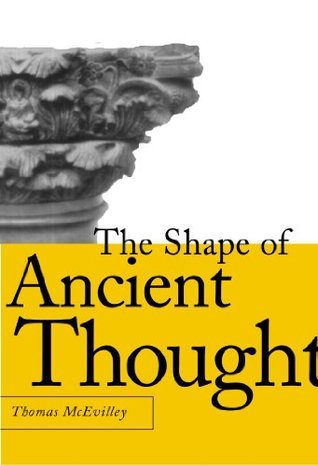
This unparalleled study of early Eastern and Western philosophy challenges every existing belief about the foundations of Western civilization. Spanning thirty years of intensive research, this book proves what many scholars could not explain: that today’s Western world must be considered the product of both Greek and Indian thought—Western and Eastern philosophies. Thomas McEvilley explores how trade, imperialism, and migration currents allowed cultural philosophies to intermingle freely throughout India, Egypt, Greece, and the ancient Near East. This groundbreaking reference will stir relentless debate among philosophers, art historians, and students.
The implicit assumption made by comparative philosophy is that the terms used in different philosophical systems refer to the same, or similar, underlying concepts. In this sense, the diffusion hypothesis that McEvilley champions--the idea that at times in history ancient Greek and Indian philosophies encountered and influenced each other--is accepted before proven. In many cases the purported similarities McEvilley shows simply may be artifacts of translation. That said, in some cases McEvilley does demonstrate rhetorical similarities between different Greek and Indian schools of thought, most convincingly laid out with Sextus Empiricus and Nagarjuna.
This serious critique aside, this book has a stupendous variety of sources, both primary (the author is fluent in both ancient Greek and Sanskrit) and secondary, and I really enjoyed learning about the cultures and philosophies discussed in the book. This is a very informative read, and the scholarship is certainly good, if not particularly original except in the broad historical argument that Greek and Indian philosophical systems interacted.
The argument is worth making, and the possibility is there; the problem is that archaeological evidence is generally lacking (with exception of the Indo-Greek culture that existed in Bactria in the centuries following Alexander the Great), and the scholarship is rife with speculation. And that's without wading into the politics that muddies the whole field.
Worth reading, but take with a huge pinch of salt. Other than that I'd say the one point on which this book really scores is in exploding the orientalist myth of the 'rational west' and the 'mystical east.' There are some excellent discussions of both the Indian and Greek material, although I suspect much of this comes from the secondary sources.
The book is a detailed (656 pages) comparative study of Greek and Indian religious and philosophical thought. McEvilley argues that there was extensive contact between India and Greece in the pre-Socratic period* and that ancient Indian religious thought was the origin of the other-worldly philosophical themes (e.g., reincarnation and monism; separation of the soul from the body) seen, for example in Parmenides, Pythagoras, and Plato.**
This account may explain Plato’s belief in an unchanging reality (an eternal, perfect oneness) as compared to the natural world of illusion (maya), cyclic time as opposed to the Judeo-Christian beginning (creation) and end (judgment day); rejection of the body that is “so saturated with matter” (Phaedo); the flux and unreality of sensory experience as opposed to unchanging other-worldliness; and philosophical knowledge and wisdom as “a freeing power” to release the soul to realize one’s essential cosmic nature. This Indian influence might also explain why Socrates seems like a wandering Indian pundit and why Plato’s Republic could be seen as a laboratory to, in McEvilley’s terms, “perfect one’s soul.”
McEvilley writes that India and Greece are typically walled off from each other by Western scholarship, with India being seen as religious, mystical and otherworldly whereas Greece was free of these elements. McEvilley argues that a division such as this is not accurate.*** Regarding why Western scholars have insisted on building this wall between Indian religious and Greek philosophical thought, McEvilley believes that this is tied up to the need of the West to justify its colonial policy of domination and the need to dismiss Indian thought as primitive and otherworldly.
McEvilley also argues that Epicureanism, though focused on the natural as opposed to the supernatural world, contains the Platonic and Buddhist elements of “imperturbability,” i.e., a “god’s kind of pleasure,” an absence of pain, “a Buddha-like” tranquility, a mental “ataraxia,” which is superior to “the vicissitudes of the body.” McEvilley states that “the fact that both the Buddha and Epicurus espoused the doctrine of personal happiness caused them to be represented by their antagonists as simple-minded hedonists. It seems that the word hedone in Epicurus should not be translated ‘pleasure’ but something like ‘joy’ or ‘serenity.’ What Epicurus means is not simply positive sense-pleasure, Buddhist sukkha, though it may include this. It is more a quietist concept, which holds ataraxia, imperturbability, as the highest delight….Thus Epicurus’s brand of “hedonism” should hardly be so called at all.”
*More specifically, McEvilley writes that “Instead of Greeks living in India or Indians living in Greece, the evidence indicates contacts taking place between them in the intermediary culture of Persia.” Sarvepalli Radhakrishnan makes a similar argument in his "Eastern Religions and Western Thought."
**McEvilley writes that “There is a relationship between early Greek philosophy and early Indian philosophy as clear as that between, say, early Greek sculpture and Egyptian sculpture.” The book is filled with textual comparisons that, in the author's view, establishes this connection between Greek and Indian thought.
*** McEvilley also argues that Greece later had an extensive influence in the development of Buddhist thought. This is his twin theme in this book.
McEvilley exhibits an amazing breadth of scholarship here (which isn't surprising considering the heft of this volume), but there's not always a corresponding depth. As someone who studies Indian and Buddhist philosophy with an interest in East-West comparative work, I have the greatest sympathy for McEvilley's overall project of trying to make the history of ideas more cross-cultural, but I'm not sure he always succeeds in doing what he sets out to do.
I noted two general procedures in the text. On the one hand, McEvilley proceeds by saying something like, "Such-and-such a Greek idea is like such-and-such an Indian idea, or vice versa. Isn't that interesting?" The second approach is to make arguments of this form: "Such-and-such a Greek idea is like such-and-such an Indian idea, or vice versa. Therefore, there was some kind of direct, historical interaction."
The first approach is sometimes interesting in opening up possible comparative projects, although I think McEvilley is often not careful enough with the particular contexts of ideas he discusses, which makes him a bit too fast and loose with his comparisons. Far too much of the book is like this for my tastes, although I do appreciate the breadth of McEvilley's interests.
The second approach is a little more interesting, at least for people interested in the cross-cultural history of philosophy. I was particularly interested in the chapters on skepticism. But as is typically the case with interesting ideas, they are much harder to support. The sad fact is that we just don't have much evidence concerning the particular details of Indian-Greek philosophical interactions in ancient times, which makes most of McEvilley's claims much more speculative than he wants to admit.
Some of my qualms may be due to my background in philosophy as opposed to McEvilley's in art history. Maybe his procedures are more at home in art history, but I found myself wanting a little more philosophical substance.
Like I said, I have a lot of sympathy for what McEvilley's trying to do. However, I don't think he always pulls it off, especially since the evidence for the particular shape taken by Indian-Greek philosophical interactions is so meager. I am convinced, however, that there probably was some sort of cross-cultural interaction even if we don't know much about the details of that interaction. This in itself is quite intriguing and may help contemporary scholars to reconsider the pervasive ethnocentrism of contemporary philosophy and history of ideas. To the extent that he does that, I suppose McEvilley has accomplished some of his aims.
At the outset, comparing the vast and complex ideas that form Greek and Indian philosophy seems like task of Sisyphean proportion. Though this book has its drawbacks, McEvilley has such a clear understanding of both traditions that he pulls it off brilliantly. With both scope and intensity, this is one of the greatest histories of philosophy written.
The central thesis is that trade and its consequent diffusion of ideas account for the parallels in Greek and Indian thought, and McEvilley documents specific ideas painstakingly and precisely. He marks which direction each idea traveled in, and where there is not enough evidence to do so, he states it clearly. One drawback is the amount of semantic conjecture required to reconcile different terms, and his unwillingness to concede that two similar ideas could have developed simultaneously.
The true value of this book however lies in questioning the orthodox view that the West is "rational" and the East "mystical." McEvilley proves that this is not the case at all. Indian philosophy, though sadly ignored, is as rational as Greek philosophy is mystical. Moreover, he believes that Greek thought, which inspired the Renaissance, is as derived from Indian ideas as vice versa, a claim that strikes at the heart of the European idea of Western civilization and modernity.
‘Many of the details of this area of Plato’s thought are obscure today since they were, as Aristotle reports (Phys. 209b14), reserved for oral teaching within Plato’s school and were never fully presented in his published dialogues. In the Phaedrus (275c–277a), and again in the Seventh Letter (341c–342a), Plato says that he distrusts written philosophy and teaches his real doctrines only orally and in private—following in the footsteps both of Socrates, who did not write, and of the Pythagoreans, who kept their most-valued doctrines secret. ..’ ‘The Hindu metaphysical system is rooted in the idea of a One which has both formless and formed aspects (nirgun.a and sagun.a brahman, respectively), like the contracted and expanded aspects of the One in Plato....In one Hindu formulation, the Many proceed from the One through the interaction of the Purush, active absolute or spirit or Being, and the Pra-krit, passive absolute or matter or non-Being, a relationship which closely parallels the action of the One upon the dyad or Receptacle in Plato’s system; in both systems, this action is conceived quasi-mythologically as a sexual union.’ ‘Plato and the Veda-ntins work out some of the difficult details of the One-Many relationship in similar ways. For both, for example, the gods of the old polytheism are considered to exist, but on a relatively low level of the One-Many framework as a whole. The universe, in both systems, is conceived, following in the Sumerian tradition of macrocosm-microcosm correspondence, as a mathematically tuned living being characterized by correspondence of individual souls and world soul. In both systems, there are moments of implication that the individual soul, once freed from the bondage of ignorance or materiality, will reenter the World Soul, which it was a miniature replica of to begin with’
I can hardly say enough good things about this book. It is ground breaking, game changing, and so wide ranging I can hardly believe one person could have the time to dig into and compare so many different philosophies and movements that span millenniums. I thought I knew something about Greek and Eastern thought, but I learned a huge amount. New things I took away from the book: The constant intercourse between Greece and India. Strains of philosophies and ways of living that I had no idea existed. Example: An atheistic sect of Indian ascetics who posited an atomistic theory of matter, living BCE! Philosophically, there really is nothing new under the sun! I am still adjusting my understanding of how life works! One last thing: The mystical component was large in Greek thought, but most historians, being thoroughgoing Western materialists, ignore that aspect as something strange and weird in the ancient ones. But it was huge and McEvilley gets it right. Even without any of its other virtues, this book is a fine corrective read. Thank you Mr. McEvilley!
A provisional note: this was a fascinating work. It displayed a daunting amount of scholarly skill and determination across what proved to be an immense intersection of thought between ancient Greece, Hellenism, and India across a span of millennia, not to mention appreciations of Sumerian, Egyptian, Persian, and Chinese connections.
I read it because I've long thought that there is a connection between Stoic and Buddhist thought. I know that such a relationship has been posited by some, but I now see that it's a much stronger and broader connection than I had imagined--and not just involving Stoicism and Buddhism in general, but a relationship that involves the whole of speculative thinking across these two cultures. The similarity of traditions from these two locales--marked by both mutual influence and independent development--provides a surprising and thought-provoking story. Anyone interested in the wisdom, ethical, and metaphysical traditions that emanated from Greece and India (and their neighbors) should read this book.
Recommended by Jeff Knapp (friend of James Schrader) in a FB thread discussing the lack of non-Western traditions in US philosophy education, based on this link: http://opinionator.blogs.nytimes.com/...
Looks like it could be an interesting way to structure an "Ancient Philosophy" course.
I approached McEvilley's tome in a full post-Modernist ride. Around four years ago, I began to look into Indian and Buddhist philosophy to find solace and inspiration - something I could not find in the western philosophies I have been taught at school. That has been my gateway into proper philosophical inquiry, however hesitant and stumbling.
The recent turn has been to pursue a degree in philosophy, which of course is exclusively western. So I was interested in looking at possible connections between the two traditions. Specifically, the single piece of information which prompted me to buy the book was the hypothesis - not a new one - that Greek skepticism was influenced by early Buddhism. Several books, more modest in their dimensions, have come up recently to deal with that particular issue; however, I wanted to have a broader picture, so I opted for McEvilley's work.
I'm glad I did so. Concerning the diffusion hypothesis in support of Buddhist influence over Pyrrhonism, McEvilley is clear in pointing out that the main elements of the Pyrrhonist doctrine should be traced back to the Greek Skeptic tradition of the Democritean lineage, rather than to the Buddhist; the 'suspension of judgement' precept, for example, serves the psychological purpose of attaining tranquillity in Skeptisim, not the religious aim of escaping transmigration of Buddhism.
For McEvilley, the hypothesis is even turned upside down: a detailed inquiry into the development of dialectic in the Indian tradition suggests that it underwent an abrupt change, which could be observed in the works of Nagarjuna, an extremely important author of the Mahayana Buddhist tradition that is generally claimed responsible of a the 'second turning of the Wheel of Dharma'. McEvilley points out that Mahayana has been developed in the Gandharian area, which had a strong Greek presence from the days of Alexander's expedition; McEvilley parallels elements of Stoic and Epicurian logic with Madhyamika's, but Greek traditions went through a steady development of dialectic, whereas it is hard to trace any logical argumentation of Nagarjuna to the ancient Indian tradition. Of the two important moments of diffusion across Greek and Indian philosophies sketched out in the book, what I have just briefly described points to a diffusion of methods. The second concerns a diffusion of contents, and it dates back to the pre-Socratic period. I knew very little about eastern influences in Greek thought, even though Greeks themselves acknowledge that much knowledge in astronomy and mathematics, for example, derived from Mesopotamia. So much for external influence - which is not preeminently subversive, as it comes from the Near East, though unbeknownst to the lay student. And although evidence begins to be gathered, Indian influence over Greek thought is even more difficult to be accepted, mainly for ethnical reasons.
And here comes the post-Modernist wave: it is destabilising for its relativisation of values, and precious for its eagerness of stripping out historical analysis of ethnical prejudices. I am all for whatever inquiry that aims at recognising an ethnically broad set of contributions to the history of mankind, at whatever may reduce the unnecessary and unjustified gaps of Western supremacy vs. Eastern subordinancy. At the same time, that research shouldn't be done unrigorously, under pressure of post-colonial rehabilitation, for example. Yes, cultural and intellectual change occurred at a much faster pace in Greece than in India, probably for its weaker connections with religion. Still, the traditional division into "Greek=rational", "Indian=mystical" is quite outdated, as a detailed comparison of both traditions sketches out a balanced compenetration of mystical pursuit and argumentative wit on both sides.
Let's finally come down to the diffusion of contents: McEvilley argues that through the medium of Persia - where Greeks and Indians lived together at the cosmopolitan court of Persian emperors - Indian thought shaped Greek philosophy on the side of monism, substance monism, atomism, elemental transformation and probably reincarnation: "Upanisads seem to precede Parmenides in monism, and to have directly influenced Heraclitus's view of the process of nature; Jain atomism and Carvaka materialism would seem to precede Democritus."((McEvilley, T. (2002) p.653))
Probably the most striking parallel is of ethical order, and it concerns the precept of imperturbability (object of the last chapter of the book): Platonism and Neoplatonism, the Vedanta and most schools of Mahayana Buddhism devise a transcendentalist approach to connect with a higher Being by means of perceptual disengagement; Theravada Buddhism, Epicurianism, Skepticism and Stoicism ground imperturbability on the understanding of natural laws. Imperturbability (ataraxia) is that mental condition by which a man is indifferent and equanimous to the events of daily life; it is a virtue ethics theme, which claims that the same act performed under different mental conditions has different ethical values. Only Aristotle advocates for a full engagement in feelings and passions. It was very interesting to me to note such similarities, and I could not help but to think about how ethical directives from such different backgrounds could be compared, given that nowadays the precept of imperturbability is brought on by the revival of Stoicism, Buddhism and Zen. Owen Flanagan outlined in The Bodhisattva's Brain how an hypothetical assessment of ethical effectiveness could proceed only after defining which type of 'happiness' each tradition seeks; afterwords, one can proceed to gather the ethical guidelines and see if they could match their goals. Given although that two different types of 'happiness' are compared, nothing much could be said about which to prefer. The surprisingly closeness of 'imperturbability' definitions among such different traditions made me wonder if an operational definition could be given to perform neurophysiological studies; the question of grounding morality in science is far from being resolved and highly controversial, but in this case, having a somewhat similar ethical goal, it would be possible to test different guidelines empirically against each other. The question then may be if imperturbability is even a desirable goal. On one hand, it is undeniable that humans search for mental stability, in different degrees; yet at the same time, many would argue that a life without emotions is not a life anymore.
McEvilley's chapters can be read as brief stories, inasmuch how historical and anthropological his outlook is, and not necessarily in its entirety, for the main concepts are broadly repeated; the length of the volume keeps the promise of dwelling into lots of historical, philosophical, philological and artistic details. With an overtly abused label: an 'highly recommended' reading.
One of the briefest statements he makes regarding his thesis is the following, which appears in the afterword: "In the Greek tradition it is the monistic systems that seem to carry Indian influence; in the Indian tradition it is the formalization of dialectics and logic that seems to represent Greek influence."
It doesn't seem so explosive at first glance but in the process of demonstrating this McEvelley's book goes against the grain of so much scholarship, especially Western. For example, Plato's flights of fancy are usually explained as some literary device, as my college professor, Kenley Dove, did. But what if Plato had some actual transcendental experience in mind? McEvelley challenges the whole notion that somehow such "irrational" elements are all due to foreign sources and are alien to Greek culture. According to him the clean divide between a rationalistic Western and irratianol Indian thought is just a stereotype. And yes, he provides lots of historical evidence, including potential lines of transmission between the two civilizations.
Though background information on ancient philosophy naturally helps, The Shape of Ancient Thought can be read on its own, at least parts can. For example, towards the end of the book he explains Epicureanism and Stoicism in 6 very short (between half a page and two pages) numbered sections which could easily serve as a bareboned introduction to each philosophy. Despite the heavy topic, it is really incredibly clearly written and very rewarding!
When I first saw this book described the subject matter piqued my interest, but I didn't realize until I started reading it just how intensely academic it was going to be and that more than a cursory background in philosophy was going to be required in order to get the most out of this book. However, even though it took me 9 months of start and stop reading to work my way through this undeniably dense tome, and there were a lot of parts that went over my head or fell too deep into the realm of philosophical naval gazing for me, there were also a number of parts of this book that I found really interesting and eye-opening. The book describes the development of both Greek and Indian philosophical traditions and shows that the typical western distinctions between western thought/philosophy as being logical and the basis of all western civilization and eastern thought/philosophy as being mystical and antithetical to western civilization is just wrong. Greek philosophy borrowed from India and vice versa as both traditions developed through the contacts between the two societies. For me the parts of the book that were more interesting were those that dealt with the history of that region, and the discussions of specific topics like mathematics/numerology, reincarnation and ethics. The later chapters which delved deep into the different schools of philosophy, the dialectic, syllogism and others were less interesting and more challenging, possibly because I lacked the requisite background knowledge.
Reading this book is like being hit over the head with a brick....a brick of wisdom. Coming to your senses you dive into ancient mysteries spanning the world.
This book covers a lot of areas. It compares the ideas of different groups of people, from Egyptians, to Sumerians, Greeks, Indians, Persians, and more. It tries to find the patterns and paths of sharing/diffusion based on what limited info we have available now.
It's unfortunately that so much of what happened in the past is now lost, especially about how these ancient ideas formed and spread. Unfortunately, many ideas were passed down orally. Many of those that were written down, the books decayed over time or may have been actively destroyed.
This book showed me many new philosophers and ideas to read more about.
One interesting thing that stood out about the ancient Sumerians:
A remarkable accomplishment of careful scholarship! This book is the pinnacle of reading for me this year. Extensive parallels between ancient Greek and Indian philosophical traditions, arguing that significant cross-cultural exchange occurred between these civilizations rather than their ideas developing in complete isolation. It challenges, and very convincingly for me at that, what demarcates Western and Eastern traditions in philosophy. There are uncanny similarities in metaphysics, epistemology, logic, and spiritual practices across both traditions. It details nothing short of the birth of philosophy through comparative analysis, and I found myself marveling repeatedly at the monumental accomplishment it represents.
I desired to read this book before I got into neoplatonism. I'm greatful I did, but a little disheartened to see the path of our wisdom tradition reverse engineered to it's illustrious roots. However, I have seen how wisdom is passed (from Mesopotamia civilizations such as Sumer, Babylon, Danube, Harrapan; to Iran as a nexus between India and Greece and a refusion of old ideas with new ideas. Ultimately with a lot of emergent philosophies between east and west, especially with Aristotle's empiricism and Bhuddist Physics.
Very well researched book and good writing. It is not easy reading and it helps to have some background on Indian and Greek philosophy. I appreciated the view that ancient knowledge is not something that belongs to a single culture, but that the ideas of the ancient world were communicated and debated across cultures despite the challenges of distance in a time where travel and communication was an ordeal.
Excellent. Highly detailed comparison of philosophies of Greek Pre-Socratics and Early Indian Buddhism. Covers the sweep of Alexander through Persia to the Indus Valley. The discussion of the metaphysics of ancient thought is very dense but rewarding.
A brilliant book from a brilliant mind. This completely changed my perspective on the origins of philosophy. It also illustrated once again how ridiculously ethnocentric the teaching of philosophy and theory is in most Western universities. McEvilley has the ability to effortless span many fields of knowledge and to see the connections between them. This book definitely isn't for everybody - it was a very challenging read.
McEvilley's breadth of scholarship is jaw dropping. This book will make you rethink the foundations of "western" civilization. Someday I hope to pick up where he has left off in comparative Greek and Indian philosophy. Truly inspiring.
Fascinating, provocative, and above all, controversial! Take this one with a big grain of salt, but the parallels between Indian and Greek philosophy are striking and probably not coincidental.
He's got some unconventional opinions, but I really enjoyed this book from start to finish. Well documented scholarship. The kind of text I'm likely to return to a few times over the years.
The author covers quite a bit of ground. I was surprised by how well he bridges east and west. The book is scholarly yet approachable and is an excellent primer on Greek and Indian philosophy and thought. For those who are interested in or study religion and or philosophy and even politics.