

What do you think?

The Complete Poems
Sappho’s thrilling lyric verse has been unremittingly popular for more than 2,600 years—certainly a record for poetry of any kind—and love for her art only increases as time goes on. Though her extant work consists only of a collection of fragments and a handful of complete poems, her mystique endures to be discovered anew by each generation, and to inspire new efforts at bringing the spirit of her Greek words faithfully into English.
In the past, translators have taken two basic approaches to Sappho: either very literally translating only the words in the fragments, or taking the liberty of reconstructing the missing parts. Willis Barnstone has taken a middle course, in which he remains faithful to the words of the fragments, only very judiciously filling in a word or phrase in cases where the meaning is obvious. This edition includes extensive notes and a special section of “Testimonia”: appreciations of Sappho in the words of ancient writers from Plato to Plutarch. Also included are a glossary of all the figures mentioned in the poems, and suggestions for further reading.
259 pages, Kindle Edition
First published January 1, 551
About the author
Sappho
318 books2,098 followersWork of Greek lyric poet Sappho, noted for its passionate and erotic celebration of the beauty of young women and men, after flourit circa 600 BC and survives only in fragments.
Ancient history poetry texts associate Sappho (Σαπφώ or Ψάπφω) sometimes with the city of Mytilene or suppose her birth in Eresos, another city, sometime between 630 BC and 612 BC. She died around 570 BC. People throughout antiquity well knew and greatly admired the bulk, now lost, but her immense reputation endured.
https://en.wikipedia.org/wiki/Sappho
Ancient history poetry texts associate Sappho (Σαπφώ or Ψάπφω) sometimes with the city of Mytilene or suppose her birth in Eresos, another city, sometime between 630 BC and 612 BC. She died around 570 BC. People throughout antiquity well knew and greatly admired the bulk, now lost, but her immense reputation endured.
https://en.wikipedia.org/wiki/Sappho
Ratings & Reviews
Friends & Following
Create a free account to discover what your friends think of this book!
Community Reviews
Displaying 1 - 30 of 1,414 reviews

December 30, 2021
Book hangovers are a thing. I think that’s why I had to read this in two halves, over a year apart.
I so often get asked what the point in reading classics is. Sappho will tell you. That her poetry can make you feel her grief, her anguish, joy and her love as we feel our own is nothing short of art or magic. Probably both. Maybe that’s where souls come in.
I so often get asked what the point in reading classics is. Sappho will tell you. That her poetry can make you feel her grief, her anguish, joy and her love as we feel our own is nothing short of art or magic. Probably both. Maybe that’s where souls come in.

March 21, 2018
I already have a book of her poems, but I'm glad I bought this, since it has new fragments included (the newest being from 2013, which was added to this book's 2015 print in the appendix). There are commentaries to each of the fragments, on the left-side page. The poems are from almost-whole to short sentences, and the left-side notes also comments on some loose words that are attached to some after the main text (words or parts of words). Further dividing is done by theme, which I thinks clears things a lot.
A full moon shone,
And around the shrine
Stood devotees
Poised and in place.
Sappho was a poet-singer from Mytilene, Lesbos, though she spent some exile years in Sicily for political reasons (that is, what side her family had been on). She was much praised by Ancient Greek/Roman world, which in part secured some poems from completely disappearing. Most of the myths connected to her are just that - she probably died in normal manner, in old age..
It is said that 90% of her poems are lost, some due to the fact that they were not written down immediately (for her world didn't write much, and memorising song-poems was more likely); of those that were written down, the wrecks of time destroyed (fire, war, changing attitudes etc.). It is known that 9 book rolls of just her poems existed. No books exist after 1204. All music that accompanied these songs is lost. The fragments that we have, outside of mentions in other people's writings, appear in coffin materials and potsherds.
As you are dear to me, go claim a younger
Bed as your due.
I can't stand being the old one any longer,
Living with you.
The poems of many moods are very visual, and there are also something to smell, like incense and flowers. Certain gods and other mythical creatures worshipped appear. Troy gets its own chapter, which tells some things from rarer female perspective. The poems were sung (mostly not solo), with accompanying picked lyre and dancing. She led a 'school' for young maidens (in their teens, pre-marriage), teaching them through songs, but also teaching singing (solo and choral), dancing, playing the lyre; and she and her pupils appeared in public performances (weddings and others).
No doubt some poems inspirations were taken from her personal life (like the one worrying about her wine merchant brother); others were inspired by Homer's works, by mythology, and by the rivalries she had. Even the smallest sentence fragments can hold much emotion in them. Some are quite erotic without being super-explicit. But there are so many that stay on your mind, like this one:
I declare
That later on,
Even in the age unlike our own,
Someone will remember who we are.
A full moon shone,
And around the shrine
Stood devotees
Poised and in place.
Sappho was a poet-singer from Mytilene, Lesbos, though she spent some exile years in Sicily for political reasons (that is, what side her family had been on). She was much praised by Ancient Greek/Roman world, which in part secured some poems from completely disappearing. Most of the myths connected to her are just that - she probably died in normal manner, in old age..
It is said that 90% of her poems are lost, some due to the fact that they were not written down immediately (for her world didn't write much, and memorising song-poems was more likely); of those that were written down, the wrecks of time destroyed (fire, war, changing attitudes etc.). It is known that 9 book rolls of just her poems existed. No books exist after 1204. All music that accompanied these songs is lost. The fragments that we have, outside of mentions in other people's writings, appear in coffin materials and potsherds.
As you are dear to me, go claim a younger
Bed as your due.
I can't stand being the old one any longer,
Living with you.
The poems of many moods are very visual, and there are also something to smell, like incense and flowers. Certain gods and other mythical creatures worshipped appear. Troy gets its own chapter, which tells some things from rarer female perspective. The poems were sung (mostly not solo), with accompanying picked lyre and dancing. She led a 'school' for young maidens (in their teens, pre-marriage), teaching them through songs, but also teaching singing (solo and choral), dancing, playing the lyre; and she and her pupils appeared in public performances (weddings and others).
No doubt some poems inspirations were taken from her personal life (like the one worrying about her wine merchant brother); others were inspired by Homer's works, by mythology, and by the rivalries she had. Even the smallest sentence fragments can hold much emotion in them. Some are quite erotic without being super-explicit. But there are so many that stay on your mind, like this one:
I declare
That later on,
Even in the age unlike our own,
Someone will remember who we are.

October 14, 2016
•Greek Lyric: Sappho and Alcaeus, tr. David A Campbell, Loeb 1990
•If Not, Winter: Fragments of Sappho, tr. Anne Carson, Virago 2002
•Stung With Love: Poems and Fragments, tr. Aaron Poochigian, Penguin 2015
SAPPHICS FOR SAPPHO
Each ellipsis teases, inviting dreams – dreams
Formed from torn papyruses' single words. Bare,
Lonely scrawls of sigmas and psis that sing, still,
Sticky with meaning.
Fragments all. What's left is the one percent, rich,
Rare. When Alexandria burned, the whole world
Choked to breathe the smoke of the ninety-nine. Now,
Desperate to get you
Back, we trawl millennia-old unearthed dumps,
Hunting out your clotted Aeolic strung lines.
Lone hendecasyllables' sounds that awed Greeks
After you quoted.
Questing, reading, marvelling – so we search on,
Poets seeking answers to questions all lost
Lovers ask. Your answers still reach us, drenched, fresh
From the Aegean.
A LIFE IN FRAGMENTS
Towards the end of the second century AD, in the last flickering light of classical Greece, a philosopher called Maximus, in a city on the Levantine coast, wrote a grammatical textbook about figures of speech. Casting around in old books for examples of how poets have described love, he writes: ‘Diotima says that Love flourishes when he has abundance but dies when he is in need: Sappho combined these ideas and called Love bitter-sweet and “ἀλγεσίδωρον”.’
So we have this one word that Sappho wrote, some eight centuries before Maximus was born. This is what we mean when we talk about her poetry existing in ‘fragments’. The Canadian poet Anne Carson translates this example as:
Very often these remnants are quoted with no regard to any poetic quality, but rather in illustration of some grammatical point. Apollonius Dyscolus, for instance, writing again some time in the 100s AD, included a throwaway remark on variant dialects during an essay on pronouns. ‘The Aeolians,’ he said, ‘spell ὅς [‘his, hers, its’] with digamma in all cases and genders, as in Sappho's τὸν ϝὸν παῖδα κάλει.’ Again Carson's translation gives us just the phrase in question:
Carson's translation of Sappho's oeuvre is well subtitled ‘Fragments of Sappho’, since most of what's left is of this nature. It's certainly nice to have everything collected in this way in English, though it must be admitted that her book sometimes seems more an exercise in completionism than in poetic expression. That said, as other reviewers have pointed out, reading pages and pages of these deracinated terms (‘holder…crossable…I might go…downrushing’) can succeed in generating a certain hypnotic, Zen-like appeal.
Nevertheless, such things lose a lot by being read in isolation; the as it were archaeological pleasure of digging them out of their original context, in works of grammar or rhetoric, is completely absent. For that, the Loeb edition translated by David A. Campbell is far preferable, for all that he has no pretensions to being a poet, just because you get Sappho delivered in that context of other writers. The fonts used for the Greek are also much more readable in the Loeb. (The Carson edition does include the original Greek, and points for that – though there are some strange editorial…choices? mistakes? – such as printing ς for σ in all positions.)
MUSIC AND LYRICS
To the Ancient Greeks, Homer was simply ‘The Poet’ – and ‘The Poetess’ was Sappho. She was held in extraordinarily high esteem, which makes it the more frustrating that so much of her has been lost: ninety-nine percent, according to some experts. Only one or two poems remain that can be said to be more or less complete.
Her poetry is mainly ‘lyric’, that is, designed to be sung while strumming along on the lyre. Sappho was, in modern terms, a singer-songwriter; she was known to be an extremely talented musician, designing a new kind of lyre and perhaps even inventing the plectrum. When we read her poetry now, we have to remember that we're looking at something like a shredded collection of Bob Dylan or Georges Brassens lyrics, with no idea of how their meaning would have interacted with the music.
But however important the lost melodies, we do know that she was revered for the beauty of her phrasing. This is something translators struggle with. Fragment 146, a proverb about not wanting to take the bad with the good, is rendered literally by Campbell as ‘I want neither the honey nor the bee’ and by Carson, ‘Neither for me honey nor the honey bee’ – which is better, but consider the alliterative dazzle of the original:
Reading the Greek, even if you don't understand what any of the words mean, will often get you halfway there with Sappho. Say it out loud and you'll get a tingle, as it starts to dawn on you what all the fuss might have been about.
But the rest of the job has to be done by translators. The Loeb edition will not help you here: its prose translations are only a crib to help you study the original. Carson's approach is slightly conflicted. She quotes approvingly a well-known statement from Walter Benjamin to the effect that a translation should ‘find that intended effect…which produces in it the echo of the original’, i.e. that one should translate ideas and feelings rather than words. But she also claims to be trying to use ‘where possible the same order of words and thoughts as Sappho did’, which is the sort of thing that makes me instantly suspicious.
Here's her version of Fragment 2, which is one of the more complete poems we have, scratched on to a broken piece of pottery which has miraculously survived from the second century AD. The first stanza (an invocation to Aphrodite) is probably missing, but the next two run like this:
This is not bad. I think the word order is unnecessarily foreign at times, but it does sound good and Carson even includes a few of Sappho's famous hendecasyllabic lines – though they are not true ‘Sapphic’ verses, a very strict form which is not well adapted to English (as you may be able to tell from my attempt at the top of this review).
Aaron Poochigian, in a selected edition for Penguin Classics, takes a different approach. ‘Sappho did not compose free verse,’ he chides, perhaps with one eye on Carson, ‘and free-verse translations, however faithful they may be to her words, betray her poems by their very nature.’ Poochigian's version of the stanzas above goes like this:
I think that's pretty great. It takes much more liberties with Sappho's actual words but, to the extent that it produces a sensual thrill in English, it more faithfully reproduces the effect that Sappho had on her original audience. At least, to me it does. Poochigian's selection, called Stung with Love, is much shorter than the other two I read, but a very good encapsulation of her qualities. It also has by far the best introduction, a brilliant essay which puts Sappho in her context extremely well. And because it's the most recently published, it's also able to include the magic new Sappho poem discovered in 2013, written on a scrap of papyrus used to stuff a mummy.
BIGGER THAN A BIG MAN
‘Someone will remember us / I say / even in another time.’ Another fragment. The irony of this one upset me at first, because she should have survived in far greater quantities than she did. But even so, the thrill of hearing the voice of a woman who lived six centuries before Christ was enough to catch my breath over and over again. Generally speaking, women in antiquity are pretty silent. But Sappho isn't, and her influence, despite the meagre remains we have, is ginormous.
It might sound hyperbolic to claim that all modern love poetry is inherited from Sappho, but in fact there's a very real sense in which that's true – so great was her reputation among Classical writers and the Europeans who, in turn, studied them, that it's quite possible to trace a direct line from Sappho, through Catullus, to the Romantic poets and from them to contemporary pop lyrics. Every song about the pain of unrequited love owes something to Sappho's Fragment 31, for example – ideas now so clichéd that we forget they have an ancestry at all. That's just natural, surely – just the way people speak? But no, it isn't natural, it's Sappho. She's part of our inheritance, part of our language. She's under our tongue.
•If Not, Winter: Fragments of Sappho, tr. Anne Carson, Virago 2002
•Stung With Love: Poems and Fragments, tr. Aaron Poochigian, Penguin 2015
SAPPHICS FOR SAPPHO
Each ellipsis teases, inviting dreams – dreams
Formed from torn papyruses' single words. Bare,
Lonely scrawls of sigmas and psis that sing, still,
Sticky with meaning.
Fragments all. What's left is the one percent, rich,
Rare. When Alexandria burned, the whole world
Choked to breathe the smoke of the ninety-nine. Now,
Desperate to get you
Back, we trawl millennia-old unearthed dumps,
Hunting out your clotted Aeolic strung lines.
Lone hendecasyllables' sounds that awed Greeks
After you quoted.
Questing, reading, marvelling – so we search on,
Poets seeking answers to questions all lost
Lovers ask. Your answers still reach us, drenched, fresh
From the Aegean.
A LIFE IN FRAGMENTS
Towards the end of the second century AD, in the last flickering light of classical Greece, a philosopher called Maximus, in a city on the Levantine coast, wrote a grammatical textbook about figures of speech. Casting around in old books for examples of how poets have described love, he writes: ‘Diotima says that Love flourishes when he has abundance but dies when he is in need: Sappho combined these ideas and called Love bitter-sweet and “ἀλγεσίδωρον”.’
So we have this one word that Sappho wrote, some eight centuries before Maximus was born. This is what we mean when we talk about her poetry existing in ‘fragments’. The Canadian poet Anne Carson translates this example as:
171
paingiver
Very often these remnants are quoted with no regard to any poetic quality, but rather in illustration of some grammatical point. Apollonius Dyscolus, for instance, writing again some time in the 100s AD, included a throwaway remark on variant dialects during an essay on pronouns. ‘The Aeolians,’ he said, ‘spell ὅς [‘his, hers, its’] with digamma in all cases and genders, as in Sappho's τὸν ϝὸν παῖδα κάλει.’ Again Carson's translation gives us just the phrase in question:
164
she summons her son
Carson's translation of Sappho's oeuvre is well subtitled ‘Fragments of Sappho’, since most of what's left is of this nature. It's certainly nice to have everything collected in this way in English, though it must be admitted that her book sometimes seems more an exercise in completionism than in poetic expression. That said, as other reviewers have pointed out, reading pages and pages of these deracinated terms (‘holder…crossable…I might go…downrushing’) can succeed in generating a certain hypnotic, Zen-like appeal.
Nevertheless, such things lose a lot by being read in isolation; the as it were archaeological pleasure of digging them out of their original context, in works of grammar or rhetoric, is completely absent. For that, the Loeb edition translated by David A. Campbell is far preferable, for all that he has no pretensions to being a poet, just because you get Sappho delivered in that context of other writers. The fonts used for the Greek are also much more readable in the Loeb. (The Carson edition does include the original Greek, and points for that – though there are some strange editorial…choices? mistakes? – such as printing ς for σ in all positions.)
MUSIC AND LYRICS
To the Ancient Greeks, Homer was simply ‘The Poet’ – and ‘The Poetess’ was Sappho. She was held in extraordinarily high esteem, which makes it the more frustrating that so much of her has been lost: ninety-nine percent, according to some experts. Only one or two poems remain that can be said to be more or less complete.
Her poetry is mainly ‘lyric’, that is, designed to be sung while strumming along on the lyre. Sappho was, in modern terms, a singer-songwriter; she was known to be an extremely talented musician, designing a new kind of lyre and perhaps even inventing the plectrum. When we read her poetry now, we have to remember that we're looking at something like a shredded collection of Bob Dylan or Georges Brassens lyrics, with no idea of how their meaning would have interacted with the music.
But however important the lost melodies, we do know that she was revered for the beauty of her phrasing. This is something translators struggle with. Fragment 146, a proverb about not wanting to take the bad with the good, is rendered literally by Campbell as ‘I want neither the honey nor the bee’ and by Carson, ‘Neither for me honey nor the honey bee’ – which is better, but consider the alliterative dazzle of the original:
μήτε μοι μέλι μήτε μέλισσα
(mēte moi meli mēte melissa)
Reading the Greek, even if you don't understand what any of the words mean, will often get you halfway there with Sappho. Say it out loud and you'll get a tingle, as it starts to dawn on you what all the fuss might have been about.
But the rest of the job has to be done by translators. The Loeb edition will not help you here: its prose translations are only a crib to help you study the original. Carson's approach is slightly conflicted. She quotes approvingly a well-known statement from Walter Benjamin to the effect that a translation should ‘find that intended effect…which produces in it the echo of the original’, i.e. that one should translate ideas and feelings rather than words. But she also claims to be trying to use ‘where possible the same order of words and thoughts as Sappho did’, which is the sort of thing that makes me instantly suspicious.
Here's her version of Fragment 2, which is one of the more complete poems we have, scratched on to a broken piece of pottery which has miraculously survived from the second century AD. The first stanza (an invocation to Aphrodite) is probably missing, but the next two run like this:
]
here to me from Krete to this holy temple
where is your graceful grove
of apple trees and altars smoking
with frankincense.
And it in cold water makes a clear sound through
apple branches and with roses the whole place
is shadowed and down from radiant-shaking leaves
sleep comes dropping.
This is not bad. I think the word order is unnecessarily foreign at times, but it does sound good and Carson even includes a few of Sappho's famous hendecasyllabic lines – though they are not true ‘Sapphic’ verses, a very strict form which is not well adapted to English (as you may be able to tell from my attempt at the top of this review).
Aaron Poochigian, in a selected edition for Penguin Classics, takes a different approach. ‘Sappho did not compose free verse,’ he chides, perhaps with one eye on Carson, ‘and free-verse translations, however faithful they may be to her words, betray her poems by their very nature.’ Poochigian's version of the stanzas above goes like this:
Leave Crete and sweep to this blest temple
Where apple-orchard's elegance
Is yours, and smouldering altars, ample
Frankincense.
Here under boughs a bracing spring
Percolates, roses without number
Umber the earth and, rustling,
The leaves drip slumber.
I think that's pretty great. It takes much more liberties with Sappho's actual words but, to the extent that it produces a sensual thrill in English, it more faithfully reproduces the effect that Sappho had on her original audience. At least, to me it does. Poochigian's selection, called Stung with Love, is much shorter than the other two I read, but a very good encapsulation of her qualities. It also has by far the best introduction, a brilliant essay which puts Sappho in her context extremely well. And because it's the most recently published, it's also able to include the magic new Sappho poem discovered in 2013, written on a scrap of papyrus used to stuff a mummy.
BIGGER THAN A BIG MAN
‘Someone will remember us / I say / even in another time.’ Another fragment. The irony of this one upset me at first, because she should have survived in far greater quantities than she did. But even so, the thrill of hearing the voice of a woman who lived six centuries before Christ was enough to catch my breath over and over again. Generally speaking, women in antiquity are pretty silent. But Sappho isn't, and her influence, despite the meagre remains we have, is ginormous.
It might sound hyperbolic to claim that all modern love poetry is inherited from Sappho, but in fact there's a very real sense in which that's true – so great was her reputation among Classical writers and the Europeans who, in turn, studied them, that it's quite possible to trace a direct line from Sappho, through Catullus, to the Romantic poets and from them to contemporary pop lyrics. Every song about the pain of unrequited love owes something to Sappho's Fragment 31, for example – ideas now so clichéd that we forget they have an ancestry at all. That's just natural, surely – just the way people speak? But no, it isn't natural, it's Sappho. She's part of our inheritance, part of our language. She's under our tongue.

January 30, 2020
Lyrical and universally capturing love and desire - 3.5 stars rounded up
Some say an army of horsemen,
some of footsoldiers, some of ships,
is the fairest thing on the black earth,
but I say it is what one loves.
A Pompeii fresco of Sappho, who by Plato was called the tenth Muse:

Lyrical (which is actually a term derived from how poetry was recited in ancient Greece, sung and accompanied by a lyre) is just another term that Sappho started of. She gives prominence to the isle of Lesbos and Sapphic love is another term for same sex love between women. For more on this I can recommend listening to: https://www.historyisgaypodcast.com/l...
But given the time between us and her, > 2.600 years ago it makes it hard to say anything definitive of the author. The yearning and appreciation of females is very clear so the monickers are not undeserved.
Funnily enough, or maybe a quirk in translation, there is one poem that alludes to love for a guy (and two that seem to refer to a daughter) so who knows:
You may
blame Aphrodite
soft as she is
she has almost
killed me with
love for that boy
The poems in general are filled with beautiful girls, the splendor of wedding days (oral odes for weddings could be the source of her work and formed a separate part of the collected work of Sappho in the library of Alexandria), for nature and heavens full of stars and flower wreaths.
Although praise for the gods and the Trojan war comes back, the feel of the work is much more human centered and personal than the poems of Homer.
Her work is short, melancholic and powerful and conjures a whole different world while also capturing universal and recognisable feelings.
I think her work should speak for herself, however fragmentary the poems are sometimes (the one word Celery is probable most famous of these fragments) having traversed so many centuries.
I couldn't find the English versions to all the poems I liked, so here is the Dutch translation:
Want zij wie ik goed doe, juist zij beschadigen mij het meest van allen.
En ik verlang en ik sta in brand
Wie mooi is, is mooi zolang je kijkt, wie mooi en goed is, zal mooi blijven.
Je bent me vergeten of bemin je een ander?
Kom bij me staan, geliefde en laat je ogen stralen.
Some say an army of horsemen,
some of footsoldiers, some of ships,
is the fairest thing on the black earth,
but I say it is what one loves.
A Pompeii fresco of Sappho, who by Plato was called the tenth Muse:
Lyrical (which is actually a term derived from how poetry was recited in ancient Greece, sung and accompanied by a lyre) is just another term that Sappho started of. She gives prominence to the isle of Lesbos and Sapphic love is another term for same sex love between women. For more on this I can recommend listening to: https://www.historyisgaypodcast.com/l...
But given the time between us and her, > 2.600 years ago it makes it hard to say anything definitive of the author. The yearning and appreciation of females is very clear so the monickers are not undeserved.
Funnily enough, or maybe a quirk in translation, there is one poem that alludes to love for a guy (and two that seem to refer to a daughter) so who knows:
You may
blame Aphrodite
soft as she is
she has almost
killed me with
love for that boy
The poems in general are filled with beautiful girls, the splendor of wedding days (oral odes for weddings could be the source of her work and formed a separate part of the collected work of Sappho in the library of Alexandria), for nature and heavens full of stars and flower wreaths.
Although praise for the gods and the Trojan war comes back, the feel of the work is much more human centered and personal than the poems of Homer.
Her work is short, melancholic and powerful and conjures a whole different world while also capturing universal and recognisable feelings.
I think her work should speak for herself, however fragmentary the poems are sometimes (the one word Celery is probable most famous of these fragments) having traversed so many centuries.
I couldn't find the English versions to all the poems I liked, so here is the Dutch translation:
Want zij wie ik goed doe, juist zij beschadigen mij het meest van allen.
En ik verlang en ik sta in brand
Wie mooi is, is mooi zolang je kijkt, wie mooi en goed is, zal mooi blijven.
Je bent me vergeten of bemin je een ander?
Kom bij me staan, geliefde en laat je ogen stralen.

May 30, 2021
Love shook my heart like wind
on a mountain punishing oak trees.
I read all the poems of this book in less that half a day, even while taking breaks in between to complete chores and not because I possess astounding reading prowess, but simply because most of these poems are just fragments consisting of two or three lines. Recent trends in minimalism have renewed interest in Sappho's poems. However, scholarly speculations are that these fragments were originally parts of larger poems swallowed by history, but mostly by book-burning religious authorities.
The language and metaphors Sappho uses are very simple and therefore the bones of each poem are laid bare for the reader. Well, I cannot actually speak for the original language used, but the translation sure is simple and I have to make the very reasonable assumption that the translators preserved the form and content in a way that did justice to the original poetry.
Therefore, there cannot be many questions as to the content and intention behind these poems, it does not seem like Sappho made any attempts to conceal either. But of course, for centuries there have been debates as to whether Sappho was a lesbian - in both the geographical and sexual sense. While today historians vouch that she was both, there have been many attempts at an erasure of Sappho's sexuality driven by ignorance and/or prejudice. And this erasure has been so ingrained into historical narratives about Sappho that it's almost comical now. After all, it has led to the modern coinage of the sarcastic phrase "Sappho and her friend" to refer to people who deny that many famous/historical figures were queer despite abundant evidence. I mean, we somehow have a flat earth society, so what can you say? People see what they want to see.
When it comes to Sappho, I suggest that any non-believer just read what survives of her poems, because really, she couldn't have made it any more obvious.
Some say there are nine Muses. Count again.
Behold the tenth: Sappho of Lesbos.
Plato, in The Greek Anthology 9.506
on a mountain punishing oak trees.
I read all the poems of this book in less that half a day, even while taking breaks in between to complete chores and not because I possess astounding reading prowess, but simply because most of these poems are just fragments consisting of two or three lines. Recent trends in minimalism have renewed interest in Sappho's poems. However, scholarly speculations are that these fragments were originally parts of larger poems swallowed by history, but mostly by book-burning religious authorities.
The language and metaphors Sappho uses are very simple and therefore the bones of each poem are laid bare for the reader. Well, I cannot actually speak for the original language used, but the translation sure is simple and I have to make the very reasonable assumption that the translators preserved the form and content in a way that did justice to the original poetry.
Therefore, there cannot be many questions as to the content and intention behind these poems, it does not seem like Sappho made any attempts to conceal either. But of course, for centuries there have been debates as to whether Sappho was a lesbian - in both the geographical and sexual sense. While today historians vouch that she was both, there have been many attempts at an erasure of Sappho's sexuality driven by ignorance and/or prejudice. And this erasure has been so ingrained into historical narratives about Sappho that it's almost comical now. After all, it has led to the modern coinage of the sarcastic phrase "Sappho and her friend" to refer to people who deny that many famous/historical figures were queer despite abundant evidence. I mean, we somehow have a flat earth society, so what can you say? People see what they want to see.
When it comes to Sappho, I suggest that any non-believer just read what survives of her poems, because really, she couldn't have made it any more obvious.
Some say there are nine Muses. Count again.
Behold the tenth: Sappho of Lesbos.
Plato, in The Greek Anthology 9.506

Read
November 4, 2013Because so little has survived (just over 600 lines), I read about ten translations and anthologies of Sappho's work, primarily in English, but also in French and Dutch. And what strikes me is how differently the translators translate even the seemingly simplest verses. Take, for example, the charming poem 105a, about an apple left hanging in an orchard after picking: the translations I read are pretty different at first glance.
"As the sweet apple blushes on the end of the bough, the very end of the bough which gatherers missed, nay, missed not, but could not reach."
"As the sweet-apple reddens on the high branch,
high on the highest branch, that the apple-pickers forgot—
no, they didn’t forget; that apple they could not reach."
"At the end of the bough--its uttermost end,
Missed by the harvesters, ripens the apple,
Nay, not overlooked, but far out of reach,
So with all best things."
"Just like the sweet apple that blushes on top of a branch,
the topmost apple on the topmost branch. It has eluded the notice of the apple pickers.
Oh, but no. It’s not that they haven’t noticed it. They just couldn’t reach it."
"An Achille’s apple
Blushing sweet on a high branch
At the tip of the tallest tree.
You escaped those who would pluck
your fruit
Not that they didn’t try. No,
They could not forget you
Poised beyond their reach."
I could go on and on. As I said: how is it possible that these simple verses are translated so differently, with - in some cases - truly striking additions? Apart from the usual issues when translating, the explanation isn't far-fetched: we lack context; we don't know whether the poems were standalone ones, or whether they were part of a larger text; we often don't know who is speaking, to whom they are addressed, and so on.
There's no shortage of guesses and hypotheses; entire libraries have now been filled with books about Sappho, and certainly not just about the erotic aspect and the "lesbian" nature of her love verses. The classic solution in the debates about authors who appear to write autobiographically is to let the text speak for itself. And that usually gets us somewhere.
I'll return briefly to the quoted poem 105a, about the unpicked apple. Given the other fragments we have from Sappho, which often deal with longing, unrequited love, lost love, and so on, an obvious symbolic interpretation is certainly justified: Sappho seems to be speaking here of a girl who still has no lover, not because she is overlooked (perhaps she's seen as too ugly or too poor), but because potential suitors cannot reach her, because she is shielded, simply too beautiful and charming, radiates aloofness, and so on. These are just interpretations; others are certainly valid as well. For who is speaking here? And to whom is the poet speaking? Does the apple stand for a girl, or is it a boy? And is the context actually one of love and friendship? Endless questions. And we're talking about only three verses here.
Perhaps we should simply confine ourselves to the intimate tenor of this poem, the measured style, especially that beautiful, colloquial turn ("nay/Oh, but no"), which gives the impression that the poet is musing aloud, and perhaps speaking directly to us. Oh yes, let's do just that: please let this woman from 27 centuries ago speak to us as directly as possible, draw us into her long-gone time and life, on her beautiful island in the Aegean Sea. It's a delight on its own!
More about the fundamental uncertainties surrounding Sappho in my History account on Goodreads: https://www.goodreads.com/review/show....
"As the sweet apple blushes on the end of the bough, the very end of the bough which gatherers missed, nay, missed not, but could not reach."
"As the sweet-apple reddens on the high branch,
high on the highest branch, that the apple-pickers forgot—
no, they didn’t forget; that apple they could not reach."
"At the end of the bough--its uttermost end,
Missed by the harvesters, ripens the apple,
Nay, not overlooked, but far out of reach,
So with all best things."
"Just like the sweet apple that blushes on top of a branch,
the topmost apple on the topmost branch. It has eluded the notice of the apple pickers.
Oh, but no. It’s not that they haven’t noticed it. They just couldn’t reach it."
"An Achille’s apple
Blushing sweet on a high branch
At the tip of the tallest tree.
You escaped those who would pluck
your fruit
Not that they didn’t try. No,
They could not forget you
Poised beyond their reach."
I could go on and on. As I said: how is it possible that these simple verses are translated so differently, with - in some cases - truly striking additions? Apart from the usual issues when translating, the explanation isn't far-fetched: we lack context; we don't know whether the poems were standalone ones, or whether they were part of a larger text; we often don't know who is speaking, to whom they are addressed, and so on.
There's no shortage of guesses and hypotheses; entire libraries have now been filled with books about Sappho, and certainly not just about the erotic aspect and the "lesbian" nature of her love verses. The classic solution in the debates about authors who appear to write autobiographically is to let the text speak for itself. And that usually gets us somewhere.
I'll return briefly to the quoted poem 105a, about the unpicked apple. Given the other fragments we have from Sappho, which often deal with longing, unrequited love, lost love, and so on, an obvious symbolic interpretation is certainly justified: Sappho seems to be speaking here of a girl who still has no lover, not because she is overlooked (perhaps she's seen as too ugly or too poor), but because potential suitors cannot reach her, because she is shielded, simply too beautiful and charming, radiates aloofness, and so on. These are just interpretations; others are certainly valid as well. For who is speaking here? And to whom is the poet speaking? Does the apple stand for a girl, or is it a boy? And is the context actually one of love and friendship? Endless questions. And we're talking about only three verses here.
Perhaps we should simply confine ourselves to the intimate tenor of this poem, the measured style, especially that beautiful, colloquial turn ("nay/Oh, but no"), which gives the impression that the poet is musing aloud, and perhaps speaking directly to us. Oh yes, let's do just that: please let this woman from 27 centuries ago speak to us as directly as possible, draw us into her long-gone time and life, on her beautiful island in the Aegean Sea. It's a delight on its own!
More about the fundamental uncertainties surrounding Sappho in my History account on Goodreads: https://www.goodreads.com/review/show....

September 23, 2022
3.5 ⭐️
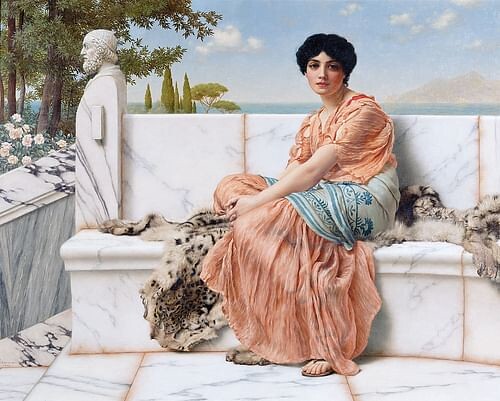
”[Sappho’s] face was engraved on coinage, her statue erected, her portrait painted on vases. Many ancient commentators praised her literary genius, while Plato, among others, called her ‘the tenth Muse’.”
I don’t see it! And it hurts me because I was really looking forward to these. Of course, I don’t need to tell you that you should probably accept Plato’s word over mine but, at least as far as the works that remain and are part of this collection (translated with an introduction by Josephine Balmer), I have to agree, somewhat, with the words of classicist and textual critic, Denys Page, when he suggested that Sappho’s poetry is "devoid of anything profound in thought or emotion or memorable in language”.
I’m not arguing that Sappho wasn’t, isn’t, or shouldn’t be considered one of the great Greek poets but when you combine the incredibly fragmentary and insubstantial nature of the surviving excerpts with the magic of the poetry being almost certainly and inevitably lost in translation, the result is underwhelming to say the least. As Balmer states:
”Ancient commentators praised the smoothness of Sappho’s style, the ‘euphony’ of her language, the choice and juxtaposition of her words. Unfortunately, this quality is one of the most difficult to capture in the transition from Greek to English; Greek has a far more flexible word order, a greater ability to mark emphasis, to use assonance or alliteration or to suggest ambiguity. In antiquity Sappho was also known for her skilful and innovative use of metre. Again this is extremely difficult, if not impossible, to render into English, as metre in Greek poetry is measured in length, in English by stress.”
Personal enjoyment of the actual poetry aside, I’m told that one must always place Sappho in her historical context and while it frustrates me that so little can be substantiated about her life, other than that she lived on the island of Lesbos circa. 600 B.C, I was fascinated by the introduction and find it quite remarkable that she could find such universal praise in an era in which a woman’s role was diminished to the extent that their ”purpose was marriage, their glory, chastity, their world, the home.”
Interpretations of her work have been consistently manipulated to suit the cultural norms regarding gender roles and sexuality of the time period concerned for the last couple thousand years, though, it is not only her work but her character that is so often the unfair subject of uninformed scrutiny. Typically, it is her sexuality and supposed eroticism that draws much of the attention and which is analyzed, wrongfully, through the lens of contemporary thought.
Anthropologist, George Devereux, goes as far to absurdly suggest that Sappho was a “masculine lesbian” with a “clinically commonplace female castration complex”. He goes further, stating that ”She is not jealous of the man... because she cannot help but identify with his masculinity. She finds him ‘equal to the gods’ because he has something which she cannot offer the woman – it is all a simple case of phallus envy.” It all sounds suspiciously freudian to me; take a seat Jorge!
Despite how I felt about much of Sappho’s poetry in this collection there is this one Ice Cold fragment which I’ll leave you with that you might find appropriate for use if you’re a jilted lover or are writing up a resignation letter for a particularly hateful job:
”When you die, you will lie unremembered for ever more; for you there will be no regret, no share in the roses of Pieria; invisible in Hades, as on earth, you will wander aimlessly among the unknown dead …”
”[Sappho’s] face was engraved on coinage, her statue erected, her portrait painted on vases. Many ancient commentators praised her literary genius, while Plato, among others, called her ‘the tenth Muse’.”
I don’t see it! And it hurts me because I was really looking forward to these. Of course, I don’t need to tell you that you should probably accept Plato’s word over mine but, at least as far as the works that remain and are part of this collection (translated with an introduction by Josephine Balmer), I have to agree, somewhat, with the words of classicist and textual critic, Denys Page, when he suggested that Sappho’s poetry is "devoid of anything profound in thought or emotion or memorable in language”.
I’m not arguing that Sappho wasn’t, isn’t, or shouldn’t be considered one of the great Greek poets but when you combine the incredibly fragmentary and insubstantial nature of the surviving excerpts with the magic of the poetry being almost certainly and inevitably lost in translation, the result is underwhelming to say the least. As Balmer states:
”Ancient commentators praised the smoothness of Sappho’s style, the ‘euphony’ of her language, the choice and juxtaposition of her words. Unfortunately, this quality is one of the most difficult to capture in the transition from Greek to English; Greek has a far more flexible word order, a greater ability to mark emphasis, to use assonance or alliteration or to suggest ambiguity. In antiquity Sappho was also known for her skilful and innovative use of metre. Again this is extremely difficult, if not impossible, to render into English, as metre in Greek poetry is measured in length, in English by stress.”
Personal enjoyment of the actual poetry aside, I’m told that one must always place Sappho in her historical context and while it frustrates me that so little can be substantiated about her life, other than that she lived on the island of Lesbos circa. 600 B.C, I was fascinated by the introduction and find it quite remarkable that she could find such universal praise in an era in which a woman’s role was diminished to the extent that their ”purpose was marriage, their glory, chastity, their world, the home.”
Interpretations of her work have been consistently manipulated to suit the cultural norms regarding gender roles and sexuality of the time period concerned for the last couple thousand years, though, it is not only her work but her character that is so often the unfair subject of uninformed scrutiny. Typically, it is her sexuality and supposed eroticism that draws much of the attention and which is analyzed, wrongfully, through the lens of contemporary thought.
Anthropologist, George Devereux, goes as far to absurdly suggest that Sappho was a “masculine lesbian” with a “clinically commonplace female castration complex”. He goes further, stating that ”She is not jealous of the man... because she cannot help but identify with his masculinity. She finds him ‘equal to the gods’ because he has something which she cannot offer the woman – it is all a simple case of phallus envy.” It all sounds suspiciously freudian to me; take a seat Jorge!
Despite how I felt about much of Sappho’s poetry in this collection there is this one Ice Cold fragment which I’ll leave you with that you might find appropriate for use if you’re a jilted lover or are writing up a resignation letter for a particularly hateful job:
”When you die, you will lie unremembered for ever more; for you there will be no regret, no share in the roses of Pieria; invisible in Hades, as on earth, you will wander aimlessly among the unknown dead …”

June 30, 2020
imagine this: you're reading sappho on a summer day. the breeze stirs the leaves in the trees above you, scattering light. your head rests comfortably in the lap of your sapphic love interest.
Alternatively titled: Ellie's Sapphic Daydreams
dream on, ellie
Alternatively titled: Ellie's Sapphic Daydreams

October 11, 2021
Aunque no soy de leer poemas, estos me han gustado muchísimo.
Hay fragmentos sueltos y con puntos suspensivos que dejan bastante a la imaginación, y eso me encanta.
Hay fragmentos sueltos y con puntos suspensivos que dejan bastante a la imaginación, y eso me encanta.

Read
December 29, 2025What nonsense can be read about the earliest known Ancient Greek poetess, Sappho of Lesbos (7th century BCE)! Legends about her were already circulating in antiquity. The most famous is that of her tragic infatuation with the ferryman Phaon, for whom she is said to have committed suicide. "Ho, ho!" I hear you say, "wasn't Sappho in favor of women's love?" Well, there you go. Besides the fact that she was a woman herself, wrote extensively about love and friendship, and that a striking number of women are both objects and subjects in her poems, there are no certainties about who she was and what she stood for. Virtually all biographical details are disputed. This doesn't prevent (on the contrary) that both the figure and the work of Sappho have been used for all sorts of purposes over the centuries, and any nuance inevitably offends sensitive toes. In our time, the sexual orientation seems the most sensitive one, see my review of The Cambridge Companion to Sappho,
here.
British classicist Pamela Gordon laconically summarized it (in her introduction to Stanley Lombardo's great translation): "she is a construct, a phantom, an icon." That phrase captures the essence very well, but is also misleading, because you'd almost be led to believe Sappho is a fictional character. Quod non.
Ultimately, only the text remains, but even there there are pitfalls, especially because new fragments regularly surface, after which entirely new theories about Sappho suddenly emerge, such as in 2004 after the publication of an almost complete poem about the effects of aging. That alone indicates how immature Sapphology still is, and perhaps will remain so for a long time to come.
Even with these new fragments, you have to be careful. A few years ago, renowned English papyrologist Dirk Obbink published no fewer than two new poems by Sappho, including an almost complete fragment about her (fictional?) brothers. Obbink was and still is unable to accurately determine the provenance of these fragments, and so there are strong suspicions of forgery. It was a major scandal in the world of classical literature and antiquity.
And I haven't even mentioned the discrepancies in translations that I discussed in my review on my general Goodreads account (https://www.goodreads.com/review/show...). One thing is certain: Sappho will remain a challenge!
here.
British classicist Pamela Gordon laconically summarized it (in her introduction to Stanley Lombardo's great translation): "she is a construct, a phantom, an icon." That phrase captures the essence very well, but is also misleading, because you'd almost be led to believe Sappho is a fictional character. Quod non.
Ultimately, only the text remains, but even there there are pitfalls, especially because new fragments regularly surface, after which entirely new theories about Sappho suddenly emerge, such as in 2004 after the publication of an almost complete poem about the effects of aging. That alone indicates how immature Sapphology still is, and perhaps will remain so for a long time to come.
Even with these new fragments, you have to be careful. A few years ago, renowned English papyrologist Dirk Obbink published no fewer than two new poems by Sappho, including an almost complete fragment about her (fictional?) brothers. Obbink was and still is unable to accurately determine the provenance of these fragments, and so there are strong suspicions of forgery. It was a major scandal in the world of classical literature and antiquity.
And I haven't even mentioned the discrepancies in translations that I discussed in my review on my general Goodreads account (https://www.goodreads.com/review/show...). One thing is certain: Sappho will remain a challenge!

June 14, 2024
Stunned as I am by the beauty of Sappho’s poetic diction, I am at the same time saddened that so little of the poetry of this brilliant writer has survived the passage of centuries. Happily, however, the poetry of Sappho survives – even if only in fragments – and this Penguin Books edition of her poetry, published under the title Stung with Love, captures Sappho’s openly and unapologetically erotic approach to life, love, and poetry.
In an informative preface, Carol Ann Duffy, the Poet Laureate of Great Britain, points out that “Plato honoured [Sappho] as the Tenth Muse, and she was to inspire the naming of both a sexuality and a poetics” (p. 5). Translator Aaron Poochigan meanwhile provides helpful contextual information about Sappho’s life and work, telling us that Sappho “clearly belonged to an aristocratic family: she had access to luxury items and education…and her brothers held an honorary government post and exported wine” (p. 20). He also emphasizes Sappho’s status as an educator of young women, pointing out that “She would no doubt have been very influential on females, especially during their post-pubescent and premarital years” (pp. 25-26).
Particularly important and noteworthy is Poochigan’s declaration that “Sappho is important because she gives a fully human voice to female desire for the first time in Western literature” (p. 45). In this connection, I thought about how male writers of classical Greece had often dramatized women’s desire – Helen’s adulterous passion for Paris of Troy, say, or Phaedra’s desire for her stepson Hippolytus. These women were often depicted as little more than pawns for Aphrodite and her son Eros to manipulate as they will; moreover, their desire was portrayed as something transgressive that threatened the social order. Sappho, by contrast, writes about women’s desire as something good and beautiful and life-affirming. What a healthy difference.
The poems are arranged in terms of their themes (e.g., “Goddesses,” “Desire and Death-Longing,” “Girls and Family,” “Maidens and Marriages”). Poochigan provides commentary that informs one’s reading of the poems, as when his declaration that “Apples, the most important fruit in Sappho, symbolize virginity” (p. 48) provides insight into this stanza found on a piece of broken pottery from the 2nd century B.C.:
Leave Crete and sweep to this blest temple
Where apple-orchard’s elegance
Is yours, and smouldering altars, ample
Frankincense. (p. 49)
I liked how Poochigan as translator worked to give the poems a subtle but unforced English rhyme scheme that works to capture how the poems, in classical Greek, would have expressed a certain musicality for their original audience.
In another poem, a speaker, spurned by the woman she loves, appeals to Aphrodite, and in response the goddess provides assurances that “‘She who shuns love soon will pursue it,/She who scorns gifts will send them still./That girl will learn love, though she do it/Against her will’” (p. 51). The idea of love as an emotional force that can overcome rational will receives strong emphasis here. And, in the poem’s final stanza, Sappho, in Poochigan’s words, “substitutes her trials in love for those of a hero in battle, and elevates matters of the heart to the same level as war”, writing,
Come to me now. Drive off this brutal
Distress. Accomplish what my pride
Demands. Come, please, and in this battle
Stand at my side. (p. 51)
One of Sappho’s most famous poems begins with a tableau of someone closely watching a young woman engaged in an erotically charged conversation with a young man:
That fellow strikes me as god’s double,
Couched with you face to face, delighting
In your warm manner, your amiable
Talk and inviting. (p. 61)
The speaker is agitated by what she sees – “But I must suffer further, worthless/As I am” (p. 61) – and, as translator Poochigan points out, the reader never quite knows why: “Is it jealousy because a man is enjoying the company of her beloved? Or a sympathetic reaction resulting from the speaker’s vicarious experience of what the man is experiencing?” (p. 60) Great poetry often occupies just this sort of zone of ambiguity.
Sappho’s poetry captures many moods and stages of love. One imagines, in another fragment, a lover bidding farewell to a younger beloved whose heart has turned toward another who is closer in aged to the beloved one:
As you are dear to me, go claim a younger
Bed as your due.
I can’t stand being the old one any longer,
Living with you. (pp. 73-74)
I like the tone of dignity here. The reader senses the speaker’s pain, along with the speaker’s determination to put her beloved’s happiness before her own. How many people, seeing before them the end of a relationship that they wanted to continue, have faced it with that sort of dignity and restraint?
At times, Sappho invokes the archetypes of classical Greece – but not, as many male writers of her time might have done, as a political project to affirm the greatness of one’s own polis or city-state. Rather, she invokes the central stories of classical culture to suggest that love is a force more powerful and more important than anything that a government or an army can bring to bear. A poem dealing with the legacy of Helen of Troy begins with a framing stanza:
Some call ships, infantry or horsemen
The greatest beauty earth can offer;
I say it is whatever a person
Most lusts after. (p. 83)
As an example to support this claim, the speaker states that Helen of Troy
…surpassed all humankind
In looks but left the world’s most noble
Husband behind,
Coasting off to Troy where she
Thought nothing of her loving parents
And only child… (p. 83)
The speaker does not approve of what Helen did, remarking how Helen abandoned “the world’s most noble/Husband” and “Thought nothing of her loving parents/And only child” while carrying out this act of abandonment; but the speaker recognizes that love and lust have the power to make people abandon the customary restraints of “civilized life.” And as the speaker thinks of how Helen was “led astray”, she seems to be reminded of her own passion for a person she lusts after, writing,
…and I think of Anaktoria
Far away,…
And I would rather watch her body
Sway, her glistening face flash dalliance
Than Lydian war cars at the ready
And armed battalions. (pp. 83-84)
Much of Sappho’s work, sadly, has been lost – but this volume captures well what is special, unique, and extraordinary about her poetry. Translator Poochigan sometimes, quite creatively, combines shorter fragments that are thematically related – capturing, perhaps, more of how Sappho’s poetry may have looked, sounded, and felt for readers of her time.
It is good that this volume concludes with a fragment of Sappho’s poetry that was recorded by a still-unknown author. This fragment reflected on the theme of becoming immortal through artistic expression:
I declare
That later on,
Even in an age unlike our own,
Someone will remember who we are. (p. 99)
The translator wryly notes that “In Sappho’s case at least, the claim has turned out to be true” (p. 99).
Stung with Love draws its title from a poem that emphasizes love’s power to intrude, to wound like the sting of a bee, and this collection provides a powerful introduction to the work of a poet who wrote about love as few other poets ever have.
In an informative preface, Carol Ann Duffy, the Poet Laureate of Great Britain, points out that “Plato honoured [Sappho] as the Tenth Muse, and she was to inspire the naming of both a sexuality and a poetics” (p. 5). Translator Aaron Poochigan meanwhile provides helpful contextual information about Sappho’s life and work, telling us that Sappho “clearly belonged to an aristocratic family: she had access to luxury items and education…and her brothers held an honorary government post and exported wine” (p. 20). He also emphasizes Sappho’s status as an educator of young women, pointing out that “She would no doubt have been very influential on females, especially during their post-pubescent and premarital years” (pp. 25-26).
Particularly important and noteworthy is Poochigan’s declaration that “Sappho is important because she gives a fully human voice to female desire for the first time in Western literature” (p. 45). In this connection, I thought about how male writers of classical Greece had often dramatized women’s desire – Helen’s adulterous passion for Paris of Troy, say, or Phaedra’s desire for her stepson Hippolytus. These women were often depicted as little more than pawns for Aphrodite and her son Eros to manipulate as they will; moreover, their desire was portrayed as something transgressive that threatened the social order. Sappho, by contrast, writes about women’s desire as something good and beautiful and life-affirming. What a healthy difference.
The poems are arranged in terms of their themes (e.g., “Goddesses,” “Desire and Death-Longing,” “Girls and Family,” “Maidens and Marriages”). Poochigan provides commentary that informs one’s reading of the poems, as when his declaration that “Apples, the most important fruit in Sappho, symbolize virginity” (p. 48) provides insight into this stanza found on a piece of broken pottery from the 2nd century B.C.:
Leave Crete and sweep to this blest temple
Where apple-orchard’s elegance
Is yours, and smouldering altars, ample
Frankincense. (p. 49)
I liked how Poochigan as translator worked to give the poems a subtle but unforced English rhyme scheme that works to capture how the poems, in classical Greek, would have expressed a certain musicality for their original audience.
In another poem, a speaker, spurned by the woman she loves, appeals to Aphrodite, and in response the goddess provides assurances that “‘She who shuns love soon will pursue it,/She who scorns gifts will send them still./That girl will learn love, though she do it/Against her will’” (p. 51). The idea of love as an emotional force that can overcome rational will receives strong emphasis here. And, in the poem’s final stanza, Sappho, in Poochigan’s words, “substitutes her trials in love for those of a hero in battle, and elevates matters of the heart to the same level as war”, writing,
Come to me now. Drive off this brutal
Distress. Accomplish what my pride
Demands. Come, please, and in this battle
Stand at my side. (p. 51)
One of Sappho’s most famous poems begins with a tableau of someone closely watching a young woman engaged in an erotically charged conversation with a young man:
That fellow strikes me as god’s double,
Couched with you face to face, delighting
In your warm manner, your amiable
Talk and inviting. (p. 61)
The speaker is agitated by what she sees – “But I must suffer further, worthless/As I am” (p. 61) – and, as translator Poochigan points out, the reader never quite knows why: “Is it jealousy because a man is enjoying the company of her beloved? Or a sympathetic reaction resulting from the speaker’s vicarious experience of what the man is experiencing?” (p. 60) Great poetry often occupies just this sort of zone of ambiguity.
Sappho’s poetry captures many moods and stages of love. One imagines, in another fragment, a lover bidding farewell to a younger beloved whose heart has turned toward another who is closer in aged to the beloved one:
As you are dear to me, go claim a younger
Bed as your due.
I can’t stand being the old one any longer,
Living with you. (pp. 73-74)
I like the tone of dignity here. The reader senses the speaker’s pain, along with the speaker’s determination to put her beloved’s happiness before her own. How many people, seeing before them the end of a relationship that they wanted to continue, have faced it with that sort of dignity and restraint?
At times, Sappho invokes the archetypes of classical Greece – but not, as many male writers of her time might have done, as a political project to affirm the greatness of one’s own polis or city-state. Rather, she invokes the central stories of classical culture to suggest that love is a force more powerful and more important than anything that a government or an army can bring to bear. A poem dealing with the legacy of Helen of Troy begins with a framing stanza:
Some call ships, infantry or horsemen
The greatest beauty earth can offer;
I say it is whatever a person
Most lusts after. (p. 83)
As an example to support this claim, the speaker states that Helen of Troy
…surpassed all humankind
In looks but left the world’s most noble
Husband behind,
Coasting off to Troy where she
Thought nothing of her loving parents
And only child… (p. 83)
The speaker does not approve of what Helen did, remarking how Helen abandoned “the world’s most noble/Husband” and “Thought nothing of her loving parents/And only child” while carrying out this act of abandonment; but the speaker recognizes that love and lust have the power to make people abandon the customary restraints of “civilized life.” And as the speaker thinks of how Helen was “led astray”, she seems to be reminded of her own passion for a person she lusts after, writing,
…and I think of Anaktoria
Far away,…
And I would rather watch her body
Sway, her glistening face flash dalliance
Than Lydian war cars at the ready
And armed battalions. (pp. 83-84)
Much of Sappho’s work, sadly, has been lost – but this volume captures well what is special, unique, and extraordinary about her poetry. Translator Poochigan sometimes, quite creatively, combines shorter fragments that are thematically related – capturing, perhaps, more of how Sappho’s poetry may have looked, sounded, and felt for readers of her time.
It is good that this volume concludes with a fragment of Sappho’s poetry that was recorded by a still-unknown author. This fragment reflected on the theme of becoming immortal through artistic expression:
I declare
That later on,
Even in an age unlike our own,
Someone will remember who we are. (p. 99)
The translator wryly notes that “In Sappho’s case at least, the claim has turned out to be true” (p. 99).
Stung with Love draws its title from a poem that emphasizes love’s power to intrude, to wound like the sting of a bee, and this collection provides a powerful introduction to the work of a poet who wrote about love as few other poets ever have.

April 7, 2018
The poetry of Sappho is wonderful but I recommend it for men only. For women, it is potentially life-changing.
All the surviving poems of Sappho can be found in this volume of twenty pages. It can be read in its entirety between the periods of a hockey game and is well worth the time spent. Through his elegant verse The translator Jules-Henry Rédarez Saint-Remy makes a eloquent case for his contention that Sappho is one of the greatest poets of all time in the Western tradition. Seldom has such a brief collection provided so many superb moments.
All the surviving poems of Sappho can be found in this volume of twenty pages. It can be read in its entirety between the periods of a hockey game and is well worth the time spent. Through his elegant verse The translator Jules-Henry Rédarez Saint-Remy makes a eloquent case for his contention that Sappho is one of the greatest poets of all time in the Western tradition. Seldom has such a brief collection provided so many superb moments.

June 26, 2022
Some say an army of horsemen,
Others say foot soldiers,
Still others say a fleet
Is the finest thing on the dark earth.
I say it is whatever one loves.
I agreed wholeheartedly with Sappho. She was a star, an eternal heroine.
Note: I checked some other version of some poems in the internet and found the translation by Diane J. Rayor and Andre Lardinois to be the best one in conveying the essence of Sappho's work. Also, it was so much fun reading all the scholars' and historians' work in collecting accounts, testimonials, ancient records, detecting and reconstructing Sappho's life and the history of her work.
Others say foot soldiers,
Still others say a fleet
Is the finest thing on the dark earth.
I say it is whatever one loves.
I agreed wholeheartedly with Sappho. She was a star, an eternal heroine.
Note: I checked some other version of some poems in the internet and found the translation by Diane J. Rayor and Andre Lardinois to be the best one in conveying the essence of Sappho's work. Also, it was so much fun reading all the scholars' and historians' work in collecting accounts, testimonials, ancient records, detecting and reconstructing Sappho's life and the history of her work.

August 21, 2023
might just be the gayest thing i've ever read (thank you sappho)
i’ve been wanting to read sappho’s poetry ever since i learned that she was widely recognised as the tenth muse... i am happy to report that i was not disappointed.
sappho’s poetry wasn’t just about loving women; she worshipped and honoured women and everything that being a woman encompasses. her work is soft and gentle, intimate and tender, and infused with life. through small fragments, sappho loves. and it feels incredible to be witness to this beautiful 2,000+ year-old act of passion.
i’ve been wanting to read sappho’s poetry ever since i learned that she was widely recognised as the tenth muse... i am happy to report that i was not disappointed.
sappho’s poetry wasn’t just about loving women; she worshipped and honoured women and everything that being a woman encompasses. her work is soft and gentle, intimate and tender, and infused with life. through small fragments, sappho loves. and it feels incredible to be witness to this beautiful 2,000+ year-old act of passion.
![Profile Image for Jessi ❤️ H. Vojsk [if villain, why hot?].](https://i.gr-assets.com/images/S/compressed.photo.goodreads.com/users/1746468325i/66224803._UX200_CR0,0,200,200_.jpg)
September 25, 2023
What can I do?
For a human not to grow old
is impossible.
They say Dawn,
dazzled by love,
took Tithonos in her rose arms
to the utter
end of the earth.
Once beautiful and young,
time seized him
into gray old age,
husband of a deathless wife.
It’s really sad that we will never be able to read the entirety of sapphos poems.
For a human not to grow old
is impossible.
They say Dawn,
dazzled by love,
took Tithonos in her rose arms
to the utter
end of the earth.
Once beautiful and young,
time seized him
into gray old age,
husband of a deathless wife.
It’s really sad that we will never be able to read the entirety of sapphos poems.

Read
December 13, 2021sappho is obligatory reading for all depressed, gay girlies out there. case in point:
that fellow strikes me as god's double,
couched with you face to face, delighting
in your warm manner, your amiable
talk and inviting
laughter — the revelation flutters
my ventricles, my sternum and stomach.
the least glimpse, and my lost voice stutters,
refuses to come back
because my tongue is shattered. gauzy
flame runs radiating under
my skin; all that i see is hazy,
my ears all thunder.
sweat comes quickly, and a shiver
vibrates my frame. i am more sallow
than grass and suffer such a fever
as death should follow.
but i must suffer further, worthless
as i am...
'in all honesty, i want to die.'
leaving for good after a good long cry, she said: 'we both have suffered terribly,
but, sappho, it is so hard to say goodbye.' (...)
but i love extragavance,
and wanting it has handed down
the glitter and glamour of the sun
as my inheritance.
you will have memories
because of what we did back then
when we were new at this,
yes, we did many things, then — all
beautiful...
and this next charming ditty i —
in honour of my girls —
shall sing out prettily.
neither the honey nor the bee
for me...
i declare
that later on,
even in an age unlike our own,
someone will remember who we are.
that fellow strikes me as god's double,
couched with you face to face, delighting
in your warm manner, your amiable
talk and inviting
laughter — the revelation flutters
my ventricles, my sternum and stomach.
the least glimpse, and my lost voice stutters,
refuses to come back
because my tongue is shattered. gauzy
flame runs radiating under
my skin; all that i see is hazy,
my ears all thunder.
sweat comes quickly, and a shiver
vibrates my frame. i am more sallow
than grass and suffer such a fever
as death should follow.
but i must suffer further, worthless
as i am...
'in all honesty, i want to die.'
leaving for good after a good long cry, she said: 'we both have suffered terribly,
but, sappho, it is so hard to say goodbye.' (...)
but i love extragavance,
and wanting it has handed down
the glitter and glamour of the sun
as my inheritance.
you will have memories
because of what we did back then
when we were new at this,
yes, we did many things, then — all
beautiful...
and this next charming ditty i —
in honour of my girls —
shall sing out prettily.
neither the honey nor the bee
for me...
i declare
that later on,
even in an age unlike our own,
someone will remember who we are.

May 13, 2023
if sappho has a million fans, then im one of them.
if sappho has one fan, it’s me.
if sappho has no fans, that means i’m dead.
if sappho has one fan, it’s me.
if sappho has no fans, that means i’m dead.

April 11, 2023
Only 🌟🌟🌟 because of the TRANSLATION.
Only a tiny fraction of Sappho’s writings have survived. In fact, we have only one complete poem, the rest of her work remains in fragments. Perhaps only 10% of what she wrote survived. Her work was found written on pottery shards, as scrunched ingredients in paper mâché coffins, in scraps of papyrus. I feel it is ridiculous and impossible to rate what survives of her poetry with a number of stars. However, I do have opinions about this translation because I have translated some Sappho in university and I think I can understand the challenges a translator faces when tackling her writing.
I will give you only two simple examples to make my point.
1. This is the opening stanza of a hymn to Aphrodite, the only extant poem that survives in full.
First, the Aaron Poochigian translation, from this Penguin edition:
"Subtly bedizened Aphrodite,
Deathless daughter of Zeus, Wile-weaver,
I beg you, Empress, do not smite me
With anguish and fear"
Now, let us see the Andrew Miller translation, from Hackett Publications:
"Immortal Aphrodite on your richly crafted throne,
daughter of Zeus, weaver of snares, I beg you,
do not with sorrows and with pains subdue
my heart, O Lady,"
2. First the Penguin Aaron Poochigian translation of the first two stanzas of "To me he seems like a god", a long fragment that survived:
"That fellow strikes me as god's double,
Couched with you face to face, delighting
In your warm manner, your amiable
Talk and inviting
Laughter - the revelation flutters
My ventricles, my sternum and stomach,
The least glimpse, and my lost voice stutters,
Refuses to come back"
Now, the Hackett Andrew Miller translation:
"To me he seems like a god
as he sits facing you and
hears you near as you speak
softly and laugh
in a sweet echo that jolts
the heart in my ribs. For now
as I look at you my voice
is empty and..."
Notice the compression of the second translation. Sappho’s writing is compact and simple, so much is conveyed by so little. That's why I like the Andrew Miller translation. The Poochigian translation is not only clunky but note that the word "kardia" which means "heart", as we all know, has been translated as "ventricles" (!!). The translator explains that he used a medical term because the word "heart" "carries sentimental baggage inappropriate to the Greek kardia".
Sappho’s poetry is about love, desire, longing, loss. It is intimate, sensual and confessional, quite unlike anything found written at that time. Even Plato, who didn't appreciate poets, honored her by giving her the unique status of being the tenth muse (traditionally there were nine muses).
The Introduction to this edition is very useful, as are the notes. However I would recommend you find another translation for Sappho’s work. I'm not suggesting that the Miller translation is the best one, but I like it much more.
Only a tiny fraction of Sappho’s writings have survived. In fact, we have only one complete poem, the rest of her work remains in fragments. Perhaps only 10% of what she wrote survived. Her work was found written on pottery shards, as scrunched ingredients in paper mâché coffins, in scraps of papyrus. I feel it is ridiculous and impossible to rate what survives of her poetry with a number of stars. However, I do have opinions about this translation because I have translated some Sappho in university and I think I can understand the challenges a translator faces when tackling her writing.
I will give you only two simple examples to make my point.
1. This is the opening stanza of a hymn to Aphrodite, the only extant poem that survives in full.
First, the Aaron Poochigian translation, from this Penguin edition:
"Subtly bedizened Aphrodite,
Deathless daughter of Zeus, Wile-weaver,
I beg you, Empress, do not smite me
With anguish and fear"
Now, let us see the Andrew Miller translation, from Hackett Publications:
"Immortal Aphrodite on your richly crafted throne,
daughter of Zeus, weaver of snares, I beg you,
do not with sorrows and with pains subdue
my heart, O Lady,"
2. First the Penguin Aaron Poochigian translation of the first two stanzas of "To me he seems like a god", a long fragment that survived:
"That fellow strikes me as god's double,
Couched with you face to face, delighting
In your warm manner, your amiable
Talk and inviting
Laughter - the revelation flutters
My ventricles, my sternum and stomach,
The least glimpse, and my lost voice stutters,
Refuses to come back"
Now, the Hackett Andrew Miller translation:
"To me he seems like a god
as he sits facing you and
hears you near as you speak
softly and laugh
in a sweet echo that jolts
the heart in my ribs. For now
as I look at you my voice
is empty and..."
Notice the compression of the second translation. Sappho’s writing is compact and simple, so much is conveyed by so little. That's why I like the Andrew Miller translation. The Poochigian translation is not only clunky but note that the word "kardia" which means "heart", as we all know, has been translated as "ventricles" (!!). The translator explains that he used a medical term because the word "heart" "carries sentimental baggage inappropriate to the Greek kardia".
Sappho’s poetry is about love, desire, longing, loss. It is intimate, sensual and confessional, quite unlike anything found written at that time. Even Plato, who didn't appreciate poets, honored her by giving her the unique status of being the tenth muse (traditionally there were nine muses).
The Introduction to this edition is very useful, as are the notes. However I would recommend you find another translation for Sappho’s work. I'm not suggesting that the Miller translation is the best one, but I like it much more.

November 6, 2022
I love Sappho so much and I’m so so sad that so much of her writing has been lost, destroyed and burned. I need to read every translation ever made of these poems. Ah I love her
Fragment 27
“…because you, too, [were] once a child
[who loved] to dance and sing.”
fragment 94
“I simply wish to die.
Weeping she left me
and told me this, too: We've suffered terribly, Sappho.
I leave you against my will.
I answered: Go happily
and remember me —
you know how we cared for you.
If not, let me remind you
*
…the lovely times we shared.
Many crowns of violets,
roses, and crocuses together
you put on by my side
and many scented wreaths
woven from blossoms
around your delicate throat.
And... with pure, sweet oil
[for a queen]...
you anointed...
and on soft beds
…delicate ...
you quenched your desire.
Not any
no holy site...
we left uncovered,
no grove...
dance
…sound”
fragment 102
“Sweet mother, I cannot weave —
slender Aphrodite has overcome me
with longing for a girl”
fragment 146
“For me neither honey nor bee …”
fragment [S/A 25]
“I have flown like a child back to its mother”
Fragment 27
“…because you, too, [were] once a child
[who loved] to dance and sing.”
fragment 94
“I simply wish to die.
Weeping she left me
and told me this, too: We've suffered terribly, Sappho.
I leave you against my will.
I answered: Go happily
and remember me —
you know how we cared for you.
If not, let me remind you
*
…the lovely times we shared.
Many crowns of violets,
roses, and crocuses together
you put on by my side
and many scented wreaths
woven from blossoms
around your delicate throat.
And... with pure, sweet oil
[for a queen]...
you anointed...
and on soft beds
…delicate ...
you quenched your desire.
Not any
no holy site...
we left uncovered,
no grove...
dance
…sound”
fragment 102
“Sweet mother, I cannot weave —
slender Aphrodite has overcome me
with longing for a girl”
fragment 146
“For me neither honey nor bee …”
fragment [S/A 25]
“I have flown like a child back to its mother”

April 7, 2017
St g h lo e: s d Fr gm nts
Th s s w at ls ke to re s is e sy? C n ou und and I'm saying? Or s h ve i pact ur co p sion d enjoyment?
I have no doubt that Sappho was an accomplished and important poet, who shaped the genre and influenced many later greats. I'm not knowledgeable enough to know just how influential she was, so I take other people's word for that. For myself, I was looking forward to trying her poetry and finding out what this 'lesbian' poet had to say. I soon realised I wouldn't have the usual problem of finding a translation I liked, though that's still an issue, but here the problem is just to find the text itself. It's turning up all the time, found in caves, dug up, or fragmented on pottery. It's really a miracle that any survives at all, but that doesn't make it an easy thing to read. There's just not enough of it.
Th s s w at ls ke to re s is e sy? C n ou und and I'm saying? Or s h ve i pact ur co p sion d enjoyment?
I have no doubt that Sappho was an accomplished and important poet, who shaped the genre and influenced many later greats. I'm not knowledgeable enough to know just how influential she was, so I take other people's word for that. For myself, I was looking forward to trying her poetry and finding out what this 'lesbian' poet had to say. I soon realised I wouldn't have the usual problem of finding a translation I liked, though that's still an issue, but here the problem is just to find the text itself. It's turning up all the time, found in caves, dug up, or fragmented on pottery. It's really a miracle that any survives at all, but that doesn't make it an easy thing to read. There's just not enough of it.

August 16, 2017
We know very little about Sappho, a few fragments and extracts that have miraculously survived the years. We do know that she was very highly regarded in antiquity - some of the fragments are preserved in writing style guides.
This book provides an opaque porthole on to an alien world - affluent Greek society in the 6th century BC. The fragmented nature of what survives, and a cultural and religious ambience far removed from our own, make this a challenging read.
And yet there are areas of resonance - love & loss, yearning, beauty, jealousy, fear of aging - which are universal across societies and time. This means that one can appreciate Sappho's talents, and grieve over what has been lost.
This book provides an opaque porthole on to an alien world - affluent Greek society in the 6th century BC. The fragmented nature of what survives, and a cultural and religious ambience far removed from our own, make this a challenging read.
And yet there are areas of resonance - love & loss, yearning, beauty, jealousy, fear of aging - which are universal across societies and time. This means that one can appreciate Sappho's talents, and grieve over what has been lost.

January 7, 2020
5 stars.
Its a big "fuck you" to all those who tried to erase Sappho's literary merits as an exposure to her sexuality only to have it survive, though partially, in twenty first century; to have her works reach every part of the world and not just the geography she was tied to. It only goes to show how even amidst sexism and bigotry, her works were admired and artists, poets and literary agents have taken it upon themselves to preserve and treasure what remained and what they could collect at that time.
Aristophane portrayed her as a clown on stage, Horace and Ovid though admired her works didn't attribute much to the passion she showed other women in her works, apologists called the homoerotic text as "oh, its just metaphor", and twentieth century poets like Auden publicly dismissed homo-eroticism in her poetry while in private admitted to it.
My favorite:
Anger
When anger is flooding
through your chest
best to quiet your reckless
barking tongue
---------------------------
Famous critique:
Some say there are nine Muses.
Count again.
Behold the tenth:
Sappho of Lesbos.
Plato, in The Greek Anthology 9.506
Yeah.
Its a big "fuck you" to all those who tried to erase Sappho's literary merits as an exposure to her sexuality only to have it survive, though partially, in twenty first century; to have her works reach every part of the world and not just the geography she was tied to. It only goes to show how even amidst sexism and bigotry, her works were admired and artists, poets and literary agents have taken it upon themselves to preserve and treasure what remained and what they could collect at that time.
Aristophane portrayed her as a clown on stage, Horace and Ovid though admired her works didn't attribute much to the passion she showed other women in her works, apologists called the homoerotic text as "oh, its just metaphor", and twentieth century poets like Auden publicly dismissed homo-eroticism in her poetry while in private admitted to it.
My favorite:
Anger
When anger is flooding
through your chest
best to quiet your reckless
barking tongue
---------------------------
Famous critique:
Some say there are nine Muses.
Count again.
Behold the tenth:
Sappho of Lesbos.
Plato, in The Greek Anthology 9.506
Yeah.

February 10, 2015

J'ai envie de dire quelque chose, mais m'en empêche la pudeur…
Cette petite édition bilingue présente l'ensemble des fragments de Sappho, célébrissime poétesse Lesbienne, d'une île en face de l'Asie mineure, née au VIIe siècle avant notre ère, et que les anciens aimaient au point de la mettre à égalité avec Homère. Hélas, quel naufrage! quelle pitié! Que reste-t-il de cette œuvre tant louée sinon quelques fragments dont l'éclat si vif nous rend inconsolables de la perte du principal? C'est un crève-cœur...
Le traducteur pèse et argumente la traduction de chaque mot. C'est qu'il est malheureusement impossible de transporter un mot d'une langue dans une autre. Les langues sont des filets lancés sur la réalité, et dont les mailles ne coïncident pas. Prenons θύμος (thymos), par exemple, vaut-il mieux le rendre par cœur, âme, désir, passion, envie, colère ? Il y a dans cette racine l'idée d'un bouillonnement, d'une fumée (latin fumus), comme celle d'un sacrifice Θυσία (thysia), ou tout simplement d'un parfum aromatique comme celui de cette plante méditerranéenne, le thym.
Le texte grec imprimé à gauche adopte pour le sigma le с cyrillique des manuscrits byzantins, au lieu des σ et ς habituels, ce qui donne à la lecture une impression de nouveauté très agréable, forçant le lecteur à s'attarder plus longtemps sur chacun des mots pour les déchiffrer. L'introduction est érudite et complète, l'appareil critique maniable avec des notes directement en bas de page. Une très bonne édition.

Read
February 21, 2021not to be a dramatic sapphic but i’ve never been so distraught over lost literature as i am sapphos we are truly being robbed here.
once again i don’t usually rate poetry esp when it’s a collection of literally all we have but ... this is a 5
“but i, be it known, love soft living, and for me brightness and beauty belong to the desire of the sunlight, and therefore i shall continue loved and loving with you”
“men are strong, and yet I will over come the strongest”
once again i don’t usually rate poetry esp when it’s a collection of literally all we have but ... this is a 5
“but i, be it known, love soft living, and for me brightness and beauty belong to the desire of the sunlight, and therefore i shall continue loved and loving with you”
“men are strong, and yet I will over come the strongest”

April 4, 2021
first time reading sappho!! these poems make me feel warm <3

October 27, 2024
Live, laugh, lesbian 🫡

Read
July 25, 2025«Memoria habrá», aunque nos quede poquita de la tuya, Safo...

September 13, 2017
οἶον τὸ γλυχὺμαλον ἐρεύθεται ἄχρῳ ἐπ' ὔσδῳ ἄχρον ἐπ' ἄχροτάτῳ λελάθοντο δὲ μαλοδρόπηεϛ· οὐ μὰν ἐχλελάθοντ', ἀλλ' οὐχ ἐδύναντ' ἐπὶχεσθαι (Fr. 105aVoigt)
La cosa incredibile e' che un tempo leggevo questi versi pure in lingua originale... Beata folle giovinezza!
La cosa incredibile e' che un tempo leggevo questi versi pure in lingua originale... Beata folle giovinezza!

April 4, 2026
Only fragments remain and those are torn by many hands. Pulled this way and that by translators, edited to fit pages in books, Sappho's voice can be hard to hear at times. Yet, it is there to be found, such as in these lines:
What country wench in country clothes
Fires your breast, yet hardly knows
How to draw the skirt of her gown
About her heels when she sits down?
The image is complete and more. It is a full scene which lures us from one skirt to another, from the novice to the experienced seductress, the girl to a woman, new love ahead and old love left behind.
The next lines continue on this theme.
O if you love me as you say
Win another wife, I pray;
For live with you I never can
The maid the elder of the man.
Everything hinges on the word "elder." It can be read in years or wisdom. Either way, Sappho never plays the victim. Her head stays high. She goes out in style. My kind of gal.
[My rating is for this edition. Its shortness cost a star. If more pages were given to Sappho and fewer to the translator for his introduction and other comments, it would have gotten five stars.]
What country wench in country clothes
Fires your breast, yet hardly knows
How to draw the skirt of her gown
About her heels when she sits down?
The image is complete and more. It is a full scene which lures us from one skirt to another, from the novice to the experienced seductress, the girl to a woman, new love ahead and old love left behind.
The next lines continue on this theme.
O if you love me as you say
Win another wife, I pray;
For live with you I never can
The maid the elder of the man.
Everything hinges on the word "elder." It can be read in years or wisdom. Either way, Sappho never plays the victim. Her head stays high. She goes out in style. My kind of gal.
[My rating is for this edition. Its shortness cost a star. If more pages were given to Sappho and fewer to the translator for his introduction and other comments, it would have gotten five stars.]
September 24, 2019
Older Translations Feel Dated
Review of the Dover Thrift paperback edition (2018) which is a reissue of "Sappho Revocata" (1928) with translations by John Maxwell Edmonds (aka J.M. Edmonds), with an introduction from Sappho: In the Added Light of the New Fragments Being a Paper Read Before the Classical Society of Price College, 22nd February 1912 (1912).
This is definitely the most economical edition currently available with a cover price of only $4 U.S. in 2019. It contains 164 poems and fragments assembled into 9 Books as curated by Edmonds. The division into 9 Books is a standard grouping as it is an attempt to mimic the historical record that a supposed 8 or 9 Books existed at one time (assembled by later scholars, not by Sappho herself). This is also one of the conventional standard translations as it also the one used for the Loeb Lyra Graeca: Being the Remains of All the Greek Lyric Poets from Eumelus to Timotheus Excepting Pindar, originally 1928 but with several reissues.
There are downsides though, which make it somewhat frustrating. The Greek texts from the 1928 editions are omitted and only the English translations are presented. These are often in somewhat flowery English which harkens back to Shakespearean or Victorian writing. The contrast to the more recent translations such as Mary Barnard's Sappho: A New Translation (1958) or Anne Carson's If Not, Winter: Fragments of Sappho (2002) is very apparent.
There is also the oddity that the translations used as examples in the Introductory lecture from 1912 are almost always different from the 1928 translations used in the body of the text, indicating that Edmonds was constantly revising. This may interest you or frustrate you depending on the degree of consistency you are comfortable with. Edmonds is also very free with his additions and speculations on missing words and lines, although he is transparent about it through the use of square brackets [ } and in the footnotes.
Still, it is the most bargain friendly edition available and is somewhat of a standard. Barnard for instance cross references her numbered selections to Edmonds' numbering. For the amateur Sappho scholar, it is an easy selection to make for your library in order to contrast century old translations and styles to more modern ones.
Review of the Dover Thrift paperback edition (2018) which is a reissue of "Sappho Revocata" (1928) with translations by John Maxwell Edmonds (aka J.M. Edmonds), with an introduction from Sappho: In the Added Light of the New Fragments Being a Paper Read Before the Classical Society of Price College, 22nd February 1912 (1912).
This is definitely the most economical edition currently available with a cover price of only $4 U.S. in 2019. It contains 164 poems and fragments assembled into 9 Books as curated by Edmonds. The division into 9 Books is a standard grouping as it is an attempt to mimic the historical record that a supposed 8 or 9 Books existed at one time (assembled by later scholars, not by Sappho herself). This is also one of the conventional standard translations as it also the one used for the Loeb Lyra Graeca: Being the Remains of All the Greek Lyric Poets from Eumelus to Timotheus Excepting Pindar, originally 1928 but with several reissues.
There are downsides though, which make it somewhat frustrating. The Greek texts from the 1928 editions are omitted and only the English translations are presented. These are often in somewhat flowery English which harkens back to Shakespearean or Victorian writing. The contrast to the more recent translations such as Mary Barnard's Sappho: A New Translation (1958) or Anne Carson's If Not, Winter: Fragments of Sappho (2002) is very apparent.
There is also the oddity that the translations used as examples in the Introductory lecture from 1912 are almost always different from the 1928 translations used in the body of the text, indicating that Edmonds was constantly revising. This may interest you or frustrate you depending on the degree of consistency you are comfortable with. Edmonds is also very free with his additions and speculations on missing words and lines, although he is transparent about it through the use of square brackets [ } and in the footnotes.
Still, it is the most bargain friendly edition available and is somewhat of a standard. Barnard for instance cross references her numbered selections to Edmonds' numbering. For the amateur Sappho scholar, it is an easy selection to make for your library in order to contrast century old translations and styles to more modern ones.
Displaying 1 - 30 of 1,414 reviews