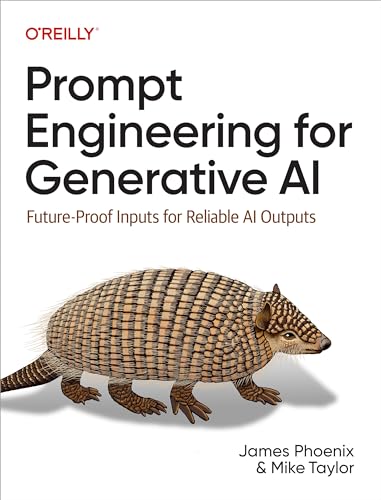
Prompt Engineering for Generative Future-Proof Inputs for Reliable AI Outputs is purchased directly from the publisher or approved distributor and spiraled by a 3rd party. Seller is not affiliated with, endorsed by, or pre-authorized by the publisher or author for the spiral listing. Large language models (LLMs) and diffusion models such as ChatGPT and Stable Diffusion have unprecedented potential. Because they have been trained on all the public text and images on the internet, they can make useful contributions to a wide variety of tasks. And with the barrier to entry greatly reduced today, practically any developer can harness LLMs and diffusion models to tackle problems previously unsuitable for automation. With this book, you'll gain a solid foundation in generative AI, including how to apply these models in practice. When first integrating LLMs and diffusion models into their workflows, most developers struggle to coax reliable enough results from them to use in automated systems. Authors James Phoenix and Mike Taylor show you how a set of principles called prompt engineering can enable you to work effectively with AI. Learn how to empower AI to work for you. This book The structure of the interaction chain of your program's AI model and the fine-grained steps in between How AI model requests arise from transforming the application problem into a document completion problem in the model training domain The influence of LLM and diffusion model architecture—and how to best interact with it How these principles apply in practice in the domains of natural language processing, text and image generation, and code
I was just expecting something different. It's 20% foundational things that are great and 80% code examples that will be outdated tomorrow. I'm not sure what's the point of including pages and pages of code in the book and explaning them line by line.
Este libro te da un conjunto de técnicas e ideas para poder sacarle buen provecho a los modelos generativos tanto de texto como de imagen y supongo que aplica a los nuevos modelos multimodales.
Me dio buenas ideas para las aplicaciones que estoy haciendo actualmente, pero siento que estos consejos tienen corta vida por lo rápido que avanza la tecnología. Algunas técnicas, sin embargo, sí parecen más duraderas.
Otra cosa que siento sobre el libro es que es un poco repetitivo y tiene un algo de paja, lo que lo hace sentir un poquito difícil de leer, por la relación valor/volumen.
Good overview of latest prompt engineering methods and tools from langchain and llamaindex. Good tools for covering advanced rag, advanced prompting, output parsing, chunking methods etc.
Just finished Multisolving by Elizabeth Sawin (Island Press, 2024) — an essential and timely guide for anyone working at the intersection of climate, equity, and systemic change.
Sawin introduces a powerful framework rooted in systems thinking, offering tools to address multiple problems at once rather than tackling them in isolation. From stocks and flows to feedback loops and leverage points, she makes complex concepts surprisingly accessible.
What sets this book apart is its clarity and optimism: rather than trying to control broken systems, Multisolving teaches us how to work with them — amplifying what’s working and strategically shifting what’s not.
Whether you’re a policymaker, activist, or just a curious thinker trying to make sense of a fractured world, this book gives you language, direction, and hope.
Highly recommended for anyone interested in real, lasting change across disciplines.
The first few chapters of the book were solid and I would give them 4 stars, I learned something from them. Then large part of the book were code examples of how to use LangChain, and later how to use Stable Diffusion (with lots of pictures) and somehow I finished a 400+ page book in 2 evenings. I’d certainly prefer to have shorter, but more packed with guides on prompt design book without so much code that might be outdated a year from now
"Prompt Engineering for Generative AI: Future-Proof Inputs for Reliable AI Outputs" by James Phoenix and Mike Taylor explores how interacting effectively with artificial intelligence is becoming an essential modern skill. As generative AI continues to evolve at a rapid pace, the ability to communicate clearly with these systems determines the quality of the results they produce. The book begins with a simple but powerful idea: AI is not inherently intelligent in the way humans are, and it cannot read intent unless that intent is clearly expressed. Because of this, vague or poorly constructed inputs often lead to misleading or incorrect outputs, sometimes delivered with complete confidence. This tendency, often described as hallucination, highlights why prompt engineering is so important. Much like learning to use tools such as spreadsheets became a fundamental workplace skill, crafting effective prompts is emerging as a key competency for anyone working with AI.
A central theme of the book is that strong outputs come directly from strong inputs, and improving those inputs requires following a set of practical principles. The authors outline five core ideas that guide effective prompting. The first is the importance of giving clear direction. When instructions are detailed and precise, AI systems are far more likely to generate useful and relevant responses. Instead of asking broad or generic questions, users are encouraged to provide context, constraints, and intent. One useful method involves guiding the AI step by step, sometimes asking it to first generate background knowledge before producing a final answer. This layered approach improves accuracy and helps align results with expectations, though the authors caution that excessive detail can sometimes create confusion if instructions conflict.
Closely connected to direction is the need to specify the desired format of the output. AI systems are capable of presenting information in many different ways, from structured formats like code or data tables to creative outputs such as stories or visual descriptions. However, without clear instructions, the format may not match the user’s needs. By explicitly stating whether the output should be a list, paragraph, script, or technical format, users can significantly improve reliability. This becomes especially important in professional or technical contexts, where even small inconsistencies in structure can lead to errors or inefficiencies.
Another key principle involves providing examples. The book explains how including sample inputs and outputs - known as one-shot or few-shot prompting - helps guide the AI toward the desired style and structure. Examples act as a reference point, reducing ambiguity and increasing predictability. At the same time, the authors emphasize that there is a balance to be maintained. While more examples can improve consistency, they can also limit creativity if they are too similar or restrictive. Effective prompt engineering requires understanding when to encourage variation and when to prioritize precision.
The fourth principle focuses on evaluating outputs. Rather than assuming the first result is correct, users are encouraged to test prompts repeatedly and compare different responses. This process can be informal, such as manually reviewing outputs, or more structured, involving rating systems or side-by-side comparisons. Over time, this evaluation helps identify which prompts perform best and why. For applications that rely heavily on AI, this step becomes critical, as consistent performance requires careful testing and refinement. The idea is to treat prompting as an iterative process rather than a one-time action.
The final principle is dividing complex tasks into smaller parts. When prompts become too complicated, AI systems may struggle to handle all the instructions at once, leading to errors or inconsistencies. Breaking tasks into simpler steps allows for more controlled and accurate outputs. This approach mirrors how humans solve problems, by tackling one piece at a time. It also enables users to identify which parts of a process are working well and which need adjustment. Techniques like encouraging step-by-step reasoning can further improve results, making outputs more logical and easier to follow.
Beyond these principles, the book provides insight into how large language models actually function. At a basic level, these systems process language by breaking it into smaller units called tokens, which can represent words or parts of words. These tokens are then converted into numerical representations that capture meaning and relationships. Using a system known as a transformer, the model analyzes how each word relates to others in a sentence, allowing it to understand context rather than simply reading text in order. When generating responses, the model predicts the most likely next word based on probabilities, building sentences one piece at a time. This probabilistic nature explains both the power and the limitations of AI, as it can produce highly coherent text but may also generate incorrect information if the probabilities lead it astray.
The authors also discuss practical strategies for working with different AI tools. Since no single model is perfect for every task, users are encouraged to experiment with multiple systems and compare results. At the same time, they highlight the importance of being mindful of data privacy, as some models may use input data for training or improvement. Additional techniques, such as analyzing writing style, generating prompts that create other prompts, and assigning roles to the AI, can help produce more tailored and consistent outputs. These methods expand the possibilities of what AI can achieve, making it a more flexible and adaptable tool.
In addition to text generation, the book explores how image-generating AI works. These systems, often based on diffusion models, learn by gradually adding noise to images and then reversing the process to recreate them. When given a text prompt, the model uses learned patterns to generate an image that matches the description. Just like with text, the quality of the result depends heavily on how the prompt is written. Techniques such as refining prompts, adding descriptive enhancements, and specifying what should be avoided can all improve outcomes. By understanding these mechanisms, users can better control the images they create and achieve more accurate results.
Ultimately, the book emphasizes that working with AI is not about mastering a fixed set of rules but about developing a mindset of experimentation and adaptation. As technology continues to evolve, new tools and capabilities will emerge, but the underlying principles of clear communication, structured thinking, and continuous improvement will remain relevant. Prompt engineering is presented not just as a technical skill, but as a way of thinking about how to interact with intelligent systems effectively.
In conclusion, "Prompt Engineering for Generative AI: Future-Proof Inputs for Reliable AI Outputs" by James Phoenix and Mike Taylor shows that success with AI depends less on the technology itself and more on how it is used. By applying the five key principles - clear direction, defined format, relevant examples, careful evaluation, and task decomposition - users can significantly improve the quality and reliability of AI-generated content. Combined with an understanding of how these systems work and a willingness to refine approaches over time, these strategies provide a strong foundation for navigating the rapidly changing world of generative AI.
Prompt engineering is the art and science of finding the right words to generate the right responses from artificial intelligence (AI). It's becoming a skill in-demand in today's workplaces. It's also becoming an essential skill for life. To understand prompt engineering, you must understand how AI tools understand their inputs. This book explains that to you in many forms.
It covers prompting as it intersects all the major AI disciplines, like general prompts (as in a ChatBot), fine-tuning, and retrieval-augmented generation (RAG). It also introduces how prompting intersects a couple of image-generation tools.
As a scientist, I appreciate the theoretical approach to these practical matters. Too many people are hacks at AI these days, and any technical understanding can rapidly advance an individual's effectiveness. Prompt engineering is often made fun of as a "soft" topic, but as this book demonstrates, it intersects all the major AI areas. Presumably less garbage in means less garbage out. This book shows how you can make that take place.
As typical for O'Reilly materials, this book appeals to people who desire an intermediate-to-advanced understanding of how AI works. It's not for the casual user. Anyone technical involved in professional knowledge generation using AI can benefit from understanding the dynamics "under the hood." It's a good, though perhaps not ground-breaking, textbook for those of us unable to take a class in the subject. Prompt engineering may be a soft topic to many, but books like this ground the field in the science that can make or break a digital or software product.
First for the book review. Prompt Engineering for Generative AI by James Phoenix and Mike Taylor is a hefty tome covering many subjects. It’s useful, but not without faults.
Good points:
* Covers a lot of the foundational concepts * Many code examples from common tools (mainly Python and OpenAI)
Cons:
* Too many code examples, that will be dated by next year (through principles behind them will likely still apply). * Not the best in clearly separating the foundational concepts from implementation.
It’s a good book if you’re a programmer (or close enough) and want to skill up in this area. It can help get an understanding of concepts that may be more thorough than just surfing articles. Then again, you can learn most of what’s on offer via reading free articles on the web.
Some bits do feel like they were written by AI (hardly surprising), and as said above I would have loved to see concepts explained more clearly first in standout sections, rather than the somewhat rambling tone.
While the book offers accessible language and clear explanations, it falls short of its intended timeless approach by heavily focusing on tool-specific tutorials, particularly for frameworks like LangChain, which are likely to become quickly outdated. The explanatory style resembles typical Medium articles - a format that could be seen as either a strength or weakness depending on your perspective. Although the book provides valuable insights in certain areas, its effectiveness is somewhat diminished by an overwhelming emphasis on technical tutorials. The balance between conceptual understanding and practical implementation wasn't quite what I expected, leaning too heavily toward the latter. The fundamental concepts of prompt engineering could have been explored more deeply instead of concentrating on current tools and implementations.
A collection of various commands and queries on how to best use AI chats. I must admit that I expected significantly more. While the presentation of techniques and code examples is extremely helpful, but after finishing reading it, it is unlikely that someone will return to this book, or the data will simply become outdated.
Zbiór różnych komend i zapytań dotyczących korzystania z chatów AI. Przyznam, że spodziewałem się znacznie więcej. O ile przedstawienie technik i przykładów kodu jest niezwykle pomocne, o tyle po przeglądnięciu materiału raczej nie wróci się do tej książki, albo po prostu się ona przeterminuje.
This is a book targeting programmers implementing projects that leverage gen-AI. It is not a book for people wanting to use gen-AI as an end-user, though there is a lot that such a person can learn from this book.
The audiobook is not a great experience. There is a lot of code mentioned in the book, and it is quite hard to go through that in audio vs reading.
I finished the book with a deeper understanding of how to use gen-AI than I had before I started. But my expectations were misaligned. I think there may be better resources out there for people who want to get better at gen-AI usage.
Finally finished. This was the primer I needed for my LLM work. While it may be true that the code examples could easily get outdated in a near future, the ideas here are acrobatic and colorful. For content creation to production grade LLMs, there's a good amount in these pages to stoke the imagination and expand awareness of ways LLMs are being used. I'm excited to review the code examples and the aggressively highlighted points I made throughout the book. This will supercharge my projects and serve as quality reference moving forward.
This book offers invaluable insights into crafting effective prompts for text and image generation, making it an excellent resource for those delving into generative AI. However, sections on LangChain feel outdated, despite the book being only six months old—a challenge inherent in rapidly evolving fields. For those comfortable navigating examples that may require adaptation, it’s a worthwhile read. Recommended for pioneers ready to tackle the dynamic nature of AI development.
I only read the first four chapters. While the book offers a wealth of practical advice, much of it feels anecdotal—as if it were cobbled together from Reddit threads rather than rooted in research or science (though there are occasional evidence-based insights, which I found valuable). That said, it could still fill a niche as an introductory guide, given the lack of comparable resources currently on the market.
This is a book from which you can get a structured guideline on how to write prompts so you can obtain the most helpful assistant from the AI.
Most of the times we don't receive a really good response from this tools and we tend to say that AI hallucinates or using such a technology is pointless. The reality is that we don't know how to properly use this tools as we don't always receive education on this. In that sense, this book is extremely helpful.
This book is absolute crap. There is like 37 pages about prompt and then get the whole history about how LLMs works, what is generative AI, langchain, vector databases, and all pretty much useless stuff not related to title, so it’s absolutely misleading title on this book and it was written just to make some cash. absolute shame.
The first chapters are really great, tricks and a lot of practice, how to work with artificial intelligence, how to reduce artifacts, generally good knowledge, but then it starts with a lot of code to write certain applications, which is good, but the book, as its title suggests, should not consist of 50% of writing two lines of code and then explaining them.
Pretty good, I bought this as I've been working with agentic AI and I wanted to see if this book can help my prompting. I picked up some good techniques on how to construct better prompts. Glossed over much of the LangChain stuff as I'm working with Bedrock.
Great book. I read it about a year ago and am still actively using the knowledge from it. Its main flaw is that it spends too much time explaining string manipulation, which is really not something I feel like I need to learn from a book about prompt engineering.
The main takeaway of this book by James Phoenix and Mike Taylor is that you can make the most out of text and image generating AI by following five essential principles of prompt engineering: give direction, specify format, provide examples, evaluate output, and divide labor.
There are too many tool dependent listings from Langchain explained line by line. And too few examples of iterative improvements of prompts for real life applications.