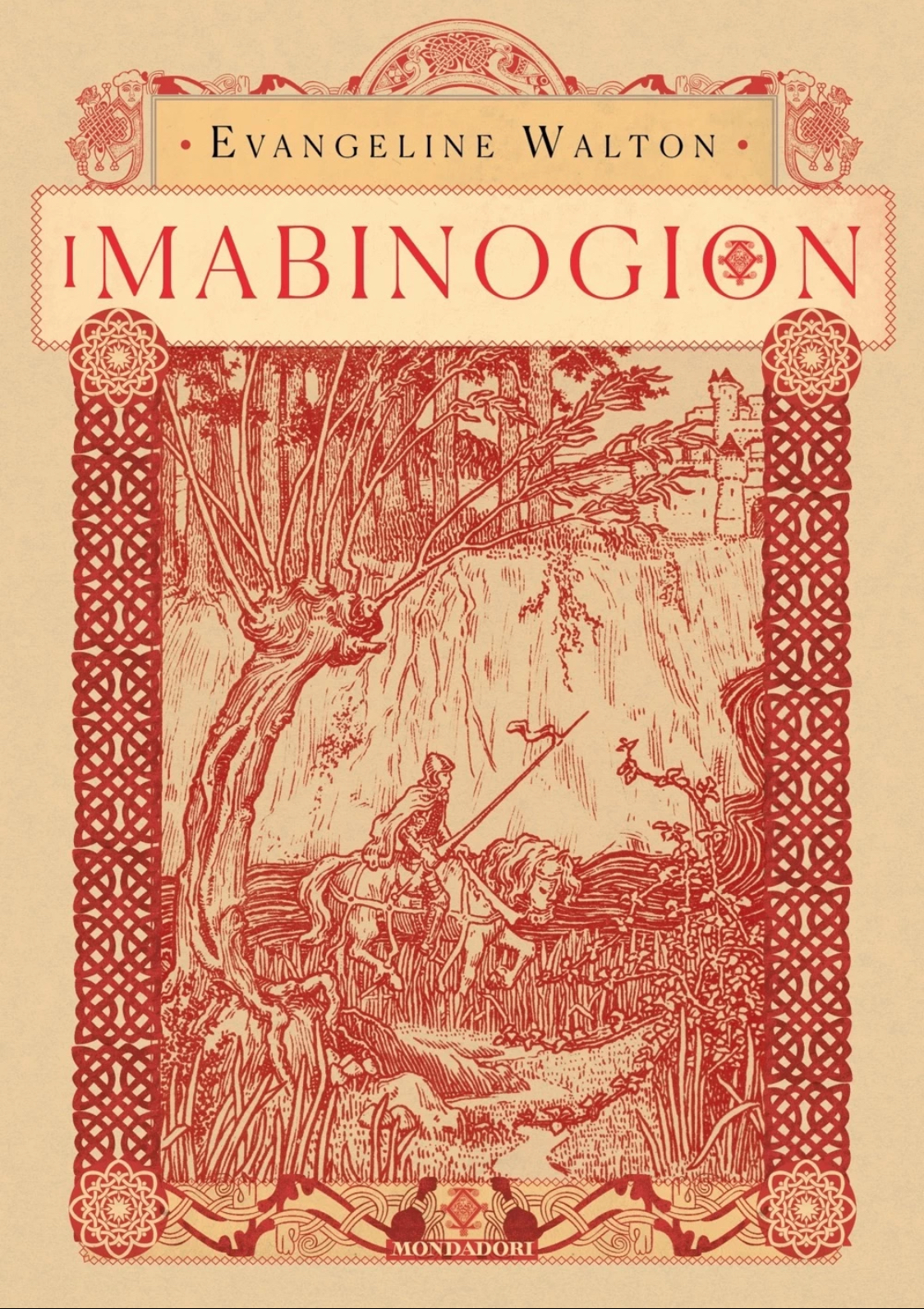
This epic fantasy series is based on the four branches of the Mabinogion which are legends from Welsh Mythology. The introduction explains that after Evangeline Walton published the fourth “The Virgin and the Swine” in the 1930s, her publisher didn’t express any interest to see more stories of this type from her and so Walton assumed that there wasn’t interest for fantasy in the publishing market and after writing the rest of the Mabinogion, she stuck it a desk door and the rest of the series didn’t see the light of day until Ballantine books discovered “The Virgin and the Swine,” and decided to republish it under the much more suitable title, “The Island of the Mighty.” It took awhile to find Walton as they had trouble locating her address but once they did they made a deal with her to publish the rest of the series. If it weren’t for that chance discovery and the devotion that these people showed to the fantasy genre then modern readers, myself included wouldn’t have the opportunity to read this lost treasure of a fantasy epic.
I have not read the original tales on which this series is based so I can’t say for sure how truthful the author was to the original, although I have seen summarizations of the four branches of the Mabinogion and from what I’ve read, it doesn’t sound like she changed much. In notes at the end of each book Walton discusses liberties she’s taken with the original material and the reasons for her decisions, much of which has to do with pleasing her audience. Obviously, the expectation that modern audiences have for their literature is vastly different than the expectations that medieval audiences had. Walton used modern telling techniques to bring the characters in these stories to life for the modern reader. She says that she herself as an interpreter of the original Mabinogion and her interpretation is feminist. Many of the themes within the series have to do with womanhood, marriage, childbirth, the patriarchy and things that will naturally concern a feminist. A work based on Celtic Mythology suits feminist themes, as the ancient Celts were worshipers of the Mother Goddess and women in Celtic culture were not viewed as the property of men but were free and independent. However, the Mabinogion harbors a strong Christian influence because Christian Monk’s transcribed these ancient, Celtic stories and imposed a Christian agenda on them. Walton made it her duty to try to purge the Christian influence from her series and to retain its purely Celtic nature. Throughout the series there is a strong resistance against the coming of the new ways and religion that many of the characters have; they fear that the new ways will replace their old, ancient customs. The resistance to the influence of the new ways reaches a climax in the, “The Island of the Mighty,” where we can see the influence of the ways of the new tribe firmly take hold, with some women in the book priding themselves on their virginity, which is something that had been alien to the ways of the Celts because to the Celts motherhood and giving birth is a sacred motif. One of the characters who is a prophet speaks of despair about the future when women’s body will be owned by men and she will not have the absolute freedom of her body and her own individual self as she did in the days of the ancient harmonies when men and women worked and lived as equals in body and soul. The Ancient harmonies is a pagan concept that has to do with maintaining balance in life, between humanity and nature and between the masculine and the feminine. There are many interesting philosophical reflections in these stories about maintaining this balance. It is clear from her writing that Walton mourns the loss of Celtic pagan culture and harbors some resentment against Christianity for the destruction of these cultures. The characters in her books have many different views so the result of her exploring these themes is a dialogue in which the reader gets to hear many different perspectives on the subject. So while there is an agenda, it is at least multifaceted and illuminating. However, by the Island of the Mighty Walton’s feminism got annoying preachy. She would insert her own views in the text at random times which took me right out of the story, such as one point when she unequivocally states that before women were forced to marry and stay faithful to their husbands, the women of ancient Celtic cultures were never raped. To me these kinds of statements look like propaganda because we don’t know enough about ancient Celtic culture to say for sure whether or not that was true. It too often felt like the author was trying to hammer home her feminist message.
As these books are based on tales that are so ancient, it comes as no surprise that there are some things that annoy me about the plot. For example, the third branch “The Song of the Rhiannon” got annoyingly repetitive towards the end when the characters did the same repetitious activities with the same results for at least a couple of chapters. The protagonists were starting their own businesses in various trades, and in a formulaic, rinse and repeat fashion, the protagonists excelled at their business far better than their competitors, taking away their customers which these other businesses didn’t appreciate, and so in response they would try to kill these upstarts. The protagonists would then have to leave town and start at a new trade in a different town and the pattern was repeated several time. The story may have had some flaws but as far as the quality of the writing is concerned it was excellent. Walton is a great writer of descriptions as her prose is lyrical and a pleasure to read. It rolls off the tongue and I imagine it would sound good read aloud.
My clear favorite of this series was the first book “The Prince of Annwan,” which is the most adventurous and action oriented of the books. In this book the characters of Pywell and Death literally exchange places for a year, and Pywell’s mission is to fight and defeat a character that even Death himself could not defeat. This book fits well under the tradition of the hero’s journey. I didn’t really have a least favorite in this series because the other three books all had their moments of excitement and their rough patches, none of them really standing out. But if I had to choose then the “Island of the Mighty” wins by a slim margin. The ending of the “Island of the Mighty” was too anti-climactic and unrewarding for how many pages the reader has to get through. It ends rather abruptly, not on an epic note at all but with the protagonists far too easily defeating the antagonists. There isn’t much of a struggle and the result is that the ending felt flat. Of the two villains one of them acts like a complete coward and for this reason is detestable and then the other one just gives himself up to be killed, rather than fight back because he didn’t want his people to be killed for his sake and he knew there was no way that he could stand up against the magic of the protagonists. This was a lazy way to end the book. Of course, it is important to realize that Walton was limited by her source material, but I still think that she could have ended the book in a more satisfying manner. A point in favor of the “Island of the Mighty” is that it has one of the most villainous female characters that I’ve seen in a book. She is a sorceress named Arianhod who so happens to be the sister of our dear protagonist Gwydion but she doesn’t start off evil. Arianhod is a woman who has made a difficult life decision and there are consequences for this decision that cause her to grow more and more evil as the book progresses, until at the end of the book she becomes as evil as a woman could become, even going so far as to do things that women are forbidden to do by the Ancient Harmonies such as causing the death of her own child. As a feminist Walton is sympathetic to this character. The reason she becomes so evil is because the patriarchy is slowly taking over Celtic culture and she is a character who has been manipulated and betrayed by the powerful men in her life and she is getting her revenge through trickery and subterfuge. While it is evident that Walton disapproves of her actions, it is clear from the text that Walton pins the blame on the patriarchy for driving her to commit such evil deeds.
Overall, the Mabinogion Tetralogy is a disappointment. Walton is an excellent writer but limitations imposed on the author because of source material and unnecessary feminist lectures sometimes get in the way of good storytelling. I disagree with the quote on the front cover saying that this is one of the greatest fantasy epics of all time. There are many epic fantasies that I think are quite a bit better than this. This is a series where the parts are greater than the whole. It is filled with passages that are brilliantly written and plot points that are exciting and philosophical reflections on the nature of masculinity versus femininity, but the issue is that it ultimately doesn’t amount to anything spectacular.