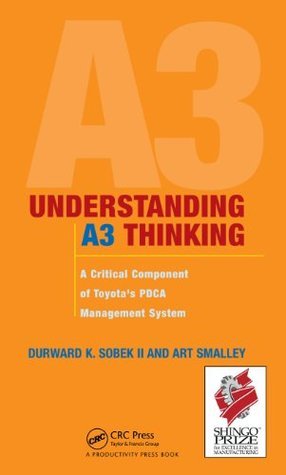
The author concludes saying "Good luck with your OWN A3 thinking". It's not teaching A3 problem solving, rather cultivating the A3 thinking. The content be taken for granted or set inside by calling it merely a "common sense" but implementations on floor mostly fail still. Even if they work, it's linked to the successful coordination or trust on that one or of the few. Remove that one or the few, organization falls flat.
Real-time* vs A3 thinking
* Root cause - What's that? Dont waste my time. Just do it (only to see the problem happening again) - see LOGICAL THINKING PROCESS
* I do not have time for data. Just decide on the go or I have X years of experience. My gut feeling precedes data driven decision making (jump to conclusion; problem clear to one person, but not to rest of organization)- see OBJEVTIVITY
* We did some improvements, but KPI has not changed drastically or KPI moved positive or negative. We don't know why (When actions are not pareto driven) - see RESULTS AND PROCESSES
* Mr./ Mrs. X's words have credibility in the organization. I do not need visuals to convince management, just recommendation from X or having X as an ally (No visuals, no reaffirmation to self, no selling to management) - see SYNTHESIS, DISTILLATION AND VISUALIZATION:
* Abc function says xyz is the problem maker and xyz says that it's abc (No consensus, no results) - see ALIGNMENT
* Every function has a different way to approach an issue. One goes by gut, the other goes by narration PowerPoint and the third goes by complicated excel (different formats challenge logical flow to PS and affect knowledge sharing) - see COHERENCY WITHIN AND CONSISTENCY ACROSS
* My team had amazing solution to the problem, but management is indifferent or not all functions are happy (Did we choose the right Problem to tackle? Is solving our problem leading to a different problem?) - see SYSTEMS VIEWPOINT
Excerpts from the book: 7 steps in A3 Thinking
1. LOGICAL THINKING PROCESS: Toyota views that the inability to properly discern between cause and effect as the leading cause of many poor decisions and problems that remained unsolved in daily management. A problem solver must clarify the problem. The first step is often to travel physically to the actual location (genba) where the problem occurred and observe the situation firsthand. Why the problem is a problem? when and what conditions? Talk to involved people. Success in Toyota is to treat quality problems like the police do a murder case.
2. OBJECTIVITY: Employees in Toyota are coached to be detailed, quantitative and specific in their characterizations of the current state or any form of problem solving. The reason is that subjective opinions have no business in science, engineering or the basic process of kaizen.
3. RESULTS AND PROCESS: The unfortunate reality us that organizations face an infinite number of problems to solve buy have only a finite amount of resources available to tackle them. Toyota is actually a results oriented organization. Achieving results accidentally or by happenstance is of little long term value. Results are truly a test if one's understanding. With A3 approach, the process can be refined and repeated for better results in the future
4. SYNTHESIS, DISTILLATION AND VISUALIZATION: A3 Thinking encourages the visualization of the key synthesized information in order to communicate the message clearly and efficiently. With such single page A3 reports, flip chart and employee narration, when Toyota's executive ranks visit the shop floor, it allows them to interact with more groups on highly productive basis
5. ALIGNMENT: Involves 3D communication. Horizontally across the organization, up and down the hierarchy. Toyota places high value on practical consensus. Effective implementation of a change hinges on obtaining prior consensus among the parties involved. Problem solvers are expected to return to that person and explain why their concerns were not addressed. They can even be requested to sacrifice their interest for the greater good
6. COHERENCY WITHIN AND CONSISTENCY ACROSS: Solutions not addressing root causes, problems not important to organization's goals etc. A3 reports promotes logical flow of information to prevent such pitfalls. Having consistent approach across the organization speeds up communication and establishes shared understanding
7. SYSTEMS VIEWPOINT: The purpose of the course of action to promote one organizational goal at expense of others will not be favorable. A problem solver should understand the broader picture and make recommendations to promote overall good of the organization
A3 defined after PDCA can be used as sole management tool to drive focussed improvements. It promotes valuable data driven thinking across the organization, speeds up communication and enhances collaboration between teams.