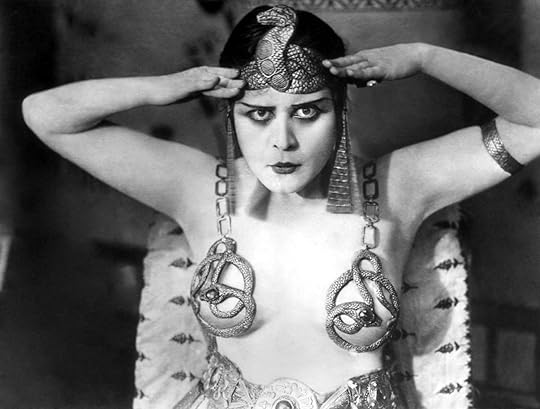
When Peter Stothard, editor of the Times Literary Supplement, finds himself stranded in Alexandria in the winter of 2010 after his flight to South Africa has been cancelled, he sets out to explore a nation on the brink of revolution. Guided by two native Egyptians, Stothard traces his own life-long interest in the history of Cleopatra, and his repeated failure to write the book about her that he had always wanted to. In Alexandria, part memoir and part travel literature, Stothard was the sights and sounds of the ancient city to reconnect with the formative experiences of his childhood education, and his literary career. Melancholy and sometimes humorous, Alexandria offers a first-hand glimpse into the fracturing police state of Hosni Mubarak, before the uprising in Tahir Square changed everything.
I am sorry to start a review by criticising other GR reviewers but I am amazed at the number of them who complain that a book entitled 'Alexandria' and subtitled 'The Last Nights of Cleopatra' and bearing the following information clearly displayed on either the back cover and hardback book jacket flyleaf:
"In the winter of 2010, Peter Stothard, editor of the TLS, is visiting Alexandria. His plans to complete a long delayed biography of Cleopatra are complicated by the onset of the Arab Spring. As Egypt's police state fractures and the old order crumbles, he visits the cities ancient sites, chasing Cleopatra's legend. At the same time he finds himself revisiting places and people from his own life...In this rich and elegaic book, part memoir and part travel literature, the politics and power struggles of the present mingle with the author's memories..."
Reading this how can anyone complain that this is not a biography of Cleopatra? Do people buy, or borrow, books without ascertaining what they are about? It is not like publishers hide the nature of their books content the way food manufacturers hide the chemical content of their prepackaged foods. One can be ignorant of the 'E' content of your frozen dinner but hardly ignorant of when a book is, or is not, a biography of an ancient Egyptian queen.
So this is not a biography of Cleopatra nor does it pretend to be. It is the story/rumination of Mr. Stothard on how Cleopatra has intersected with his life, how he has attempted, and failed on many occasions since he was a schoolboy, to write about Cleopatra. It is also a book about looking back on places, people and events which have formed him. At the time it was published the book was praised, in the UK, as 'bewitching' and 'utterly brilliant'. I would happily endorse that praise.
Mr. Stothard comes from a generation of UK, and Irish, men and women whose education was firmly rooted in the classical literature and, to a lesser extent, history of Greece and Rome even if they did not, like Mr. Stothard, become classicists. Mr. Stothard is one of the last of a generation of writers whose writing, even if it isn't about the ancient world, is imbued with the lessons, examples and exemplars of the history and literature of Greece and Rome. I adore it (see also my review of 'The Spartacus Road' by Stothard) because when handled by a writer with Mr. Stothard's skill it is a lesson in how deeply rooted knowledge can be dispensed with an easy elegance that leaves you wanting more.
There is much about Cleopatra but mostly by viewing her and her actions and times through secondary and ancillary characters like Publius Canidius Crassus, Lucius Munatius Plancus, the writers Horace and Cornelius Gallus. That one of these ancient men (and I apologise that they are all men but I cannot alter the misogyny of the past) was famous for dressing up as merman in blue/green paint and fish tail and slithering across the marble floors of palaces on his belly is just one of the choice historical mise en scène resurrected for own benefit. It also provided the inspiration for an extraordinary brothel? party venue? created by one of Mr. Stothard's friends during his time at Oxford. Either such titbits will intrigue you or they will leave you cold, depending on which will decide if this book is for you.
Least you imagine this is a book of tawdry and scurillous tales from ancient history and more recent times let me happily disabuse you. It is most remarkably an account of how the world has changed in the last forty years. For a younger reader the most impossibly remote times are not those of Cleopatra but Mr. Stothard's working for a UK oil company and later Times Newspapers in the 1980s. The days when Shell (unnamed but unmistakeable to a UK reader) employed hundreds of office workers in two vast establishments on either side of the Thames are not only over but forgotten, even the buildings those teaming hundreds of workers ocuppied are nolonger owned by Shell. As for Fleet Street and newspapers? Fleet Street is a historical term, the battle between printers over hot metal presses is as obscure, and forgotten, as the details of why the Baarle-Nassau enclaves of Belgium exist with the territory of the Netherlands. Will any newspaper have either the reputation, arrogance or importance to celebrate its two hundredth anniversary with a party at Hampton Court Palace as The Times did in 1985? Yesterday seems stranger, and more remote, then Cleopatra's Alexandria.
A wonderful book of history, memory and so much more.
A final note, I originally read this book back in 2017 and intended to briefly reacquaint myself with it so I could write a review. I found it impossible to either dip into or skim, I couldn't resist rereading from cover to cover. It was a joy to do so.
BBC BLURB: When Peter Stothard, former editor of The Times and now editor of the Times Literary Supplement, finds himself in Alexandria in the winter of 2010 after his flight to South Africa has been cancelled, he sets out to explore a nation on the brink of revolution.
Accompanied by two native Egyptians, Mohammed and Socratis, whose eagerness to spend time with him is never really explained, Stothard traces his lifelong interest in the history of Cleopatra, and his repeated failure to write the book about her that he has started so many times.
Melancholy and sometimes humorous, Alexandria filters the life of a classics scholar turned journalist through the prism of Cleopatra's turbulent history - while all around the author, the cracks begin to appear in Hosni Mubarak's own empire.
Alexandria: The Last Nights
1: Pieces of paper, sketches and maps on a hotel room bed and the remarkable story behind the only fragment of parchment to bear Cleopatra's signature - a political gesture sanctioning a tax break. 2: Peter Stothard was a bookish child, who began his only work of fiction, featuring Cleopatra, aged nine. The new library in Alexandria is the obvious place to visit. 3: A meal with the author's two newly acquired friends, Mahmoud and Socratis, takes a bizarre conversational turn. 4: A visit to a carpet shop and a history lesson - ancient and modern. 5: The author recalls seeing Elizabeth Taylor in the 1963 film Cleopatra. In the meantime, the Arab Spring begins.
From BBC radio 4 - Book of the week: When Peter Stothard, former editor of The Times and now editor of the Times Literary Supplement, finds himself in Alexandria in the winter of 2010 after his flight to South Africa has been cancelled, he sets out to explore a nation on the brink of revolution.
Accompanied by two native Egyptians, Mohammed and Socratis, whose eagerness to spend time with him is never really explained, Stothard traces his lifelong interest in the history of Cleopatra, and his repeated failure to write the book about her that he has started so many times.
Melancholy and sometimes humorous, Alexandria filters the life of a classics scholar turned journalist through the prism of Cleopatra's turbulent history - while all around the author, the cracks begin to appear in Hosni Mubarak's own empire.
Episode 1 (of 5): Pieces of paper, sketches and maps on a hotel room bed and the remarkable story behind the only fragment of parchment to bear Cleopatra's signature - a political gesture sanctioning a tax break.
Read by Kenneth Cranham Abridged and Produced by Jill Waters A Waters Company production for BBC Radio 4.
On page 67 of Alexandria: The Last Nights of Cleopatra, Peter Stothard acknowledges what the reader knew some 60 pages earlier. ‘This is becoming a book about me. That is not what I intended.’
Based on the cover, one might assume this to be a conventional history of Cleopatra; born 69 or 70 BC, the last pharaoh of Egypt, the woman who murdered and seduced to advance her political ambitions. Theatrical motifs from her life are scored into our collective unconscious. It is said that at 21 years old, she was smuggled past Ptolemy’s guards in a carpet and unveiled to Julius Caesar, then over 50, and became his mistress. She dissolved a pearl in a cup of wine and drank it to vex her other famous lover, Mark Antony, in a bet over who could feast the most extravagantly. And her grand finale, a spectacular suicide involving (if Shakespeare and the Victorian painters are to be believed) a basket of figs and an asp. There have been countless depictions of her story rendered in art and print, and yet since the age of nine, Stothard has wanted to make his own version.
This book is partly about Cleopatra and partly about the author watching himself trying to write about her. For this is Cleopatra the eighth, as in, ‘precisely the eighth time’ Stothard has attempted this biography. ‘I never intended to write so much here about my own life,’ he reiterates later in the book, getting a twinge of writers’ doubt over past promises unfulfilled:
‘But I do select every memory by how much it connects to those promises. It seems random. But there is a reason, a pattern and, in the end maybe, a picture too.’
Yes. I can confirm there is a lucid and rewarding whole.
This is a history book because I now know more about Cleopatra’s life and times than I did before. It is also a writer’s journal, a record of false starts when one has a project in mind that eats away at you if don’t get it down on the page. It is travel writing, about Stothard’s days in Alexandria in January 2011 and the prelude to the Arab Spring. And it is memoir, recalling the author’s intellectual awakening and most especially two friends, Maurice and V, who, though not so very close to Stothard in the usual sense, both challenged, frustrated and inspired him.
Peter Stothard is the editor of the TLS. He was the editor of The Times from 1992 to 2002, chronicled Tony Blair’s war from inside the goldfish bowl, is a survivor of cancer and a classicist. These accomplishments make it difficult somehow to reconcile this as the author of Alexandria, an object which represents childhood wish fulfilment. The prose is as clear and elegant as you would expect, but the tone is surprising. Alexandria is meditative, sentimental, written from the heart, not from a journalistic imperative.
One of themes in this book is how written language, the most indelible method we have of recording human thought from one century to another, is fragile. Names of the ancient Egyptian dead, cut in stone to guarantee immortality, were later chiselled out by enemies to obliterate souls in the afterlife. The burning of the Ancient Library of Alexandria is another motif Stothard evokes when he describes going to the Bibliotheca Alexandrina, a vast, modern complex built to recapture the spirit of the original. (Of course, Stothard does what any procrastinating author might be tempted to do: he looks himself up.) Even his writing, many hundreds of thousands of words over the course of a career, is vulnerable. ‘Most have sunk deservedly deep beneath the library sea,’ he says.
Words have permanence when they’re not lost or destroyed.
Sometimes a mere fragment survives from classical antiquity for scholars to pore over. There is, Stothard explains, one example of Cleopatra’s handwriting discovered recently on a papyrus used as post-mortem packing material. It is a tax exemption for one of Mark Antony’s generals drafted by a secretary upon which Cleopatra writes in Greek, ‘ginestho,’ meaning, ‘let it be done,’ ‘make it happen,’ a single queenly command passed down through the ages.
In Alexandria, Stothard concentrates on the ephemera of his Cleopatra, different incarnations rough-written, partially typed, bits copied or sellotaped together. He arranges them in his hotel room and his mind. He’s drawn into spaces of the past, schoolrooms, college bedrooms, red tents, drab offices, while giving the reader a sense of this as unfinished business as though the decades spent on news and politics were an interruption.
It is possible, perhaps, to read too much into a bereavement or health scare as the motivation for making work. Books have a spirit of their own. Sometimes authors don’t realise what they’re writing until they’ve written it, and this memoir is unusual because it lays that process bare. The people on the page, whether they lived long ago or are alive and well today, are captured as an impression – a reaction – a mood. It’s a way for the author to understand these relationships. Stothard has succeeded in writing his book about Cleopatra, yet her presence in our memories was already assured. It is the people history probably wouldn’t remember, his friends, his teachers, his colleagues, his guides, that he has done a real service to. This is writing from kindness.
I wanted a book about Cleopatra. I got a navel-gazing memoir about...uh...well, hell. I have no idea what it was about.
Ostensibly a memoir about writing a biography of Cleopatra. But not really. A better title might have been "Hella Disjunct Random-Ass Memories of My Life (In No Particular Order) That Happened to be Written While I Was Visiting Alexandria While Trying to Write a Book About Cleopatra" or "Alexandria-Adventures in Writer's Block" for short.
There were moments of history but they were few and far between. Tedious.
As in Spartacus Road, Stothard writes a mix of autobiography and ancient history. The book is ostensibly written during an extended visit to Alexandria, his final and successful effort to write a book on Cleopatra. Stothard covers his time in an old-fashioned prep school, Trinity College (Oxford), and in various jobs (ending as editor of the Times and then TLS). In each place he tries to write about Cleopatra and collects scraps of the abortive attempts. Old school friends reappear throughout the book, asking him about Cleopatra. Interwoven with this are his odd visit to Alexandria and stories about Ptolemy Auletes, Cleopatra, Caesar, Antony, Plancus, Canidius, and Octavian. He covers the little we actually know about Cleopatra, along with much of the speculation. His accounts of Plancus are by far the most interesting. Throughout his time in Alexandria, he is led around by two self-appointed guides, Socratis and Mahmoud. He doesn't hire them, they just show up at the Hotel Metropol and take over his life. He never identifies them as secret police, though it is hard not to. At the beginning of his visit there is an explosion in a Coptic church; unrest persists and only at the end does Stothard note that this was the beginning of Arab Spring and Mubarrak's downfall.
The writing is striking and beautiful in its balance and cadence. The scenes in Alexandria matched with the historical anecdotes about Cleopatra and various Roman generals and personalities made this a deeply pleasurable read. The portions about the author's friends in the UK, etc were somewhat distracting, but did contribute to the overall effect of past and present intertwined in the streets of Alexandria with police, shifting tides of rumors and various Cleopatra branded items sold in storefronts.
This is an intriguing book, which, apparently like the author's attempt to pin down his stated subject over the years, has a sensation of slipping through your fingers as you read. Touching and elegiac, it is also mysterious and at times alarming. The author's photographs, of apparently rather random bits of street furniture, which illustrate the text, add to the nebulous feeling of the whole thing. It's like glimpsing something rather beautiful through a series of veils.
A Memoir, almost an Auto-biography, it's rather interesting, to follow the memories of the author through the daily life of an unplanned trip to Alexandria, a place he's apperently been imagining since childhood in one form or another. There's a slight mystery that will probably never be solved about his trio of guides and their quirks aside from the trio and their families themselves. I wonder if they know they're in a book now?
Somewhat of a dry read until you get into it, it's more dry if your looking for 'Cleopatra' and deserts and ancient times IN the deserts rather then the mind of an Author as he revisits different times in his life and different attempts at writing about one famous Cleopatra. Otherwise it's a pretty interesting little look at what happened in the past, and in the first month of 2011 in the city of Alexandria.
Also it gives one a curiosity, what might his Cleopatra story have been, if he had written it as he originally wanted, so many years ago, a fiction? or as a middle-aged man, would it have been more of a history? Whatever it would have been, this is what it is now; a look back for the author, and a few new details and things to check out for the curious.
Interesting take on the city and the queen of Egypt that gives a nice and different perspective on what is a beautiful location and a fascinating woman.
More self indulgent than this reader desires. I was hoping to find a book about Alex past and present but it instead is a partial biography about the author's struggles with writing such a book and therefore falls flat.




 BOTW
BOTW