Our estate was built on land claimed from fields – we were at the foot of those rolling Kilpatrick hills, but over the roof of the school you could see more green fields and woods. I felt grateful to be on the edge of all that countryside – there was a magnetic pull towards what I thought that wild was, or could be. ‘One day, I’m going to walk to those hills and woods,’ I’d think to myself.
Soon, it would become a sanctuary.
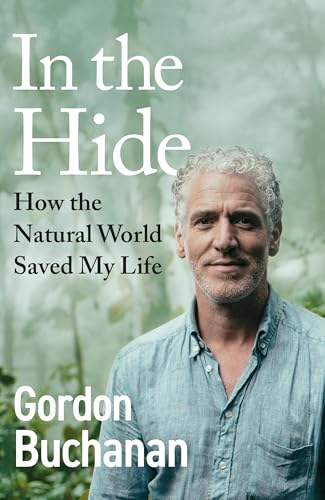
Gordon Buchanan is probably the best known natural history cameraman the BBC has ever produced. From wild 'snow wolf' packs in Ellesmere and polar bears in Svalbard to leopards in Mumbai and equine therapy in Mongolia, he has filmed in the world's most far-reaching places for over 30 years. His dedication to his craft means he often spends weeks inside a cramped camera hide, tolerating extreme sleep deprivation and poor living conditions, all in search of that one extraordinary shot.
But dangerous animals were not the only thing he was hiding from.
In the Hide is Gordon's emotionally honest and raw account of a challenging childhood in Glasgow and Mull, and the escape and solace he found – and continues to find – in the natural world around him. An intimate and inspiring account of resilience in the face of hardship, In the Hide marks the arrival of a bold new voice in nature writing.
Surprisingly fantastic book. This tells us Gordon's story of growing up in Scotland and I actually found myself laughing out loud as he told the story of him and his three siblings growing up in the '70s. Part of his childhood weren't so idyllic though; his Dad left them when he was wee (which made his family an enigma in Mull in the the late '70s) and then her mum married a man who ended up abusing her. We then hear about how Gordon ended up being a wildlife cameraman, the stories of that and how he balanced that with a life back home. Really fab book. Highly recommended.
Really enjoyed this book I’ve been following Gordon on tv for years and went to his current touring show where I purchased this book , it was great hearing about Gordon’s story growing uo , I loved his honest and humorous storytelling and being a similar age and being brought up in the 70’s in Scotland could relate to a lot of the book.
I feel I know a lot more about the man behind the lense.
Loved it throughout. Love the natural, easy style of writing. Love the stories of him as a child and a teenager and a struggling film maker. Plus the stories of the animals he met along the way.
Reading *In the Hide* was an unexpectedly powerful experience for me—not just because of the breathtaking wildlife encounters Gordon Buchanan is known for, but because of how vividly and honestly he writes about his youth. I picked up the book expecting gripping stories from behind the camera, but it was his formative years on the Isle of Mull that stayed with me most.
Buchanan paints a raw, unfiltered portrait of a childhood shaped by both freedom and instability. Growing up in a rural setting, with little structure and few rules, his early life was wild in more ways than one. He writes about secret motorbike rides, air rifle shootouts with his brothers, and a kind of chaotic independence that seems unimaginable now. But underlying these stories is a deeper emotional current: the fallout of family conflict, especially his difficult relationship with his mother’s partner, and the silent resilience that formed in response.
What struck me most was the connection Buchanan makes between those early experiences and the observational skills that later defined his career. As a child, he became highly attuned to subtle shifts in mood and detail—first out of necessity, later as a professional tool. That link between personal history and professional strength is something the book explores with surprising insight.
His honesty about depression and lifelong feelings of inadequacy was also affecting. It’s rare to see someone in the public eye speak so openly about these things, and it added a lot to my reading experience. These emotional undercurrents made his accomplishments feel all the more earned. Rather than glossing over the more painful parts of his past, Buchanan uses them to reflect on how he came to be who he is—someone deeply sensitive, driven, and curious about the world.
While the wildlife encounters are fascinating and the anecdotes from filming are gripping—especially his close call with a polar bear and time among wolves—it was the quieter moments from his youth that gave the book its weight. They made the later chapters feel not only adventurous, but also deeply personal and hard-won.
For me, In the Hide wasn’t just a memoir about a wildlife filmmaker. It was a coming-of-age story set in a wild, beautiful, and sometimes dangerous landscape—both physical and emotional. I came away with a deeper understanding of Buchanan’s work, and an appreciation for the personal history that informs it. Reading his account made me want to go back and revisit his films with new eyes, now knowing more about the life that shaped the person behind the lens.
This entire review has been hidden because of spoilers.
A very likeable and surprising book. I've seen some of Gordon Buchanan's wildlife film work but not a great deal (and not really of that referred to here) and I didn't have the faintest idea about his early life. Poverty, a largely absent parent, a move to Mull, domestic violence... quite a 'wild' life (and not of his making), and that's before we get to being caught up in civil war. The narrative jumps about a bit - he's co-written and it is hard to know who did what in terms of structuring the story. Too often the use of a co- or ghost writer (Will Millward here) lays a dead hand on a memoir but I didn't feel that was so for this book. The focus is generally on particular moments and projects.
Overall the book is perhaps more of a testament to people 'saving' his life, despite the obviously huge place that the natural world has for him and part of the 'saving' has been facilitating his work within it. There's generosity without gushing (well, maybe he gushes a bit about his wife and his children - all as individuals rather than mere ciphers) There's a sparing but effective and funny use of profanity.
This is not my usual kind of reading material, however, as an avid fan of Gordon I was keen to stick at it. I read to escape from day to day life and a lot of information in the book was quite familiar. Once Gordon was in Sierra Leone I became hooked. I adore wildlife and enjoy watching any kind of animal documentary so it was fascinating to hear it all done. I feel it's also so important that people are open about their mental health and although it must have been difficult to write about his depression, it is part of who Gordon is and he is right to be absolutely up front about it.
It a biography/autobiography for me, no. But I did enjoy this story and recommend it to anyone that has a love for wildlife, Scotland or an autobiography.
This entire review has been hidden because of spoilers.
I love watching Gordon Buchanan.on TV. His passion for thr natural world is contagious and its exactly the same in this book. His enthusiasm leaps off the page.
Theres a lot about his early life which is incredibly interesting. I've visited the magical Isle of Mull as an adult, and I can only jealously marvel at what it must have been like to live there as a child.
Gordon's description of his feelings the first time he rode a horse, exactly mirrored my own. It brought thise feelings rushing back to me and gave me a warm fuzzy feeling.
In all honesty, I could have happily read a book twice as long and still be left wanting more.
(If I'm being really picky... there's a mistake on page 63, Loc 925, which an editor really should have picked up)
We love watching Gordon Buchanan with his enthusiasm and knowledge shining through on his wildlife shows so getting to know a lot more about him was a joy to read, especially how, as a teenager, he became a part of the world of filming wildlife, in Sierra Leone. Strongly related to his struggle with depression. Like Gordon I was diagnosed later in my life but realised I had issues with it for the vast majority of my life. You don't recover from it, you learn coping mechanisms but I digress. Gordon has had an amazing journey and, health permitting, will continue to for many decades.
I have watched Gordon Buchanan for many years and I have always loved his work. An excellent presenter and camera operator with an array of amazing stories to tell.
A great read and plenty of great anecdotes from his career.
I can’t help but feel that he could have included even more stories about his adventures as a presenter and cameraman.
I have never read an autobiography before and this one was wonderful. I have watched Gordon Buchanan for many years in all of his excellent Natural world tv programs and to read about how he got where he is today is quite special.
Not sure it’s everyone’s ideal book, but I throughly enjoyed it. I thought at first it seemed to jump about a lot but I soon got used to that, I even spent my mid morning coffee break today last until lunch time.
I was lucky enough to see Gordon Buchanan at a live event and this gift was gifted by someone who knew that. An enjoyable read about an amazing career.