‘Do you know what an ah-gwi is?’ ‘A ghost of someone who starved to death.’ Ghost stories, urban legends, weird tales floating around the Internet, I was into all of that. Sometimes, I would tell her some of them between puffs as we stood there staring at the dumpsters. But this was the first time she had mentioned that stuff on her own.
In Grocery List, the Korean writer Bora Chung reimagines the ghost story as a chilling tale of intimacy with appetite. The dividing lines of reality and thoughtforms blur as Chung takes on the ever-timely subject of food consciousness. Cutting and evocative, Grocery List is a feast for eaters of all kinds.
Born in Seoul, Bora Chung is a distinct new voice in global literature. The author of three novels and three collections of short stories, Chung was shortlisted for the International Booker Prize in 2022. Chung holds an MA in Russian and East European area studies from Yale University and a PhD in Slavic literature from Indiana University. She teaches Russian language and literature and science fiction studies at Yonsei University, and translates modern literary works from Russian and Polish into Korean.
Anton Hur was born in Stockholm and currently resides in Seoul. He won a PEN Translates grant for his translation of The Underground Village by Kang Kyeong-ae and a PEN/Heim grant for Bora Chung’s Cursed Bunny, the latter of which was shortlisted for the 2022 International Booker Prize; his translation of Sang Young Park’s Love in the Big City was longlisted for the same prize that year. Other internationally recognized translations include Kyung-Sook Shin’s Violets (2022) and Baek Sehee’s I Want to Die but I Want to Eat Tteokbokki (2018). Also a writer, Hur’s novel, Toward Eternity, a speculative treatment of a transhumanist future, will debut with HarperVia in summer 2024.
Bora Chung has written three novels and three collections of short stories. She has an MA in Russian and East European area studies from Yale University and a PhD in Slavic literature from Indiana University. She currently teaches Russian language and literature and science fiction studies at Yonsei University and translates modern literary works from Russian and Polish into Korean.
A few days later, when we were standing side by side again on our break as I smoked a cigarette, the girl asked. "Do you know what an ah-gwi is?" "A ghost of someone who starved to death." Ghost stories, urban legends, weird talcs floating around the Internet, I was into all of that.
Grocery List is from the International Booker shortlisted team behind Cursed Bunny - author 정보라 (Bora Chung) and translator Anton Hur.
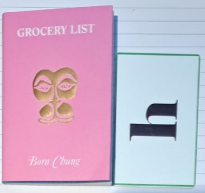
This is part of the second series of chapbooks by Hanuman Editions and it's worth saying up front that the physical book is both a lovely work of art, and that it is tiny - 11cm by 7cm, the picture below versus a credit card, so that the 80 pages contain a story of I would estimate less than 4000 words.
The story is told second hand by someone who hears it from a girl who keeps him company while he is on a cigarette break from their supermarket job. She lures him in by telling him this will be a story about a 아귀, a 'hungry ghost', then starts with a conventional tale of a teenage girl developing an eating disorder, impacted by the divorce of her parents, before the story takes the promised more supernatural, and later somewhat sinister, turn.
It's nicely done, closer to the grotesque style of Cursed Bunny rather than the more speculative fiction of Your Utopia. I must say I had also, from the billed 80 pages, expected something more substantial. 3.5 stars.
This short story is something I didn't expect eventho I have read Cursed Bunny and Your Utopia. Short and shocking with her surrealism touch (as usual).
In Grocery List, Bora Chung brings daughter-mother complex relationship. It also talks about eating disorder and it's connection with teenager. Somehow, I felt that Bora Chung is trying to remind all women out there that generational trauma could be in any shape that close to us. Whether it's about food, dysfunctional family, or else.
Beside of the story, I was lucky enough to read this in Hanuman Edition--since it's hard to get in Indonesia. Small book but worth having 😄
The book is so small that it hightened my body dysmorphia while holding it open to read, which played along with the body horror of the story perfectly lmao
read on one subway trip. sneaky and harsh, reminded me of junji ito's stories, especially in the description of the ghosts. i love the hanuman editions so much
There isn't too much to say without spoiling this tiny chapbook and its tiny story, but for fans of Bora Chung's Cursed Bunny there will be much to enjoy in Grocery List - the content is very disturbing and potentially triggering regarding domestic abuse between parent and child, as well as eating disorders and body dysmorphia, but the tone of the story's narration is deftly offbeat with the incorporation of spirits and how it's told through smoke break recollections between gossiping colleagues.
Dark, disturbing, yet somehow quirky, with fantastic social commentary and use of magical realism - I loved this.
I came across this little gem at an art book fair. It was a pocket zine size but I was surprised by how much text was in it as I quickly flipped through. I realized it was more novel than a zine as intriguing phrases and sentences caught my eye. After I circled the book fair, I came back to the publisher's table. Another book, much larger than Grocery List, had piqued my interest and as I made my purchase I impulsively decided to add Grocery List to my purchase as well. Turns out I enjoyed Grocery List much more than the other book that I bought. As I leisurely read Grocery List in the bath, I was transported to the familiar angsts of being a tween and teenage girl. The all-too-familiar needling of intrusive parental scrutiny and self-imposed body image criticisms. Grocery List took me along a fantastical tale starting from that relatable psychic foundation. Its imagery and message stayed with me long after the I got out of the bath.
I had no idea when I ordered this just how small it is - £12.99 for a novella (single short story?) that fits in the palm of your hand is waaaay overpriced Waterstones!!!! I would have been furious and probably returned this, had it been by anyone other than Bora Chung. While I still think its exorbitant, the story itself is as you'd expect from Chung, excellent.
Like the recent Midnight Timetable - the strange story is told to the narrator by a colleague - giving it a whiff of urban legend. This explores the theme of Hunger and the effects of family breakdown - The girl of the story is bulimic (brought on by issues with her mentally ill mother) and begins to obsessively draw food. Her hunger manifests in these mini 'monsters?' who attach themselves to her drawings and feed off them. This takes a dark turn because they can be transferred to people....
There's so much packed into this tiny story which is wonderfully quirky with a dark almost sting in the tale ending.
As a huge fan of Bora Chung, I was impressed as usual.
This short story, formatted as a tiny print book with a beautiful embossed cover, was a horrifying bite-sized read. The story is told by the protagonist's coworker, who tells the tale of her classmate that developed an eating disorder due to her mother's constant nagging. Of course, as is the case for most of Bora Chung's stories, the story is never as simple as it seems.
Chung's exploration of mother-daughter relationships, societal pressure, eating disorders, and the policing of women's bodies all weave together to make a painfully relatable story that feels both heart-wrenching and satisfying.
Also, a shoutout to Anton Hur, for his brilliant translation as always!
“the hunger of women, of children. of the overlapping meanings between hunger and loneliness.” bora chung did not only understand the assignment, she MADE it. and everyone else failed to turn up. thats all im saying