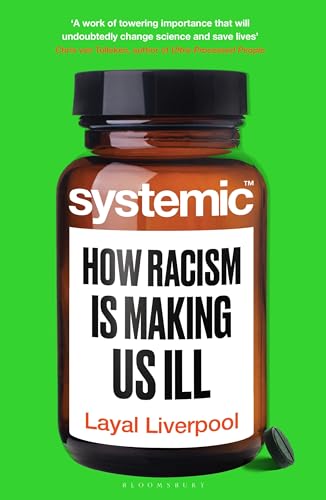
A science-based, data-driven, and global exploration of racial disparities in health care access by virologist, immunologist, and science journalist Layal Liverpool: in the spirit of ambitious bestselling books like Medical Apartheid and Killing the Black Body. The COVID-19 pandemic taught us that viruses disproportionately affect people of color. Here, Layal Liverpool goes a step further to show that this disparity exists for all types of illness and that it is caused by racism. Liverpool shows how racism is woven, invisibly, not just into the structure of medicine and science but into our very bodies. Refuting the false belief that there are biological differences between races, Liverpool goes on to show that racial stereotyping and trauma can lead to biological changes that make people of color more vulnerable to illness. The dangerous health consequences of systemic racism, from the physical and psychological effects of daily micro- and macro-aggressions to intergenerational trauma, the fatal stereotypes that keep people of color undiagnosed, untreated, and unsafe, and how we can fix these problems by confronting bias and closing the data gap. Using data-driven science, Layal Liverpool shows that racism itself can have biological consequences on the body.
This book was so good that I immediately recommended it to a friend who is a Texan politician, telling her that I think this book could be helpful to her work, if she has yet to read it. There was so much in here - some I'd already known, but so much more that I now understand even better or have learned for the for first time. Most of the book focuses on the consequences of medical racism for Black people, but there is also time dedicated to Indigenous, Asian, Latinx, immigrant, transwomen, and disabled populations (probably in that order).
A lot of books I've read on systemic medical prejudice has been from the perspective of women being excluded from data collection, and the intersectionality of the other demographics are layered on top. This book does the reverse, and it started with the author having a very common skin condition (eczema) that went untreated her entire life because the white doctors in the countries she'd lived in couldn't recognize it for what it was, given her skin was Black and that her condition presented slightly differently than any cases they'd seen or learned about in medical school. When she finally got a diagnosis from a Black doctor, she started asking questions.
Something else that surprised me was what the author calls race normalizing in terms of data. Actually, it shouldn't have surprised me. Yet...race normalizing adjusting the data for Black people which puts them at a significant disadvantage. I was especially interested in the chapter on eGFR readings. Mine are consistently high within the normal range, as is my BUN. As a result, my ratio of the two is always just over the line and presents as outside of normal range. My doctor explained that since both numbers are within normal, the ratio itself can be ignored. I had no idea that doctors had been instructed for who-knows-how-long to skew data for Black people by a factor of roughly 1.2, which has had an impact on how well their kidney issues have been treated in the past. This was one example. There were others that were deeply troublesome and appalling - cases that were taken from today's times in developed countries.
I knew racism and sexism play a role in the efficiency of care people get. I was particularly disturbed that even Black women doctors were subjected to dismissal by medical professionals at every level (EMT to surgeons). While reading this section, I kept remembering how my mom's cancer diagnosis was overlooked by doctors for years, she being told that she was being overly emotional about a problem they thought was insignificant (her inability to eat) and that she should take the antidepressant pills they were diagnosing. She used to call me in tears about being unheard. And I reflected also about my recent experience where my primary care physician dismissed my concerns as "in my head" because that was the only logical conclusion, given he wasn't able to help me with it (literally what he said - yeah - I don't see that doctor anymore). I thought if my mom and I, as two Asian women who are unfortunately higher up in the race hierarchy are treated this way commonly, then the frustration that people lower on that hierarchy must be so much worse. And with the evidence presented in this book, that seems to be sadly true.
One other topic I'll touch on here is how harmful stereotypes can be, and I'll use a couple of the ones I've had to face. We may think that some are "positive" - like how all Asians are good at math. However, I'm terrible at it. And weirdly, one of my symptoms of grief after my parents died was that my computation abilities have completely disappeared. I can barely calculate tip without a calculator. Sometimes, simple arithmetic escapes me. Yet, I'm expected to have a high cognitive function in math just because of the way I look, the last name I hold, the heritage I talk about proudly. So when people discover the truth, they often look at me like there's something wrong with me. This results in loss of professional confidence from people at work who don't really know me, and opportunities I might've been given based on a false stereotype are suddenly out of reach, even if computation capabilities have nothing to do with them. That tiny microagression can compound and multiply into longer term frustration, stress, and anger, because now that also limits my promotion and raise potential. (My parents only died a few years ago, so this didn't apply to me, but it could have. Hopefully, that’s evident by the way I’ve drawn it out.)
Another more dangerous stereotype I've frequently had to fend off is the idea that Asian women are always sexually submissive and pliant. This has resulted in everything from verbal sexual harassment to physical, illegal, and traumatizing sexual assault. These are two slices of my life that I’m willing to share because talking about it openly will maybe help someone else who’s been victimized, though I’m unwilling to share details. Stereotypes in medicine can be even more life threatening. Even a common one like how Black people suffer less pain because of the false idea that their skin is darker is very damaging to them and can lead to dismemberment, chronic unnecessary pain, or even death, because they are often under diagnosed, misdiagnosed, or completely ignored. The author starts out with a fairly famous case in the US where Serena Williams nearly died after delivering her baby because the doctor wouldn't listen to her about a chronic condition that she knew she was dangerously heightened in that moment. Multiply her experience by the 1.2 billion Black people around the world, and it's impossible to ignore the medical injustices carried out every single day as a result of medical racism.
There were so many other profound moments, but if I share them all, then I'd be stealing the discovery process from you. I chose these three because I could absorb them relative to my own experiences, which I am ok to share here. I think this book is really important for everyone to read, if for no other reason than maybe you might be surprised to find out your own prejudices might be buried in there that you may have been unaware of until now.
This book provides a thorough overview of the ways racism affects health outcomes for racialized people, from systemic bias to generational trauma to the profit-motivated marketing of toxic beauty products. It shows the ways that even well-intentioned doctors can harm patients out of ignorance. One example that I found particularly illuminating is the way medical textbooks exclusively show photos of skin conditions on white skin, meaning something as simple as eczema can be overlooked or misdiagnosed when the patient is Black.
The author blends journalism, her scientific background and personal stories to shed light on these important issues. I definitely recommend this book.
Just go on ahead and buy the book. With some nonfiction reads, there's simply no way I can express my thoughts better than what the book itself says, and Systemic is a prime example of that. Two of my favorite books are Medical Apartheid and The Delectable Negro, so I was very interested to see how Liverpool would approach similar topics. She not only provides a wealth of information and context, but the pacing and layout of this book feel almost addictive—I just kept craving more.
From personal accounts to meticulously presented facts, Systemic is a perfectly organized read. The research and resources alone are impressive, but Liverpool’s narrative does more than inform; it reels you in, breaks your heart, and ignites a fire within you. Reading this has only made me more excited to pick up Legacy by Uché Blackstock.
I’m genuinely glad to see more people becoming conscious, informed, and passionate about the dangerous systems affecting BIPOC communities. Liverpool proves that you don’t need a lengthy read to make a powerful statement and spark necessary conversations.
Zu Beginn des Buches dachte ich, dass ich bereits viel über das Thema wüsste. Doch die Autorin hat mit ihrer fundierten Recherche einige Aspekte ans Licht gebracht, die mich überrascht bzw. schockiert haben. Sie schafft es, einzelne Beobachtungen zu einem umfassenden Bild eines systemischen Problems zusammenzufügen – und zeigt eindrucksvoll, dass Rassismus im Gesundheitswesen nicht nur eine Frage der Gerechtigkeit ist, sondern buchstäblich über Leben und Tod entscheidet.
Besonders spannend fand ich das Kapitel zur race-bezogenen Datenerhebung und den länderspezifischen Unterschieden. Hier wurde deutlich, wie sich Rassismus in verschiedenen Gesundheitssystemen manifestiert und wie notwendig differenzierte Daten sind, um Diskriminierung überhaupt sichtbar zu machen.
Übrigens ist ein grosser Pluspunkt des Buches, dass es nicht nur den angloamerikanischen Kontext betrachtet, sondern teilweise auch die deutsche Situation und Teile des Globalen Südens einbezieht. Vielen Dank an den Verlag und NetGalley für die Bereitstellung des Rezensionsexemplars. Eine kluge, aufrüttelnde und gut argumentierte Lektüre, die nicht nur informiert, sondern auch zum Handeln auffordert. Grosse Leseempfehlung!
I found this book an great read and was extremely well written. The author's approach to discussing race and racism in relation to health and wellbeing was incredibly insightful and well-articulated. Unlike other books on race which are often more general, this one delved into the intricate connections between racism and health, offering a detailed exploration that I found to be quite compelling.
One chapter that particularly stood out to me was the one on environmental racism. It shed light on the profound impact of not only experiencing racism but also living under the constant threat of it on one's everyday life and overall health. If your body is constantly in fight or flight due to the threat of racism it is obvious going to have a detrimental affect on health and wellbeing.
While I did notice some generalisations in the text and some scientific studies used as examples have relatively small participant numbers, I appreciated the book's strong scientific foundation. The extensive bibliography also made it easy for me to delve deeper into the referenced studies.
The book also brought to my attention the issue of racial bias in medicine, illustrating how medical professionals often only encounter examples of conditions on lighter white skin. This systemic bias hinders the recognition and treatment of conditions in individuals with different skin tones, which was a perspective I hadn't fully considered before.
The author also emphasised the critical importance of data in addressing discrimination. This resonated with me, as I encounter similar challenges with data in my professional life. The book highlighted how the absence of accurate data not only hinders efforts to address discrimination but also affects various aspects of intersectionality. I was particularly struck by the discussion of the sensitive nature of medical data collection in some European countries, such as Germany, due to historical fears and valid concerns about privacy and misuse.
At times I did find that the book could be a little repetitive but overall, I thought it was, thoughtfully structured, and truly eye-opening for those who may not have firsthand experience with racism.
a hugely important book on how racism affects health through individuals' stories of experiences with racism & health that happen all too often, and published research from different specialties. it explores racism as a global health threat, the role of racism in health inequality, the historical context of racism and colonisation and it's impact on heath inequality and how to provide culturally safe health care & reduce these inequalities and so much more.
it's a hard but vital read and I think all health professionals should have to read this.
This is an insightful, well researched, and impactful book drawing on and furthering important discussions about systemic bias, medical racism, and how these realities not only affect people’s healthcare but their very health and health outcomes.
The book is super comprehensive, delving into how physical healthcare, mental healthcare, maternal and infant mortality, environmental disparities and so much more are impacted by systemic bias. The author breaks down scientific concepts, making them clear even to readers without a scientific background. This is so important because it ensures people aren’t excluded from research into pressing, real-world issues that affect real lives.
I also appreciated how the book combines strong scientific evidence (cited studies, expert input, etc.) with powerful anecdotes from a range of people impacted by systemic bias, including the author’s own experiences as a Black woman. This really highlights the human aspect, ensuring that the people and families facing medical racism are not reduced to statistics. The anecdotes are devastating but so necessary to hear, honour, and learn from, so that society, policy, and the healthcare system can do right by people.
I would encourage anyone to read this book, regardless of who you are and whether or not you work in related fields such as healthcare, policy, or education. It’s informative, accessible, and a timely, much-needed contribution to a conversation that deserves far more awareness.
Thank you to NetGalley and Bloomsbury Publishing for providing me with an advanced reader copy of Systemic by Layal Liverpool.
Illuminating and academic delve into systemic racism in an accessible way. This book challenges readers to think critically and evaluate the world around them, to see and identify racism in science, research, and treatment in the medical field. Racism is so pervasive, that the manifestation in medical care is a result of living in a white supremacist society that refuses to change. This book is a must-read for everyone, even if you are uninvolved in the medical field. There is so much for everyone to learn, from understanding the existing stereotypes and barriers that Black people, and other people of color, face when they need healthcare, to understanding where these originate and continue to perpetuate in research and scientific spaces. Anyone working, or with an understanding of, science and research in any field will benefit from this book and should also look at their own institutions/fields to reflect.
I received a free ARC via NetGalley for this book. Thank you to the publisher and author!
Thank you, NetGalley and Astra Publishing House for this advanced readers copy. This book needs to be required reading in every health class, public health program, medical School curriculum. I was aware of some of things brought up by this author as I am nurse working in women’s health for many years, but many of the topics written about were new. Racism touches EVERY aspect of life and health of men, women and children. We need to do better in how we care for people, the research studies that are conducted and the resources provided. Do better! We are all human. Thank you Layal Liverpool for showing what changes have been made recently, but just how far we still have to go.
I thought this was great, and so readable! I loved how many topics she covered and the personal anecdotes that she included, I'd recommend this to people who work in healthcare or healthcare-adjacent, or just if you care about the health of everyone and want to better understand how we are where we are!
Manche Bücher klären auf. Andere lassen dich sprachlos da. Und dann gibt es solche, die beides gleichzeitig tun – so wie Racism Kills von Layal Liverpool.
Ich habe in den letzten Jahren viele Bücher über systemischen Rassismus im Gesundheitswesen gelesen, aber dieses hier hat mich auf eine ganz neue Weise erstaunt. Es beginnt mit etwas Alltäglichem: einer Hautkrankheit. Eczema. Doch für Layal Liverpool wurde daraus ein jahrzehntelanger Leidensweg, weil weiße Ärzt*innen in mehreren Ländern ihre Symptome auf schwarzer Haut nicht erkennen konnten. Erst eine schwarze Ärztin sah, was los war. Und das war der Anfang einer tiefgreifenden Recherche zu ihrem Buch "Racism Kills".
Was ich besonders stark finde: Liverpool dreht die Perspektive. Viele Werke zu medizinischer Voreingenommenheit starten mit dem weißen Standard und fügen dann die marginalisierten Gruppen als „Abweichung“ hinzu. Liverpool geht den umgekehrten Weg – schmerzhaft ehrlich und längst überfällig.
Ein Thema, das mir noch lange nachging, war das sogenannte Race-Normalizing – eine Praxis, bei der medizinische Daten für Schwarze Menschen systematisch „korrigiert“ werden, meist zum Nachteil der Patient*innen. Ein Beispiel: Die eGFR-Werte zur Einschätzung der Nierenfunktion. Über Jahrzehnte hinweg wurden diese bei Schwarzen Menschen künstlich hochgerechnet, was dazu führte, dass Nierenschäden oft zu spät erkannt oder behandelt wurden.
Und ich muss sagen: Vieles, was in dem Buch beschrieben wird, hat mich nicht überrascht – weil ich es selbst erlebt habe. Ich kann gar nicht zählen, wie oft ich Ärzt*innen gewechselt habe, weil ich mich nicht ernst genommen fühlte. Weil Diagnosen sich nicht richtig anfühlten. Weil ich durch Berichte und Erfahrungen anderer wusste, wie leicht es ist, übersehen, falsch eingeschätzt oder in stereotype Schubladen gesteckt zu werden
Und doch bleibt das Buch nicht bei der Analyse von Rassismus gegen Schwarze Menschen stehen. Liverpool nimmt die gesamte Komplexität von Diskriminierung in den Blick. Sie spricht über die Black Community, aber auch über asiatische Minderheiten, Maori-Frauen und indigene Völker. Es geht um Rassifizierung im medizinischen System – nicht auf eine Ethnie beschränkt, sondern breit und tief beleuchtet.
Was mich besonders begeistert hat, war die Art, wie komplexe medizinische und gesellschaftliche Zusammenhänge erklärt werden. Da ist zum Beispiel die Geschichte einer schwarzen Ärztin, die ihren eigenen Herzinfarkt diagnostizierte – und trotzdem von Notfallpersonal nicht ernst genommen wurde. Liverpool erklärt hier nicht nur den Vorfall, sondern liefert auch einen verständlichen Mini-Crashkurs: Was sind Symptome eines Herzinfarkts? Wie läuft eine Diagnose ab? Das ist keine trockene Theorie – das ist praktisches Wissen „to go“.
Ein weiteres starkes Kapitel behandelt Umweltrassismus. Hier zeigt Liverpool den Zusammenhang zwischen Umweltbelastung, ethnischer Herkunft und Klassenzugehörigkeit auf. Es sind nicht nur die Armen, die in belasteten Gegenden leben müssen – es sind gezielt marginalisierte Gruppen, die schlechtere Luft atmen, weniger sauberes Trinkwasser bekommen, und denen buchstäblich der Boden unter den Füßen vergiftet wird.
Und genau hier liegt die große Stärke dieses Buches: Es verbindet analytische Schärfe mit tiefem Mitgefühl. Es zeigt, dass Diskriminierung nicht eindimensional ist – sondern sich überlagert mit Klasse, Geschlecht, Behinderung und weiteren gesellschaftlichen Ungleichheiten. Und es macht dabei nie den Fehler, einen Faktor gegen den anderen auszuspielen.
Es ist kein Buch, das man einfach nach dem Lesen zur Seite legt. Es verändert die Art, wie man Gesundheitsversorgung betrachtet – und vielleicht auch, wie man selbst Arztbesuche erlebt. Ein zutiefst notwendiges, zutiefst menschliches Buch.
“Recognising that it is racism, rather than race, which is the most significant contributor to racial and ethnic health equalities globally means we are acknowledging that change is possible.”
There is plenty to appreciate about Systemic. It’s an accessible primer on the impact of racism on peoples’ health, ranging from environmental racism to minority stress to poorer education about how diseases present in darker skin. It does a good job explaining some concepts that can be difficult to grasp: for example why, if race is a social construct, some drugs perform worse on some races.
This book also highlights some topics which I didn’t know about. For example, the modifiers applied to certain medical tests if the patient is black, which makes it harder for certain conditions to be diagnosed.
However, whilst I think this is an important book, I don’t think it’s the best it could have been. There was, at least for the first few chapters, an over reliance on anecdotes to provoke an emotional reaction. Some were horrific, such as the story of a child who died from asthma exacerbated by air pollution. Others were less convincing, such as the story of a woman whose doctors hesitated to give her more morphine.
In addition, not all of the points the author made felt like they should have had a place in the book. In particular, the half a chapter about hair relaxants: this felt like something the author had a bee in her bonnet about and just wanted to talk about, rather than a real health hazard to black women (the single study she cited about the effect of hair relaxants concluded that an extremely small portion of their sample might have had an increased cancer risk, but having read the study I couldn’t figure out how big that subsection was).
There were quite a lot of points in this book I disagreed with (for example, the author doesn’t think that genomic data should be open source, which I think stands in the way of medical progress) but that doesn’t mean that she’s wrong. If I agreed with every book I read, what would be the point of reading? Ultimately I think this was a pretty good starting point in learning about medical racism, and I would recommend it if you particularly want to learn about that subject, but I wouldn’t recommend it to the average person who is interested more broadly in science writing.
(I received a free copy in exchange for an honest review!)
I’d like to thank the publishers of this book for this commission and sending me a pre-publication edition of this book in exchange for an honest review!!! This book is due to be published in English on the 18th of June 2024, and below is my review as of January 2024.
Wow. People always have needed, and always will need, doctors, healthcare, hospitals, nurses, medicine, carers- The list goes on. And ever since the beginning of human history, we have worked hard to improve how we treat ourselves. We’ve developed medicines, pain killers, disinfectants, new technologies, vaccines, surgical techniques. And more recently we’ve began enhancing the way we provide healthcare with AI, while paying more attention than ever to mental health, neurodivergence, therapies, and more diverse diagnosis. You’d think that with so much improvement, the healthcare system, above all else, would be the least discriminatory when it comes to the race of the human being.
Turns out that’s not really the case. This book has never been more relevant.
In this book, Liverpool presents us with an incredibly important documentation of how racism systematically manifests itself into the healthcare system across the world, delving into stories from people all across the world, and dismantling the ever-living racist science and stereotypes practiced by doctors and medical schools worldwide.
This book is a must read for everyone, however I especially recommend it for those going into healthcare (ANY area in healthcare), as well as social sciences and politics. We all need to be aware of just how common and systemic the racism in our healthcare system really is, in order to dismantle and remove it completely.
I think this book is a brilliant insight into the systemic racism that is intrinsic to the medical sector. The author compiled so many great examples and instances to illustrate her points, and I will be referencing this book very often when discussing systemic racism with those around me. She discusses both UK and US based studies mainly, but also makes references to other global examples.
One point I found particularly interesting was concerning AI becoming embedded with existing racial inequalities through programming, existing data, and observation. Relying on this AI for guidelines and treatment risks then reproducing these disparities into the future and further solidifying racial inequalities. I also thought that her critical discussions of research bodies using Indigenous Peoples’ DNA to produce new cures and treatments very perceptive, as these populations themselves will often not be the ones receiving treatment and therefore their DNA is arguably being mined and exploited for western gain. She also illustrated inequity in maternal care between black and white women, to which I have found lots of supporting data.
Would definitely pass this book on and would encourage everyone to read it!
At first, I was a bit scared because of the medical aspect that it might be too technical or difficult to understand, but that was absolutely not the case. Everything in this book is well explained, with concrete examples that make even the most precise biological concepts easy to grasp.
I learned so much. I was already aware of many of the racist ideas that still exist in medicine (especially in gynecology and about pregnancy and births), but there are so many other things I didn't know (probably some naivety on my part that made it feel so shocking how many criteria for diagnosis are still based on assumptions and racist ideas that have zero basis in science or reality).
I recommend this book to everyone but specifically to anyone working in the broad field of healthcare and medicine, because it is SO important to check your bias and to be well informed, to know how to challenge racist ideas (even and especially if they're what you were thought in school / by other doctors).
Thank you NetGalley and Astra Publishing House for the opportunity to read this ARC.
In Systemic: How Racism is Making Us Sick, Layla Liverpool explores race disparities in healthcare. It is a science-based, data-driven, global exploration of racism’s effects on health. She maps out the toll it takes around the world, and why such health inequalities exist and persist. The text is well written, easy to follow and filled with evidence. The next advance in healthcare should be tackling systemic racism.
Systemic is a must-read for anyone working on the front lines in healthcare or medical education. The references to current events as well as the COVID pandemic made the content that much more impactful and relevant. As a medical educator who has extensively studied and teaches in the social determinants of health, I am so impressed with this book. It reads like a scientific paper— which is so appropriate! I plan to share this with my students as soon as it is published!
[We] must move away from pathologizing race and instead recognize racism as the disease.
I'm going to make a rather odd suggestion up front: start with the conclusion. What an excellent wrap-up that effectively delivers all one needs to know about the goals and contributions of this text.
[We] can welcome antiracism as the next major advance in human health.
Let me also suggest a term that summarizes a lot of what Liverpool aims to highlight here, but with greater specificity than the unfortunately vague "systemic": medlining. Sadly, I can't say I've coined the term, as a Google Search points me to a 1998 article (https://www.washingtonpost.com/wp-srv...). The basic idea comes from redlining, or the practice of discrimination by way of caging in our out certain people based on perceived belonging to certain social groups, especially race. Redlining is about space, especially living spaces like neighbourhoods. Medlining is about medical practice: not physical offices or hospitals or care facilities, but structures embedded in the system, including tools used to make decisions about health, based on discriminatory notions about social identities, notably, again, race.
[Both] systemic and interpersonal forms of racism exist in medicine and health care.
Liverpool is a wonderful science writer for the lay reader. She backs up her claims with academic research and other quality sources, while at the same time writing with clarity for those less in the know. My only wish was more images. The hardest part for me to wrap my head around was about genes and population sampling. I feel like a series of images illustrating how slicing and dicing the population based on (or without) different classifications, such as race, would have made it much easier to grasp.
Liverpool's focus is also narrow, centred largely on Black and White (her choice of capitalization) folks within the Western sphere, and there mostly the US and the UK. This is not so much her fault, given the state of medical research globally. It's kind of a case in point, really. She does try to draw in perspectives and research from other areas in nuanced ways. For example, how colourism is embodied in Filipinix communities with respect to both anti-Black racism and anti-Indigeneity.
I'd also be remiss to overlook some of Liverpool's more tenuous claims, like the association between perceived lifetime discrimination and dementia. This is a classic case of confusing correlation with causation. As an Oxford Ph.D., she should know better than to conclude to her lay audience that "racism clearly afects* our biology."
* Finally, there was some oddities in the text, like all cases of doubling being singular, e.g., f instead of ff. Perhaps this was an issue in the galley version.
Overall, a wonderful read, evidence-based, humane, and mightily convincing.
Thank you to NetGalley and Astra Publishing House for the advance copy.
This book really broadened my understanding of racial discrimination in healthcare, something that is still shockingly prevalent today. While I was already familiar with issues like medical apartheid and the lack of diversity in vaccine development, I hadn’t fully realized the extent of discrimination in fields like dermatology and gynecology. The book highlights how people of color are often underrepresented in clinical studies, leading to a lack of evidence-based practices for these communities. This gap in research is especially concerning when it comes to treatments for skin conditions, where people of color are often left out of the conversation entirely.
One of the most surprising aspects of the book was learning about "race-based medicine." This approach doesn’t focus on genomic differences across populations, but instead, it often perpetuates unstudied, unjustified biases that unfairly target people of color. The author does a good job of pointing out the complexities of addressing these issues, acknowledging that increasing representation in clinical trials is important, but it also opens the door to the potential exploitation of marginalized communities. This nuance adds a layer of depth to the discussion that I appreciated.
However, I was somewhat put off by the author’s heavy reliance on anecdotal experiences. While I understand the importance of case studies to illustrate the real-world impact of these issues, the book felt overly emotionally charged at times. The extensive use of personal stories made it feel a bit manipulative, which I found distracting. In a book that deals with science and medicine, I would have preferred a more balanced approach, blending personal anecdotes with clinical data and studies to support the arguments.
Though I initially considered putting the book down because of this emotional tone, I’d already read more than half of it, so I decided to push through. In the end, while I think the author makes important points, the overwhelming reliance on stories rather than hard evidence made it harder for me to fully engage with the material. Overall, it is a thought-provoking read that sheds light on the ongoing racial disparities in healthcare, but the emotional weight and lack of scientific balance left me wanting more.
Thanks to the publisher and Netgalley for this eARC.
In her groundbreaking book, “Systemic: How Racism Is Making Us Sick,” science journalist Layal Liverpool delves deep into the pervasive and often overlooked impact of racism on health. Through meticulous research and powerful storytelling, she uncovers the shocking truths about how racial disparities manifest in healthcare.
Liverpool’s exploration takes us beyond the surface, revealing the intricate web of systemic racism that affects us all. Here are the key takeaways:
The Health Threat of Racism:
Liverpool unearths the shocking facts behind how racism directly impacts health outcomes.
Scientific bias exacerbates this threat, leading to worse treatment for everyone.
We are collectively more ill, and our potential for scientific discoveries is hindered.
Debunking Biological Myths:
Refuting the false belief that there are inherent biological differences between races, Liverpool shows that racism-related stress and trauma can lead to biological changes.
These changes make people of color more vulnerable to illness, challenging the myth of illness as the great equalizer.
Racial Bias in Medicine:
The default human subject in medical research is often white, perpetuating racial bias.
Fatal stereotypes keep people of color undiagnosed, untreated, and unsafe.
Daily Microaggressions and Intergenerational Trauma:
Liverpool explores the physical and psychological effects of daily microaggressions.
She sheds light on the intergenerational trauma caused by systemic racism.
What Can We Do?
Liverpool calls for awareness, education, and systemic change.
By dismantling racist structures, we can create a healthier, more equitable future.
“Systemic” is an urgent wake-up call—a call to action for a world where health is truly accessible to all. Layal Liverpool’s eloquent prose and unwavering commitment to justice make this book essential reading for anyone who cares about the intersection of health, race, and humanity. 📖🌍🌟
This is a must read for anyone interested in the fight for health equity.
Liverpool begins with her own experience, discussing how long it took her to have a simple case of eczema diagnosed simply because of the color of her skin. But it's not just dermatology that racism is prevalent in health care--we see it in birth outcomes, HIV treatment, even in something as basic as how likely a doctor is to listen to your concerns and take them seriously. She discusses how micro- and macro- aggressions impact health just as much as a virus or infection, and the ways that racism impacts health independently of other factors such as socioeconomic status or gender.
As someone who works in a job that were part of the mission is to obtain health equity, and as someone with a MPH--I cannot recommend this enough. This is a fantastic primer for anyone coming into the conversation with little to no experience, and it's explained in such an accessible and clear way. Despite being a nonfiction book dealing with medicine and other anthropological aspects that can be convoluted and confusing, this was incredible straightforward and appropriately infuriating.
Because the fight for health equity impacts all of us, regardless of your race, gender, or socioeconomic status. And it's a worldwide concern--not something unique to the UK or the US as many politicians would lead us to believe. I cannot recommend this book enough to anyone who works in ANY healthcare discipline--from doctors to patient access, to social services to nursing and everyone in between. As Liverpool suggests, it's going to take everyone to fix these deeply rooted systemic issues, and to do that we need to uncover and address our individual biases.
Thank you so much to Netgalley and Astria Publishing for the opportunity to read this incredibly informative (and appropriately enraging) book prior to publication!
Thank you to Astra House Books @astrahousebooks for the physical copy. All thoughts are my own.
A science-based, data-driven, and global exploration of racial disparities in health care access by virologist, immunologist, and science journalist Layal Liverpool.
This was an eye opening and hard read. A lot of the information wasn’t new to me, I’d heard it in passing. How women of color are almost three times more likely than white women to die during childbirth. And it isn’t just in the US, this is felt in the UK and elsewhere as well. But it doesn’t stop there, marginalized groups basically just have worst chances at the doctor no matter what they go for. Longer waits for pretty much everything from cancer to mental health. It’s a mess. So, what’s the cause. Well, that isn’t a clear-cut answer, but in short, racism. Doctors are taught on primarily white skin patients, and some diseases look differently on different skin tones. The author also went into other ways that racism is present in medicine, such as the belief that certain groups feel less pain or are not as intelligent, so cognitive scores need to be adjusted. Strides are being made in diversity in medicine, but there is a long way to go. There is plenty of research to back the claims that the author makes. Her writing style helps make a difficult topic palatable and engaging.
So, despite this not being the most comfortable read for me, it was a good one, and one that I am not likely to forget for a long time.
Systemic by Dr Layal Liverpool is a thought-provoking and beautifully written book that delves deep into the complexities of systemic racism and oppression in society. Layal’s writing is both powerful and poignant, as she skillfully navigates through the various systems that perpetuate inequality and injustice.
The book is divided into clear and concise chapters that tackle different aspects of systemic racism, from education to healthcare to the criminal justice system. Layal provides well-researched data and statistics to support her arguments, making it impossible to ignore the pervasive nature of systemic racism in our society.
What sets Systemic apart from other books on this topic is Layal’s ability to humanise the data and statistics by sharing personal stories and experiences. Through these narratives, readers are able to connect on a deeper level and truly understand the impact that systemic racism has on individuals and communities.
Overall, Systemic is a must-read for anyone looking to gain a better understanding of the root causes of inequality and oppression in our society. Layal’s insightful analysis and compassionate storytelling make this book a powerful tool for sparking important conversations and driving meaningful change. I highly recommend Systemic to anyone interested in creating a more just and equitable world
Systemic: How Racism Is Making Us Sick is a factual, educational, enlightening, engrossing, raw, and compassionate read! Everyone should read this nonfiction book.The author is a highly educated woman who speaks with authority and hard undeniable facts. While acknowledging we can and must do better, her hope and positivity shine through. This is a beautiful balance which is imperative for a hard hitting book like this one.
Systemic highlights the impact racism has in society, in healthcare, and in science. Racism impacts health directly and indirectly. The author takes care breaking down all the ways Racism impacts health. I was truly astounded. Not only is the US spotlighted, but this author takes a global approach to data collection. A full picture came together which goes beyond US society, US attitudes, and US history. Racism is a global health issue. For a fairer and healthier world we must address it in all arenas of life.
I read this book in multiple settings. It is the type of book you don't want to put down, but also want to carefully take in. I am glad I decided to pace myself through it because each week I was able to take time reflecting on all I learned. Truly, this book is spectacular!
Having read Medical apartheid I was naturally drawn to Systemic by Layal Liverpool. Once again I was somewhat shocked by her challenging evidence which only served to highlight the systemic racism that still exists in diagnosis and medical treatment between races. I found the book accessible and easy to manage for the lay reader as well as those trained in the profession.
The continual stereotypical approach when dealing with black people and people of colour during COVID was particularly enlightening. For me it put a lot of doubts and questions into perspective. Liverpool does a great job in addressing this up to date event that shook the nation by demonstrating just how POC were treated as if their socio-economic situations played no part. For that I thank her.
The stories of those around the world proved also interesting and some of the cases resonated with me and I suspect this will be the case for many once the book is published. Maybe some day the healthcare will be truly equal without prejudice.
Thank you NetGalley for giving me the opportunity to read this- highly recommend
A Must-Read for Everyone: Eye-Opening and Essential
Systemic by Layal Liverpool is a remarkable and vital book that I believe everyone should read and learn from. It shines a critical light on the medical bias that persists against darker skin tones, offering invaluable insights for understanding and navigating these challenges.
Through powerful examples, such as the tragic case of the girl who died from air pollution in London and Serena Williams’ harrowing experiences, the author sheds light on the dire consequences of systemic inequities in healthcare. Layal Liverpool’s connections to both Ghana and London lend a unique and compelling perspective to this work.
This book feels like an insurance policy—a guide for survival and empowerment—but it’s much more than that. I learned so much from it and cannot recommend it enough. It also emphasizes a critical point: while addressing bias against marginalized groups is essential, all of humanity benefits from diverse research across races. We need inclusive DNA studies to truly tackle illnesses and create equitable healthcare solutions.
I am profoundly grateful to Layal Liverpool for her outstanding work and contribution. Systemic is not just a book; it’s a call to action for a more just and inclusive medical world.
I’m not normally a fan of nonfiction books, but this was a delight to listen to. I found myself constantly learning new things and challenging my own education and perceived biases. The narrator had such a natural flow to presenting the information in an interesting and engaging manner. The author had a wonderful way with words and sharing facts that weren’t dry, or harsh, but genuinely wanted the reader to have growth after reading this. I appreciate so many of the sources shared and will certainly be recommending this! 5⭐️
I thoroughly enjoyed reading this book. It shed light on experiences as a Black woman, such as being disregarded or offended when sharing mistreatment.
Racism hinders adequate healthcare due to health inequity or healthcare providers’ neglect, disbelief, or discrimination.
Even with access, fear and distrust of institutions can negatively impact ethnic minority experiences.
Gendered racism, a form of oppression resulting from race and gender social constructs, further discriminates and perpetuates health inequity for women.