Inventions and improvements of inventions--these were the products of Fulton's mechanical ability. His most famous was the "Clermont," a steamboat he launched on the Hudson. Here is his boyhood.
Marguerite Henry (April 13, 1902–November 26, 1997) was an American writer. The author of fifty-nine books based on true stories of horses and other animals, her work has captivated entire generations of children and young adults and won several Newbery Awards and Honors. Among the more famous of her works was Misty of Chincoteague, which was the basis for the 1961 movie Misty, and several sequel books.
"It is exciting to me that no matter how much machinery replaces the horse, the work it can do is still measured in horsepower ... even in the new age. And although a riding horse often weighs half a ton and a big drafter a full ton, either can be led about by a piece of string if he has been wisely trained. This to me is a constant source of wonder and challenge." This quote was from an article about Henry published in the Washington Post on November 28, 1997, in response to a query about her drive to write about horses.
Marguerite Henry inspired children all over the world with her love of animals, especially horses. Author of over fifty children's stories, including the Misty of Chincoteague series, Henry's love of animals started during her childhood. Unfortunately, Henry was stricken with a rheumatic fever at the age of six, which kept her bedridden until the age of twelve. Born to Louis and Anna Breithaupt, the youngest of the five children, Henry was a native of Milwaukee, Wisconsin. Because of her illness, Henry wasn't allowed to go to school with other children because of her weak state and the fear of spreading the illness to others. While she was confined indoors, she discovered the joy of reading. Soon afterward, she also discovered a love for writing when her father, a publisher, presented her with a writing desk for Christmas. On the top of stacks of colored paper her father wrote, "Dear Last of the Mohicans: Not a penny for your thoughts, but a tablet. Merry Christmas! Pappa Louis XXXX."
Henry's first published work came at the age of eleven, a short story about a collie and a group of children, which she sold to a magazine for $12. Henry always wrote about animals, such as dogs, cats, birds, foxes, and even mules, but chiefly her stories focused on horses.
In 1923, she married Sidney Crocker Henry. During their sixty-four years of marriage they didn't have children, but instead had many pets that inspired some of Marguerite's stories. They lived in Wayne, Illinois.
In 1947, she published Misty of Chincoteague and it was an instant success. Later, this book—as well as Justin Morgan had a Horse and Brighty of the Grand Canyon—were made into movies.
She finished her last book, Brown Sunshine of Sawdust Valley, just before her death on November 26, 1997 at the age of 95.
IT WAS AWESOME!!!!!!!!!!!!!!!!!!!!!!!!!!!!!!!!!!!!!!!!!!!!!!!!!!!!!!!!!!!!!!!!!!!!!!!!!!!!!!!!!!!!!!!!!!!!!!!!!!!!!!!!!!!!!!!!!!!!!!!!!!!!!!!!!!!!!!!!!!!!!!!!!!!!!!!!!!!!!!!!!!!!!!!!!!!!!!!!!!!!!!!!!!!!!!!!!!!!!!
We took a hiatus from this one to go back and finish Benjamin West and His Cat Grimalkin, we also finished Ben and Me, about Benjamin Franklin and his door mouse Amos. Both of these lead into further enjoyment of Robert Fulton Boy Craftsman.
Do you have a child who’s always coming up with ideas or working on projects? My middle child is one of those.
This biography for children is about the boy who grew up to construct the first successful steamboat, The Clermont in 1807. Robert Fulton was born in Lancaster County, Pennsylvania in 1765, and as his father died when he was only three or four years old, he became a gunsmith’s apprentice at a young age. Mrs. Henry’s story depicts Robert as a bright and inventive lad who was always coming up with ideas and finding better ways to do things. She also portrays young Robert as a helpful, responsible, hard-working boy who is thoughtful, kind, and patient towards others.
“Even as a boy he was the kind to see a way to improve things. He always finished up whatever he set out to do, too, and he made a fine job of it. Bob was never happy unless he was making something – something according to a plan.”
This engaging biography follows Robert Fulton as he designs and makes one thing after another: a candlestick for his mother, lead pencils, ink, paint brushes, fireworks, and paddle wheels for a fishing boat — all by the age of 17. Robert demonstrates the great quality of resourcefulness as a boy who is able to “make much out of little,” as his schoolmaster remarks on one occasion. In 1778, when the American colonies were at war with Great Britain, Fulton worked for a gunsmith repairing firearms. Because of the war, the gunsmiths were always busy, and although a sign was posted outside the shop which read “No Visitors Allowed,”
"All the gunsmiths welcomed Bob. Even though he was only twelve, his head was full of ideas. And his ideas worked. When he suggested a change in the design of a gun, the men listened with respect."
However there were times – both in this story and in real life – that he was mocked and teased for his crazy “notions” or told that a plan he had was impossible. But Robert Fulton remained tenacious and confident in his designs and never allowed the doubts of others to discourage him from moving forward.
As an adult Fulton’s designs, inventions, and patents include machines for spinning flax and making rope, a mill for sawing marble, power shovels for canal digging, and a submarine torpedo-boat. And his first steamboat became a system of steam ferryboats used to transport passengers and cargo on the Hudson River, and eventually improved navigation on other major river systems of the United States.
Based on articles and information that I found, Henry’s book seems to give quite an accurate account of Fulton’s life and achievements. During his lifetime, Fulton was a portrait and landscape artist, an engineer, and an inventor, but one article referred to Fulton as more of an innovator than an inventor. He worked with several important famous individuals, including Benjamin Franklin, Benjamin West, Robert Livingston, and Napoleon. This biography of Robert Fulton mentions his connections with all of these men.
This book is a great story to show kids that persistence pays off, and to remind parents that not all children learn the same way and sometimes we just need to allow them to experiment, to express themselves, and to learn by trying and doing. I read this book aloud with my kids when they were between the ages of 5 and 9, and it’s an especially good choice for homeschoolers because it can be used to teach children about history, science, and vocabulary, as well as character building. The edition I used (published by Mile-Hi) has at the back a timeline of events related to Robert Fulton’s life, a list of vocabulary words used in the story, comprehension questions, and suggestions for supplemental activities and research.
This book makes me long (but not quite willing to forgo my modern conveniences) for past village life where children were not segregated all day in public school away from their families or the trades and crafts people. Robert Fulton was interested in everything, and his upbringing gave him access to working men and women who were happy to pass on their expertise on to a questioning boy. Of course, given his talents and work ethic, he did much more with those opportunities than many children in similar situations.
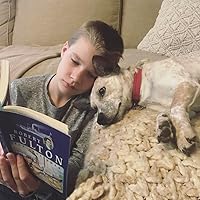
I read this with my son. I’d recommend reading it with your kids if you have a budding inventor on your hands.
This is different from other things I've read of Henry's, but would work well as a beginning chapter book that focuses on the childhood of an important American inventor.
I've always recognized the name of the steamboat inventor through this book's title, but it wasn't until I read a brief history of boats that I wanted to know more about Robert Fulton the person. And when the encyclopedia said Fulton made a submersible named Nautilus, just like the one in Verne's 20,000 Leagues Under the Sea — that's when I knew I had to read this!
This book is about the life of Robert Fulton, a young metalworker from Pennsylvania in the days of the American Revolution. I wish I'd paid more attention to the subtitle "Boy Craftsman," because this book focuses on his childhood. To be more exact, this book chronicles Fulton's life from the ages of 7 to 40... but he's still 17 only three chapters from the end. In retrospect I was more interested in Fulton's later life, during which he travels, learns, invents, supports his family, and meets and works with many other famous people. (Fulton's meeting with Benjamin Franklin makes a lot of sense to me, after reading how useful electricity was for Verne's Nautilus submarine.)
Maybe it's just the career books I've been reading lately talking, but I liked watching Fulton's talents and experiences blend together to yield incredible results! He is clever and resourceful, building what he needs (like a pencil) from whatever materials are around him. And he uses his art skills to draft up designs for his creations. Even at a young age, Fulton had great instruction, through the local smith's mentorship, to mold and hone his abilities. The book lists Fulton's many time-saving devices in one or two places, which I felt gave me a sense of what Fulton must have been like as a person: He's always streamlining processes and boosting productivity.
This book centers on one invention in particular, saying Fulton developed the idea for a steamboat as a boy, after a laborious day of poling a rowboat while fishing for leisure with friends. The book takes multiple perspectives into account when looking at this new form of travel. This technique made the story's conclusion feel open-ended to me; I would ask myself, Was the invention of the steamboat a good thing? It sounded like a disruptive technology that displaced jobs but encouraged others such as building canals. I'd like to know more about it.
And maybe more about the time and place as well. When we visited the Lancaster County area, we saw the Amish. (The Shoo-Fly Pie was delicious!) Similarly, several characters here belong to another peaceful group, the Quakers. But for a time Fulton works as a gunsmith for the Continental Army. I wondered how these contrasting worldviews got along.
In the beginning, young Fulton reminded me of Johnny Tremain. And his industriousness was like Nat's in Carry On, Mr. Bowditch. I've also read a little about Benjamin Banneker and his experiences in astronomy and mathematics. There were some really smart, hard-working people in Early American history!
From bios, it sounds like the author might like animals even more than I do. We both probably squirmed at the part where Fulton uses the family pet as... an assistant. I'd like to try another one of the author's books soon.
This entire review has been hidden because of spoilers.
Robert Fulton was a man of many talents and was credited with the creation of the steamboat.
Jilly - 10/10. Favorite character - Robert Fulton, because he was amazing and craft and intelligent. Favorite part - when he invented the steamboat.
George - 3/5. Favorite character - Matilda the cat, she was the most ragtag cat in the universe. Favorite part - when him and the cat formed a food agreement in exchange for tufts of her fur to create paintbrushes.
Dottie - 4/5. Favorite character - Bob, he is clever and creative and inventive and reminds me of my children. Favorite part - when Bob upgraded his friends fathers boat with a paddle wheel so they wouldn’t have to pole the boat for fishing.
My boys read this for school, we read it together, and the rating is their average. I was surprised it received this high because we had many days the boys were not excited to read it. My 11 year old wanted to give it 5 out of 5 because he liked the adventures Robert Fulton had and the inventions he came up with. My 13 year old wanted 4 out of 5 because it wasn't as good as he expected it would be but he still enjoyed it. My 8 year old gave it 4 out of 5 because he didn't pay as close attention but he liked Robert's little brother, Abraham.
Robert Fulton is a very sweet and kind boy! I love how he is called Bob! You can see 4 pages into the book that he has a learner's heart! (To have a learner's heart is to be eager to learn and do work) I really liked this book because Bob was so uplifting and Marguerite Henry is a very good author!
Okay, I don't know why, but I am SO sad that this book ended! I'm very near to tears!! I literally didn't want it to end!! It was THAT good to me!! I loved it!! I would DEFINITLY reread it again!!
This was such a good book for my son to read. It tells the story of the young boy Robert Fulton, and how resourceful and inventive he was. Bob Fulton kept motivated, and kept persisting no matter the obstacles. All through his childhood, young adulthood, and manhood he worked and invented things to make life better for people, and used his earnings to take care of his mother and siblings. The story was heart warming, inspiring and encouraging.
Biography for young children about Robert Fulton, an early American engineer and inventor who invented an early version of a steamboat that successfully carried passengers from New York City to Albany and back in 1807. This account focuses mostly on his life as a young boy growing up in Pennsylvania in the late 1700s.
A great little biography of the man who invented the first successful steam boat. It was fun getting a glimpse at his early life and other things he invented and did before he because famous.