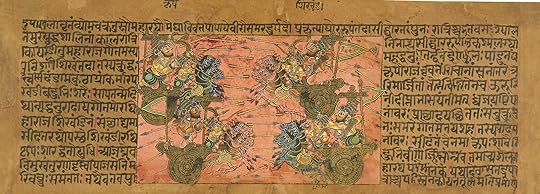
In this cauldron of great illusion, with the sun as fire, day-night as fuel; using months and seasons as stirrer, Time is cooking all beings that is the message. ~Yudhishthira, in the Mahabharata s Vana-parva 313.118
The Mahabharatha never ceases to fascinate. By far the longest of the world s epics, it transcends the limitations of genre. History, encyclopaedia, philosophy, scripture, warrior saga, it encapsulates all these in one exalting epic tragedy underscoring the truth in the ancient adage that the whole knowable world is Vyasa s leftover.
The Great Epic of India encompasses an awesome interplay of human effort and destiny, set against the backdrop of inexorable Time. Marvels and Mysteries, with its lucid and engaging narrative, seeks to unravel some of its enigmas: the characters of Vyasa, Krshna, Yudhishthira, Arjuna, and Draupadi; aspects of the Mahabharatha s historicity; its medley of interpretations; the stupendous text-critical project to sift its perceived accretions; its inter-relationship with the Ramayana and other epics; and its universal relevance brought home through a series of trans-cultural comparisons.
This is the one book about the Mahabharatha which everyone will love to read and gift.
A passion from the depth of one’s soul supported by years’ of study can only bring up such literary works. If Mahabharata is your all-time intriguing tale, this book is sure to add glory to your bookshelf! Marvels & Mysteries of the Mahabharata is thoroughly researched, extensively referenced and deeply analyzed!
This undoubtedly is one of the books I took very long to complete, Abhijit Basu has written a well researched book on Mahabharatha and I was reading and re-reading things to get if I understood the things correctly. Then I was also trying to match this with the story I learnt and was seeing if things were portrayed correctly. So it took quite long time for me to read the book and here I am with my review.
Speaking about his work, the Mahabharata, Sage Veda Vyasa says
“yadihaasti tadanyatra yannehaasti na tat kwachit”
meaning whatever is there in the world it’s here and whatever is not here is not there anywhere. He epic with about 1,00,000+ verses obviously captures the imagination of one and all. Everyone who has read it once would want to understand and learn more about the epic, the lives of those legends and the stories that entwine their lives.
Abhijit Basu, the author of the book also undertook one such journey where he focused on a few people and a few incidents and tried to probe those men and women and their characters a little more deeply. The result is this book.
What did I like in the book ?
The writer has focused on specific people and tried to dig deep into their persona. This is definitely good. He was speaking about Shri Veda Vyasa, Yudhistira,Lord ShriKrishna, Draupadi and the book the Mahabahrata itself. I liked the idea of looking into individuals and understanding the epic through their eyes. While people do a lot of research about Karna, Arjuna , Krishna and various others, very few people would try to understand the role of Veda Vyasa here, the very idea of trying to understand about Vyasa and trying to see as to how many times Vyasa appears in his own narrative was indeed an interesting thought .
The space devoted to Yudhistira and trying to explore the depths of his character was a good attempt. He is definitely one of the unsung heroes of MahaBharata. His resolve for justice and his regards for rules was very well depicted. Bringing out his conversations with Yaksha , the “Yaksha Prashnaas” was indeed good. Then Yudhistira’s conversations with Nahushaa were also included which is a good thing.
Again the various shlokas and the disambiguation of various Sanskrit words was good, when you read it you indeed know that there was some good research done.
The things I did not like
First, while depicting Krishna the author gets into the Aryan Dravidian theory, this theory was a proposition to drive a wedge in the Indian society and is widely rejected. While the author does not seem to side with any of the arguments, he does seem to have drawn a lot from Irawathi Karve’s writings on Mahabharata. I somehow felt a disconnect here. I was looking for the original views of shri Abhijit Basu, not the views of Irawati Karve. I felt a little too much of a space was devoted to the views of her.
Looking at the way Shri Krishna’s persona was handled throughout the book, I have my own reservations, things could have been handled better. There were some fallacies also, Shri Krishna did side with the Pandavas as he wanted victory for the Dharma. At times the narrative feels as if it is against Krishna, though the author does make amends towards the end of the book, you would definitely feel that it is very late and very little. I just wanted to suggest one thing, it was not Shri Krishna who compromised on ethics in the battle, it all started with the killing of Abhimanyu. The way Abhimanyu was killed in an extremely unlawful manner changed the way the battle was fought after that. I did not know why the author did not touch upon this.
We also see that Karna gets his share of adulation from the author, yes definitely Karna was a great warrior, while we all sympathize with him, we also should take into cognizance the fact that it was he who broke Abhimanyu’s bow from behind. It was this act that actually ld to the death of the 17 years old valiant fighter in the hands of 6 atiradha maha radhas. The author should have brought this in to make the book more balanced.
While I do agree that Yudhistira was depicted very well, I also should say that claims that link Yudhisthira and Vidura are too far fetching and could have been avoided. Again this idea comes out as the idea of Iravathi Krave and not that of the author, then why does this have a mention in the book is something I do not understand. The author could have cleared the air on what his opinion on this.
What could have been included ?
I do not know if I can say this as a review, do not know if it is good or not. This is the first time I am writing this sort of stuff in a book review and I believe that this would be taken in the right spirit.
I feel that more content should have been added to the depictions of Draupadi and Shri Krishna. I felt they were touched more superficially. When you try to understand Draupadi, it’s not just the insult she bears in the court that is important, she shows tremendous anger , maturity and temperament when she loses her children. The way she shows all of them after the war and after losing her kids is astonishing. It gives us a deep insight into the heart of that woman who suffered a lot in her life. Same is the case with Shri Krishna, Khandavadahana was one important thing , however the circumstances that led to the war, the role he played there, the role he played as the advisor to the pandavas in the forests, the importance of Bhagavadgita and the way he makes pandavas learn things from Bhishma are all wonderful things that give us insights into his personality. The author could have touched upon these things as well.
Language & Style
The language is definitely high end, you would see a lot of words which make you refer the dictionary. However, seasoned readers would love reading it as it builds your vocabulary. It’s nice to read a book ornated with wonderful words at least once in a while. It makes us smile in happiness and makes us appreciate the author for his/her efforts.
All in all some good amount of research presented , it seems that the author does not give his own stand in some contentious conclusions and passes them as someone else’s views. It would have been great had the author come out clearly on what he thinks on them. It would have been great had some of the biases been removed. Nevertheless, you would get some great perspectives on Yudhistira and Vyasa when you read the book.
I know Mahabharata only through my grandma & DD. But after reading this book, i knew how much more i didn't know about this book.
It has something for everyone who wants to know something about everything.
Lets us look at those somethings
A. Mahabharata talks about ethics in war, a few thousand years before Geneva convention could be codified.
B. It has sci-fi and weapons tech in it. There are references to Brahmastra and its after effects which eerily sound like a nuclear explosion.
C. It talks about philosophy, it also talks about another epic the Ramayana and also includes the Gita.
If i have to talk about the Mahabharata in numbers then it would as follows: An epic which is a minimum of 5000 Yrs old, of atleast 200000 lines minus the supplement called Harivamsa, with a geographic spread of atleast 7 countries in SE Asia, written in 12 different languages, divided into 18 parvas or divisions, the longest being the 12th Parva or the book of peace. Out of which a critical edition or mother of all editions was planned and completed in 50 years which runs to 19 volumes or 13000 pages!!!! Thats a lot. I mean really really lot...
Before i talk about what i liked about this book is this line. This very important line which all the pseudo secularists & Dravidians always conveniently forget or ignorant about.
This was a line quoted by Yudhishthira when he was asked by King Nahusha who is in the form of a serpent and has Bheema in his folds.
"Satyam Daanam kshamaa sheelam- aanrshamsyam tapo daya / Drshyante yatra naagendra sa Brahmana iti smrtah // Vedyam sarpa param brahma nirdukhama-sukhanca yat / Yatra gatvaa na shocanti bhavatah kim vivakshitam //
The crux of the above lines are, the 4 varnas are not permanent and are subjective. A man can be a brahmana and a shudra at the same time. The varnas are not permanent. I really thank the author for this gem.
What i liked about this book
A. It gives facts which i never really thought about earlier. Best e.g. is, what were the questions that Yudhishthira answered that were asked by the Yaksha.
B. The book talks about our epic being an obsession with lot of European orientalists starting from the late 18th century till date.
C. It gives importance to characters who have been given the short hand. e.g. the author Vyasa himself who is the key to the book, Yudhishthira who is talked about very little and Draupadi
D. It talks about history and the antiquity of Mahabharata. How old is it? Did it really happen? Did it happen in India or somewhere else? Two examples given were really interesting
Bheema's lack of facial hair!! He is insultingly called by Karna as Toobaraka!!! Drona talking about his wife and mentioning her as a lady with sparse hair!!!!
I mean they are really inconsequential points while writing the epic. If they were incorporated did this really happen? Makes one wonder.
E. It talks about a critical edition on the epic. This is one information that i never really knew anything about.
Things i did not like
A. The pages and its font are absolutely reader unfriendly. The information is packed and really dense. The paper also could have been a shade lighter.
B. There is dense information packed in each of its pages. The author could have made it into 2 parts or written a longer version.
C. The language used in the book could have been much simpler in some places.
Overall i felt enlightened reading the book that i knew so little about so many things. Humbled. I sincerely thank Parad from Leadstart for this opportunity to review the book.
Please do check out the slideshare. Some interesting pointers.
The first part of the book makes a better reading than the second one. The interpretations drawn by the author about Vyasa are very interesting. So are the interpretations of Bakayaksha's questions and Yudhishthira's answers.
The second part is like a thesis and is too long (as the author himself admits in a chapter). There are so many studies which are quoted in an attempt to pinpoint the date that it all seems a bit boring. Having read Yuganta, one wishes that Basu would've drawn more conclusions by himself instead of oft quoting Karve. (Also it needs some editing to get rid of spelling mistakes/font mismatch)
‘Marvels and Mysteries of the Mahabharata: Probing the Folds of India’s Epochal Tradegy’ by Abhijit Basu seeks to delve into a few of its mysterious facets of the great epic, in turn providing insightful explanations for the assortment of the astonishing incidents and mysteries and in turn shed some light on the widespread significance of the age-old, yet timeless, epic.
A very well researched book with detailed references and notes. The perspectives on Vyasa is in particular interesting. The second half of the book took me longer than the first part as it was a lot of information thrown at the reader. If Mahabharata is one of your favorite epics, then this is a must have on your shelf
Not impressed. The author believe the Aryan invasion theory throughout the book which in fact a rejected theory. I would've given good score if it was minus the Aryan theory