What was it they were battling? Their smallness, of course, their smallness.
d, a nonbinary gig worker living in Seoul, briefly escapes the grasp of isolation when they meet dd, only to be ensnared by grief when dd dies in a car accident. Meanwhile, the world around them reckons with the 2014 Sewol ferry disaster that left more than 300 dead.
As formally inventive as it is evocative, dd's Umbrella is composed of twin novellas. The first is told from the perspective of d, and the second from the perspective of a writer researching a book they may never write. Both figures dwell in society's margins––queer, working-class, and part of nontraditional family structures.
As people across Korea come together to protest the government's handling of the Sewol ferry disaster, and to impeach the right-wing president in office, the novel examines how progressive movements coexist with social exclusion, particularly of women and sexual minorities, invisibilised in service of the 'greater cause'.
dd's Umbrella is a meditative and off-centre novel about mourning and revolution.
When it’s time to go home, they each need an umbrella.
From ‘Didi’s umbrella’ (디디의 우산) from the 2012 collection Pa ssi’s Beginnings.
There is nothing that needs to be said, There is nothing that has to be taught. So full of sorrow and thus beautiful, The dark and intimate animal soul.
dd's Umbrella (2024) is e. yaewon's (이예원) translation of 디디의 우산 (2019) by 황정은 (Hwang Jungeun), and published by Tilted Axis, the fourth of the author's works I've read in translation.
The work consists of twin novellas, 'd' and 'There is Nothing That Needs to be Said' ('아무것도 말할 필요가 없다'), both set in the years around and after 16 February 2014, a date seared into Korean national memory as the 세월호 침몰 사고 (Sewol ferry disaster). Each concerns queer working-class lives against a background of political protest and a growing economy that leaves many behind.
The first, 'd', is narrated from the perspective of d, non-binary and of working-class background, now in their 30s. Their partner, dd, has recently been killed in a bus accident.
In dd, d had found their sacred object. dd was the words that must continue, the body that must remain intact. It was through encountering dd that d learned how sacred their own labour could be. How a person who has love could be beautiful, how one could, simply by finding an object of beauty, experience sadness and joy. The noise that filled the world and occasionally troubled d no longer irked. I want to be happy, d decided. I want to be happier. The life d and dd shared was shoddy, exhausting, and lacking in many ways, but they had their private jokes, their shared laughter and sorrow, their clasped hands. Thumbs tracing knuckles, fingertips caressing napes and knotted shoulders; holding each other's perfectly small and ordinary ears, kissing each other's necks, helping with coat sleeves when the days turned chilly. I'll be happy, d thought. I'll be happy alongside dd's happiness.
The two first met as children at school. Each remembers a particular incident where lightning struck the floor of their classroom in front of their eyes: in dd's memory they and d were their together and walked home, sharing an umbrella, but d has no real memory of dd's presence. And sharing an umbrella was how they re-met many years later and became partners so its symbolism was important to their relationship, and d feels guilt that they can not reproduce the memory that dd wanted to share with them:
d remembers the day, remembers seeing the bolt of lightning strike in front of their eyes. It was an extraordinary thing to witness, unprecedented and as yet unmatched. d remembers the exact shape of the mark, how it resembled a small mouth with an upturned corner. They had assumed the pressure of their fingers would gradually rub it out, but it hadn't. d had looked and looked, completely entranced. Had there been someone else in the room? Possibly. But this is the extent of what d remembers. Apparently the two of them had chatted as they headed home under the same umbrella, but d has no memory of this either. They are gripped with remorse, feeling somehow at fault for misplacing the memory. d has recurring dreams about the day even now.
Another childhood memory for d is the defection of the North Korean figther pilot Lee Woong-pyung, in his fighter jet, to the south in February 1983, one which caused a brief scare that the plane enroaching into the South's airspace was the start of an attack. And key events in modern Korean history are woven through the text of both novels.
I understand this novella draws on two short stories, not included in this text - one also called '디디의 우산' from 2010, and included in a 2012 collection, which introduced d and dd and the shared umbrella, and '웃는 남자' ('The Man Who Laughs') from 2014, which told of dd's death. But the novella presented here is self-contained.
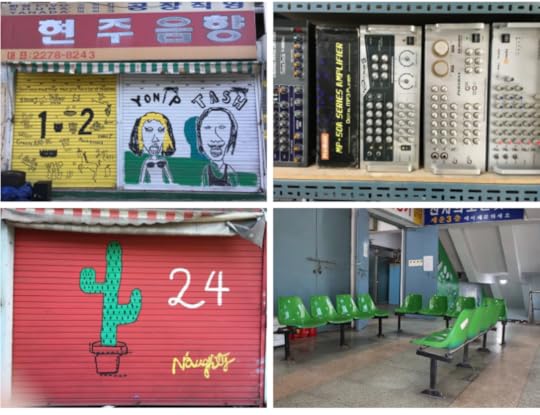
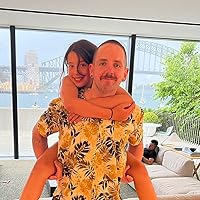
Post dd's death, d is isolated - even objects feel hot to the touch as they are so cold inside. But, they find a job in the Sewoon electronics market (세운상가). The market, or one like it, was also central to 백의 그림자 (One Hundred Shadows in Jung Yewon's translation)
dd's Umbrella is a more realist take that the more dreamlike One Hundred Shadows, but equally powerful in its portrayal of the poorer-side of the booming Korean economy, and indeed the twin threats of decay and modernisation to the once-booming market. But here the focus in particularly on the strong sense of community for those who remain, and which starts to allow d to belong.
d is also caught up, more by accident, in the mass demonstrations (and the aggressive police kettling thereof) for the first anniversary of the Sewol disaster, which was also attended by the narrator of the 2nd section, Kim Soyoung.
The 2nd section takes it's title from (in English Alex Cigale's translation) of an Osip Mandelstam poem. Kim Soyoung is a writer and this novella is narrated in the first person. As a result Kim Soyoung's preferred pronouns are not explicit, but I will use 'she' as Kim Soyoung refers to her partner, Seo Sookyoung, who she has lived with for 20 years, that way and gives no indication otherwise. Kim Soyoung and Seo Sookyoung also live closely with Soyoung's sister Kim Sora and her 5 year old son Jung Jinwon, the three adults resisting the binary confines of gender roles to which Jinwon's teachers subject them.
A connection to the first part is that Soyoung's father owned one of the stores in the electronics market, but here there is a greater focus on both political activism, but also on literature.
Kim Soyoung has eleven manuscripts that have yet to become short stories and one manuscript that have yet to become a novel, all unfinished, largely due to her inability to find a story that doesn't end in tragedy.
Osip Mandelstam was sent to a labour camp in May 1938, during Stalin's Great Purge, after which he vanished without a trace. There are no records to tell us when or how he died. The poetry he wrote had been banned, seized, set aflame, but escaped sinking into complete oblivion thanks to the tireless efforts of his wife, Nadezhda Yakovlevna Mandelstam, who continued to recite and transcribe his poetry from memory Nadezhda Mandelstam did need words. As do I.
I would like to finish one story in which no one dies. What if, were I to eventually get around to doing so, I titled it 'There Is Nothing that Needs to Be Said'? As the story itself will eventually have to die. As it falls out of use and becomes a story that needs no further telling. Is this possible?
Many works of world literature are referred in her story - and I was delighted to see all referenced by their Korean translator as well as the original author, as well as in the English translator's afterword, with the English translation used. This includes a case in the novel where Kim Soyoung questions a Korean translation choice (how to render Hannah Arendt's "banality"), and one in the notes where e. yaewon finds the English and Korean translators have chosen a completely different word for Antoine St Expury's original text ("miserly" vs "fiery" in English). Alongside Arendt and St Expury other key texts, in their respective English and Korean translations, include Olav H. Hauge's poetry, various works by Barthes, Nietzche, Primo Levi, Zweig and Jin-Sung Chun. This a passage on how our narrator purges their ever-growing library within their cramped accommodation:
To decide what to keep and what to throw out, I'll ask myself one question: would I reread it? A simple question but answering it can be a complicated process. Sarah Waters's Fingersmith in Choi Yongjoon's translation and Margaret Atwood's Alias Grace in Lee Eunseon's translation were both wonderful reads for me, but whereas I was content with a single reading of the first book, two readings still weren't enough for the second. Why is this? Why or rather how is it that a book that makes it through this nebulous, unpredictable ritual one year can be cast aside without regret the following year? Kawabata Yasunari held on for several consecutive years until last year when every one of his books were packed up; John Williams and Kim Seung-wook's Stoner barely made the cut last year and wasn't as lucky this time round. What will happen to Sakaguchi Ango next year? Every year there's the added nuisance of books printed on paper so thin the text on the verso and even the next leaf show through, rendering these books illegible regardless of whether I want to read them or not, and of books weighed down with introductions and forewords and blurbs I've no interest in reading. With the latter I have no choice but to tear off the back covers, though this makes them even more unsightly and exasperates me no end, and eventually I'll have to give them up, unless of course I want to hold on to them for a reread, in which case... But enough of that.
But much of the novel concerns the political activism which is key to Kim Soyoung and Seo Sookyoung's life - and the way in which the swell of protest that eventually leads, in the novel's closing pages, to the day the revolution is said to have arrived, 10 March 2017 and the impeachment of the President 박근혜 (Park Geun-Hye), is also exclusionary with the misogynistic language used by many protestors. That the 2022 Presidential elections would see the winning candidate run on an explicitly anti-feminist ticket is an outcome that would not, I'm sure, have been a shock to the narrator of the novel.
A very impressive book - and a late contender for the International Booker.
I really admired the way that this book approached the topics of grief and ambition on both a personal and national scale. As this was the first fictional book that I have read that directly addressed the Sewol Ferry Disaster and the societal unease that followed, this book was SO interesting to read. I also loved the way that queerness as a topic in this was normalised and generally not an entirely defining feature of the plot.
dd's umbrella was a comforting exploration on grief and loss through the lenses of the minority group. Told through two stories/two novella of non-binary group from the first story titled dd's umbrella and the 2nd story on There is Nothing to be Said. With focus in political views on South Korea's government, the sinking Sewol Ferry Tragedy in 2014 and what led to the biggest demonstrations to usurp the President of the country back then to the discrimination faced by queer people.
dd's umbrella was a quiet, melancholic narrative of d whom lost their partner, dd to a car accident and how they struggled to confront the reality of losing someone they loved, the solitude and emptiness, a presence to be missed and the reality faced by non-binary people. There are views on the political sides of the story which talked about the demonstrations during the 80s of student protests and how the government tackled these youngsters by violence & force. The blunt truth of police oppression, corruption to silence these students whom seeked for justice and freedom. South Korea is a developing country, proud of their democracy and one of the most advanced country in technology but behind this, there are history of student demonstration and protests, police brutality that kept buried underneath. Without these kind of stories that reminded the society again and again of what their scarifices were, there are no success without the hard work, no advanced civilization without blood and tears.
Stepping into a direct lens of Sewol Ferry tragedy in the 2nd story, I appreciated the highlight on this event and the unity of these people to bring justice to a horrible tragedy. Im also angered by the misogyny in this one as its terrible, disgusting how women are treated as such in a scoiety that demand respect but never give one to the women. Our narrator struggled dealing with sexual harrassment, discrimination and the rising argument to defend themselves gets clouded by other factors and also by gender. So much to dissect about the book but let me say, its such a unique book that filled with literary references and said about feminism which I appreciate a lot
Absolute catnip for me - interlinked stories of urbanism, class, books and gender politics, centred around a famous dilapidated Brutalist megastructure - but beautifully, subtly told, so I'm sure it can be enjoyed by people for whom that description isn't an instant hit.
It is moderately evocative in the first half but gives way to a certain unfocused autofiction towards the end. I appreciate its very clear dedication to depicting the lives of those seeking revolution but it isn't especially engaging towards that end, and the two separate stories are mostly incongruous. The first section is superior by a mile, and the second harps on certain motifs (the sum of sentences written before us, eg) that don't seem particularly illustrative. It was a worthy read and short enough, but not my fav. I also don't think that it treated grief in a way that wasn't simply incidental. Good prose and imaginative use of the form, but not amazing
Hwang Jungeun’s dd’s Umbrella is a compelling and emotional read that shines a light on the nonbinary experience within contemporary Korean society. The novel is presented as twin novellas, each offering a unique perspective on grief and societal upheaval.
The story follows di, who is deeply affected by the sudden death of their partner, dd, in a tragic bus crash. As di struggles with their loss, they are also surrounded by the national shock over the MV Sewol ferry disaster, which claimed many lives, including numerous students. The impact of this disaster on the country’s political climate adds another layer to di’s grief.
The second novella shifts to an interested writer exploring the lives of marginalized individuals. Her research, influenced by various philosophical and literary texts, mirrors the broader societal quest for justice and change in response to the disaster.
Jungeun’s writing is beautifully spare yet powerful, creating a vivid contrast between the personal and political aspects of the story. While the novel sometimes delves into abstract territory, its emotional depth and social commentary make it a standout piece of literature.
Overall, dd’s Umbrella is a poignant and important work, offering a rich exploration of both individual and societal struggles. It’s a significant contribution to contemporary literature, deserving of its recognition and praise.
Thank you Pansing for sending me a copy in exchange for honest review.
Twin novellas composed in a societal, political and familial backdrop with its hue on human connection/interaction, queer and lifestyle— bit taut to me with its melodrama prose but loving the exploration and how the main characters narrated and executed their tales.
📖d (3.7/5*) Of loss, grief and longing that was crafted in a working class setting with relationship and friendship arc. I followed d in a mourning and solitude vignette after losing a partner, dd in an accident; a day-to-day fragment of reminiscing (loved that scene about dd’s umbrella) as well surviving the present and coping with the silence in their home. Loved that glimpse of the Mok-2-dong neighbourhood; those people and their life struggles as well how d’s story intertwined with an affecting perspective from the Korean War to the chaos of South-North conflict in the 80s and the post-Sewol tragedy in 2014. On realisation, one’s acceptance and a will to live; having an abrupt ending to me but fairly enjoyed it anyway.
📖There Is Nothing That Needs To Be Said (4/5*) Favouring this plotline more as it was narrated from a writer; Kim Soyoung who was trying to write a story with a plot of no one dies. A devastating perspective that relates too much with Sewol incident and its post-tragedy movement. Quite descriptive, political and familial driven with that peek on its queer, misogyny issue and mistreatment (my rage reading about K) as well its societal unease but truly love Soyoung’s assertive character and way she linked her tale back to that ‘no one dies’ motive. Loved those literature refs in between, her relationship with Sookyung and the gripping ending scene of how a day should be recalled.
*both stories having without quotation marks structure but the first one can be a bit confusing at first for its gender-neutral pronouns
(Thank you Pansing Distribution for the gifted review copy!)
First and foremost, this is a very politically charged book that highlights and emphasizes various real atrocities where in which police brutality, demonstrations, genocide, and moments of political unrest are remembered, not just in Korea but also in Europe. I wouldn't recommend this book highly unless a political deep dive is what you are looking for, and knowing the city of Seoul would also be beneficial to reading this, as there are many long descriptions of streets and squares and rivers in the city.
dd's Umbrella is comprised of two novellas, where gentrification plays a bigger role in the first one, but also highlights grief, loss, purpose, and mourning. The second novella, the clear standout in this book, takes a more non-fiction approach to its prose, but weaves in some dazzling reflections on misogyny, homophobia, workplace harassment, and disability.
The main reason the first novella worked less for me is because I thought it had too far many meandering descriptions of buildings and passageways and shops, alongside their contents. If I hadn't read One Hundred Shadows by the same author, I probably wouldn't have cared as much, but the themes between both books, at least regarding gentrification and the damning effects on small businesses in the ever-expanding Seoul, were handled better in her debut novel.
The second novella just included much more of a personal touch that resonated with me, even while it expounds on real political attacks with references to news articles and books. It's intellectual and artsy fartsy at times, but it was a wonderful experience. Hwang Jungeun is a great writer, and you can tell a lot of her personal experiences went into this book. Not for everyone, but a good book.
i really enjoy hwang’s writing. dd’s umbrella is two novellas that, in different ways, present the lives of ordinary people living in south korea. there are a lot of interesting observations about certain moments in south korean history and i learnt a lot from reading this. read in seoul, october 3025.
Such an interesting combination of two novellas in one book. Part One follows the titular characters d and dd, their love story and d's grief after losing dd - the sombreness really hit the right notes for me, and e yaewon's translation is simply beautiful. Part two is a novelist's attempt to finish writing a manuscript, while reflecting on her research, love life, queerness, ageing, and so much more - quite a surprising shift from the first half, but nevertheless interesting and happy to have read it.
There’s two novellas inside this collection: I’d give ’dd’s Umbrella’ 3 stars and ’There Is Nothing that Needs to Be Said’ 4 stars…so the whole collection is the average of that.
I was more interested in ’dd’s Umbrella’, but unexpectadly I actually liked it less than the other novella. The story felt very disjointed and even though d was supposedly the protagonist, the story concentrated a lot on people around them. I don’t even mean dd (from the story’s title), but other people connecting with d, who is struggling with loneliness and grief. The story ends very abrubtly and I didn’t feel it had a complete arch.
’There Is Nothing that Needs to Be Said’ was a real suprise, though! I didn’t have sny expectations for it, which is probably why it failed to disappoint me. The story felt extremely real and it made me wonder, if it is actually autofiction. I reminded me so much of ’Fair Play’ by Tove Jansson: it was full of snapshots of a sapphic couple (where the POV character is an author) living their life together, figthing against the norms of society in the smallest ways possible.
The second novella is also about resistance and protesting, even when everything is or feels futile. There is a mention of Palestine and the atrocities of the state of Israel, but it’s mostly about the student activism and the Sewol ferry disaster protest. The story ends in the most stomach dropping way, even though I know Korean history enough to know what happens after.
I preferred the second of these two novellas but felt throughout the limitations of its first person narrative. Its intriguing hinterland - queer family and the history of the Korean left - was done a disservice by an insubstantial and unfocused narrative voice. The first novella to me felt formally incoherent more than it did experimental. A shame!
This latest work of Hwang Jungeun translated to English consists of two novellas, and unfortunately neither of them was to my taste. The first story, "d," struck me as a lesser version of Hwang Jungeun's previously published novella One Hundred Shadows. Both stories focus on Korea's working poor, with magical realism used so sparingly that you wonder if it's magic at all, and the setting of the market in each work was very similar to the point where I wondered whether they were supposed to be the same location. Because of this, however, d lacked novelty compared to One Hundred Shadows, and I also disliked the tone. This is a darker work, lacking One Hundred Shadows's undercurrent of hope and a message that joie de vivre is possible even among society's less fortunate. Replacing this is a greater focus on loss, both of individuals and of community, with its main character never coming to terms with such loss (at least that's my interpretation). d also felt less complete than One Hundred Shadows, and I finished the novella still unclear as to the role of the sound system, especially given the ending.
The second novella, There is Nothing that Needs to be Said, is certainly distinct from the other works by Hwang Jungeun that I've read, focusing much more on the struggles of being a woman (and non-heteronormative) in South Korea, as well as centering on contemporary political events explicitly instead of implicitly. Unfortunately, the stream of consciousness writing style of this novella is one that I almost never find enjoyable, and There is Nothing that Needs to be Said is not an exception. The main character's narration jumps from topics as diverse as John Williams’ book Stoner, to the anime The Sky Crawlers, to the Hansen Writing Ball, before its climax focuses on the Sewol ferry disaster and the impeachment of President Park Geun-hye. As someone with only a passing familiarity with these contemporary events it was difficult for me to parse some of the nuances of this ending, though of course it would have made little sense for Hwang Jungeun to explain these events given that the vast majority of her readers undoubtedly already knew all about them.
Since I found half of dd’s Umbrella to be a less-successful version of another work by Hwang Jungeun, and the other half to be written in a style I did not enjoy, this collection didn’t do much for me. I can easily recommend One Hundred Shadows, so if you haven’t read that one consider picking up a copy. However, I’d only recommend you to consider reading dd’s Umbrella if you’ve already read One Hundred Shadows and want more in a very similar vein. 3/5.
This was a bit of an unusual book to read, the main reason for its unusualness being that it’s two novellas that are loosely connected primarily by modern South Korean history and politics (especially with how it takes place around the time the Sewol ferry disaster happened in 2014), but also by grief, both personal and national. In addition to the unusual setup, I found that this was a rather dense book to get through due to its politically charged nature, which I admittedly didn’t anticipate. Much of it is commentary on modern-day South Korea, so much so that it would be helpful for the reader to have some prior knowledge of what happened in the 2010s to really understand the gravity of the situation. It was also interesting to center queerness in this book, as it added a distinct perspective to how these characters were making sense of what was happening around them.
Between the two novellas, I found the second one far more compelling, perhaps because I thought it was clearer and more grounded. The first novella (‘d’) was interesting enough, and I especially appreciated how Hwang explored themes of loss and grief (particularly the personal), but there was something about the way it was written that I struggled a bit. As for the second novella (‘There Is Nothing That Needs to Be Said’), I was intrigued by how Hwang approached themes around resistance and grief (particularly the collective). I liked how she wove in news articles and quotes from various works of literature to craft Soyoung’s distinct way of seeing the world and how they tie to the political unrest happening right outside their door. More than anything, though, I thought the ending was haunting, especially considering what followed after the impeachment of President Park Geun-Hye (i.e., the 2022 presidential elections).
I think this is a book I’d like to revisit in the future, because I feel that I didn’t fully appreciate it to the extent that I could have on my first readthrough. There was a lot of information to chew on, especially given the political content.
Hwang Jungeun has created a remarkable work of literary art that demonstrates her extraordinary ability to find profound meaning in the lives of society's outsiders. These two interconnected novellas showcase the author's distinctive voice and her talent for creating what can only be described as tender, spooky portraits of characters existing on the margins of contemporary Korean society.
What makes this collection particularly compelling is Hwang's masterful use of setting and context. The old-fashioned, nearly empty electronics market in Seoul serves as both a physical location and a powerful metaphor for obsolescence and persistence, while the backdrop of national tragedies—a deadly ferry disaster and political upheaval—creates a haunting atmosphere that permeates every page. The author's ability to weave together personal and political narratives demonstrates her sophisticated understanding of how individual lives intersect with larger historical forces.
The first novella's portrayal of d and dd's relationship is especially moving. Hwang's description of their "shoddy, exhausting" yet ultimately happy life together captures the complexity of queer love with remarkable authenticity and emotional depth. The author's unflinching examination of how joy and hardship coexist in marginalized communities feels both specific to Korean society and universally resonant.
Perhaps most powerfully, Hwang explores the fundamental question of how we create meaning in the face of both personal and collective trauma. The second narrator's struggle to write "a story in which no one dies" while caring for her sister's child becomes a beautiful meditation on hope, creativity, and the possibility of imagining better futures. The recurring question "How will today be remembered?" transforms what could have been despair into a profound reflection on memory, witness, and the stories we choose to tell. This is essential reading from one of contemporary literature's most distinctive voices.
Korealainen yhteiskunta on yhä varsin perinteinen ainakin Suomeen verrattuna ja esimerkiksi seksuaali- ja sukupuolivähemmistöjen oikeudet ovat heikot. Myös vanhempien ihmisten köyhyys on suurinta OECD-maista juuri Koreassa yhteiskunnan tuen vähäisyyden takia. Hwang Jungeun on käsitellyt romaaneissaan yhteiskunnan muutosten vaikutusta huonompiosaisiin sekä vähemmistöihin ja tässä kaksi laajaa novellia sisältävässä teoksessa ollaan samojen teemojen äärellä. Novelleja sitoo toisiinsa vuonna 2014 tapahtunut Sewol-lautan tragedia, jossa kuoli yli 300 ihmistä, pääosin kouluikäisiä lapsia.
d on muunsukupuolinen, työväenluokkainen aikuinen, joka on parisuhteessa dd:n kanssa. Kun dd yllättäen kuolee liikenneonnettomuudessa, d putoaa tyhjän päälle. Kuka kuuntelee ja kannattelee ulkopuolista yksinäistä? Teemoina myös entisaikojen yhteisöjen rapautuminen, köyhyys, musiikki.
Toisessa novellissa päähenkilö kirjoittaa kirjaa, joka ei välttämättä tule koskaan valmiiksi. Kuvatuksi tulee häneen ja hänen naisystäväänsä kohdistuvia ennakkoluuloja, siskonlapsensa vimmaista sukupuoliroolittamista päiväkodissa, sukupolvien välistä kuilua, köyhässä perheessä kasvamista ja mielenosoittamista tärkeiden asioiden puolesta.
Arvostan kirjallisuutta, jossa nostetaan esille niitä tahoja, jotka eivät nykymedian menestyspainotuksissa pääse esille. Oli sitten kyseessä romaani, novelli tai tietokirja, kaikki laajentavat käsitystä siitä monimutkaisesta maailmasta, jossa elämme. Siksi voin suositella kaikkia Hwang Jungeunin kirjoja, sillä näin korealaisen "soft powerin" aikana tällaiset tarinat usein jäävät kertomatta.
#BookReview : Dd’s Umbrella - Hwang Jungeun; translated by E. Yaewon
d : narrated from d’s pov, a non-binary character with a working class background who recently lost their partner, dd in an accident. the story delved on d’s grieving state and exploring their surroundings. it goes in a non linear style, shifting between glimpses of their childhood memories with dd and reflection on SK’s political situation in the past. This narrative style kinda disorienting at first, requiring me some time to adjust 😮💨.
the novella vividly portrays the working-class background of 🇰🇷people, detailing their struggles, work, and daily life in an atmospheric and detailed manner. despite this, the story retains a dreamy, melancholic tone—likely reflecting d’s emotional state throughout.
there is nothing that needs to be said : i actually appreciated the second novella more for its clearer and more straightforward storytelling. it follows three adults as they reflect on their past experiences, transitioning from girlhood to adulthood, while rejecting traditional gender roles. the novella confronts the hideous misogyny prevalent among South Korean men—ugly, perturbed, and alarming.
the narrative also includes a wealth of world literature, such as Arendt and Saint-Exupéry, primarily in connection to political activism.
both novellas are influenced by the government’s handling of the 2014 Sewol Ferry Disaster, resulting in an angrier, more tense tone that intertwines with the lives of marginalized people in 🇰🇷.
The first novella was pretty good. It took me a chapter or so to get into it, and the ending was really not an ending at all, but it reminded me of Shin Kyung Sook's I'll be right there, which I enjoyed. Probably a 4 star read.
The second novella dragged. I'm not interested in stories about writers anyway and this one felt endless. I almost dnf'd multiple times. None of the musings of the main character were interesting. It was cool to learn about the protests but that's about the only appealing aspect. It's probably a 1 star because if this wasn't in the same book as the first novella I would've dnf'd it.
The following words might offend some so please know I don't care. I ended up ripping this book in half. I'm only keeping d and discarding the second novella. I've only done this once before, with a poetry collection of 3 different poets, and I never regretted my decision so I'm sure I'll live happily keeping half this book.
I am torn what to give this. Maybe a 2,5 rounded up to a 3.
This is an interesting book. There are two novellas, and both have queer protagonists. It covers protests in South Korea, homophobia, misogyny, ableism, and war. It is also about grief. In the first novella a nonbinary person is grieving the death of their partner, and in the second novella the narrator thinks about what will happen if she or her partner were to die, since they are unable to get married. (It would be great if people didn't have to get married at all, but unfortunately that's not the world we live in.) Also I really liked when the narrator in the second novella questions how people determine what is "common sense." The only thing I didn't like about this book is that there are no quotation marks when people are speaking. Overall I really did like this book and would recommend it to people
This short book is really two novellas translated from Korean by a publisher seeking to bring more disparate voices to wider audiences.
The first story is about dd's umbrella, and is a beautifully written story about love and loss between two non-binary people in Seoul. The umbrella is what's left behind, and the story is an exploration of how things get left behind. It also explores the question of love and grief and loneliness.
The second story is tangential to the other story and follows the path of two people whose long term relationship doesn't fit in neatly with society. Sometimes they are invisible, and other times their visibility endangers them.
DD's Umbrella tells a story about an individual korean's life that has already been affected and continues to be affected by collective grief. It presents twin novellas from the perspective of two distinct narrators. The novellas communicate how today could be easily forgotten or come to be immensely meaningful, but will be lived either way.
everything mcm random ehy tiber but i love the issues mostly. relatable to local more regarding their country. tapi love betul writing ehy cerita pasal common sense berpage-page pun sedap je aku baca. cuma part their/they i is confused skit lps tu okay dah. 😂
Hwang Jungeun’s subdued prose, in Emily Yaewon's careful translation, is as captivating as always—and her world as rich and her characters as compelling. This is perhaps her densest novel yet, and I’m sure I will have to go back and re-read it when I have more attention to spend on its intricacies.